Radiation Cats: The Bizarre Idea To Turn Felines Into Living Nuclear Waste Detectors

How do you ensure people will heed warnings to steer clear of nuclear waste storage sites thousands of years in the future? One outlandish proposal involves genetically engineering domestic cats to glow in the presence of radiation.

Imagine you’re a person living five thousand years downstream.

Maybe civilization collapsed and restarted, maybe records were lost, or maybe like Etruscan, Harappan and proto-Elamite, the languages we speak today will be long forgotten.

At any rate, if you discover a forceful warning left by your ancestors from the deep past, would you understand it without translation or cultural context?

And if you’re the one tasked with leaving the message, how would you do it?

The message has to be enduring. It must be recorded in a format that will withstand the tests of time, conquest and natural disasters. The message must be comprehensible without cultural context, because we have no idea how language will shift in the future or whether our descendants will enjoy the knowledge that comes with continuity of records.

Lastly, the message must be both compelling and absolute in its meaning, because its content is vitally important: This site contains nuclear waste. Do not under any circumstances excavate or disturb the contents of this facility. It will lead to sickness, suffering and death.

The traditional trefoil warning sign is unlikely to scare anyone off. The new radiation hazard sign, right, seems unambiguous, but so do warnings on Egyptian tombs.

How do you phrase that in a way our naturally curious species will heed the message?

We certainly didn’t heed the warnings on the tombs of King Tut and other pharaohs. For all we know, humans of the future might believe the hidden chambers deep in Yucca mountain or buried 3,000 feet underground are filled with fabulous treasures and wonders beyond imagination.

They might interpret the warnings as superstition, meant to ward off looters, “grave robbers” and anyone else who might be motivated to break in. They might see the care and effort that went into encasing the objects and conclude there must be something very much worth preserving inside.

Or they might be driven by simple curiosity, as so many human endeavors have been.

A tour group visiting the incomplete Yucca Mountain nuclear waste storage facility. Credit: Daniel Meyer/Wikimedia Commons

Arguments about how to warn the future are at least as old as the Manhattan Project (1942) and the first nuclear power plants (1954 in the USSR, 1958 in the US), but there weren’t serious efforts to come up with a plan until the 1970s, when scientists, historians and other thinkers began to engage in formal efforts to find a long-lasting solution.

Some of the ideas are boring, some are impractical, and some are absurd, like an idea to create a “garden of spikes” atop nuclear material waste sites, to discourage people from settling in the area or excavating.

Unfortunately, one idea that’s still being kicked around is the concept of the radiation cat, or raycat.

Knowledge and language may be lost to history, signage may be destroyed, physical obstacles may be removed. But one constant that has endured, that has seen empires rise and fall, and has existed long before Stonehenge and the pyramids of Giza, is the human relationship with cats.

They’re now valued as companions, but we still use them as mousers on ships, in heavily populated cities, in ancient structures and on farms and vineyards.

They’re embedded so deep into our cultural psyche that it would not be outlandish to think the archaeologists of the future may conclude the internet was constructed primarily to facilitate the exchange of images of cats.

Even the first high-bandwidth deep space transmission was a video of a cat, so in a very real sense, the dawn of a solar system-wide internet was heralded by an ultra high definition clip of an orange tabby named Taters, beamed back to earth from the exploratory spacecraft Psyche, which was 19 million miles away when it transmitted Taters on Dec. 11, 2023.

Consider also that the basic felid body plan — shared by domestic kitties, tigers, pumas, black-footed cats and the 37 other extant species — has barely changed in 30 million years, because cats are extremely successful at what they do.

In other words, cats aren’t going away, and domestic felines have a place in every human society.

So philosophers Françoise Bastide and Paolo Fabbri conceived of the “living warning” in 1984. The idea is to alter the genetic code of felis catus so that the animals glow or change color in the vicinity of nuclear waste, using minuscule levels of radiation as the trigger.

There are natural precedents for this, including bioluminescence and several species of octopus that radically change colors and patterns on their skin to evade predators.

The second component, once the genetic code has been altered, is the creation of folklore: songs, stories and myths that will endure through time, warning people to keep cats close, treat them well, and run like hell if they change color because it means something terrible, something evil beyond imagination, is nearby.

To ensure the folklore of feline Geiger counters endures, an idea by linguist and semiotician Thomas Sebeok would be incorporated. Although empires and states rise and fall, there’s one organization that has survived for 2,000 years preserving a unified message: the Catholic church.

Sebeok proposed an atomic priesthood, an order that would pass the knowledge down through generations, continually seeding culture with stories and songs of glowing felines.

Spent nuclear fuel rods are stored in on-site pools at the facilities where they were used, but pools are meant only as temporary storage solutions. Credit: Wikimedia Commons

If this stuff sounds wacky, that’s because it is. We won’t figure out a way to ensure a message is received and understood thousands of years in the future without considering some off-the-wall plans.

Of course messing with the genetic code of any animal raises serious ethical questions.

We don’t have the right to play God and tinker with the genetic code of extant species. We don’t fully understand the immediate consequences for the health and happiness of cats, and we know almost nothing about the long-term effects on the species.

I’d also argue that we have a special relationship with cats and dogs, one that exceeds any obligations we may feel toward our primate “cousins” or other non-human animals.

Cats and dogs have been living with humans for a combined 40,000 years. They have been molded by us, they are dependent on us, and all that time in human proximity has led to unique changes.

No animals on this planet can match them when it comes to reading human emotions. Our little buddies pick up on our emotional states before we’re consciously aware of them partly because of their robust sensoriums, and partly because as their caretakers, our business is their business.

A clip of a cat named Taters was the first data burst transmitted to Earth using NASA’s upgraded deep space network. Credit: NASA/JPL

We bear a responsibility to both species and the individual animals. It’s not just the fact that without them, our lives would feel less meaningful. It’s the indisputable fact that without them — without dogs who flushed out prey on yhr hunt and guarded small settlements, without cats who prevented mass starvation by hunting down rodents — we would not be here.

Cats and dogs play a major role in the story of the human race. We are indelibly linked. Their DNA is not ours to tinker with, and they are not tools we can repurpose at our convenience.

Thankfully the US Department of Energy has never endorsed the concept of raycats. While there is a website advocating for a raycat program and small groups around the world dedicated to its propagation, the interest is mostly academic.

The Raycat Solution, which maintains a site dedicated to the idea, has a FAQ which says its supporters are serious about its potential usefulness, but for now most experts see it as a thought experiment and reminder that the problem must be dealt with eventually. At some point NIMBY will have to yield to reality, and wherever the US ends up storing nuclear waste, it’ll need to be secured, sealed and marked.

The goal is for the message to endure at least 10,000 years, at which point scientists say the radiation will be minimal.

That’s assuming that the future holds the collapse and rebuilding of human civilization, or at least a technological backslide in which the majority of our species’ knowledge is lost.

We like to think things will be brighter than that and instead of glowing to warn people of danger, cats of the far future will be where they belong — with their human buddies, exploring new frontiers on starships with plenty of comfortable napping spots.

Header image depicts the Alvin Ward Vogtle Nuclear Power Plant in Georgia, the largest nuclear plant in the US. Image via Wikimedia Commons/NRC

[1] The nuclear waste storage facility at Yucca Mountain was initially funded and approved by congress in 2002, then was canceled and de-funded in 2011 after significant pushback from people who live in Nevada, along with their representatives in congress. Plans for the site have changed several times in more than two decades, leaving the US with no central, secure site to store nuclear waste.
The Latest Influencer Trend Puts Unfair Expectations On Felines

Cats aren’t equipped to use human language and there’s nothing wrong with that. Our feline friends already go to great lengths to communicate in ways we can comprehend. The least we can do is meet them halfway.

I would love it if my cat could talk to me.

Sure, he never shuts up, but if he could speak English I’d know why he meows at the same spot at the same time every morning, or what he wants on the occasions when he’s still meowing insistently at me despite the fact that his bowls are full, his box is clean, he’s had his play time, and every possible need and want of his — that I can fathom — has been met.

Most of all, I’d really like to know he understands I’ll be back soon when I go away for a few days, and my (mostly ignored) pleas for him not to attack his long-suffering, way-too-kind sitter.

Alas, Bud cannot speak. No non-human animal has ever demonstrated even basic proficiency in human language. People will point to examples like Koko the Gorilla and Nim Chimpsky, but there’s a reason why funding dried up for that kind of experiment.

It doesn’t work. It never did.

The scientists who end up taking on dual roles as researchers and parents to the animals invariably serve as interpreters, get too close to their subjects and swear that a gorilla pounding shiny buttons for “food tree food submarine” means the ape wants to have a picnic next to the ocean, or “car fly house car star” means she wants to ride a Tesla Roadster to Mars and start a colony with Elon Musk.

koko

Koko, Nim, Chantek and the other apes who were the subjects of decades-long attempts to humanize them — and teach them language in the process — were ultimately not much different than Clever Hans the horse, who was reading subconscious nonverbal cues from his owner and convinced tens of thousands of people that he could do math and understand spoken language.

Hans had scores of experts fooled until the German psychologist Oskar Pfungst figured out how the horse was coming up with the correct answers.

Regardless of which famous example we’re talking about, no animal has ever mastered syntax, and the best that could be said of their proficiency with language, or lack of it, is that they learned they’d get attention and food when they pounded on a talking board or approximated a word in sign language.

Even if non-human primates were able to learn a handful of words by frequently reinforced association with an object, there has never been any evidence that they are actually using the words as language rather than simply understanding “Pushing the button that makes this sound means I get a treat!” (And yes, there is a profound difference. The former reveals the presence of cognitive processes while the latter is a conditioned response.)

Despite decades of intense effort, no animal has ever demonstrated the ability to use human language. At best an animal bangs on a few buttons and people are left to speculate on the intent. Maybe Fluffy likes the way a certain word sounds. Maybe it’s just fun to hammer on buttons the way it’s fun to pop bubble wrap. Most likely, these cats and dogs know that using a talking board is a guaranteed way to get attention, a treat and a head scratch from their caretakers.

Influencers and their talking boards

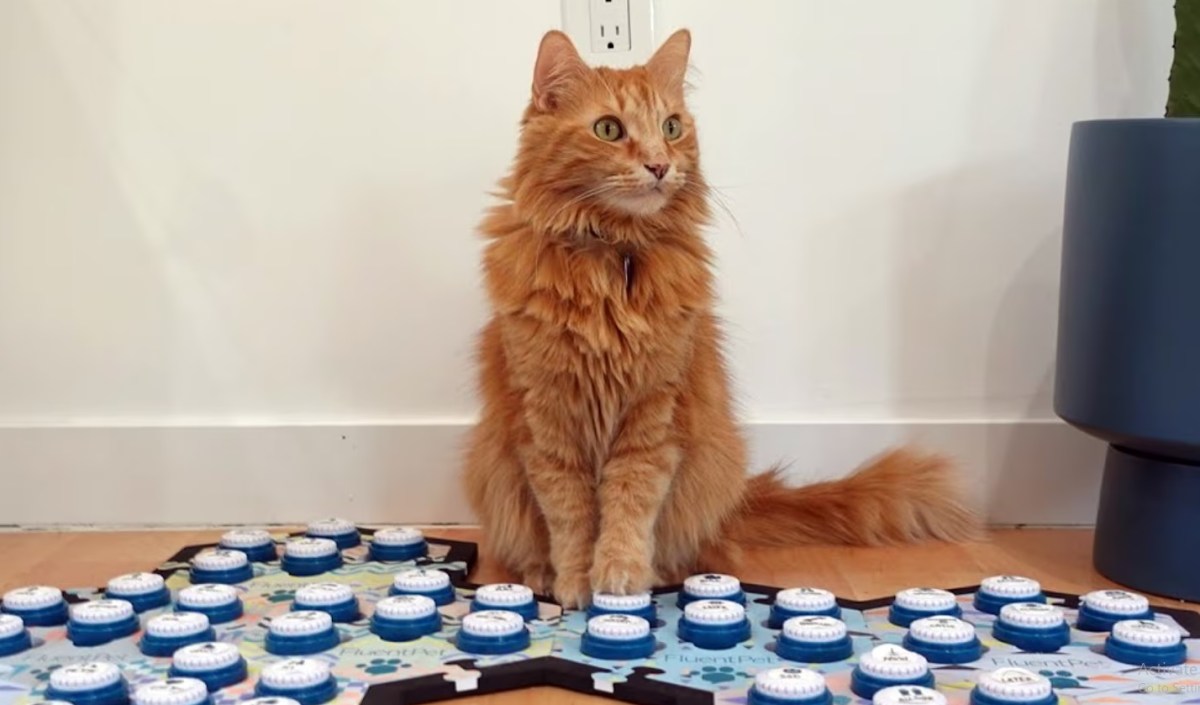
TikTok, which spawns inane trends with the reliability of an atomic clock, has provided a platform for people who insist their cats and dogs can talk. Using “talking boards” — elaborate set-ups in which words are assigned to their own buttons — they “teach” their cats how to express themselves in English and provide proof in the form of heavily edited, out-of-context clips that require the same sort of creative interpretation pioneered by Penny Patterson, Koko’s caretaker.

billiecattalk
Seriously?

I just watched a video in which a woman claims her cat, named after Justin Bieber, was describing an encounter with a coyote by stomping on buttons for “stranger,” “Justin,” “Mike,” and “stranger.”

The woman says she thought Justin was asleep at the time, but now she believes the orange tabby saw the coyote outside and was still stressing about it well into the next day.

While she’s repeating Justin’s “words” back to him, two of her other cats come by and step all over the talking board. I guess whatever they had to say wasn’t important.

Justin’s talking board has 42 buttons, which stresses credulity well beyond the breaking point. More than half of the buttons are used for abstract concepts.

@speaking_of_cats

⚠️TRADE OFFER⚠️ Jackson recieves a brushing, Mom recieves 10 I Love You’s #fluentpet #talkingdog #talkingcat #cat #catsoftiktok #catlover #cattok

♬ original sound – Jackson the Cat

But forget all that for a moment and ask yourself how our own efforts to decode the meow have been going.

Despite our status as intelligent, sapient animals, despite the powerful AI algorithms at our disposal, despite the benefit of being able to digitally record and analyze every utterance, we haven’t come close to a reliable method for interpreting feline vocalizations.

Likewise with dolphins, whale song, corvid calls and the sounds made by other animals at the top of the cognition pyramid.

Mostly, we’re learning we’ve underestimated the complexity of our non-human companions’ inner lives, especially when it comes to the kind of multi-modal communication humans also engage in, but only subconsciously. We say what we want with our mouths, while our eyes, facial expressions and body language say what we’re actually thinking.

Likewise, the meow is an unnatural way for cats to communicate, and it contains only a fraction of the information cats are putting out there. It’s just that we can’t reliably read feline facial expressions, let alone tail, whisker and posture. (Studies have shown most of us, even when we live with cats, don’t get measurably better at this. In fact, we’re often no better than people with limited feline experience, but we think we’re better.)

Putting the burden on our furry friends

If we can’t crack a simple and limited system of vocalizations, aren’t we putting unrealistic expectations on cats? The average person has a vocabulary of tens of thousands of words, yet somehow we expect cats can latch on to an arbitrary number of them, approximate mastery of syntax that has eluded even our closest cousins, and bridge a cognition gap we haven’t been able to bridge ourselves.

It’s all too much.

There’s a simple truth at the heart of this: Cats did not evolve to speak or parse human language, and that’s perfectly fine.

The little ones already meet us more than halfway because they understand we are hopelessly incompetent at reading tail, whisker or body language, and they understand we communicate with vocalizations.

By forgoing their natural methods of communication in favor of ours, cats are already taking on most of the burden in interspecies communication. Asking them to do more than that, to learn many dozens of words and the rudimentary rules of language, seems like laziness, wishful thinking or insanity on our part. Pretending that certain cats are successful is an exercise in the same kind of cynical opportunism that fuels every other desperate attempt by people trying to turn their pets into influencers. People do it because the reward is money and attention.

catboard

Worse, it contributes to the spread of misinformation. TikTok’s talking board videos routinely net millions of views, converting a credulous audience into an army of true believers who are convinced that, with just a little effort, their feline pal can shoot the shit with them.

If people want to construct elaborate talking boards in their homes and pretend their cats are expressing themselves in English, who am I to object? It’s not the smartest use of time, but have at it. What I won’t do is participate in the delusion that felines are a few buttons away from being able conversation partners, nor will I pretend these efforts have any relationship to science.

So to the journalists who keep writing credulous stories about these supposedly talking animals: please familiarize yourself with the example of Clever Hans, and please, I beg you to stop promoting these videos as if they’re anything more than wishful thinking. You are doing your readers a disservice for the sake of a few clicks.


Note: Jackson Galaxy isn’t a fan either, saying he’s “got some serious problems” with the talking board trend. Calling it “problematic,” he points out that cats are not only partially domesticated and the only animal species in history to take that step without human prompting, but humans have never selectively bred cats for specific behaviors or to bring out intelligence traits as we have with canines. (Think of sheep dogs or retrievers, who are the products of thousands of years of breeding for well-defined tasks.) There simply hasn’t been a need to breed cats for behavioral traits since the thing humans traditionally valued most about them — their ability to reliably eradicate rodents and protect human foodstuffs — is innate. No one had to teach cats how to hunt or breed them for the task. It’s only in the last two hundred years or so that certain human societies began breeding cats, and they did so for aesthetic attributes like coat patterns. Galaxy also notes that animals do not express emotions the same way humans do. Like monkeys, who “smile” when they’re terrified, felines express joy, anger and fear with their tails, whiskers, ears and body language. It’s not in their nature to tell us they’re happy or scared by padding up to a contraption and hammering on a button.

Top image of “Justin Bieber” the cat credit Sarah Baker.

The First Edition Of Webster’s Dictionary From 1828 Says Cats Are ‘Deceitful’ And ‘Extremely Spiteful’

What would the Dictionary Man think of a modern American society dominated by the power and cuteness of cats?

Cats have taken over the internet, claim a mighty share of the $64 billion Americans spent on pet food in 2023, and have essentially installed themselves as the leisurely masters of 28 percent of American homes.

But it wasn’t always that way, and a look at the first-ever edition of Webster’s Dictionary reveals a very different attitude toward our furry overlords:

“The domestic cat needs no description. It is a deceitful animal, and when enraged, extremely spiteful. It is kept in houses, chiefly for the purpose of catching rats and mice.”

Wow. Whoever does feline PR should get a raise, because we’ve gone from “We tolerate the imperious little bastards because they’re good at killing rodents” to “Does my little angel want a snack? How about some ‘nip then? Anything for my bestest little pal!” in the span of two centuries.

Buddy to Noah Webster: Bow!
Buddy 1, Noah Webster 0. Naturally.

Noah Webster, whose name is now synonymous with dictionaries, saw the effort to standardize spelling and pronunciation as central to formalizing an American linguistic identity distinct from our mother country. Or, as he put it, “[t]o diffuse an uniformity and purity of language in America” that would not only differentiate our English from England’s, but also unify the states at a time when many people still viewed the idea of a united states with skepticism.

By doing so, he hoped America would avoid the pitfall of dividing itself into regions of nearly mutually unintelligible dialects, a problem that plagues other countries. Consider the fact that India has almost 800 distinct languages and dialects, down from a staggering 1,652 in 1961 as hundreds of local languages died with the last generations of their speakers. Hindu, the country’s most popular language, is spoken only by about 43 percent of the population.

The goal, Webster wrote when he published his dictionary’s first edition, was “to furnish a standard of our vernacular tongue, which we shall not be ashamed to bequeath to three hundred millions of people, who are destined to occupy, and I hope, to adorn the vast territory within our jurisdiction.”

As dictionary.com notes, Webster wrote that passage in 1828 when the US population was just 13 million and vast swaths of what we now consider familiar territory was at the time largely unexplored wilderness.

His prediction of an America of 300 million people came true in 2006. Today there are approximately 335 million of us.

In other words, a hell of a lot has changed since the Connecticut born-and-raised Webster cobbled together a uniquely American system of spelling and pronunciation, so maybe it shouldn’t be a surprise that attitudes toward cats have shifted so dramatically.

Still, we’d love to see the look on Webster’s face if we could bring him forward in time and show him how the “deceitful” and “extremely spiteful” little furballs have come to such prominence in American culture. What would Webster make of the spoiled modern house cat, with her condos, tunnels, toys, harnesses, bowls filled with salmon and duck, and even psychoactive recreational drugs for their enjoyment?

Bow before your feline overlords, Webster!

Editor Cat Says
“We have made some edits, humans. See to it that the next edition includes this new and improved definition, or we shall withhold snuggles.”

The Dividing Line Between Human And Animal Has Been Blurred Again As AI Reveals Startlingly Complex Whale Language

By unlocking the mysteries of how sperm whales communicate and demonstrating their impressive cognitive abilities, researchers hope to get people invested in the fate of these endangered animals.

Sperm whales are chatty.

Their language is markedly different from the deep cetacean moans associated with other whales, taking the form of Morse code-like clicks that boom through the ocean in a decibel range almost twice that of jet engines.

And while we’ve long known animals like monkeys assign specific meaning to short vocalizations varying from alarm calls to affirmations of social rank, sperm whale conversations can endure for an hour or more, with participants exchanging complex strings of clicks that vary depending on context, environment and even which pod family is speaking.

Sperm_whale_Tim_Cole_NMFS_crop
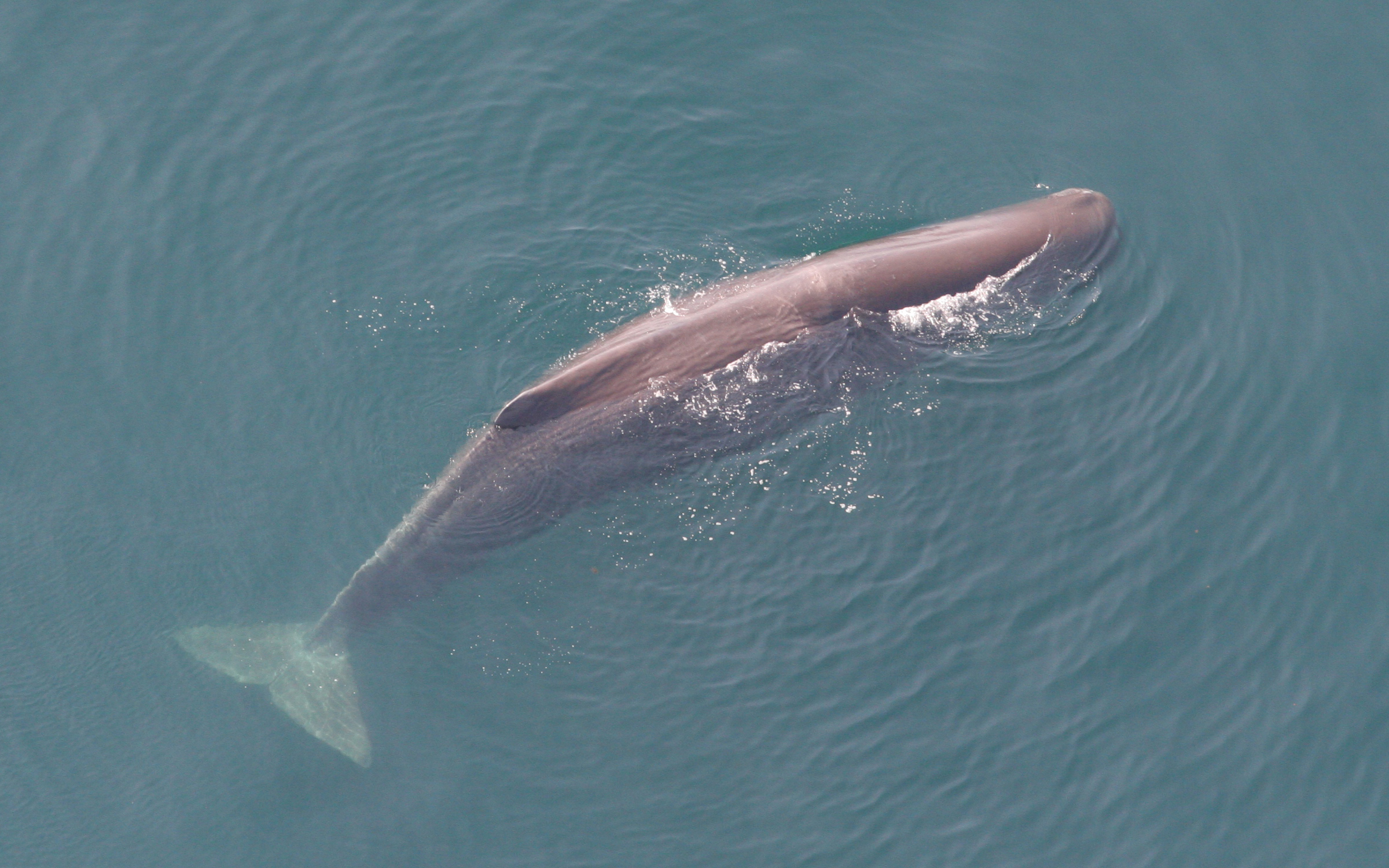
An aerial view of a sperm whale near the ocean surface. Credit: Wikimedia Commons

While artificial intelligence has been maligned over the past few years as people grapple with its rapid progress and potential for abuse, it remains the best tool we have for teasing out patterns that our human minds can’t discern, especially from large quantities of data.

With more than 9,000 recordings of sperm whales, Project CETI — Cetacean Translation Initiative, a non-profit effort to decode and translate sperm whale communication — had precisely the kind of huge data cache that AI excels at analyzing.

By feeding the recordings into specially trained machine learning algorithms, the research team was able to identify a wealth of new language patterns. While human languages are composed of quantized morphemes — prefixes, suffixes and root words — whale communication is broken down into sequences of clicks and pauses called “codas.”

Like Morse code, codas make a distinction between short clicks and long clicks. Sperm whales also vary the tempo of the clicks, which could represent inflection, “dialects” or concepts completely alien to the human mind.

“Some of what they’re doing might be totally different from our way of communicating and we’re probably never going to be able to fully grasp those differences,” Oregon State postdoctoral marine researcher Taylor Hersh told NPR.

sperm whale fluke
A sperm whale fluke visible above the surface of the ocean. Credit: Wikimedia Commons

Researchers believe the “inter-click intervals” — akin to ghost notes in music — may be as significant as the clicks themselves. Importantly, while human ears were able to identify and catalog some of the codas, the machine learning algorithms found many that human analysis missed.

That’s not surprising considering sperm whales — the loudest animals on Earth, capable of generating sounds up to 230 dB — took a much different evolutionary course and, as ocean-dwelling creatures weighing up to 90,000 pounds (40,800 kg) likely have a radically different sensorium compared to humans.

The comparisons to music go further than ghost notes.

“This study shows that coda types are not arbitrary, but rather that they form a newly discovered combinatorial coding system in which the musical concepts of rubato and ornamentation combine with two categorical, context-independent features known as rhythm and tempo, by analogy to musical terminology,” CETI’s team wrote on May 7 while unveiling the most recent study.

Sperm_whale_distribution_(Pacific_equirectangular)
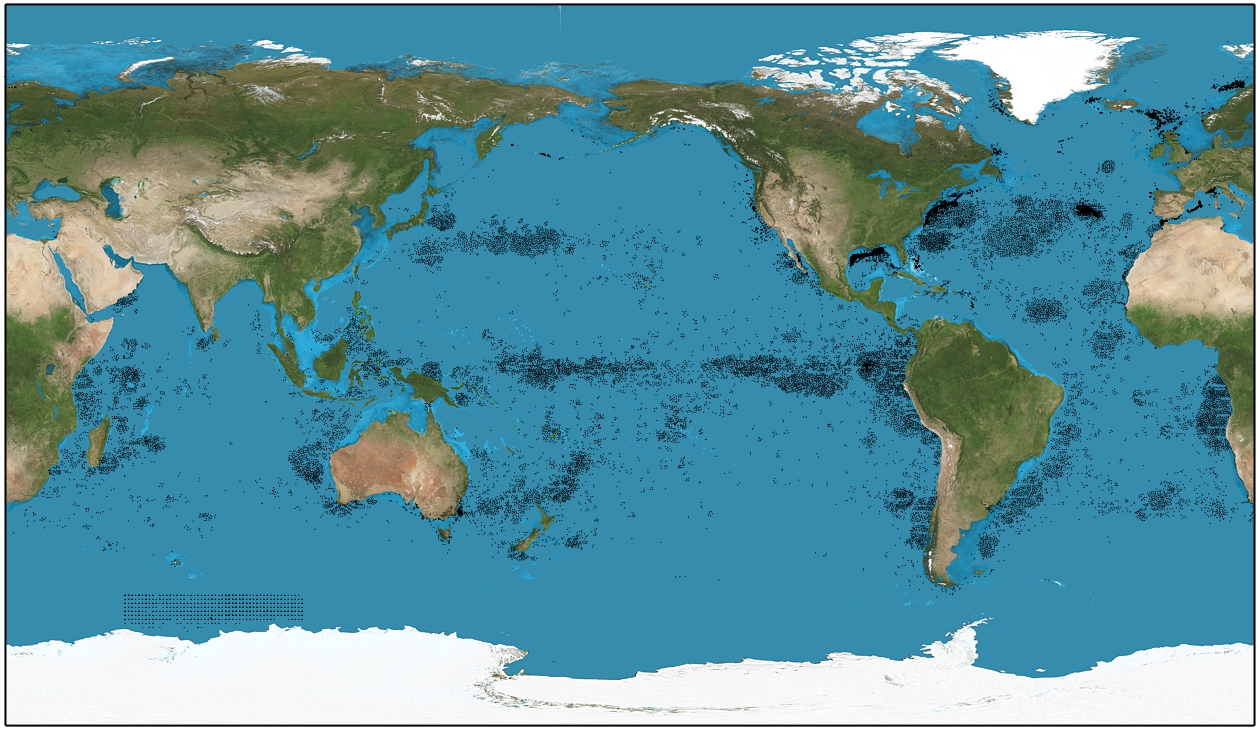
Sperm whale distribution based on human sightings. Sperm whales freely travel the oceans except in cold, ice-packed environs. Credit: Wikimedia Commons

While people have used many abilities to mark the dividing line between humans and animals over the years — including the ability to use tools, experience emotions, and demonstrate self-awareness — human capacity for authentic language with syntax and context-dependent meaning was one of the stalwarts, standing the test of time as new research toppled the other dividers by showing animals do indeed use tools, experience rich emotions and have complex inner mental lives.

With this research, scientists are assembling a “sperm whale phonetic alphabet” that will make it easier to discern and catalog whale codas.

To be clear, there’s still a lot of work ahead before scientists can prove sperm whale codas are comparable to human definitions of language, but whether they strictly meet that definition may not matter. After all, it’s clear the clicks and pauses of whale codas are imbued with meaning, even if it remains elusive to us for the moment.

Indeed, “sperm whale communication has both contextual and combinatorial structure not previously observed in whale communication,” the team wrote.

Proving sperm whale codas are tantamount to human language isn’t the goal anyway. The team has two overriding priorities — decode the meanings behind the codas, and get the wider public invested in the fate of these endangered animals by showing they’re not so different from us.

“Our results show there is much more complexity than previously believed,” MIT AI lab director Daniela Rus told NPR, “and this is challenging the current state of the art or state of beliefs about the animal world.”

This Parrot Loves Earth, Wind And Fire

The last few decades have revealed birds like crows and parrots possess astonishing intelligence. “Bird brain” might not be much of an insult after all.

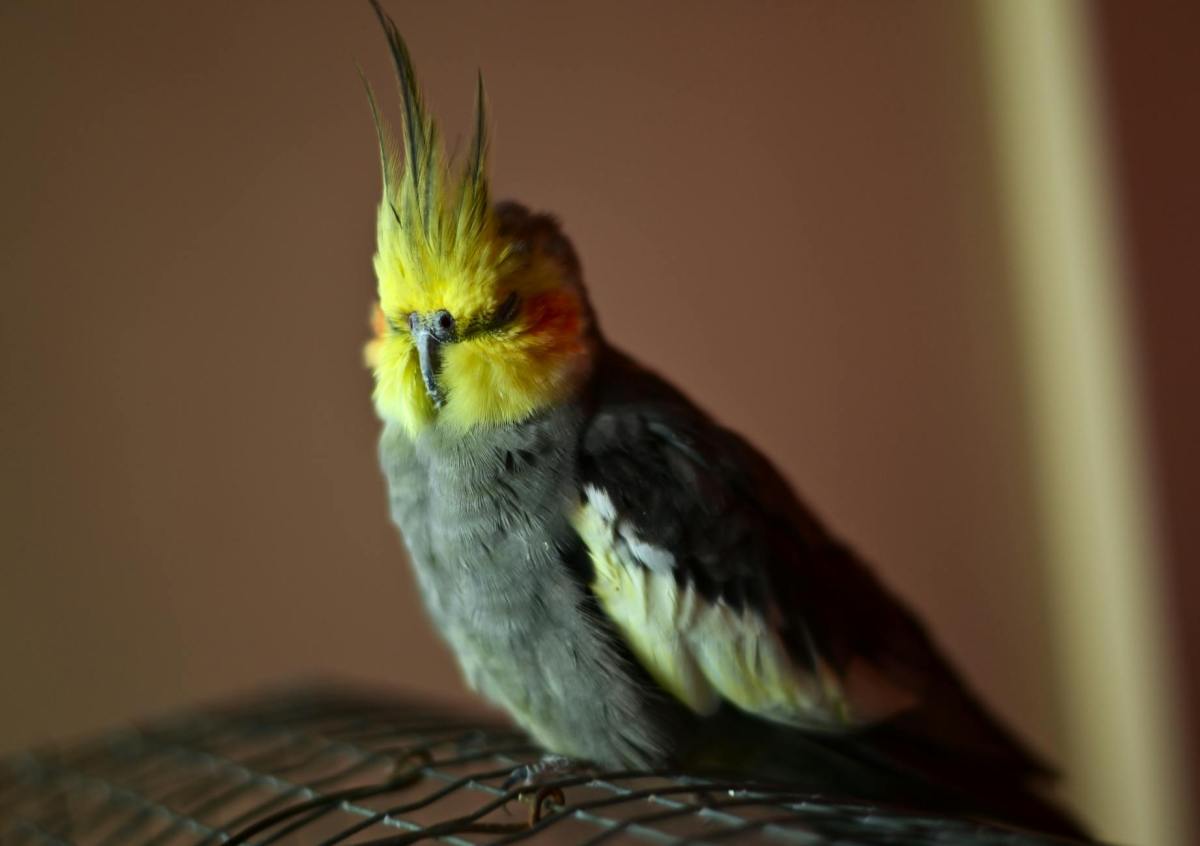
Meet Kiki the cockatiel, a bird who loves Earth, Wind and Fire so much that he sings the band’s classic hit, September, regularly — whether he’s just chilling by himself, singing along to the recording or driving his human crazy by whistling the catchy hook at ungodly hours.

“Kiki, it’s seven in the morning!” she tells him in one clip, raising an admonishing finger. “Silence!”

Kiki regards her for moment as if her request is absurd, then launches right back into September.

Hey, hey, hey
Ba-dee-ya, say, do you remember?
Ba-dee-ya, dancin’ in September
Ba-dee-ya, never was a cloudy day

In another video Kiki’s human sets her phone to record and leaves the room, and Kiki busts out his favorite song again. He’s got great taste in music!

I’ve always thought parrots are a fascinating example of animal cognition and further proof that we share our planet with billions of other minds who think and feel.

Humans and birds last shared a common ancestor more than 300 million years ago. That means between them there’s been more than 600 million years of divergent evolution resulting in radically different physiology, abilities and minds.

Yet parrots can speak while non-human primates (apes and monkeys) cannot!

For decades scientists thought apes and monkeys, by virtue of their relative similarity to humans, possessed an inmate affinity for language and that the physical limits of their vocal apparatus is what keeps them from speaking.

But a 2016 study by a team from Princeton University found monkeys do possess the vocal “hardware” to speak, meaning their mouths and throats are capable of making the sounds necessary for human language. It’s the lack of associated brain circuitry that prevents them from talking.

If the ability to speak and the ability to dance/appreciate music and rhythm is uniquely human among the primate order, and birds arrived at it at a different point in their evolutionary history, that means language and appreciation for music/rhythm developed separately along two divergent evolutionary lines!

That’s incredible and has intriguing implications for the cognitive abilities of animals.

A common argument is that birds with the ability to form human speech are simply mimicking sounds and don’t understand what they’re saying. That’s a natural assumption given what we think we know about non-human capacity for understanding language, but research suggests it’s wrong.

Take a look at this video of the famous late African grey parrot, Alex:

When Dr. Irene Pepperberg asks Alex how many blue blocks are present on a tray with a random assortment of blocks, balls and triangular toys in different colors, Alex can’t give a rote answer. First he has to understand that a question is a request for information and not part of the strange human ritual called small talk. He can’t simply count or guess at the number of blocks either.

Instead, Alex has to perform two calculations. He must tally the blue objects and count the number of them that are blocks, or he’s got to count the number of blocks and figure out how many of them are blue.

If he was simply repeating information in context — like saying “Hello!” when a person walks into a room — Alex wouldn’t be able to correctly answer the questions, and Pepperberg’s research funding would have dried up. Instead, Alex became a focal point of research that persisted for decades.

There’s no indication Alex could master syntax, which has proven elusive for even the smartest animals. But the African grey, who died in 2007 at 31 years old, was curious, asking questions that were unique and unexpected of an animal. He once asked his caretakers to describe his physical appearance, and the night before he died, he told Pepperberg: “You be good. I love you. See you tomorrow.”

We’ve talked about parrots before on PITB, including Snowball the dancing cockatiel who not only appreciates music and has a great sense of rhythm, but also has an entire repertoire of unique dance moves. Then there’s my personal favorite, Ruby the African grey, who has demonstrated mastery of absolutely vile, uniquely British insults.

Sure, there may not be much research value in hearing Ruby hurl verbal abuse at her very loving human, Nick Chapman, but few things have made me laugh as hard as that extraordinarily foul-mouthed bird. She has to be seen and heard to be believed. (But if you’ve got kids in the room, stick with the wholesome Snowball. He’s got serious moves.)

Snowball the dancing parrot
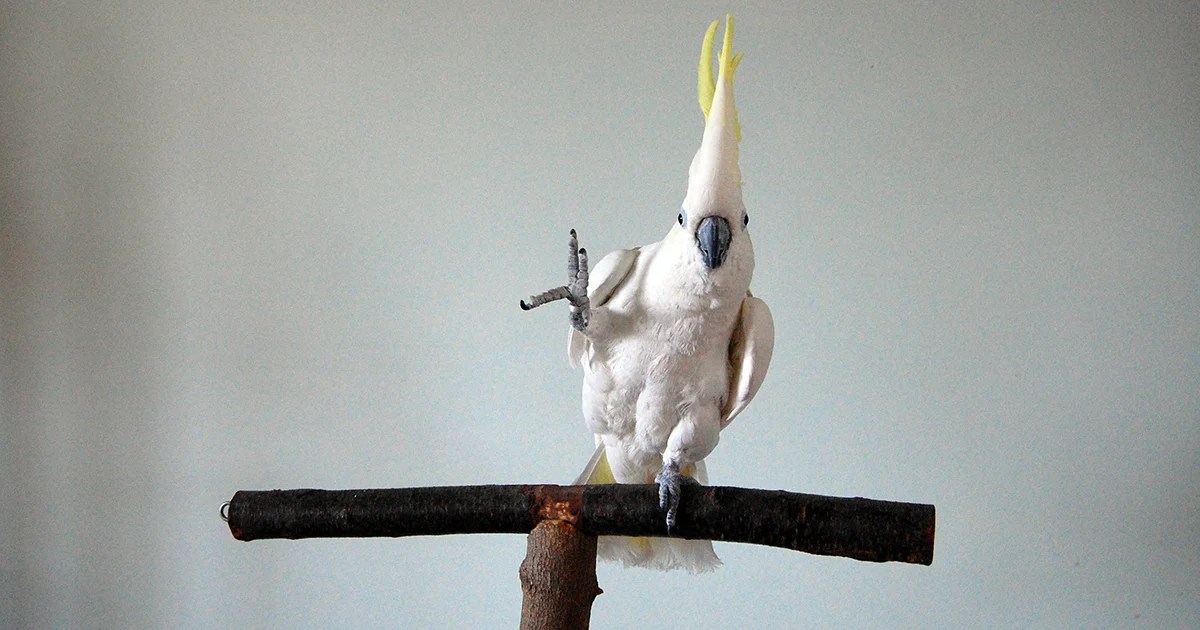
Scientists credit Snowball with choreographing his own dance routines, with dozens of individual dance moves and combinations, and moves that change depending on the song he’s rocking out to.

Now if you’ll excuse me, I’m off to teach a certain feline a few Earth, Wind and Fire songs in the hope that he’ll give up on the screeching meows and use his natural falsetto for a more gentle wake-up experience.

Hey, hey, hey
Ba-dee-ya, hey there my Big Buddy
Ba-dee-ya, Little Buddy’s hungry!
Ba-dee-ya, get your lazy ass up and feeeeeed me!

Bud close up