Vet’s Urgent Warning Over Laser Toys, Plus: US Now Has 200+ Cat Cafes

People who frequent cat cafes say they feel relaxed among the little ones. Hundreds of thousands of felines find their forever homes via cafes in the US, which are typically integrated with local shelter and rescue networks.

You may have noticed that most journalists don’t actually interview anyone these days, and the majority of “news” stories are either rewrites or lazily-assembled, 300-word virtual birdcage liners about which celebrity or influencer is “clapping back” at haters for “throwing shade” at them, with quotes directly copied and pasted from X or Instagram.

It’s cheap, easy content — far cheaper than funding war correspondents or impactful investigative journalism — and it doesn’t require reporters to leave their desks, speak to sources on the phone, or even fact-check what they’re writing.

“Well, they said it” is good enough for modern newsrooms, which is why we can’t have a national story or a disaster like the wildfires without waves of misinformation getting amplified by press and influencers alike. And the executives of the handful of remaining news companies wonder why trust in media is at historically low levels.

So these days, a veterinarian warning about laser toys via a TikTok video is considered international news. Nina Downing, a veterinarian with UK pet charity PDSA, took to the social media platform to warn about “laser pointer syndrome,” which she says can result in obsessive compulsive behavior in cats and dogs.

Our furry friends can become frustrated that they never actually capture the elusive red dot, according to proponents of the theory, and too much laser pointer play can result in a pet who barks at shadows or tries to tackle anything that moves.

“Cats have a hunting sequence to follow which is replicated in play, however if it doesn’t come to a successful capture at the end, this can cause them to become really agitated,” Downing warns.

Credit: WIkimedia Commons

Happily, Buddy is impervious to this alleged syndrome because he doesn’t actually have a “hunting sequence.” Born indoors, he’s known nothing but warmth and comfort, and food is something that’s served to him on a precise schedule, not something that needs hunting.

Accordingly, when we play with wand toys, Bud’s version of a “kill” is to grab the plush toy or feathers while dancing around on his back paws. He bobbles the toy while he dances, lets it go and resets the game.

The concept of a kill bite is completely alien to him, and apparently not even his feline instincts are enough to tell him there’s another step to “winning” the game. Still, I tell him he’s a good boy and a fierce little tiger because we can’t have fragile egos getting bruised.

That said, if you find lasers are one of the few reliable ways to get your kitty moving, it’s probably a good idea to wind down by switching to a wand toy. Let the little one simulate a kill, get a few rabbit kicks in and feel like a champ. There’s little or no research supporting the concept of laser pointer syndrome, but it still couldn’t hurt to give your feline overlord something tangible to “kill” at the end of a play session.

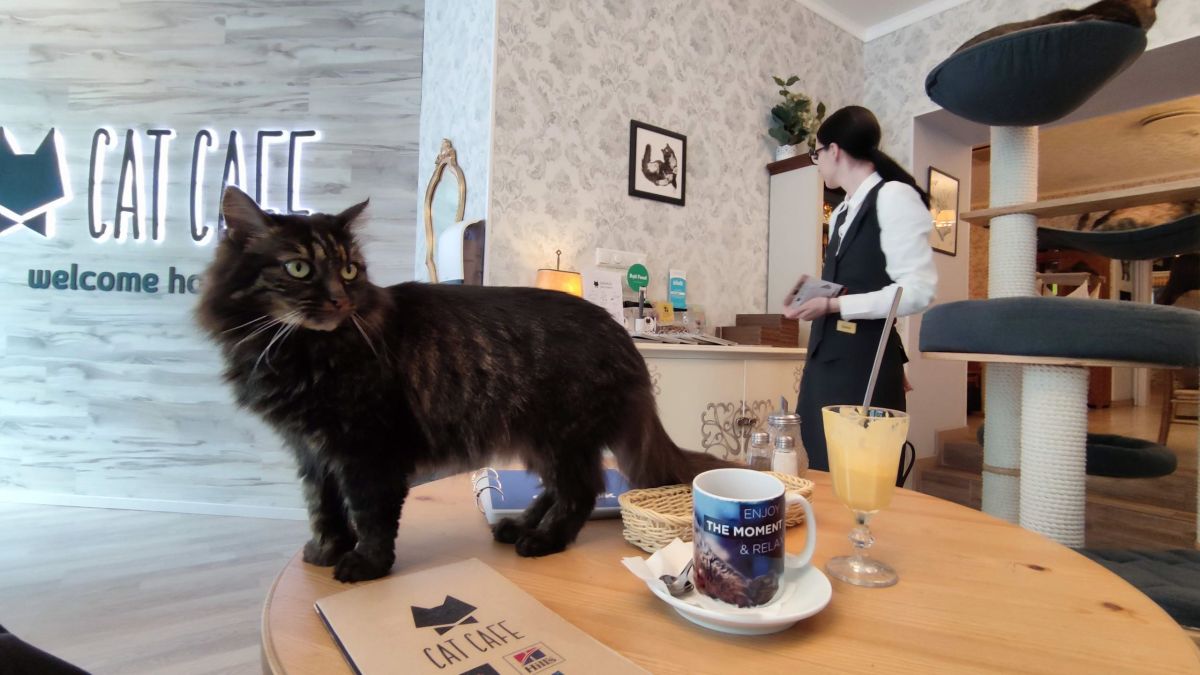
Cat cafes are more popular than ever in the US

USA Today has a story today about the apparent ubiquity of cat cafes in the US, and how they’re changing things for the better, for felines as well as people.

Using data from Yelp, the newspaper found there were 200 cat cafes, give or take, across the country at the end of 2024, up from about 75 in 2020.

“When we started, people weren’t quite sure what they were, there was a lot of explaining how they worked and what they were,” said Laura Konawalik, owner of a chain of three cafes featuring felines in North Carolina. “Nowadays people come in knowing the general concept.”

The same data shows searches for strings like “cat cafes near me” have increased 78,700% between February of 2020 and February of 2024, USA Today reported.

Patrons playing with cats at a cafe in Osaka, Japan. Credit: Wikimedia Commons

While cafes in some other countries are populated by felines owned by the proprietors, most cat cafes in the US are integrated with their local shelter and rescue networks, so patrons can adopt if they fall in love with the little ones they meet while having a cup of coffee or tea.

That means some of the oldest cat cafes in the country have facilitated thousands of adoptions and continue to find forever homes for their animals.

About 330,000 cats were euthanized in the US in 2023, the most recent year for which complete statistics are available, according to Shelter Animals Count, a national database that keeps track of shelter intakes and cat/dog euthanasia figures. Data for the first half of 2024 showed a decrease from the previous year’s numbers, but numbers from the latter half aren’t available yet.

Jet Taylor, a regular at Konawalik’s Mac Tabby cafes, says he keeps coming back to destress and feel calm.

“I would be willing to bet,” he said, “you could put a heart rate monitor on me and when I’m sitting there petting a cat, my heart rate goes down.”

This Cat Looks Like An Orangutan

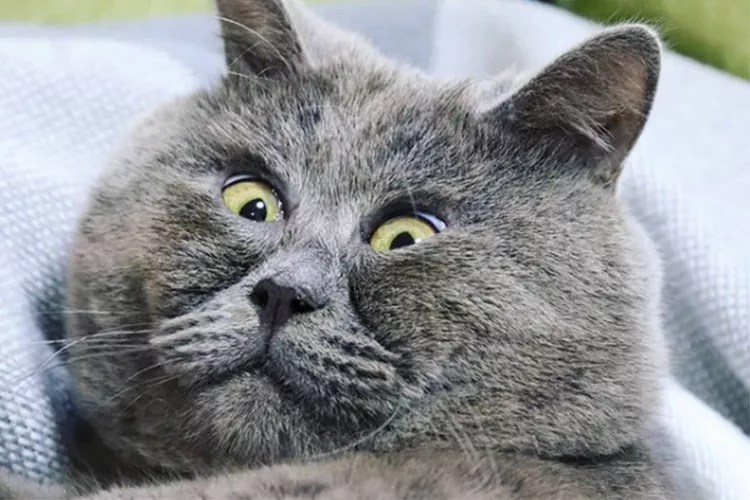
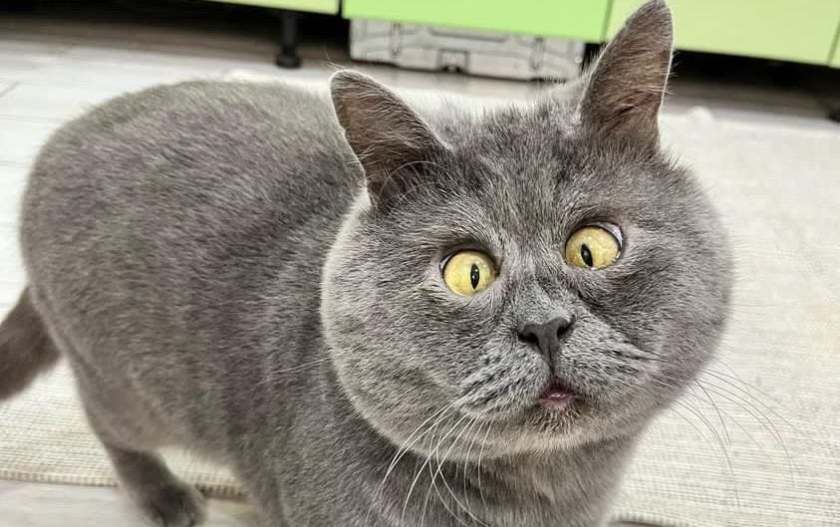
The former stray has become hugely popular online thanks to his permanently surprised-looking expression.

Much as I love my cat, I’ve never been a fan of being startled awake by the little stinker jumping on my chest or slapping my cheek, only to find him right up in my face, staring as creepy as you please.

I now realize I’m fortunate. Imagine waking up to this dude yowling in your face:

TELEMMGLPICT000369718995_17099205376400_trans_NvBQzQNjv4Bqg0QhGUrJBLC1cMiJLC7a7xa306WnPHVE_UdBq2uCdwc

Sheesh.

That’s Fedya, a four-year-old cat who presumably has some Persian lineage or a similar breed. His human, 42-year-old Natalya Zhdanova, found the little guy in her backyard when he was just a kitten. He was in a bad way at the time and she nursed him back to health with help from her neighbor’s kind cat.

His perpetually perplexed countenance wasn’t as obvious in his kitten days and Zhdanova has said she never imagined he’d become an online sensation with more than 300,000 people following the Russian feline on Instagram.

People have said Fedya looks like a real life cartoon character, but I think he looks like an orangutan, specifically an adult male with pronounced cheek flanges. In orangutans, cheek flanges are useful for attracting mates, as they signal a male is strong, healthy and his body is coursing with testosterone.

In cats? Who knows. Maybe they’re a result of Fedya’s swagger. (Fedya, by the way, is a diminutive of the Russian name Fyodor, also spelled Fedor, from the original Greek name Theodore, or Theodorus.)

We wish the big guy well, whether he’s curled up by a fire in Russia or stalking the humid jungles of Borneo!

Tokyo’s ‘Waving Cat’ Temple, Gōtoku-ji, Has Run Out Of Cats

The world-famous cat shrine has experienced a surge in tourism, leaving it bereft of the familiar statues that are inspired by the legend of a friendly cat.

Gōtoku-ji temple has a unique problem.

The complex, where legend says a friendly waving cat led a Japanese feudal lord and his men to warmth and safety ahead of a brutal storm, has seen an influx of travelers since Japan relaxed its COVID-era restrictions and tourists have returned.

Now Gōtoku-ji can’t keep up with the demand for maneki neko, the ubiquitous “beckoning cat” statues that visitors purchase at the shrine’s tiny gift shop, the Washington Post says in a new report. People who come to the temple write prayers on the statues and place them in a perpetually-expanding section of the shrine grounds.

The cats are said to bring good luck, with variations in their designs and colors: red for health, pink for love, gold for success and so on. White maneki neko, which are sold at the shrine, are the original and “all purpose” prayer cats. The shrine is Buddhist, but practitioners of Shinto, Jainism, Christianity and other religions write prayers on the little cats, hoping they’ll be heard by whichever version of God they believe in.

The manufacturer, which also makes statues for the Lunar New Year and other festivities, can’t keep up with the demand. Now staff at Gōtoku-ji have put up signs apologizing to visitors. They say they don’t know when they’ll get more maneki neko.

When I visited in 2019 there were many thousands of the iconic statues, but the photos from Monday’s WaPo story show thousands more placed on recently-built shelves. Temple staff have begun asking visitors to take their maneki neko home with them instead of leaving them at Gōtoku-ji. They clean, shelve and organize the thousands of statues currently there and won’t dispose of them because they represent the prayers of visitors, but the volume has become unmanageable.

Maneki Neko at Setagaya Tokyo
Visitors leave their own maneki neko statues at the shrine, often with personal messages asking for different blessings and written in black marker on the back of the statues. Credit: Pain In The Bud

Despite Gōtoku-ji’s rise in popularity, I still recommend checking it out, especially for cat lovers who are headed to Japan. While most of Tokyo’s most famous shrines are located in the city proper, with modern skyscrapers looming above temples that date to pre-modern Japan — never letting you forget you’re in a bustling metropolis — Gōtoku-ji is in Setagaya, a mostly-residential ward.

The temple grounds are surrounded by homes and they’re quiet in a way that others aren’t. The shrine is well-manicured and beautiful, dotted with statuary as well as centuries-old wooden temple structures.

When I was there a smiling elderly docent walked the grounds carrying a photo album that showed the temple and its structures over the years. With my sister-in-law’s rudimentary Japanese we were able to get a bit around the language barrier, and he told me one of the most striking buildings, a three-story tiered wooden tower, was home to one of the resident cats who liked to sleep on its second floor.

I wasn’t able to catch a glimpse of the little one but I imagine Gōtoku-ji is one of the best places on the planet a stray cat could call home. Like the people of Turkey, respect for cats is ingrained in Japanese culture and temple cats in particular are treated extremely well. Some even have their own Instagram pages and fan clubs, becoming tourist draws in their own right.

Maneki Neko Setagaya Tokyo
Maneki Neko statues at Setagaya shrine. Credit: PITB

Hugely Popular Influencer Abuses His Cat For Clicks

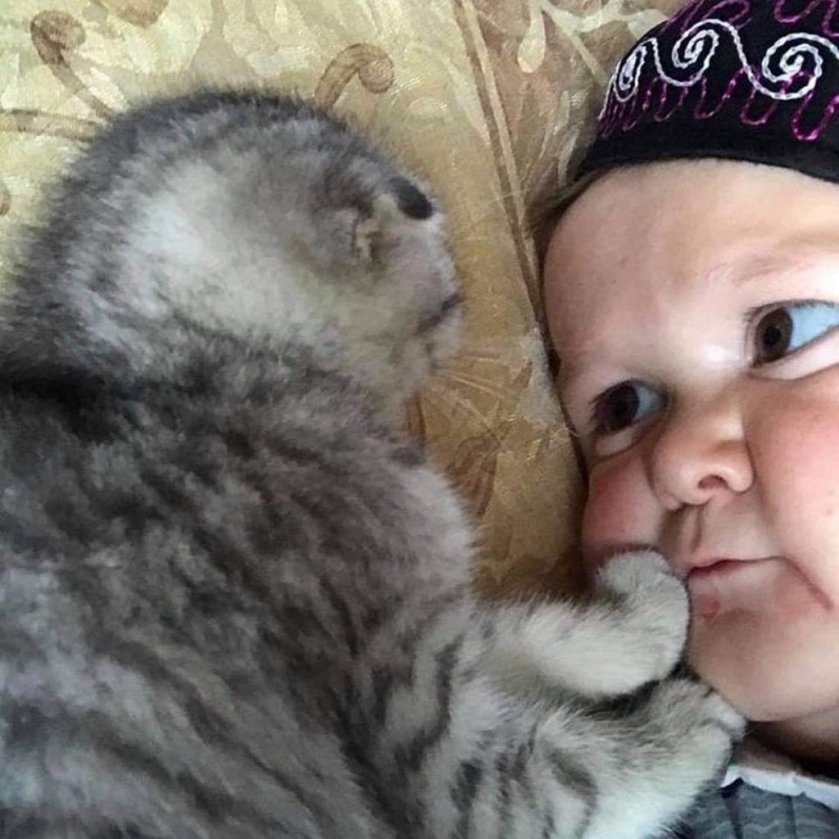
Hasbulla filmed himself pulling his cat by its ear and repeatedly smacking it.

Even if you haven’t heard the name Hasbulla Magomedov, chances are you’ve seen images of the Russian’s cherubic face, which exists in the pantheon of internet memes with the likes of Cash Me Outside Girl, Kermit and Condescending Wonka.

Magomedov is not a child, despite his 3’4″ stature and toddler-like appearance. He’s an adult man who suffers from a form of dwarfism, although he’s never publicly spoken about his condition in detail.

HASBULLA

Normally known simply by the mononym Hasbulla, beyond his status as a meme the diminutive Russian is mostly known for hawking garbage (cryptocurrency, self-branded merchandise, supplements) and for his nebulous association with mixed martial arts, existing as a sort of barnacle on the UFC where he appears at weigh-ins, uploads video of himself providing commentary and is carried around as a kind of good luck totem by Russian fighters.

Now Hasbulla is famous for something else — horrifically abusing his cat.

In a new video — which Habsulla was apparently proud of and voluntarily shared publicly — the 20-year-old speaks in his native Russian while pulling violently on his cat’s ear. The feline — which is terrified of Hasbulla and flinches when he approaches — escapes to the safety of a shoe box, but his tiny tormentor follows, smacking the poor cat on its body and head while barking in the gutteral nonsense that passes for a language in his gas station of a country:

Hasbulla boasts six million followers on Instagram, 1.5 million on Twitter, and his videos on TikTok have amassed an astounding 10.3 billion views.

The video is disturbing enough on its own, though I can’t help but wonder if Hasbulla is willing to share this kind of behavior, what’s going on when the cameras are off?

And if people are willing to physically abuse their cats to feed the content beast and keep their viewers “entertained,” how will they lower the bar in the future when their clicks slow down and they feel they need to do something even more shocking to reignite interest?

Hasbulla and cat
An older photo of the same cat in kittenhood, when Hasbulla introduced the kitty to his followers. The sweet cat

Manly, Heroic Ex-NFL Player Kills Puma For Fun, Cries About Backlash

Wolfe complained to Tucker Carlson when, instead of the praise he expected, online commenters blasted him for killing an animal that was merely surviving.

Derek Wolfe is a badass.

The 295-lb former NFL lineman recently got a license to kill mountain lions, so when he heard about a puma that was “terrorizing” a Colorado community by existing near it, he packed his weapons of war, rounded up his hounds and set off, trailing testosterone like a beefed up Jim Corbett gone to deliver justice to the Champawat tiger.

First he spoke to a local homeowner, who had an ominous warning for him.

“And when we had talked to the landowner, they said, ‘Hey, we have house cats. And the cats are acting weird.’

No doubt the cats were agitated and wanted to get out there to cause havoc with their feline brother by existing and eating stuff. The cats would have to be dealt with later.

Arriving at the scene, Wolfe (what a badass name) found the remains of a recently-killed deer and knew the evil mountain lion hadn’t reformed its ways. By continuing to exist despite the discomfort of people in the area, and continuing to eat, the defiant cougar was practically asking to be hunted down and killed.

bowofrighteous

Moving downwind of the fearsome predator so that it wouldn’t smell the pheromonal cloud of machismo that permanently surrounds him, Wolfe began climbing. The ascent was exhausting — not only is the 6’5″ Wolfe almost 300 pounds, but he was also carrying his sword, his health elixirs and his Bow of Righteous Smiting, a 1,000-DPS legendary weapon he obtained after slaying the Goblin King of Dreadmoore. Wolfe was carrying more than 400 pounds up the slope when he caught sight of the puma and did what men of testicular fortitude do: he released the hounds, who cornered the cat and chased it up a tree.

Then, with righteous fury, Wolfe drew his bow and killed — excuse me, “harvested” — the mountain lion, whose species is notoriously averse to conflict with humans and has killed fewer people in a century than dogs do in a week. But what are a few inconvenient facts between friends, amirite?

When Wolfe descended the treacherous slope with the corpse of the mighty cat like Geralt of Rivia toting the trophy from a monster hunt, the villagers applauded and sang songs of his bravery, then feasted in his honor.

wolfekill
Derek Wolfe, conqueror. Credit: Derek Wolfe/Instagram

But all was not well, for when Wolfe posted the manly photos of himself posing manfully with the corpse of the big not-quite-big cat, a contingent of insignificant peons criticized him on Instagram for killing an animal that was allegedly “just surviving.”

So Wolfe did what men of his stature do, and went on Tucker Carlson’s show to cry about the rodential men and women nipping at his heels.

wolfecarson
Wolfe on Carlson’s TV show. Credit: Fox News

It is said that the combined testosterone of Wolfe and Carlson created a vortex of badassery that threatened to spark untameable hair and muscle growth in anyone who ventured too close. Female assistants had to be ushered out of the studio before the segment began, and the lesser men manning the cameras had to sign waivers absolving Wolfe and Carlson of blame if they were transformed into hulking man-beasts by the combined presence of the former lineman and the scion of a TV dinner empire.

“I’ve been through some tough training camps, brother, but this hunt was –  man – it beat me up bad. I was beat up bad. I’m all cut up and scraped up. I was in full-body cramps [and] barely made it up there,” Wolfe told Carlson.

Wolfe proceeded to regale Carlson with tales of how dangerous mountain lions are. Puma concolor, the scientific name for the species, is responsible for a whopping 27 deaths in the last century. That’s one person every four years, and most of those people triggered the confrontations by getting too close to puma cubs or cornering the animals. By comparison, dogs kill 25,000 people a year via attacks, and another 25,000 by spreading disease, the latter mostly in third-world countries. Cows killed 655 Americans over a nine-year period from 1999 to 2007. More than 40,000 Americans are killed in car crashes annually.

And while you’re 25 times more likely to be killed by a tornado than a shark, there were five times as many fatal shark attacks (144) in the US over the past century compared to fatal mountain lion attacks.

In other words, pumas rank extremely low on the list of potential dangers to people, despite their size and their superficial resemblance to much more dangerous African lions. Pumas/mountain lions, also known as catamounts and cougars, actively avoid humans and try to steer clear of conflict with people. When they kill a deer or even a pet, it’s not because they’re “terrorizing” communities — it’s because they’re obligate carnivores who need to eat meat to survive.

photo of a cougar near a log
A mountain lion. Credit: Nicky Pe/Pexels

Wolfe explained that it’s important to “tree” mountain lions in order to do recon on them and make sure they’re appropriately big and impressive-looking.

“Those full-grown males will kill kittens as well, they’ll kill kittens to get the females to go back into heat,” Wolfe said, confusing terms and the dominance behavior of African lions with American pumas, which are not the same species. “It’s important to manage that herd, right? You have to manage every population of animal out here, especially mountain lions. So we got the dogs on ’em.”

Who knew cats were herd animals? Who knew pumas had decided to give up their solitary lifestyles and live in prides? Who knew former NFL linebackers arbitrarily killing random pumas qualifies as ‘managing a population’? Someone call the wildlife biologists so they can rewrite their field guides!

Despite his ability to scale mountains and slay (mountain) lions, Wolfe was wounded by the backlash when he posted photos of himself with his “harvest.”

“I can’t believe what’s happening to me…They’ve had 200 calls to Colorado Parks and Wildlife trying to turn me in like I did something wrong,” Wolfe complained. “I’ve been harassed.”

Disclaimer: Since this is the internet, and this post is bound to bring in readers unfamiliar with PITB and the fact that we’re sarcastic jerks, allow us to state for the record that Wolfe did not kill the Goblin King of Dreadmoore, does not own the legendary Bow of Righteous Smiting, and we’re not exactly sure if the villagers in the unidentified rural Colorado community threw a feast in Wolfe’s honor after he returned with the corpse of the cat that had been “terrorizing” their community. I mean, they probably feasted him, but we haven’t confirmed it.