How Do You Keep Your Cat Interested In Play Time?

The challenges of getting a lazy cat interested in play time and toys again.

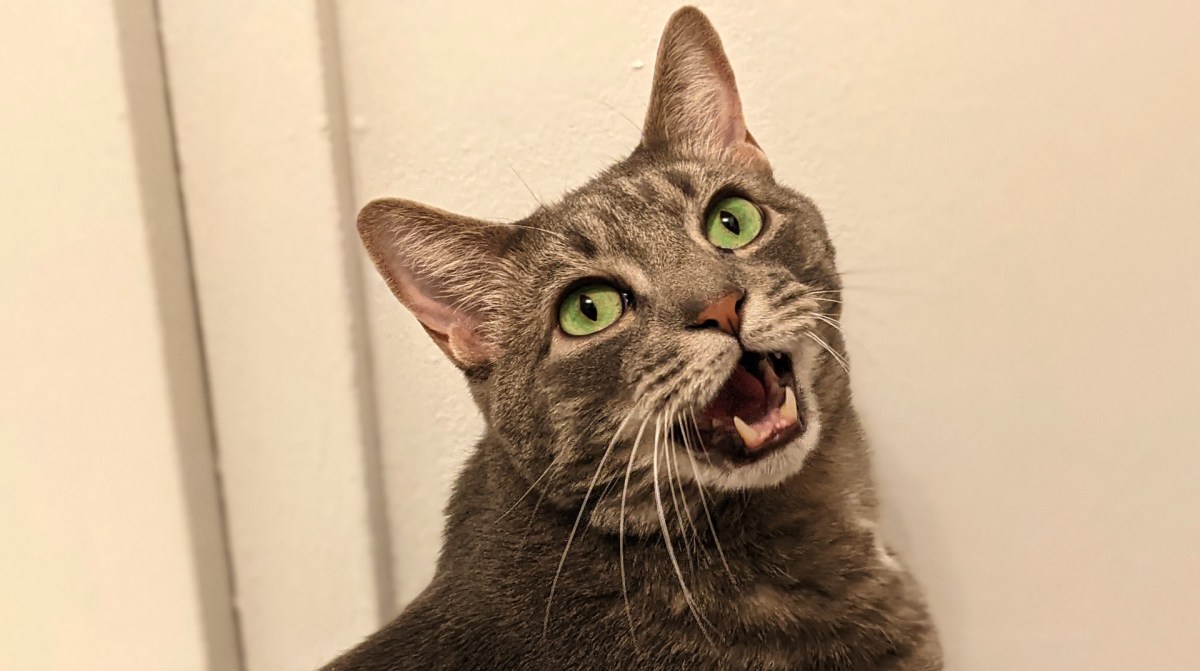
Buddy is friendly, outgoing and incredibly vocal, but he’s always been a bit lazy.

His preferred method of getting down from the couch isn’t jumping — although he does jump sometimes — it’s slowly oozing off the cushion like he’s liquid, taking the path of least resistance and letting gravity do all the work until he drops down and lands with a “Mmmrrrrrppp!”

When we wake up, the first thing he does is demand a snack, then he lays down for First Nap, apparently because the act of chewing and swallowing is so demanding.
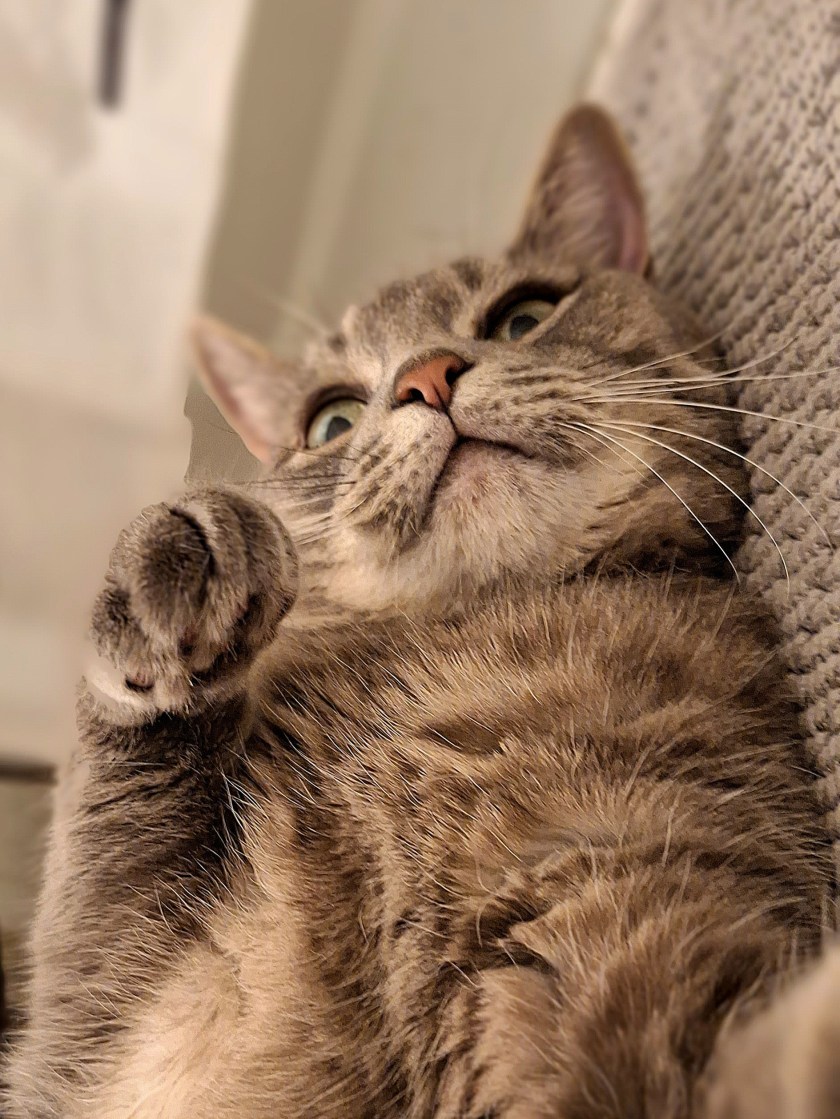
Brave Buddy
“Now’s an excellent time for a nap.”

While he used to chase the laser with a fury and jump several times his own height to paw at it — even after figuring out it’s light fired out of a pen held by me — nowadays he can’t be bothered. At best he halfheartedly chases it for a bit and then loses interest even though I make an effort to move the laser like prey, as I do with his wand toys.

Worst of all, catnip makes him even lazier because he doesn’t just sniff the damn stuff, he eats it. I try to get him interested in his favorite wand toy when he’s buzzing on a heady combination of ‘nip and silver vine, but he won’t chase it. He just rolls onto his back and paws at it lazily, maybe getting in a few “rabbit kicks” if he’s feeling feisty.

All of this would be funny if he wasn’t about to turn 10 years old and if he didn’t tip the scale at about a pound and a half to two pounds above his normal body weight when the vet weighed him a few months ago.

“Hey fat boy!” I tell him, getting the familiar “Brrrrrr!” in response. (He’s a big time triller. Feline linguists estimate at least 60 percent of the Buddinese dialect consists of trills of various pitch, length and intensity.)

Fat Boy lost most of the excess weight during a particularly brutal stretch when he screeched at me for snacks constantly and I had to deny him most of the time. At least with kids you can explain things to ’em. I’ve got no way of communicating to the Budster that he’s a Chubster.

Since then he’s put some of the weight back on, so I’ve gotta do something.

Here’s my plan:

  1. Training him to do new tricks. He already knows come, stop, sit and high-five, so we’re gonna have to try something new, like teaching him to roll and maybe teaching him to jump on my shoulder and “ride” around with me. Training is mentally stimulating, it should be fun for him, and it lays the groundwork for more challenging tricks.
  2. A cat obstacle course! I can rig something up with his tunnel, some boxes and some “hazards” that he must traverse in order to get his paws on some catnip.
  3. Snacks dispensed via puzzle feeder only. None of that free-feeding when he gavones the stuff down like he’s starving.
  4. Rotating toys. Admittedly I haven’t been very good about doing that. Almost every guide mentions rotating cat toys so your little buddies don’t get tired of them.
  5. A mirror so he can see how ripped chubby he’s gotten. He really needs to see himself loafing. It’s not pretty.

Okay that last one is a joke, mostly because I’m pretty sure he’ll just admire his “meowscles” in the mirror. Cats are masters of self deception. Bud is scared of rustling paper bags and absolutely terrified of vacuums, yet he still thinks he’s a hulking tiger. That’s impressive cognitive dissonance.
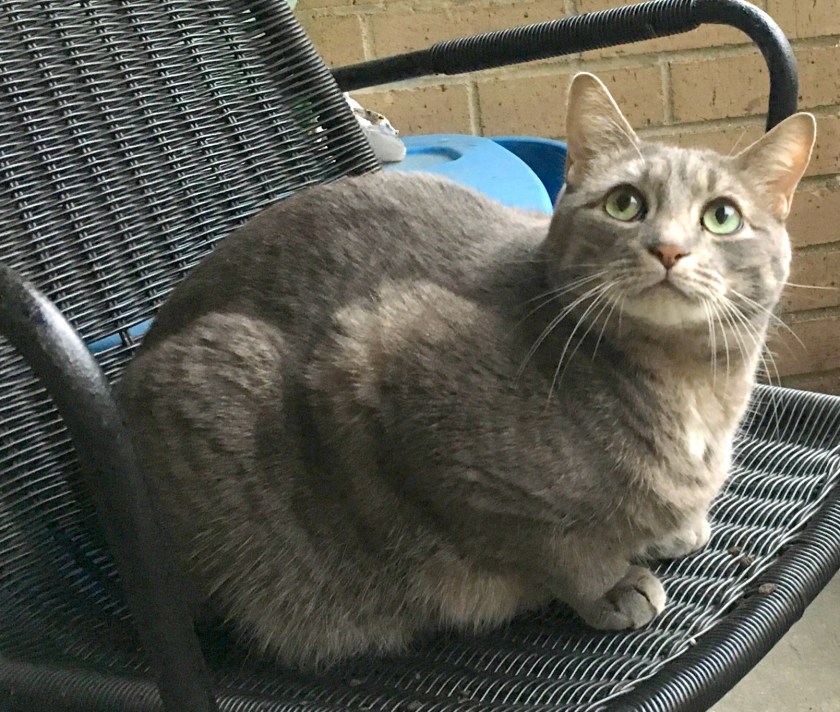
Meatloafing Buddy
This is by far the fattest-looking photo of Buddy I could find. He’s in a super-meatloaf pose here, looking like a chonkmaster.

So we shall embark on this grand endeavor, and I’ll report back here to catalog successes and failures. Hopefully more of the former.

Buddy will always be like a baby to me, and I can’t quite wrap my head around the fact that he’s now a “senior” cat, but he is and it’s on me to make sure he remains active so he hopefully lives at least another 10 years in good health. There are many adventures yet to be had, many more schemes for world domination to hatch, and more turkey to eat.

What Is Schrödinger’s Cat?

Cats are at the heart of one of the most famous thought experiments in science.

If you’ve spent time around physics types, listened to media appearances by science educators like Michio Kaku and Brian Greene, or even watched episodes of The Big Bang Theory, you’ve almost certainly heard of Schrödinger’s cat.

But what is it, why is it important, and what does it really have to do with cats? Most importantly, if you’re a cat lover, does it involve harming cats?

I promise you, if you stick with me and have a little patience, you’ll not only understand Schrödinger’s cat, but a hugely important element of physics will be demystified for you.

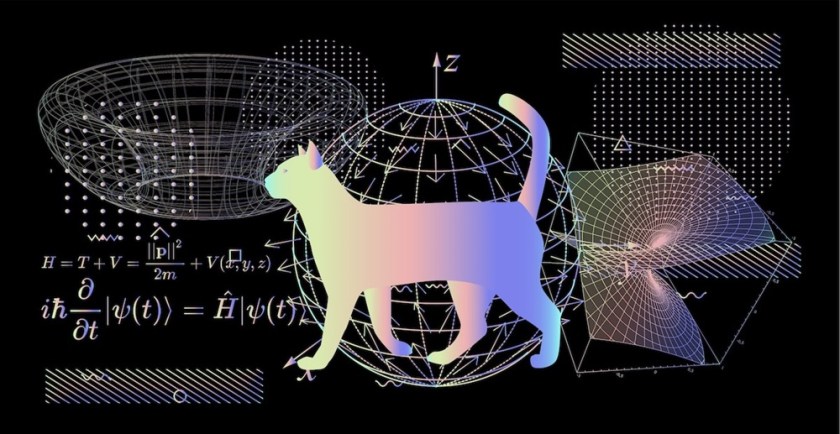
QuantumEntanglementCat

Let’s take a step back. First, we all learned in school that Isaac Newton was the “father of physics,” and Albert Einstein came along about two centuries later, revolutionizing physics by adding to Newton’s work and coming up with his own, more accurate model.

To this day, Newton and Einstein are in a class by themselves among physicists because they single-handedly changed everything we know about the natural world.

We all remember the famous story about Newton watching an apple fall from a tree, wondering why the apple fell down instead of up, and eventually developing his theory of gravity. Newton went on to develop his theories, which describe everything we see in the natural world, from that apple falling to the complexities of orbital mechanics.

Everything seemed to work perfectly, until a physicist named Max Planck came along in 1905 and published a paper introducing quantum physics.

What is quantum physics?

Now the word “quantum” has been incorporated into practically everything these days and has been so utterly abused as a marketing buzzword, a way to add a veneer of science to things that are otherwise nonsense, that it’s essentially a meaningless word to most people. Practically everything is described as quantum, from deodorants to claims of psychic telepathy.

But the gist of it is this: While Newtonian physics does indeed describe everything we see with our own eyes accurately, it does not accurately describe things at the subatomic level.

In other words, there are two sets of rules in our universe. Everything larger than an atom behaves according to one set of rules in our universe, and everything the size of an atom or smaller — which includes subatomic particles — behaves according to a different set of rules.

Not only that, but at the quantum scale, things get really, really weird.

They behave in ways that are completely at odds with everything we intuitively understand about reality, so much so that even Einstein himself was disturbed by what he found. Einstein famously described quantum entanglement — the ability of two different objects to be linked and share properties, regardless of how far apart they are — as “spooky action at a distance.”

So what the hell does this have to do with cats?

Ready to get even weirder?

Thanks to Planck, Einstein, John Stewart Bell and innumerable physicists — who are still studying these concepts, and still winning Nobel prizes for them in 2022 — we know that two particles can be “entangled” and will remain that way no matter how far apart they are.

You could take one particle, transport it 10,000 light years away, and it would still be entangled with the other particle.

But it gets even stranger than that.

Schrödingerscat

Our entangled particles have certain properties, such as their spin, which are unknowable until we measure them. In fact, they exist simultaneously in all possible states until the moment when we observe them, at which time the wave function “collapses.” It’s called quantum superposition.

Not only that, but when we measure one particle in an entangled pair, the second particle’s wave also “collapses” (settles on a certain state) and we know its spin instantaneously, regardless of how far apart the particles are.

If I measure an entangled particle here on Earth and find its spin is up, I know the corresponding particle that’s been moved to, say, Epsilon Eridani, 10.47 light years away, is spin down.

You can see why this would be profoundly disturbing to scientists. It violates the speed of light, and it’s completely counterintuitive. How can the mere act of observation change something in the physical world, and how can it change something else potentially thousands or millions of light years away? Everything we know, every gut instinct we have, screams that this should not be true.

But it is true.

These aren’t just ideas kicked around by scientists smoking the sticky stuff, by the way. They’ve been proven experimentally many times over. No matter how much we might dislike the idea, no matter how weird or spooky it may seem, it’s true.

Schrödingerdeadalive

Enter Erwin Schrödinger, an Austrian physicist. He devised a thought experiment that goes like this:

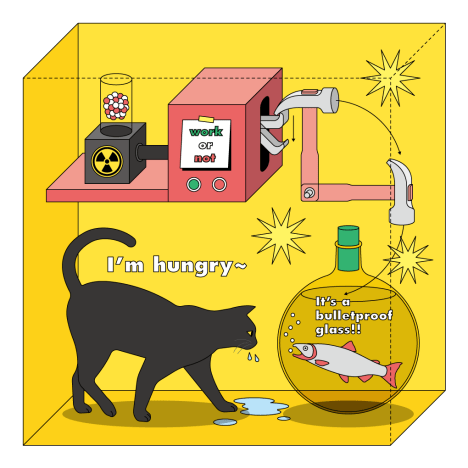
Imagine you have a sealed box with a cat inside. Inside the box are two buttons: One button feeds the cat a yummy treat, the other button kills the cat. There is an equal (50/50) chance of the cat pressing either button. (Other versions use a more complex system involving radioactive material, or poison, that could kill the cat, again with a 50/50 chance.)

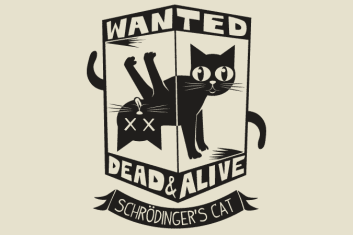
We don’t know if the cat is alive or dead until the moment we open the box. So in this thought experiment, we can think of the cat as both alive and dead until we “measure” or “observe” by opening the box.

That’s what’s happening in the above example of quantum entanglement and the idea that a particle is neither in one position or another until we measure it.

Why is measurement the key here? No one knows. Scientists are still arguing about that. Some believe that there’s some special quality of consciousness that interacts with the universe, so the mere act of observing something can change physical reality.

Others scoff at that idea and insist we’re missing something, that it’s not the act of observation that determines the final state of a particle at all.

Regardless, the important thing here for cat lovers is that Schrödinger’s cat is just a thought experiment.

Schrödinger never had a cat, as far as anyone has been able to ascertain, and no one has used an actual cat in an attempt to reconstruct the thought experiment because 1) You wouldn’t learn anything, since cats are not subatomic particles, and 2) Anyone intelligent enough to be a physicist is presumably intelligent enough to understand how absurd, pointless and cruel it would be to use a living being in an experiment that can’t give you any answers.

For those of us who aren’t geniuses, here’s Sheldon explaining the thought experiment as a child (in Young Sheldon) and as an adult (in The Big Bang Theory):

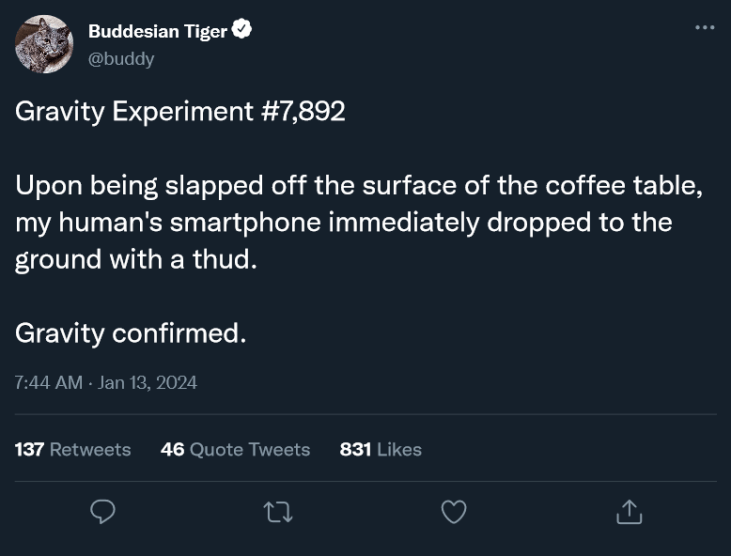
Buddy Successfully Completes 412,377th Gravity Experiment After Swatting Phone Off Table

Following in the scientific footsteps of Sir Isaac Newton, Buddy seeks to understand a fundamental force of reality.

NEW YORK — Buddy the Cat recorded the results of his 412,377th gravity experiment on Tuesday after successfully swatting his human’s smartphone off of a nightstand.

The silver tabby, who is a longtime enthusiast of experimentation with gravitational forces, said his most recent experiments were opportunistic.

“Usually my human secures his phone and his glasses before going to sleep, because he’s jealous of my scientific exploits and seeks to impede my progress,” Buddy explained. “But he must have been really tired the night before, because I noticed the glasses and phone were just sitting there unattended. They were calling out for me to swipe them onto the floor.”

It would have been rude not to take advantage, Buddy said.

buddyportrait_saturated2
The scientist: Buddy is committed to unlocking the mysteries of gravity.

Gravity experiment #412,377 went as predicted with the smartphone landing on the floor with a satisfying slap, the scholarly feline reported.

Gravity experiment #412,376 was equally successful, with an added bonus — the glasses ricocheted off the nearby wall and became wedged between the mattress and the wall.

“My human, Big Buddy, was very angry when he woke up and couldn’t find his glasses,” Buddy admitted. “It was fun watching him fumble around like he was blind. He came close a couple of times and I considered meowing to let him know he was getting warm, but decided it was crucial to the experiment to see how long it would take him to find them. After all, what is a scientist without his integrity?”

Buddy the Cat said he expects a Nobel Prize at some point in the future for his groundbreaking work.

“Gravity is remarkably consistent,” the feline scientist noted. “No matter how many times I swipe things off of flat surfaces, they always fall to the floor. But I haven’t even tried 500,000 times yet. I feel I need at least a million attempts to have a really robust dataset, and my experiment could benefit from more variety as well. Maybe I’ll try the TV next, or maybe the dishes in the kitchen cabinet. The possibilities are endless!”