

Imagine you’re a person living five thousand years downstream.
Maybe civilization collapsed and restarted, maybe records were lost, or maybe like Etruscan, Harappan and proto-Elamite, the languages we speak today will be long forgotten.
At any rate, if you discover a forceful warning left by your ancestors from the deep past, would you understand it without translation or cultural context?
And if you’re the one tasked with leaving the message, how would you do it?
The message has to be enduring. It must be recorded in a format that will withstand the tests of time, conquest and natural disasters. The message must be comprehensible without cultural context, because we have no idea how language will shift in the future or whether our descendants will enjoy the knowledge that comes with continuity of records.
Lastly, the message must be both compelling and absolute in its meaning, because its content is vitally important: This site contains nuclear waste. Do not under any circumstances excavate or disturb the contents of this facility. It will lead to sickness, suffering and death.

How do you phrase that in a way our naturally curious species will heed the message?
We certainly didn’t heed the warnings on the tombs of King Tut and other pharaohs. For all we know, humans of the future might believe the hidden chambers deep in Yucca mountain or buried 3,000 feet underground are filled with fabulous treasures and wonders beyond imagination.
They might interpret the warnings as superstition, meant to ward off looters, “grave robbers” and anyone else who might be motivated to break in. They might see the care and effort that went into encasing the objects and conclude there must be something very much worth preserving inside.
Or they might be driven by simple curiosity, as so many human endeavors have been.

Arguments about how to warn the future are at least as old as the Manhattan Project (1942) and the first nuclear power plants (1954 in the USSR, 1958 in the US), but there weren’t serious efforts to come up with a plan until the 1970s, when scientists, historians and other thinkers began to engage in formal efforts to find a long-lasting solution.
Some of the ideas are boring, some are impractical, and some are absurd, like an idea to create a “garden of spikes” atop nuclear material waste sites, to discourage people from settling in the area or excavating.
Unfortunately, one idea that’s still being kicked around is the concept of the radiation cat, or raycat.
Knowledge and language may be lost to history, signage may be destroyed, physical obstacles may be removed. But one constant that has endured, that has seen empires rise and fall, and has existed long before Stonehenge and the pyramids of Giza, is the human relationship with cats.

They’re now valued as companions, but we still use them as mousers on ships, in heavily populated cities, in ancient structures and on farms and vineyards.
They’re embedded so deep into our cultural psyche that it would not be outlandish to think the archaeologists of the future may conclude the internet was constructed primarily to facilitate the exchange of images of cats.
Even the first high-bandwidth deep space transmission was a video of a cat, so in a very real sense, the dawn of a solar system-wide internet was heralded by an ultra high definition clip of an orange tabby named Taters, beamed back to earth from the exploratory spacecraft Psyche, which was 19 million miles away when it transmitted Taters on Dec. 11, 2023.
Consider also that the basic felid body plan — shared by domestic kitties, tigers, pumas, black-footed cats and the 37 other extant species — has barely changed in 30 million years, because cats are extremely successful at what they do.
In other words, cats aren’t going away, and domestic felines have a place in every human society.
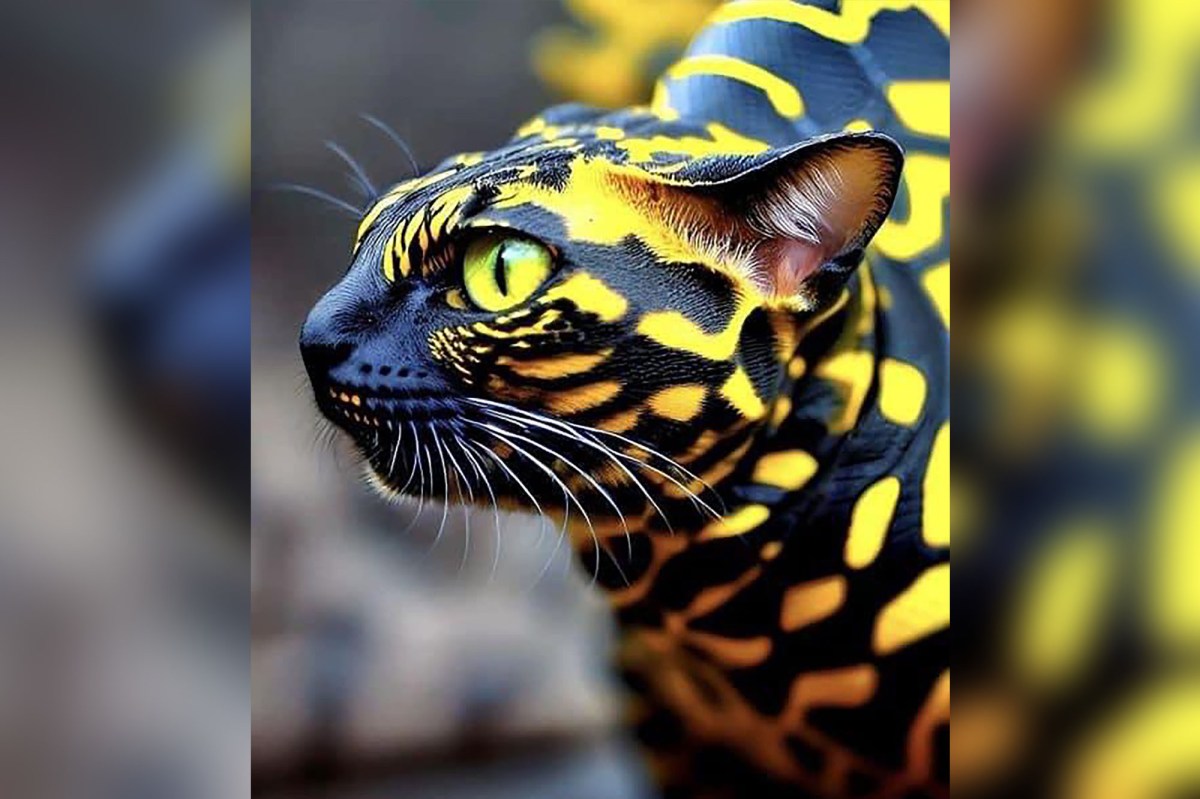
So philosophers Françoise Bastide and Paolo Fabbri conceived of the “living warning” in 1984. The idea is to alter the genetic code of felis catus so that the animals glow or change color in the vicinity of nuclear waste, using minuscule levels of radiation as the trigger.
There are natural precedents for this, including bioluminescence and several species of octopus that radically change colors and patterns on their skin to evade predators.
The second component, once the genetic code has been altered, is the creation of folklore: songs, stories and myths that will endure through time, warning people to keep cats close, treat them well, and run like hell if they change color because it means something terrible, something evil beyond imagination, is nearby.
To ensure the folklore of feline Geiger counters endures, an idea by linguist and semiotician Thomas Sebeok would be incorporated. Although empires and states rise and fall, there’s one organization that has survived for 2,000 years preserving a unified message: the Catholic church.
Sebeok proposed an atomic priesthood, an order that would pass the knowledge down through generations, continually seeding culture with stories and songs of glowing felines.

If this stuff sounds wacky, that’s because it is. We won’t figure out a way to ensure a message is received and understood thousands of years in the future without considering some off-the-wall plans.
Of course messing with the genetic code of any animal raises serious ethical questions.
We don’t have the right to play God and tinker with the genetic code of extant species. We don’t fully understand the immediate consequences for the health and happiness of cats, and we know almost nothing about the long-term effects on the species.
I’d also argue that we have a special relationship with cats and dogs, one that exceeds any obligations we may feel toward our primate “cousins” or other non-human animals.
Cats and dogs have been living with humans for a combined 40,000 years. They have been molded by us, they are dependent on us, and all that time in human proximity has led to unique changes.
No animals on this planet can match them when it comes to reading human emotions. Our little buddies pick up on our emotional states before we’re consciously aware of them partly because of their robust sensoriums, and partly because as their caretakers, our business is their business.

We bear a responsibility to both species and the individual animals. It’s not just the fact that without them, our lives would feel less meaningful. It’s the indisputable fact that without them — without dogs who flushed out prey on yhr hunt and guarded small settlements, without cats who prevented mass starvation by hunting down rodents — we would not be here.
Cats and dogs play a major role in the story of the human race. We are indelibly linked. Their DNA is not ours to tinker with, and they are not tools we can repurpose at our convenience.
Thankfully the US Department of Energy has never endorsed the concept of raycats. While there is a website advocating for a raycat program and small groups around the world dedicated to its propagation, the interest is mostly academic.
The Raycat Solution, which maintains a site dedicated to the idea, has a FAQ which says its supporters are serious about its potential usefulness, but for now most experts see it as a thought experiment and reminder that the problem must be dealt with eventually. At some point NIMBY will have to yield to reality, and wherever the US ends up storing nuclear waste, it’ll need to be secured, sealed and marked.
The goal is for the message to endure at least 10,000 years, at which point scientists say the radiation will be minimal.
That’s assuming that the future holds the collapse and rebuilding of human civilization, or at least a technological backslide in which the majority of our species’ knowledge is lost.
We like to think things will be brighter than that and instead of glowing to warn people of danger, cats of the far future will be where they belong — with their human buddies, exploring new frontiers on starships with plenty of comfortable napping spots.
Header image depicts the Alvin Ward Vogtle Nuclear Power Plant in Georgia, the largest nuclear plant in the US. Image via Wikimedia Commons/NRC
[1] The nuclear waste storage facility at Yucca Mountain was initially funded and approved by congress in 2002, then was canceled and de-funded in 2011 after significant pushback from people who live in Nevada, along with their representatives in congress. Plans for the site have changed several times in more than two decades, leaving the US with no central, secure site to store nuclear waste.






 Pain In The Bud