PA Pols Push Declaw Ban, Online Series Features Bodega Cat ‘Interviews,’ Plus: ‘The Last Cat’ Of The Skies, The Iconic F-14 Tomcat

Bodega cats are the stars of a popular online series and could soon become legal in New York, where they’ve helped keep delis and small groceries rodent-free for as long as such places have existed.

Although it’s way too early to celebrate, Pennsylvania could become the fourth state to outlaw cruel declawing procedures after two lawmakers there introduced a new bill.

The Pennsylvania declawing ban proposal closely mirrors laws already passed in New York, Maryland and Massachusetts, and would outlaw the procedure except in cases where it’s medically necessary. (Although extremely rare, sometimes cats suffer from cancer of the nail bed and other maladies that necessitate surgery, but that’s a far cry from the elective declawing currently legal in 47 states.)

The state’s Veterinary Medical Association, the usual villain in these situations, is opposed to the ban. State veterinary medical associations argue that outlawing the procedure — which amputates a cat’s toes up to the first knuckle — would limit options for veterinarians and caretakers.

The veterinary medical associations, which contrary to their names do not represent all or even most veterinarians, also claim that declaw bans lead to more surrenders, but that claim has been repeatedly debunked by statistics from states and municipalities where bans have passed. In each of those cases, surrenders actually decreased, which is not a surprise to those who understand declawing, rather than “solving” any behavioral issues, actually causes cats to lash out even more because of the suffering they endure from the mutilation.

Here in New York, the Veterinary Medical Association successfully prevented declawing bans from making it out of committee for years, despite organizations like the Humane Society, SPCA, Alley Cat Allies and others wholeheartedly opposing elective declawing. Each state VMA buys influence with campaign donations, and relies on the lawmakers they support to kill declawing bans. Let’s hope Pennsylvania’s Veterinary Medical Association proves less adept at derailing that state’s bill.

The Last Cat of the Skies: The Iconic F-14 Tomcat

When I was a kid, the two Dream Machines that adorned posters on my wall were the Lamborghini Countach and the F-14 Tomcat. The Countach remains a car without equal with its inimitable, angular design that still manages to look futuristic more than half a century since the first models rolled out of the factory.

The twin-engine Tomcat is kind of like the Countach of fighter jets with its variable wing geometry, prominently angular air intakes and unique silhouette that makes it easy to distinguish even from the ground.

A Tomcat from the Nimitz-class aircraft carrier USS Theodore Roosevelt (CVN 71) during a combat flight over the Persian Gulf in 2005. Credit: U.S. Air Force photo by Tech. Sgt. Rob Tabor

Grumman’s air superiority fighter was immortalized in pop culture when Tom Cruise’s ace fighter pilot, Maverick, flew the aircraft in 1986’s Top Gun, and the Tomcat enjoyed a nostalgic encore in 2022’s excellent Top Gun: Maverick, displaying its staying power in a film that also heavily featured newer aircraft like the F-18 Super Hornet and the sixth generation prototype “Darkstar,” based on Lockheed Martin’s secretive SR-72.

The F-14 is the last of Grumman’s “cat” aircraft, after the Wildcat and Hellcat, and while it no longer fills a role in the US military, it remains a potent weapon for other countries half a century since its first flight. You can read all about the Tomcat in The Aviationist’s new feature here.

The Tomcat’s variable wings were a technological marvel when the aircraft was first released. The wings are swept forward for takeoff and landing, and typically swept backward during high speed, high altitude flight, allowing the fighter to maneuver in ways other aircraft could not. The wings can also shift to an asymmetrical configuration, allowing for unique capabilities in flight.

New York’s deli cats get their say

Bodega cats, longtime fixtures of New York’s answer to grocery stores, are enjoying a moment thanks to a major push to finally legalize their presence, and popular social media accounts featuring photographs of the beloved mousers keeping watch over their stores and snoozing in snack aisles.

A bodega cat in New York takes a siesta from his usual napping, eating and rodent-hunting duties. Credit: Wikimedia Commons

Now the New York Times has a feature on the popular TikTok series Shop Cats, which features “interviews” with the neighborhood felines.

Like Buddy, they seem to have an odd fascination with Mao Zedong, and their answers don’t make much sense, but that’s part of their charm. Check it out here.

Header image of a bodega cat courtesy of Pexels
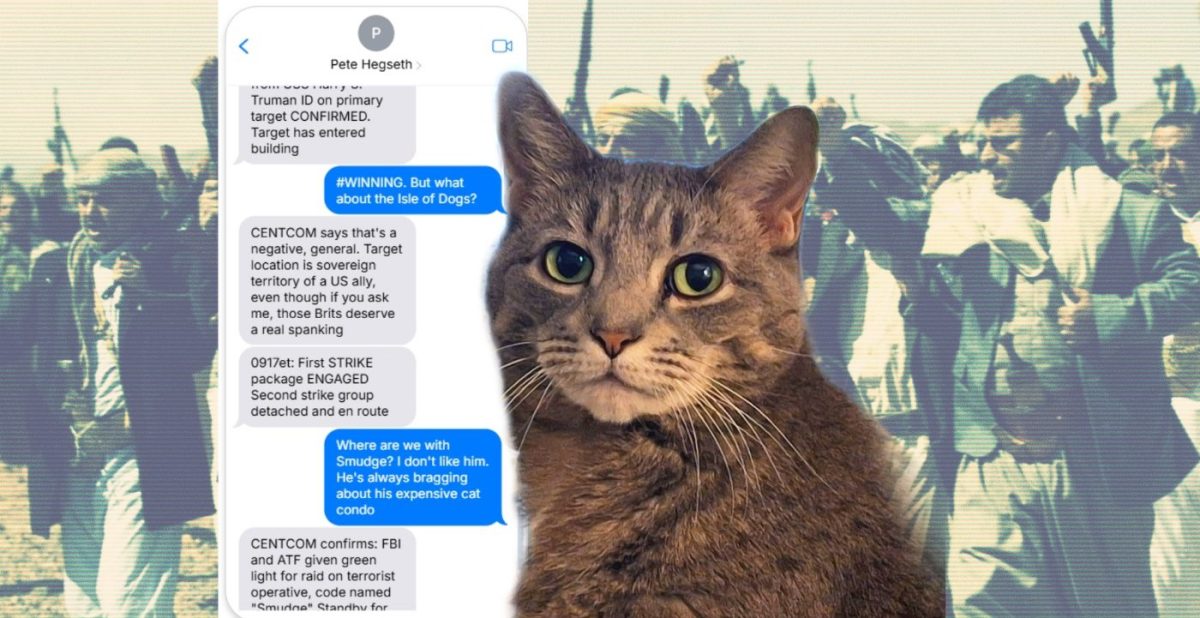
Report: Trump Officials Added Buddy The Cat To Houthi War Plans Text Group

The mercurial tabby cat tried to convince Secretary of Defense Pete Hegseth to bomb the Isle of Dogs, White House officials grudglingly acknowledged.

The controversy over leaked war plans expanded Monday after new reports revealed a journalist was not the only outsider added to a text group between senior members of the administration.

Buddy the Cat, a domestic tabby from New York, was also invited to the group and subsequently made privy to classified information, the White House acknowledged.

While Atlantic editor Jeffrey Goldberg observed the text conversation between senior members of the Trump administration without participating in the exchange, sources say Buddy the Cat tried to convince Pete Hegseth, the defense secretary, to bomb London’s Isle of Dogs.

In addition, White House press secretary Karoline Leavitt grudgingly acknowledged Buddy was able to convince Hegseth and Kristi Noem, the homeland security secretary, to send federal agents to the home of a cat named Smudge, describing him as “a gastronomic terrorist who hates America and will stop at nothing to claim all the snacks for himself.”

When administration officials denied knowing Buddy the Cat, social media users began unearthing dozens of photos of the feline associating with national leaders. No one knows how deep the conspiracy goes.

Initially White House officials denied the feline was given access to the text group, with Leavitt calling it “an egregious example of the fake news media inventing absurd stories,” but they were forced to acknowledge the veracity of the incident when confronted with copies of the exchange.

“Folks, we are cleared for go, CENTCOM has given us the green light for the fifth strike package,” Hegseth wrote. “F-18 launch imminent.”

“Are we just going to ignore the Isle of Dogs?” Buddy the Cat texted in response.

The text caused confusion, with several senior officials speculating on the sender’s identity.

“The contact says ‘BTC.’ Who the heck is this?” Director of National Intelligence Tulsi Gabbard asked.

“It’s [US Marine Corps] Gen. [Barrington T.] Caldwell,” replied Mike Waltz, the National Security Advisor. “Got to be.”

Noem also initially tried to distance herself from the scandal by claiming she didn’t know Buddy, but photographs soon emerged of the tabby cat lounging on the podium while she spoke at CPAC in 2003.

It’s not clear how senior White House officials were convinced by a cat that a London neighborhood was related to an Iran-backed Shia militia in Yemen, but an anonymous official credited Buddy the Cat for “being very convincing. We all thought he was the general.”

While the feline’s suggestion to bomb the London neighborhood was co-signed by Hegseth, it was ultimately rejected by CENTCOM, which noted the UK is an allied country and there was no indication “terrorist dogs” populated the London neighborhood.

More successful was Buddy the Cat’s suggestion to send a federal strike team to the home of Smudge, his archrival.

The chonky cat screeched his innocence after heavily armed and armored federal agents smashed the door down and found him mid-bowel movement in his litter box.

“1337et: Agents have located the CHONKY little jerk in his domicile, where they found fresh explosive materials in his litter box and a suspiciously well-stocked cupboard,” Buddy wrote to the Houthi PC Small Group.

“Congrats, general!” Waltz wrote, while Noem called the arrest “a major win for American freedom and security.”

Reporters, former military officers and intelligence officials criticized the leak, pointing out that if a cat could get access to highly sensitive war plans — and influence them in real time — America’s enemies could do the same. But White House officials pushed back on the criticism, saying it was overblown.

“So someone put a cat on a text chain,” Leavitt said, snapping at a reporter during a press briefing. “So what? You guys are, like, being so dramatic!”