The Latest Influencer Trend Puts Unfair Expectations On Felines

Cats aren’t equipped to use human language and there’s nothing wrong with that. Our feline friends already go to great lengths to communicate in ways we can comprehend. The least we can do is meet them halfway.

I would love it if my cat could talk to me.

Sure, he never shuts up, but if he could speak English I’d know why he meows at the same spot at the same time every morning, or what he wants on the occasions when he’s still meowing insistently at me despite the fact that his bowls are full, his box is clean, he’s had his play time, and every possible need and want of his — that I can fathom — has been met.

Most of all, I’d really like to know he understands I’ll be back soon when I go away for a few days, and my (mostly ignored) pleas for him not to attack his long-suffering, way-too-kind sitter.

Alas, Bud cannot speak. No non-human animal has ever demonstrated even basic proficiency in human language. People will point to examples like Koko the Gorilla and Nim Chimpsky, but there’s a reason why funding dried up for that kind of experiment.

It doesn’t work. It never did.

The scientists who end up taking on dual roles as researchers and parents to the animals invariably serve as interpreters, get too close to their subjects and swear that a gorilla pounding shiny buttons for “food tree food submarine” means the ape wants to have a picnic next to the ocean, or “car fly house car star” means she wants to ride a Tesla Roadster to Mars and start a colony with Elon Musk.

koko

Koko, Nim, Chantek and the other apes who were the subjects of decades-long attempts to humanize them — and teach them language in the process — were ultimately not much different than Clever Hans the horse, who was reading subconscious nonverbal cues from his owner and convinced tens of thousands of people that he could do math and understand spoken language.

Hans had scores of experts fooled until the German psychologist Oskar Pfungst figured out how the horse was coming up with the correct answers.

Regardless of which famous example we’re talking about, no animal has ever mastered syntax, and the best that could be said of their proficiency with language, or lack of it, is that they learned they’d get attention and food when they pounded on a talking board or approximated a word in sign language.

Even if non-human primates were able to learn a handful of words by frequently reinforced association with an object, there has never been any evidence that they are actually using the words as language rather than simply understanding “Pushing the button that makes this sound means I get a treat!” (And yes, there is a profound difference. The former reveals the presence of cognitive processes while the latter is a conditioned response.)

Despite decades of intense effort, no animal has ever demonstrated the ability to use human language. At best an animal bangs on a few buttons and people are left to speculate on the intent. Maybe Fluffy likes the way a certain word sounds. Maybe it’s just fun to hammer on buttons the way it’s fun to pop bubble wrap. Most likely, these cats and dogs know that using a talking board is a guaranteed way to get attention, a treat and a head scratch from their caretakers.

Influencers and their talking boards

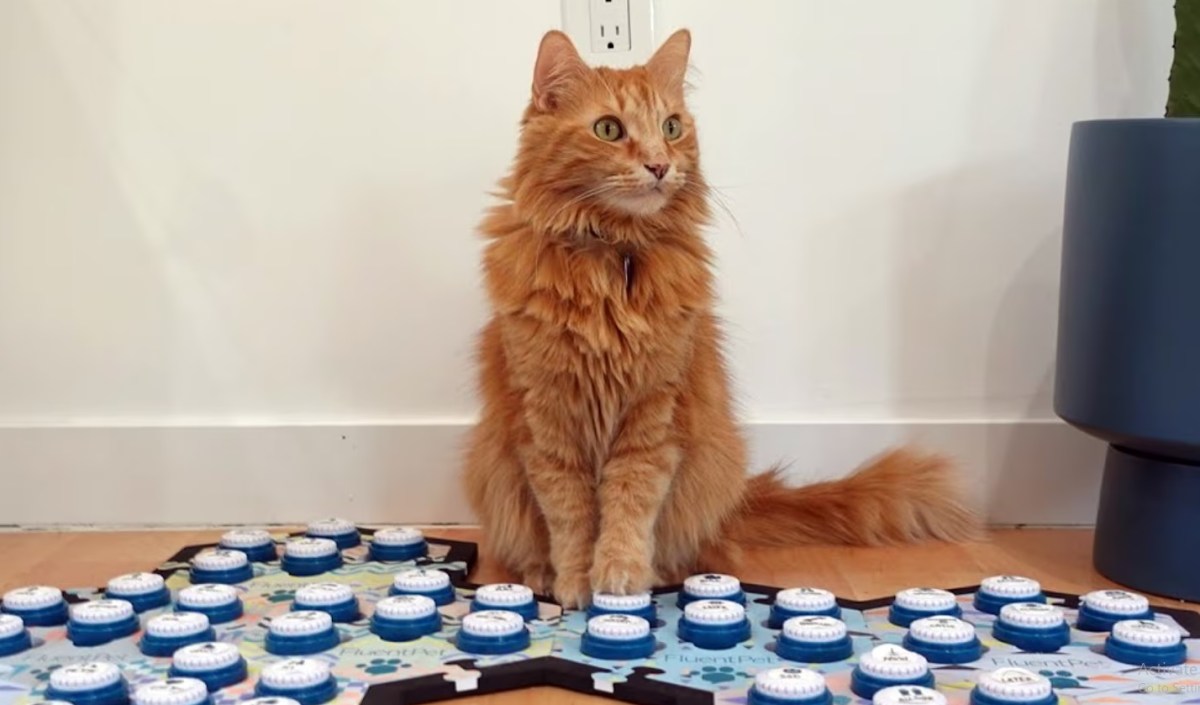
TikTok, which spawns inane trends with the reliability of an atomic clock, has provided a platform for people who insist their cats and dogs can talk. Using “talking boards” — elaborate set-ups in which words are assigned to their own buttons — they “teach” their cats how to express themselves in English and provide proof in the form of heavily edited, out-of-context clips that require the same sort of creative interpretation pioneered by Penny Patterson, Koko’s caretaker.

billiecattalk
Seriously?

I just watched a video in which a woman claims her cat, named after Justin Bieber, was describing an encounter with a coyote by stomping on buttons for “stranger,” “Justin,” “Mike,” and “stranger.”

The woman says she thought Justin was asleep at the time, but now she believes the orange tabby saw the coyote outside and was still stressing about it well into the next day.

While she’s repeating Justin’s “words” back to him, two of her other cats come by and step all over the talking board. I guess whatever they had to say wasn’t important.

Justin’s talking board has 42 buttons, which stresses credulity well beyond the breaking point. More than half of the buttons are used for abstract concepts.

@speaking_of_cats

⚠️TRADE OFFER⚠️ Jackson recieves a brushing, Mom recieves 10 I Love You’s #fluentpet #talkingdog #talkingcat #cat #catsoftiktok #catlover #cattok

♬ original sound – Jackson the Cat

But forget all that for a moment and ask yourself how our own efforts to decode the meow have been going.

Despite our status as intelligent, sapient animals, despite the powerful AI algorithms at our disposal, despite the benefit of being able to digitally record and analyze every utterance, we haven’t come close to a reliable method for interpreting feline vocalizations.

Likewise with dolphins, whale song, corvid calls and the sounds made by other animals at the top of the cognition pyramid.

Mostly, we’re learning we’ve underestimated the complexity of our non-human companions’ inner lives, especially when it comes to the kind of multi-modal communication humans also engage in, but only subconsciously. We say what we want with our mouths, while our eyes, facial expressions and body language say what we’re actually thinking.

Likewise, the meow is an unnatural way for cats to communicate, and it contains only a fraction of the information cats are putting out there. It’s just that we can’t reliably read feline facial expressions, let alone tail, whisker and posture. (Studies have shown most of us, even when we live with cats, don’t get measurably better at this. In fact, we’re often no better than people with limited feline experience, but we think we’re better.)

Putting the burden on our furry friends

If we can’t crack a simple and limited system of vocalizations, aren’t we putting unrealistic expectations on cats? The average person has a vocabulary of tens of thousands of words, yet somehow we expect cats can latch on to an arbitrary number of them, approximate mastery of syntax that has eluded even our closest cousins, and bridge a cognition gap we haven’t been able to bridge ourselves.

It’s all too much.

There’s a simple truth at the heart of this: Cats did not evolve to speak or parse human language, and that’s perfectly fine.

The little ones already meet us more than halfway because they understand we are hopelessly incompetent at reading tail, whisker or body language, and they understand we communicate with vocalizations.

By forgoing their natural methods of communication in favor of ours, cats are already taking on most of the burden in interspecies communication. Asking them to do more than that, to learn many dozens of words and the rudimentary rules of language, seems like laziness, wishful thinking or insanity on our part. Pretending that certain cats are successful is an exercise in the same kind of cynical opportunism that fuels every other desperate attempt by people trying to turn their pets into influencers. People do it because the reward is money and attention.

catboard

Worse, it contributes to the spread of misinformation. TikTok’s talking board videos routinely net millions of views, converting a credulous audience into an army of true believers who are convinced that, with just a little effort, their feline pal can shoot the shit with them.

If people want to construct elaborate talking boards in their homes and pretend their cats are expressing themselves in English, who am I to object? It’s not the smartest use of time, but have at it. What I won’t do is participate in the delusion that felines are a few buttons away from being able conversation partners, nor will I pretend these efforts have any relationship to science.

So to the journalists who keep writing credulous stories about these supposedly talking animals: please familiarize yourself with the example of Clever Hans, and please, I beg you to stop promoting these videos as if they’re anything more than wishful thinking. You are doing your readers a disservice for the sake of a few clicks.


Note: Jackson Galaxy isn’t a fan either, saying he’s “got some serious problems” with the talking board trend. Calling it “problematic,” he points out that cats are not only partially domesticated and the only animal species in history to take that step without human prompting, but humans have never selectively bred cats for specific behaviors or to bring out intelligence traits as we have with canines. (Think of sheep dogs or retrievers, who are the products of thousands of years of breeding for well-defined tasks.) There simply hasn’t been a need to breed cats for behavioral traits since the thing humans traditionally valued most about them — their ability to reliably eradicate rodents and protect human foodstuffs — is innate. No one had to teach cats how to hunt or breed them for the task. It’s only in the last two hundred years or so that certain human societies began breeding cats, and they did so for aesthetic attributes like coat patterns. Galaxy also notes that animals do not express emotions the same way humans do. Like monkeys, who “smile” when they’re terrified, felines express joy, anger and fear with their tails, whiskers, ears and body language. It’s not in their nature to tell us they’re happy or scared by padding up to a contraption and hammering on a button.

Top image of “Justin Bieber” the cat credit Sarah Baker.

Cat Domestication Was The Start Of A Beautiful Friendship

Domestication’s real goal: to make cats cuddly as well as great mousers.

Cats have been doing things their way since the very beginning.

Unlike literally every other domesticated animal, cats were not domesticated by humans. They did it to themselves.

As if that didn’t make them unique enough, they lay claim to another major distinction: they’re the only species of obligate carnivores to undergo domestication in the entire history of human existence.

That explains why cats, more than any other animal that depends on humans, so closely resemble the wild animals they were before signing up for the good life of naps, warmth, endless rodents to hunt and free food from their new human friends.

In a new essay for The Conversation, evolutionary biologist Jonathan Losos, author of The Age of Cats: From the Savanna to Your Sofa, notes new DNA analysis settles the question of where cats came from once and for all.

Domestic cats are descended from North African wildcats, specifically the species felis sylvestris lybica. Unlike dogs, who underwent telltale physical transformations when they evolved from wolves, house cats “appear basically indistinguishable from wildcats.”

“In fact,” Losos writes, “only 13 genes have been changed by natural selection during the domestication process. By contrast, almost three times as many genes changed during the descent of dogs from wolves.”

While the change in genetics that happen with domestication left cats pretty much as they were physically, the process made dramatic changes in the feline brain, reducing regions governing fear and expanding those related to social behavior. The result? The major difference between house cats and their wildcat ancestors is disposition.

In other words, domestication made cats cuddly.

buddyevolution
Housecat evolved.

Notably, felis sylvestris lybica had to be pretty friendly in the first place, as well as bold and driven by the now-legendary feline curiosity to risk padding into human settlements with their bright lights, strange smells, open flames and the two-legged giants striding around them.

They didn’t have a way of negotiating or signaling their intent. They couldn’t say: “Hey guys, we’re here to kill and eat the tasty rodents who have been giving you problems by chowing down on your yums, but we don’t want your yums for ourselves. Plants are disgusting!”

So they had to demonstrate their usefulness, prove their worth, and enjoy the fruits of it by curling up in front of warm fires or on human laps.

That explains why it was the African wildcat that became a human companion species and not European wildcats, whom Losos notes are often “hellaciously mean” in interactions with people, even if they’re raised around humans when they’re young. It was also a matter of being in the right place at the right time, as nascent human civilization took root in the Fertile Crescent.

But ultimately, just like cats decided to domesticate themselves and didn’t really bother to consult us about it, so too do they bend us to their will with an entire repertoire of manipulative behavior, from solicitation purrs to incessant meowing and having a talent for looking their cutest when they want something.

While we may think we set the rules and parameters of our relationship with the furry little ones, as Losos notes, “cats usually train us more than we train them.”

Read the whole thing here:

Feline evolution: How house cats and humans domesticated each other

How Do Cats Apologize To Their Humans?

Even cats sometimes think “My bad!” How do they communicate that to their people?

As George Carlin famously observed, cats don’t accept blame — but that doesn’t mean they don’t apologize sometimes.

Let me preface this by saying I neither expect nor demand apologies for the standard methods of Buddesian destruction. If Bud swipes my phone off the table and it cracks, that’s my fault for leaving it where he’s known to conduct his ongoing gravity experiments. Likewise, there’s no sense getting upset with him when he paw-slaps a set of keys four feet across the room, or when I return from the kitchen to find the remote controls on the floor.

That’s Buddy being a cat. Getting angry at him for it would be pointless, and expressing that anger would only make him fearful and stressed.

There are times, however, when even Bud realizes an apology is in order. As I’ve documented before, the little guy sometimes redirects his fear or aggression to the nearest person, which is invariably me, and almost mindlessly lashes out with claws and/or teeth. After working on it together, he’s improved dramatically and knows how to handle his fear and frustration peacefully. Still, every once in a while he gets really freaked out or overstimulated beyond what he can handle, and he’ll clamp onto a foot or forearm, drawing blood.

That’s when I react. I don’t yell at him beyond telling him to stop, but he can see from my reaction that he’s gone way overboard and done something he shouldn’t do.

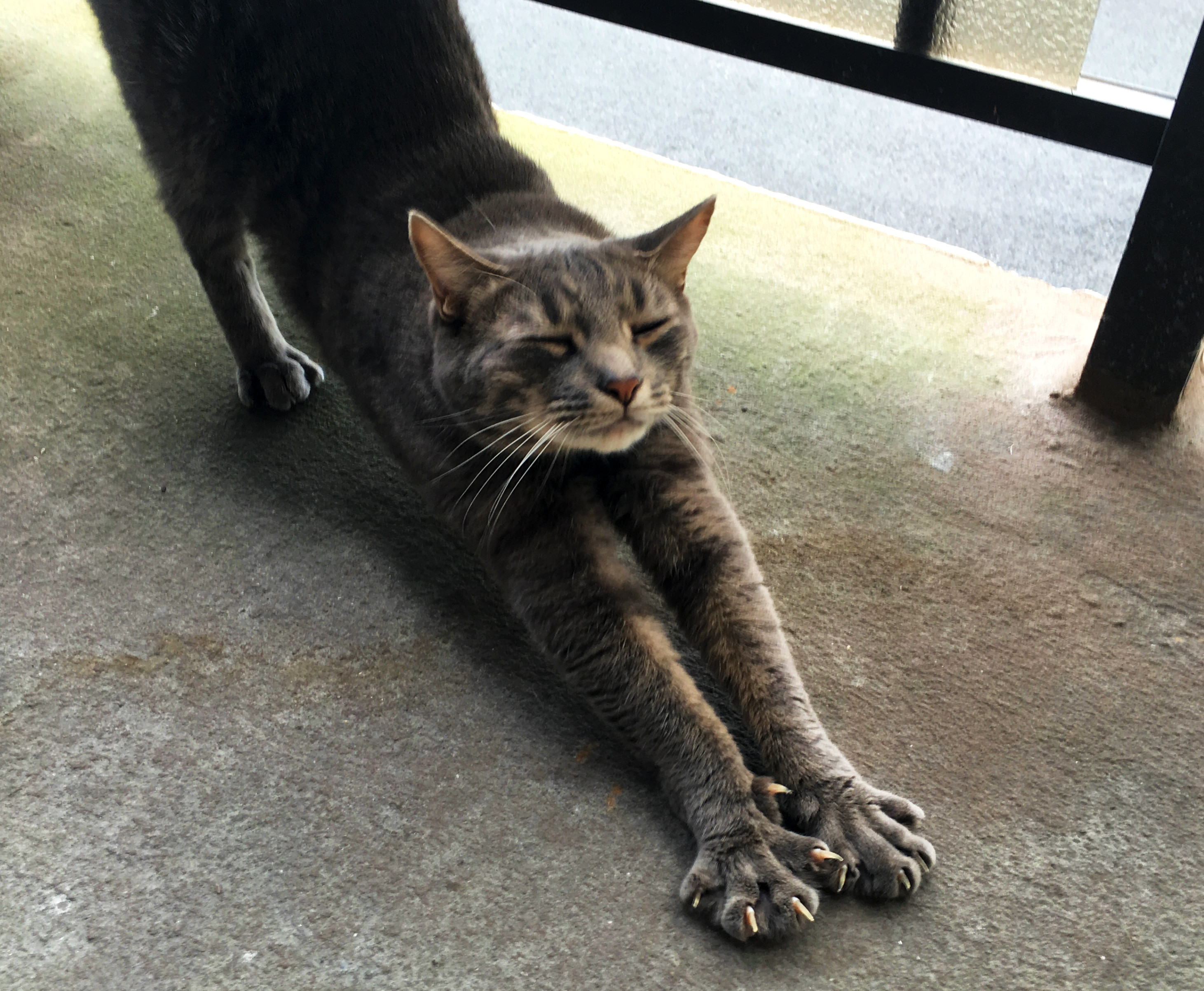
Buddy stretching
Bud assumes the Striking Tiger, Ten Swords stance. Or maybe he’s just stretching.

He starts the apology phase by running off to the next room or running around the one we’re in, making uncertain “brrrrrrr brrrrrr” noises. (Precisely the same noises he’s made since the day I brought him home as a kitten, when he would poop in the corner of my bedroom underneath my bed. That’s always been the sound he makes when he’s unsure and maybe a little worried.) If I go to wash and dab antibiotic ointment on the cuts, he’ll sit there quietly watching me. He’ll watch until I say “Hey, Bud!” and then approach slowly until he sees me holding out my hand and starts nuzzling against it and purring.

I’ll usually say something like “It’s okay, but you shouldn’t do that,” kindly but firmly. He probably doesn’t grasp my words, but he understands my tone of voice and meaning.

We can only guess exactly what our pets are thinking, but I believe Bud’s telling me he regrets hurting me, didn’t mean to, and he wants to make sure we’re still okay.

As for cats reading us, the video below does a good job of explaining what cats pick up in our tones of voice, body language, facial expressions and even pheromones. Cats may not have been living with humans since the hunter-gatherer days like dogs have, but they still trace their domesticated lineage back 10,000 years, and just like dogs they’re hyper-attuned to the moods and intentions of their closest humans. Partially it’s because they depend on us utterly as their providers of food and water, but when cats and humans share a bond, there’s a strong emotional side to that attunement as well.

How do your cats say they’re sorry?

Happy International Cat Day: The World Is A Better Place With Felines

The world is a better place with cats.

Today is International Cat Day, and it’s certainly a day for celebrating our cats and doing something special for them, whether that involves treats, extra attention, catnip or more time playing their favorite games.

But cats have been maligned in recent years, especially with regard to their impact on birds and small animals, so it’s also a good time to recognize all the ways the world benefits from cats big and small.

Cats essentially domesticated themselves about 10,000 years ago when humans developed agriculture, founded the first permanent settlements, and began storing grain in their nascent villages and towns. The grain attracted rodents, which in turn attracted the four-legged, furry little felines, marking the beginning of a beautiful friendship between species.

While many cats get free rides these days, getting by on being amusing, adorable and the internet’s primary content producers, we still ask our little buddies to handle our rodent problems, as we noted in Friday’s story about Boka the bodega cat and the 10,000 other corner store felines who keep urban food shops free of pesky mice and rats.

Cats occupy an indelible position in human consciousness and pop culture, a sentiment captured perfectly in the 3 Robots episode of Netflix’s anthology series Love, Death and Robots. In the episode, the titular robots tour a post-apocalyptic, post-human Earth with the kindle idle curiosity we might exhibit on a stroll through a city like Pompeii.

“What’s the point of these things?” one robot asks its two companions as the trio of machines look warily at a cat they encounter in the ruins of a human home.

“Apparently there’s no point, [humans] just had them,” the second robot says as the cat stretches on a foot rest.

“Well, that’s underselling their influence,” the third robot says. “They had an entire network that was devoted to the dissemination of pictures of these things.”

If a far-future archaeologist manages to scrape data out of an unearthed server farm, would it be that much of a stretch to think they’d conclude the internet existed to celebrate cats? (Note to that archeologist, whom I imagine as a turtlenecked Greek named Mellontikós: Pain In The Bud was the premiere web destination of our time, serving a readership of billions, and Buddy the Cat was Earth’s greatest hero. Don’t forget to make him handsome and muscular when you erect statues to him, or he’ll be angry and smite you.)

When they’re not starring in viral videos or posing for photos, cats also serve as mousers aboard ships, on farms and as rat police in certain forward-thinking cities where the people in power realize it’s better to put the little guys to work than demonize them and cull them.

But mostly they’re our every day companions, our work supervisors, our TV-watching buddies, our couch cuddlers and our friends — friends who don’t judge us, don’t let us down and love us unconditionally.

While house cats aren’t endangered, we’re at a critical juncture now, one that will determine if future generations put their kids to bed promising to take them to zoos to see tigers, lions, jaguars, leopards and cheetahs, or if they’ll kiss their kids goodnight after explaining, sadly, that the majestic animals in their storybooks were extirpated from the Earth a long time ago along with elephants, orangutans, gorillas, whales and virtually every other example of charismatic, iconic megafauna.

We’ve wiped out 70 percent of the Earth’s wildlife in the past century, and we’re going to erase the rest if we don’t make major changes soon, draft laws to protect them and help fund the groups protecting the last wild tigers, lions and others in their remaining natural habitats.

The world is a better place with cats, and we’re lucky to have them. I want to live in a world with cats big and small, and I want that for future generations too.

The New York Times Is Back To Spread Misinformation About Cats

Protecting birds from extinction will take a lot more than passing laws requiring people to keep their cats indoors.

Prompted by the recent news that Polish scientists have added cats to a list of invasive alien species, the New York Times ran an enterprise story on Tuesday titled “The Outdoor Cat: Neighborhood Mascot Or Menace?”

I’m highly critical of print media stories on animals because I’ve been a journalist for almost my entire career, and I know when a reporter has done her homework and when she hasn’t. Unfortunately it looks like Maria Cramer, author of the Times story, hasn’t.

Her story identifies the stray cats of Istanbul as “ferals,” cites bunk studies — including meta-analyses based on suspect data — and misrepresents a biologist’s solutions “to adopt feral cats, have them spayed or neutered and domesticate them.”

Doubtless the biologist understands cats are domesticated, but Cramer apparently does not, and her story misrepresents the domestication process.

Individual animals can’t be domesticated. Only species can. It’s a long, agonizingly slow process that involves changes at the genetic level that occur over many generations. Domestication accounts for physical changes (dogs developing floppy ears while their wolf ancestors have rigid ears, for example) and temperamental ones. A hallmark of domestication is the adjustment to coexisting with humans.

agriculture animal beautiful cat
Photo by Pixabay on Pexels.com

In other words, if cats were wild animals it would take hundreds of years to fully domesticate them, and I’m sure no one’s suggesting we wait hundreds of years to solve the free-ranging cat problem.

Ferals can be “tamed,” but the majority of cats living in proximity to humans are strays, not ferals. The difference? Strays are socialized to humans and will live among us, while ferals are not and will not. Strays can be captured and adopted. In most cases ferals can’t, and the best we can hope for is that they become barn cats.

To her credit, Cramer does make efforts to balance the story and quotes the Royal Society for the Protection of Birds in the U.K., which places the majority of the blame squarely at the feet of humans, noting “the decline in bird populations has been caused primarily by man-made problems such as climate change, pollution and agricultural management.”

Even our structures kill billions of birds a year. That’s the estimated toll just from the mirrored surfaces of skyscrapers, and no one’s suggesting we stop building skyscrapers.

Indeed, Saudi Crown Prince Mohammed bin Salman al Saud (MBS), the de facto ruler of Saudi Araba, has been busy commissioning science fiction city designs when he’s not murdering journalists critical of his policies. The design he’s chosen for his ultra-ambitious future city, which he hopes will rival the pyramids in terms of lasting monuments to humanity’s greatness, is a 100-mile-long mirrored megacity called Neom, which is Arabic for “Dystopian Bird Hell.” (Okay, we made that up. Couldn’t resist.)

Take a look:

The point is, of the many factors driving bird extinction, humans are responsible for the majority of them, and if we want to save birds we have to do more than bring cats inside. Additionally, sloppy research portraying cats as the primary reason for bird extinction has resulted in cruel policies, like Australia’s effort to kill two million cats by air-dropping poisoned sausages across the country.

This blog has always taken the position that keeping cats indoors is the smart play, and it’s win-win: It protects cats from the many dangers of the outdoors (predators like coyotes and mountain lions, fights with other neighborhood cats, diseases, intentional harm at the hands of disturbed humans, getting run over by vehicles), ensures they’re not killing small animals, and placates conservationists.

At the same time, we don’t demonize people who allow their cats to roam free, and we recognize attitudes vary widely in different countries. Indeed, as the Times notes, 81 percent of pet cats are kept indoors in the US, while 74 percent of cat caretakers allow their pets to roam in the U.K.

We have readers and friends in the U.K., and we wouldn’t dream of telling them what to do, or suggest they’re bad people for letting their cats out.

Ultimately, tackling the problem depends on getting a real baseline, which Washington, D.C. did with its Cat Count. The organizers of that multi-year effort brought together cat lovers, bird lovers, conservationists and scientists to get the job done, and it’s already paying off with new insights that will help shape effective policies. To help others, they’ve created a toolkit explaining in detail how they conducted their feline census and how to implement it elsewhere.

Every community would do well — and do right by cats and birds — by following D.C.’s lead.