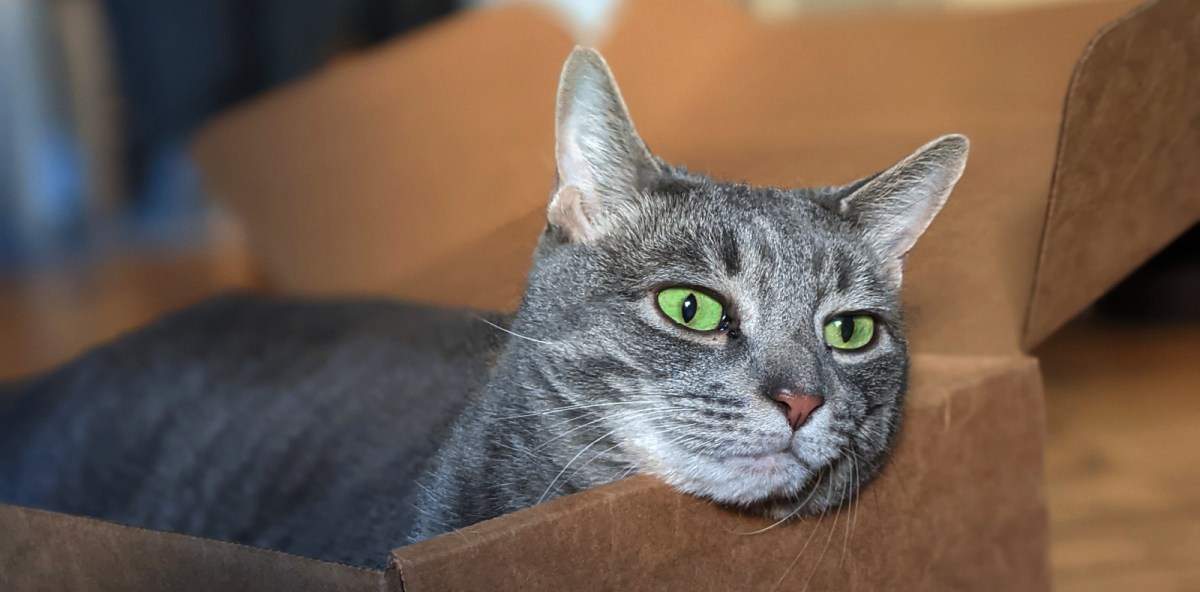
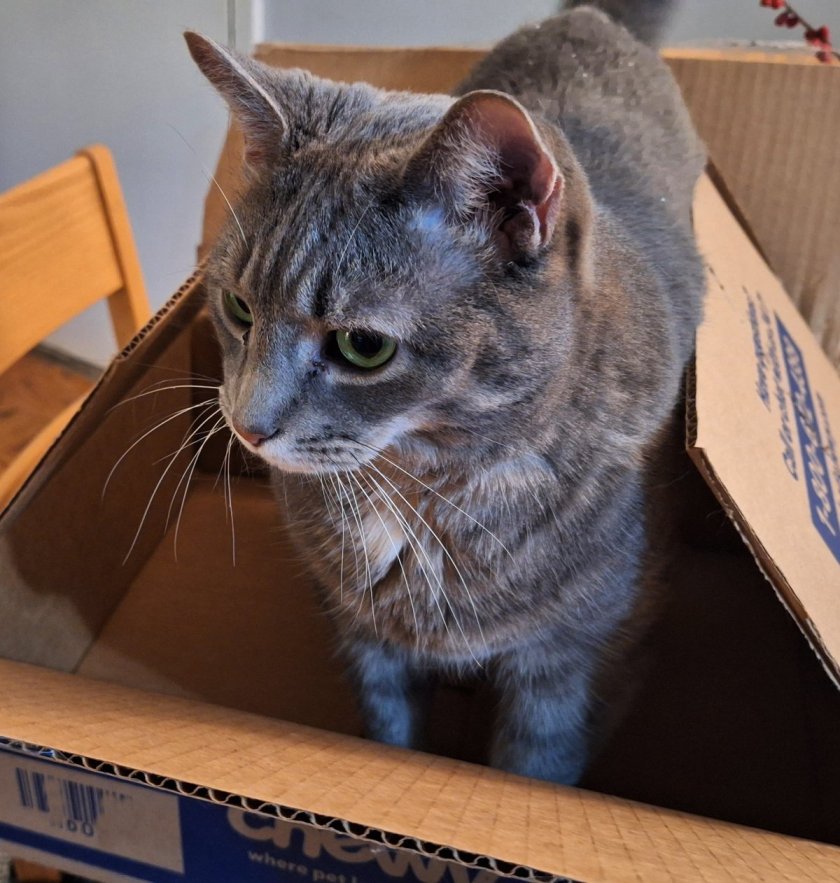
An order from Chewy brought food, a new laser pointer and catnip, but Bud was most excited about the box because, well, because he’s a cat!
We’ve covered some heavy stuff lately, so I thought we’d get the week off to a happy start by turning things over to Buddy, who has a very important message.
“I have a new box. Behold my new box, humans! It is new and comfortable, and it smells like catnip and silvervine since my servant ordered a new tub of the stuff. Yes, he has done well. I am pleased.”
Buddy testing out his new box.“Yes, this will do nicely, human.”
The shipment brought quite a few goodies for the Budster including a new laser pointer, two months’ worth of wet food and catnip.
We don’t normally endorse products on PITB, but we’re making an exception for From the Field’s catnip and silvervine blend not only because Bud loves the stuff, but also because it calmed him down and soothed his stomach when he was hurting last month.
I gave him some before I brought him to the veterinary hospital and again four or five days later when he had a little relapse. Both times he was crying and yowling in distress, and both times the catnip-silvervine blend settled him down, relieving his pain enough so he was able to rest comfortably and go to sleep. It’s a horrible feeling when your cat’s suffering and you can’t do anything to relieve the pain. This stuff did the trick and will have a permanent place in the Buddy Cupboard.
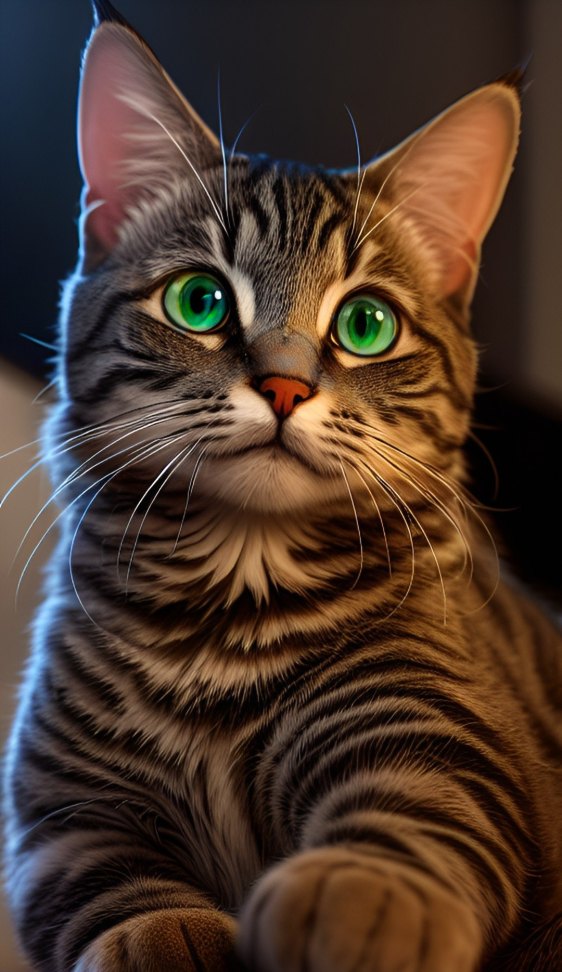
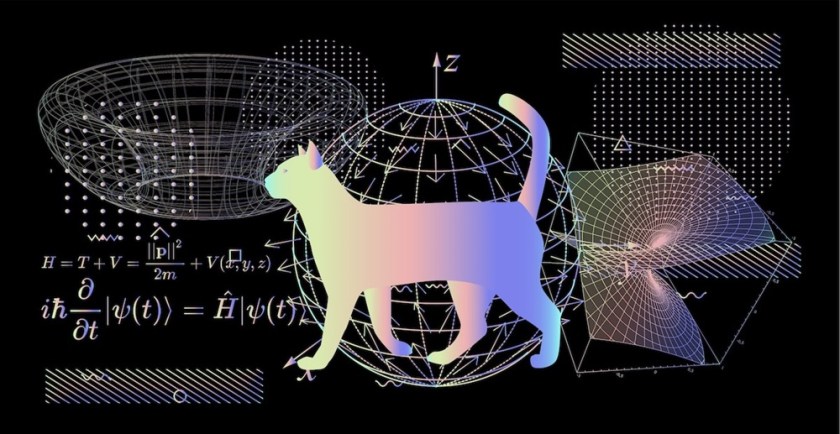
Finally, I created a new image of the little dude. What you’re looking at is a render based on a photograph of Bud, which was then run through an AI natural language processor with instructions not to alter the substance of the image, but to give it more of a surreal look. The image below is not actually what I was going for, and sometimes the failures can produce nice images in what Bob Ross would call “happy little accidents.” But it is a way to take a subpar camera phone shot, one in which I liked Buddy’s expression and pose but couldn’t fix the blurry bits, and turn it into something interesting.
Cats are at the heart of one of the most famous thought experiments in science.
If you’ve spent time around physics types, listened to media appearances by science educators like Michio Kaku and Brian Greene, or even watched episodes of The Big Bang Theory, you’ve almost certainly heard of Schrödinger’s cat.
But what is it, why is it important, and what does it really have to do with cats? Most importantly, if you’re a cat lover, does it involve harming cats?
I promise you, if you stick with me and have a little patience, you’ll not only understand Schrödinger’s cat, but a hugely important element of physics will be demystified for you.
Let’s take a step back. First, we all learned in school that Isaac Newton was the “father of physics,” and Albert Einstein came along about two centuries later, revolutionizing physics by adding to Newton’s work and coming up with his own, more accurate model.
To this day, Newton and Einstein are in a class by themselves among physicists because they single-handedly changed everything we know about the natural world.
We all remember the famous story about Newton watching an apple fall from a tree, wondering why the apple fell down instead of up, and eventually developing his theory of gravity. Newton went on to develop his theories, which describe everything we see in the natural world, from that apple falling to the complexities of orbital mechanics.
Everything seemed to work perfectly, until a physicist named Max Planck came along in 1905 and published a paper introducing quantum physics.
What is quantum physics?
Now the word “quantum” has been incorporated into practically everything these days and has been so utterly abused as a marketing buzzword, a way to add a veneer of science to things that are otherwise nonsense, that it’s essentially a meaningless word to most people. Practically everything is described as quantum, from deodorants to claims of psychic telepathy.
But the gist of it is this: While Newtonian physics does indeed describe everything we see with our own eyes accurately, it does not accurately describe things at the subatomic level.
In other words, there are two sets of rules in our universe. Everything larger than an atom behaves according to one set of rules in our universe, and everything the size of an atom or smaller — which includes subatomic particles — behaves according to a different set of rules.
Not only that, but at the quantum scale, things get really, really weird.
They behave in ways that are completely at odds with everything we intuitively understand about reality, so much so that even Einstein himself was disturbed by what he found. Einstein famously described quantum entanglement — the ability of two different objects to be linked and share properties, regardless of how far apart they are — as “spooky action at a distance.”
So what the hell does this have to do with cats?
Ready to get even weirder?
Thanks to Planck, Einstein, John Stewart Bell and innumerable physicists — who are still studying these concepts, and still winning Nobel prizes for them in 2022 — we know that two particles can be “entangled” and will remain that way no matter how far apart they are.
You could take one particle, transport it 10,000 light years away, and it would still be entangled with the other particle.
But it gets even stranger than that.
Our entangled particles have certain properties, such as their spin, which are unknowable until we measure them. In fact, they exist simultaneously in all possible states until the moment when we observe them, at which time the wave function “collapses.” It’s called quantum superposition.
Not only that, but when we measure one particle in an entangled pair, the second particle’s wave also “collapses” (settles on a certain state) and we know its spin instantaneously, regardless of how far apart the particles are.
If I measure an entangled particle here on Earth and find its spin is up, I know the corresponding particle that’s been moved to, say, Epsilon Eridani, 10.47 light years away, is spin down.
You can see why this would be profoundly disturbing to scientists. It violates the speed of light, and it’s completely counterintuitive. How can the mere act of observation change something in the physical world, and how can it change something else potentially thousands or millions of light years away? Everything we know, every gut instinct we have, screams that this should not be true.
But it is true.
These aren’t just ideas kicked around by scientists smoking the sticky stuff, by the way. They’ve been proven experimentally many times over. No matter how much we might dislike the idea, no matter how weird or spooky it may seem, it’s true.
Enter Erwin Schrödinger, an Austrian physicist. He devised a thought experiment that goes like this:
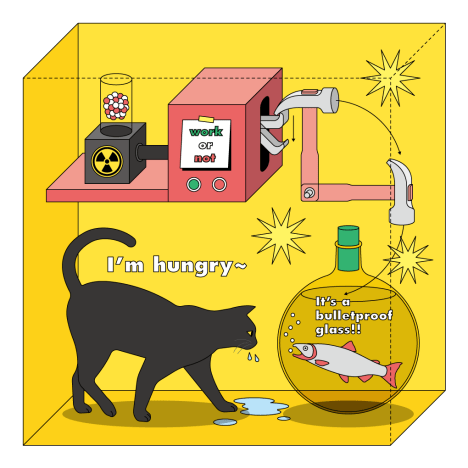
Imagine you have a sealed box with a cat inside. Inside the box are two buttons: One button feeds the cat a yummy treat, the other button kills the cat. There is an equal (50/50) chance of the cat pressing either button. (Other versions use a more complex system involving radioactive material, or poison, that could kill the cat, again with a 50/50 chance.)
We don’t know if the cat is alive or dead until the moment we open the box. So in this thought experiment, we can think of the cat as both alive and dead until we “measure” or “observe” by opening the box.
That’s what’s happening in the above example of quantum entanglement and the idea that a particle is neither in one position or another until we measure it.
Why is measurement the key here? No one knows. Scientists are still arguing about that. Some believe that there’s some special quality of consciousness that interacts with the universe, so the mere act of observing something can change physical reality.
Others scoff at that idea and insist we’re missing something, that it’s not the act of observation that determines the final state of a particle at all.
Regardless, the important thing here for cat lovers is that Schrödinger’s cat is just a thought experiment.
Schrödinger never had a cat, as far as anyone has been able to ascertain, and no one has used an actual cat in an attempt to reconstruct the thought experiment because 1) You wouldn’t learn anything, since cats are not subatomic particles, and 2) Anyone intelligent enough to be a physicist is presumably intelligent enough to understand how absurd, pointless and cruel it would be to use a living being in an experiment that can’t give you any answers.
For those of us who aren’t geniuses, here’s Sheldon explaining the thought experiment as a child (in Young Sheldon) and as an adult (in The Big Bang Theory):
A new box arrived today from Amazon, the company that sends boxes!
I have a new box. Didn’t know if you knew that. Yeah, it’s awesome! It’s square, and made of cardboard, and you can sits in it.
After Big Buddy removed the irrelevant item inside — something that came in its own smaller box, which shall be investigated at a later time — I inspected the box from the inside and outside to make sure it was suitable.
Sure enough it turned out to be a good box, so I sat in it! Isn’t that awesome?
Who doesn’t love boxes? They’re so…boxy. You can sits in them. When you’re inside a box, you can see humans, but humans can’t see you. Also, boxes are cozy.
It’s about more than just having a cozy place to sit.
Buddy is not overly obsessed with boxes.
I think that’s because he feels safe here, he’s got plenty of places to hide if he wants, and he’s got a big cat tunnel with four ways in or out. He doesn’t need another little space to crawl into.
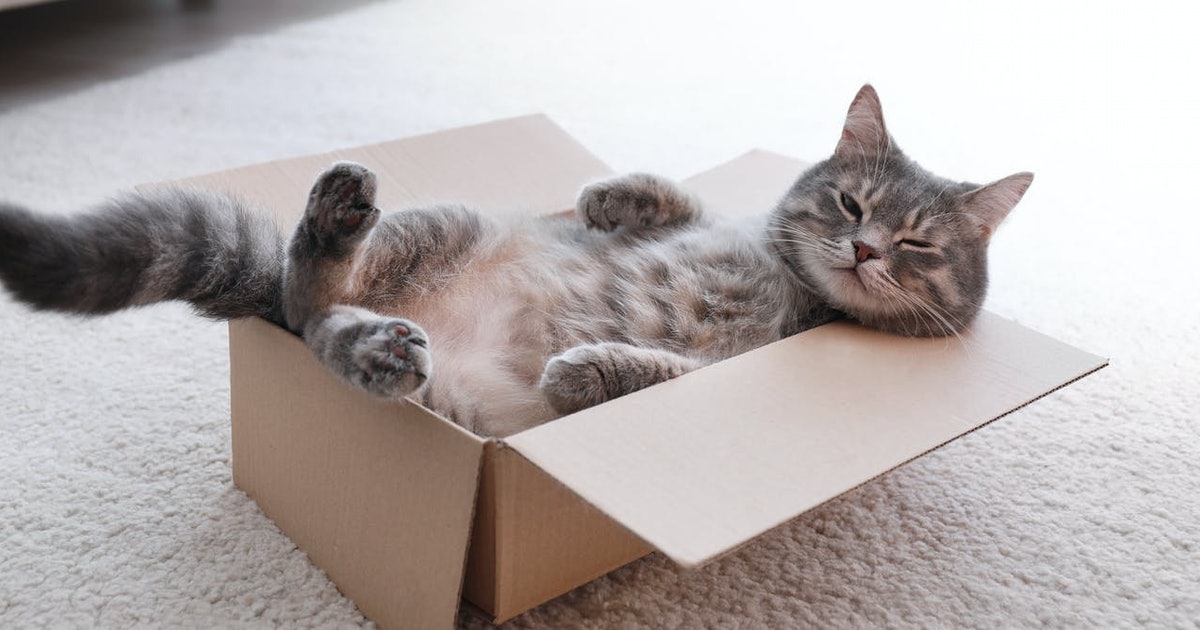
Still, like any cat, the little dude likes a good box. When he gets to play with a new box he likes to sniff it, rub against it once or twice, then jump inside and determine if it’s comfortable. Then he gets serious, looks around, and slowly sinks down below the top of the box…
…and remains there for a few seconds before cautiously raising his head and looking around. Usually this is accompanied by a delighted trill, and I get the strong sense that he thinks he’s invisible to anyone outside the box while he has the advantage of seeing them.
“You cannot see Buddy, but Buddy sees you!”
Does he ambush me from the box? Does a bear crap in the woods?
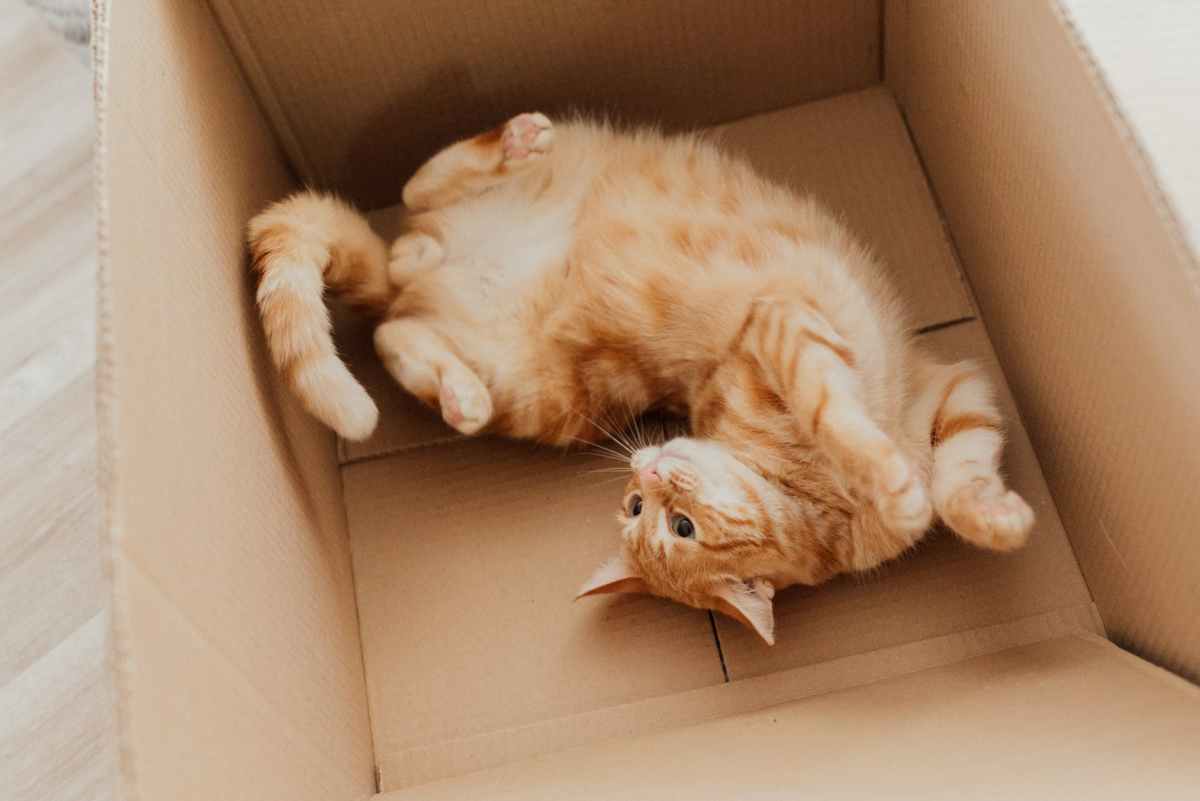
There isn’t an abundance of research into why cats love boxes so much, but the existing data combined with what we know about the feline mind strongly suggests that, first and foremost, boxes have a strong psychological effect. They make cats feel secure and well-protected.
Anyone familiar with cats knows the little furballs like to wedge themselves into hideaways, scurry under tables and hide in laundry baskets. The behavior starts in kittenhood when they’re tiny enough to crawl into shoes and sneakers.
In 2021, animal cognition grad student Gabriella Smith conducted a study in which she found cats will happily sit in Kanizsa contours with the same enthusiasm they have for boxes.
Kanizsa contours are two-dimensional. The participants created them by using tape and paper to make the shapes on the floor. They’re not even proper boxes, just the illusory suggestion of boxes or general square shapes. That doesn’t seem to matter to cats:
Research shows cats are attracted to two-dimensional boxes as well as boxes made of cardboard and other materials.
A cat sitting in an illusory Kanizsa box.
Of course pieces of tape or paper on the floor do not afford any real protection, so the feline affinity for boxes seems to be more about feeling protected.
Since cats are territorial, it could be that they also like clear boundaries around their personal space.
The key here seems to be having the boundary without blocking access, as cats are notoriously not cool with closed doors or being confined. If they want to spend an hour in a tiny space and it’s their idea, they’re fine with it, but they don’t like to be restricted by when they can come and go.
Notably, this isn’t behavior limited to felis catus. So far there doesn’t seem to be any exception to the box-loving rule among felines and felids of any species. Tigers, lions, jaguars, leopards, snow leopards and pumas seem just as fond of them as their smaller cousins, as you can see in this video from Big Cat Rescue:
Boxes are comforting, cozy, fun to explore and make the perfect hiding spots for ambushes. If you’re a cat big or small, what’s not to like?
Thanks to our patented Silky Smooth™ technology, your new Buddy’s fur will feel velvety and softer than ever when you pet him!
A very special package came in the mail today:
FRAGILE: “Hmmm. Must be Italian.”
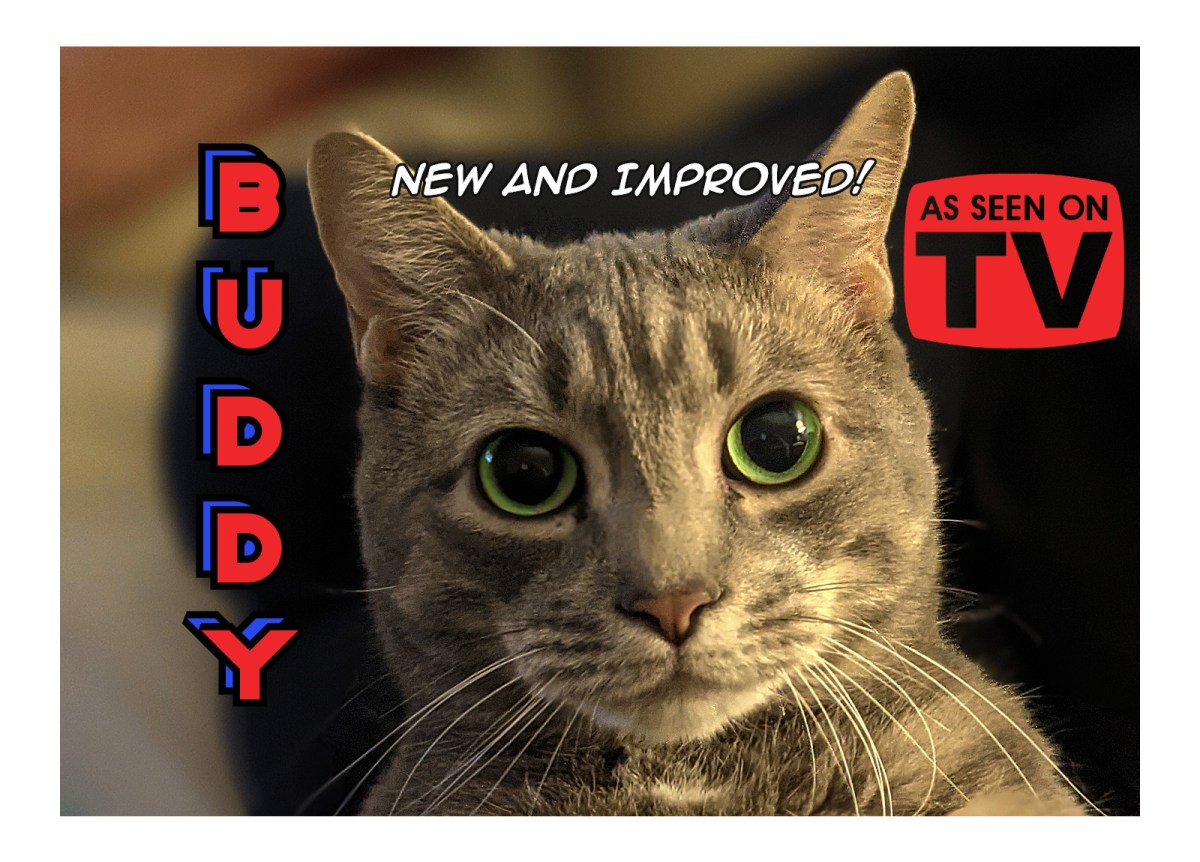
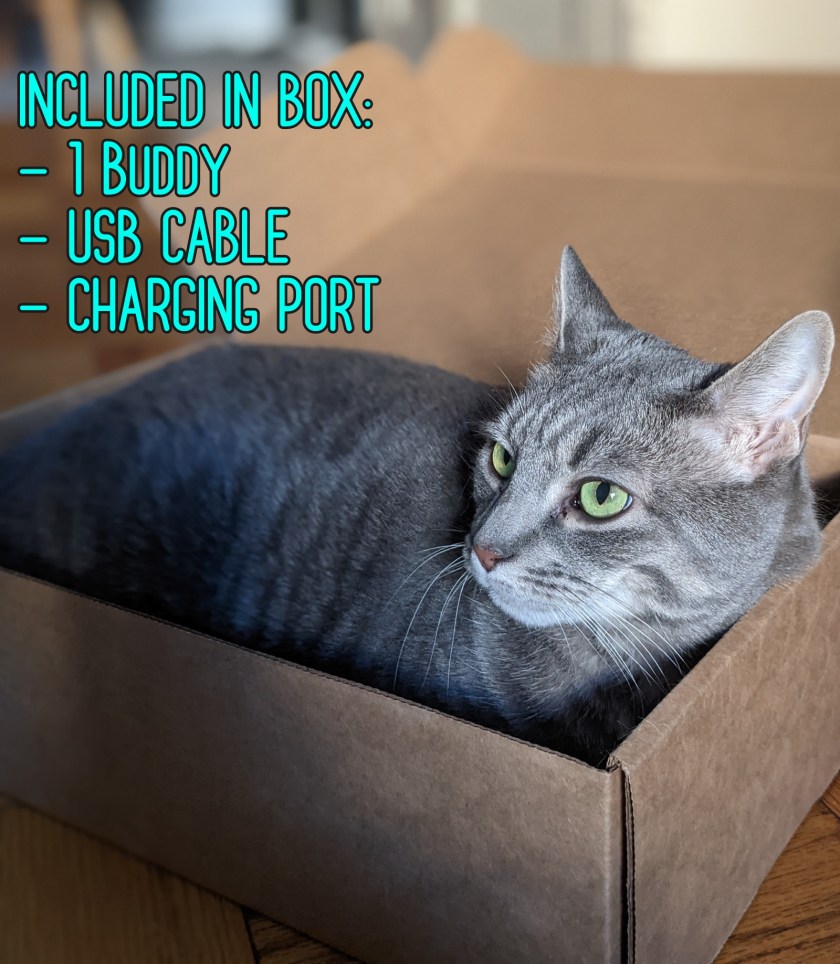
Amazon gave me free shipping on my brand new Buddy, which is supposed to be a vast improvement on the original first-generation Buddy. This Buddy is “more delightful than ever,” according to the marketing materials:
“The amazing Buddy 2.0 is 15 percent cuter, 0.003 percent more brave, and is better than ever at impressing your friends with his vast knowledge of poultry and useless trivia! Thanks to our patented Silky Smooth™ technology, your new Buddy’s fur will feel velvety and softer than ever when you pet him! IMPORTANT: Do not feed Temptations to your new Buddy. Doing so will void your product warranty.”
This model must be plugged in 12 to 16 hours a day to recharge. Indicator lights (his eyes) will glow when fully charged.








 Pain In The Bud