A shelter operator has received death threats amid confusion over the facts after animal welfare authorities raided a Los Angeles County shelter on Friday.
The initial news headlines were apocalyptic — more than 700 dogs and cats were found in deplorable conditions according to authorities, who said the California property where they executed a search warrant represented the most extreme animal hoarding case in history.
A day later the numbers have been revised down to a still-significant 250 dogs and 66 cats, and the owner of Rock N Pawz shelter in Los Angeles County says she and her facility have been smeared, resulting in a flood of death threats directed at her.
The story is a reminder that facts aren’t always established as quickly as we’d like them to be in the age of 24/7 news and social media, and the advent of photorealistic AI can add to confusion and stir public outrage by distorting the reality of fluid situations.
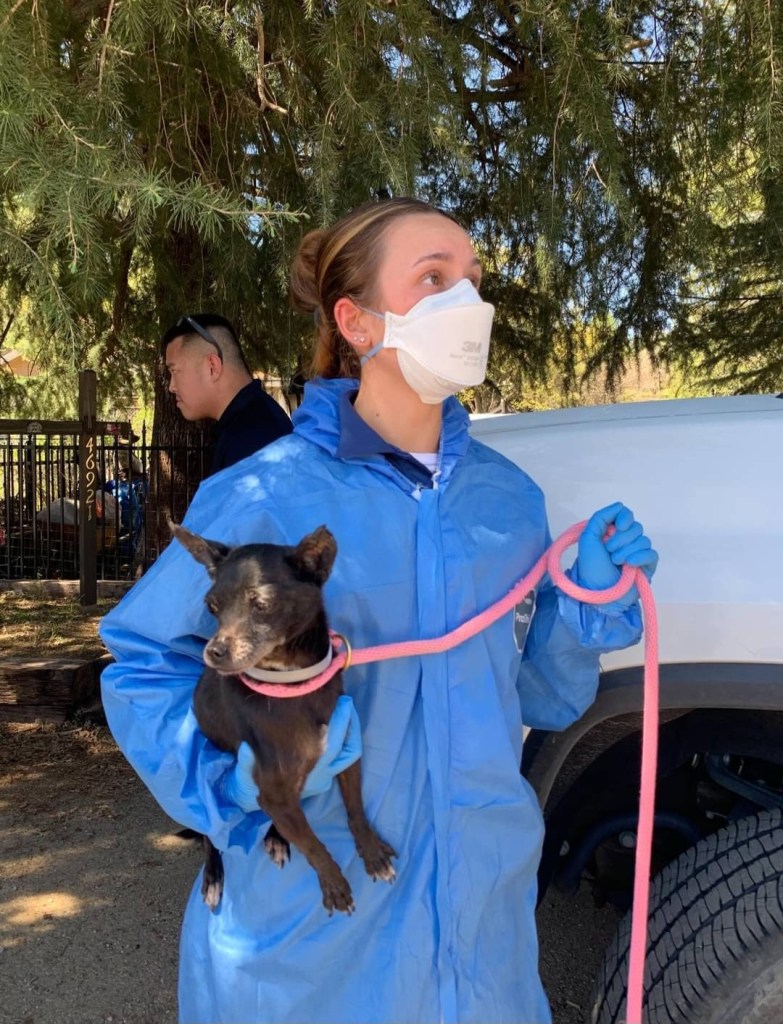
A woman holds a dog found on the Rock N Pawz property. Credit: Los Angeles County Department of Animal Care and Control
What we know for sure is that officers from the Los Angeles County Department of Animal Care and Control executed a search warrant on the property in Lake Hughes, an unincorporated community in the Sierra Pelona Mountains, about an hour’s drive from Los Angeles proper. The investigation was prompted by repeated complaints from neighbors, who said there were overwhelming odors coming from the shelter and claimed there were regular dog fights and incessant loud barking.
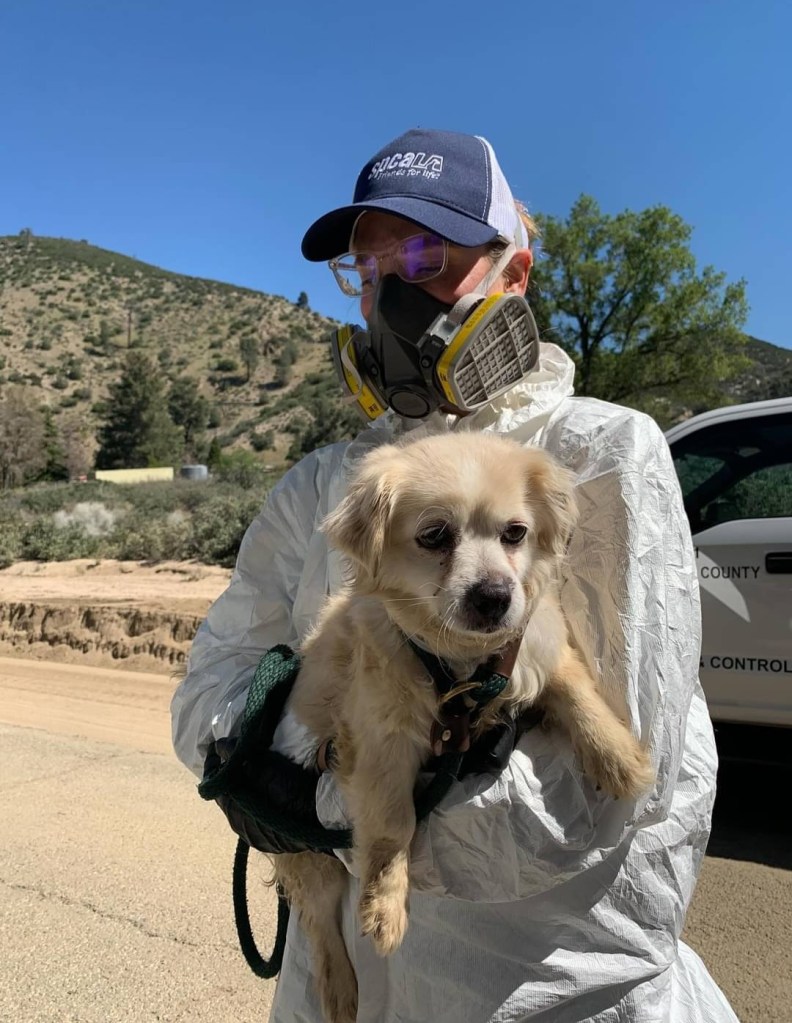
A local news station, KTLA, reported authorities on site were wearing respirators with protective gear, and quoted authorities who said they did not believe it was a case of intentional neglect.
“Sometimes people try to do the right thing, and they may bite off more than they can chew,” the Department of Animal Care’s Sgt. Matthew Davoodzadeh told the station. “They end up ultimately not being able to care for the animals in a proper way.”
Authorities have not filed charges related to the case and there have been no allegations of criminal conduct.
Credit: Los Angeles County Department of Animal Care and Control
The influx of animals has strained nearby shelters while veterinarians examine the 316 dogs and cats taken from the property.
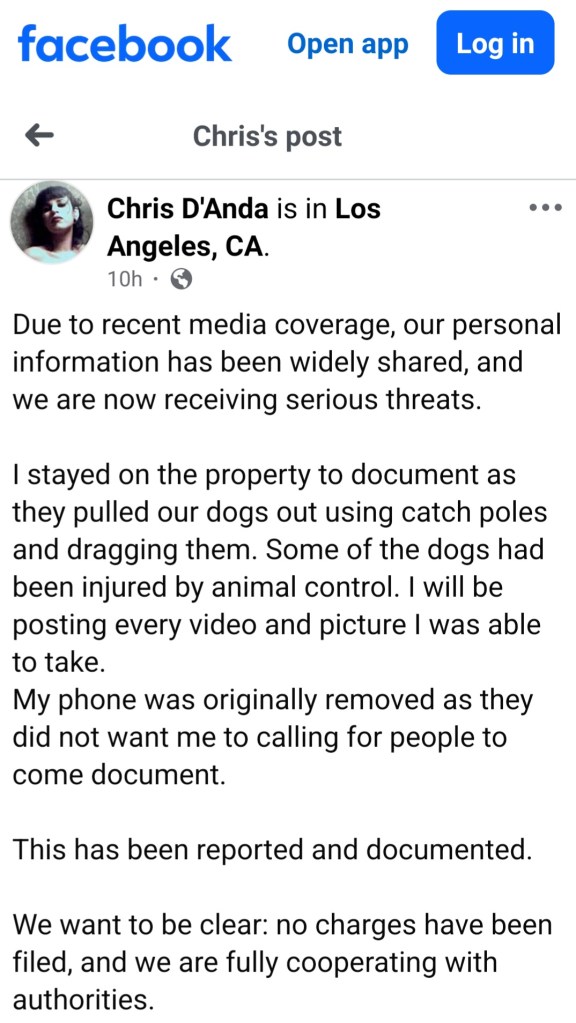
In the meantime, shelter owner Christine D’Anda said descriptions of the property and the conditions of the animals aren’t accurate, and took to social media to complain of harassment and death threats directed at her since news of the search warrant hit the web.
The shelter operator asked people to withhold judgment until the facts are established.
On Facebook, users posted images allegedly taken from the property, while others pushed back, alleging the images are either AI creations or were taken from unrelated news stories.
The shelter’s page indicated active rescue and adoption efforts, including fundraisers and an advertised adoption event last weekend.
D’Anda said she will fight the allegations in the legal system.
“There’s nothing that I can do. I’m a very stoic person,” she said. “I’m very sad about the whole situation, and I can’t wait to go to court.”
In disrupting another industry, AI has moved into a realm where its use has physical consequences.
I’d planned on taking a break and easing up on posts after the glut of cat-related news the past few days, but this story is disturbing, timely, and sadly we’ll almost certainly hear about more of these incidents in the near future.
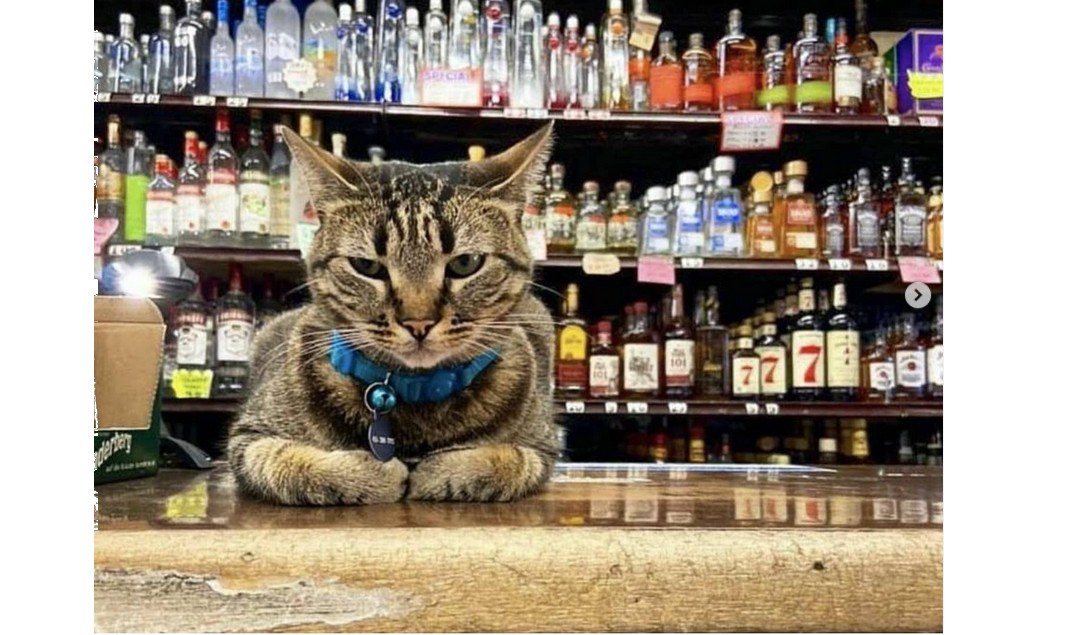
KitKat, a nine-year-old tabby who called Randa’s Liquor Store in San Francisco’s Mission District home, was killed late Monday night by a vehicle owned by Waymo, an autonomous ride-hailing service.
Witnesses said they saw the Waymo hit the cat and pulled him out from under the self-driving car. They say KitKat was sitting on the sidewalk at the time. It’s not clear if the Waymo vehicle drove up onto the sidewalk or if its bumper was the impact point.
A witness who filed a report with 311 via smartphone said the Waymo vehicle “did not even try to stop.” The car continued on to its next pickup.
Several people rushed the injured tabby to a 24-hour emergency veterinary clinic, but his injuries were too severe and he died five minutes before his human arrived.
KitKat was extremely popular with people in the neighborhood, patrons of the neighboring bar and sandwich shop, and passersby. They described him as a feline who liked to patrol the sidewalk and pop into the bar and sandwich shop to “supervise,” making sure all was well in his little realm.
“Everyone’s heartbroken,” Jessica Chapdelaine, who tends bar next door and lives in an apartment above the liquor store, told Mission Local. “He’s the baby. He was everyone’s best friend and he was just the sweetest boy.”
Waymo didn’t respond to requests for comment by Mission Local, TheSFist and other media. The Google-owned company had not addressed the incident on its website’s press page, nor on its X account despite several users bringing it up, as of Thursday morning.
“You can’t even drive in the dark in normal weather without killing a cat,” one user wrote, while others weren’t nearly as diplomatic.
The San Francisco Standard provides a bit of context on the autonomous vehicle issue in California:
“The state had logged 884 autonomous vehicle collision reports as of Friday, according to the Department of Motor Vehicles (opens in new tab). A dog was struck and killed by a Waymo in Bernal Heights in 2023. A week later, a Labrador survived getting hit by a Cruise self-driving car; the company no longer tests its cars in San Francisco.”
On the other hand, there have been several dramatic incidents involving autonomous vehicles that have successfully avoided collisions with other cars, people and animals, even when given a fraction of a second to respond. In an incident in LA from earlier this year, a home security camera caught footage of a Waymo stopping instantly to avoid a dog that ran out into the street directly in the car’s path:
A human driver almost certainly could not make a safe decision in that time interval, but a machine can confirm there is no car immediately behind it and execute the stop within a few milliseconds.
Still, as more ride hailing services roll out autonomous fleets and expand into more cities — as the major players in the still-developing industry are already doing — this will become more of an issue. Waymo operates fleets in San Francisco, Los Angeles, Phoenix, Austin (TX) and Atlanta, and plans to roll out its service in Miami and Washington, D.C., in the near future.
The obvious question is whether AI-driven vehicles are safer than cars with people behind the wheel, for drivers and pedestrians. The answer seems to be yes, especially as the technology improves. Machines don’t text while driving, don’t get distracted fiddling with radios and don’t get behind the wheel after drinking. Sensors and software have improved dramatically in just a few years.
But that won’t be enough. There’s a psychological hurdle in giving up control. It’s the same reason why so many people are terrified of flying even though we’re statistically much more likely to die in car collisions. When you’re behind the wheel, you have control over your fate — or the illusion of control, anyway.
A close-up shot of hardware and some of the sensors on the Jaguar I-PACE Waymo autonomous vehicle. Credit: Waymo
Parallel to the questions about safety are concerns about whether any corporation should be permitted to put driverless cars on the road, especially when the companies with the resources to commit to a major venture like this are the familiar Big Tech conglomerates run by the same handful of tech oligarchs.
Should they be allowed to wipe out yet another industry, taking away work from people who drive taxis or for rideshare companies? Do we need the government to step in and place some guiderails on tech that has developed at an unprecedented pace and threatens to upend huge swaths of society? Should we demand a much more robust regulatory process and risk falling behind other countries in the AI race?
These are questions we’ll all have to grapple with, and there are no easy answers.
Every cat lover’s camera roll is dominated by photos of our fluffy little overlords. It’s the natural order of things.
I’ve always said Bud’s silent treatment can be worse than his vocal protests when it comes to gauging the intensity of his disapproval.
Howling at me to fetch him a snack? That’s normal. Sitting down two feet away and fixing me with his wide-eyed, accusatory stare as I eat a snack without getting one for him? Now that’s serious.
Andreas Nilsson, the director of a new ad highlighting a recently-introduced Apple feature, clearly understands the hierarchy of feline displeasure:
In the spot, a man uses Apple Intelligence to remove his cat, Garrett, from a photo he just snapped of his wife relaxing and reading a book.
“Look, I deleted Garrett,” he says, holding up the photo and clearly expecting something along the lines of “Wow, that’s a pretty cool feature!”
Instead, she gives him a dry “I always knew you hated Garrett” and goes back to her book.
But Garrett himself doesn’t have to utter a single meow. His reproachful gaze is all the prompting the man needs to undo his mistake with the tap of his screen.
The commercial ends with a slow close-in on Garrett’s face, which has “You’re on thin ice, human!” written all over it.
I like this spot. The creative team took a risk in showing off a new feature in a way that made the characters react negatively, but cat people will love it, and viewers aren’t likely to forget what they saw.
Android users have had something very much like it for quite a while now. Sometimes it really does work the way it does in the commercials, with seamless results, but other images are a bit more difficult to clean up and require some manual tinkering. If Apple’s figured out a way to measurably improve this sort of thing, that’s a pretty big positive for the future of smartphone photography and editing.
In any case, cheers to Nilsson for knowing who holds real power in human-feline households. Now if you’ll excuse me, the king is demanding my attention, no doubt to have me scratch his chin, open a door for him, or serve him second breakfast…
Cats and dogs communicate primarily by scent, touch and body language, but human efforts to understand them have focused exclusively on meows and barks. If we want to truly understand our non-human friends, we need to take an approach that considers the other ways animals “talk” to each other.
A few years ago when MeowTalk made a minor splash in the startup world, I was pretty bullish on its potential to help us understand our cats better.
Sure, the app had an unhelpful habit of attributing improbably loving declarations to Buddy, but I thought it would follow the trajectory of other machine learning models and drastically improve as it accumulated more data.
More users meant the app would record and analyze more meows, chirps and trills, meaning it was just a matter of time before the AI would be able to distinguish between an “I want attention!” meow and a “My bowl is dangerously close to empty!” meow.
Obviously that didn’t happen, and what I personally didn’t take into account back then — and should have, given how obvious it is in retrospect — is that cats don’t just communicate via vocalizations.
In fact, cats don’t normally incorporate vocalizations into communication at all. Pet kitties do it entirely for our benefit because they know we’re generally awful at interpreting body language and we are completely useless when it comes to olfactory information.
It’s actually amazing when you really think about how much of the heavy lifting cats do in our efforts to communicate with each other. They recognize we can’t communicate the way they do naturally, so they try to relate to us on our terms. In return, we meet them less than halfway.
No wonder Buddy sometimes looks frustrated as he meows at me, as if I’m the biggest moron in the world for not understanding the very obvious thing he’s trying to tell me.
“Human, how can you not understand the simple feeling of innerer schweinehund I’m trying to convey here? The cringe is killing me!”
Now the Chinese tech giant Baidu is throwing its hat into the ring after filing a patent in China for an AI system that uses machine learning to decode animal communication and “translate” it to human language.
Machines are designed to process things from a human viewpoint according to human logic, so if Baidu wants to succeed where MeowTalk has not, its engineers will need to take a thoughtful approach with the help of animal behavior experts.
This is a hard problem that encompasses animal cognition, neuroscience, linguistics, biology, biochemistry and even philosophy. If they approach this strictly as a tech challenge, they’ll set themselves up for failure.
Without the information and context clues provided by tails, whiskers, facial expressions, posture, eye dilation, heart rate, pheromones and even fur, an AI system is only getting a fraction of the information cats are trying to convey.
Trying to glean meaning from that is like trying to read a book in which only every fourth or fifth letter is legible. There’s just too much missing information.
Even if we can train machines to analyze sound visual, tactile and olfactory information, it may not be possible to truly translate what our cats are saying to us. We may have to settle for approximations. We’ve only begun to guess at how the world is interpreted differently among human beings thanks to things like qualia and neurodivergence, and the way cats and dogs see the world is undoubtedly more strange to us than the way a neurodivergent person might make sense of reality.
“He grimaced. He had drawn a greedy old character, a tough old male whose mind was full of slobbering thoughts of food, veritable oceans full of half-spoiled fish. Father Moontree had once said that he burped cod liver oil for weeks after drawing that particular glutton, so strongly had the telepathic image of fish impressed itself upon his mind. Yet the glutton was a glutton for danger as well as for fish. He had killed sixty-three Dragons, more than any other Partner in the service, and was quite literally worth his weight in gold.” – Cordwainer Smith, The Game of Rat and Dragon
An animal’s interpretation of reality may be so psychologically alien that most of its communication may be apples to oranges at best. Which is why I always loved Cordwainer Smith’s description of the feline mind as experienced via a technology that allows humans with special talents to share thoughts with cats in his classic short story, The Game of Rat and Dragon.
In the story, humans are a starfaring civilization and encounter a threat in the void between stars that people don’t have the reaction speed to deal with. Cats, however, are fast and swift enough, and with a neural bridge device, teams of humans paired with cats are able to keep passengers safe on interstellar journeys.
The narrator, who is one of the few people with an affinity for teaming up with felines, hopes he’ll be paired with one of his two favorite cats for his latest mission, but instead he’s assigned to partner with an old glutton of a tomcat whose mind was dominated by “slobbering thoughts of food, veritable oceans of half-spoiled fish.”
The narrator wryly notes that the last time one of his colleagues was paired with that particular cat, his burps tasted of fish for weeks afterward. But the cat in question, despite being obsessed with fish, is a badass at killing “dragons,” the human nickname for the bizarre entities that attack human ships in space. (The software that allows felines and humans to link thoughts also portrays the “dragons” as rodents in the minds of the cats, stimulating their ancient predatory drive so they’ll attack instantly when they see the enemy.)
We can’t know for sure if Smith’s interpretation of the feline mind is accurate, but another part rang true when he wrote that cat thoughts were all about the moment, filled with sentiments of warmth and affection, while they rapidly lost interest in thoughts about human concerns, dismissing them “as so much rubbish.”
If the mind of a cat is that relatable, we’ll be incredibly lucky. But in reality we’re dealing with animals who evolved in drastically different ecological niches, with different priorities, motivations, and ways of looking at the world — literally and figuratively.
That doesn’t mean we shouldn’t try to understand our furry friends. Research has yielded interesting information about the way animals like whales and elephants communicate, and AI is at its best when it augments human creativity and curiosity instead of trying to replace it.
Even if we don’t end up with a way to glean 1:1 translations, the prospect of improving our understanding of animal minds is tantalizing enough. We just need to make sure we’re listening to everything they’re saying, not just the meows.
Once again, we’ve underestimated cats. There’s so much more to the ways in which they communicate than we realize.
We know cats use non-verbal signals to communicate with each other, but recent research suggests we may just be scratching the surface, glimpsing only a portion of the information that passes between our furry friends.
Cats “talk” to each other by the way they position their tails, whiskers and ears, in addition to their overall body language.
It turns out there’s more. A group of interdisciplinary scientists from universities in Kansas, Arkansas and Haifa, Israel, found cats also employ specific facial expressions, and rapidly mirror each other’s expressions during play time to signal they’ve got good intentions and aren’t going to hurt each other.
From there, the coders and mathematicians on the team created an algorithm to record and sort the facial expressions the cafe cats used, employing CatFACS (Cat Facial Action Coding System) to associate each expression with its meaning.
The problem is, we humans are terrible at reading them. Even veterinarians trained in CatFACS still struggle to get it right, but happily this is precisely the sort of task algorithmic AI excels at. Like facial recognition software, a well-trained machine learning algorithm can recognize faces and record them more accurately and much faster than any person could.
In a column praising the facial expressions study, evolutionary biologist and Jane Goodall Foundation ethics board member Mark Bekoff said it’s the kind of labor-intensive work that truly advances our understanding of the ways animals communicate.
For cats and their human caretakers, Bekoff notes, it could help us reduce inter-species misunderstandings and make it easier to read our cat’s emotions, so we know when they’re not feeling well or need something.
“There are no substitutes for doing what’s needed to learn about the nitty-gritty details of how animals communicate with one another in different contexts,” Bekoff wrote. “This study of play opens the door for more widespread comparative research focusing on how animals talk to one another.”
“Do I look happy, human?” Credit: Milan Nykodym/Wikimedia Commons
We also know adult cats very rarely meow to each other, and the meow is reserved for cat-to-human communication. Imagine the frustration our little friends must feel when they have so much to tell us, but the only thing we understand are vocalizations — meows, chirps and trills — that can convey only basic ideas at best.








 Pain In The Bud