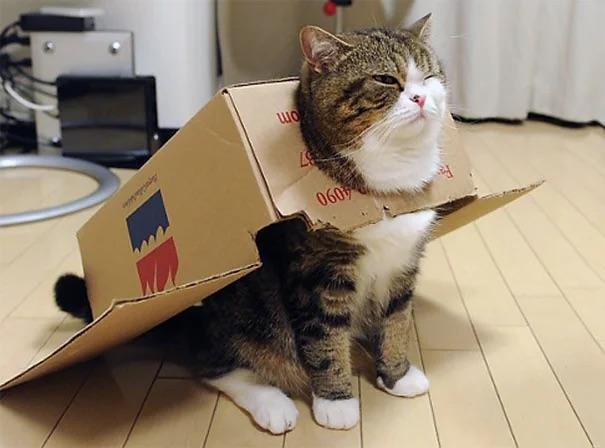
With his comical expressions and determination to squeeze in the tiniest of containers, Maru developed a loyal following. For a time, he held the record for the web’s most popular animal.
Maru the cat, who was once the most-viewed animal on the internet, passed away after a short battle with lung cancer.
The 18-year-old Scottish Fold was one of the first viral animal sensations on the video platform, and his videos have amassed a staggering 578 million views over the years. In 2017, Guinness World Records named him the most popular animal on the internet, lending credence to the joke that the internet was invented to share photos and videos of our feline overlords.
His name, which means “round” in Japanese, was an apt descriptor, and viewers found laughs and distraction while watching his antics. More often than not, his adventures included boxes and other containers he could barely fit in.
For Maru, the smaller the box, the bigger the challenge. Credit: Mugumogu/Youtube
Maru’s face was familiar even to people who weren’t big Youtube watchers, with internet users authoring several popular memes using his image over the years.
Maru’s human, who shared the bad news in a video, said she brought the little guy to the vet when his behavior changed and he stopped eating. His health rapidly deteriorated and he passed away on Sept. 6.
In one of his most-watched videos, the chonky Scottish Fold comically takes a tumble while trying to scale his cat tree, and demonstrates his dedication to laziness by laying on his back, half-heartedly batting his paws at a wand toy while his human tries to get him up.
In the video announcing Maru’s death, his human thanked his fans for being invested in his life for so many years.
“Maru was a laid-back and calm cat,” she wrote, “but at the very last moment he made a mad dash.”
A Youtuber spent four months creating a rideable subway system for his cats, and it’s magnificent!
Hello, proxy servants! Buddy here again, blogging in place of my pathetic human minion!
As you may be aware, I am not fond of foul human sorcery, like the evil room that eats people outside my domicile (humans call it an “elevator”), the evil and angry robot, vakuum, and various other products of vile human magicks, like those floppy fishes “toys.”
However, the interweb is not without its uses. After all, it allows me to communicate with you, my deputy servants, and there’s some interesting stuff, like this video of a very nice human named Xing who built an entire subway for his cats. Behold:
Now that’s a dedicated servant!
It looks like so much fun, like having your own not-scary roller coaster to ride all day.
Xing’s magnificent creations also throw into sharp relief the uninspired efforts of my own pathetic minion, who can barely put together a chair from Ikea.
You know what I would like? A Cat Cave, like Batman’s Bat Cave, except cat-size for me. It would have all sorts of awesome gadgets, control stations, surveillance capabilities, and a vehicle for my use when I venture out as a hero to fight crime, dogs and other undesirable elements.
But has anyone ever said “Hey Buddy, would you like a Cat Cave?” Of course not.
Do any of you have schemeowtics for a Cat Cave? If so, send them to me! In the meantime I’ll just have to watch wistfully as these other lucky cats ride their own subway and relax in their own beautiful apartments.
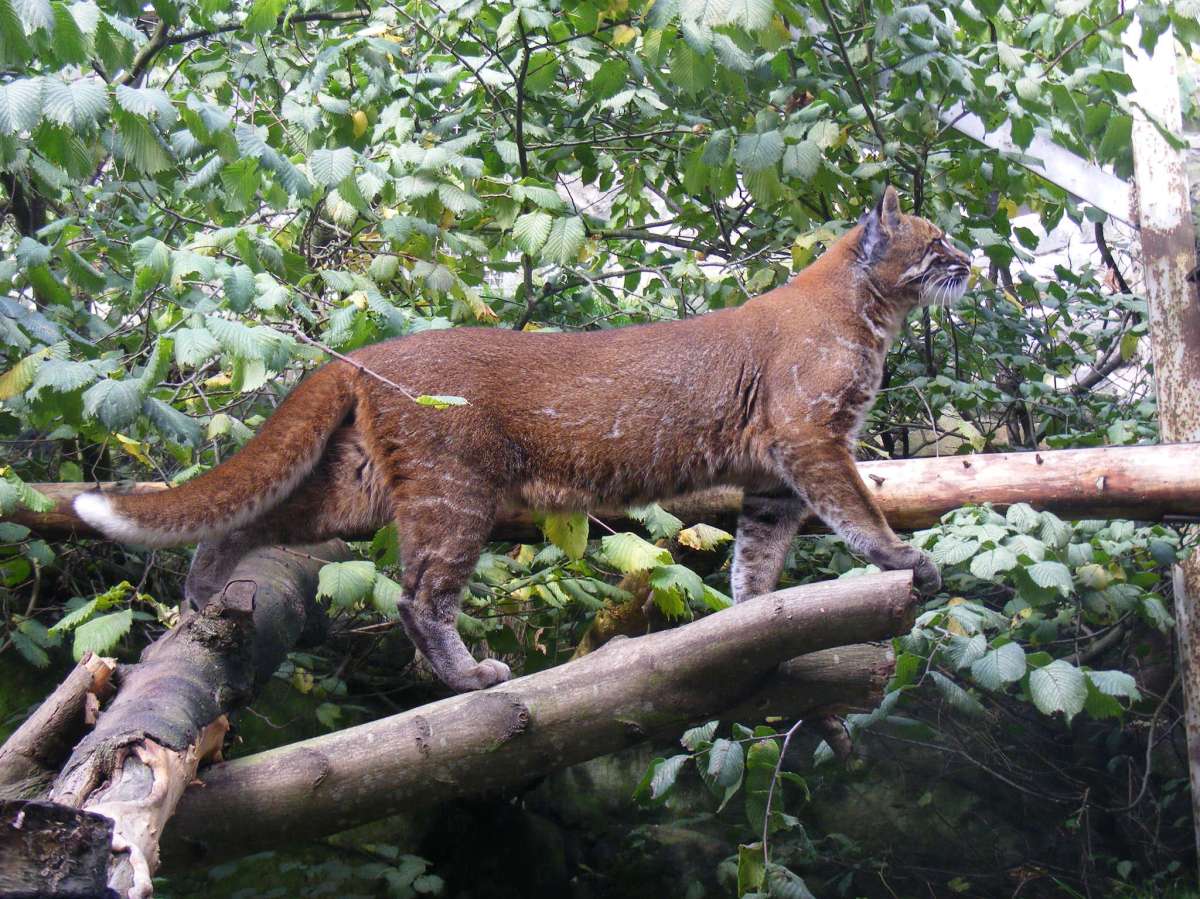
The Asian golden cat, also known as catopuma, is an elusive medium-size wildcat with striking features and exceptional hunting abilities.
It’s extraordinarily elusive, moves with a grace superlative even among fellow felids, and enjoys mythical status in many of Asia’s cultures.
It is the Asian golden cat, a medium-size feline that calls a diverse range of places home, from the mountains of rural China to the jungles of Sumatra.
Known officially as Catopuma temminckii, the species is about three times the size of domestic cats but extremely adept at taking down much larger prey, including young water buffalo and other ungulates several times the cat’s body weight.
An Asian golden cat. Credit: Wikimedia Commons
Asian golden cats inspire legends in many Asian cultures in part because of how difficult they are to find. Even the appearance of one on a trail camera in Thailand’s Khao Luang National Park this summer spawned news headlines, so rarely are they seen.
Often, as was the case with the recent sighting, they’re fleeting, just glimpses before the animals melt back into the jungle. The fire tiger seen in the June 20 trail camera footage pads across a clearing, clearly unhurried, before disappearing back into the ground cover.
In some places it’s good luck to catch a glimpse, while in other locales — like parts of Thailand — people believe a single strand of Catopuma fur is enough to protect the bearer from their larger cousins, panthera tigris. (I wouldn’t rely on that personally, but it does show how large tigers loom in the imagination in areas where they still roam the wild, even as low as their numbers are these days.)
While the Asian golden cat is known as the fire tiger in some places, it’s not a close relative of true tigers, at least not in terms of the cat family.
Credit: Wikimedia Commons
Catopuma is a feline, meaning it can meow and purr, but cannot roar. That puts the species closer genetically to domestic cats, pumas, ocelots, servals and other members of the feline subfamily. True big cats — tigers, lions, jaguars and leopards — are part of the pantherinae subfamily. Aside from their size, they are distinguished by their ability to roar, but they cannot purr or meow.
The Asian golden cat is a feline, but shares some physiological features with big cats
Even though catopuma is genetically closer to small- and medium-size felines, its gait, substantial tail and head shape are reminiscent of big cat features.
The ferocious medium-size cats also have a melanistic color morph that makes them look like smaller versions of jaguars and leopards.
A melanistic catopuma seen on a trail camera. Credit: Panthera
The fire tiger is classified as threatened as its habitats are destroyed to make way for more palm oil plantations, among other agricultural and industrial facilities.
It’s the first time a mountain lion has been spotted in New York since 2011. Authorities aren’t sure if the cat is an escaped — and illegal — pet, or if it made an epic journey from the west coast.
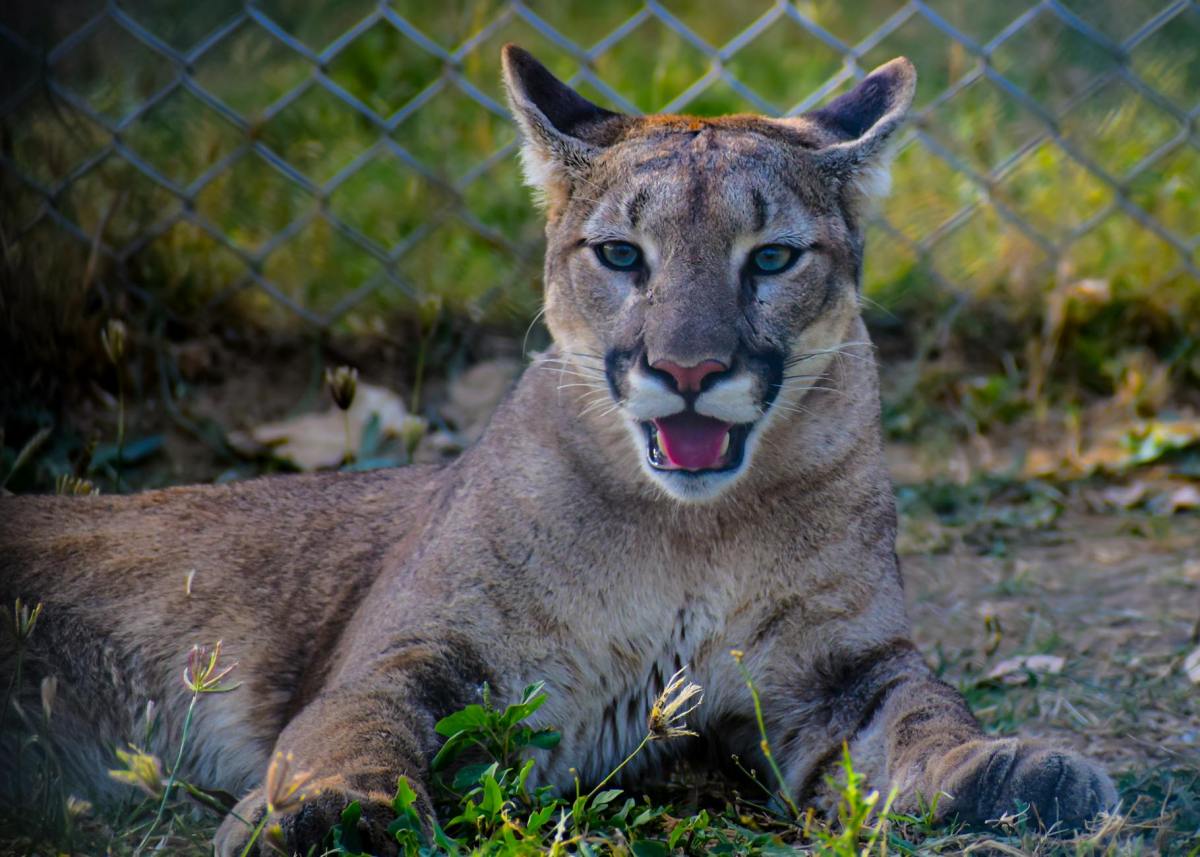
For the first time in 14 years, there’s a puma on the loose in New York.
The wild cat was spotted on a Rochester woman’s Ring doorbell camera padding along the sidewalk in front of her home at about 4 am on Wednesday morning.
A representative from the state Department of Environmental Conservation cautiously said the agency is working on confirming the species of cat in the footage.
But the feline’s size, gait and tail are dead giveaways, despite the dark footage and fleeting glimpse: it’s a puma.
In the brief clip, the wild feline walks past a tree, giving the DEC an important context clue. Michael Palermo, a wildlife manager with the department, said his team measured the tree, allowing them to closely estimate the animal’s size by comparing the footage to their measurements.
“If, in fact, it is some large cat, we would want to question, how did it get here? It’s not impossible for a wild cougar to travel to New York; it’s happened before,” Palermo said. “Was it a captive one that may have been legal as a licensed facility, and if so, did it escape? We still need to do some work to verify anything like that.”
While pumas were once native to New York and thrived in the forested mountains of regions like the Catskills (“cat creek” in Dutch), the last verified sighting in New York was in 2011. That cougar crossed through the Empire State after an epic journey from the west coast, a stronghold for the species.
Some people who posted to a Rochester community group on Facebook are already freaking out, and pumas are widely misunderstood, so it’s important to note the facts:
Pumas are not African lions, are not closely related to them and do not behave like them
They’re not aggressive toward people. In fact, they try to stay away from humans and will go out of their way to avoid confrontation
The exceptions are when people threaten a puma’s cubs or corner the animal, giving it no opportunity to escape
Americans are 150 times more likely to be struck by lightning than killed by a puma. There are only 27 reported cases of people killed by pumas in more than a century. By contrast, an estimated 4,300 to 10,000 Americans have been killed by dogs in that same time span. (Higher estimates include people who did not die immediately from dog bites, and people who died of infections or complications from bites.)
While some people and media reports erroneously call pumas “big cats,” they are not members of the panthera genus. They are felines more closely related to domestic cats and small wildcats. Accordingly, pumas can purr and meow, but they cannot roar
Pumas are also known as mountain lions, cougars, panthers, painters, screamers, catamounts, pangui, onca parda, cuguacuarana, katalgar, chimbica, shunta-haska, fire cats, California lions, ghost cats, and red tigers, among many other names.
In fact, the species has more names than any other animal. That’s because it’s adaptable with a historically wide and varied range. There are some 40 names for pumas in English and more than 80 in Spanish, Portuguese and the languages of indigenous Native American tribes.
The species is officially known as puma concolor, or “puma of one color” thanks to its typically biege fur that, unlike tigers, jaguars, leopards and even house cats, does not have stripes, spots or rosettes.
While it’s extremely unlikely the mystery cougar would pose a threat to people, Rochester police — who have fielded several reports of sightings in recent days — advise locals to keep their pets indoors and to exercise caution while walking their dogs.
Update: The DEC has officially confirmed the cat is a puma, although it was obvious from the footage.
In the meantime, a Rochester man says he saw the wild cat — and people running away from it — on Wednesday night.
Although that sighting has not been substantiated by authorities, it does illustrate the need to educate the public about these animals.
“You know, a mountain lion, it be ‘rawr.’ They be crawling and… serious,” Curtis Jones told WHAM, an ABC affiliate in Rochester.
“I am going to keep this bat right here, man, just in case,” he told a TV reporter. “I am going to protect us, I ain’t going to let nothing happen to us, nothing. OK?”
Let’s hope common sense somehow finds its way into the Facebook algorithm amid all the misinformation as the locals discuss the sightings online.
If you’re from the area, we beg you: please do not attack, shoot or chase after the puma with a baseball bat. The animal does not consider you food, is not a danger to you, and is probably scared and hungry.
That deserves special emphasis if, as the DEC’s staff have said, the puma is more likely an escaped captive than a long-wandering traveler from the western US.
Jones said he saw the puma “slithering” and hear it “rawr,” but it’s worth noting, again, that pumas are members of the genus felinae, meaning they’re genetically and behaviorally much closer to house cats and can meow and purr, but cannot roar. Despite their size, mountain lions are not true “big cats.”
As for Jones, we hope him and his neighbors give the cat a wide berth and let the authorities safely capture it, have a veterinarian evaluate, and figure out where it belongs.
“I don’t play with lions, I don’t play with tigers, bears, nothing in the wild, I don’t play with those, I promise you,” Jones told the station. “I don’t even do rollercoasters. I’m good.”
Most cats wouldn’t go near water if you promised them a barrel of Temptations, but a handful of special felines love to swim and play in the ocean.
Someone over at Hearst Television was digging through the company’s video archives and unearthed this gem from 30 years ago.
It’s a short news segment about Toby the cat, who liked to hang out with his human so much that he happily took to playing in the ocean.
“I’d jog on the beach at night, and he’d run into the water with me,” Toby’s human, Teddy Townsend, told Hearst.
A news crew caught up with the human-feline pair at Ormond-By-The-Sea, an oceanside community on Florida’s east coast, about an hour’s drive south of St. Augustine.
“I just started taking him out in the water,” Townsend said as Toby perched happily on his shoulder.
The surf board came later as Townsend looked for a way to make time in the water more fun for his pal.
“He surfs, I don’t surf,” Townsend explained, smiling.
Townsend didn’t have Toby on any harness or other restraint, and it was pretty clear the little guy wasn’t going anywhere without his human. Footage of the tubular tabby showed him skillfully balancing on the board while cresting and riding a series of small waves.
Check out the 1995 segment here:
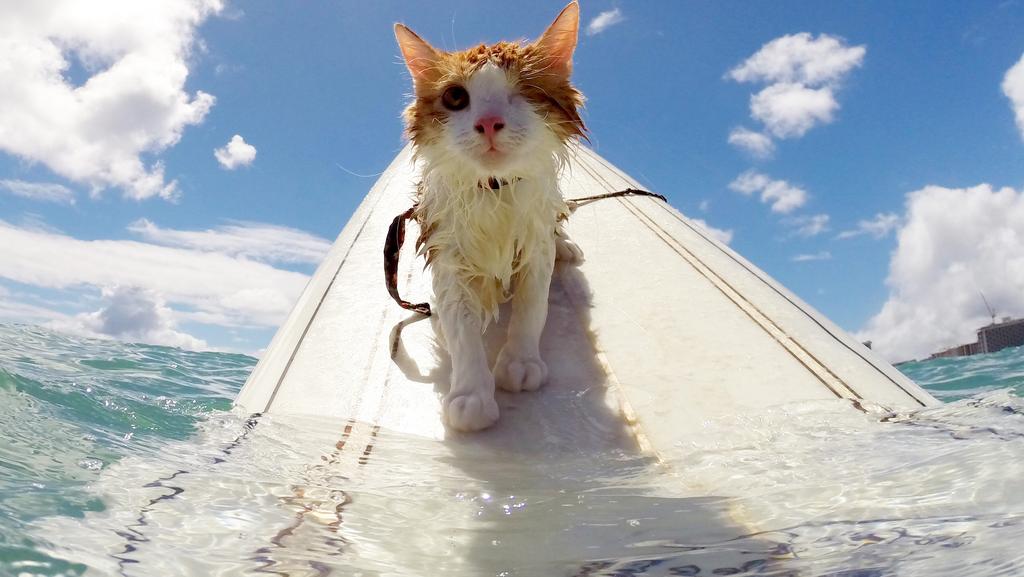
Surfing cats are pretty rare, but not unheard of. A 2016 story detailed the adventures of Kuli, a one-eyed rescue cat from Honolulu who loves to surf with his humans. (Kuli is pictured in the header image, above, and in the image below.)
Kuli lost an eye at just four months old due to an infection, and endured lots of baths during his formative months to prevent another infection from taking hold. Alexandra, one of his humans, said she believes that’s why Kuli is so calm in the water.
“For a while I took Kuli out on my long boards, but it wasn’t until I was playing around with a boogie board one day that I realised he really loved to get his claws into the foamy material,” she said. “So we bought a board that Kuli would be able to get out on the surf with.”
Kuli on his board. Credit: Caters News Agency
Here at Casa de Buddy, I asked His Grace if he’d like to dip into the ocean and have fun by learning to surf.







 Pain In The Bud