Fresh Off Binging K-Dramas, Buddy Demands Others Call Him Jeonha

Buddy has taken to styling himself as a Joseon king after gorging himself on Korean period dramas set during the long-enduring dynasty.

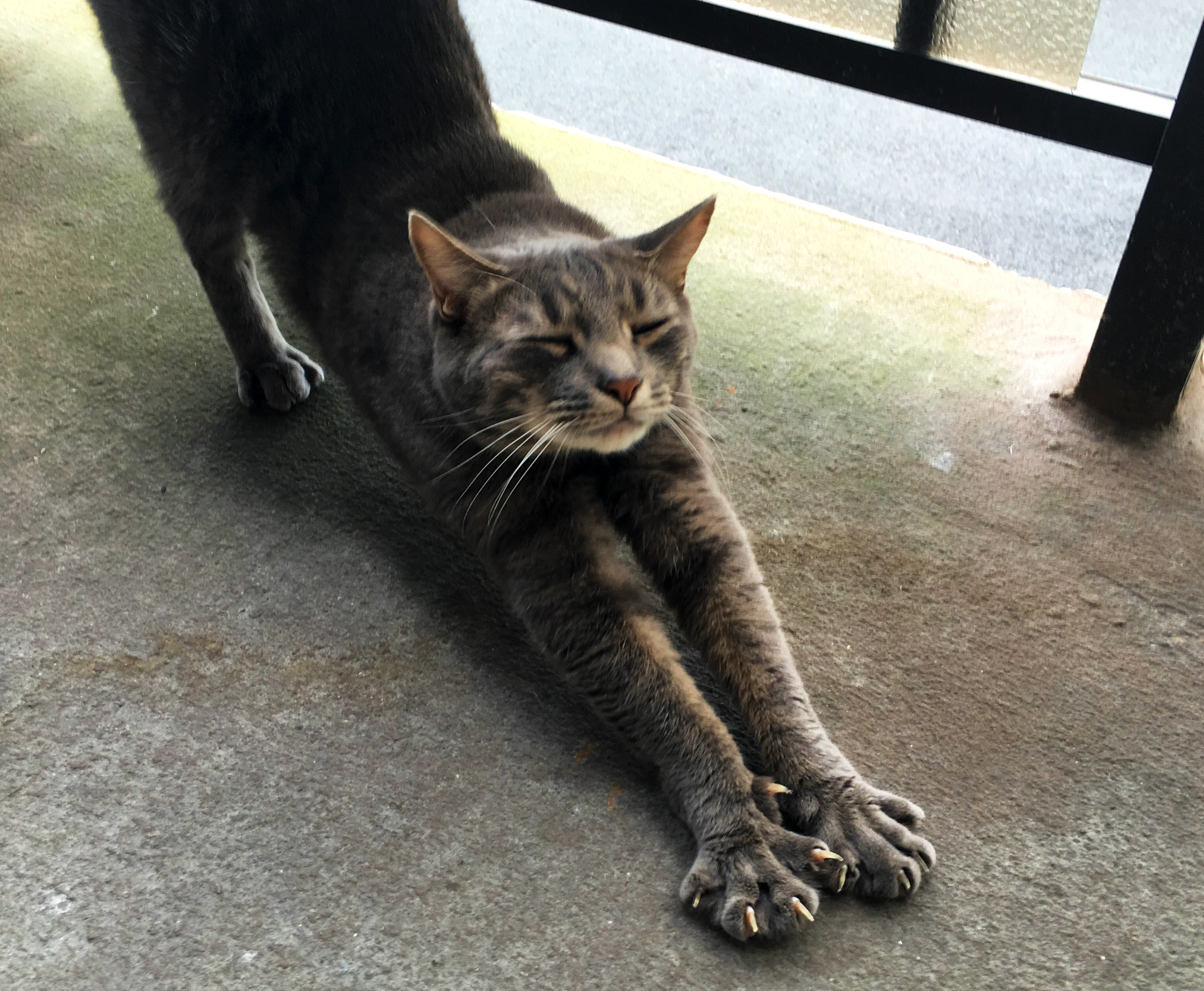
NEW YORK — Buddy the Cat has taken to wearing Joseon dynasty royal robes and insisting others call him “Jeonha” — a style of address for a king which means “Your Highness” — after binging Korean historical dramas over the last several months.

The silver tabby, who once pretended to be Spanish and has previously tried to ingratiate himself with lion prides and zoo tigers, took on the persona of a king of Joseon, the historical name for the kingdom of Korea as it existed for half a millennium. The move followed an extended TV binge during which Buddy watched Netflix’s Kingdom, The Crowned Clown and Six Flying Dragons.

“Where is the Left State Councilor?” Jeonha Buddy shouted on Friday while lounging atop a replica of the famously elaborate Phoenix Throne. “The Ministry of Yums is late with my dinner once again. This will not be overlooked!”

Committing fully to his cosplay, Buddy designated each floor in his apartment building as its own “province,” appointing cats in other apartments as governors, Confucian scholars and tax officials. In addition, he created a court schedule dictating three official audiences per week, demanding reports on “the state of the cat food cupboard” and vigilance in looking for signs that a Japanese neighbor, Mr. Fuji, planned to invade his realm.

“We must not underestimate the Shogunate,” he said. “Have the Chief Secretary draw up an official mobilization order for the Five Armies so that we may have a regiment stationed along the border in case Mr. Fuji has military intentions.”

“Yes, Jeonha!” the other cats said, bowing. “Your grace is immeasurable!”

Asked on Sunday what he thought of the group of cats who stood watch outside his apartment, Mr. Fuji said: “I like cats!”

Seoul_Throne_in_Geunjeongjeon_03
Buddy’s replica Phoenix Throne. Credit: Wikimedia Commons

Most of Jeonha Buddy’s royal decrees, however, have dealt exclusively with food. Royal Proclamation #11, for example, specified the size and serving time of the king’s late night snack, while Royal Proclamation #19 clarified that seafood must not be served two meals in a row, and should be served only after meals of poultry or beef.

Meanwhile, Royal Proclamation #22 sought to appoint Big Buddy as the king’s eunuch.

“You’re pressing your luck, ‘Jeonha’,” the human said, glaring at Buddy. “I still have my balls. You, however, do not.”

As of press time, Buddy consulted the basket that holds his many toys and confirmed that he did indeed still possess his balls, including one that lights up and makes a beeping sound when it’s batted around.

“My court eunuch is a liar,” Jeonha Buddy declared. “Eighty lashes for him!”

PITB Reviews: Ghostwire Tokyo: Cats Play A Central Role In This Japanese Horror Game

Felines play a major role in Ghostwire: Tokyo, a horror adventure from Japanese studio Tango.

The premise of Ghostwire: Tokyo is simple: The entire human population of the city has vanished in some mysterious, cataclysmic supernatural event, leaving the heart of Tokyo silent, vacant and draped in an ethereal fog.

Instead of the bustle of humanity, the city is now populated by demons and yōkai, which are roughly equivalent to ghosts in Japanese folklore.

Only one human survives: Akito, our protagonist. He remains alive due to pure luck after a spirit named KK inhabits his body, intending to use it to fight the supernatural forces that have emptied Tokyo of its human inhabitants.

Akito and KK come to an uneasy truce sharing one body due to their aligned goals. KK’s presence not only allows Akito to survive the malevolent forces at work, but also imbues him with fantastic elemental powers to wield against the yōkai prowling the otherwise empty streets: He can summon wind, fire and water, and cleanse spirits and locations with Shinto prayer rituals.

Akito is set on rescuing his sister from sharing the same fate as hundreds of thousands of others, while KK spent his human life — and now his afterlife — trying to stop the mysterious figure behind the spirit invasion from harvesting human souls. For Akito to do the former, he and KK must do the latter.

Oh, and there are animals — lots of scared, confused cats and dogs who don’t know what to make of the city’s supernatural new inhabitants and don’t understand why the humans have gone missing. KK’s powers allow Akito to read animals’ thoughts.

“I can’t smell my buddy anywhere,” a confused dog tells me early in the game, whimpering as he wanders near the Shibuya scramble crossing.

It’s worth paying attention to Ghostwire’s lost pets. Feed a dog and the good boy could lead you to a cache of cash or a Jizo statue where you can say a prayer and augment your powers. Stop to pet and talk to a cat, and she might tell you a yokai is hiding nearby, disguising itself as an every day object.

True to a country obsessed with felines going back centuries, a cat isn’t always just a cat in the world of Ghostwire: Tokyo.

There are your regular domestic pets and strays, which are simply called neko, the Japanese word for cat. Akito encounters them often, comforts them and can read their thoughts with KK’s powers. Like the dogs, they’re confused, scared and hungry.

Then there are nekomata, which are the spirits of domestic cats who have become yōkai. Nekomata have made themselves at home in the absence of humans, showing their entrepreneurial spirit. The ghost cats have taken over every convenience store and kiosk in the city, urging Akito and KK to buy their snacks and supernatural wares to “be purrpared” for what awaits them.

“You’ve gotta spend money to make money,” one nekomata tells me, “so why not spend it here with meow?”

Nekomata are not to be confused with bakeneko, who are also yōkai but differ from their spirit cat cousins in subtle ways. Bakeneko can be friendly, mischievous or ambivalent, they can move without making a sound, and like nekomata they can speak and understand human language. Unlike nekomata, which have two tails, bakeneko only have one.

Finally, there are maneki neko. You’ve seen maneki neko even if you don’t realize it, probably on the counter of your local Japanese grocery, sushi house or Chinese restaurant. They’re the smiling, beckoning cats who are said to bring good fortune, health and other benefits. They’re based on the legend of a friendly cat who led a road-weary Japanese feudal lord and his men to a sanctuary just before a violent thunderstorm centuries ago, and have become ubiquitous in Japan and wider Asian culture.

For a game with a grim premise set in an empty but lived-in city, there’s plenty of bizarre humor as well. One mission has you delivering toilet paper to a human spirit who really, really needs to wipe after an epic bowel movement before he can move on and rest easy in the afterlife.

On another occasion I stopped to admire the detail and near-photorealistic beauty of a street bordering a shrine when I heard a nekomata hilariously meowing a cheerful song out of tune. When I turned toward the little cat, I saw him floating in the air and bouncing to his happy song.

As Akito, the player is tasked with lifting the fog from neighborhoods of central Tokyo, rescuing the spirits of deceased humans before they can be harvested by the demons and yōkai, and investigating the what, why and how of Tokyo’s takeover by malevolent spirits.

Akito and KK accomplish the former by “cleansing” Tokyo’s many shrines using a ritual performed at the shrine torii gates. Once a torii gate is cleansed, the fog around it subsides and more of Tokyo opens up for exploration and investigation. Meanwhile, Akito and KK must fight off yōkai to reach the floating spirits of Tokyo’s citizens, using a talisman to secure them. The duo can then “wire” the spirits to an ally outside the city, who helps return them to their bodies. The game keeps track of how many souls are saved, with the count rising to the hundreds of thousands for adept players.

The game remains true to Japanese folklore in the way it presents enemies, who are usually corruptions of human souls who have deep regrets about their lives. The spirits represent anxieties unique to, or prevalent in, Japanese society.

There are Rain Walkers, unnaturally thin salarymen toting umbrellas who advance on you inexorably, representing the angry spirits of men who spent their entire lives in service to a corporation, hardly spending time with their families or raising their kids because they work so much.

There are the Students of Pain and Misery, headless schoolgirls and schoolboys representing the spirits of teenagers whose grades couldn’t carry them into good universities, damning them to a life of tedious, low-paying jobs. Those are real concerns in a country where students spend in excess of 10 hours a day, six days a week in school. Teenagers are under enormous pressure to get top grades, and teen suicide is a major contributor to the country’s unusually high suicide rates.

Spirits of Lamentation are dangerous and move in sickeningly unnatural ways as spirits of people who were estranged from loved ones, while the small, raincoat-clad Forsaken are the spirits of abused children.

These malevolent spirits and others wander the streets, linger in alleys and leap across rooftops, but they also form groups called Hyakki Yagyo, which are parades of oni and yōkai who march through the streets of Japanese cities on summer nights, according to folklore.

Hyakki Yagyo
You’ll hear the Hyakki Yagyo before you see it, tipped off by the booming taiko drums that accompany the ghostly parade.

The arrival of Hyakki Yagyo in Ghostwire is impressively atmospheric: Lights and neon signs flicker and die out, while taiko drums boom from the mists. Then you see the spirits — yōkai with their umbrellas, massive demons, bizarre apparitions.

The first time I encountered a Hyakki Yagyo, I was so engrossed in watching the procession that I didn’t realize I was in its path until it was too late. I learned that if you get too close, the spirits yank you into an ethereal plane and surround you in numbers, determined to end your physical existence and make you one of them. Those encounters are among the most difficult in the game, but they’re also a fun test of skill.

Ghostwire gives us the most complete recreation of Tokyo in any game to date, and it’s magnificent. The metropolis extends seemingly forever in every direction, with 36 million people living a metro area that sprawls for almost 1,000 square miles. (That’s three times the size of New York with all its boroughs.)

Because of that, no game studio can handle the challenge of recreating the entire city on a 1:1 scale, and Ghostwire doesn’t attempt it. Instead the game world encompasses the famous Shibuya district and part of Minato City, two of the most bustling and famous districts in the heart of Tokyo. It’s a massive playground stretching from west of the scramble crossing, through Roppongi and all the way to Tokyo Tower.

Ghostwire is beautiful, polished and a hell of a lot of fun to play. You’re not going to find the gloriously intuitive combat of a game like Control, or even an experience like the fluid melee action of Shadow Warrior 2. Ghostwire’s combat is pedestrian compared to those games, but it becomes more fun and interesting as the game progresses and you’re given different powers and options to deal with a growing variety of ghastly enemies.

The lure of a game like this is its moody atmosphere, magnificent visuals, tense sound design and a plot that weaves hundreds of years of Japanese folklore into the mix, creating a world unlike anything else in gaming.

The writing deftly transitions between serious and funny, tense and lighthearded, and the partnership between Akito and KK allows for a running dialogue throughout the game, with the two of them asking each other questions, arguing over tasks and reacting to the craziness around them. What starts out as an uneasy alliance held together by necessity becomes grudging mutual respect and eventually friendship.

Rounding out the cast of characters are Mari, Rinko, KK’s friend Ed, and the masked protagonist. Rinko is the spirit of a woman who worked with KK in their human lives. Rinko and KK were killed for their determination, and in death they continue the fight against the malevolent spirits. Ed is a weirdo: He’s KK’s man on the outside, helping to reunite the severed souls of Tokyo with their human bodies when Akito and KK rescue them, but the only way to talk to Ed is by payphone — and even then, he only answers in recordings.

Mari is Akito’s sister, who was unconscious and helpless in a hospital when everyone vanished. More than anything, Akito wants to protect her.

Finally, there’s the man in a oni mask, the mysterious mastermind behind the supernatural takeover of Tokyo. Who is he? What does he want? Can he be defeated?

To answer those questions requires an adventure very much worth having.

Title: Ghostwire: Tokyo
Release date: March 25, 2022
Platforms: PC, Playstation 5
Audience: Mature
Cats: Many

Oscars Shock! Garfield Slaps Buddy After Joke About Wife Venus

The Acatemy Awards turned into a beatdown on Sunday night after Garfield took exception to a joke by Buddy the Cat.

Buddy the Cat was cruising through Sunday night’s Acatemy Awards ceremony and razzing the celebrity cats in attendance when things took a turn for the bizarre and violent.

After joking that Alejandro Baldwinito the Spanish cat would have to lose Best Actor after his wife, Ellaria, lost Best Actress, comedian Buddy turned to Garfield and his better half, Venus the two-faced kitty.

“Venus, I love you! Two-Face in the next Batman movie, can’t wait to see it!” Buddy said, drawing laughs from the crowd — including from Garfield, who appeared to find the joke hilarious.

But when Garfield noticed Venus staring daggers at him, he cleared his throat and stood up.

“Uh oh!” Buddy said as Garfield padded over to him. “Uh oh! It’s…”

Venus
Venus, who did not take kindly to Buddy’s joke about her playing Two-Face in the upcoming Batman movie.

Buddy was stopped mid-sentence as Garfield paw-slapped him hard across the face, drawing shocked gasps from the stars in attendance.

“Oh, wow! Wow!” Buddy said. “Garfield just slapped the s— out of me!”

“Keep Venus’ name out your —-ing mouth!” Garfield yelled, settling back into his seat.

“Wow, dude!” Buddy replied. “It was a Batman joke!”

“Keep my wife’s name out your —ing mouth!” Garfield repeated, casting a glance at Venus as Lupita Purrongo looked on behind them, open-mouthed and horrified.

“I’m going to, okay?” Buddy said, momentarily at a loss for words.

“That was, uh, the greatest night in the history of television!” Buddy said, recovering and cutting some of the tension in the room.

Just minutes later, Garfield accepted the Oscar for Best Actor and had a meltdown on stage.

“I do it for love!” the rotund orange tabby said. “I have to protect the people around me, and Richard, King Richard, he once said, you know… Who has lasagna? Does anyone have lasagna?”

Netflix’s ‘Inventing Anna’ Reveals Friendship Between Anna Delvey And Buddy The Cat

The German-Russian fake heiress frequented many of the same parties and ran in the same circles as Buddy the Cat.

NEW YORK — Anna Delvey said she was at a low point when she crossed paths with Buddy the Cat at a party one night.

“So many of my friends were so disappointing,” Delvey says. “When people show up to a party looking poor or fat, and they’re not wearing designer clothes, it’s a huge buzzkill.”

But Buddy, who was a guest of Princess Charlotte Marie Pomeline Casiraghi of Monaco, was clearly someone who understood style and luxury and moved in the exclusive circles Delvey frequented.

“I was like ‘Oh my God, you know [Monegasque designer] Pauline Ducruet?” Delvey recalls. “Buddy had just arrived with Felix [Finch, editor of the Trafalgar Review of Books]. He knew all the right people, was at the best parties and always knew when to leave before unattractive people showed up.”

On the night she met Buddy, Delvey says she was already shaken by a woman who showed up to a film festival afterparty wearing clothes from Target when her group faced another setback: The maître d’ at Dorsia had double booked their reservation, so they were forced to head to Espacé on the upper west side.

“I was on the verge of tears when we arrived at Espacé, since I was positive we wouldn’t get a decent table,” Delvey recalls. “But we did, and relief washed over me in an awesome wave.”

It turned out Buddy knew the maître d’ at Espacé and was able to secure a table by slipping him two crisp $100 bills.

“Friends like that,” Delvey says, “are worth keeping around.”

Anna Delvey and Buddy the Cat
Delvey, center, with Buddy at New York Fashion Week in 2018. Credit: Netflix

Delvey’s roster of friends was whittled down to just a handful when she was arrested in 2018 and charged with defrauding various luxury hotels, spas, boutique shops and bankers out of more than $300,000. She was also on the verge of securing a $22 million loan from Cavendish Holdings, ostensibly to open a VIP arts club, when authorities caught up with her and charged her with multiple counts of wire fraud, grand larceny and tampering with financial records.

Delvey’s story was immortalized in a 2019 New Yorker piece which went viral and, with the premiere of Netflix’s Inventing Anna miniseries just 10 days ago, millions of people are now privy to almost every sordid detail of Delvey’s long con, in which she presented herself as a fabulously wealthy German heiress sitting on a $60 million trust fund.

The now-convicted former socialite, whose real name is Anna Sorokina, moved in the highest echelons of New York society for more than two years. She quickly made a name for herself after arriving in New York from Paris, where she’d interned at fashion magazine Purple, and soon worked her way into the orbit of celebrities, famous designers and even royalty.

Like Delvey, the source of Buddy’s wealth was shrouded in mystery.

“I think he was some sort of poultry oligarch,” said stylist Ronaldo Chen. “Vast holdings in eastern Europe, turkey farms, wineries and hotels.”

Bud and Anna
Delvey often took Buddy on her shopping sprees. Friends said she valued the feline’s astute fashion observations. Credit:

Others said he was a Youtuber and vlogger who helped popularize the wildly popular genre of unboxing videos, while some people said he was a tech bro raising venture capital.

“He comes from old money just like Anna does,” said French socialite Marinus. “House Buddeaux is one of the oldest catnip families west of the Seine.”

Episode 11 of the Netflix hit details the now-infamous party 2017 in Budapest at which Delvey is alleged to have made off with more than $150,000 of the Duke of Sandringham’s diamonds and left Buddy with more than $30,000 in hotel charges.

Still, there are apparently no hard feelings between the two.

“Buddy is a genius, bitches,” Delvey told Vogue last summer in a jailhouse interview. “I was surrounded by genius and now I’m here, wearing a horrid jumpsuit, locked up with basic bitches. My cellmate says she’s serving a life sentence for stabbing her cheating boyfriend, and I was like ‘Why are you being so dramatic?'”

Titanic With A Cat!?

OwlKitty is back and this time she’s sliding into Leonardo DiCaprio’s DMs.

The last time I saw Titanic was in a movie theater 25 years ago when the film was just released, its theme song was befouling airwaves and its director, James Cameron, was playing at deep sea explorer in the Mariana Trench. (Cameron would return for an expedition more than a decade later, matching the depth of a science team who made the dive decades earlier, but doing it solo. His interest had been sparked by the work he did on Titanic.)

I remember feeling restless as the movie dragged out, then incredulous as women and girls all around me sniffled, dabbed at their eyes with tissues and even sobbed! Teenage Big Buddy could not comprehend it.

But this version of Titanic? It’s more my speed, coming in at an economical 1:07 running time and featuringOwlKitty in place of Kate Winslet:

As you can see, Winslet isn’t entirely gone from this cut. She just plays second fiddle to OwlKitty, Leonardo DiCaprio’s first love.

Who’s the Queen of the World now?

Want more OwlKitty? Check out her star turn in Jurassic Park, where she replaced the T-Rex and rampaged around the doomed island looking got catnip and treats.