Maggie Beer was reportedly intrigued by the idea of eating a “pussycat sandwich.”
Meet Maggie Beer, a “culinary icon” from Australia who was convinced to teach cooks at some sort of community kitchen on the promise that another chef would kill a feral cat to make her a “pussycat sandwich.”
Beer was invited to help instruct cooks who volunteer for a program feeding Australian seniors. In return, one of the cooks would show her how to prepare domestic cat meat.
That goes a long way to explaining the state of mind in a country that recently killed millions of cats by poisoning them and has pledged to exterminate all free-roaming cats because self-styled conservationists believe felines — not habitat destruction, mass industrialization, the widespread use of carcinogenic pesticides, windmills, glass buildings and all the other changes wrought by human presence — are the primary drivers of local bird and small mammal extinction.
Beer and Brown, cat eaters.
“We were talking a lot about cooking kangaroo tails and then I also told her about how one of our directors… had recently cooked us a feral cat from Kiwirrkurra,” said Sarah Brown, the CEO of Purple House, which prepares meals for Australian seniors.
“She got very excited about this and I said, ‘Well if you come to Alice Springs and do some cooking classes with us, then Bobby West will teach you how to cook a pussycat and you can have a pussycat sandwich for lunch.'”
Feeding seniors intelligent companion animals is about giving them “joy as well as sustenance,” Brown claims.
Thankfully not everyone in Australia thinks this is amusing, nor do they buy the claims that slaughtering cats will magically solve all the problems facing indigenous wildlife.
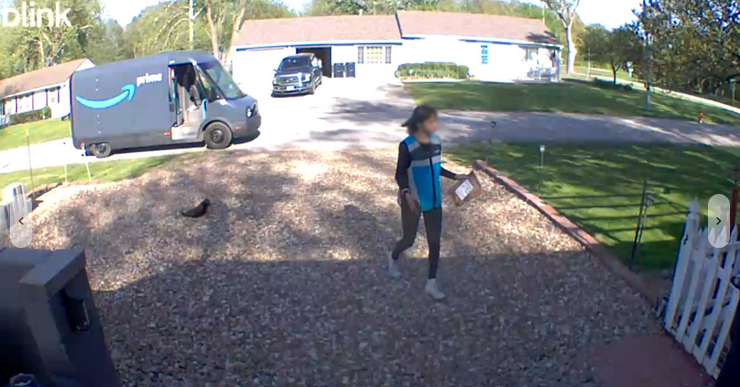
A Kansas City family is in anguish after an Amazon delivery driver stole their senior cat, beginning a sequence of events that led to his death. Once again, Amazon treated the situation like a routine customer service issue.
At this point it feels like the certainties in life are death, taxes and Amazon delivery drivers stealing pets.
If there’s a fourth, it’s Amazon’s predictably awful response to customers whose cats and dogs are stolen by the company’s drivers. Whether asking distraught customers how much the pet was worth, offering credit, or offering to send stuffed animals as replacements, Amazon has generally been unhelpful. This is a pattern going back years now and Amazon still hasn’t come up with a protocol to handle these situations.
A recurring problem is that Amazon treats the incidents like regular customer service complaints. Their customer service representatives aren’t trained for the possibility, they are apparently reluctant to go off-script, and the result is that the reps treat the missing pets like fungible products, as if these situations can be rectified by sending a replacement or reimbursing a customer.
That’s the last thing anyone wants to hear. Pets are companions, considered family by most Americans who have cats and dogs in their homes. Hearing “And how much would you say Fluffy’s worth?” exacerbates the frustration and worry.
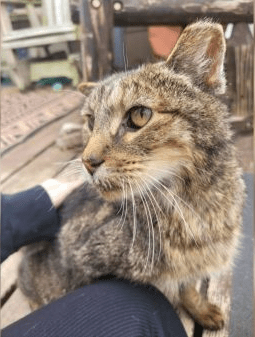
In the latest incident, surveillance footage shows an Amazon driver picking up a cat named Sidney from his family’s driveway in Kansas City on April 20. At 16 years old, dependent on medication with his health failing, Sidney was near the end of his life, Marsha Reeves told the local Fox affiliate.
Sidney
“I knew his time was near, and I just wanted him to be comfortable and at home when it came,” she said.
Because of the driver’s actions, Sidney’s last days were spent in distress and confusion, separated from the people who loved him. The driver surrendered him to a shelter the next day, and Sidney was bounced between shelters and animal control with his family frantically trying to track him when a veterinarian at a rescue group euthanized him.
“I cannot even imagine what he was thinking,” she said. “He did not deserve to die on a metal table with strangers poking him. He should have been at home in my arms when he took his last breath.”
Marsha Reeves, Sidney’s human
It’s a tragic and horrific end for a cat whose family wanted to fill his last days with love. They’re denied closure, and to add to the awfulness of the situation, Reeves said the mega-corporation was not helpful, at first not admitting one of its drivers took the cat, then slow-walking the response.
“I cannot even imagine what he was thinking,” Reeves said. “He did not deserve to die on a metal table with strangers poking him. He should have been at home in my arms when he took his last breath.”
We’ve written about this before, and previous cases make it clear: people who find themselves in this situation should not wait for Amazon (or any other company) to handle it, because it’s not a priority for them. In every case in which a family has successfully regained their cat, the common denominator was they took it upon themselves to lead the effort and were relentless in searching, posting flyers locally, rallying support online and making noise in local media. Sometimes even that’s not enough, but it increases the odds of a happy reunion by orders of magnitude compared to putting faith in a corporation and police.
In this case, there’s been no word from Amazon about consequences for the driver or changes to the way the company trains its delivery workforce and customer service representatives.
The driver “needs to come with a supervisor and face me and my family members who this has affected,” Reeves told the local Fox affiliate. “I think Amazon needs to be held accountable. I think this young woman needs to be held accountable. She needs to realize that there are consequences to her decision making.”
So far the company hasn’t admitted wrongdoing or offered an apology, which is consistent with cases in the past involving drivers who have stolen pets.
“Why won’t Amazon just come out and say ‘we screwed up?’”
The California man was hunting another animal when a herd of African elephants charged him and his professional guide.
The reaction to the trampling death of a “big game hunter” this month can be broken down to two main camps.
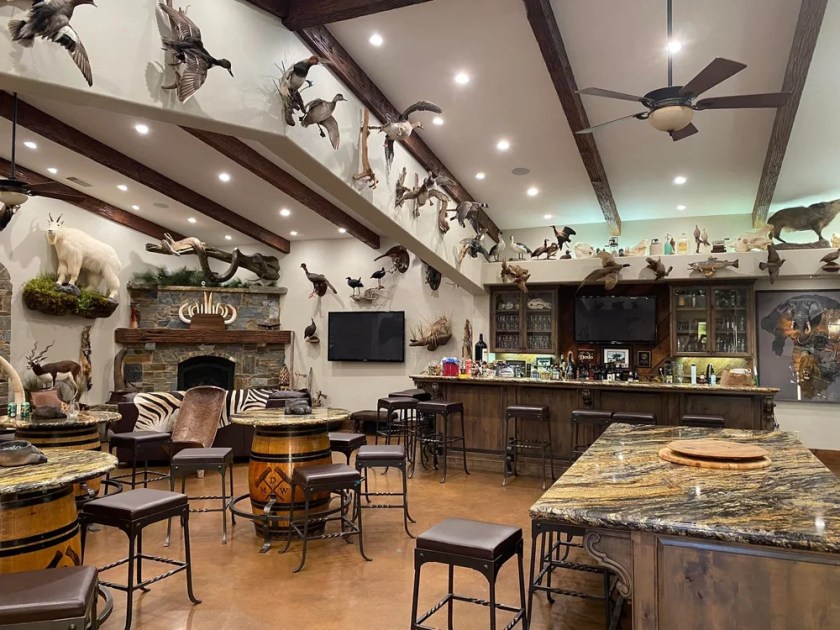
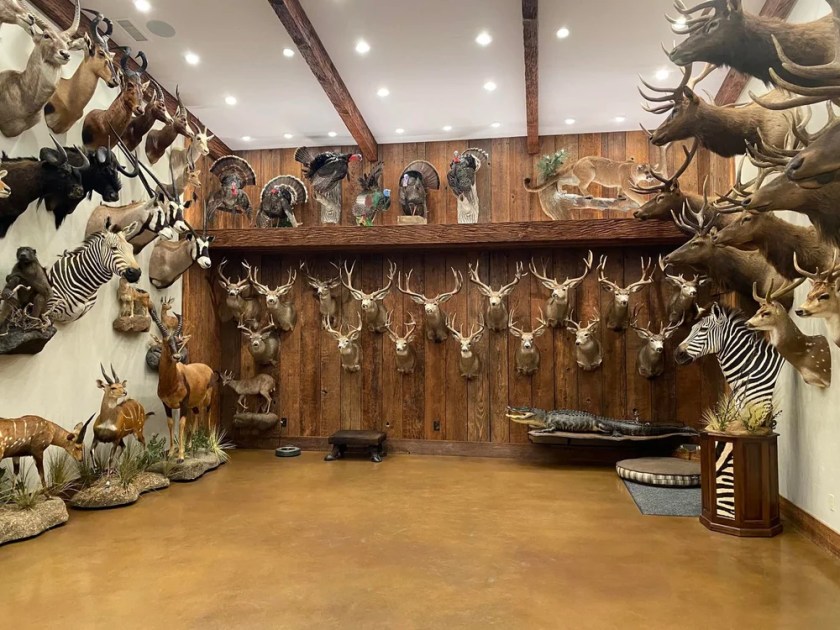
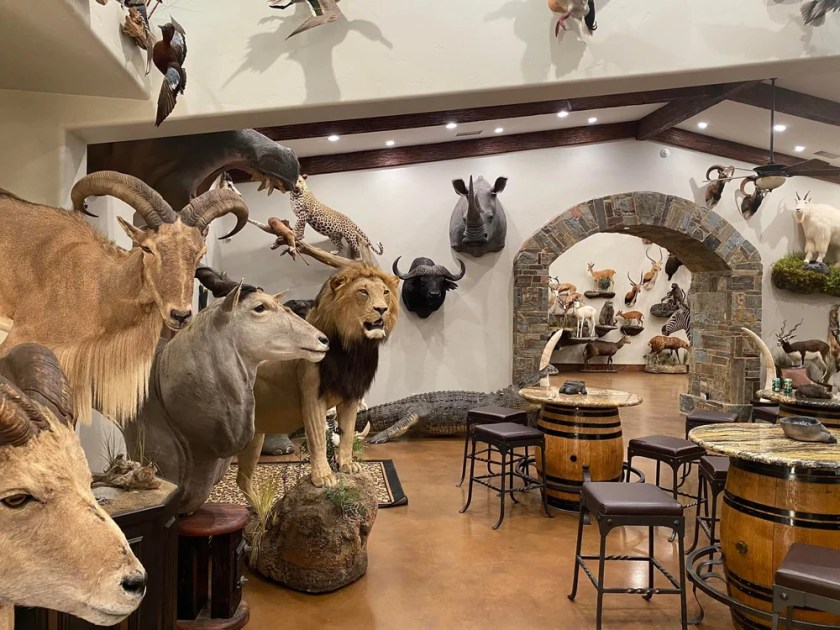
One side is in a celebratory mood, saying Ernie Dosio deserved to be trampled by African elephants on April 17 in Gabon, central Africa. His death was poetic justice, they say, delivered by animals of a species Dosio hunted, whose preserved and mounted heads he proudly displayed on his extensive trophy walls back home in California.
On the opposite end are people engaged in the hagiography of the 75-year-old business owner, describing him as a “pillar of the community” and a “great guy” who gave generously to charity.
We like our narratives black and white, our heroes and villains clearly delineated. To most people, Dosio was one or the other.
In reality, the two sides of Dosio are not mutually exclusive. It’s entirely possible he was a good member of the community who had compassion for people. It’s also true that contrary to claims that he was a “conservation hunter,” Dosio took pride in killing animals from critically endangered and protected species, like many who think their wealth entitles them to rob the Earth of wonderful and unique forms of life so they can collect trophies.
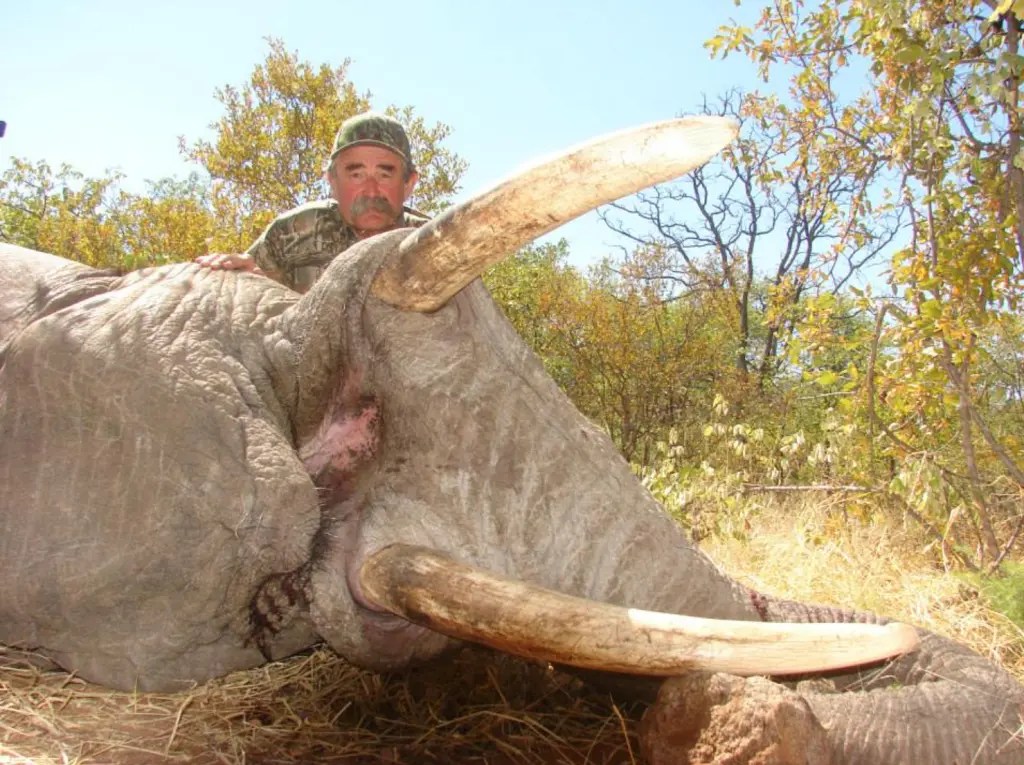
Dosio posing with an elephant he killed on an earlier trip.
Indeed, the concept of a “conservation hunter” is an oxymoron. The pro-hunting side says the fees hunters pay for licenses, guides and other services are crucial to fund conservation efforts.
The truth is that the majority of the money finds its way into the pockets of officials in kleptocracies. If the contributions of so-called conservation hunters are supposed to make a difference, then reality proves them to be an abject failure: population numbers for endangered species like elephants, lions, cheetahs and rhinos continue to trend down, and those species will be extinct in a decade or two if we don’t put a stop to poaching, hunting, habitat loss and other threats.
I also have a problem with calling these people hunters.
These men and women are not Jim Corbett roughing it on foot in the British Raj, using their skill and knowledge of the land to take out vicious man-eaters at great risk to themselves.
They are weekend warriors, wealthy tourists who pay tens of thousands of dollars to kleptocratic governments for their blessing to “harvest” the animals they kill. It’s big business: in South Africa alone, the trophy hunting industry brought in $120 million, according to a 2015 estimate. That number is likely considerably higher today.
When he was killed, Dosio was hunting for a yellow-backed duiker, a rare antelope listed as near-threatened on the IUCN red list. He paid Gabon’s government a $40,000 fee to “harvest” the animal.
Trophy hunters don’t stalk by moonlight, rifle in hand, looking for tracks and camping rough.
They are chauffeured around by hired drivers in comfortable, climate-controlled luxury off-road vehicles. They have servants who pitch their tents, cook their meals, light their fires and guard their camps.
They do not track their targets. They pay men to lure the unsuspecting creatures directly into their paths using food as a lure. The lions, leopards and other animals they kill don’t even realize they’re being hunted before the rifle shots end their lives.
Then the hunters retreat to the air-conditioned comfort of their vehicles while their hired servants do the dirty work of beheading the animals so they can be packed up, prepped for display and shipped back to the US, where they will join the heads of other animals killed by these wealthy men and women. Men and women who proudly show off their kills when they invite people to their homes, recounting their heroics to the bored guests, who make appropriately polite noises to pretend they’re impressed.
In addition to the 30 or so animals on display here, photos show the walls on the rest of Dosio’s home are covered with the preserved heads and bodies of animals he’s killed.
Nothing about this grotesque sequence of events resembles hunting. It is killing. It requires no skill, it carries no risk, its outcome is never in doubt, and it serves no purpose other than to pad the egos of people who have lots of disposable income and little self-confidence.
They have their defenders and their haters.
“I knew I was going to enjoy this,” one person wrote in response to a news story about Dosio’s demise.
“Do you think the elephants will mount his head on their walls?” another joked.
Some people speculated that the elephants, a species with notoriously long memories, may have remembered him from a prior encounter.
The more likely explanation is the elephants saw Dosio and one of his guides, both carrying weapons, as a threat to the calf they were protecting. Rather than put the baby and themselves at risk, they attacked first. If that’s the case, humans are at fault for that too, because the elephants know people carrying guns do not have good intentions. It may not have been Dosio who killed a member of that particular herd, but odds are overwhelming that someone has, and the elephants haven’t forgotten.
While celebrating Dosio’s death may provide a cheap dopamine hit and a sense of righteous justice, to be truly on the side of life means to value all forms of it, animal and human.
Dosio, 75, was reportedly a millionaire and owned a business that partnered with vineyards in California.
Celebrating Dosio’s demise means we’re no better than the “hunters” who grin like psychopaths for photos with the animals they’ve just killed. It makes those of us concerned about animal welfare and conservation look like extremists, and it only takes a few bad actors to wreck the efforts of an entire group. If a thousand protesters gather in a city square and two of them become violent, the resulting headlines will be about those two, not the 998 others who peacefully made their opinions known.
The way to fight back against trophy killing is by educating the public about the damage those killers do, by countering their claims that the fees they pay protect other animals, and by pointing out that without drastic intervention, elephants, lions and cheetahs will be nothing more than memories for a few generations, and near-myth to subsequent generations.
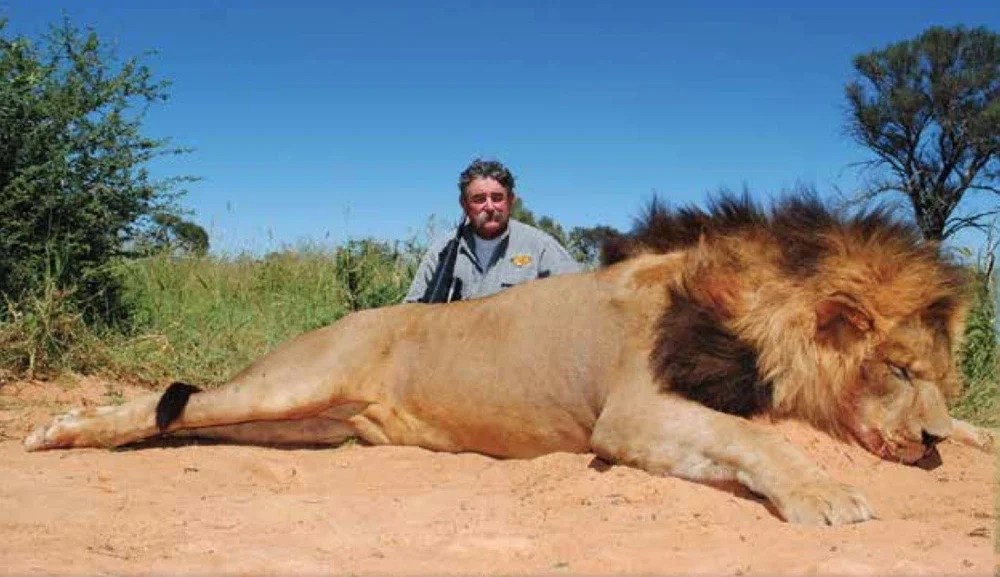
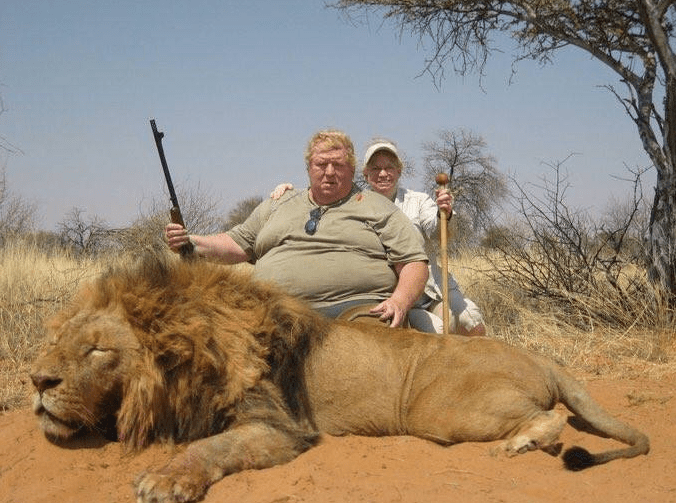
Killing, not hunting: this photo of an unnamed trophy hunter and his wife is instructive because it shows trophy “hunts” are never in doubt, never pose a risk to the “hunters,” and require no physical ability.
This also calls for self examination. On an Instagram account I made for Buddy, one I log into two or three times I year, I follow a handful of National Geographic photographers.
One of their images remains indelibly burned into my brain: a beautiful tiger cub, looking happy and full of curiosity about the world, gazing right at the camera. Even though I know I’m anthropomorphizing a bit, I can’t help feeling good about the expression on the young tiger’s face, an expression that looks like an enthusiastic grin. He is radiating joy at life.
And then I read the caption. This cub, this beautiful animal of a species that teeters on the edge of extinction, is growing up on a hunting reserve. His fate is already set. He will be killed, his life cut short by another weekend warrior paying to “harvest” him and mount his head on a wall so he can tell stories about his own bravery to bored friends and acquaintances.
That’s not just inhumane, it reveals something deeply disturbing about the kind of people who take pleasure from killing. Something primal, something that has no place in our civilization if we’re going to mature as a species, overcome our violent instincts, and have a future on this planet without destroying ourselves and taking every other form of life with it.
That’s why we need to be on the side of life. The alternative is reducing this garden world, this paradise, into a cold, lifeless rock.
No money, no prizes, just cute cats and bragging rights.
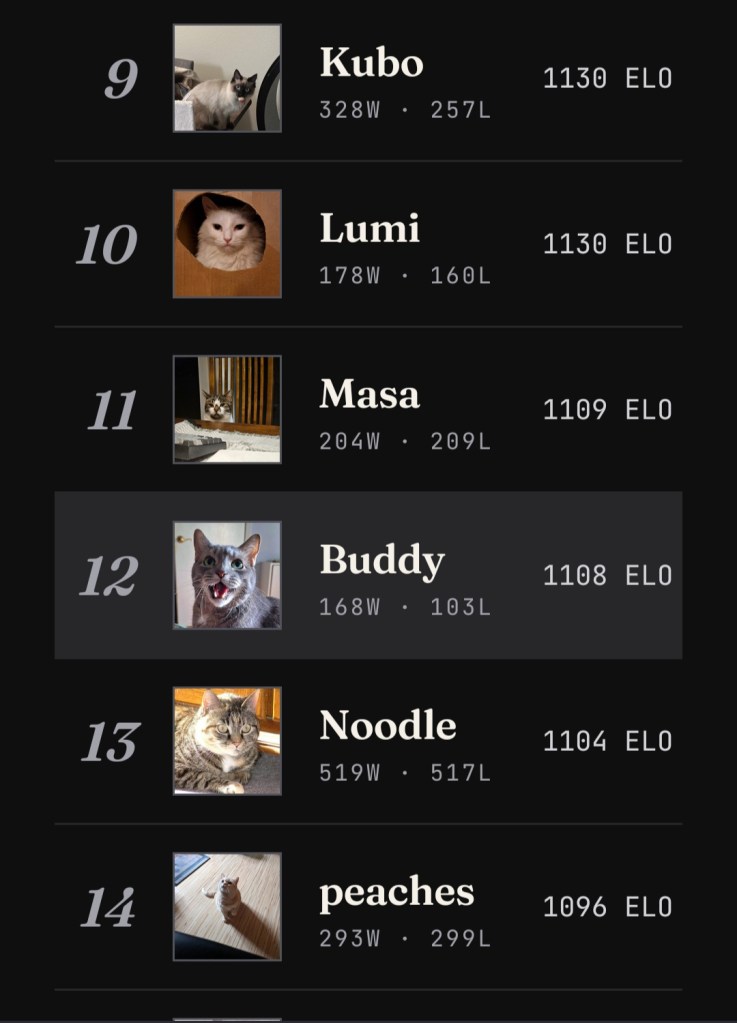
A post on BoingBoing Tuesday alerted me to the existence of CatRank, a site that allows users to view cat photos two at a time and pick the one they like better.
Or as the site puts it, “tap the superior cat.”
When you make your selection, the page instantly refreshes with two new cats. Per BoingBoing:
“A big part of winning seems to have to do with getting the right photo of your cat, which is a challenge on its own — anyone who has tried to photograph a cat knows they rarely cooperate on command. All cats are created equally, of course, but this site is like an online pageant they’ll never even know they participated in.”
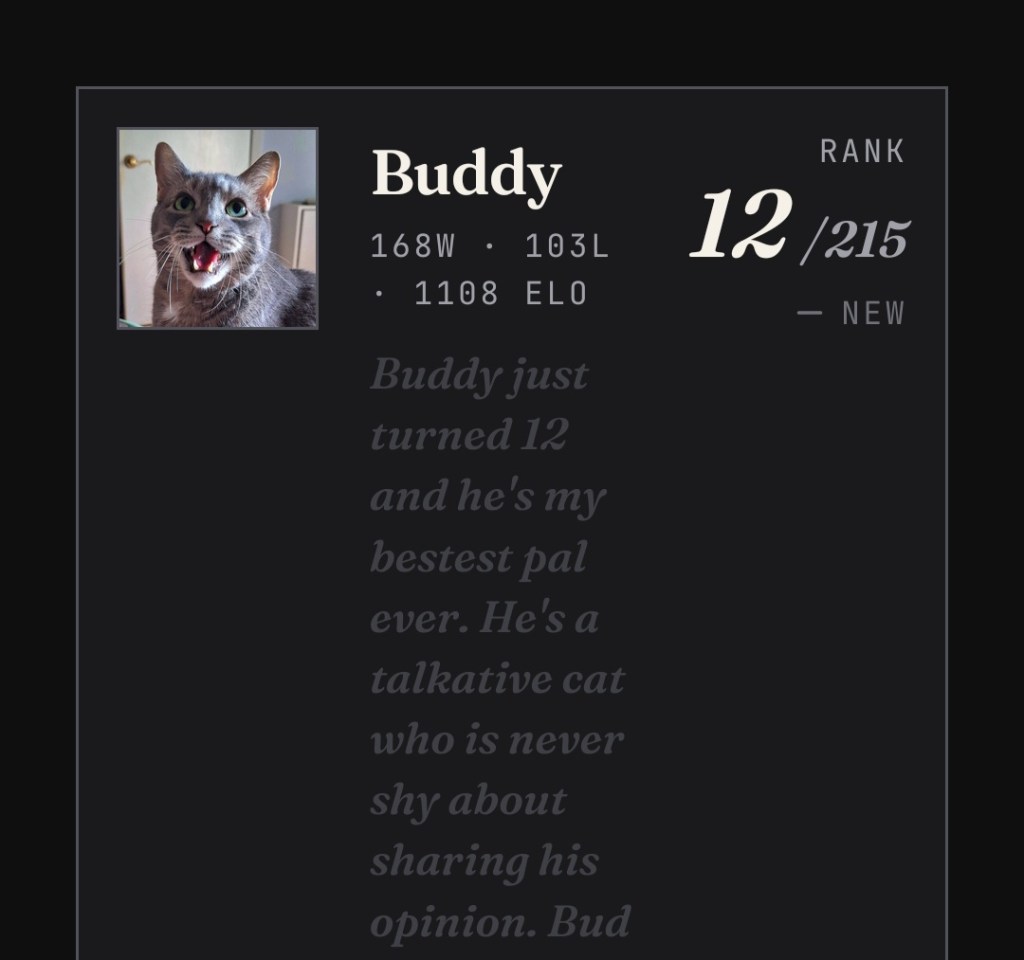
I decided to volunteer Bud for the “pageant” and uploaded a derpy photo of him looking excited. If memory serves, he was happily pawing at a wand toy at the time.
He was #34 on Tuesday, #12 last night, dropped all the way to #68 earlier today, and was #22 last time I checked.
A screenshot from yesterday when Bud’s derpy grin was winning him points.
The rankings have a simple win/loss component and a weighted ELO component, borrowed from chess and sports, that awards more points for “wins” against high-ranking “opponents.”
As for my own voting habits, I tend to vote for photos more tightly focused on the kitties since the images are relatively small as presented on the site. It’s difficult to see a feline’s features if the image isn’t cropped properly. I’ve got a subconscious bias toward clear, well-lit photos of voids since they’re notoriously difficult to shoot, and because they’re often unfairly overlooked.
My only real complaint is the top photo for most of this week is AI-manipulated, and at least one other is an AI creation. It looks like the vast majority are legitimate photos of real cats, though I’m sure we’ll see more generated images as the site becomes more popular.
You can upload as many as three of your own cats and write short bios for them.
Which is pointless because there’s no prize or money involved, just bragging rights, but people can be weird.
Ah well. Naturally, Bud expects all readers of his blog to head to the site and vote for him, and if you don’t he’ll do something ferocious and meowscular.
“They better vote for me or else!” he says. “If they don’t I’m gonna do something tremendous, something the likes of which they’ve never seen before, believe me. A lot of people are saying I’m the most handsome cat, a lot of people are saying it. I’m the most — and by the way, no other cat is as stylish as me. It’s incredible. So readers better vote for me by 10 am tomorrow and if they don’t, I’m gonna make more threats and extend the deadline. It’s tremendous.”
Vigilantism against stray cats and their caretakers is on the rise in Australia and New Zealand amid increasingly pitched rhetoric from conservationists who say felines are responsible for driving other species to extinction.
Antone Martinho-Truswell wants to get rid of every free-range cat in his native Australia and says “it’s time we outlawed pet cats” as well.
The University of Sydney academic, who styles himself as a zoologist and makes impossible claims about the number of animals supposedly killed by felines every year, doesn’t mince words when presenting his argument, which boils down to a logical fallacy. He says he’s an expert, he says cats must be driven to extinction, ergo it must happen.
“Your cat is a killer and it cannot be permitted to live here,” Martinho-Truswell said.
With rhetoric like that, and special interests groups claiming cats are the primary force behind the pending extinctions of native flora and fauna, it’s not a surprise when people think they should take the problem into their own hands. In Australia and New Zealand we’ve already seen vigilantes who fail at hiding their joy at killing felines, and now volunteers helping cats have to worry about their physical safety.
A colony manager and two other volunteers were feeding strays in western Sydney on April 17 when a man in a gold Nissan stopped and asked them if they were helping the cats.
When they said they were, the man became violent and attacked the colony manager, a 31-year-old woman, and a volunteer who tried to protect her, a 33-year-old man who was knocked unconscious by the suspect, police said. The man drove off before officers arrived.
The victims were treated at a local hospital. Police have a description of the suspect and a license plate number, according to local media in Sydney, but it isn’t clear if they know his identity.
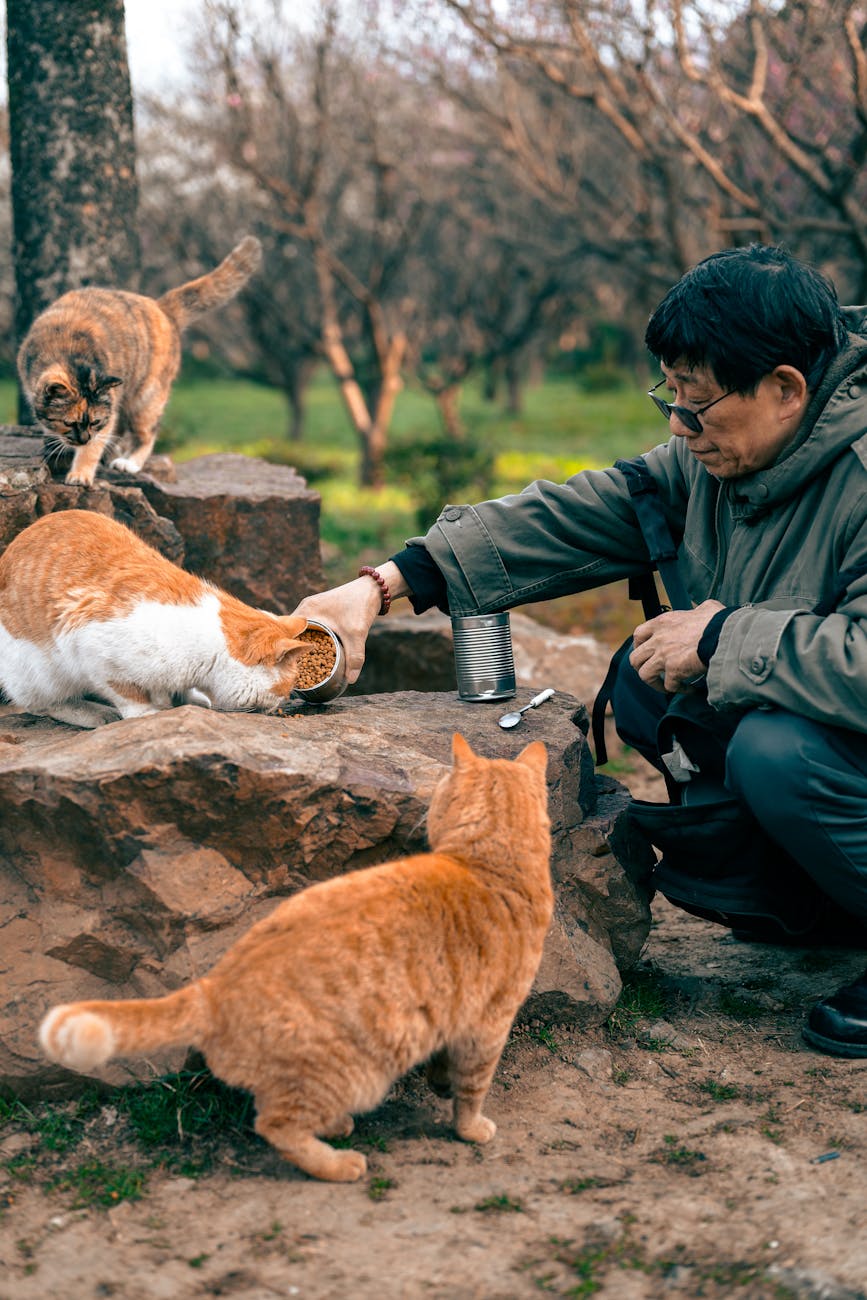
Credit: Cheng Shi Song/Pexels
A spokeswoman for the volunteer group, Community Helping Campbelltown Cats, told Sydney’s 9News that the resources the government makes available are “simply inadequate,” leaving volunteers to do the bulk of the work and fundraising for trap, neuter, return (TNR) and colony management.
“It is left to volunteer rescue groups and members of the community to do what they can to stop the breeding and get cats off the streets when they can,” she said. “These individuals risk their welfare day in day out; it is simply not right.”
As for the conservationists who advocate extreme measures, they need to dial it down a bit with the apocalyptic talk. There are productive ways to handle this problem, and they don’t involve demonizing animals for behaving the way nature intended, whipping people into a frenzy, and calling for the violent extinction of an entire species. Cat owners will need to be onboard for any effort to come up with a meaningful solution, and you won’t secure their cooperation if you’re constantly telling them their companion animals are “murderers” who need to be killed.