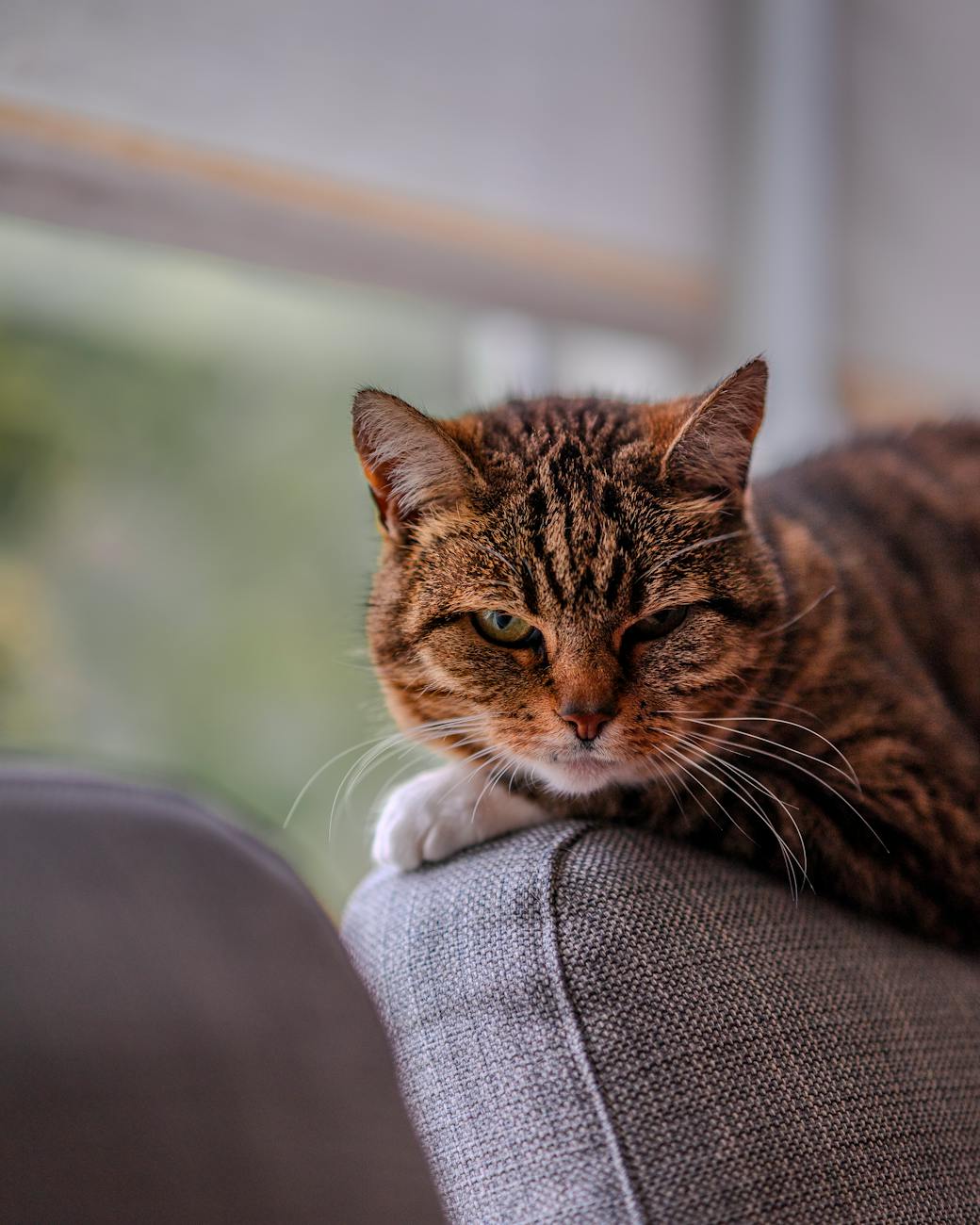
What’s With The Stories Claiming Men Don’t Bond With Or Listen To Their Feline Buddies?

There’s a disconnect between the usually careful language of research studies and the exaggerated claims of news articles.

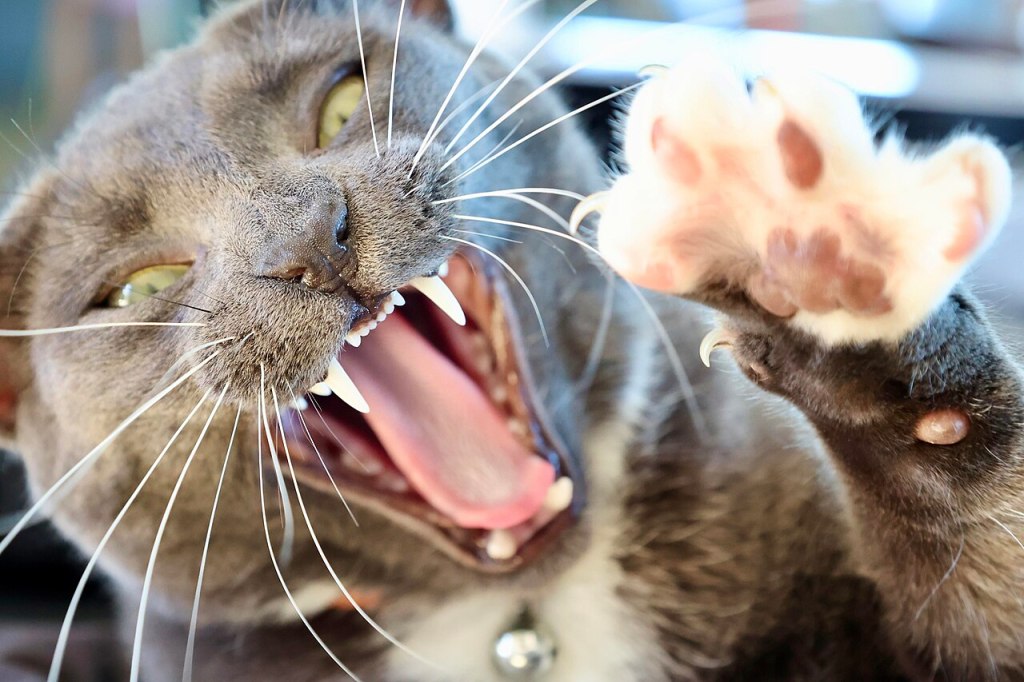
The headlines over the past few weeks have all been variations on the same riff: cats meow more frequently to male caregivers because we don’t know how to bond with the little stinkers, we disregard their feelings, and we ignore their pleas.

Others are more blunt in their assessment, like a story from YourTango that stated women “bond deeply” with cats, whereas we men are merely “manipulated” by them.

“Other studies have found that women are much better at giving their cats more attention, understanding their cats’ emotions, and are more likely to mimic their cats’ vocalization, too,” the YourTango story claims. “Whereas for men, the same cannot be said. Considering they tend to give affection more sparingly than women, it’s no wonder that the dynamic is different.”

Just picture it: women levitating above the rest of us, sharing their amazing Female Affection with the poor, emotionally starved pet felines who belong to men. If we’re trying to get rid of the “crazy cat lady” stereotype and spread the idea that cats are great companions for every kind of person, this probably isn’t helping.

“I am NOT a loudmeowth!”

So what’s the source of these claims?

Apparently a study out of Turkey that involved just 31 cats and their humans. All of the human participants were Turkish, and just 13 of them were male. All were recruited online. (And for some parts of the study, like the analysis of greetings by owner gender, only 26 participants were included because the other five did not submit complete data, including the ages of their cats.)

It’s important to make a distinction between what the study’s authors claim and what the media reports, because they’re almost always two different things.

“Science” doesn’t “say” anything. Science is a method for investigating things we don’t understand. It’s not an entity, it has no opinions, and the only clear conclusion from such a small study is that we need more data.
Hogwash! Balderdash! Codswallop!

The research team from the University of Ankara counted more meows directed at the 13 male caregivers in their study compared to the 18 female caregivers. In their paper, the team acknowledged their sample size was too small to draw any conclusions, and lacked the demographic diversity to rule out innumerable potential reasons why those 13 cats meowed more frequently than the 18 cats cared for by women.

Even with a more robust sample size including men of different ages, social classes, and nationalities, correlation is not causation, and it may be that the apparent difference in feline vocalizations disappears with a larger study group that more accurately reflects universal demographics.

Indeed, the study’s authors state clearly that feline greeting behavior is “a complex, multidimensional phenomenon that defies straightforward explanation.” (Emphasis ours.)

The conclusion, as always, is that we need more data, which is one reason why studies must be repeatable.

That nuance doesn’t make it into listicles or stories optimized for maximum shareability on Facebook, so instead we get headlines that present studies as the last word instead of the first tentative steps to understanding a phenomenon.

In case it wasn’t obvious, there is no data to support the claim that men “give attention more sparingly” than women, or that women are better at reading feline emotions. We don’t even have baselines or criteria for those claims. How do we objectively measure “better” when it comes to reading cats, especially when every cat and human bonded pair have their own pidgin “language”? What’s the “right” amount of attention?

Buddy the Cat, a gray tabby cat, with a synthwave background.
“Brrrrrrrruuuuppp!”

As the loyal servant of an infamously talkative cat, I’m not sure gender makes any difference. Bud’s vocal tendencies were already present from kittenhood, and I simply nurtured them by engaging in conversations with him, giving him loads of attention and doting on him.

Often our conversations go like this:

Bud: “Mreeeoww! Mow mow! Brrrrrt a bruppph!”

Me: “I know, little dude. You told me, remember?”

Bud: “Brrrrrr! Brrrruppp! Yerp!”

Me: “Yes, but they’ve tried that already. It’s not just about tokamak design, it’s…”

Bud: “Merrrrrp! Mow mow!”

Me: “No, it’s about plasma containment. No containment, no reaction, no energy gain!”

Bud: “Brrrrr! Mrrrowww! Brupbrupbrrrruppp!”

Me: “Yeah, well that’s just, like, your opinion, man.”

I really do talk about science and science fiction with my cat, since he seems to respond to it. Of course it’s gotta be at least partially due to my tone, but strangely if I talk to him about other abstract things, he acts like I’m bothering him with so much human nonsense.

Regardless, Buddy and I object to the claim that a talkative cat is a disengaged or neglected cat. It’s not that he talks a lot, it’s that he never stops!

Opening Your Heart To A Crazy Cat: The Story Of Kevin

A writer reminds us that feline friendships don’t always come easy, but some of the hardest-won are the most rewarding.

When San Francisco’s KQED, the local public radio affiliate, asked its culture writers to reflect on “one beautiful thing” from 2025, Rae Alexander chose her cat, Kevin.

Kevin is “chaos in cat form,” a feline “sociopath” who doesn’t realize how much damage he does with his claws. The tabby, Alexander writes, is “never not screaming at us for food” and pads around as if he owns the place. (That sounds awfully familiar!)

After bringing Kevin’s heavily pregnant mother in from the cold earlier this year, Alexander adopted Kevin’s mother and his “well-behaved sister,” but was repeatedly rebuffed when she tried to get rid of Kevin himself.

Three potential adopters fell through while Kevin was growing out of his kitten stage, drastically reducing his chances of finding a home.

Then something crazy happened: cat and human came to a mutual understanding and the beginnings of trust led to friendship and love. As with any progress in gaining a cat’s trust, it was not a quick process, but Kevin eventually showed another side — a much softer, appreciative version of himself who enjoys cuddling and expresses love despite his quirks.

“As this fraught year draws to a close, I want Kevin to be a pertinent reminder to us all that the little things bumming us out today might just lead to the things that make us happiest tomorrow,” Alexander wrote. “Start putting all those everyday stresses on the stairs. You never know where that might lead in 2026.”

Read the whole thing here:

https://www.kqed.org/arts/13983150/kevin-favorite-cat-sociopath

We’re back after a brief interruption!

Apologies for going radio silent over the past week. This past Saturday I sat down to write and my computer was dead. As in completely dead — I couldn’t even trick it into loading BIOS or getting a boot screen.

So I said farewell to a machine that had served me well since 2018, that served as my primary platform for writing, producing music and gaming.

Now I’ve got an absolute beast of a machine centered on one of the new Ryzen chipsets, and it takes quite a bit of restraint not to go into nerdy details. I’m still setting things up, especially the music production workflow.

The important thing is, I’m able to properly sit at a desk and write again, and Buddy can properly supervise me from his desktop perch again, so we are now back!

“I Am The Very Model Of A Feline So Phenomenal!” Buddy Does Gilbert And Sullivan

Buddy the Cat’s talents are innumerable! In this rousing number he slips into the style of Gilbert and Sullivan and uses verse to tell us what a feline should be.

“I am the very model of a feline so crepuscular
My visage is so handsome and my meowscles are so muscular!
I am a little tiger though the fact may seem improbable
My knowledge is near boundless in all matters gastronomical
I eat six meals a day in circumstances nominal
For serving snacks when I demand, my human is responsible
No challenge is impossible, no problem yet insoluble
I am the very model of a feline so phenomenal!

I’m schooled in all biology from macro to subcellular
A meowster of olfactory for every object smellular
My hearing’s extrasensitive in low and higher frequencies
I hear the mice a-chatter but the elephants don’t speak to me
My style is more Big Punisher than Doctor Dre or Easy E
Cuz when it comes to hip hop my tastes all face to easterly
I like to shake my booty, I’m funky when I need to be
I am the very model of a cat who does it easily!

I rule with iron paws be it jungle or the living room
And when I’m finished dining, I am content to sit and groom
When it comes to games I am the ultimate competitor
Obligatory carnivore, I am a model predator
Yet somehow cute and fluffy when I feel the need to be
Mostly when I tell my buddy “Wake up, human, and feed me!

I am well-versed in big cats whether tiger or jaguarian
And qualities of catnip like a feline rastafarian
Intimidating surely, in my home I am the guardian
Look dashing in a tux or the kit of a safarian!
When it comes to ladies all the gents seek my analysis
I designed the Taj Mahal and Cleopatra’s palaces
I drink champagne from bottles and sip water from my chalices
Then ignite sky with a range of borealises!
A champion of Opens like the French, Aussie and Wimbledon
My game is too complex for the tastes of canine simpletons

A predator so optimal, impeded by no obstacle
When I’m roused to anger you will find me quite unstoppable
Stylish with a monacle, calm and rarely volatile
I am the very model of a feline so phenomenal!

I am the very model of a feline so phenomenal!

[Chorus of girls]

He is the very model of a feline so phenomenal! Find a better cat? Well that is just impossible! He is the very model of a feline so phenomenal!”

Oh Oh Oh Ozempic For Our Oh Oh Oh Obese Cats? It’s Close To Reality

In apocalyptic news for house cats everywhere, a pharmaceutical company is kicking off a trial of a GLP-1 drug for felines.

If cats could read newspapers, chances are they’d be gripped by a cold terror right about now, wondering if they’re among the unfortunates to have their yums curtailed by the same weight loss drugs their humans have been gobbling.

As the New York Times reports, a biopharma company headquartered in San Francisco, Okava Pharmaceuticals, is about to begin a trial to determine if GLP-1 drugs can help our chonksters slim down. More than 60 percent of American pets are packing extra pounds, the Times notes, while consequences like diabetes are shortening the lifespans and reducing quality of life for felines and canines.

“It is our belief that the condition of obesity, the condition of being overweight, is by far the number one most significant preventative health challenge in all of veterinary medicine,” Okava founder and CEO Michael Klotsman told the paper.

The upcoming study will include 50 cats. Most will receive a GPL-1 medication while a control group — about one third of the cats — will be given a placebo.

Since cats aren’t exactly known for being cooperative when it comes to taking oral medicine and weekly injections at a veterinary office are impractical, Okava has developed a system with a patch about the size of a microchip that will dispense the weight loss drugs over six months before a tiny cartridge needs to be replaced.

If all goes well with the trial, Okava will seek FDA approval and address other obstacles like convincing caretakers that their little pals can benefit from the feline version of Ozempic, Mounjaro and Wegovy.

That may be easier said than done considering our relationships with our furry friends and the role food plays in things like training, bonding and every day life

For lots of cat caretakers “their main way that they interact with and show their love to their pet often revolves around food,” Dr. Maryanne Murphy, a veterinary nutritionist at the University of Tennessee, told the Times.

How could the dynamic between cat and human change if the flow of yums is reduced to meals only? Will training — for everything from walking on a harness, to entering a carrier and fun tricks like high fives — still work if the reward is just a bit of encouragement or a scratch behind the ear?

An earlier weight loss drug developed for dogs, Slentrol, did not catch on because, as one veterinarian noted, “the main way [people] interacted with their pet was by feeding them, and seeing their excitement and happiness when they were eating the food.”

There’s also the not-so-small matter of cost. GLP-1 drugs are in high demand, and they’re expensive. One in eight Americans has taken Ozempic or one of its competitors. At times, the demand has threatened availability for diabetics, for whom the drugs were developed in the first place.

If the trials are successful and the GLP-1 drugs for pets gain FDA approval — which would require a series of much larger scale, more rigorous studies — the company hopes to offer them to consumers at a cost of about $100 per month per pet.

Even if this iteration of the drug fails, it’s unlikely to derail the larger effort. Vets have been prescribing tiny doses of the human version to cats with diabetes, and perhaps most telling of all, pet obesity continues to rise despite years of efforts by the veterinarian community to get people to play with their pets more and feed them less.

As Dr. Ernie Ward, a veterarian and founder of the Association for Pet Obesity Prevention, told the paper: “We haven’t moved the needle.”


And now we check in with our correspondent, Buddy the Cat. Buddy, what do you think about the possibility of GLP-1 for your species and the end of the proverbial gravy train?

Buddy? Bud? Are we having technical difficulties?

I’m sorry, ladies and gentlemen, we can’t find Buddy the Cat. We’ll resume this segment if and when we manage to locate him.

People Think This Nebula Resembles A Smiling Cat, PLUS: What Kind Of Music Soothes Felines?

Your cat’s taste in music may or may not align with your own.

Before we get into today’s cat news, I received an email asking why there hasn’t been much Buddy on the site lately.

Fear not, friends of Buddy! The little guy is down in the Amazon visiting his jaguar pals, but he’ll be home in time for the most important holiday of the year, Turkey day. He wouldn’t miss it for the world!

Buddy with a jaguar buddy in the Amazon, where there’s a special felid conference on new napping techniques.

A smiling cat?!

A story on Space.com says people see a “smiling cat” in images of a nebula, although we’re not so sure.

The nebula in question is Sh2-284, or Sharpless 284. It spans about 150 light years and sits about 15,000 light years from our star system near the edge of the Milky Way, in an outer spiral arm.

From a certain orientation, there may be suggestions of cat-like ears and eyes, although if there is a smile, it’s crooked and deranged-looking. Maybe the cat’s on pain pills from the vet?

There’s an opportunity here, since the nebula doesn’t have a nickname. The Buddy Nebula has a nice ring to it!

Here’s an image from NASA:

This spectacular picture of the Sh2-284 nebula has been captured in great detail by the VLT Survey Telescope at ESO’s Paranal Observatory. Sh2-284 is a star formation region, and at its centre there is a cluster of young stars, dubbed Dolidze 25. The radiation from this cluster is powerful enough to ionise the hydrogen gas in the nebula’s cloud. It is this ionisation that produces its bright orange and red colours. This image is part of the VST Photometric Hα Survey of the Southern Galactic Plane and Bulge, led by Janet Drew at the University of Hertfordshire in the UK.

And here’s an annotated image from astrophotographer Jim Thommes that shows us what we’re looking at and the immediate galactic neighborhood:

In Star Trek there’s always a convenient nebula nearby when the Enterprise — or Voyager, Titan or Discovery — needs to “hide” from some well-armed belligerent, and science fiction in general creates the impression that they’re like space swamps.

In reality nebulas are regions where the interstellar medium — the space between stars — is filled with gas, cosmic dust and inert matter. Some are stellar nurseries — places where stars are “born” — and some are the remnants of dead stars and the planets that orbited them.

They can seem to glow red, orange, green or blue depending on the elements present. Some of them reflect starlight while others are like filters, with the gases and dust lending their color to the nebulae structure.

Cats are pretty well-represented in the cosmos, from a human perspective. From the cat’s paw nebula to the Cheshire Cat galaxies, to the Lynx, Leo and Leo Minor constellations, astronomers have seen cats in the sky for millennia.

Does music help cats relax?

Although the research is limited, some studies have indicated certain genres of music can help our little buddies chill out. And if research into the canine response to music is any indication, we should expect to see more evidence for cats enjoying tunes.

When it comes to what kind of music is most effective, studies point to classical music with a slow tempo, as well as reggae and soft rock “with simple rhythms, slower tempos and no heavy percussion,” according to a new story from the BBC.

Just listening to some meowsic!

A 2016 study looked at the effect of music on 12 female cats who were recovering from spay surgery. The research team played “three different genres of music: classical music (CM), ‘Adagio For Strings (Opus 11)’ by Samuel Barber; pop music (PM), ‘Torn’ by Natalie Imbruglia; and heavy metal (HM), ‘Thunderstruck’ by AC/DC.”

The team measured heart rate, breathing rate and pupil dilation, concluding that classical music was most effective, followed by the Imbruglia song and AC/DC last. (Maybe next time they can slide The Tony Danza Tapdance Extravaganza in there for some extra fun.)

Anecdotally, Bud did not respond well to composer David Teie’s Music for Cats, but he hangs out and nods along to funk, classic 90s New York hip hop, retrowave, nu-disco, reggae and certain kinds of rock, which is almost certainly because he grew up hearing that stuff with me.

So maybe there’s a nature vs nurture element to feline musical preferences, although I wouldn’t hold out hope for cats who enjoy the Tony Danza Tapdance Extravaganza. Some things are best left alone.