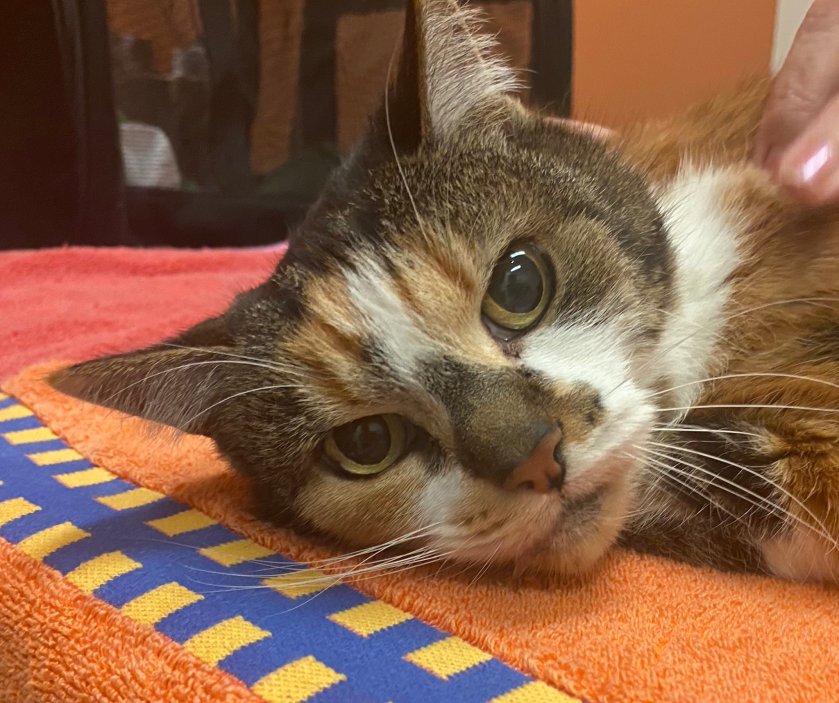
A tabby in Japan got help after an elderly man fell into an irrigation channel.
When an elderly Japanese man fell into an irrigation channel and couldn’t get out under his own power, it was a cat who got the attention of a neighbor, leading to the man’s rescue.
The incident happened at 7:30 p.m. on June 16 in Toyoma, a city of about 413,000 people about 300 miles northwest of Tokyo on Japan’s main island, Honshu.
Koko the cat, a gray tabby, managed to catch the attention of a 77-year-old neighbor, leading her to the spot where the man had fallen into the irrigation channel, Kyodo News reported. The neighbor enlisted the help of her daughter — Koko’s owner — Tomoyo Nitta, and her two grandsons — ages 20 and 18 — who pulled the victim to safety.
Civic duty is a big thing in Japan, and Japanese police agencies in turn honor civilians who go out of their way to help or rescue others. (US police agencies, which are desperately trying to repair their tense relationship with regular Americans, could learn a thing or two from the Japanese model of community policing.)
The humans involved got an official calligraphic thank-you citation from the cops, while Koko got cat food. We’re sure she’s not complaining about her reward.
“I want to tell her well-done,” Nitta said, cradling the usually shy Koko in her arms during the brief recognition ceremony on June 28.
A cat and a group of people who rescued an elderly man from an irrigation ditch were honored by police in Toyoma, Japan, earlier this week.
Bob the Street Cat represented hope, second chances and the unconditional love between humans and animals.
Back in 1 AB (that’s After Bud, for those of you who don’t use the Buddesian Calendar) my mom got me a copy of A Streetcat Named Bob, which told the story of a recovering heroin addict and the cat who literally walked into his life.
James Bowen was in a rehab program and was living for the first time in his own apartment when the injured but insistent orange tabby showed up at his door. Though dirt poor, Bowen scraped together enough money from busking — playing his guitar in public for tips — to bring Bob to the veterinarian and buy the basics he’d need to care for the cat.
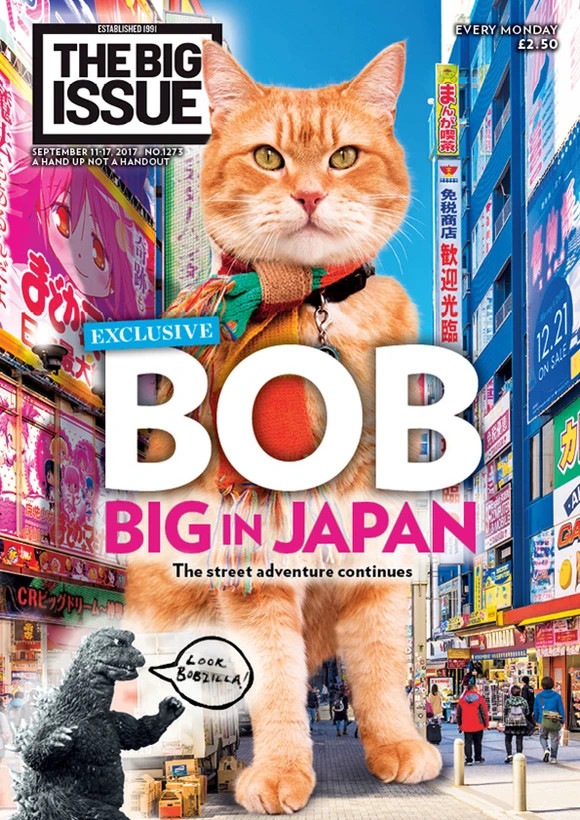
After adjusting to life inside the apartment with James, Bob decided one day he’d accompany his human to work, which for James meant standing outside major metro hubs and hawking a magazine called The Big Issue. For our readers who aren’t familiar with the magazine, The Big Issue exclusively employs the homeless and the struggling as magazine vendors, offering them an opportunity for employment when they might not otherwise be able to secure it.
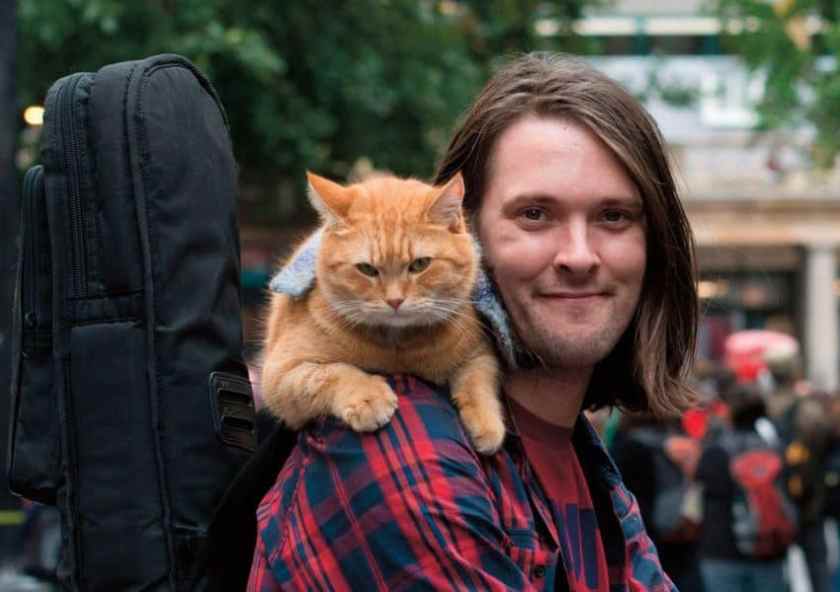
Bob turned out to be an unflappable cat, calmly riding on James’ shoulders as they took the bus to James’ assigned vendor location. Whether perched on James shoulder or standing next to him, Bob became a fixture by James’ side, handling the crowds and the interested passersby with a calm not usually associated with cats.
Bob riding the shoulder of his beloved human, James Bowen.
Soon word spread of the magazine salesman with “The Big Issue cat.” A local newspaper ran a story about James and Bob, then a few Youtubers visited the duo on the street, uploading videos of man and cat selling magazines and busking for extra money.
One of James and Bob’s biggest breaks came when Sir Paul McCartney heard their story and visited them in person as they were hawking magazines in London.
From there, as the Legend of Bob grew, a shrewd literary agent saw potential in the story of the recovering addict and the cat, and inked Bowen to a book deal. The rest is history: The book propelled James and his feline friend to stardom, leading to a handful of additional books, a cartoon and a 2016 movie about the duo.
“He taught me that I had to buckle up…because he was following me around and stuff like that, I had to take responsibility for him,” Bowen recalled in a 2016 interview. “I didn’t know it then, but the love that he was giving me was helping me to change my ways.”
For many people, the story of James and Bob represented not only the unconditional love between cat and human, but also hope and the promise of second chances in life.
Bud is no Bob — he’d run screaming at a book signing with hundreds lined up to greet him — and I’m no James, but my mom thought I’d enjoy the book because I was also going through a tough time when I adopted Buddy — though nothing as dramatic as James’ situation — and like James I found a measure of peace in taking care of my cat, which allowed me to look outward and gave me a responsibility that took my mind off my own problems.
Actor Luke Treadaway, left, who played James Bowen, right, in the movie based on Bowen’s book. Bob played himself!
After finishing the book I pulled up a few of the early videos of James and Bob on Youtube and, among the streetside interviews and other clips, I found a vid of James and Bob appearing on a British morning television show.
For the most part the interview went the way you’d expect those things to go: James and Bob were there to promote their book, James gave Bob a treat in exchange for a high-five, and the questions were rote.
All except one, when the male anchor turned to James and asked him if he’s thought about what he’ll do when Bob dies.
As his female co-anchor stared daggers at the man, James swallowed, hesitated, and said he doesn’t like to dwell on that thought, that he prefers to focus on the moment, being grateful for having Bob in his life and appreciating him.
Bob became an international celebricat, with his book tour taking him and James to Japan and other countries.
At the time the eventuality of Bob’s death seemed remote. No one was sure how old Bob really was, but veterinarians estimated he was eight or nine years old.
Now, at age 14, Bob has passed away.
Bob’s fans are legion: They lined up in their hundreds and thousands for his book tours, they sent thousands of scarves as gifts to the orange tabby and they made him the most celebrated cat in the UK.
Now they’re flooding The Big Issue with condolences and letters about Bob, and we hope James takes comfort from the fact that his little buddy touched so many lives.
Bowen, understandably, is devastated.
“There’s never been a cat like him. And never will again,” he said. “I feel like the light has gone out in my life. I will never forget him.”
For the rest of us, it’s a reminder that our cats are only with us a short while, and that there will come a day when we wish they’re still around to annoy us by jumping on our keyboards or rousing us from sleep with urgent meows for breakfast.
Appreciate them. Love them. And pay attention to them, which is all they really want from us.
Footage shows a shadow slowly coalescing into what appears to be a cat curled up on a sofa.
A Redditor believes she caught the ghost of her late cat on camera a year to do the day after he died.
Aw, shit. If this is true, you know what it means, don’t you?
I’ll never escape Buddy and his incessant meowing for more Temptations. I’m condemned to live out my existence hearing “Mrrrrrrrppp! YUMS NOW!” from spectral Buddies who will continue to demand turkey and turkey-flavored treats even in the afterlife.
I shall be a servant forever, scooping phantom poop out of a litter box and serving wet food to a nonexistent cat like a madman.
All jokes aside, people who read this blog know I’m a skeptic, and I don’t think it’s coincidence that every example of allegedly supernatural and extraterrestrial phenomena — from “ghosts” popping up on camera to “UFOs” tracking on military IR — can only be seen in grainy, low-resolution footage.
We are humans, after all, given to superstition and genetically hardwired to see patterns everywhere, even where there aren’t any. That’s precisely what’s happening when, for example, we see faces and familiar shapes in clouds. (We also have a long, repeatedly proven tendency to invent explanations for phenomena when none are forthcoming.)
So it’s with a grain of salt that I present to you this clip, which one Reddit user believes may show her late cat lazing on her living room sofa precisely one year to the day after passing away:
As you can see in the video, one of the woman’s living cats drops down from near the window and pads in the direction of the front door as she walks in. But on the couch a shadow starts to take shape, gaining definition in the dark until the woman flips on the lights and the shape becomes well-defined.
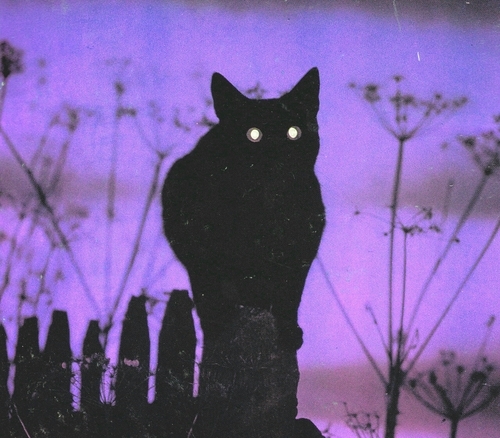
The Redditor says she believes the shape could be Blackjack, her late all-black kitty. As you can see in the footage, she appears to look right at the phantom feline, but she says she didn’t see anything until she was reviewing cam footage from May 24, the day it was recorded.
The shape is certainly convincing, but keeping in mind Occam’s Razor — favoring the explanation with the fewest assumptions, or “entities should not be multiplied without necessity” — what I see is the shadow of an object that, when viewed from a particular angle, happens to look like a cat. The mind looks for a pattern, so we see a cat.
That explanation also makes the most sense with the surrounding context: The shadow didn’t become solid until the lights flipped on, and the woman didn’t notice anything amiss when she was looking straight at the couch in the video. If we’re seeing a shadow that only looks like a cat from the right angle, it makes perfect sense that she wouldn’t see anything strange from her vantage point.
Her kitties don’t react either, which they’d almost certainly do if another cat simply materialized in front of them.
“That most certainly looks like a cat,” one user wrote, “but hey, I’m no expert, I’m just some idiot on Reddit [who] enjoys strange memes.”
Note:Buddy doesn’t have an opinion on this, but he would like you to know he’s absolutely NOT hiding behind my legs while producing faint, terrified mews.
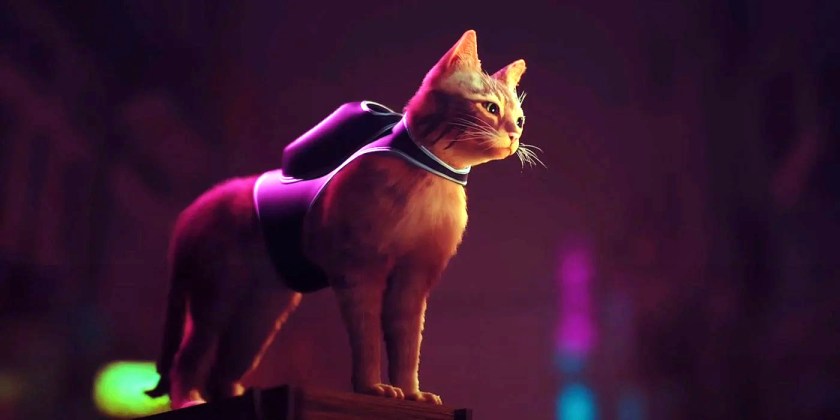
In the world of Stray, cats navigate a futuristic, neon-lit Hong Kong.
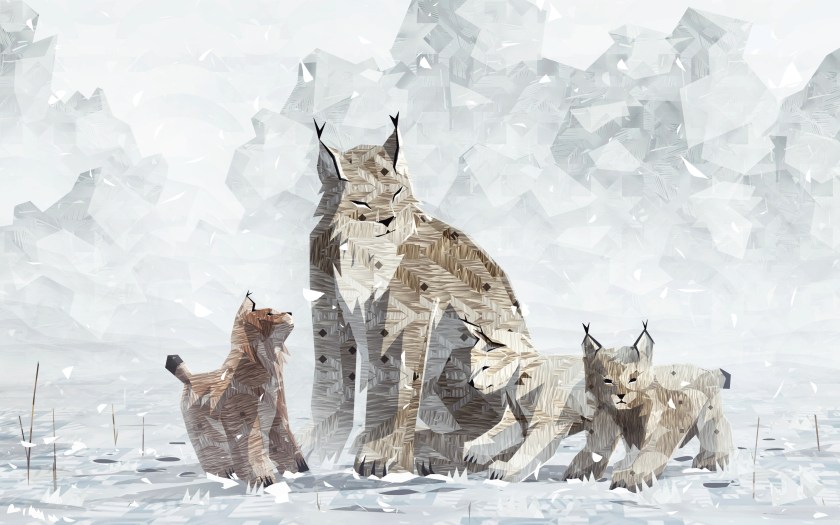
After 2015’s Shelter 2 — in which gamers take on the role of a female Lynx protecting her cubs in the wild — proved there’s a real audience for games from a cat’s perspective, there have been a few feline-centric games coming down the development pipeline.
None of them, however, look as unique and fascinating as Stray, a newly-unveiled title in which players take the role of a cat surviving in a post-human future Hong Kong.
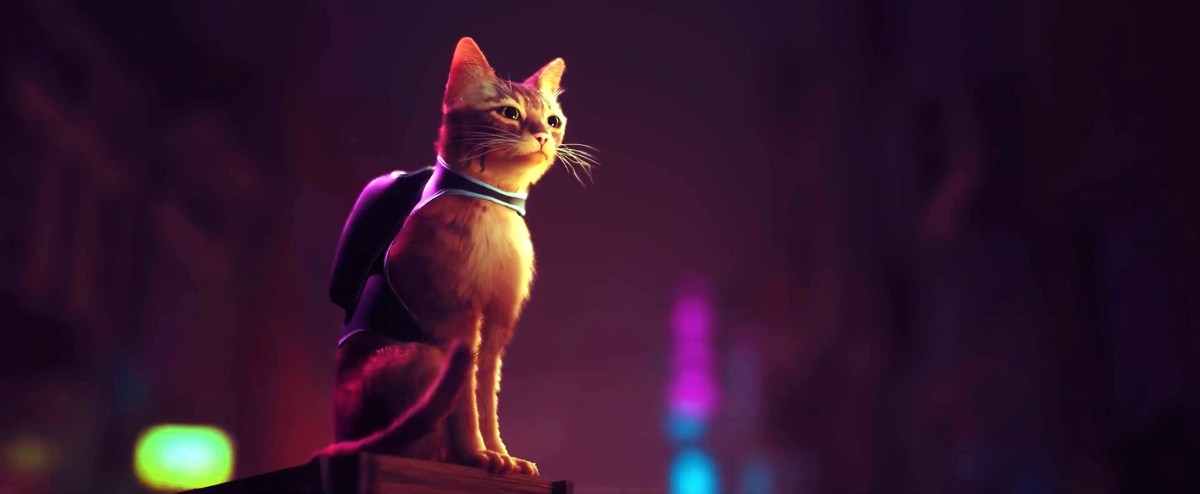
The game’s trailer is spectacular, following an orange tabby cat navigating a neon-lit urban landscape populated only by machines. Details about the narrative haven’t been revealed and it’s not clear what happened to humanity in the game’s universe, but cats are alive and well in Stray, and it looks like they’ve manipulated robots into serving them the same way they had humans wrapped around their little paws.
“I will throw my money at anything that lets me play as a cat,” one Youtube user posted.
“There’d better be a meow button,” another wrote.
Although it’s early yet and we haven’t seen gameplay videos, the cat depicted in the trailer is exceptionally well-modeled and rendered by game artists who clearly love the little furballs. The feline’s gait, movements and vocalizations are spot-on.
Stray will be a PS4/5 exclusive at launch (boo!) but will also have a PC release, presumably at least a few months later. We’ll be watching eagerly for more news about this interesting and unique game, which is slated for a 2021 release.
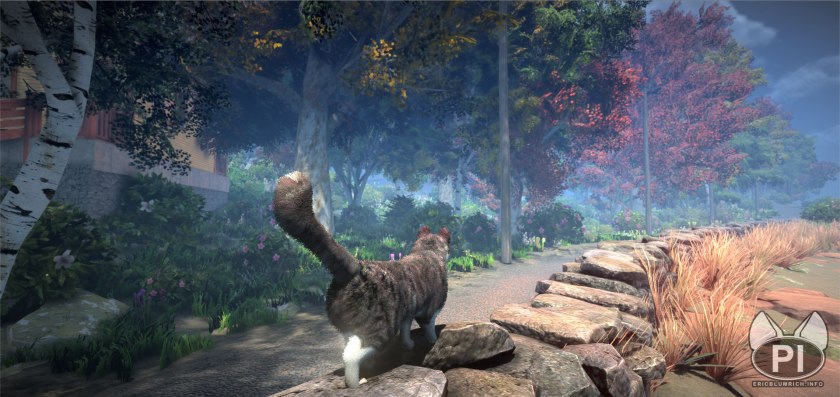
The feline player character seen in the trailer sports a backpack which could serve as a player inventory or hide gadgets. We always knew cats were smarter than they let on.A mother lynx and her cubs in Shelter 2, which employs heavily stylized visuals to represent animals and their environment.Peace Island is another game currently in development that will allow players to control cats, who are the protagonists of the game.
The Gladiator actor was training for a new role when he found a mewing kitten just off a path near his home in rural Australia.
Russell Crowe was training for the 2005 movie Cinderella Man, in which he plays boxer James J. Braddock, when he “took the bunch of blokes who had been beating me up for their pay check” — his trainers and fellow actors playing boxers in the movie — on a mountain bike ride in rural Australia.
After cresting a “particularly punishing hill” and stopping for a sip of water, Crowe wrote, he heard plaintive mews coming from the trees off the rural Australian trail.
“Underneath the swirl of sounds I heard something out of place. Was that a meow? I started to look around me. I heard it again. I took a few steps of the track into the rain forest. Thick with ferns and vines. One more step and then I saw it. A kitten…”
The baby cat was abandoned, and Crowe says he thinks the cat might have been dumped by a driver who passed the bicyclists a few minutes earlier.
“I looked back down the track and the boys were gaining on me,” he wrote. “I put the kitten in my backpack and rode on.”
Cinders as an adult. Credit: Russell Crowe
After returning to camp, Crowe took the kitten out of his pack, showed it to his friends and told them he was going to give it to his mother, who had been talking about adopting a cat.
“There’s something reassuring in a bunch of big sweaty boxers going crazy over a kitten,” Crowe wrote. “We flew down the hill in a tight group and arrived back at my farm together where I presented my mother with this tiny baby kitten. She was floored. So happy.”
That was in 2003. Cinders lived for 17 years and died on June 9. Crowe shared the story of finding and adopting the beloved cat in a Twitter thread.
Crowe, who was living with his mother while training for the movie, said he was originally opposed to getting a cat because felines are “the notorious enemy of bird life.”
When he found Cinders, he wrote, he felt “this was the universe telling me to respect my mother and give her what she wanted.”
“She had never grown to be fully trusting of humans, but, she loved my mum and my mum loved her.”
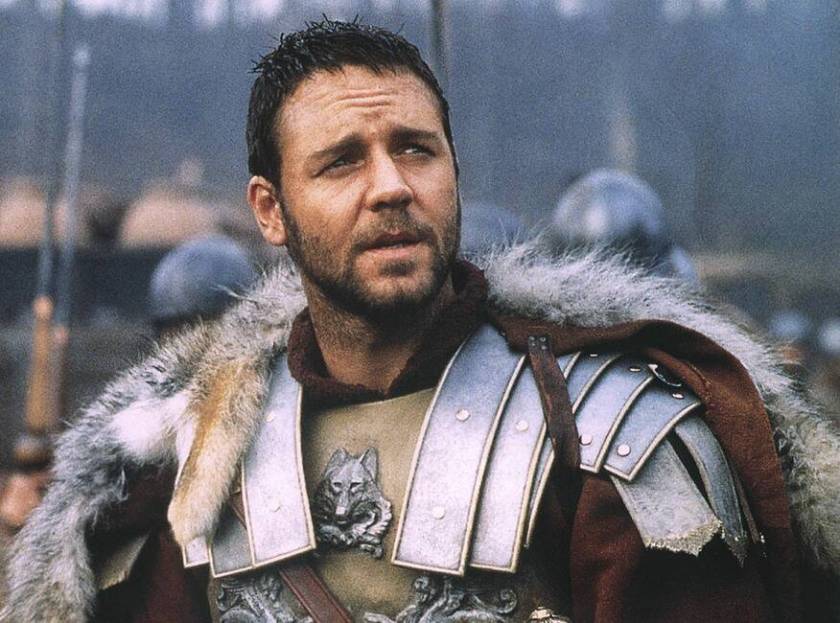
Russell Crowe is perhaps best known for his role as the Roman general Maximus in Ridley Scott’s 2000 epic “Gladiator.”