Tokyo’s ‘Waving Cat’ Temple, Gōtoku-ji, Has Run Out Of Cats

The world-famous cat shrine has experienced a surge in tourism, leaving it bereft of the familiar statues that are inspired by the legend of a friendly cat.

Gōtoku-ji temple has a unique problem.

The complex, where legend says a friendly waving cat led a Japanese feudal lord and his men to warmth and safety ahead of a brutal storm, has seen an influx of travelers since Japan relaxed its COVID-era restrictions and tourists have returned.

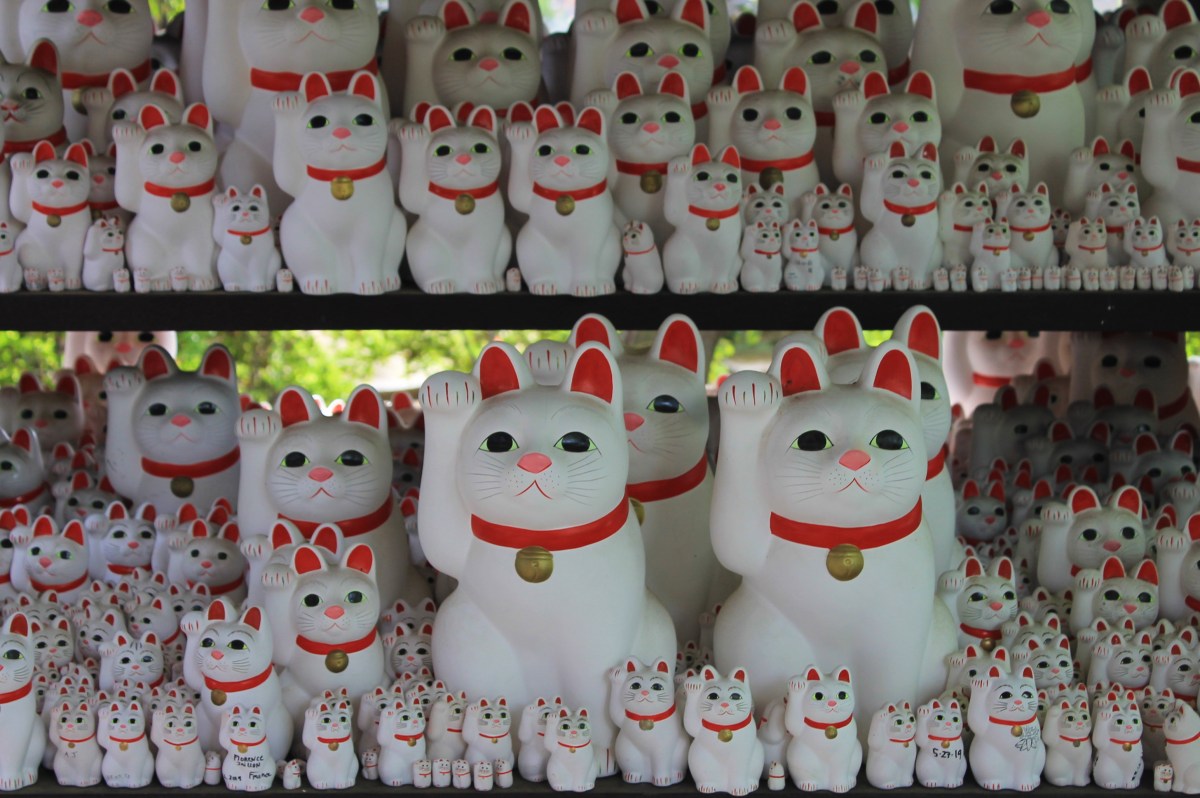
Now Gōtoku-ji can’t keep up with the demand for maneki neko, the ubiquitous “beckoning cat” statues that visitors purchase at the shrine’s tiny gift shop, the Washington Post says in a new report. People who come to the temple write prayers on the statues and place them in a perpetually-expanding section of the shrine grounds.

The cats are said to bring good luck, with variations in their designs and colors: red for health, pink for love, gold for success and so on. White maneki neko, which are sold at the shrine, are the original and “all purpose” prayer cats. The shrine is Buddhist, but practitioners of Shinto, Jainism, Christianity and other religions write prayers on the little cats, hoping they’ll be heard by whichever version of God they believe in.

The manufacturer, which also makes statues for the Lunar New Year and other festivities, can’t keep up with the demand. Now staff at Gōtoku-ji have put up signs apologizing to visitors. They say they don’t know when they’ll get more maneki neko.

When I visited in 2019 there were many thousands of the iconic statues, but the photos from Monday’s WaPo story show thousands more placed on recently-built shelves. Temple staff have begun asking visitors to take their maneki neko home with them instead of leaving them at Gōtoku-ji. They clean, shelve and organize the thousands of statues currently there and won’t dispose of them because they represent the prayers of visitors, but the volume has become unmanageable.

Maneki Neko at Setagaya Tokyo
Visitors leave their own maneki neko statues at the shrine, often with personal messages asking for different blessings and written in black marker on the back of the statues. Credit: Pain In The Bud

Despite Gōtoku-ji’s rise in popularity, I still recommend checking it out, especially for cat lovers who are headed to Japan. While most of Tokyo’s most famous shrines are located in the city proper, with modern skyscrapers looming above temples that date to pre-modern Japan — never letting you forget you’re in a bustling metropolis — Gōtoku-ji is in Setagaya, a mostly-residential ward.

The temple grounds are surrounded by homes and they’re quiet in a way that others aren’t. The shrine is well-manicured and beautiful, dotted with statuary as well as centuries-old wooden temple structures.

When I was there a smiling elderly docent walked the grounds carrying a photo album that showed the temple and its structures over the years. With my sister-in-law’s rudimentary Japanese we were able to get a bit around the language barrier, and he told me one of the most striking buildings, a three-story tiered wooden tower, was home to one of the resident cats who liked to sleep on its second floor.

I wasn’t able to catch a glimpse of the little one but I imagine Gōtoku-ji is one of the best places on the planet a stray cat could call home. Like the people of Turkey, respect for cats is ingrained in Japanese culture and temple cats in particular are treated extremely well. Some even have their own Instagram pages and fan clubs, becoming tourist draws in their own right.

Maneki Neko Setagaya Tokyo
Maneki Neko statues at Setagaya shrine. Credit: PITB

What It’s Like To Care For World’s Oldest Cat, Plus: Utah Zoo’s New Kitten Is Cute But Deadly!

A London woman’s cat, Flossie, just celebrated her 29th birthday, making her the oldest cat in the world. And in Utah, a zoo just debuted an adorable little predator.

Happy Sunday, everyone, and if you’re on the east coast of the US like we are, we hope you’re safe and warm during this year’s first snow.

We’ll start off with a bit of significant news first reported in the The Buddesian Times: the famous artist and sculptor Meowchelangelo has unveiled a glorious marble statue of our favorite feline hero, “striding like a colossus toward evil-doers in the distance, his rippling muscles rendered in magnificent Calacatta Borghini,” which is marble from the same quarry in Carrara, Italy, that supplied the raw material for another masterpiece, the Renaissance sculpture commonly known as “David.”

The statue, which honors Buddy’s recent valorous defense of a helpless dog during a vicious attack by a pack of 72 coyotes, will likely be installed in Manhattan, although Washington’s city council is lobbying hard for it, promising the famous statue of Abraham Lincoln in his eponymous monument would be removed for the Buddesian likeness.

buddesiantimes
Today’s edition of the Buddesian Times with a front-page story on the statue.

The World’s Oldest Cat still moves like a kitten

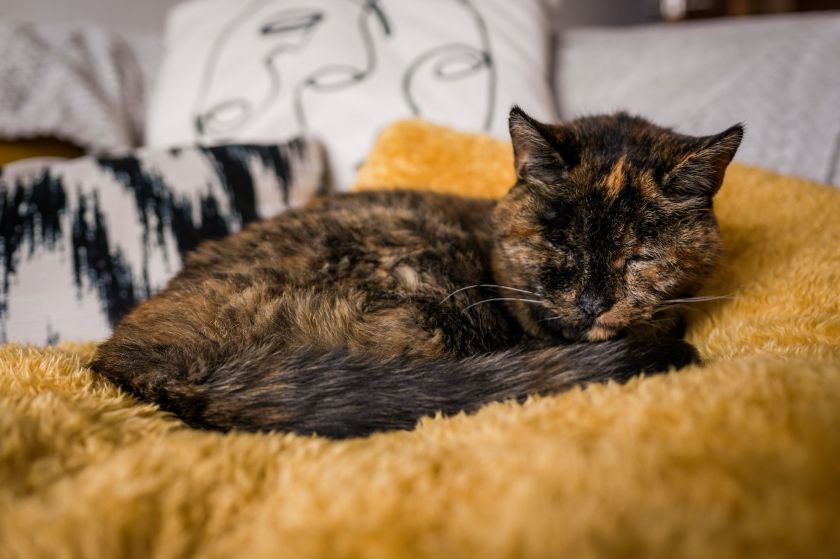
The Guardian has an interesting column from Vicki Green, cat mom to Flossie, who at 28 years old is the Guinness World Records certified oldest domestic cat in the world.

Flossie, who was born in December of 1995, is as old as Green, who attributes the tortoiseshell’s longevity to “luck, and because she was loved by her previous owners.” Flossie was initially an outdoor kitten who lived in a managed colony until she was adopted by her first human, who died when Flossie was 14 years old.

The woman’s sister took Flossie in next but died after 10 years. Her son became the long-lived feline’s third servant, but after three years he brought her to Cat’s Protection in London, saying he could no longer provide the level of care Flossie deserved and needed.

Shortly after, Green was looking to adopt a cat and saw Flossie’s listing online.

“At the time, I thought it was an error and that she must be 17,” she wrote. “Cats Protection told me she was still available to adopt and that no, she was in fact 27, the same age as me.”

Green thought Flossie would likely only live a few more months, but “she’d at least spend them in a nice, warm flat, be fed well and get treats as well as a comfy bed.”

“To my surprise,” Green wrote, “I’ve had her for over a year now and she’s still going strong.”

Flossie napping
Flossie takes lots of naps but is surprisingly active and playful for her age. Credit: Vicki Green

Despite her advanced age, Flossie is active, seeks attention and still plays with her favorite toys. Green got miniature stairs for the senior kitty to easily reach the couch, but Flossie doesn’t use them, preferring to jump up instead.

“The biggest difficulty is dealing with the fact that there may soon come a time when she passes. I’m in denial about that. I look at her and just think she doesn’t look old at all,” Green wrote. “Yet who knows? She could well be on the way to becoming the oldest cat in history. Though even if she doesn’t break the current record of 38 years and three days, at least I’ll know she had a great retirement home.”

Gaia the three-pound terror debuts in Salt Lake City

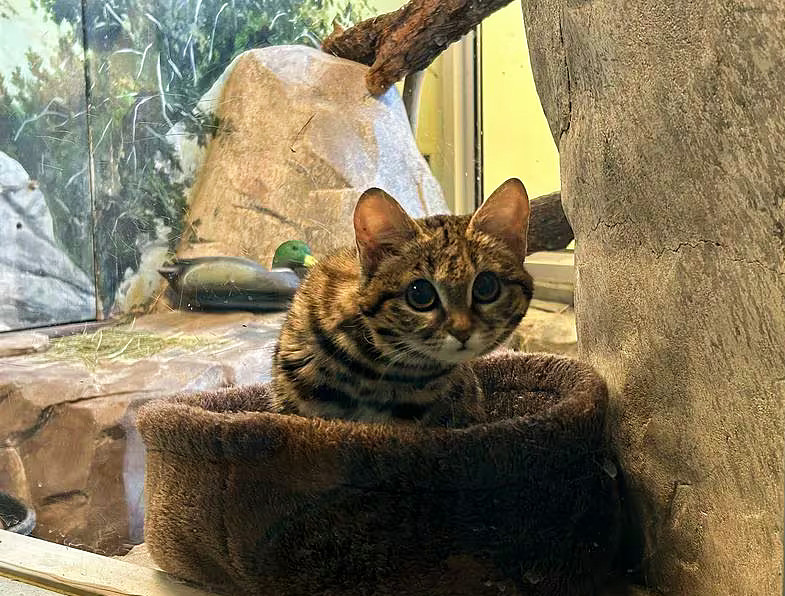
Black-footed cats are known primarily for three things: they’re outrageously cute, they’re diminutive and they’re remarkably deadly.

Of course with a maximum weight of three pounds, only tiny prey have to worry about the fury of these furry little guys. The rest of us get to point and go “Aww!”

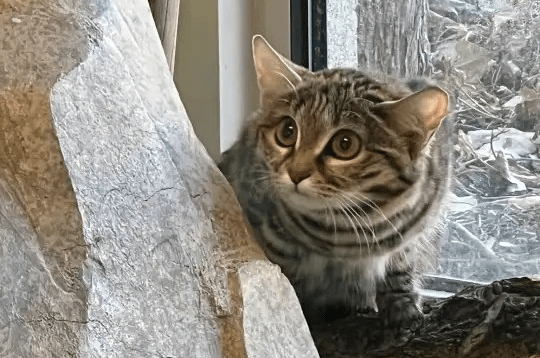
Gaia the black-footed kitten
Gaia’s personality is “large and feisty” according to zookeepers. Credit: Hogle Zoo

Native to the savannas of southern Africa, black-footed cats are excellent hunters, but like all felines they’re also prey, and they’re the subject of a worldwide zoological breeding and conservation program due to declining numbers in the wild.

The newest success story for those breeding efforts is Gaia, an eight-month-old black-footed kitten who just made her debut at Hogle Zoo in Utah.

Zookeepers describe baby Gaia’s personality as “large and feisty,” and they expect she’ll be popular with zoo visitors.

She’s now the second of her species at Hogle, joining Ryder, a male. They haven’t been introduced yet. A carefully supervised introduction is “in the cards, but we’ll let these two feline friends get acquainted when Gaia reaches maturity,” the zoo said.

Meowgadeath, Cat Sabbath, Deft Leopards Headline Felifest 2024!

Fans of thrash metal, doom-napping and predatorial purring will love this year’s festival lineup.

Feline thrash metal legends Meowgadeath will hit the road this winter to support their new album, Obligate Carnivores, and cats are desperately trying to get their paws on tickets.

The quartet will headline Felifest, the annual heavy metal festival that features the gnarliest bands, the most radical shredding and the most extreme subgenres including zoomcore, doom-napping and predatorial purring.

Cat Sabbath and Deft Leopards are the sub-headliners and lead an all-star lineup that includes symphonic thrash rockers Claws of Death, pop-metal posers Puns and Poses, progressive Vikingcore standouts Ragnar and the Berserkers, and grunge-metal pioneers Purrvana. The latest rumors suggest littercore legends The Tony Danza Tap Dance Extravaganza will join the festival lineup as well, fueling significant interest.

meowgadeath_tour
The official tour poster with early 2024 dates shows Meowgadeath will kick off their shows in the northeast before heading south and west.

Meowgadeath has already enjoyed significant airplay from the new record, with the singles “Lounge to War” and “Overlords of the Apes” both reaching the Scratchboard top 10 in the US, Europe and Asia.

“Felifest 2024 promises to be the most righteous, most tubular, most hardcore gathering of up-to-eleven discordant noise since cat sex was invented,” wrote Modal Meow critic Mr. Snuggles Razorclaw. “Not since Fuzzy Fuzzbourne ate a live mouse on stage has the metal community been so excited.”

Meanwhile, Buddy likes his music on the more funktacular side of things and says he’s most excited to see Le Handsome Club play to a booty-shakin’ crowd in New York in support of their newest record, Cosmic Megafunk For Extraterrestrial Discos. Le Handsome Club will be preceded by a familiar opening act, the funktastic stylings of Purrliament Funkadelic. Prepare for the funk!

Clarence The Three-Legged Kitten, Plus: Happy New Year From A Cat Cafe In Tokyo

Fellow blogger Molly Hunt is fostering a special little guy who’s recovering from an amputation.

Blogger, cozy mystery cat writer and foster parent Molly Hunt has opened her home to a special little guy, and following his progress is a good reminder of the great work so many cat lovers do — walking the walk, as they say.

Molly’s charge, Clarence, is just a kitten but he’s already had a really rough go of it:

“Clarence, a six-month-old kitten, came to the Oregon Humane Society with a 1.5” round wound on his right hip. Tests traced its origin to a mass attached to the bone which may have occurred when a previous fracture healed badly. The left hip had also been affected by the trauma. The upshot was surgery on the left hip and the amputation of the entire right leg. Two days later, the call went out for a foster parent, a call that I happily answered.

It had been several months since I’d fostered a cat, and I was excited to begin again. I have a designated foster room with a pleasantly equipped kennel where I’d cared for many cats with mobility issues. I thought this one would be similar—limited movement, no running or jumping, and a twice-daily set of physical therapy exercises. I wasn’t worried about the fact he had only three legs. I’ve seen tripod cats who got along just fine, not limited by their disability as humans tend to be. I understood this would be a new experience for me, but I forgot to take into account that it was a new experience for Clarence too.”

Molly writes movingly about Clarence, his trauma upon waking up to find a leg missing, and the way he’s quickly adapted to his new situation. Cats are incredibly resilient, especially when they have the love and care of a good human to help them along:

Clarence was shocked to find out he no longer had a back leg. I’ve rarely seen cats react with that sort of complete panic. It’s usually caused by a loud noise such as fireworks or something unexpectedly crashing to the ground. This was different. This was Clarence’s own private terror.

Despite his initial shock, Clarence has been learning how to get around on three legs and he’s even gotten back to playing with his favorite toys. We wish Clarence and Molly the best on their journey together and if Clarence doesn’t end up as a foster “fail,” we hope he finds a forever home full of support and love. Click here to read parts one, two and three from Molly.

Happy New Year From Tokyo

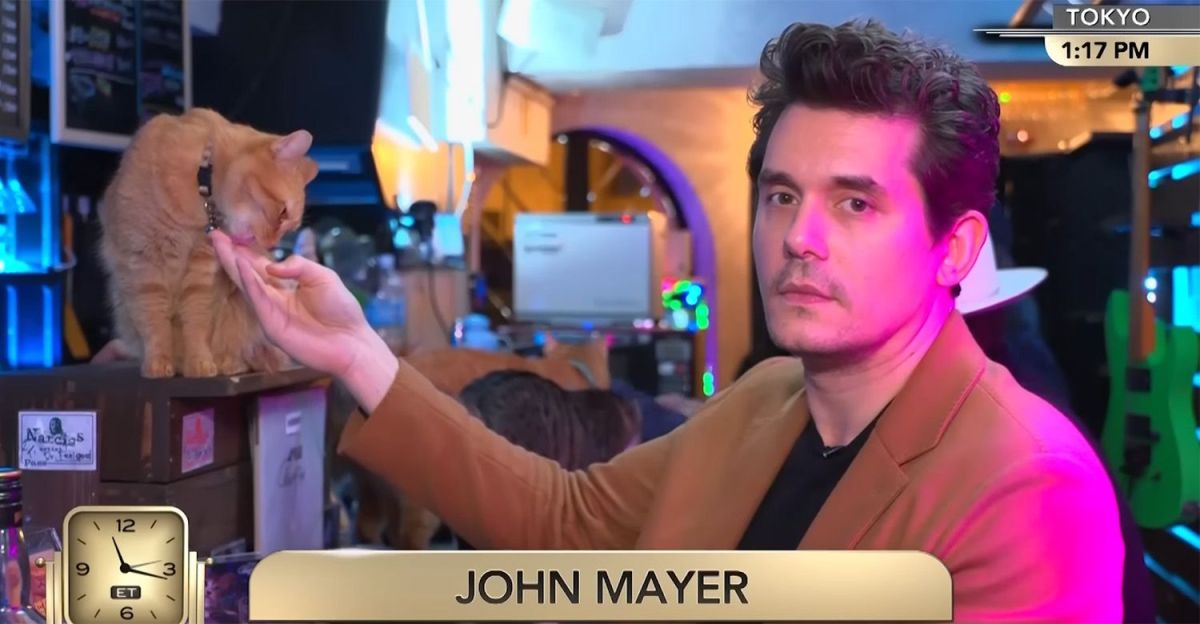
John Mayer brought some feline fun to the New Year’s Eve festivities this year when he called in to CNN’s broadcast from a cat cafe in Tokyo, amusing Anderson Cooper to no end:

The cafe is called Cats In The Box and it’s located in Shinjuku. I’ve got some photos of the exterior of the place from my time there — unlike the cat cafe I visited in Roppongi, Cats In The Box has prominent, floor-to-ceiling windows looking out over one of Tokyo’s busiest neighborhoods, so you can’t miss it. From the street you can see the furry residents climbing their cat condos and chasing toys as if they’re saying “Come on in, join the fun and buy me some of that good ‘nip, will ya?”

Japan is famously in love with cats, and in addition to having several cat cafes, Shinjuku also boasts a famous 3D billboard that features a cute calico padding around and meowing in between advertisements.

Click to play the short video below:

Buddy The Cat And The Search For The Lap Of Luxury

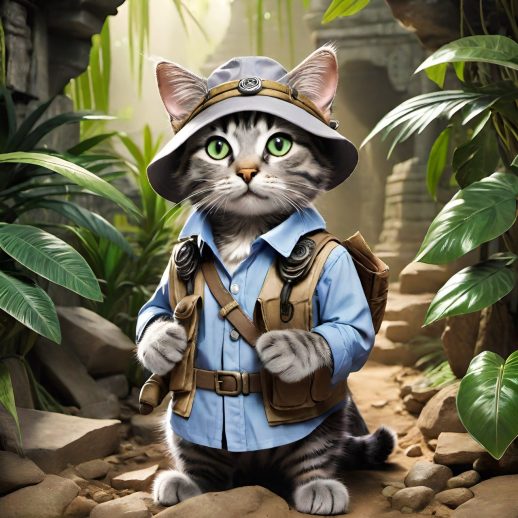
Sir Buddy leads an expedition into the jungle to find the legendary Lap of Luxury.

AMAZON RAINFOREST — At the peak of the hill, still well within the darkness of the tree canopy where only a few slabs of light penetrate through the understory to the jungle floor, a path stops abruptly.

In its place is a steep drop and the mouth of an underground chasm carrying water over the edge, creating one of the planet’s most spectacular waterfalls — and a sweeping vista of the lake and its shores below, where structures from deep antiquity seem to exist only as outlines in the mist.

It is here in the Lost City of Casarabe that intrepid explorer Buddy the Cat believes he’ll find the legend his species has sought for more than a thousand years.

It is, he believes, the site of the Lap of Luxury.

“Many explorers have braved these jungles in search of the legendary Lap of Luxury,” Sir Buddy says as members of his team pad around their camp. “I stand on the shoulders of some pretty big cats here, on the cusp of history, to finally achieve what so many felines set out to do.”

buddy_archaeologist2
Buddy on the hunt for the legendary Lap of Luxury, which may be located in the Lost City of Casarabe.

Buddy believes the Lap of Luxury will be found in this ancient city, which was abandoned more than a thousand years ago for reasons that so far elude the experts accompanying him. Only a very small part of the Lost City of Casarabe is visible even this deep in the jungle. The flora here is too dense and the jungle floor too dark to give up its secrets so easily.

Under Sir Buddy’s direction, teams have cleared a thick network of vines to reveal a stepped pyramid, the twelve spires of a temple dedicated to a mysterious jaguar deity, and a remarkably well-preserved palace that Buddy believes once belonged to an aristocratic feline.

Some seventy rooms are contained in the palace, including a chamber the team has dubbed the Hall of a Thousand Naps, where stunning stone-carved reliefs depict an advanced felid civilization that engaged in napping not only as a biological necessity, but a function of religious fervor.

“The Caztecs were known for their brutality and the Layans were known for their enduring empire, but the hallmark of Casarabian society was the elevation of napping into high art,” says Ferdinand Lyle, an expert on South American antiquities with the British Museum. “Indeed, grand murals depict a civilization that measured time in naps and meals, and even military disputes with neighboring powers were scheduled around shut-eye. To the Casarabians, violating the sanctity of the Nap Schedule was considered an affront to the very fabric of society.”

jaguar lying on tree log
Otorongo, one of Buddy’s buddies, met the intrepid explorers deep in the jungle and accompanied them to the Lost City, facilitating a cultural exchange of napping technique. Credit: Benni Fish/Pexels

Legends and the surviving records of neighboring civilizations mention the Lap of Luxury using a dictionary’s worth of superlatives to describe its magnificence. Aztec scholars called it “simultaneously radiant and outrageously comfortable, always the perfect temperature, the substrate upon which kings enjoyed serene naps and gentle massages while being fed candied figs.”

It is alternately described as gilded, soft, gem-like in its facets and silken in tactile sensation.

“Of its comforts, it knows no equals,” wrote 19th century explorer Percy Fawcett, who spent the latter part of his life searching for Casarabe. “If today’s artisans were capable of emulating such perfection, which they are obviously not, all of civilization would grind to a halt as millions fall into deep, satisfying slumber.”

Khalbalique, a jaguar historian and contemporary of the Casarabians, wrote that the Lap of Luxury “thrillified me down to my paws.”

“Such was the lazification of this tremendulomentous relaxatory,” the big cat wrote, “that I found it extraordinatiously operose to extractify my personage from its embraculations.”

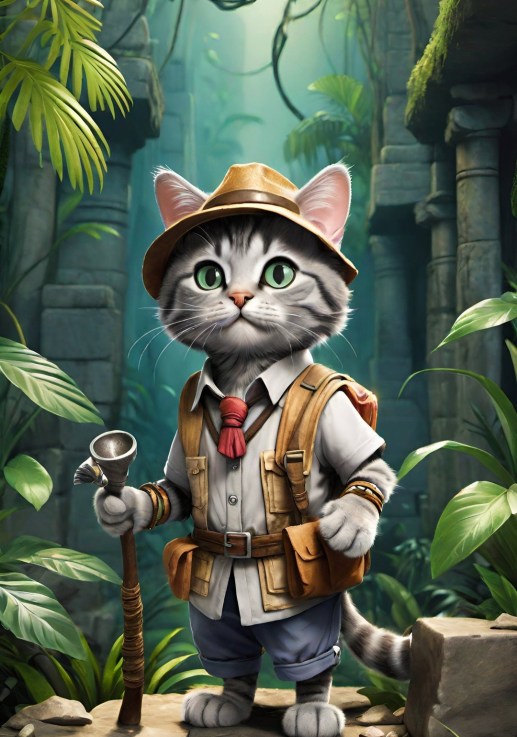
buddy_archaeologist
Sir Buddy strides fearlessly through the jungle, determined to find the Lost City and its most precious treasure, the Lap of Luxury. Here he poses for a portraitist who will send his likeness back to the Explorer’s Club to be hung on its walls alongside Mewis and Clarke, Claward Carter, Catto the Navigator and other intrepid legends.

Regardless of the conflicting accounts, all agree on one thing: the Lap of Luxury is magnificent.

Sir Buddy and his team are working out the details of bringing a helicopter into the deep jungle in order to use LIDAR, or light detection and ranging, to sweep the area. Using a mix of near-infrared, ultraviolet and visible light, a team using LIDAR from the air can digitally “remove” the dense jungle to reveal the structures underneath, natural and man-made.

For the intrepid explorers it’s an advantage their forebears never had, and it’s one reason why Sir Buddy believes he will succeed where those who came before him did not.

“With this technology we can map the entire city and find its most opulent palaces and temples, the places most likely to house the elusive Lap of Luxury,” Sir Buddy says. “When we find it, it shall be my honor to be the first cat in more than two hundred years to settle into it, get comfortable and have a nice nap.”

lidar
LIDAR reveals the jungle’s secrets by peering through the trees and the thick blanket of foliage that has swallowed once-glorious cities.