Buddy losing his normally meowscular and ripped physique is my fault.
Ruh roh! It’s diet time again.
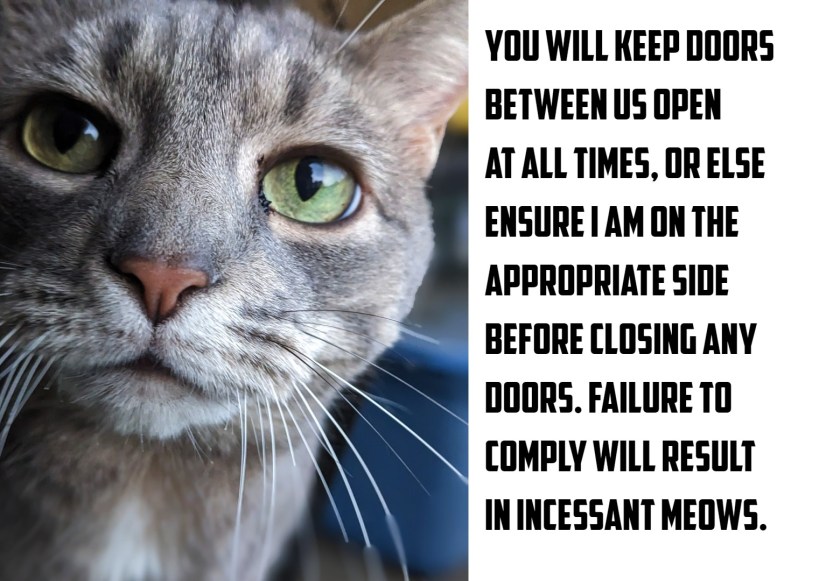
The meowing protests have begun.
Buddy has noticed his dry food tastes a little bit different, and he’s not happy. And while he may not be good with numbers, he strongly suspects his snack allocations are a little light.
He’s right.
Good boy has become fat boy, and that’s my fault and my responsibility.
When you love your cat, it’s easy to fall into the trap of thinking that giving in all the time is an expression of love.
Cats are pros at insistence, especially when it comes to food. When Buddy stands in front of the treat cabinet and meows mournfully, or when he gives me his sad-eyed stare as if he’s Julius Caesar — “Et tu, Big Bud?” — I’m weak and I fold. Snacks are dispensed.
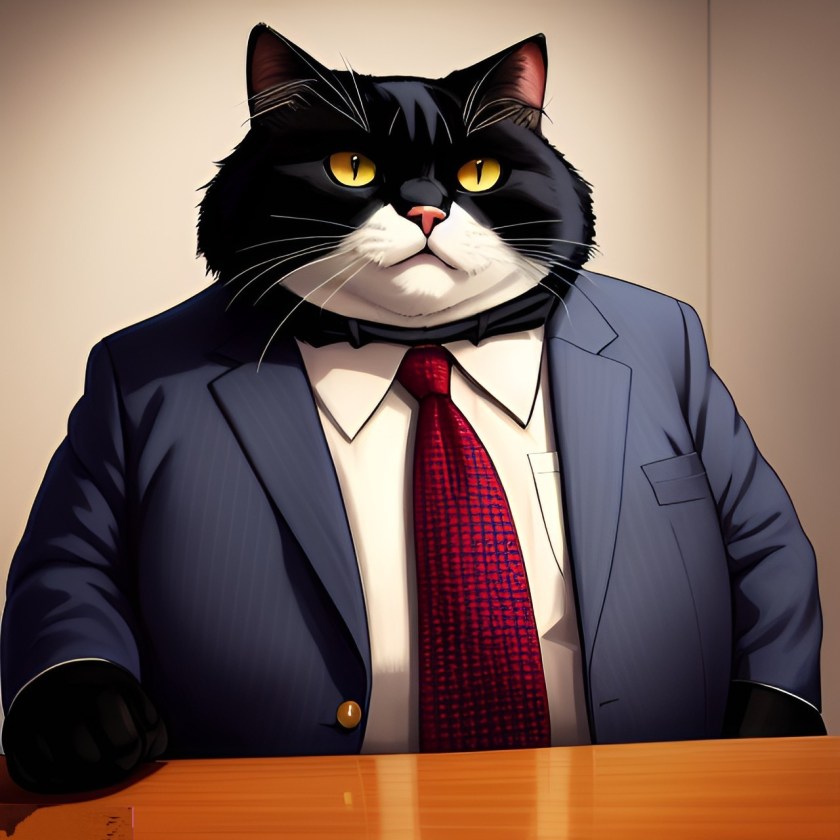
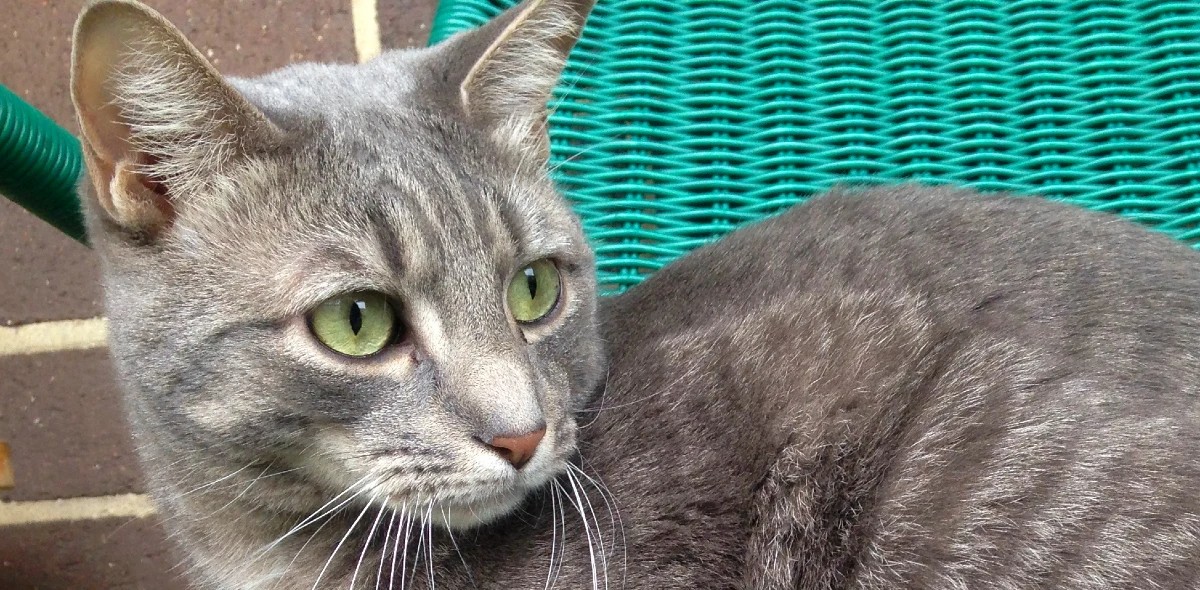
Chonky cats suffer health problems, reduced mobility and ill-fitting suits. Image: PITB
Yet there’s no denying Bud is plump.
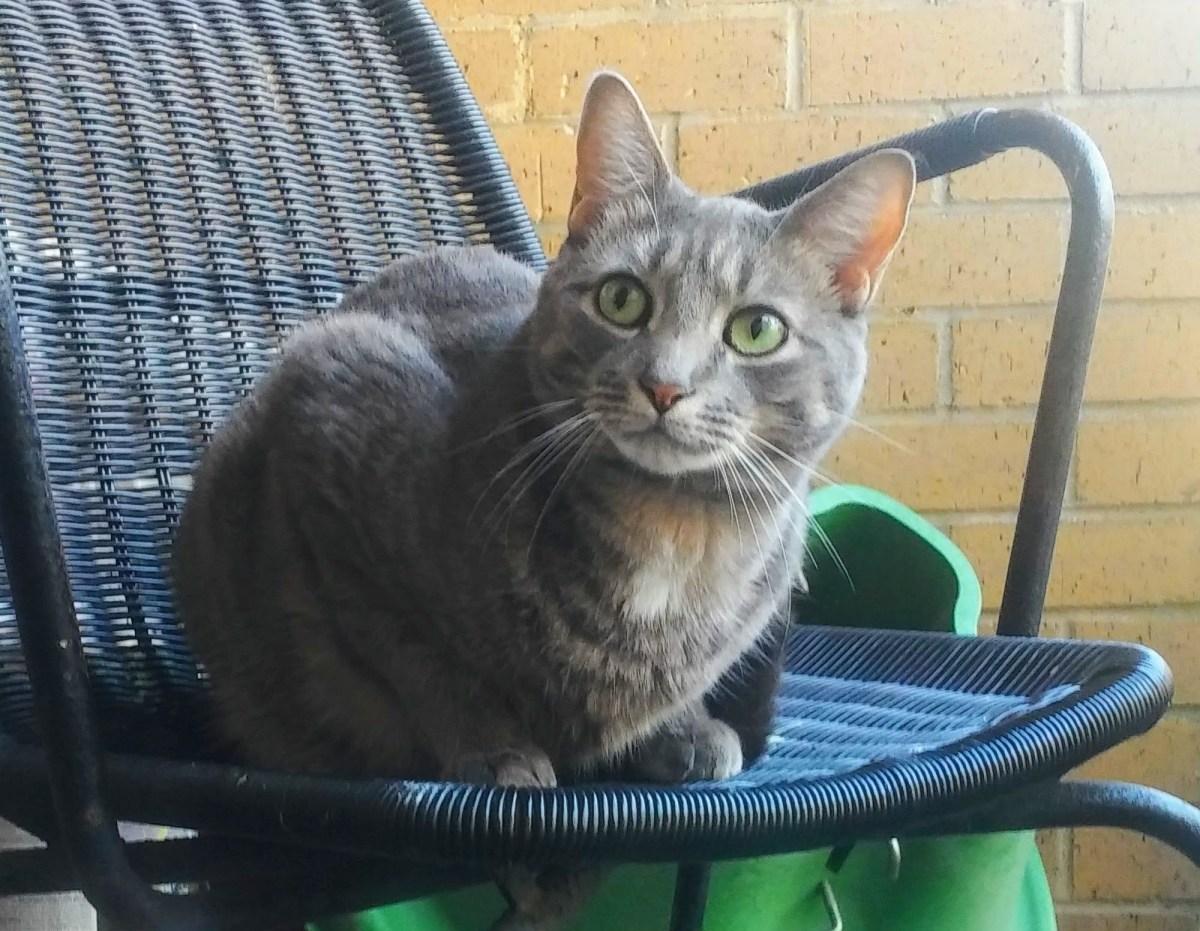
He’s got a belly, and it’s not just his pronounced primordial pouch. His cheeks are starting to fill out. When he loafs, he looks like a gray blob.
He’s also incapable of doing his old door-opening trick, which requires him to jump and momentarily hang from the handle while his feet find purchase on the frame. Shoving off on his hind legs, he would push the handle down while leaning into the door, easing it open.
He’s just too chunky, unable to balance his weight properly to pull it off nowadays.
Most importantly, a chubby Buddy is not a healthy Buddy. That’s my fault.
So it’s back to the diet, and hopefully the little guy can be motivated to move more during play time. If not, well, we’ll have to resort to drastic measures to get him moving. An angry vacuum ought to do it.
Police say foxes are responsible for killing cats in London, but animal welfare activists insist there is indisputable evidence of human cruelty.
It’s difficult to know what to make of the Croydon cat killer story.
Initially, people from London-area cat rescues said they were looking for a person who had mutilated dozens of cats in the South London area. As the number increased to more than 100 and public outrage became palpable, police opened an investigation.
The story was wild. Newspapers bandied about disturbing figures, claiming hundreds of cats mutilated at the hands of a sick individual or several people. There were reports of feline remains artfully arranged in the driveways and on the front steps of victims’ homes to inflict maximum trauma on the people who discovered them, with allegedly clean cuts indicating a human with a blade was responsible.
Then in 2021, the Metropolitan Police announced they were closing their case after three years and almost $200,000 spent.
Foxes, not cruel humans, were responsible for the cat killings, they said. A study in the journal Veterinary Pathology found fox DNA on the corpses of 32 cats and said puncture wounds on the feline bodies were consistent with fox bites.
London-area animal rescues disputed the findings, saying the study couldn’t account for the mutilation of so many animals. The study’s authors blamed “badly behaved foxes” who were scavenging on the remains of strays and pets killed in traffic or by ingesting antifreeze.
Credit: Fajer u015eehirli/Pexels
Lots of other people refused to accept the Metropolitan Police conclusion, including people whose cats had been victimized. In some of those cases, veterinarians concluded the cats were killed by humans, not animals.
Which brings us to now.
The Mirror has teamed up with the South London Animal Rights Network (SLAIN) to create an interactive map showing the locations where more than 1,000 dead cats were found over the past several years.
“This map shows where incidents have occurred but also and perhaps just as important, where incidents have never happened,” SLAIN’s Boudicca Rising told the paper. “If you know of someone who made journeys to these locations on these dates please do get in touch with us. All information will be treated in the strictest of confidence.”
Documents obtained by journalists in London indicate there was internal tension at the Metropolitan Police over the resources that had been allocated to the cat case, and spokesperson for the force admitted that was a consideration. But the department stands by its assessment and says there’s no evidence a serial cat killer is on the loose.
It’s difficult to believe someone or a group of people could evade capture while allegedly killing more than 1,000 cats since 2015, especially in a city like London where CCTV cameras blanket most neighborhoods.
There are an estimated one million CCTV cameras covering 607 square miles of London, and the commonly-cited statistic claims Londoners are caught on CCTV cameras an average of 300 times per day. Other estimates claim that number is too high, and the average UK citizen is spotted on a municipal surveillance camera 70 times a day.
Notably, those figures do not include private cameras like Ring systems and surveillance operated by private businesses. The point is, it’s very difficult to avoid cameras in London, and if there are human feline killers out there, they must know an awful lot about where the cameras are.
If the phantom cat-killers are real, not only have they been able to avoid appearing on surveillance, they’ve evaded the watchful eyes of neighbors as the story circulated widely in the press. The theory that the killings were the work of animals, mostly under the cover of night and beneath the notice of people, sounded more plausible to many people.
Still, the theory doesn’t neatly fit the evidence.
Not all veterinarians agree that foxes are the culprit. While the veterinary pathologists who authored the study looked at photographs of the mutilated felines, some veterinarians who directly examined the bodies of slain cats concluded they were killed with blades. When experts are at odds over evidence, what can you do but gather more information and hope for the best?
London may have to do what Washington, D.C. did and deploy low-to-the-ground trail cameras and regular surveillance cameras around the city. In Washington, the goal was to get an accurate census on the number of strays and ferals living within city limits. In London, a census could be a bonus as they finally get an answer to the question of who’s been killing all those cats.
Mankind’s achievements in space came at the expense of dogs, cats and non-human primates, who were sent into orbit during the early days of the space race.
I’ve been watching Apple TV’s exceptional show, For All Mankind, which dramatizes the space race of the 1960s and beyond in a sort of alternate history where the Soviets, not Americans, first lay boots on the lunar regolith.
That loss lights a fire underneath the behinds of the people at NASA and convinces American politicians that the space race is the ultimate measure of our civilization. In real life, American ingenuity and the creativity fostered by a free society allowed the US to leap ahead and “win” the space race. Space missions were already becoming routine by the time the drama of Apollo 13 briefly rekindled public interest.
Then the Soviet space program faded, the competition turned one-sided, and without an arch-enemy to show up, American politicians pulled back NASA’s funding to a fraction of what it once was, where it remains today. That’s why the rise of the private space industry — Elon Musks’s Space X, Jeff Bezos’ Blue Origin, etc — will almost certainly be our ticket to Mars.
But in For All Mankind, NASA remains the budgetary behemoth and source of prestige it was in the 60s and 70s, leading to the development of a permanent moon base, lunar mining operations and a planned mission to the red planet.
There’s a quiet moment in the second season when a Soviet cosmonaut, visiting the US as part of a peacekeeping mission, shares a drink in a dive bar with an American astronaut.
“Do you like dog?” the cosmonaut asks.
“Dogs?” the astronaut replies. “Of course. Who doesn’t like dogs?”
The Soviet shakes his head.
“No, dog,” he tells her. “Laika.”
Laika was the first dog in space, or more accurately, the first dog the Soviets acknowledged sending into space. (The Soviets didn’t acknowledge their failures, and we can only guess at the number of lost cosmonauts and animals officially denied by the Russians, drifting in space for eternity or disintegrated in atmospheric re-entry.)
Laika, also nicknamed Muttnick, wanted to please the humans who had taken her in, and didn’t understand that her trip would be one way. (Historical photo)
The moment turns somber as the cosmonaut recalls the Moscow street dog who was selected because she was docile, fearless and could handle the incredible noise and g-forces of a rocket launch.
“I held her in my arms,” the cosmonaut tells his American counterpart, taking a sip of his Jack Daniel’s. “For only one or two minutes on the launchpad.”
Then he leans in and tells her the truth: Laika didn’t triumphantly orbit the Earth for seven days in 1957 as the Soviet Union told the world. She didn’t endure the mission.
She perished, alone and afraid, just hours after launch when her capsule overheated.
The Soviets never designed the Sputnik 2, Laika’s ship, to return to Earth safely. Her death was predetermined.
We laud astronauts and cosmonauts, the brave men and women who willingly strap themselves into tiny capsules attached to cylinders of rocket fuel the size of skyscrapers and depart this Earth via brute force, knowing something could go wrong and their lives could end before they realize what’s happening. We should admire them. Their accomplishments are all the more impressive when you consider the fact that the combined processing power of every computer at NASA’s disposal in the 1960s was but a fraction of what we each hold in our hands these days when we use our smartphones.
Those first astronauts and cosmonauts were extraordinarily brave — but only up to a point.
Unwilling to risk human lives in the early days of space exploration, space programs used dogs, cats and later monkeys and apes, strapping them into confined spaces, wiring their brains with electrodes for telemetry data, poring over the information they gleaned about their heart rates, blood pressure and breathing as they left our home planet.
The sad eyes of a stray dog, separated from everyone she loved, were the first to behold Earth from space. A few years later the eyes of a French street cat took in the same view before humans did.
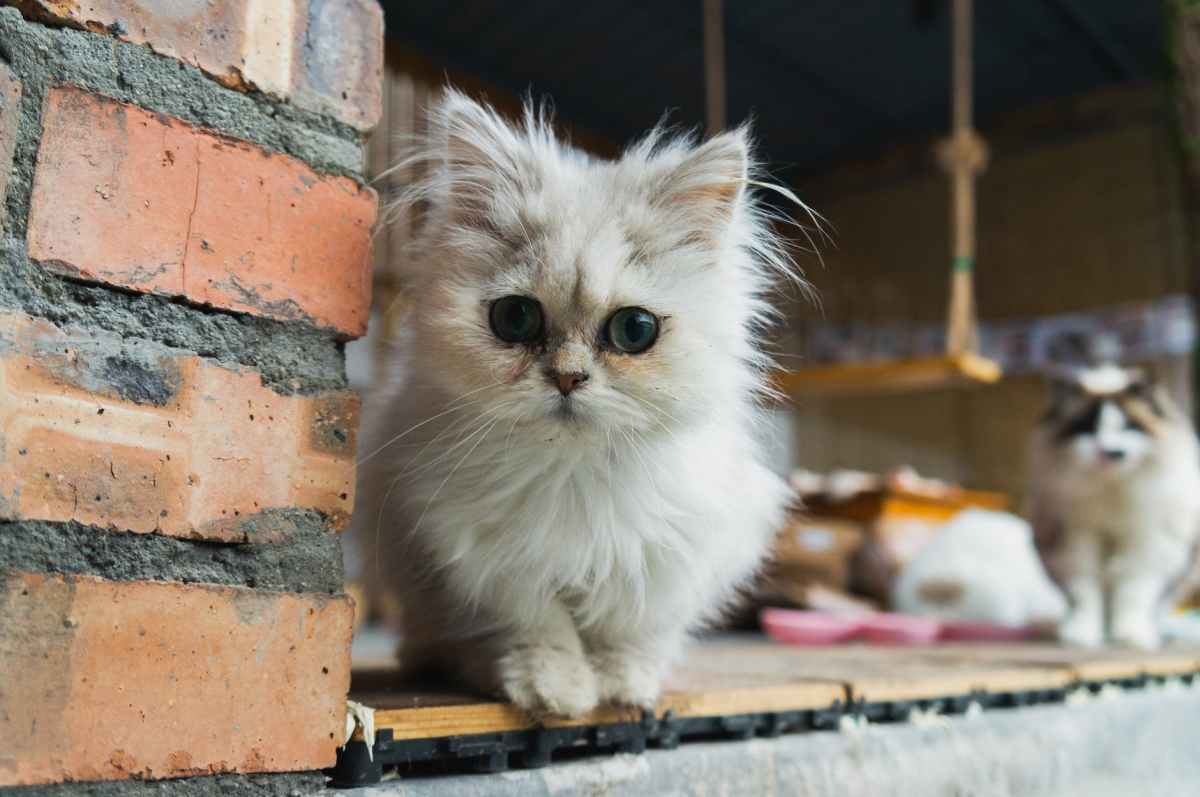
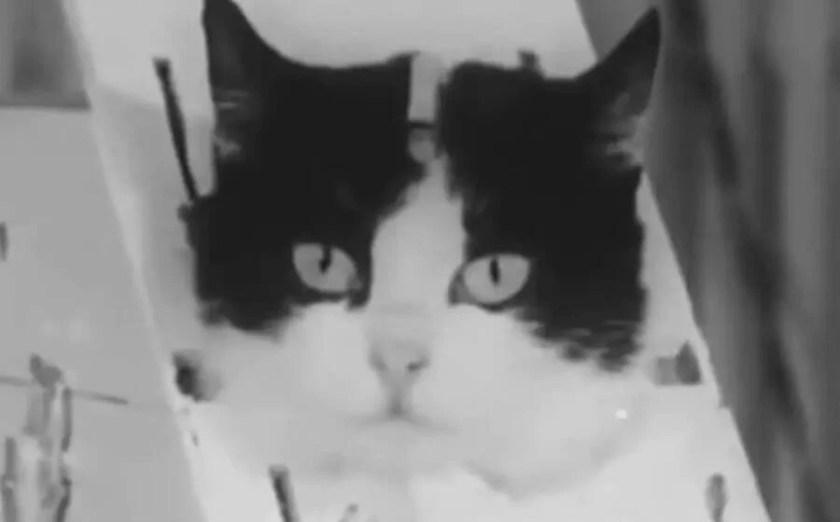
Felicette couldn’t move when she was placed into the capsule that took her to space and back.
Felicette, the tuxedo cat who was launched into space by the French on Oct. 18, 1963, didn’t even have a name until the French recovered her capsule and took her back for examination.
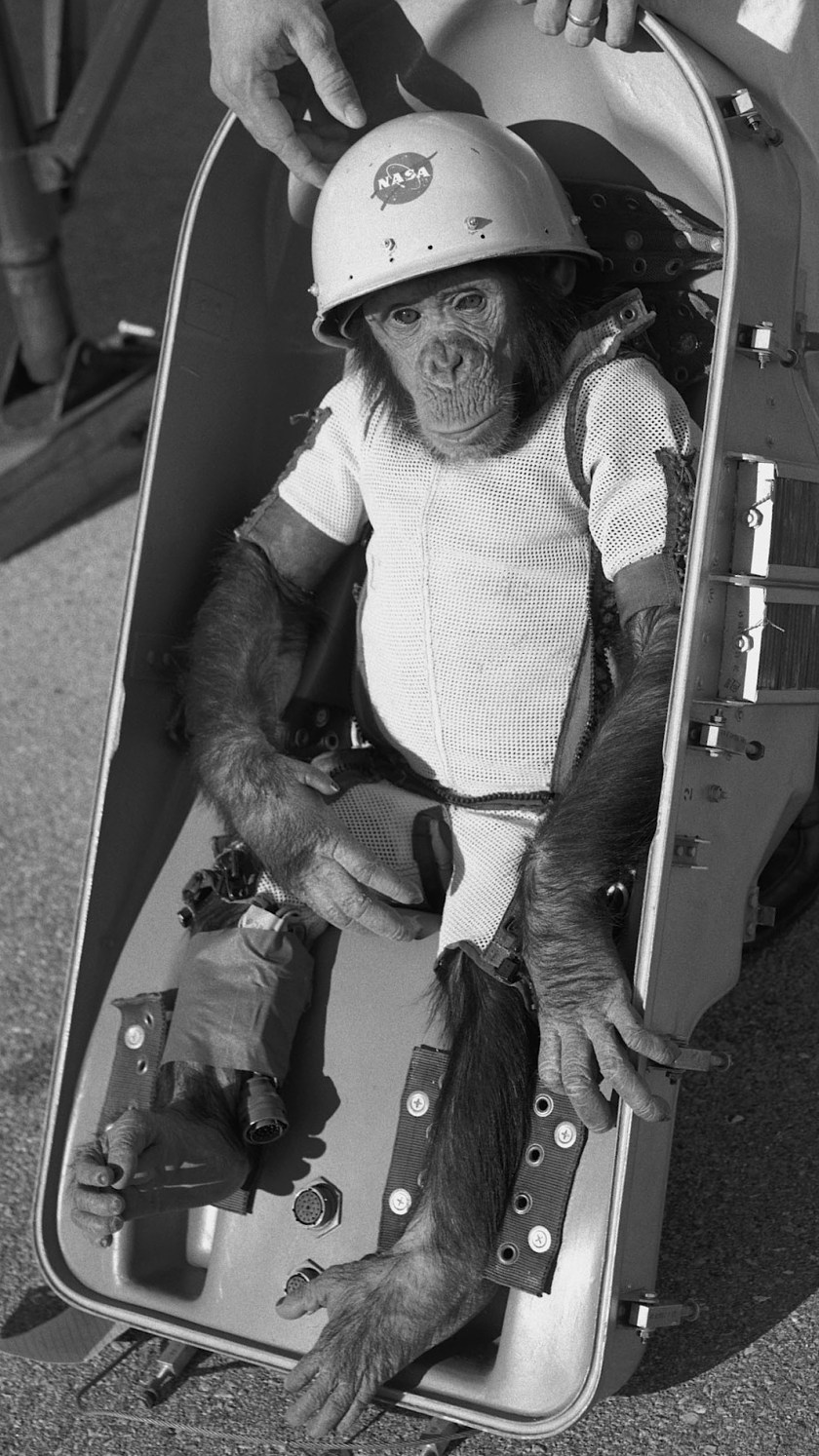
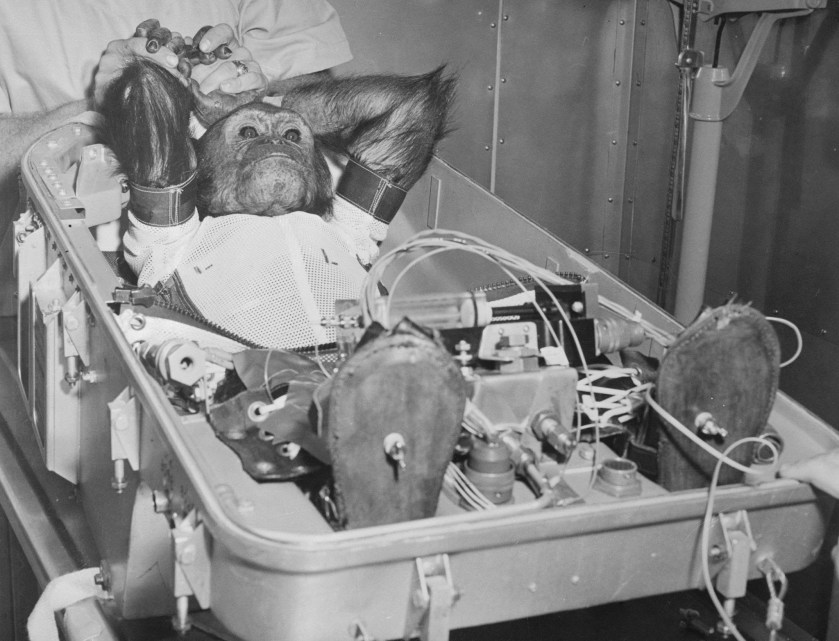
The scientists and engineers in charge of the launch didn’t want to humanize her if she didn’t make it, which was a common practice in space programs. (Ham, the chimpanzee sent into space by NASA in January of 1961, was known as No. 65 until his successful recovery. NASA was worried that a name would make him more sympathetic and lead to bad press if the chimpanzee died during the mission.)
Ham the chimpanzee was little more than a baby. Credit: NASA archives
Despite Felicette’s endurance and successful return, French scientists repaid her bravery by euthanizing her a month later so they could study her brain and learn more about the effects of spaceflight on mammalian biology.
Felicette, like Laika and Ham, was never given a choice. Those animals, with their child-like mental capacity, endured their missions out of a desire to please their human caretakers as much as any natural stoicism they may have possessed.
Would we do the same thing today? Will we repeat those experiments as we set our eyes on Mars?
Consider that the moon is a three day trip, and it’s close enough to Earth’s magnetic field to protect living beings from radiation. Mars is at least a seven month trip if the orbital conditions are right, and there will be no protection from radiation aside from what can be built into the craft. Take that trip without adequate protection and you’re guaranteed to get cancer.
It’s easy to say we wouldn’t make animals our test subjects for a Mars journey, and NASA now has decades of data on the effects of space and zero gravity thanks to the International Space Station.
And yet Neuralink, another company owned by Elon Musk, currently uses monkeys to test its brain interface technology, which allows the primates to operate computers with their thoughts. Those monkeys are forced to endure radical surgery to implant microchips in their brains. The teams working on the technology say suffering by those animals will be worth it as people with paralysis are able to do things with their thoughts and regain a measure of independence, increasing their quality of life.
Likewise, it will probably be an animal, or animals, who will be the test subjects on board craft that first venture beyond the Earth’s protective magnetosphere. Scientists and engineers will do their best to create a vessel that shields its occupants from harmful radiation, but they won’t know how successful they’ve been until the test subjects are returned to Earth and their dosimeters have been examined.
Will an astronaut volunteer for that kind of mission, knowing the “reward” could be a drastically shortened life?
Felicette pictured on commemorative stamps.
Felicette, left, was just one of several cats considered for the launch by French scientists.
To hear Musk and futurists tell it, pushing toward Mars is not just a matter of exploration or aspiration, but is necessary for the survival of our species. Earth becoming uninhabitable, they say, is an eventuality, not an if.
Others point out it’s much easier and wiser to pour our resources into preserving the paradise we do have, and the creatures who live in it, rather than banking on a miserable future existence on Mars where society will have to live underground and gravity, at 0.375 that of Earth, will change the human form in just a few generations.
To put it bluntly, while Musk and futurists look at life on Mars through the rose-colored glasses of science fiction fans, in reality living there is going to thoroughly suck.
If people do live on Mars they’ll never venture outside without a suit, never feel the sun on their skin, never swim in an ocean. They’ll never have another backyard barbecue, watch fireworks light up the sky on the fourth of July, or fall asleep to the gentle rain and crickets of warm summer nights. They’ll never hear birdsong or have the opportunity to see iconic animals like elephants and lions. Every gulp of air will be recycled, every glass of water will have passed through the kidneys of others. There will never be snow. Circadian rhythms will be untethered from the cycle that governed human biology for the 200,000 years our species has existed.
And while there could be a future — if you want to call it that — for people on Mars, there won’t be a future there for the rest of the living creatures on Earth.
As a lifelong fan of science fiction who devours SF novels, counts films like Alien and Bladerunner among my favorites, and is fascinated by shows like For All Mankind, The Peripheral and Star Trek, I understand the appeal of space and the indomitable human spirit that drives us to new frontiers. I just hope we can balance that with respect for the Earth and the animals we share it with. Let’s hope there is never another Laika, Felicette or Ham.
Correction: For All Mankind is the name of the Apple TV series about an alternate history space race. The first reference to the show’s name was incorrect in an earlier version of this story.
A close-up of Felicette’s face. Credit: French government archivesHam the Space Chimp waits for his apple reward. Credit: NASA archives
To celebrate my birthday and Bud’s adoptaversary, the little guy commissioned a portrait of us together. As many of you know, cats think of us as big, slow cats, which is reflected in the resulting painting. I present to you “Buddies: Airbrush on canvas”:
There is a slight inaccuracy, of course: I have gray eyes, not green. If I’m portrayed as a cat, I should probably be an orange tabby as well. And finally, little Buddy should be much more muscular. Perhaps he’s meant to be a kitten in this painting as he was more of a shoulder cat when he was tiny. Other than that, seems pretty accurate!
In truth we don’t really know exactly how cats view us.
We know there’s a parental element, that house cats retain kitten-like qualities for life as they remain in our care. The meow is probably the best example of that, since it mirrors the vocalizations kittens make to their mothers.
We know house cats depend on us physically, psychologically and emotionally. In recent years behavioral scientists have taken studies originally designed for children and modified them for cats, yielding interesting results: House cats who are bonded to their humans behave in ways startlingly similar to humans children.
When we form bonds with them, they draw comfort from our presence and look to us for behavioral cues to determine how they should respond to situations and objects that are new and potentially frightening. Just like kids, cats look to us, and just like kids, they stay calm if we do.
When you treat a cat well, kitty returns that love, trying to comfort you when you’re sick, refusing to leave your side, alerting you to potential trouble.
Bud is super friendly, but he isn’t the cuddliest cat out there. He doesn’t like being hugged or picked up, but he knows that when he pads up to me while purring and sits on my chest or in my lap, I’m never going to force him to stay or subject him to pets he doesn’t want. That’s why he approaches me often and why he feels so relaxed.
It’s probably also why he often wakes me up, purring like an engine, looking for a chin scratch and affirmation that he is indeed a good boy.
Perhaps the biggest complements are Bud grooming my hair and beard, and sleeping on me.
There’s no greater expression of trust between a feline and human than when a cat falls sleep in your lap. Cats are never more vulnerable than when they’re asleep, and sleeping in your lap means your four legged friend feels safe with you and trusts you completely.







 Pain In The Bud