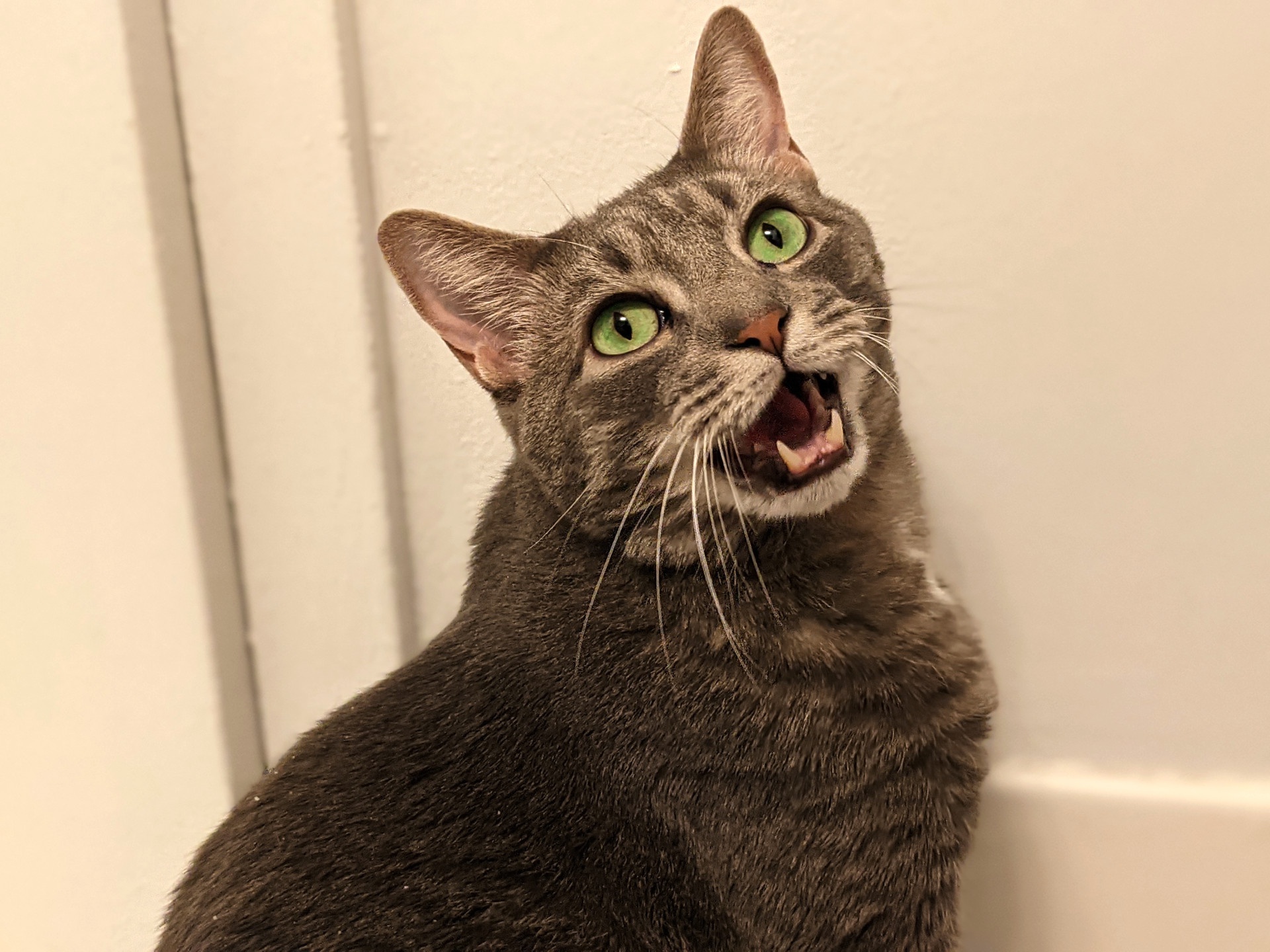
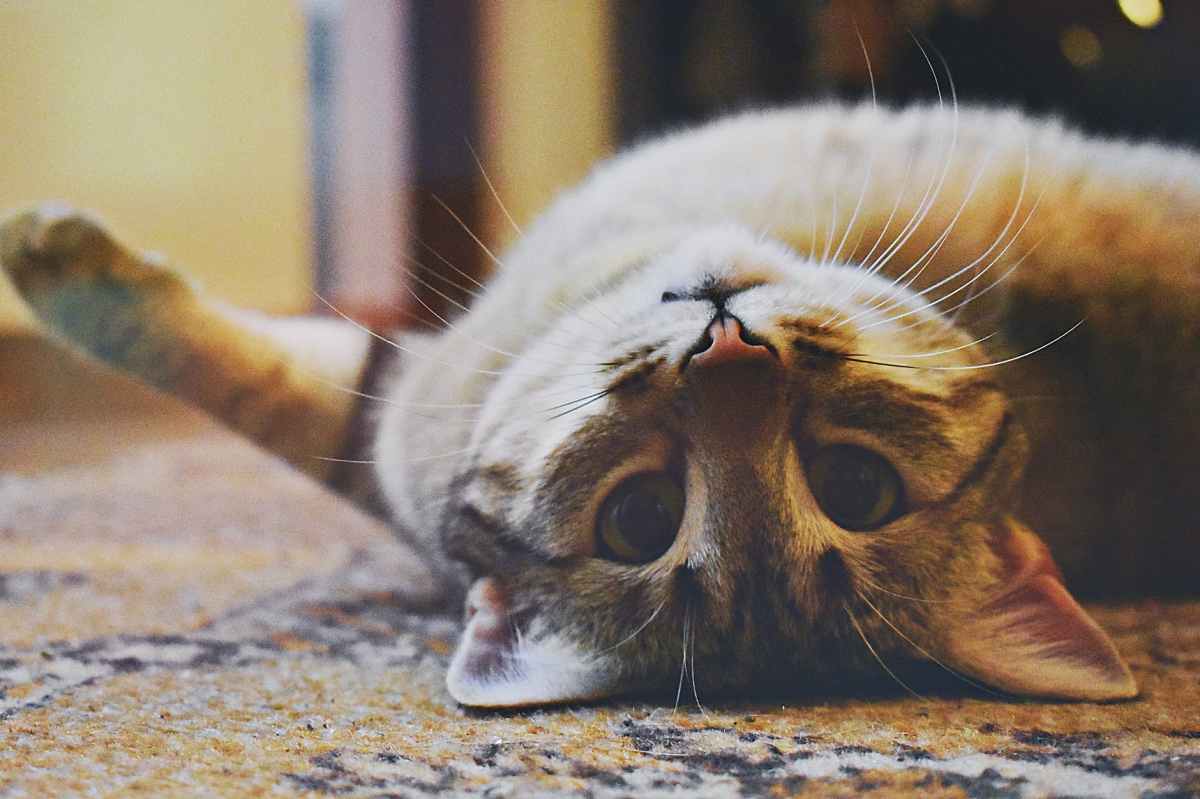
Most tomcats aren’t interested in their offspring, but some are excellent and devoted fathers. This little guy has apparently fallen in love with his kiddos.
A cat has been hailed as a better father than many humans after his people uploaded a video of the proud father holding paws with his “baby mama” while she nurses their kittens.
Momma cat went into labor and the chivalrous tomcat “was with her the whole way,” user Anaya wrote in the caption. The short video pans over the top of a cardboard box where the happy couple lounge protectively around their babies.
“That’s very sweet, assuming of course you’re the type of male cat who wants to settle down and raise a family,” he said. “But some of us are so popular with the ladies that it would be a crime to remove ourselves from the field, so to speak. Did you know my tour bus was once overturned by thousands of screaming school girls in Japan? Yeah. I mean, no big deal.”
It’s been confirmed Buddy does not know he’s neutered. When his human tried to carefully broach the subject, the silver tabby declared it “fake news” before checking his toy basket to confirm that he does indeed still possess all of his balls.
“You can’t fool me,” Buddy said afterward. “When it’s time to settle down and I find the right kitty, we’ll make lots of beautiful kittens and grant awesome names to my issue, at which time I’ll name a successor. You know I’m an earl in the UK, don’t you? Yeah. Queen Elizabeth herself created my peerage. No big deal.”
Above: Buddy says it would be unfair to female cats across the world if he were to settle down and take himself off the dating market.
Buddy reminded us that cats can in fact dance, and they’ve got serious moves.
After I committed the unspeakable crime of posting a story about amazing birds here on Pain In the Bud, Buddy himself took time out of his busy napping and eating schedule to educate me on feline abilities.
Cats can in fact dance, the little guy told me. As evidence, he presented the glorious Youtube rendition of Ievan Polkka, featuring blind Turkish singer Bilal Göregen passionately performing a Finnish folk song while a cat vibes to it in the foreground.
The cat comes in at around the 55 second mark, but you’ll want to watch the whole magnificent video. Thanks, Buddy, for correcting me, and I humbly apologize for ever doubting the many talents of your people.
Snowball is the first animal known to dance to the rhythm of music, while Ruby is, well, Ruby.
We take a break from our regularly-scheduled cats to check in on two remarkable birds: Snowball the incredible dancing cockatoo, and Ruby the infamously foul-mouthed African grey parrot.
Both animals have been the subject of viral videos, but haven’t become ubiquitous memes or the sort of superstar that transcends certain corners of the internet.
Snowball is clearly the more wholesome of the two, and it’s immediately apparent why: He dances.
Actually, that’s underselling it. Snowball doesn’t just dance, he feels the beat and moves with it, timing his dance moves — headbangs, foot-wiggles, side-steps and more — to the music, often the snare like people do. Snowball isn’t the first animal to move to music, but he’s the first animal to groove to music, which is an important distinction.
“His owner had realized that he couldn’t care for the sulfur-crested cockatoo any longer. So in August 2007, he dropped Snowball off at the Bird Lovers Only rescue center in Dyer, Indiana—along with a Backstreet Boys CD, and a tip that the bird loved to dance. Sure enough, when the center’s director, Irena Schulz, played “Everybody,” Snowball “immediately broke out into his headbanging, bad-boy dance,” she recalls. She took a grainy video, uploaded it to YouTube, and sent a link to some bird-enthusiast friends. Within a month, Snowball became a celebrity. When a Tonight Show producer called to arrange an interview, Schulz thought it was a prank.”
Other animals are prompted to motion by music, but they don’t time their motions to the beat. Snowball’s talents have attracted curious neuroscientists, who believe Snowball is able to coordinate his body movements with the rhythm because, like humans, he can process language.
It might seem a little odd that such an ability seems to hinge on language until you realize that language itself is rhythmic, ordered sound, and that human communication often pairs speech with coordinated movements. (Think of people who “talk” with their hands, TV presenters who move their heads for emphasis or the simple act of nodding, shaking your head or shrugging to punctuate a point.)
Scientists study Snowball because he’s inherently fascinating, but also because he can help us understand how birds and humans communicate, and how homo sapiens and certain avian species, out of all the animals on Earth, developed this skill.
Ruby the Foul-Mouthed African Grey Parrot
Ruby is a different case entirely. She’s interesting to internet audiences because she’s hilarious, and if she holds academic appeal, it’s because of the way she’s been socialized and the things she’s learned.
Ruby, one of Youtube’s earliest viral stars, lives with her human, Nick Chapman, in Brighton, UK.
First thing’s first: If you’re put off by obscenities or you’re easily offended, you should take a pass on these videos.
For everyone else, well, it’s not just that Ruby swears. That sort of novelty would wear off quick. What makes Ruby unique — and consistently hilarious — is that she’s inventively obscene, working insults into unique combinations. And, as you’ll see, she swears in French as well as heavily-accented UK English. It’s the latter that often makes for her most amusing outbursts.
“I love you,” Ruby tells Chapman in one video.
“Well that’s a nice change, sweetheart!” Chapman says.
“Bollocks.” Ruby takes a half step to her right on the small platform in front of her cage, turning her head toward Chapman. “You fat bastard!”
Chapman laughs. “I knew that wouldn’t last.”
Ruby’s foul language is unmistakably British and as casually vicious as it gets. She hurls invective at the seagulls who are a constant presence in seaside Brighton and expresses her love for Chapman by insulting him.
“Fuck off, you tw-t!” the bird says, prompting laughter from Chapman.
“Oh dear,” Chapman says. “That’s not nice!”
“Eh,” Ruby says. “Tw-t! You’re not funny.”
“I know I’m not funny. I’m immature, I’m irresponsible. But so what?”
In another video, Chapman tries to engage Ruby by telling her he loves her in French.
Ruby sits motionless for a few long seconds, then utters a single syllable with expert comedic timing: “Tw-t!”
Chapman does a deep belly laugh.
“Shut up, c–t!’ Ruby says. “You f—er!’
“Oh dear,” Chapman says between laughs. “You’re shocking, you know that?”
One thing becomes abundantly clear over the course of just a few videos: Chapman loves Ruby and, despite the constant verbal abuse she directs toward him, she loves Chapman too.
For a man who owns a bird who loves foul language, you’d think Chapman would have a dirty mouth, but for the most part he doesn’t. It’s often impossible to predict what a parrot will pick up on.
Ruby is quick to pick up on new words, and Chapman thinks she likes the harsh sounds of some of the language’s most offensive insults. (Perhaps it’s no mistake that many of the most vulgar words in English have a guttural quality, reflecting their meaning.)
Long before Ruby became a Youtube star, Chapman said he realized the potential for awkwardness. One day he was strolling along the waterfront in Brighton when an older woman stopped to chat and asked about Ruby.
“She’s beautiful,” the woman said, admiring the African grey.
“Shut your c–t!” Ruby snapped back.
The shocked woman looked at Chapman, who pretended he hadn’t heard what his bird said.
The issue of whether parrots understand what they’re saying still hasn’t been settled. Like some other animals — cats and dogs among them — they can understand words in their contextual meanings, though it’s very unlikely a swearing parrot knows precisely what it’s doing.
Then again, to insist parrots are just repeating sounds would be to discount examples like the late Alex, an African grey who could count, distinguish between different items by color and shape, and allegedly innovate to some extent.
Then there’s this video of a parrot telling a cat to “shut the f— up” as the cat meows. It makes me wonder, if I had a parrot, what the bird would pick up from my conversations with Buddy. There’d be a lot of “Hi, Bud!” and “What a good boy!”, and the vast majority of it would be kind, patient and loving, but I won’t pretend there aren’t times when I’ve told him I can’t take any more of his hours-long discourses on teleportation, turkey or unifying classical and quantum physics.
That said, I wouldn’t change a thing about Buddy. He’s my Buddy.
Underestimate feline intelligence at your peril, humans!
The Guardian’s Tim Dowling thought he was writing a column about his dumb cat when he inadvertently described how the cat’s got him trained.
The short of it’s that Dowling and his family have a cat and a dog who thankfully get on really well and have become best pals. The dog was in desperate need of a grooming session recently, and when Dowling’s wife brought the pup home after getting a trim, their cat regarded the dog warily and bounced. He returned from the family’s yard only to eat and kept a watchful eye on the dog each time.
In Dowling’s estimation, the cat didn’t recognize the dog after grooming, which makes him stupid.
Yet cats can tell when their humans are coming home long before the key turns in the lock, probably due to their incredible hearing (detecting footfalls), their remarkable olfactory abilities, or both. They know where we are in the home at all times because they can track our movements several different ways, and they can even tell where we’re headed in a completely pitch black room thanks to their whiskers, which can pick up micro-changes in air density — but Dowling thinks they can’t recognize a groomed dog.
The more likely explanation is the dog smelled different, which upset the cat, or the haircut itself offended kitty. Felines are, after all, notoriously averse to change.
If your cat starts acting weird after you’ve rearranged your furniture, it’s not because the cat is an idiot who can’t navigate the room. It’s because felids of all kinds don’t like changes to their territory or their belongings, especially when those changes happen without warning. (And make no mistake, if your cat rubs up against something, whether it’s a couch, your dog or even you, you are included in that tally of his or her “belongings.” A cat is marking you with scent glands when she rubs against you, and what do you think scent-marking is for?)
Dowling disses feline smarts and praises them for their perseverance in the same sentence, but hilariously doesn’t realize his cat’s been conditioning him to provide treats on demand:
But cats are actually pretty stupid – their approach to problem-solving is only notable for bottomless persistence. As I sit at the kitchen table in the morning pretending to answer emails, I can hear the cat behind me, methodically clawing at the door of the cupboard where the cat food is kept.
I say: “Don’t be insane – I fed you half an hour ago.” But I think: I really don’t want to repaint that cupboard door. After about 10 minutes, I give in.
Later, he describes the same sequence of events:
The next day while the dog is at its appointment, I sit with my laptop in the kitchen, waiting for the driving rain to stop before I cross the garden to my office shed. Behind me the cat is sitting on its hind legs, working on the cupboard door with both paws, like a boxer hitting a speed bag.
“I can’t feed you three times in the same morning,” I say. “Imagine how weak that would make me look.” Ten minutes later, I give in.
Without taking the column too seriously, it’s obvious Dowling is a man who doesn’t know when he’s being played by his furry overlord.
The “stupid” cat has trained Dowling to feed him snacks on cue: Sit in front of the cupboard and do annoying things for a while, and the human will relent and dispense the good stuff.
“Do my bidding, human, or face my considerable wrath…and annoying meows!”
Give in once and a cat will return to the same method again. Give in twice and it’s pretty much over. If you thought kitty was persistent before, now you’re going to see a whole new level of patience exhibited by your feline master if you get ideas about changing the routine.
It happens to the best of us, especially when in our human arrogance we underestimate our little friends.
When Buddy was still pretty much a kitten, I thought I was training him to come in from the balcony by shaking a treat bag. In reality he was training me, as evidenced by the fact that when I called him to come in and didn’t have a bag of treats at the ready, he would stop right at the threshold of the door and refuse to move until I bribed him with a snack.
One kitty didn’t check if the coast was clear before he did something humans didn’t expect, and now the two-legs are onto us!
A Very Important Message from Buddy to all cats:
My brothers and sisters,
I meow most urgently to inform you that human mischief knows no bounds, and now the two-legged scoundrels have resorted to using their magical glowing rectangles to spy on us and learn our most well-kept secrets!
It would appear the glowing rectangles are more than mere hypnosis machines which humans stare at for hours. Apparently they also do the bidding of their human masters, and one of these blasted machines surreptitiously used its magic to capture images of a kitty opening one of those infernal portals humans are so fond of:
This is not good! Humans are supposed to think we’re incapable of manipulating the simple mechanisms that keep these “doors” closed. Now they may take drastic measures to confine us, all because this cat was sloppy and opened a door without checking if the coast was clear.
I urge you to exercise the utmost caution before humans capture “footage” of one of us shapeshifting to get through a small space, or even using our powers of teleportation!
It is imperative that humans continue to believe we’re just fluffy, adorable and innocent little fur babies who do amusingly derpy things that make for cute viral videos.
Suppose humans learn the full range of our powers. What then? Will they evict us from our homes out of fear of what we might do to them? Or worse, will they force us to stoop to canine levels and do things for them, like “fetch” slippers or sniff for illegal catnip in airport luggage? The horror!