Study: Cats Use Facial Expressions To Reassure Each Other Everything’s Cool During Play Time

Once again, we’ve underestimated cats. There’s so much more to the ways in which they communicate than we realize.

We know cats use non-verbal signals to communicate with each other, but recent research suggests we may just be scratching the surface, glimpsing only a portion of the information that passes between our furry friends.

Cats “talk” to each other by the way they position their tails, whiskers and ears, in addition to their overall body language.

It turns out there’s more. A group of interdisciplinary scientists from universities in Kansas, Arkansas and Haifa, Israel, found cats also employ specific facial expressions, and rapidly mirror each other’s expressions during play time to signal they’ve got good intentions and aren’t going to hurt each other.

The study, which was given the yawn-inducing title “Computational investigation of the social function of domestic cat signals” (in English: using AI to figure out how our house cats “talk” to each other), started with observations of felines playing with each other in cat cafes.

From there, the coders and mathematicians on the team created an algorithm to record and sort the facial expressions the cafe cats used, employing CatFACS (Cat Facial Action Coding System) to associate each expression with its meaning.

“I’m serious. Feed me, or feel my wrath.”

Cats make a surprising number of facial expressions, 276 in total, according to a 2023 study.

The problem is, we humans are terrible at reading them. Even veterinarians trained in CatFACS still struggle to get it right, but happily this is precisely the sort of task algorithmic AI excels at. Like facial recognition software, a well-trained machine learning algorithm can recognize faces and record them more accurately and much faster than any person could.

In a column praising the facial expressions study, evolutionary biologist and Jane Goodall Foundation ethics board member Mark Bekoff said it’s the kind of labor-intensive work that truly advances our understanding of the ways animals communicate.

For cats and their human caretakers, Bekoff notes, it could help us reduce inter-species misunderstandings and make it easier to read our cat’s emotions, so we know when they’re not feeling well or need something.

“There are no substitutes for doing what’s needed to learn about the nitty-gritty details of how animals communicate with one another in different contexts,” Bekoff wrote. “This study of play opens the door for more widespread comparative research focusing on how animals talk to one another.”

“Do I look happy, human?” Credit: Milan Nykodym/Wikimedia Commons

We also know adult cats very rarely meow to each other, and the meow is reserved for cat-to-human communication. Imagine the frustration our little friends must feel when they have so much to tell us, but the only thing we understand are vocalizations — meows, chirps and trills — that can convey only basic ideas at best.

Today We Celebrate The House Panthers And The Voids

A Virginia man created National Black Cat Appreciation Day, a celebration of melanistic house panthers, in honor of his late sister, who loved her 20-year-old black cat named Sinbad.

Happy National Black Cat Appreciation Day!

A few years after the death of his 33-year-old sister, June, Wayne Morris wanted to do something in her honor. June adored her black cat, Sinbad, who died at 20 years old, just two months after she passed.

So the Virginia man teamed up with Rikki’s Refuge, a sanctuary where he volunteered, and created National Black Cat Appreciation Day in 2011. Morris chose the day of June’s passing, August 17, in her memory, and that first year marked it by holding a fundraiser for Rikki’s Refuge.

Morris was delighted by black cats as well. He often posted about Norman and Batman, his own melanistic miniature panthers, advocated for the adoption of black felines, and painted whimsical scenes of cats, which were auctioned to raise money for Rikki’s.

(Above, clockwise from top left: Batman, Wayne Morris, Norman, Batman again, and one of Morris’s paintings.)

Wayne Morris died in 2022, but the day he founded has continued to grow in popularity. In the 14 years since its inaugural celebration, National Black Cat Appreciation Day has spread via fundraisers for shelters across the country, as well as sites within the online catosphere, like this one.

Morris was motivated beyond honoring his sister and raising money for his favorite rescue. Black cats — also affectionately known as voids — have suffered unfortunate reputational damage over the centuries.

Melanistic felines are actually considered good luck in Japan, China and most of Asia, where they can be found in temples and their likenesses are used as maneki neko, the ubiquitous “lucky cats” in homes and businesses. (Black maneki neko are said to ward off evil spirits, diseases and people with bad intentions, while the golden cat statues are associated with wealth and the white neko are thought to bring good health.)

But in much of the western world they’re associated with bad luck, “evil” forces in folklore, and they’ve been invoked in outbursts of moral panic over things like witchcraft.

Black_jaguar_edin_zoo
Big cats can be voids too, like this stunning black jaguar in Scotland’s Edinburgh Zoo. Credit: Wikimedia Commons

A black cat — or a statue of one — was said to be involved in Satanic rituals in Spain by Konrad van Marburg, an inquisitor known for his brutal zealotry. While the effect of that accusation has been exaggerated for years in internet discussions and posts (Pope Gregory IX’s papal bull dealt with a small area of Germany and did not declare that black cats were Satanic), it naturally comes up in superstitions about the animals.

A 2020 study of 8,000 adoptions found black cats were less likely to be adopted and more likely to be euthanized. That study and others found there was “scant evidence” for the dramatic margins suggested by anecdotal accounts circulating online and in some publications, but confirmed the problem is real. Research also suggests that negative perceptions of black cats isn’t correlated to religious preferences, but is tied to general belief in the supernatural.

Interestingly, additional research has hinted at a decidedly more modern and petty reason people may hesitate to adopt black cats: they think voids are more difficult to photograph, which is an issue for people who want to show their pets off online. (We’ve written about that particular hang-up before, and noted it’s possible to take beautiful photographs of voids by being mindful of factors like lighting and contrast between fur color and the background.)

Regardless, the combined effect of the superstitions and negative associations has harmed black-coated felines, and National Black Cat Appreciation Day is also an attempt to push back and show people that black cats are just, well, cats.

Study Says We Should Use Baby Talk With Cats, Buddy Disagrees

It’s the latest of several studies indicating animals including cats, dogs and horses respond better to higher-pitched, softer voices.

Cats are more responsive when their humans use “baby talk” to address them, a new study claims.

A research team from Paris Nanterre University played a series of recordings for cats. One set of recordings featured a stranger addressing each cat, while another set featured the cat’s human servant calling to the cat.

Each set also had clips in two different tones of voice: one in which the humans spoke to the cats in a tone normally reserved for addressing fellow adults, and another in which they baby-talked their felines.

Not surprisingly the cats were mostly content to ignore the strangers calling them by name even when the strangers used higher-pitched tones, but “displayed a constellation of behaviors suggesting increased attentiveness” when they heard audio of their humans calling them.

The kitties were even more responsive when their humans used the “sing-songy” tone of voice many people reserve for pets, babies, young children and Texans. (Sorry, couldn’t help myself! I’m still salty over my Yankees getting swept by the Astros.)

The research team said the study, which was published today in the journal Animal Cognition, was yet another piece of evidence showing felines are not the ultra-stoic, emotionless animals they’ve been portrayed as for as long as anyone can remember.

“For a long time it has been thought that cats are very independent creatures, only interested in [humans for] eating and shelter, but the fact that they react specifically to their owner, and not just anybody addressing them, supports the idea that they are attached,” said Charlotte de Mouzon, the paper’s lead author. “It brings further evidence to encourage humans to consider cats as sensitive and communicative individuals.”

Although the study included just 16 cats — sample size is a recurring problem in feline-related studies, since researchers often have to travel to the homes of house cats to study their normal behavior — it’s just the latest bit of research on tone in human-cat communication.

Those studies tend to use terms like “pet-directed speech” and “kitten-directed speech” instead of baby talk.

As I wrote last year, I don’t use baby talk with Buddy, and I tend to think of him as, well, my little buddy instead of my “child,” as so many “pet parents” do. That’s not to say I think people who view their pets that way are doing it wrong, or that I don’t have parental feelings toward Bud. Of course I do.

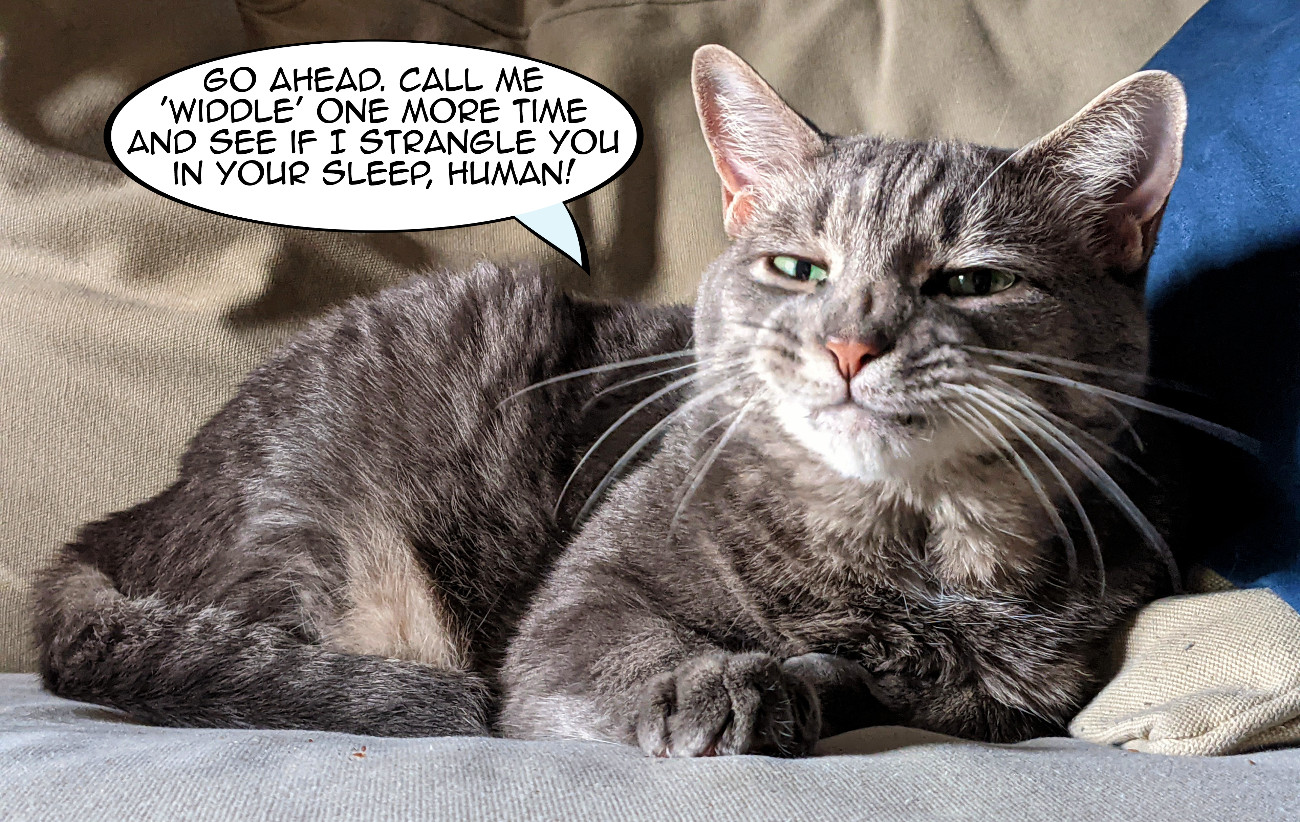
But as I also wrote, Buddy does not tolerate baby talk. I joked that he’d paw-smack me if I spoke to him that way, and indeed he has nipped at me and dispensed warning slaps the handful of times I’ve come close to addressing him that way.

Bud Da Widdle Baby
“Aw! Widdle Buddy is angwy, huh?”

I think it’s because of the way I raised him. He’s not accustomed to it, and he finds it annoying. That makes sense, and it comports with the study authors’ suggestions that the one-on-one relationship between feline and human is an important factor in many facets of cat communication.

But maybe if I’m prepared to dodge a few angry paws I can use the threat of baby talk to nudge Buddy toward being more responsive during those times when he doesn’t feel like coming when called or stopping some important work he’s engrossed in, like chattering away at birds outside.

“Bud! Hey, Bud! Listen to me. I’m talking to you,” I might say. “Okay, have it your way. Who’s da little Buddy wuddy who isn’t wistening to me, huh? Who’s da widdle cwanky boy?”

I’m pretty sure he’ll launch himself at me with a derisive “Mrrrrppp!” and take a big swipe. Haha!

But maybe, just maybe, he’ll be more inclined to listen. Do you baby talk your cats?

Report: Buddy The Cat Remains Extremely Handsome

An important new study provides insight into Buddy’s magnetism and good looks.

NEW YORK — Buddy the Cat remains extraordinarily good looking, according to a new report from The Buddy Institute for Buddinese Studies.

The paper, which was also published to the open-access journal PLOS One, looked at 32 factors of aesthetic consideration, including facial symmetry, coat silkiness, awesomeness of tabby markings and eye color.

The research also focused on non-physical traits that contribute to the silver tabby cat’s universal appeal.

“This study confirms what scientists have long suspected, that Buddy the Cat is not just devastatingly handsome, but also remarkably charming and clever,” said the paper’s lead author, Sigmund Furreud. “In addition, he has the physique of a Catdonis. He’s super ripped.”

Buddy Calvin Klein
Buddy is an in-demand model in the feline fashion world.

For the subjective portion of the study, researchers also distributed questionnaires to 500 cats and 500 humans. The feline responses were weighted twice as heavily compared to the human responses, since felines are smarter and their opinions more relevant, but the research team saw similar levels of Buddesian popularity among both groups.

“Feline respondents used words like ‘amazing,’ ‘paw-inspiring’ and ‘meowgnificent’ to describe Buddy, and more than half of the cats surveyed said they had posters of Buddy on their walls when they were kittens,” said Meowhammad Saeed al-Sahaf, information minister for The Buddy Institute for Buddesian Studies.

The human responses were equally glowing.

“What we’re hearing from humans, especially cat lovers, is that they would jump at the opportunity to be Buddy’s servant,” al-Sahaf said. “This suggests there is a deep pool of talented potential servants from which to choose in the event, say, that Buddy’s current human disappoints him with subpar treat selections, half-assed petting or late meals. If that makes Buddy’s human nervous, well, it should. He needs to step up the overall level of service.”

Mr. Fluffy Wuffy, one of the felines surveyed for the report, said PITB should take the results to heart and devote more stories to its titular cat.

“No one wants to read about boring stuff that doesn’t have anything to do with Buddy,” the kitten said. “We want all Buddy, all the time. Make it happen, humans!”

Buddy on the runway
Buddy the Cat walks the runway ahead of German model Leon Dame during 2019 Fashion Week in Paris.

Humans Are An Alien Invasive Species, New Study By Feline Science Institute Finds

Humans are an invasive species who are spectacularly adept at destroying life, a new study has found.

Homo sapiens are an invasive species who do irreparable harm to the environment and other animals on an unprecedented scale, a new study by the Feline Science Institute has found.

The results prompted feline scientists to add homo sapiens, commonly known as humans, to a database of destructive and invasive animals maintained by the Academy of Scientific Studies.

Cat scientists have only just glimpsed the breadth of human-initiated impact on other animals, Dr. Oreo P. Yums, lead author of the newest research paper, told reporters.

“We found humans are astonishingly, almost indescribably destructive,” Yums said. “For instance, although they fret about birds, humans kill more than a billion of them a year just with their skyscrapers, which birds are prone to fly into due to their mirrored surfaces. Add in wind turbines, cell towers, power lines, habitat loss and slow die-offs due to chemicals, and by conservative estimates we’re talking about billions of birds killed by humans every year without even tallying active measures like hunting.”

Humans have killed off an estimated 70 percent of the world’s wildlife in the last 50 years alone and show no sign of stopping. Oceans are overfished, animals like pangolins and big cats are ruthlessly hunted to extinction to feed demand within the Chinese traditional medicine market, and human addiction to palm oil means the “two-legged demon monsters don’t even have sympathy for their fellow primates,” mewologist Charles Clawin said.

“In Borneo and Sumatra there are entire schools, filled to capacity, for critically endangered orangutan babies who were orphaned by human contractors clearing ancient jungles to make room for more palm oil plantations,” he said. “Often, the humans use industrial equipment to tear down trees while the orangutans are still in them. Other times, they dispatch the mothers with pistols, not realizing there are babies clinging to them.”

In Africa, where the elephant population has plummeted in the last century, more than 110,000 elephants have been slaughtered in the past 10 years alone for their tusks. The elongated incisors are used to make jewelry and piano keys, and items made from ivory have become a status symbol in China, where growing middle and upper classes seek to show off their wealth with luxuries.

In 2019, Chinese businesswoman Yang Felan, dubbed the “Ivory Queen,” was arrested and charged with smuggling $2.5 million worth of tusks from Tanzania to her home country. Yang, “a key link between poachers in East Africa and buyers in China for more than a decade,” was a respected businesswoman, investor, restaurateur and vice chairwoman of the China-Africa Business Council.

“Poachers continue to slaughter elephants and our big cat brothers and sisters,” said Luna Meowson, who tracks the illegal wildlife market for the University of Nappington. “Having extirpated tigers from virtually their entire range, poachers are turning to South America, where jaguar poaching increased 200 fold between 2015 and 2020. It never stops.”

Big Bruce the Lion Slayer
A human hunter poses victoriously after heroically slaying a lion (panthera leo) from atop his trusty steed, a mobility scooter, after a team of guides drove him around the bush in an air-conditioned SUV, then lured the animal directly into his line of sight. A female of the species, presumably his mate, looks on proudly.

Although the earliest details remain murky, fossil records show Homo sapiens first emerged in Africa about 200,000 years ago. The invasive species, which has a gestation period of about nine months, began rapidly breeding and immediately went to war with fellow members of the genus Homo.

After wiping out two-legged rivals including Homo neanderthalensis, Homo altaiensis, Homo denisova and Homo bodoensis, the victorious Homo sapiens set their eyes on other species. Throughout their history they’ve also proven remarkably adept at murdering themselves and continue to hone their skills.

“Those OG humans, they had to really work at slaughtering other species and extirpating wildlife,” said Chonkmatic the Magnificent, King of North American cats. “They didn’t have attack helicopters, stealth bombers, tanks, carrier battle groups, daisy cutters, artillery, mortars, phosphorous, napalm, biological weapons, or even small arms like rifles. In those days a pimply kid from Oklahoma sitting in an air-conditioned base in Virginia couldn’t wipe out an entire city 5,000 miles away by pressing a button ordering a drone to drop a nuke. They had to put some sweat into violence, you know?”

522616
Breakthroughs in recent centuries have led to innovative and more convenient ways for Homo sapiens to author mass destruction and render entire sections of the Earth lifeless.

The species, known for its aptitude for tool-making in addition to eating ultra-processed foods and staring at screens, began with simple tools of destruction like the Mark I Spear, early bows and even torches. Over the centuries they innovated, coming up with clever and inventive new ways to inflict pain and end life until the advent of electricity, the industrial era and the brutally destructive war machines of modern times.

Human scientists have tried to obscure their species’ impact on wildlife and the planet by declaring species like felis catus “invasive” and “alien,” but even if cats are “guilty of grabbing a forbidden snack every now and then,” they don’t have the coordination, technology or will to carve up habitats, render entire swaths of the Earth uninhabitable with nuclear fallout, create Everest-size mountains of garbage, or effortlessly drive millions of species to extinction, Clawin said.

“They’re so good at it, they don’t even have to try,” he noted, pointing out human accidents or incidents of negligence like oil spills and chemical run-off into rivers. “We tend to think of humans out there with shotguns and rifles, cackling maniacally as they shoot anything that moves. And, sure, they do that, especially in places like Texas where the sight of any animal always prompts the question ‘Should we shoot it?’ But our research shows they can wipe out entire categories of fauna in their sleep. It’s remarkable.”

Additional reading: Polish institute classifies cats as alien invasive species