The Europeans aren’t messing around when it comes to noise on public transportation, and a loud pet can cost you.
Note to self: Never take Buddy on a French train, unless I want to be out a few hundred bucks by the time I reach my destination.
That’s my takeaway after coming across this story about a woman who was fined €110 (about $130 in ‘Merican dollars) by the French National Railway Company after another passenger complained that her cat was causing “acute tensions” by vocalizing.
Naturally, the passenger and the railroad have two different versions of events. Camille, who was identified only by her first name, said she’d purchased a ticket (about $8) for her cat, Monet, and had the feline in a carrier for the trip from Vannes, Brittany, to Paris, per railroad rules.
Monet “meowed a bit at the start” at the beginning of the journey, Camille admitted, but wasn’t excessively loud.
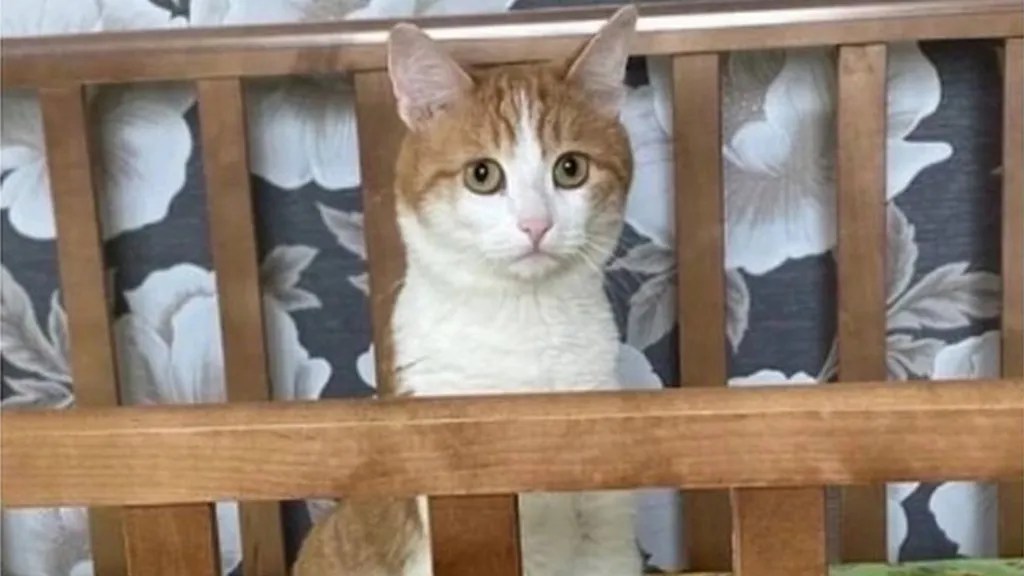
“Loud? I’m merely expressing my displeasure with the level of service around here!”
Railroad operators said there were multiple complaints, not just one, and claimed a conductor asked Camille and her boyfriend, Pierre, to switch to a mostly-empty car as a compromise with other passengers.
A conductor ticketed Camille when she declined the “simple and common sense solution,” according to French broadcaster BFM.
I’ve joked in the past about sedating the Budster before flights so the other passengers won’t toss him out at 40,000 feet, but there’s truth at the heart of it: Buddy is a naturally chatty cat, he’s got strong opinions, and he doesn’t hesitate to share them with anyone.
Of course you don’t want your companion animal to create a scene or make other passengers uncomfortable. I still wince when ai think about the woman who forced fellow passengers to endure the smell, proximity and potential defecation of her “emotional support horse,” and when people began abusing the privilege of going places with emotional support animals (emotional support alligator, anyone?), it was only a matter of time before companies that operate common spaces — be they in a fuselage, a baseball stadium or a grocery store — tightened the rules to avoid conflict.
Still, unless the cat was wailing, or Camille really did refuse to switch seats, a $130 fine is excessive.
Just something to think about for those of us who have plans to travel with our cats.
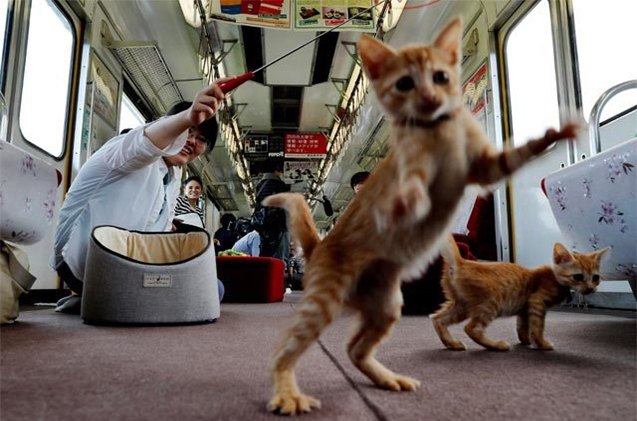
Header image of a cat cafe train car in Japan, credit: Wikimedia Commons
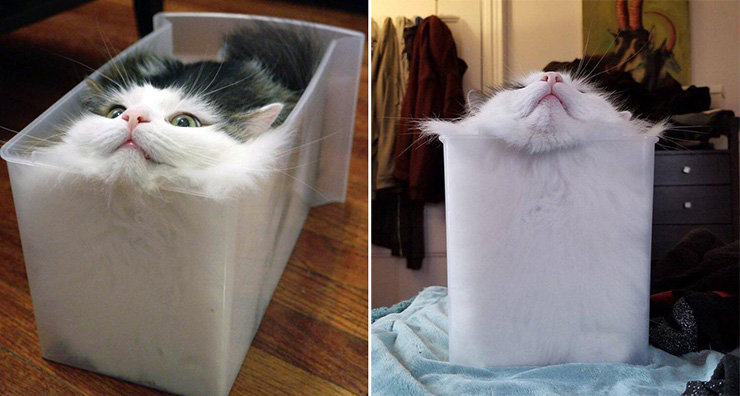
After seeing memes about liquid cats, physicist Marc-Antoine Fardin set himself the task of figuring out whether the little ones really are liquid.
Pour water into a glass or a jug, and the water takes the shape of the object immediately. Pour honey into a bottle, and it’ll likely take minutes before the slow-moving stuff fully conforms to its new container.
Both are liquid, but they’re not the same.
To differentiate levels of liquidity, rheologists — scientists who study the “deformation and flow” of liquids — use something called the Deborah number. The quicker the liquid takes the shape of its container, the lower its Deborah number, the “more liquid” it is.
On the extreme end are liquids like glass and tar pitch. It took an astounding 69 years for a single drop of the latter substance to fall at Trinity College, which set up a tar pitch experiment in 1944 and finally recorded its first drop on camera in 2013.
So what about cats? Are they really liquid?
If you’re a cat lover and you haven’t been living under a rock for the last 10 or 15 years, you’ve almost certainly seen memes showing photos of felines and their uncanny ability to conform their bodies to containers, as well as their tendency to “pour” themselves.
My Buddy is an expert in the latter, often electing to drop down from the couch in the laziest possible way, by shifting his weight and letting his body follow the path of least resistance until he slides off the side and onto the floor.
“Watchu lookin’ at, human? Haven’t you seen a liquid cat before?”
Marc-Antoine Fardin, a physicist with the French National Center for Scientific Research and Paris City University, won an Ignoble Prize for taking the memes seriously and studying the fluid properties of felines. Cats, Fardin wrote in an article about feline liquidity, “are proving to be a rich model system for rheological research.”
Cats, he concluded, are a “non-Newtonian liquid” with the ability to “alter their shapes to fill out the container without changing their volume,” putting them in the same general category as ketchup.
So the next time my cat gets all imperious with me, I’m going to remind him he’s a glorified condiment.
People who were asked to identify feline moods based only on audio of meows fared the worst in the study.
A new study suggests people misinterpret their cats’ moods often, but offers an easy fix.
A group of researchers from Paris Nanterre University split participants into three groups: one that was shown soundless video and images of cats, a second group that heard audio-only recordings of feline vocalizations, and a third group that had the benefit of video and sound.
Participants from the first two groups misinterpreted feline moods as much as 28 percent of the time, the study found, but people who had the benefit of seeing and hearing cats correctly identified their mental state almost 92 percent of the time.
The study also yielded another insight: people are much better at accurately assessing positive moods than they are at spotting an upset or antagonistic cat.
Credit: Sami Aksu/Pexels
The findings indicate we’re better off giving our cats our full attention than, say, jumping to conclusions about what they want based solely on their vocalizations or the position of their tails. It seems obvious, but how many of us have our eyes on a screen or we’re multitasking when our cats want our attention?
Of 630 people who participated in the research, 166 were professionals in animal-related fields like veterinary medicine and animal behaviorism, while the rest were lay people. There was a major gender imbalance among participants, with 574 women, 51 men and five people who didn’t identify with either gender.
It’s not clear how such an imbalance might skew the results, and it would be nice to see follow-up research evenly split between women and men.
The outrage over the death of a pet cat may be the best barometer of Russia’s national mood as its disastrous war on Ukraine enters its third year.
For the past two years I’ve had a lurid hobby. I’ve been watching translated clips from the bizarre world of Russian state TV, where Vladimir Putin’s pet propagandists tell the Russian people what to think.
There’s ringleader Vladimir Solovyov, a guy who dresses like the admiral of a galactic fleet of military starships and is prone to wild mood swings. Depending on when you catch Solovyov he could be cackling maniacally at the prospect of nuking London or crying into his microphone as he laments the loss of his overseas bank accounts and his boss’s slipping grip on power.
There’s Margarita Simonyan, the 43-year-old head of RT (Russia Today) and rumored alcoholic who, strangely, is even-keeled compared to Star Admiral Solovyov.
Then there are the second-tier propagandists: Olga Skabeeva, the “Iron Doll of Putin TV” who matter-of-factly endorses horrific war crimes, and men like Anton Krasovsky, who famously fantasized about drowning Ukrainian children in the Tysa River, a tributary of the Danube, his desk rising three inches as he excitedly repeated “Just drown those children, drown them!” Apparently he forgot he was on television and said the quiet part out loud, forcing his boss (Simonyan) to grudgingly condemn his words.
Margarita Simonyan, left, and Vladimir Solovyov, right, are two of Russia’s most famous pro-Putin propagandists. Credit: Russian state TV
Solovyov, Simonyan and the others looked like a bunch of investors celebrating the sale of a billion-dollar company during the opening phases of the war in early 2022, giddily playing footage of Russian missiles taking out Ukrainian apartment buildings and artillery flattening hospitals.
Their rhetoric was extra-dimensional at the time: they spoke often of a glorious New World Order with Russia at its head and all of humanity united under Putin’s tiny feet, where people would undoubtedly conclude that life under Russian masters is better than any over-hyped concept of freedom.
When Russia faltered and Ukraine began stringing together victories with the help of western weapons and real-time intelligence from the US and UK, the tone of Putin’s propagandists grew bitter. Their body language mirrored their frustration. Solovyov began a tradition of threatening to nuke a different country every day, for “crimes” like acknowledging the reality of Russia’s military incompetence or calling for peace.
To date, Solovyov’s threatened to nuke the UK, France, Spain, Germany, Italy, Japan, Finland, Sweden and the US, and that’s just off the top of my head. He especially hates the British for reasons that aren’t entirely clear, but he regularly makes it clear that it’s only through Putin’s benevolence that cities like London and Paris continue to exist.
He’s also extremely fond of Tucker Carlson: he plays clips from Carlson’s show on X regularly, offered him a job after the American was fired by Fox News, and has declared him the greatest journalist in the western world.
In Putin Russia, cat feed you!
I thought of that motley crew of Putinious jackwagons this week as I read about the Russian public’s horrified response to an incident on a train.
A couple was traveling on a Russian Railways train to St. Petersburg when their beloved cat, Twix, escaped his carrier. The frightened ginger tabby just kept running until he was scooped up by a female conductor, who unceremoniously tossed him into the snow in Russia’s frigid Kirov Oblast. Temperatures regularly dip into the single digits and below zero in the winters there.
On Jan. 20, after a search joined by hundreds of people, little Twix’s body was found in the snow about a half mile from the train tracks. The feline, who was used to safety and warmth, suffered multiple animal bites and died either from his wounds or the temperature.
Twix the cat in a photo from his family that was reposted to a Russian Telegram channel.
To say Russians are furious is an understatement.
Twix’s fate has been the talk of Russian social media platforms for days. Surveillance camera footage of the conductor tossing the tabby ignited a new level of rage. As of Wednesday more than 300,000 Russians had signed a petition calling for the firing of the conductor, whose name hasn’t been released by the state-owned passenger railroad company. A second petition goes further, calling for criminal prosecution, and has 100,000 signatures in just a few days.
Public outrage about the fate of Twix just might be the first authentic sentiment to reach Russian media in years.
In an unusual move, the government acquiesced — partly — to the public’s demands and pulled the conductor from duty pending an investigation. They’ve also acknowledged that Twix’s humans had properly purchased a pass for him and were riding in a car designated for passengers with pets. In the future, they’ve vowed, conductors won’t toss animals from trains.
Russia is a famously cat-loving country. Felines comprise more than 64 percent of all pets kept by Russians, and more than half of all Russian households have pet cats. They’re considerably more popular than dogs in the nation of 143 million.
Cats are popular in Russian folklore, where traditions say the furry ones have the power to ward off evil, and they’re a much more convenient pet for the millions who live in Soviet-era apartment blocks in cities like Moscow and St. Petersburg.
Still, this feels like something more.
Russians haven’t had an easy two years thanks to Putin’s disastrous “special military operation.” They can face years in prison simply for calling for peace with Ukraine. Unless they’re part of the nation’s elite or have connections among them, men can’t leave the country because the military needs more warm bodies. The country’s economy is in shambles as the government pumps more money into the war and international sanctions have taken their toll.
A Russian tank laden with loot, including a toilet, rolls past the ruins of residential buildings in Popasna, a city in eastern Ukraine.
The government has canceled or downplayed annual military celebrations so the public won’t be reminded of the war’s costs. Russia is on pace to lose an astonishing 500,000 men in two years of combat, according to the UK’s Ministry of Defense, and Putin has tried to stem the anger of the country’s mothers by staging several meetings with actresses posing as the moms of Russia’s war dead, events which have been heavily covered by state press.
Russians can’t oppose the war they’re dying in. They can’t mourn their dead fathers, sons, brothers and husbands, not by revealing their real emotions.
Quality of life has further degraded in a country where tens of millions don’t even have indoor plumbing, which is why there have been so many clips of Russian soldiers stealing toilets, washing machines and other appliances from Ukrainian homes. The prospect of being pulled off the street, sent for two weeks’ worth of rudimentary training and deployed as cannon fodder hangs heavy over the heads of Russian men and their families, especially ethnic minorities and the poor.
But Twix? They can mourn him. They can get angry about what happened to him. The furious public sentiment regarding his death wasn’t manufactured by Solovyov and company. State TV didn’t spark the backlash, it was forced to acknowledge it.
I’m neither a Russophile nor an expert on that often difficult-to-understand country, but I’d bet all my rubles that those dueling petitions say more about the Russian mood than any opinion poll to come out of Russia since 2022, and definitely more than the words of anyone allowed to express an opinion on Russian TV.
A historian casts doubt on tales of widespread cat purging, tracing the origin of the claims to a novel published in the 1990s.
The Washington Post has a new guide for taking better photos of cats and dogs with some solid advice for people using smartphones as well as more traditional cameras.
The article is in front of the paywall so you don’t need a subscription to view it, and it emphasizes a few major points I’ve often written about when people ask me how I’ve been able to get certain shots of Bud:
Always let your cat get used to the camera, whether she sniffs it, head butts it or just wants to see it up close. Let her check it out and lose interest and then it becomes just another thing, allowing you to begin capturing more candid-style photos.
Bribe ’em: Your cat’s a model and deserves compensation. A few treats will keep him hanging around and happy as you snap away.
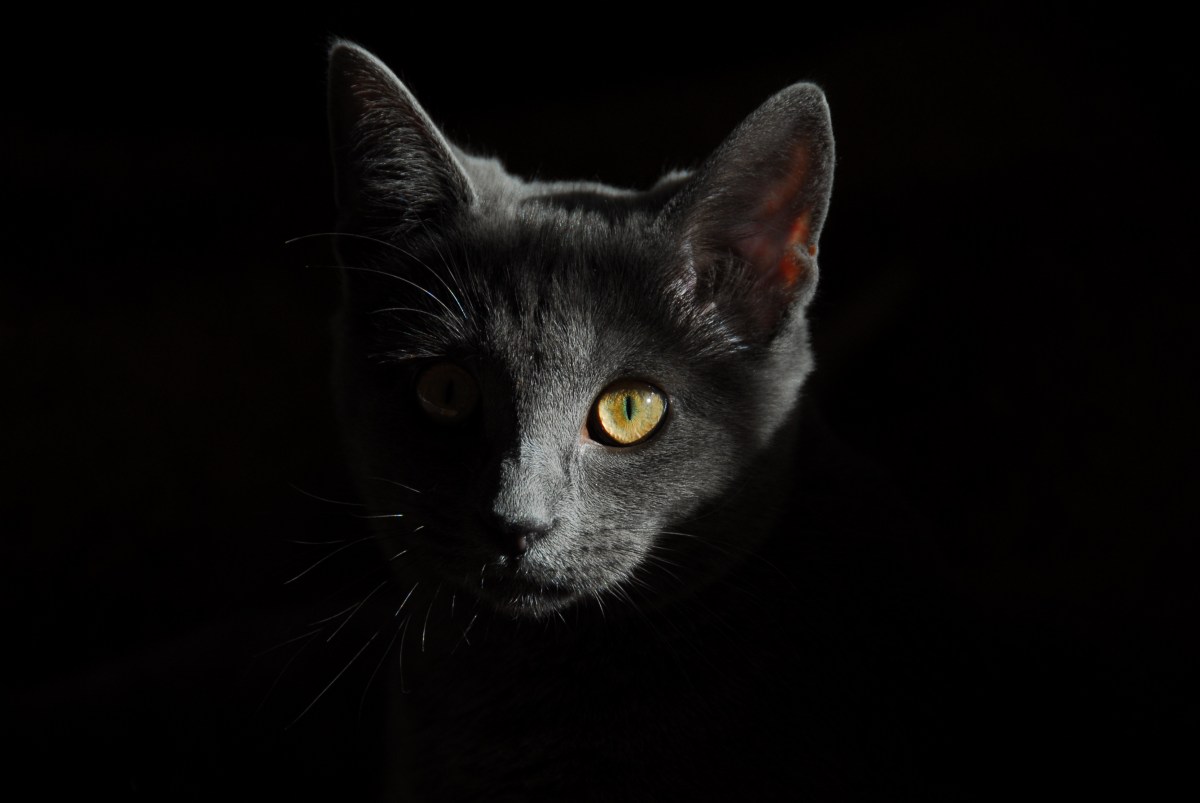
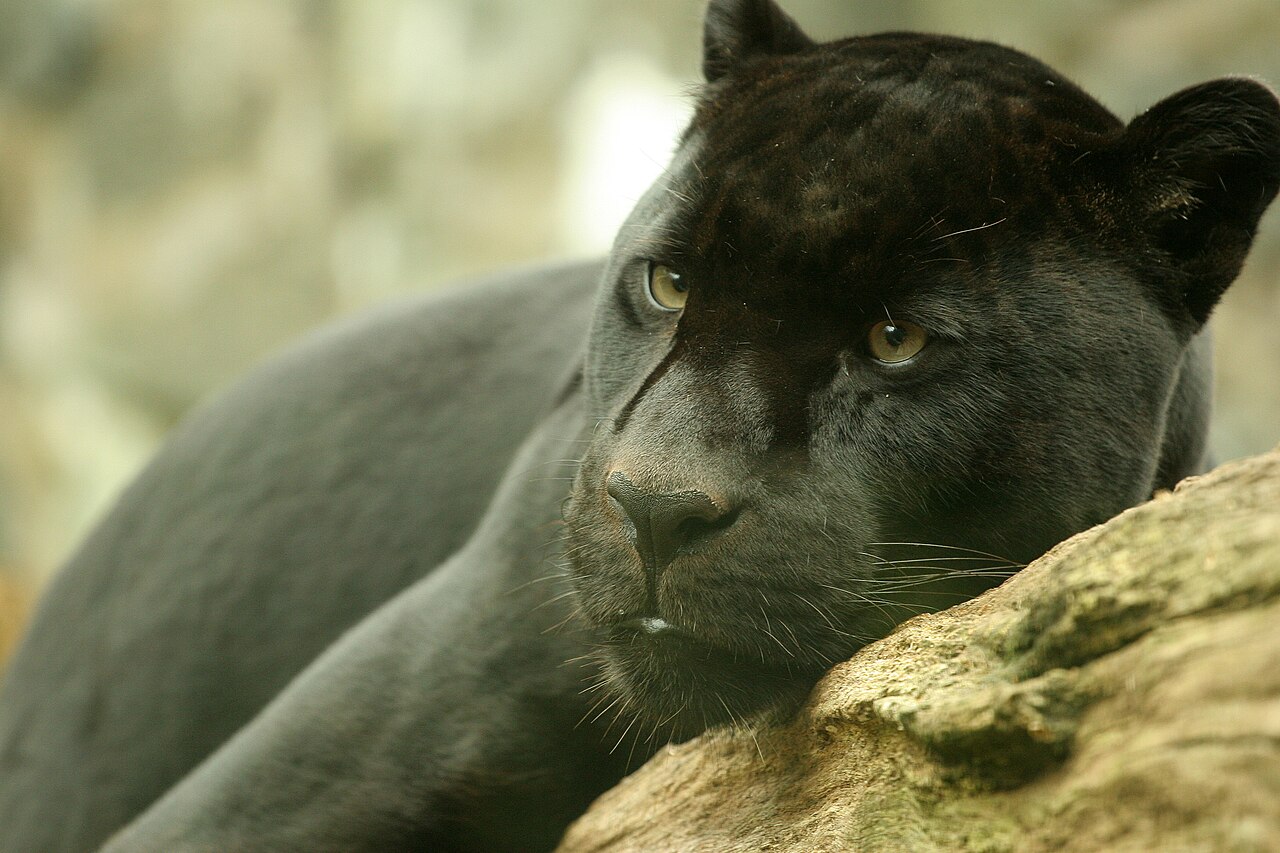
Pay attention to the lighting, especially if you’re shooting a black cat or a kitty with a darker coat pattern. Unless you’re going for a silhouette or a sunrise behind your furry friend, keep your cat facing to the right or left of the primary light source so you’re getting light and shadow to put those feline features in relief. It’s also worth taking a close look at how professional photographers shoot melanistic jaguars and leopards, carefully using light to highlight their features. In the right conditions their rosettes are still visible, they’re just slightly different shades of black. While house cats don’t have rosettes, the same attention to light and detail can help pick out the contours of their beautiful coats.
Under the right light conditions, the contours, spots and rosettes of a black jaguar are visible in beautiful detail. Credit: Edin Zoo/Wikimedia Commons
Did People Really Slaughter Cats During The Plague?
It’s often claimed that Europeans murdered felines en masse during the waves of Black Plague that devastated Europe during the Dark Ages, visiting countless cruelties on cats while inadvertently amplifying the spread by nearly wiping out disease-carrying rodents’ most effective predators.
In a new post that closely examines documents and evidence from burial sites of the era, Snopes concludes there was much less cat-killing than claimed, and the claims of widespread purging at the hands of pandemic-weary zealots have their roots in a 90s novel, which was then circulated on the web as fact.
Sites where as many as 79 sets of cat bones from the era were found show clear signs that the animals were slaughtered for their fur, and a singular slaughter in 1730s Paris often cited as proof is not only a few centuries off but was also motivated by class hatred, not fears of the plague.
While the papal bull Vox In Rama was real, and a famously zealous inquisitor really did make the preposterous claim that Satanists had a ritual that involved literally kissing the asses of black cats, the pope never called on anyone to kill felines and there’s no evidence that people took it upon themselves to do so. There was plenty of other unbelievable superstitious idiocy that led to the deaths of animals at the time, including the practice of putting animals on trial for alleged crimes, but Europeans weren’t rampaging through towns and killing cats.
Snopes quotes Welsh historian Mike Dash, who says the modern claims of widespread cat-killing are “almost certainly a modern internet-based fabrication.”







 Pain In The Bud