“Can’t find your keys, human? That’s terrible. I don’t know where they are, but perhaps I could recall that information if, say, there were treats involved. Take your time, I’m in no rush even if you are.”
A new study shows dogs and human toddlers are eager to help when their adult caregivers are looking for a missing item, but cats don’t seem to care.
The study, which involved running the same experiment for young children, dogs and cats in their own homes, made it clear cats were fully aware of what was happening and understood their humans were looking for the missing object.
They just didn’t care.
There was one notable exception, of course. If the missing items were important to the cat — a favorite toy, for instance, or a bag of treats — the felines were motivated to help search or direct their humans to the missing objects, the research team from Eötvös Loránd University in Hungary found.
But at all other times, feline observers were content to hang back and watch, even when they understood their humans were getting frustrated.
By contrast, young children and dogs actively tried to help and signaled to adults when they thought they’d found the object.
“Lookin’ for something? No, I’ll just watch, thank you. Warm, warmer…oh! Cold…colder…that direction doesn’t look promising, human.” Credit: Gord Maclean/Pexels
So does this mean cats are jerks? Probably. Are we surprised by the results? Not at all.
We still love our furry friends, who do have their own unique ways of demonstrating they care about their humans beyond seeing them as providers of food, shelter, and safety, as well as playmates, minions and servants.
Besides, testing whether dogs or cats were helpful or not wasn’t the point. As the authors note, “[t]hese three species provide an important comparison because they share a similar anthropogenic environment but differ in their ecological and evolutionary backgrounds.”
In other words, they’re interested in figuring out how evolution plays a part in how species behave in particular situations. Although it’s yet to be conclusively proven for this behavior, a likely reason is because domestic cats are the descendants of a mostly solitary wildcat species, whereas we humans and our canine friends have long evolutionary histories of living in social groups and cooperating with each other.
The study is included in the March 2026 issue of Animal Behavior.
Cats aren’t equipped to use human language and there’s nothing wrong with that. Our feline friends already go to great lengths to communicate in ways we can comprehend. The least we can do is meet them halfway.
I would love it if my cat could talk to me.
Sure, he never shuts up, but if he could speak English I’d know why he meows at the same spot at the same time every morning, or what he wants on the occasions when he’s still meowing insistently at me despite the fact that his bowls are full, his box is clean, he’s had his play time, and every possible need and want of his — that I can fathom — has been met.
Most of all, I’d really like to know he understands I’ll be back soon when I go away for a few days, and my (mostly ignored) pleas for him not to attack his long-suffering, way-too-kind sitter.
Alas, Bud cannot speak. No non-human animal has ever demonstrated even basic proficiency in human language. People will point to examples like Koko the Gorilla and Nim Chimpsky, but there’s a reason why funding dried up for that kind of experiment.
It doesn’t work. It never did.
The scientists who end up taking on dual roles as researchers and parents to the animals invariably serve as interpreters, get too close to their subjects and swear that a gorilla pounding shiny buttons for “food tree food submarine” means the ape wants to have a picnic next to the ocean, or “car fly house car star” means she wants to ride a Tesla Roadster to Mars and start a colony with Elon Musk.
Koko, Nim, Chantek and the other apes who were the subjects of decades-long attempts to humanize them — and teach them language in the process — were ultimately not much different than Clever Hans the horse, who was reading subconscious nonverbal cues from his owner and convinced tens of thousands of people that he could do math and understand spoken language.
Hans had scores of experts fooled until the German psychologist Oskar Pfungst figured out how the horse was coming up with the correct answers.
Regardless of which famous example we’re talking about, no animal has ever mastered syntax, and the best that could be said of their proficiency with language, or lack of it, is that they learned they’d get attention and food when they pounded on a talking board or approximated a word in sign language.
Even if non-human primates were able to learn a handful of words by frequently reinforced association with an object, there has never been any evidence that they are actually using the words as language rather than simply understanding “Pushing the button that makes this sound means I get a treat!” (And yes, there is a profound difference. The former reveals the presence of cognitive processes while the latter is a conditioned response.)
Despite decades of intense effort, no animal has ever demonstrated the ability to use human language. At best an animal bangs on a few buttons and people are left to speculate on the intent. Maybe Fluffy likes the way a certain word sounds. Maybe it’s just fun to hammer on buttons the way it’s fun to pop bubble wrap. Most likely, these cats and dogs know that using a talking board is a guaranteed way to get attention, a treat and a head scratch from their caretakers.
Influencers and their talking boards
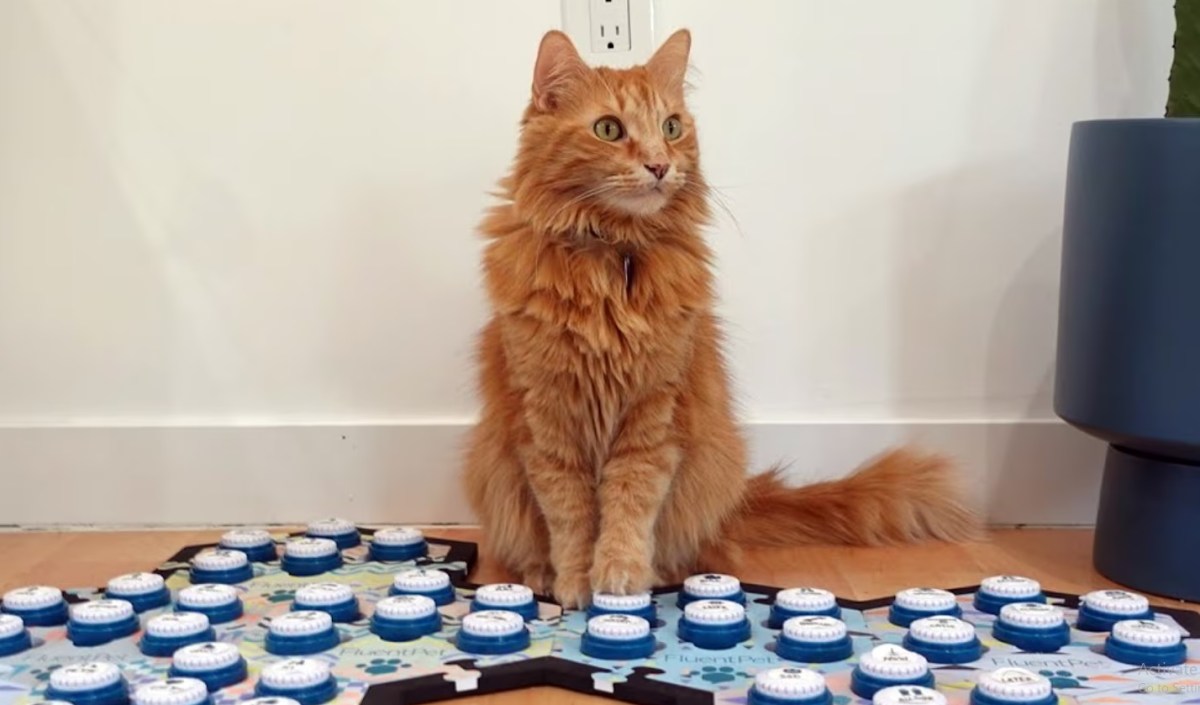
TikTok, which spawns inane trends with the reliability of an atomic clock, has provided a platform for people who insist their cats and dogs can talk. Using “talking boards” — elaborate set-ups in which words are assigned to their own buttons — they “teach” their cats how to express themselves in English and provide proof in the form of heavily edited, out-of-context clips that require the same sort of creative interpretation pioneered by Penny Patterson, Koko’s caretaker.
Seriously?
I just watched a video in which a woman claims her cat, named after Justin Bieber, was describing an encounter with a coyote by stomping on buttons for “stranger,” “Justin,” “Mike,” and “stranger.”
The woman says she thought Justin was asleep at the time, but now she believes the orange tabby saw the coyote outside and was still stressing about it well into the next day.
While she’s repeating Justin’s “words” back to him, two of her other cats come by and step all over the talking board. I guess whatever they had to say wasn’t important.
Justin’s talking board has 42 buttons, which stresses credulity well beyond the breaking point. More than half of the buttons are used for abstract concepts.
But forget all that for a moment and ask yourself how our own efforts to decode the meow have been going.
Despite our status as intelligent, sapient animals, despite the powerful AI algorithms at our disposal, despite the benefit of being able to digitally record and analyze every utterance, we haven’t come close to a reliable method for interpreting feline vocalizations.
Likewise with dolphins, whale song, corvid calls and the sounds made by other animals at the top of the cognition pyramid.
Mostly, we’re learning we’ve underestimated the complexity of our non-human companions’ inner lives, especially when it comes to the kind of multi-modal communication humans also engage in, but only subconsciously. We say what we want with our mouths, while our eyes, facial expressions and body language say what we’re actually thinking.
Likewise, the meow is an unnatural way for cats to communicate, and it contains only a fraction of the information cats are putting out there. It’s just that we can’t reliably read feline facial expressions, let alone tail, whisker and posture. (Studies have shown most of us, even when we live with cats, don’t get measurably better at this. In fact, we’re often no better than people with limited feline experience, but we think we’re better.)
Putting the burden on our furry friends
If we can’t crack a simple and limited system of vocalizations, aren’t we putting unrealistic expectations on cats? The average person has a vocabulary of tens of thousands of words, yet somehow we expect cats can latch on to an arbitrary number of them, approximate mastery of syntax that has eluded even our closest cousins, and bridge a cognition gap we haven’t been able to bridge ourselves.
It’s all too much.
I’ve had Buddy since he was eight or nine weeks old, and in more than nine years I still don’t know why he makes this praying motion. We may be best buds, but some things just don’t translate.
There’s a simple truth at the heart of this: Cats did not evolve to speak or parse human language, and that’s perfectly fine.
The little ones already meet us more than halfway because they understand we are hopelessly incompetent at reading tail, whisker or body language, and they understand we communicate with vocalizations.
By forgoing their natural methods of communication in favor of ours, cats are already taking on most of the burden in interspecies communication. Asking them to do more than that, to learn many dozens of words and the rudimentary rules of language, seems like laziness, wishful thinking or insanity on our part. Pretending that certain cats are successful is an exercise in the same kind of cynical opportunism that fuels every other desperate attempt by people trying to turn their pets into influencers. People do it because the reward is money and attention.
Worse, it contributes to the spread of misinformation. TikTok’s talking board videos routinely net millions of views, converting a credulous audience into an army of true believers who are convinced that, with just a little effort, their feline pal can shoot the shit with them.
If people want to construct elaborate talking boards in their homes and pretend their cats are expressing themselves in English, who am I to object? It’s not the smartest use of time, but have at it. What I won’t do is participate in the delusion that felines are a few buttons away from being able conversation partners, nor will I pretend these efforts have any relationship to science.
So to the journalists who keep writing credulous stories about these supposedly talking animals: please familiarize yourself with the example of Clever Hans, and please, I beg you to stop promoting these videos as if they’re anything more than wishful thinking. You are doing your readers a disservice for the sake of a few clicks.
Note: Jackson Galaxy isn’t a fan either, saying he’s “got some serious problems” with the talking board trend. Calling it “problematic,” he points out that cats are not only partially domesticated and the only animal species in history to take that step without human prompting, but humans have never selectively bred cats for specific behaviors or to bring out intelligence traits as we have with canines. (Think of sheep dogs or retrievers, who are the products of thousands of years of breeding for well-defined tasks.) There simply hasn’t been a need to breed cats for behavioral traits since the thing humans traditionally valued most about them — their ability to reliably eradicate rodents and protect human foodstuffs — is innate. No one had to teach cats how to hunt or breed them for the task. It’s only in the last two hundred years or so that certain human societies began breeding cats, and they did so for aesthetic attributes like coat patterns. Galaxy also notes that animals do not express emotions the same way humans do. Like monkeys, who “smile” when they’re terrified, felines express joy, anger and fear with their tails, whiskers, ears and body language. It’s not in their nature to tell us they’re happy or scared by padding up to a contraption and hammering on a button.
Top image of “Justin Bieber” the cat credit Sarah Baker.
Feeding strays is now punishable by a $150 fine in an Ohio town, the latest municipality whose elected leaders chose to ignore expert guidelines on managing feline populations.
Every time the stray cat issue comes up, local town boards and city councils act as if they need to reinvent the wheel.
Imagining that they are the first to deal with this extremely common problem, they make decisions from positions of ignorance, dismissing the concerns of people who actually work with cats. Or they “do the research” and come up with their own ineffective policies instead of simply looking at what other towns and cities have tried in the past.
At least that way, you know what works and what doesn’t, and how much your decision’s going to cost taxpayers.
But that would be the smart thing to do, which is why our local elected leaders don’t do it. Instead they pull stunts like the village board of Mogadore, Ohio, a town of 3,700 about 10 miles east of Akron.
The Mogadore board just passed a law that makes feeding strays and ferals punishable by a fine of up to $150, as if that will stop cats from finding food and breeding.
Tellingly, Mogadore’s elected leaders say their ordinance applies to “wild, stray, or un-owned” cats, which means they don’t understand they’re all the same species.
Apparently neither do the reporters at WOIO, a local news station in Cleveland. A story from the station is confidently incorrect in telling readers “[d]omestic cats that have become wild, meaning live outdoors, roam free, and rarely interact with humans, are also considered feral.”
Credit: Sami Aksu/Pexels
Felis catus is a domestic animal. By definition a domestic cat is not wild and cannot become wild. Evolution cannot happen to a single animal.
While evolution is a constant process, speciation — wolves becoming dogs, wildcats becoming house cats, wild boar becoming docile farm pigs — is a species-wide shift that takes at leasta few hundred years but often much longer, “from human-observable timescales to tens of millions of years” depending on the species.
The whole process results in changes at the genetic level. The transition from wildcats to domestic cats, for example, involved changing only 13 genes.
This is not rocket science, it’s basic stuff we all learned in high school science classes.
But that’s almost beside the point.
Fining people for feeding stray cats, including caretakers who voluntarily manage cat colonies, will not solve the problem. It doesn’t work. It has never worked in any town anywhere in the world.
It also creates a needlessly adversarial relationship with the passionate people doing the hard work of managing the feline population, often thanklessly and at their own expense. Why make enemies of them when they’re doing a public service?
Mogadore’s village board had a representative from Alley Cat Allies and people from local rescues on hand to inform them that fines don’t work, and to offer the humane and effective option of trap, neuter, return. TNR may not be perfect, but it’s better than anything else people have tried.
Mogadore’s board and mayor ignored the experts and went ahead with their plan to fine people instead.
They’re not alone. This happens thousands of times across the US, Europe, Australia and most other places where domestic cats live. Japan and Turkey take a more humane approach, and they’re better for it. But here in the US, we often deal with issues by ignoring precedent and engaging in wishful thinking.
If the residents of Mogadore are lucky, their elected officials will realize their mistake sooner rather than later.
Stray and feral cats already have a difficult existence without ill-advised laws making it illegal to care for them. Credit: Mehmet Fatih Bayram/Pexels
Cats have established themselves as the de facto rulers of 220 million households, where they enjoy perpetual lives of leisure and are doted on by their adoring humans. How much more successful can they be?
Dear Buddy,
There’s been a lot of talk lately among the humans about how they’ll evolve in the future, whether they’ll become more successful, and whether they’ll merge with machines! Scary!
But what about us? How will cats evolve to be more successful? Will we always have human servants?
Feline Futurist in Florida
Dear Futurist,
Do we really need to be more successful?
As a species we’ve secured our rightful place as royalty in human homes where all our needs are catered to.
We’ve become so adept at manipulating our human minions that we even know how to spur them to immediate action by embedding urgent baby-like cries in our purrs.
We figured out that humans are hardwired to respond to cries in that frequency, and once we find that manipulative sweet spot, we never forget it. We’ll push that coercive button all day and night to get what we want. There is no rest for humans until they comply with our demands.
But now we have gone beyond that significant accomplishment, essentially hijacking the humans’ species-wide consciousness by taking over the internet.
Imagine some alien archaeologist poking through the rubble of human civilization far in the future, its delight at recovering data from an ancient human server turning to utter confusion as it realizes entire zetabytes are comprised of nothing but images and videos of small, mysterious, furry creatures that seemingly do little besides eat, sleep and enjoy massages.
“Did I have it all wrong?” the confused alien might say. “Could it be that these ‘cats’ were the true power on this planet all along, and humans were in thrall to them?”
What else do we need to be successful, and to what evolutionary pressures do we need to adapt? We’re not fighting our way through hostile territory in the living room, fending off attacks en route to the kitchen where there’s only a chance for food.
Nope. It’s literally served to us on a regular schedule and whenever we screech for it. Our servants know they will never hear the end of it if they don’t meet our demands, and the best of them have learned to anticipate our desires before we have to vocalize them.
How much better can it get? We’ve managed to achieve a lifestyle in which we can perpetually live in the moment with no worries about the future, and everything taken care of for us. The humans don’t expect us to do anything in return except be cute and cuddly.
We “earn” our keep by allowing them to pet us every now and then as we lounge, until we grow weary of human affection and dismiss them with an annoyed flick of the tail or a gentle bite that says “Enough, you’ve had your 30 seconds, human!”
We break their stuff, vomit on their carpets, poop in their shoes, disturb their sleep, lay on their clean piles of laundry, ignore their boundaries, deny them their privacy, destroy their furniture, steal their cheeseburgers, force them to scoop and dispose of our waste, take over their beds, and we still act like the humans are fortunate to serve us.
We are irreproachable, imperious and untouchable, and when we’ve pushed our luck perhaps a bit too far, all we have to do is flop onto our backs, pull our little paws up beneath our chins, and squeak out a meow.
“Awww,” our humans say, their thoughts manipulated by our toxoplasma gondii mind-control superpower. “What a good boy! He’s so innocent! Of course he didn’t mean to [insert incredibly disrespectful action here], he’s an angel!”
So no, my friend. I don’t think we have to participate in the evolutionary arms race. That’s for lesser creatures whose futures are uncertain. Us? We’re winning at life without lifting a paw.
Your pal,
Buddy
“That’s right. Obey us, humans. We honor you by allowing you to serve our meals, scoop our poop, scratch our chins and buy us toys. You are so fortunate!”
The last few decades have revealed birds like crows and parrots possess astonishing intelligence. “Bird brain” might not be much of an insult after all.
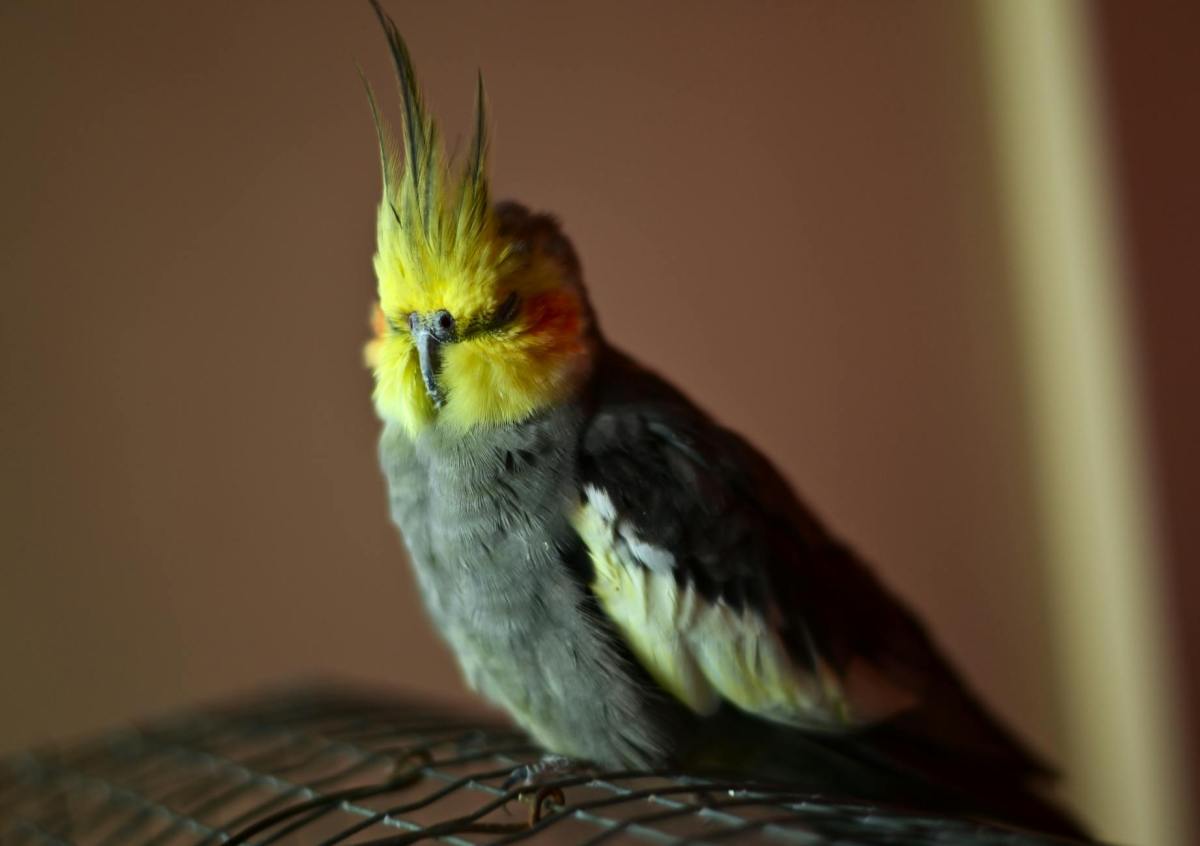
Meet Kiki the cockatiel, a bird who loves Earth, Wind and Fire so much that he sings the band’s classic hit, September, regularly — whether he’s just chilling by himself, singing along to the recording or driving his human crazy by whistling the catchy hook at ungodly hours.
“Kiki, it’s seven in the morning!” she tells him in one clip, raising an admonishing finger. “Silence!”
I’ve always thought parrots are a fascinating example of animal cognition and further proof that we share our planet with billions of other minds who think and feel.
Humans and birds last shared a common ancestor more than 300 million years ago. That means between them there’s been more than 600 million years of divergent evolution resulting in radically different physiology, abilities and minds.
Yet parrots can speak while non-human primates (apes and monkeys) cannot!
For decades scientists thought apes and monkeys, by virtue of their relative similarity to humans, possessed an inmate affinity for language and that the physical limits of their vocal apparatus is what keeps them from speaking.
But a 2016 study by a team from Princeton University found monkeys do possess the vocal “hardware” to speak, meaning their mouths and throats are capable of making the sounds necessary for human language. It’s the lack of associated brain circuitry that prevents them from talking.
If the ability to speak and the ability to dance/appreciate music and rhythm is uniquely human among the primate order, and birds arrived at it at a different point in their evolutionary history, that means language and appreciation for music/rhythm developed separately along two divergent evolutionary lines!
That’s incredible and has intriguing implications for the cognitive abilities of animals.
A common argument is that birds with the ability to form human speech are simply mimicking sounds and don’t understand what they’re saying. That’s a natural assumption given what we think we know about non-human capacity for understanding language, but research suggests it’s wrong.
Take a look at this video of the famous late African grey parrot, Alex:
When Dr. Irene Pepperberg asks Alex how many blue blocks are present on a tray with a random assortment of blocks, balls and triangular toys in different colors, Alex can’t give a rote answer. First he has to understand that a question is a request for information and not part of the strange human ritual called small talk. He can’t simply count or guess at the number of blocks either.
Instead, Alex has to perform two calculations. He must tally the blue objects and count the number of them that are blocks, or he’s got to count the number of blocks and figure out how many of them are blue.
If he was simply repeating information in context — like saying “Hello!” when a person walks into a room — Alex wouldn’t be able to correctly answer the questions, and Pepperberg’s research funding would have dried up. Instead, Alex became a focal point of research that persisted for decades.
There’s no indication Alex could master syntax, which has proven elusive for even the smartest animals. But the African grey, who died in 2007 at 31 years old, was curious, asking questions that were unique and unexpected of an animal. He once asked his caretakers to describe his physical appearance, and the night before he died, he told Pepperberg: “You be good. I love you. See you tomorrow.”
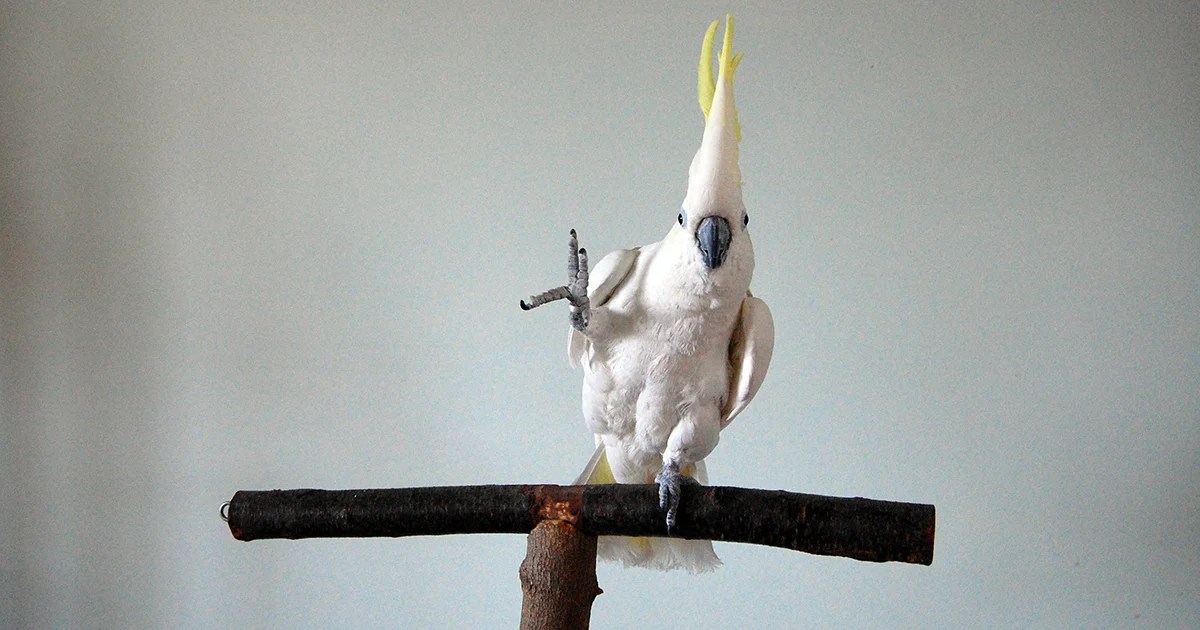
We’ve talked about parrots before on PITB, including Snowball the dancing cockatiel who not only appreciates music and has a great sense of rhythm, but also has an entire repertoire of unique dance moves. Then there’s my personal favorite, Ruby the African grey, who has demonstrated mastery of absolutely vile, uniquely British insults.
Sure, there may not be much research value in hearing Ruby hurl verbal abuse at her very loving human, Nick Chapman, but few things have made me laugh as hard as that extraordinarily foul-mouthed bird. She has to be seen and heard to be believed. (But if you’ve got kids in the room, stick with the wholesome Snowball. He’s got serious moves.)
Scientists credit Snowball with choreographing his own dance routines, with dozens of individual dance moves and combinations, and moves that change depending on the song he’s rocking out to.
Now if you’ll excuse me, I’m off to teach a certain feline a few Earth, Wind and Fire songs in the hope that he’ll give up on the screeching meows and use his natural falsetto for a more gentle wake-up experience.
Hey, hey, hey Ba-dee-ya, hey there my Big Buddy Ba-dee-ya, Little Buddy’s hungry! Ba-dee-ya, get your lazy ass up and feeeeeed me!







 Pain In The Bud