Cats have established themselves as the de facto rulers of 220 million households, where they enjoy perpetual lives of leisure and are doted on by their adoring humans. How much more successful can they be?
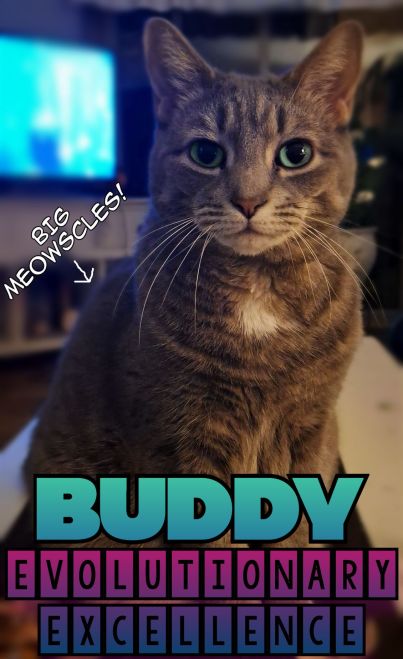
Dear Buddy,
There’s been a lot of talk lately among the humans about how they’ll evolve in the future, whether they’ll become more successful, and whether they’ll merge with machines! Scary!
But what about us? How will cats evolve to be more successful? Will we always have human servants?
Feline Futurist in Florida
Dear Futurist,
Do we really need to be more successful?
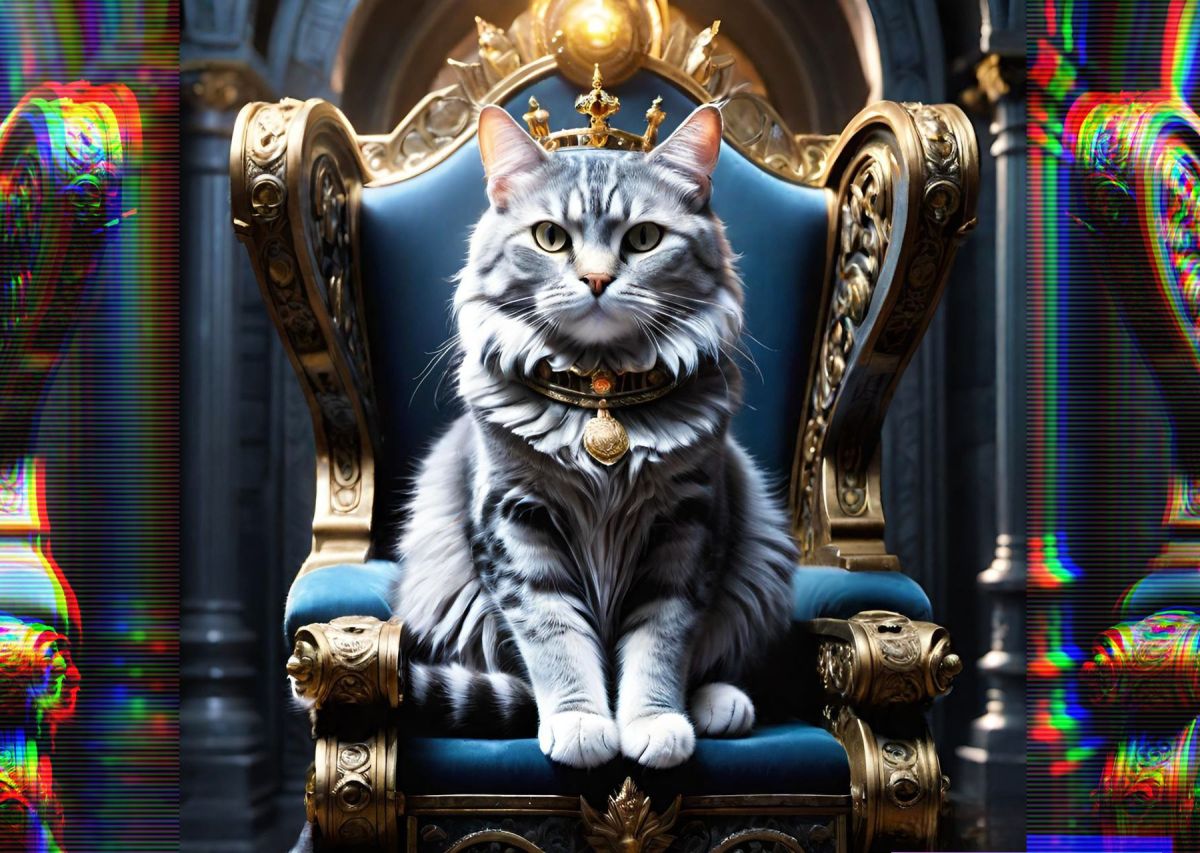
As a species we’ve secured our rightful place as royalty in human homes where all our needs are catered to.
We’ve become so adept at manipulating our human minions that we even know how to spur them to immediate action by embedding urgent baby-like cries in our purrs.
We figured out that humans are hardwired to respond to cries in that frequency, and once we find that manipulative sweet spot, we never forget it. We’ll push that coercive button all day and night to get what we want. There is no rest for humans until they comply with our demands.
But now we have gone beyond that significant accomplishment, essentially hijacking the humans’ species-wide consciousness by taking over the internet.
Imagine some alien archaeologist poking through the rubble of human civilization far in the future, its delight at recovering data from an ancient human server turning to utter confusion as it realizes entire zetabytes are comprised of nothing but images and videos of small, mysterious, furry creatures that seemingly do little besides eat, sleep and enjoy massages.
“Did I have it all wrong?” the confused alien might say. “Could it be that these ‘cats’ were the true power on this planet all along, and humans were in thrall to them?”
What else do we need to be successful, and to what evolutionary pressures do we need to adapt? We’re not fighting our way through hostile territory in the living room, fending off attacks en route to the kitchen where there’s only a chance for food.
Nope. It’s literally served to us on a regular schedule and whenever we screech for it. Our servants know they will never hear the end of it if they don’t meet our demands, and the best of them have learned to anticipate our desires before we have to vocalize them.
How much better can it get? We’ve managed to achieve a lifestyle in which we can perpetually live in the moment with no worries about the future, and everything taken care of for us. The humans don’t expect us to do anything in return except be cute and cuddly.
We “earn” our keep by allowing them to pet us every now and then as we lounge, until we grow weary of human affection and dismiss them with an annoyed flick of the tail or a gentle bite that says “Enough, you’ve had your 30 seconds, human!”
We break their stuff, vomit on their carpets, poop in their shoes, disturb their sleep, lay on their clean piles of laundry, ignore their boundaries, deny them their privacy, destroy their furniture, steal their cheeseburgers, force them to scoop and dispose of our waste, take over their beds, and we still act like the humans are fortunate to serve us.
We are irreproachable, imperious and untouchable, and when we’ve pushed our luck perhaps a bit too far, all we have to do is flop onto our backs, pull our little paws up beneath our chins, and squeak out a meow.
“Awww,” our humans say, their thoughts manipulated by our toxoplasma gondii mind-control superpower. “What a good boy! He’s so innocent! Of course he didn’t mean to [insert incredibly disrespectful action here], he’s an angel!”
So no, my friend. I don’t think we have to participate in the evolutionary arms race. That’s for lesser creatures whose futures are uncertain. Us? We’re winning at life without lifting a paw.
Your pal,
Buddy
“That’s right. Obey us, humans. We honor you by allowing you to serve our meals, scoop our poop, scratch our chins and buy us toys. You are so fortunate!”
The last few decades have revealed birds like crows and parrots possess astonishing intelligence. “Bird brain” might not be much of an insult after all.
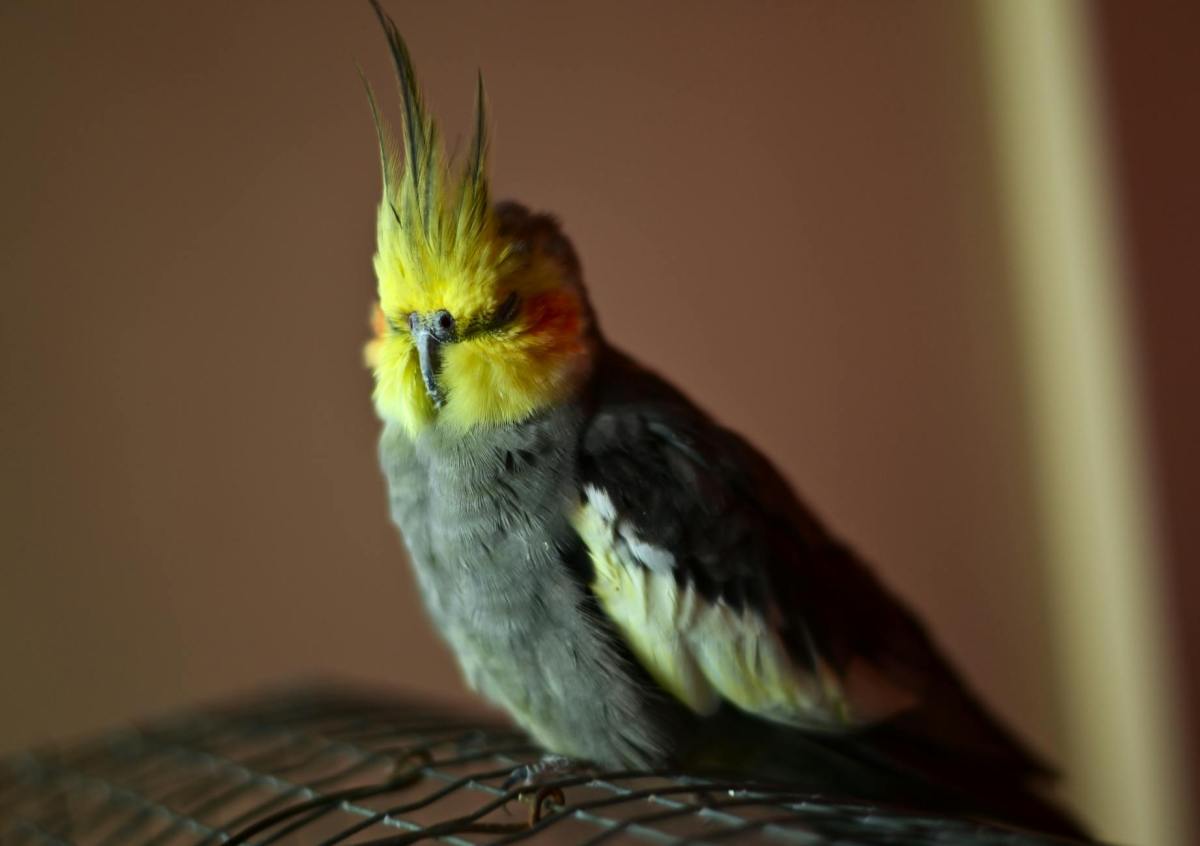
Meet Kiki the cockatiel, a bird who loves Earth, Wind and Fire so much that he sings the band’s classic hit, September, regularly — whether he’s just chilling by himself, singing along to the recording or driving his human crazy by whistling the catchy hook at ungodly hours.
“Kiki, it’s seven in the morning!” she tells him in one clip, raising an admonishing finger. “Silence!”
I’ve always thought parrots are a fascinating example of animal cognition and further proof that we share our planet with billions of other minds who think and feel.
Humans and birds last shared a common ancestor more than 300 million years ago. That means between them there’s been more than 600 million years of divergent evolution resulting in radically different physiology, abilities and minds.
Yet parrots can speak while non-human primates (apes and monkeys) cannot!
For decades scientists thought apes and monkeys, by virtue of their relative similarity to humans, possessed an inmate affinity for language and that the physical limits of their vocal apparatus is what keeps them from speaking.
But a 2016 study by a team from Princeton University found monkeys do possess the vocal “hardware” to speak, meaning their mouths and throats are capable of making the sounds necessary for human language. It’s the lack of associated brain circuitry that prevents them from talking.
If the ability to speak and the ability to dance/appreciate music and rhythm is uniquely human among the primate order, and birds arrived at it at a different point in their evolutionary history, that means language and appreciation for music/rhythm developed separately along two divergent evolutionary lines!
That’s incredible and has intriguing implications for the cognitive abilities of animals.
A common argument is that birds with the ability to form human speech are simply mimicking sounds and don’t understand what they’re saying. That’s a natural assumption given what we think we know about non-human capacity for understanding language, but research suggests it’s wrong.
Take a look at this video of the famous late African grey parrot, Alex:
When Dr. Irene Pepperberg asks Alex how many blue blocks are present on a tray with a random assortment of blocks, balls and triangular toys in different colors, Alex can’t give a rote answer. First he has to understand that a question is a request for information and not part of the strange human ritual called small talk. He can’t simply count or guess at the number of blocks either.
Instead, Alex has to perform two calculations. He must tally the blue objects and count the number of them that are blocks, or he’s got to count the number of blocks and figure out how many of them are blue.
If he was simply repeating information in context — like saying “Hello!” when a person walks into a room — Alex wouldn’t be able to correctly answer the questions, and Pepperberg’s research funding would have dried up. Instead, Alex became a focal point of research that persisted for decades.
There’s no indication Alex could master syntax, which has proven elusive for even the smartest animals. But the African grey, who died in 2007 at 31 years old, was curious, asking questions that were unique and unexpected of an animal. He once asked his caretakers to describe his physical appearance, and the night before he died, he told Pepperberg: “You be good. I love you. See you tomorrow.”
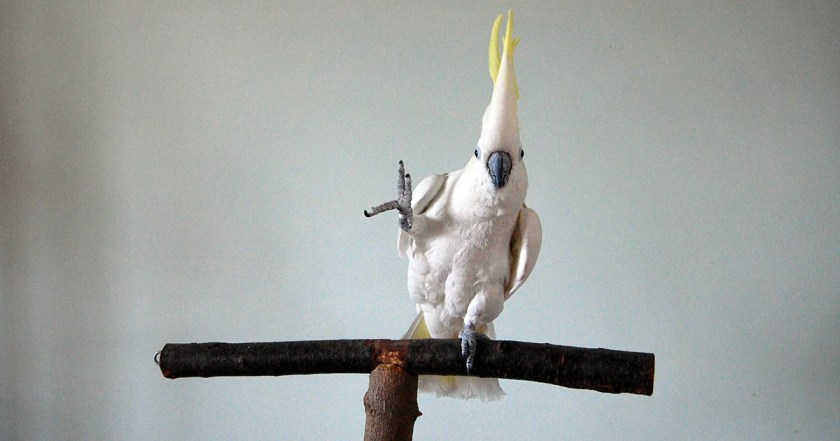
We’ve talked about parrots before on PITB, including Snowball the dancing cockatiel who not only appreciates music and has a great sense of rhythm, but also has an entire repertoire of unique dance moves. Then there’s my personal favorite, Ruby the African grey, who has demonstrated mastery of absolutely vile, uniquely British insults.
Sure, there may not be much research value in hearing Ruby hurl verbal abuse at her very loving human, Nick Chapman, but few things have made me laugh as hard as that extraordinarily foul-mouthed bird. She has to be seen and heard to be believed. (But if you’ve got kids in the room, stick with the wholesome Snowball. He’s got serious moves.)
Scientists credit Snowball with choreographing his own dance routines, with dozens of individual dance moves and combinations, and moves that change depending on the song he’s rocking out to.
Now if you’ll excuse me, I’m off to teach a certain feline a few Earth, Wind and Fire songs in the hope that he’ll give up on the screeching meows and use his natural falsetto for a more gentle wake-up experience.
Hey, hey, hey Ba-dee-ya, hey there my Big Buddy Ba-dee-ya, Little Buddy’s hungry! Ba-dee-ya, get your lazy ass up and feeeeeed me!
Domestication’s real goal: to make cats cuddly as well as great mousers.
Cats have been doing things their way since the very beginning.
Unlike literally every other domesticated animal, cats were not domesticated by humans. They did it to themselves.
As if that didn’t make them unique enough, they lay claim to another major distinction: they’re the only species of obligate carnivores to undergo domestication in the entire history of human existence.
That explains why cats, more than any other animal that depends on humans, so closely resemble the wild animals they were before signing up for the good life of naps, warmth, endless rodents to hunt and free food from their new human friends.
In a new essay for The Conversation, evolutionary biologist Jonathan Losos, author of The Age of Cats: From the Savanna to Your Sofa, notes new DNA analysis settles the question of where cats came from once and for all.
Domestic cats are descended from North African wildcats, specifically the species felis sylvestris lybica. Unlike dogs, who underwent telltale physical transformations when they evolved from wolves, house cats “appear basically indistinguishable from wildcats.”
While the change in genetics that happen with domestication left cats pretty much as they were physically, the process made dramatic changes in the feline brain, reducing regions governing fear and expanding those related to social behavior. The result? The major difference between house cats and their wildcat ancestors is disposition.
In other words, domestication made cats cuddly.
Housecat evolved.
Notably, felis sylvestris lybica had to be pretty friendly in the first place, as well as bold and driven by the now-legendary feline curiosity to risk padding into human settlements with their bright lights, strange smells, open flames and the two-legged giants striding around them.
They didn’t have a way of negotiating or signaling their intent. They couldn’t say: “Hey guys, we’re here to kill and eat the tasty rodents who have been giving you problems by chowing down on your yums, but we don’t want your yums for ourselves. Plants are disgusting!”
So they had to demonstrate their usefulness, prove their worth, and enjoy the fruits of it by curling up in front of warm fires or on human laps.
That explains why it was the African wildcat that became a human companion species and not European wildcats, whom Losos notes are often “hellaciously mean” in interactions with people, even if they’re raised around humans when they’re young. It was also a matter of being in the right place at the right time, as nascent human civilization took root in the Fertile Crescent.
But ultimately, just like cats decided to domesticate themselves and didn’t really bother to consult us about it, so too do they bend us to their will with an entire repertoire of manipulative behavior, from solicitation purrs to incessant meowing and having a talent for looking their cutest when they want something.
While we may think we set the rules and parameters of our relationship with the furry little ones, as Losos notes, “cats usually train us more than we train them.”
A new paper claims cats are healthier when fed human diets, but the “study” is activism masquerading as science.
We have a science problem in this country.
Tens of millions of adults are scientifically illiterate and cannot articulate a simple definition of the scientific method.
That includes the usual suspects, the people who don’t understand the difference between anecdotes and hard data and say things like “Evolution’s just a theory” or “I don’t believe in science” as if it’s an ideology or religion. It also includes people who like to declare they’re “into science” as if it’s a band or a genre of cinema, and often post articles from sites like “I F—-ing Love Science,” which routinely mistakes natural phenomena like stars, interstellar space and the animal life for “science.”
To quote Sam Kriss’ wonderful essay on the subject: “‘Science’ comes to metonymically refer to the natural world, the object of science; it’s like describing a crime as ‘the police,’ or the ocean as ‘drinking.'”
Science is a formalized method for studying the natural world. That’s it. No more, no less. It isn’t natural phenomena itself, it isn’t something that requires faith. It’s meant to be challenged, with each piece of knowledge hard-won as the scientific community collectively chips away at the vast edifice of things we don’t understand.
The lack of scientific literacy is an indictment of the American education system, but the science and journalism communities are also big contributors. A flawed academic publishing system encourages researchers to make grandiose claims in abstracts and press releases to increase the chances their work will get positive coverage in the press. Few journalists are more scientifically literate than the general population, so they report dubious claims credulously and present individual studies as the final word on subjects instead of tentative first steps in contributing to the corpus of human knowledge.
We see this all the time with reporting on the environmental impact of felines, but it’s certainly not limited to that subject. How many times have you seen your local news anchors or newspapers tout studies saying coffee is healthy, only to report the next week that a new study says coffee isn’t healthy after all?
“Those scientists can’t make up their minds,” they’ll say with a forced chuckle before handing the broadcast over to the weatherman, oblivious to their own failure to provide context.
The effort to rebrand cats as vegans
A new “study,” given prominent play today by major news outlets like Newsweek and aggregators like Drudge, is a classic example of misleading claims given the veneer of scientific authority. The paper claims vegan cats are “healthier” than their meat-eating counterparts. The study — which is actually a survey — says no such thing, and its authors are surely aware that the way it’s been packaged for media consumption will cause confusion, but they’ve gone ahead with it anyway.
The research involved asking 1,369 cat owners to fill out surveys about their cats, the cats’ diets, and their veterinary health histories.
Of those surveyed, there were 123 reported “vegan cats” in their households (about nine percent of the total), and while the abstract and media pitches claim the surveys show vegan cats are healthier, the differences are statistically insignificant. The sample size is too small to draw any conclusions from, and the fact that the details are self-reported means the “data” is worthless: People who put their cats on vegan diets despite knowing felines are obligate carnivores have a vested interest in defending their decision. They’re not impartial, and their survey answers aren’t either. (The paper acknowledges that 91 percent of the respondents are female, and 65 percent are vegans, vegetarians or pescatarians themselves. Those are admirable choices for a human diet, but not for a cat.)
Relying on self-reported “data” also means the research team doesn’t actually know the true veterinary histories of the cats in question, nor does it know anything about the nutrient content of the vegan “cat food” given to the 123 cats who have been deprived of meat. It also cannot account for possibilities like the so-called vegan cats slipping out at night to hunt rodents.
Credit: Engin Akyurt/Pexels
That’s especially important because of “vegan cat food’s” dubious history. Evolution, the brand that popularized the concept, is owned and operated by a man named Eric Weisman, who has been prosecuted and repeatedly sanctioned for misrepresenting himself as a physician, veterinarian and scientist — and continues to misrepresent himself.
Weisman, a chiropractor by trade, racked up a long list of violations in his chosen field before his chiropractor license was pulled, then was charged and convicted criminally for, among other things, practicing veterinary medicine and regular medicine without a license. Weisman’s list of offenses include “treating” cancer patients, “treating” and misdiagnosing animals, and posing as a physician for years, including in advertisements and literature related to his pet food and fake veterinary practices.
Weisman is still calling himself a physician in violation of his plea agreement, and he’s still selling “vegan cat food.” Would anyone in their right mind weigh the claims of that man against the tens of thousands of veterinarians and pet nutritionists who are horrified at the idea of restricting cats to vegan diets?
(In case you’re tempted to think chiropractors are legitimate to begin with, you should know that chiropractor was founded by a lifelong quack who claimed its methods were taught to him by the ghost of a physician, which allegedly appeared to him during a seance. Chiropractor’s founder dodged accountability for years by claiming his practice was a “religion.” The fact that it’s now a $15 billion industry despite its origins, and decades of research that has found no benefit to the practice, illustrates how eager people are to believe just about anything.)
The consequences of bad science
Not only will the “study” and press coverage of it mislead people into believing its claims, it’s another black mark on the scientific community. Trust is hard-won, easily lost, and for better or worse the misdeeds of a few scientists reflects on the entire field.
Others will simply believe it, especially when major news outlets like Newsweek report the results without question, without acknowledging that it’s a lazy effort masquerading as science by a research team that already knew what result it wanted before handing out the surveys. (The “study” was funded by ProVeg, an NGO that promotes plant-based consumption and is involved in the development of plant-based foods.)
Lastly and most tragically, cats will suffer for it. Cats who are denied meat suffer slow and agonizing deaths, with health problems accumulating due to the lack of certain proteins until they go blind, become chronically malnourished and eventually suffer organ failure.
And for what?
Because some people believe human morals apply to cats?
Because, despite all common sense, they think they can change a species that has been dependent on meat for so long in their evolutionary history that their bodies literally cannot synthesize certain proteins and cannot extract nutrients from most plant material?
How would we like it if we were dependent on giants to feed us, and those giants decided we could and should live on a diet of marshmallows? We’d suffer horribly and we’d die, but at least we’d know why.
Cats don’t have that luxury. They depend on us to do right by them, and when we adopt them it’s our basic responsibility to keep them healthy and well-fed. Let’s not fail our little friends by pretending human ethics is applicable to a species that can’t understand it, or consent to participating in it.
Loafing Larry’s outlasted Liz and Liz’s lettuce. Lucky lad!
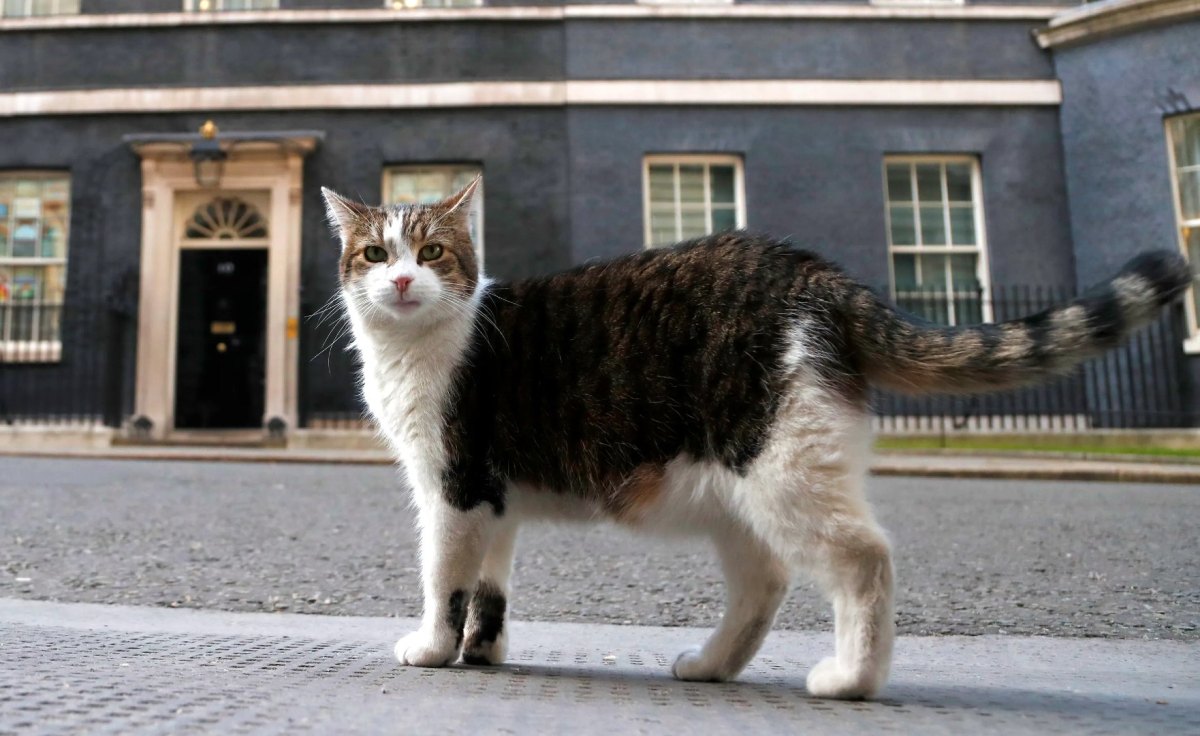
No. 10 Downing Street in London is supposed to be the official residence and office of the UK’s prime minister, but we think it should be called Larry’s House.
Larry, the official mouser in chief since 2011, has now outlasted four prime ministers: David Cameron, Theresa May, Boris Johnson, and the short-tenured Liz Truss, who lasted just 44 days. (And became the butt of jokes when The Daily Star set up a live webcast of a head of iceberg lettuce, betting that Truss’s time as PM would be over by the time the lettuce wilted. The lettuce won.)
“The King has asked me to become Prime Minister because this nonsense has gone on long enough.” pic.twitter.com/eFL3fgSfVL
Now Larry, the de facto leader of the UK, will be served by a fifth prime minister. There’s also a chance he’ll see his fifth prime ministerial term, if not officially a fifth prime minister, if Johnson manages to return to power. Apparently there’s a real chance of that happening.
Why the loaf?
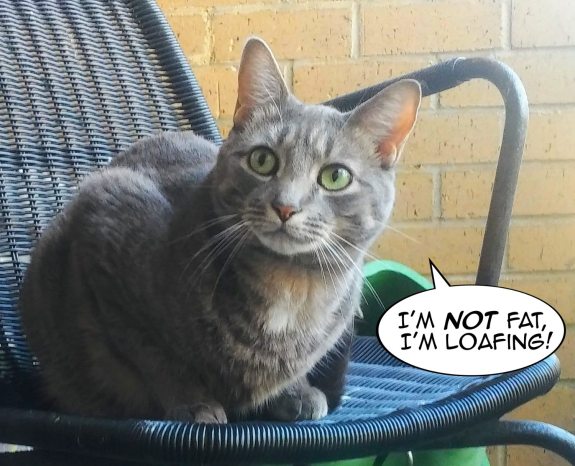
How dare you suggest Buddy is chubby!
If you’ve ever wondered why your cat likes to lay in the famous loaf position, Jackson Galaxy has weighed in on the matter. (There’s a British theme here too. For some reason Galaxy, real name Richard Kirschner, uses a British accent to explain loafing behavior, and it’s…not good.)
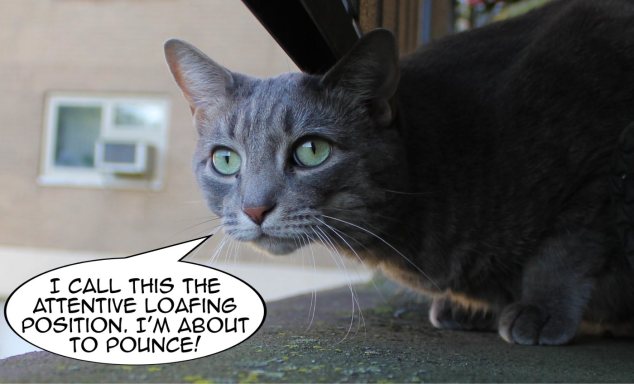
“The first thing that we want to look at is the position itself; we’ve got paws tucked under the whole body resting basically on arms,” Galaxy says in a video. “This look right here is decidedly cat. Because what this is saying is I’m not going anywhere.”
Cats loaf to conserve body heat while remaining in a position that allows them to quickly get up if need be. Galaxy cautions, however, that a “half loaf” position could indicate your cat isn’t feeling too hot, health-wise.
If a cat is half-loafing, he says, that could mean she’s not getting completely comfortable because she feels vulnerable, and for evolutionary reasons (cats are both predator and prey) cats in pain feel particularly vulnerable. Most predators go for the easy kill, which is why cats go to great lengths to disguise pain and discomfort, as opposed to us humans, who whine and complain and make sure everyone knows how lousy we feel.