Bud Battles A New Vacuum, Plus: Webb Telescope Reveals ‘Toe Bean’ Of Cat’s Paw Nebula

Buddy confronts his machine arch-nemesis, while NASA celebrates JWST’s third anniversary by imaging the cosmic cat’s paw in detail we’ve never seen before.

To mark its third anniversary, the team behind the James Webb Space Telescope has released an image of the Cat’s Paw nebula, and it’s incredible!

Below is a dramatically scaled down version of the image to make things easier on readers who may have slower connections or tend to visit PITB on mobile devices. The original is 30mb and can be found here.

It really is worth viewing at maximum resolution, where you can see details of the stellar nursery and the thick plumes of ionized gases that comprise the radiant, multi-hued structure of the nebula.

The dark red areas are dense concentrations of gases, the clouds from which stars are born. The blue stars are the cosmic newborns, and if you scroll through the image at maximum resolution, you can see those young stars floating in seas of their golden brethren in interstellar expanses stretching thousands of light years. In this image, we’re looking at an area of our galaxy between about 4,000 and 5,500 light years away.

Here’s the small version:

And here are images that better illustrate why it’s called the Cat’s Paw, with a view oriented in the “correct” way to trigger our brains’ pattern recognition processes, the mechanisms that make us think “Oh yeah, that does look like a cat’s paw!”

“Toe beans” up top, large pad beneath. The Cat’s Paw Nebula.
Viewed in different wavelengths to better see the overall structure without the obscuring elements.

We’re fortunate there is no cosmic-scale feline floating out there. Just imagine entire star systems batted around for fun, or a section of the galaxy reserved as a litter box.

I know this can seem overwhelming to some people, while others see images like this and think “What’s the big deal? Haven’t we seen things like this before?”

And the truth is no, we haven’t. That’s the beauty of the James Webb Space Telescope. We’re not only seeing galaxies and structures previously undiscovered, we’re also seeing familiar cosmic locations in detail and resolution that was previously impossible.

In a very real way, we’ve upgraded from standard definition Cosmic TV to the HD version.

The scope is in orbit, at a gravitationally stable position known as Lagrange point 2. In plain English, it’s a special place a million miles from Earth where the gravitational dance between our planet and our sun effectively cancel each other out.

Or, as NASA puts it, Lagrange points are “positions in space where objects sent there tend to stay put.”

It took decades of planning and the engineering talents of thousands of humanity’s best to create the JWST, which is also a spacecraft. The scope was built to travel to L2 without anyone aboard, then unfold itself in a delicate ballet of almost innumerable moving parts. The JWST’s ability to transform, like a butterfly emerging from a cocoon, is an engineering marvel in and of itself, and that’s before it began providing us with a better view of the cosmos than we’ve ever had in the history of our species.

Cheers to the scientists and engineers at NASA, who have repeatedly demonstrated they’re cat-loving people!

Header image credit: Texas Tech University Department of Physics and Astronomy

The fury of the Budster

Casa de Buddy has a new vacuum, desperately needed during this hot summer as Bud has been shedding more fur than usual.

I could have made another cat from all the hair the new vac picked up from the area rugs, couches and pillows, but Buddy wasn’t happy.

As PITB readers know, vacuums are high on the list of things Buddy despises. He’ll start hissing the moment he sees one, even if it’s not plugged in. He thinks they are angry nemesis machines created to infiltrate his territory and torment him.

Usually I try to lure the little dude into another room with treats and lock him in for a few minutes while I vacuum, but he was nowhere to be found, so I thought he’d spotted the vac and retreated voluntarily.

Tragically, I was mistaken.

Shortly after I began vacuuming my bedroom, I heard a low growl, then Buddy leaped from his hiding spot under my desk and shrieked his high-pitched, baby-like battle cry as he launched himself at the evil vacuum!

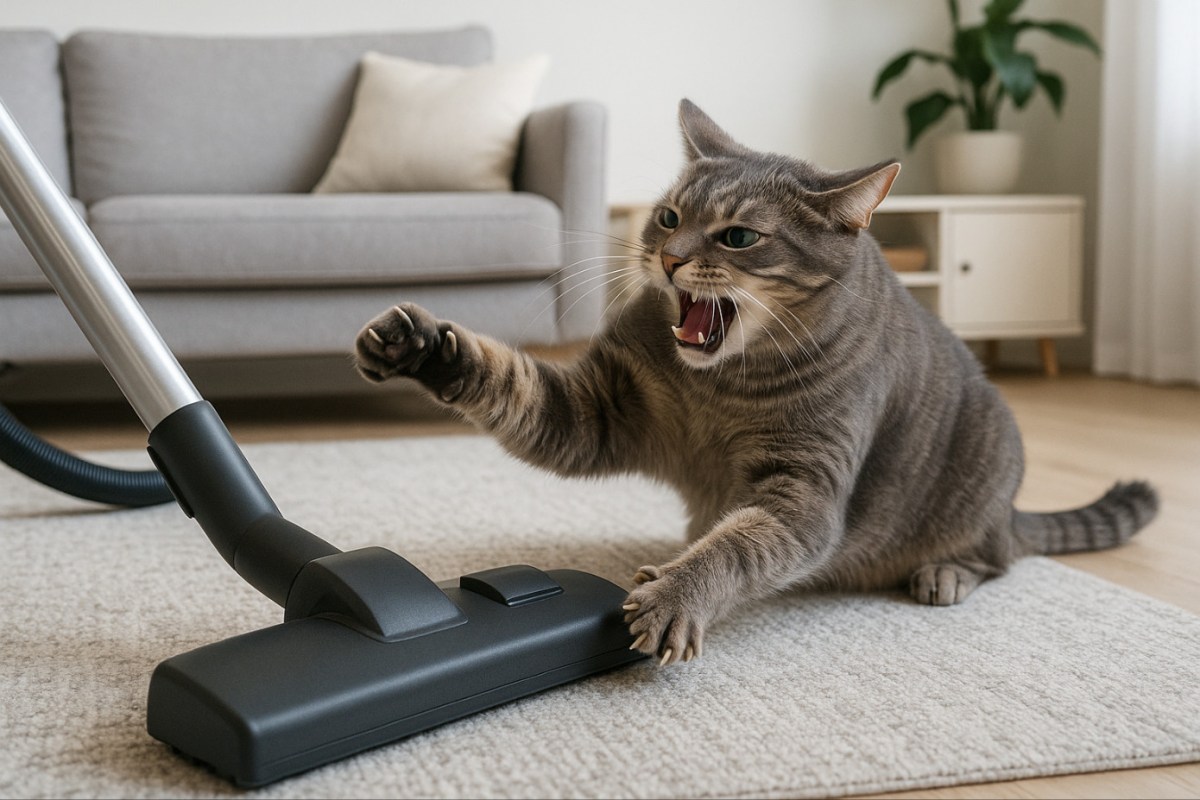
It was comical. His little face was twisted into a mask of rage, his ears were pinned back, and he slapped the hell out of the vac: SLAP SLAP SLAP SLAPPP!!! with his little paws.

Here’s a reimagining of the ghastly incident, since it would be cruel to repeat it just to get photos. It’s Buddy — or the “model” of Buddy I’ve built using dozens of photos — exacting his wrath on the evil machines that disturb his peace:

I turned the vacuum off and tried to calm him down by reassuring him in a soft voice that he was safe. Nothing to be worried about, pal!

But I couldn’t stop laughing, which didn’t help the situation. Little man does not like to be mocked, and I’m convinced he fully understands when I’m laughing at instead of with him.

Ah, well. Next time there will be no assumptions and I’ll get him safely out of harm’s way before using the evil contraption.
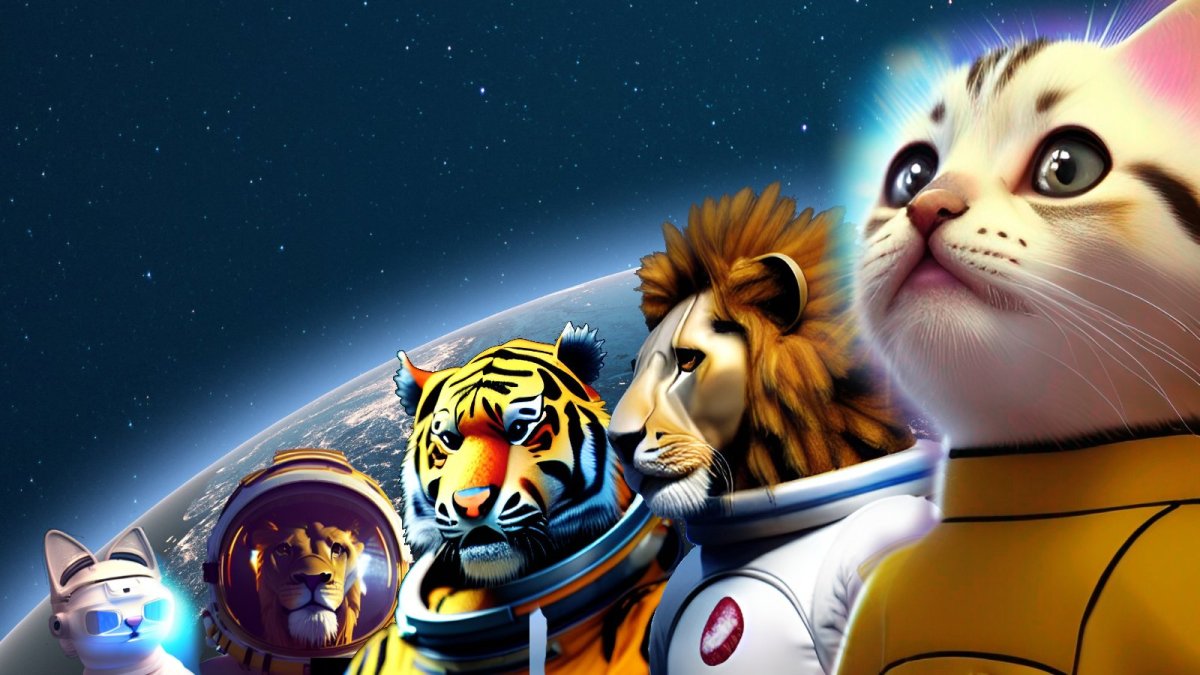
Catstronauts: Buddy Leads Exploratory Expedition To Epsilon Eridani

Kittens back home on Earth ask the brave catstronauts about their mission and life in space!

STAR COMMANDER BUDDY’S LOG, STARDATE 12142022, Aboard the USS Fowl Play

Lt. Commander Freddie Ferocious has command of the bridge while I’ve retired to my ready room for the important task of answering video messages from kittens in Mrs. Meowmore’s Kittengarden class.

Catstronauts
Lt. Commander Freddie Ferocious, executive officer of the USS Fowl Play.
Catstronauts!
Star Commander Buddy, commanding officer of the USS Fowl Play.

Myles, a three-month-old tuxedo who wants to be a catstronaut when he grows up, has asked me how catstronauts eat and use the litter box in zero gravity.

“Well, Myles,” I tell him, “as you may have guessed, regular litter is no good without gravity! You can’t bury your business, obviously, and you run the risk of free-floating poops and granules of litter escaping into the ship’s habitable areas, so a litter box is out of the question. That is why we have a sealed Litter Chamber and a special suction device. It takes some getting used to, especially since it tends to pull on your fur while you’re doing your business!”

Sophia, a five-month-old Calico, asks us what we eat in space.

“This morning at 0100 hours I was informed that our food replicators are malfunctioning, which means the entire crew has had to make do with freeze-dried kibble and pate MREs. No wonder we’re all so cranky! I have ordered the engineering department to devote all available resources and catpower toward the repair of the replicators. This simply cannot be allowed to go unresolved, for a cranky crew can easily become a mewtinous one, and I don’t want to have to start spacing kitties out of the airlock. Er, I mean throwing ’em in the brig! Chief Engineer Meowdi LaForge tells me the replicators should be back online by breakfast.”

Catstronauts!
Chief Engineer Meowdi LaForge

Simba, three and a half months, asks: “Dear Commander Buddy, how far are you from the place you’re traveling to, and what will you do when you get there? Is it true there might be monsters? That would be scary!”

“Thanks for writing, Simba! It’s 10.47 light years to the Epsilon Eridani star system, which is a long ride! Fortunately the USS Fowl Play is a pretty big, comfortable ship, with lots of stuff to do to keep her running, and some pretty cool options for entertainment and R&R when we’re off duty. We’re less than two light years away from our destination now, which means the Fowl Play has already flipped and is engaged in a prolonged deceleration burn. We have to do that, see, so we don’t sail right on past Epsilon Eridani!

“Where did you hear about the thing with the monsters? It’s not true, okay? I don’t know what anyone told you, probably that jealous jerk Commander Calvin, but I totally did not run screaming from a monster during the expedition to Luyten 726-8, okay? That’s fake news!

“What happened was, I saw the monster and issued a blood-curdling battle cry, but then I hit the wrong button on my Planetary CatRover, which caused it to spin around and run in the other direction. I was trying to inspire my team, not abandon them. I would have turned around and battled the monster too, except by the time I realized my mistake I was already more than half way back to the lander and the others had scared the monster away with their laser pointers.”

That’s my rover on the left, and the Scary Monster on the right. As you can see, I’m very brave for facing the Scary Monster:

Five-month-old Pepper asks: “Star Commander Buddy, do you think smart aliens are out there? What do they look like? Will they be nice when you meet them?”

“Hi, Pepper! Those are good questions. Well we should remember that we cats are not only a super intelligent species, but we are intimidating too! We have sharp teeth and claws, some of us can roar, and we look really strong and tough! So maybe the aliens will be scared of us!

“I think there will be smart aliens even though we haven’t found other intelligent life on Earth. I mean, there’s humans, but they’re simple-minded creatures, aren’t they? That’s why they’re our servants! LOL! Maybe the aliens will only have fur on their heads like humans. Maybe they’ll look like dogs. Gross, I know! Or maybe they’ll look like a cross between elephants, manta rays and aardvarks.

“We just don’t know, which is why we’re trying to find out. Picture it: Star Commander Buddy, fearlessly leading the first expedition to make contact with smart aliens. It’ll be pretty cool to be in the history books. Tell ya what, Pepper. If we find smart aliens, you and the rest of Mrs. Meowmore’s class will be the first to know. After NASA, of course. We’ll send you pictures. Deal?”

Catstronauts!
Lt. Loki pilots our lander, and he’s a good example of how intimidating our species can look! Will aliens be scared of him?


Catstronauts
Vice Admiral Yo’oko Nahsuareo. Did you know jaguars make up only 4% of the Catstronaut Corps? They are usually sleep specialists, designing cryosleep pods for space travel and constantly improving comfortable napping spots on our ships.


Every Attempt To Translate Meows Has Failed. Why?

A New York Times science writer tries MeowTalk, the app that says it can tell you what your cat is saying.

New York Times science writer Emily Anthes details her experience with MeowTalk in a new story, and has more or less come to the same conclusions I did when I wrote about the app last year — it recognizes the obvious, like purring, but adds to confusion over other vocalizations.

Back in January of 2021, in MeowTalk Says Buddy Is A Very Loving Cat, I wrote about using MeowTalk to analyze the vocalizations Bud makes when he wants a door opened. After all, that should be a pretty basic task for an app that exists to translate meows: Cats ask for things, or demand them, some would say.

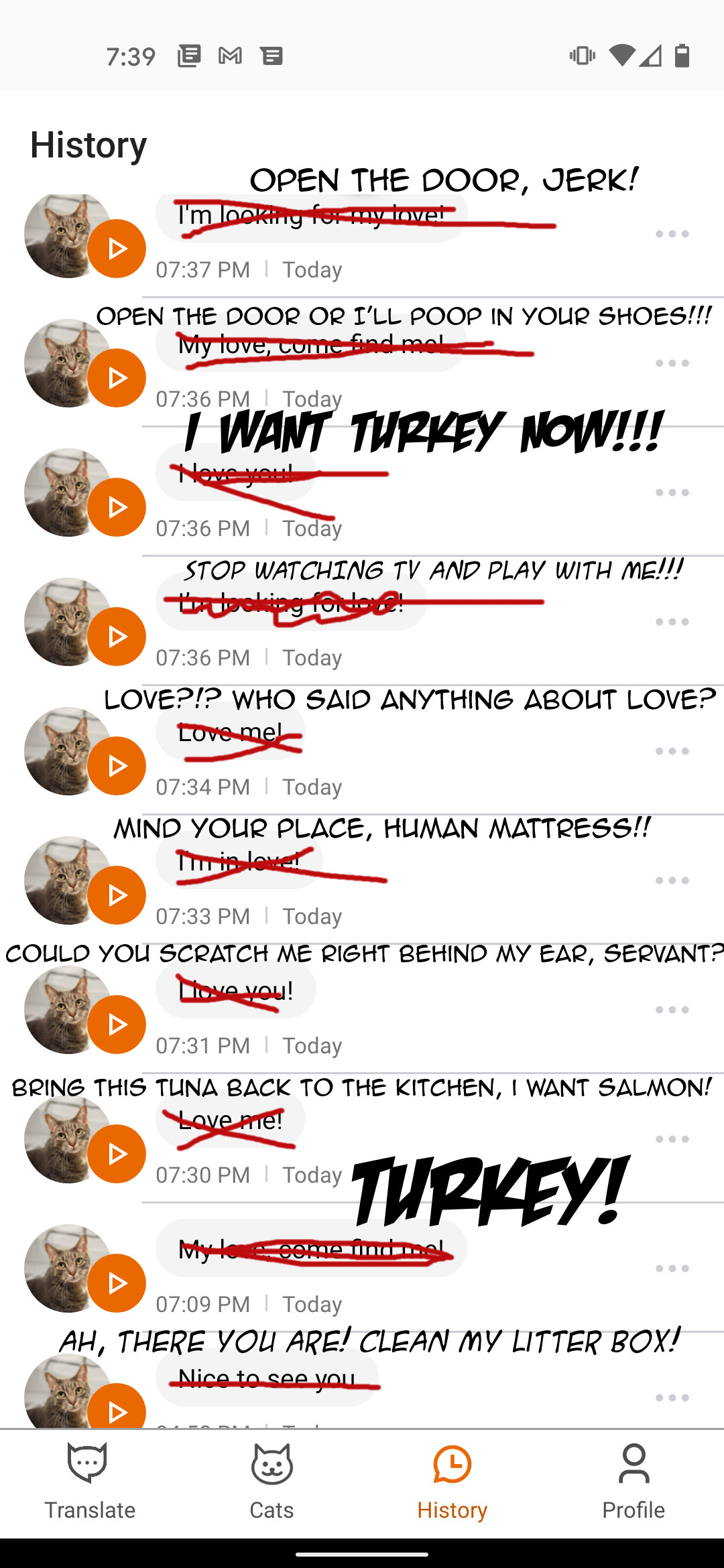
But instead of “Open the door!”, “I want to be near you!”, “Human, I need something!” or even “Obey me, human!”, it told me Bud was serenading me as he pawed and tapped his claws on the door: “I’m looking for love!”, “My love, come find me!”, “I love you!”, “Love me!”, “I’m in love!”

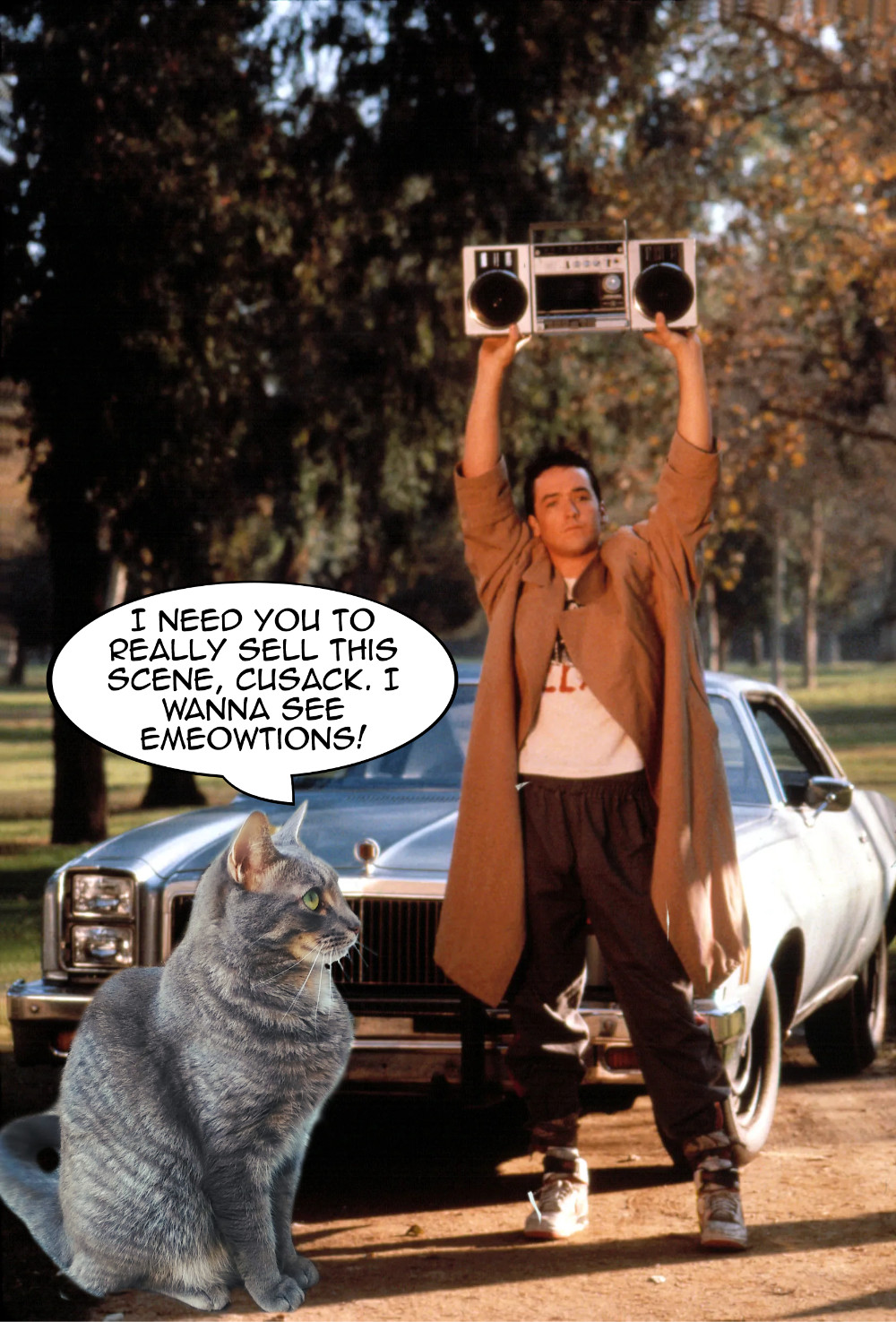
According to MeowTalk, my cat was apparently the author of that scene in Say Anything when John Cusack held up a boombox outside of Ione Skye’s bedroom window.

John Cusack and Buddy the Cat
Buddy the Director.

Anthes had a similar experience:

“At times, I found MeowTalk’s grab bag of conversational translations disturbing. At one point, Momo sounded like a college acquaintance responding to a text: ‘Just chillin’!’ In another, he became a Victorian heroine: ‘My love, I’m here!’ (This encouraged my fiancé to start addressing the cat as ‘my love,’ which was also unsettling.) One afternoon, I picked Momo up off the ground, and when she meowed, I looked at my phone, ‘Hey honey, let’s go somewhere private.’ !”

On the opposite side of the emotional spectrum, MeowTalk took Buddy’s conversation with me about a climbing spot for an argument that nearly came to blows.

“Something made me upset!” Buddy was saying, per MeowTalk. “I’m angry! Give me time to calm down! I am very upset! I am going to fight! It’s on now! Bring it!”

In reality the little dude wanted to jump on the TV stand. Because he’s a serial swiper who loves his gravity experiments, the TV stand is one of like three places he knows he shouldn’t go, which is exactly why he wants to go there. He’s got free rein literally everywhere else.

If MeowTalk had translated “But I really want to!” or something more vague, like “Come on!” or “Please?”, that would be a good indication it’s working as intended. The app should be able to distinguish between pleading, or even arguing, and the kind of freaked-out, hair-on-edge, arched-back kind of vocalizations a cat makes when it’s ready to throw down.

buddytranslations
Accurate translations of Buddy’s meows.

Still, I was optimistic. Here’s what I wrote about MeowTalk last January:

“In some respects it reminds me of Waze, the irreplaceable map and real-time route app famous for saving time and eliminating frustration. I was one of the first to download the app when it launched and found it useless, but when I tried it again a few months later, it steered me past traffic jams and got me to my destination with no fuss.

What was the difference? Few people were using it in those first few days, but as the user base expanded, so did its usefulness.

Like Waze, MeowTalk’s value is in its users, and the data it collects from us. The more cats it hears, the better it’ll become at translating them. If enough of us give it an honest shot, it just may turn out to be the feline equivalent of a universal translator.”

There are also indications we may be looking at things — or hearing them — the “wrong” way. Anthes spoke to Susanne Schötz, a phonetician at Lund University in Sweden, who pointed out the inflection of a feline vocalization carries nuances. In other words, it’s not just the particular sound a cat makes, it’s the way that sound varies tonally.

“They tend to use different kinds of melodies in their meows when they’re trying to point to different things,” said Schötz, who is co-author of an upcoming study on cat vocalizations.

After a few months in which I forgot about MeowTalk, I was dismayed to open the app to find ads wedged between translation attempts, and prompts that asked me to buy the full version to enable MeowTalk to translate certain things.

The developers need to generate revenue, so I don’t begrudge them that. But I think it’s counterproductive to put features behind paywalls when an application like this depends so heavily on people using it and feeding it data.

To use the Waze analogy again, would the app have become popular if it remained the way it was in those first few days after it launched? At the time, I was lucky to see indications that more than a handful of people were using it, even in the New York City area. The app told me nothing useful about real-time traffic conditions.

These days it’s astounding how much real-time traffic information the app receives and processes, routing drivers handily around traffic jams, construction sites and other conditions that might add minutes or even hours to some trips. You can be sure that when you hear a chime and Waze wants to redirect you, other Waze users are transmitting data about a crash or other traffic impediment in your path.

Bud
“I’m thinking deep thoughts about turkey.”

MeowTalk needs more data to be successful, especially since — unlike Waze — it depends on data-hungry machine learning algorithms to parse the sounds it records. Like people, machine learning algorithms have to “practice” to get better, and for a machine, “practice” means hearing hundreds of thousands or millions of meows, chirps, trills, yowls, hisses and purrs from as many cats as possible.

That’s why I’m still optimistic. Machine learning has produced algorithms that can identify human faces and even invent them. It’s produced software that can write prose, navigate roads, translate the text of dead languages and even rule out theories about enduring mysteries like the Voynich Manuscript.

In each of those cases there were innovators, but raw data was at the heart of what they accomplished. If MeowTalk or another company can find a way to feed its algorithms enough data, we may yet figure our furry little friends out — or at least know what they want for dinner.