Amazon’s response not only leaves a lot to be desired, it’s also an example of precisely what not to do when an issue goes beyond a simple customer service complaint. The company missed an opportunity to respond with compassion and earn a family’s gratitude.
An Amazon delivery driver took a Washington family’s cat and drove away with her on July 21.
Since then, Amazon has admitted its driver has the cat, but has offered little more than carefully-worded customer service responses mixed with boilerplate language about valuing the family’s business and feedback.
Ray and Karin Ishak have video of the driver petting and playing with 13-year-old Feefee in the family’s driveway during the delivery. The motion-activated camera timed out, according to a report by Seattle ABC affiliate KING5-TV, but when the camera began recording again, triggered by the driver pulling away, Feefee was gone.
“The driver [was] driving away and there’s not a cat in sight. It’s pretty obvious the cat disappeared in those seconds,” Ray Ishak told the station, adding he filed a report with the Snohomish County Sheriff’s Office.
An Amazon driver playing with Feefee in the Ishak family’s driveway before driving away with the cat. Credit: Ray Ishak
Amazon has chosen to deal with the incident via email, as if it’s a dispute over a returned item rather than a living being who is valued as a family member by her people.
A company customer service representative told the Ishaks that the driver said she contacted the police to return Feefee, but the family called the sheriff’s office and the police in Everett, Washington, where they live, and both agencies told them they hadn’t heard from the driver or from Amazon.
The Ishaks asked Amazon if the company could at least tell them the town or city where the driver lives, figuring the driver may have contacted police there instead of the departments that have jurisdiction over their hometown. Amazon declined to provide that information.
When the Ishaks followed up with Amazon again, a customer service representative said she’d be happy to help — if the police approach Amazon. She provided an email address for law enforcement use only, said Amazon will cooperate if the police contact them, and ended the reply with a request to “vote about your experience today.”
This is an awful response by Amazon, and the company deserves any bad PR it gets as a result. The very first thing the company should have done was escalate the ticket to a manager empowered to take care of the case directly, and that manager should have picked up the phone, called the family and promised to get their cat back immediately.
If the company doesn’t have anyone in its customer care hierarchy who understands why it’s important to make that kind of judgment call, then it’s done a poor job of hiring and training its employees.
Treating this like a routine complaint only exacerbated the Ishak family’s stress and uncertainty regarding the fate of their beloved cat. Putting the onus on the family and the police to sort out of the problem makes things worse, and you’d think any halfway competent customer service rep would skip the “rate your service” pitch, at least until after the problem is solved and Feefee is back with her family.
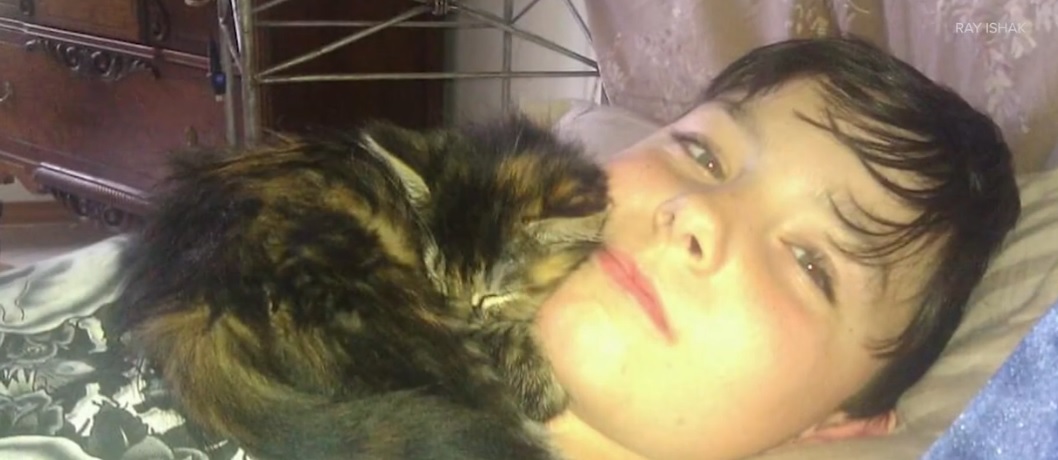
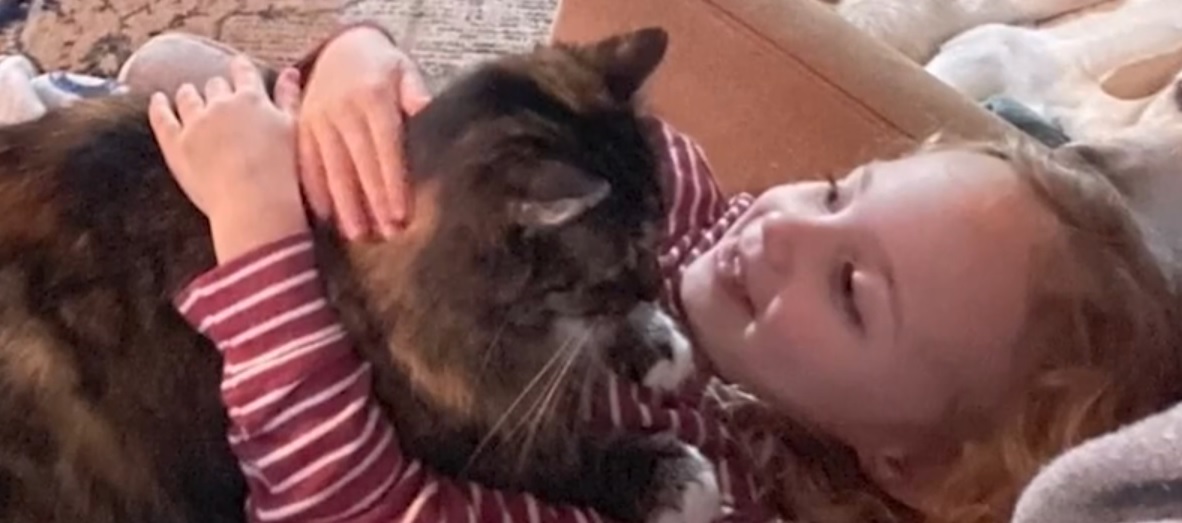
Ray Ishak said Feefee’s disappearance has been especially hard on his grandchildren, who love the gentle feline. Credit: Ray Ishak
It doesn’t matter how massive and successful the company is, there has to be a better way to handle issues like this without requiring even the police to approach Amazon like customers dialing a service line, or supplicants petitioning a king to turn his gaze toward a situation that normally falls beneath his notice. There’s also no recognition of the impact on Feefee, who is almost certainly confused and stressed at being separated from the only home and family she’s known for her entire life.
Lastly, Amazon missed an opportunity to respond with compassion and earn the gratitude of a family whose members are obviously very concerned about their cat. A PR win like that is worth a thousand commercials, and can earn enormous good will with customers. Instead, people will hear about how the company treats a problem like this as if a customer is returning a shirt that’s too small.
As for the Ishak family, they say they’re giving the driver the benefit of the doubt. Maybe she thought Feefee was a stray. But, as Ray Isha told KING5, it’s been made abundantly clear that Feefee is a beloved member of the family, and she needs to be returned.
“Maybe you did this out of the kindness of your heart,” Ray Ishak said. “I appreciate it, but bring me my cat back.”
Top image of Feefee as a kitten with one of Ray Ishak’s grandchildren courtesy of Ray Ishak, via KING5.
Vakuum, the terror of many a cat, was put on notice by Buddy’s display of astonishing bravery. If AI and robots ever try to take over the Earth, Buddy is a natural choice to lead the combined armies of cats and men to victory over the machines.
NEW YORK — Buddy the Cat was particularly pleased with himself on Thursday after he successfully scared off one of his mortal enemies by using his powerful roar.
The gray tabby cat had just finished his second Food O’Clock meal of the day and was settling down for 5th Nap when the infernal machine known as Vakuum the Disturberizer encroached upon the Buddesian domicile and began its high-pitched shriek.
While previously he’d hiss at the accursed machine and retreat to the safety of the bedroom, Buddy decided to put his paw down, sources said. It was time to make a stand.
The heroic sequence of events that led to Vakuum beating a hasty retreat.
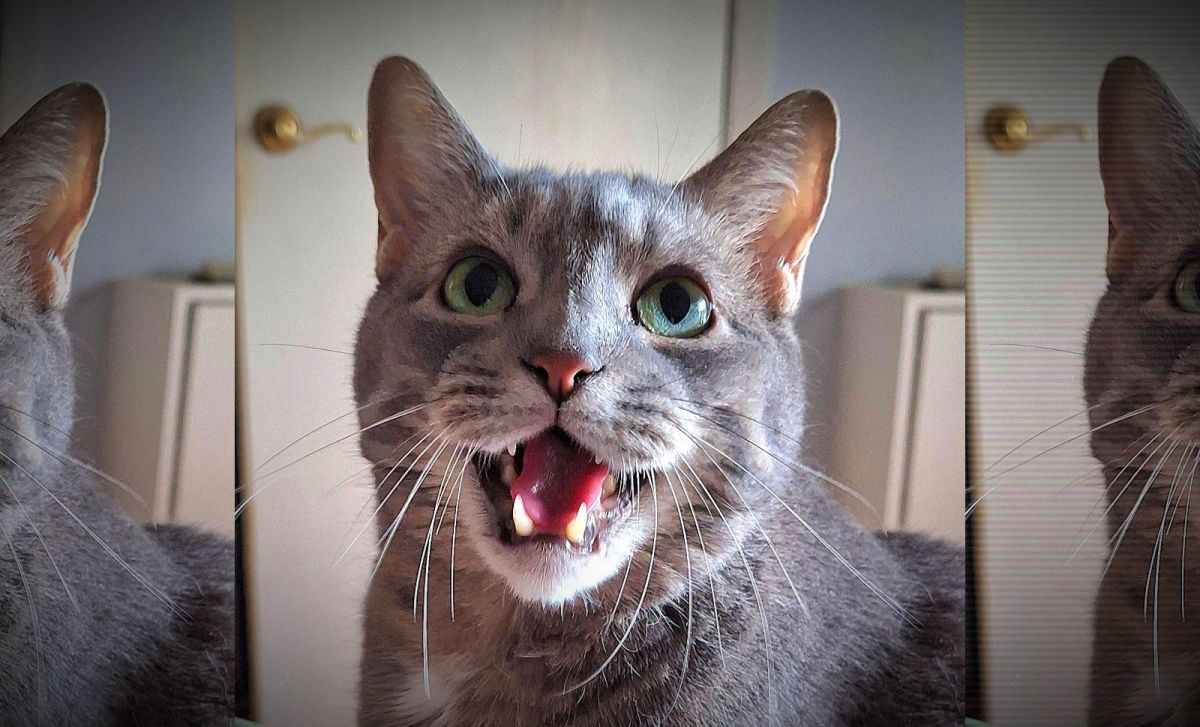
Rising up to his full height of almost a foot, Buddy let loose a mighty, blood-curdling roar — and was shocked when Vakuum immediately stopped making its pestiferous racket.
“That machine took one look at me and decided it didn’t want a piece of this,” Buddy said, his primordial pouch jiggling as he flexed. “It helps to be a meowscular and intimidating cat, you know. We jaguars are quite ferocious when we need to be.”
A spokescat for the Yguara Nation of the Americas confirmed that while Buddy is an honorary jaguar and was bestowed the name Kinich Bajo, meaning “Tiny Sun-Eyed One,” he is not in fact an actual jaguar.
A cat’s affection has to be earned, but the good news is it’s not rocket science. A little patience and consideration for your fluffy little pal goes a long way toward building trust and a strong bond. Once you do, you’ll have a loyal friend for life.
“How do I make my cat like me?”
That question comes up regularly on social media posts, in cat-centric discussion groups, Q&A sites and even in our inbox. People adopt a cat, and whether the little one dives under a bed and refuses to emerge, or just seems reluctant to snuggle the way people imagined, they turn to the internet to find out why they don’t have a purring, contented feline in their lap.
The short answer is you can’t “make” your cat feel anything, and it’s best to dispense with that notion as quickly as possible so you can acknowledge the truth: cats are individuals with their own thoughts and feelings.
The good news, however, is that you can earn your cat’s affection with patience, respect and love. Our patience and respect for our little buddies leads to trust, which in turn creates and strengthens the special bond we share with them.
The love of a cat isn’t as easily won as the love of a dog, and in many ways that makes it even more special. Cats don’t love just anyone.
It starts with acknowledging your cat has feelings, and understanding that you have to respect those feelings as you would those of a person.
Don’t make your cat do things she doesn’t want to do.
Despite what you might think or what you may have been told, most cats don’t like being picked up, held or feeling restricted. The majority of felines don’t like belly rubs, and people have a habit of mistaking a sign of trust — a cat showing her belly — as an invitation to pet.
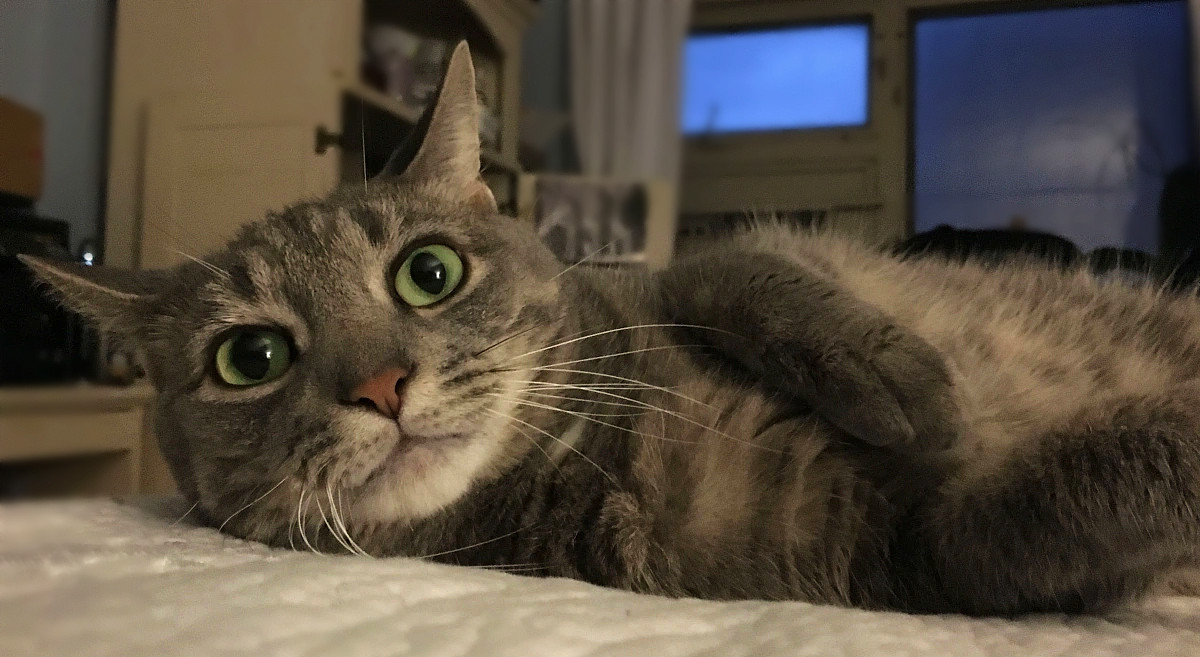
A cat showing its belly is a sign of trust. It’s a vulnerable position for a cat, and not an invitation for belly rubs. Credit: Wikimedia Commons
Every cat is different, but generally the best way to make sure your kitty doesn’t want to approach you is to ignore her personal boundaries and treat her like a stuffed animal.
Those “cute” videos you see on TikTok of terminally online people spinning their cats to Taylor Swift songs, holding them like phones to reenact scenes from The Princess Diaries, or forcing them to wear ridiculous outfits?
Don’t do that. It destroys your cat’s trust in you, and the cheap dopamine hit you get from strangers “liking” your content isn’t worth stressing your furry pal out and damaging your relationship.
Don’t do this. It’s not funny, the meme is lame and you’ll teach your cat to fear you. Credit: TikTok
If you tend to restrict your cat and hold her in your lap, you’re discouraging her from sitting there in the future. If you give kitty unnecessary baths, you could create a situation in which your cat fears you.
Even if you think you’re not doing anything wrong, if your cat is reluctant to approach you, there’s something that needs fixing, and it’ll require patience.
Don’t subject your cat to forced petting sessions.
Unlike dogs, cats have a limited tolerance for physical affection, and they don’t always want to be touched.
Your pal will be much more likely to regularly approach you for physical affection if you let him come to you. Ignore the impulse to reach out and start petting him like you would a dog. Instead, put your hand out and let your cat initiate the petting. You’ll develop a physical shorthand in which he signals he wants chin scratches or head rubs by leaning in and rubbing his face against your outstretched hand.
All felines have scent glands in their cheeks, and the initial contact of a cat rubbing his cheek against your fingers is an olfactory signal that says “This human is my family. I like this human.”
Even though our noses can’t detect those pheromones, they’re still important to our cat(s), and they’re the reason why cats will scent-mark objects by brushing past them in your home, just like tigers will mark their territories by scent-marking trees with urine. Same concept, but thankfully our miniature house tigers generally don’t feel the need to do the latter. (If yours does, take him to the vet. If he’s not “fixed,” get it done ASAP.)
Less is more when it comes to petting
Stop me if you’ve heard this one before: “I just don’t get it! I was petting my cat and she was purring and loving it, then without warning she bit me!”
Pro tip: A bite like that never comes without warning, it’s just that most of us don’t see the signs right in front of us.
Cats communicate by tail and whisker, and we communicate by making noises with our mouths. Adult cats don’t meow to each other. The little ones are smart enough to understand how we exchange information, so meows, trills, chirps and grunts are their way of trying to speak our language, to communicate on our terms.
But sometimes — like, say, when they’re purring and relaxed — they’re distracted and forget to meow, or they meow and we ignore them.
That’s when they bite, or swipe at us with their paws.
If you pay attention to non-verbal cues, you’ll notice your cat getting overstimulated when her tail starts swishing and her pupils dilate. If those signs aren’t enough, there are others: twitching ears, shifting positions, moving away.
The best way to avoid misunderstandings is to give kitty a few head rubs and chin scratches, then stop. If she wants more, she will let you know. If she doesn’t, she’ll be content to remain on your lap or by your side, knowing you’re not going to keep going indefinitely.
No harm, no foul, no bite.
This cat is not enjoying selfie time with her human. Credit: imgur via Reddit
Don’t take your bad day out on your cat
Remember when you were a kid and your mom or dad came home from a bad day at work with a storm cloud hanging over their head? Maybe they snapped at you for apparently no reason, or made family dinner miserable with fraught silence. Maybe they unfairly got on your case about something minor.
Either way, the tension in the house was palpable because, as kids, your parents controlled your lives and you were dependent on them for everything.
That’s what it’s like for our pets. Whether we call ourselves “fur mommies” and “cat daddies” or not, the fact is that the pet-human dynamic absolutely shares some elements with the parent-child relationship.
Our pets are utterly dependent on us, they’re subject to our moods, and they’re deeply attuned to our emotions.
As a result, how we’re feeling has a big impact on them, for better and worse. Unlike children, who at least have some concept of redirected frustration, cats and dogs have no idea why we have bad moods and no way to insulate themselves from the consequences.
We’re all human and we all get frustrated with our feline friends at some point. If you’ve been sitting in traffic for three hours and come home to find Socks pooped all over the rug or threw up on your comforter, frustration is a natural response.
But for the sake of the innocent little ones we share our homes with, it’s up to us to be mindful of our moods and do our best not to let external factors impact how we treat our pets. Things as seemingly small as our tone of voice can have a major impact on their emotions.
A cat chowing down. Credit: Wikimedia Commons
Don’t feed them crap
This has been covered exhaustively elsewhere, so we’ll direct you to catinfo.org if you have in-depth questions about feline nutrition.
In general, wet food should make up the majority of your cat’s diet. Cats don’t have a high thirst drive and they’ve evolved to get most of their hydration from meat, so a cat who eats mostly — or only — dry food is in danger of developing serious health problems.
Aside from that, more expensive doesn’t always mean better, and the important thing is that your cat’s food has real meat as the top ingredient. If the primary ingredient is a filler like corn or grain, or poultry/beef byproducts, steer clear and find a better alternative.
Feeding quality food means kitty will be happier, healthier, less prone to health complications and more active.
Keep things interesting
You don’t have to spend a lot of money on toys, and everyone who’s ever lived with a feline knows the fluffy little guys are just as likely to take a shine to a new box or the little plastic ring from a milk bottle as they are to the $10 new toy you bought from the pet store.
That said, there are certain toys that are almost universally beloved by felinekind, and the more you keep things interesting for your cat, the happier your furry overlord will be.
You can never go wrong with wands for interactive play. Keep it simple and manipulate the toy at the end of the wand like prey so your house panther can feel like a mighty hunter. Track toys with balls that cats can bat around are good for relatively quiet solo play. Cat tunnels are great too, especially if you toss treats inside them for kitty to find randomly.
A cat playing with a toy mouse. Credit: Wikimedia Commons
You don’t need a special occasion to surprise your little buddy with a catnip and play session, and you’d be surprised how enthralled felines can be by “cat TV” on Youtube. There are dozens of channels that provide hours-long videos of birds eating seeds from outdoor feeders, aquariums filled with interesting fish, and critters like squirrels and rodents.
You can also engage your cat by training her to do simple things like come when called, sit on command high five you. Those “tricks” are very easy to teach and require no more than two or three practice sessions a day, maximum 10 minutes each. Your cat will love it, especially with rewards for learning, and it’s fun to show skeptics that, yes, cats can do tricks just like dogs.
Sometimes “fun” is just something unusual, something your cat rarely gets to do or see. On occasion, I let Buddy walk up and down the hallway with me in my apartment building late at night when chances are low we’ll encounter anyone.
Elevators: products of foul sorcery that swallow humans and sometimes spit out Korean rappers.
He loves to stop at each door, listen and take in the strange sounds and scents. If anyone emerges from one of the doors or the elevator opens, he just makes haste back to our apartment, where I leave the door slightly ajar for that reason. As for the elevator, he seems to think it’s some sort of product of foul sorcery — it rumbles, the doors open by themselves, and when people walk in, they don’t walk out. Sometimes they enter only to emerge as a different person a few minutes later!
I’m happy to indulge his paranoia with regard to the elevator, because it means I don’t have to worry about curiosity getting the better of him.
If you’ve got rooms your cat doesn’t normally have access to, a yard with cat-proof fencing, or an activity you only do sometimes, consider breaking up your cat’s day with a little exploration or some ‘nip-fueled fun.
“Extremely accurate portrait of the Buddies” commissioned by Buddy the Cat in 2024.
Treat your cat as a friend
Your cat may not have legal personhood, but he is a fully sentient being who feels emotions just as strongly as people do. Cats experience the full range of primary and secondary emotions, but not tertiary emotions. That means kitty can feel happy, sad, excited, anxious, jealous, bored, depressed and overjoyed, but she’s not going to be embarrassed if another cat’s wearing the same collar or fret over whether people and other cats like her.
The important thing is remembering cats have feelings.
It’s not rocket science, and it doesn’t cost us anything to treat our cats with respect, patience and love. Bonding with a cat requires more than just feeding, watering and scooping, but the effort is always worth it and you’ll have a loyal friend for life. Good luck!
Top image of incredibly sexy beast (Buddy) copyright Pain In The Bud.
When the abandoned garage she was sheltering in caught fire on a cold day in 1996, Scarlett the cat was determined to get all five of her babies to safety.
The night of March 30, 1996, was unseasonably cold, and as temperatures dipped below freezing, a young cat and her litter of five found shelter in an abandoned garage in Brooklyn.
Unfortunately for them a few humans had the same idea, huddling for warmth in the garage as they smoked crack.
Prodigy’s “Firestarter” was at the top of the charts at the time, an apt soundtrack for what would happen next — the crack-addled humans started a fire that spread quickly and took the young feline mother by surprise.
That momma, who would later be named Scarlett, scooped up one of her kittens and brought it to safety before immediately heading for the flames again.
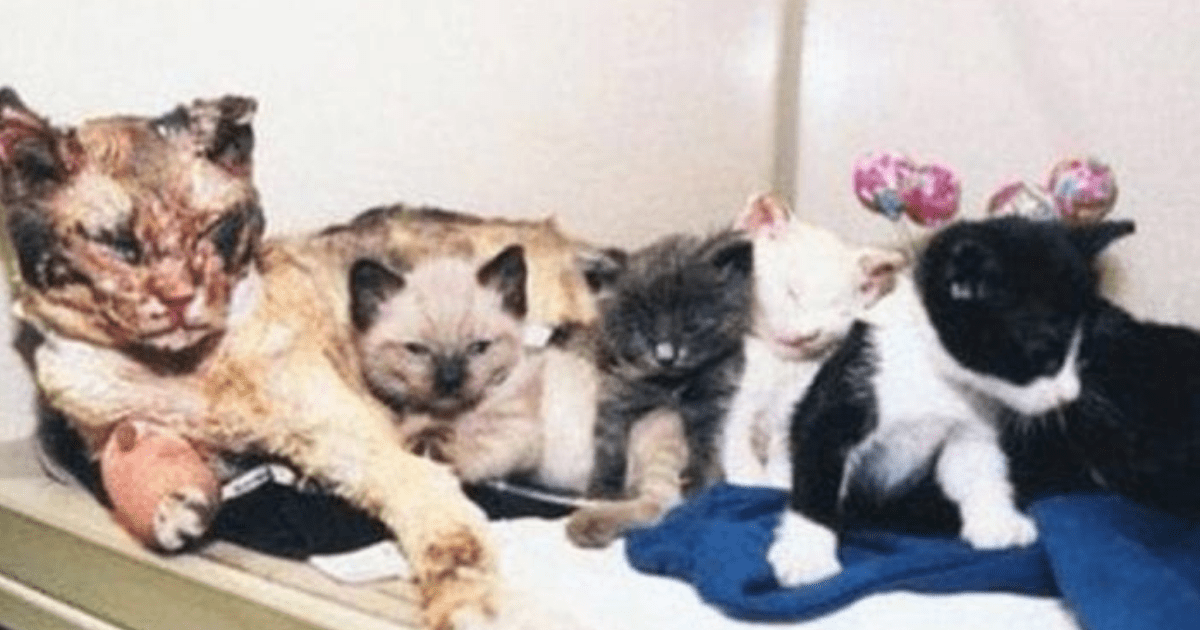
Scarlett, badly burned and bandaged, with her kittens at the North Shore Animal League. Credit: North Shore Animal League
FDNY firefighter David Giannelli was among the first responders at the engulfed garage and realized the small calico was rescuing her babies, running back into the flames to carry them out one by one.
When Scarlett had retrieved the last kitten, Giannelli watched her as she nuzzled all five of them to count them because she could no longer see — her eyes were sealed with burns and blisters.
Satisfied that her kittens were out of harm’s way, Scarlett collapsed.
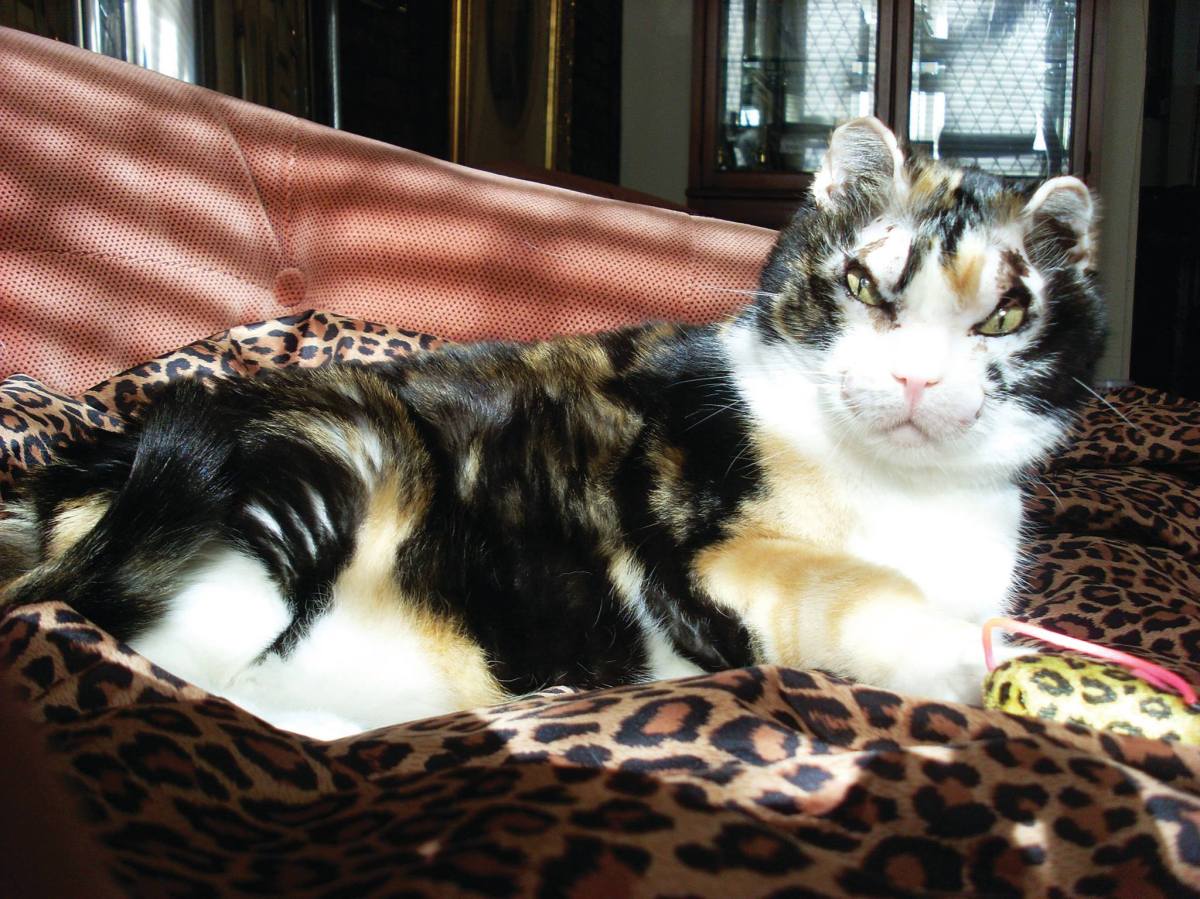
She paid a heavy toll for her actions. Her whiskers and the fur on her face was singed off, her ears were disfigured and she nearly died from smoke inhalation.
Giannelli brought the unconscious cat and her babies to New York’s North Shore Animal League, where veterinarians saved her life and put her on a path to recovery while also housing her with her beloved kittens.
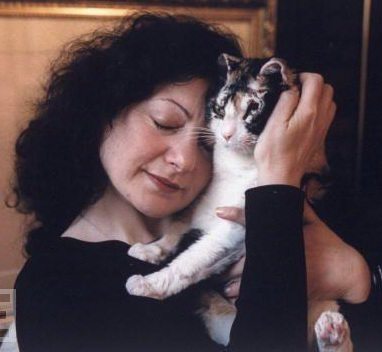
Four of Scarlett’s kittens survived and were adopted out in pairs. Scarlett herself was adopted by New Yorker Karen Wellen, who was chosen out of thousands of applicants who wrote to the shelter. Wellen, who had suffered a medical emergency of her own, was specifically looking to adopt a special needs cat.
Scarlett’s kittens went to nearby families, who kept in touch with Wellen and scheduled reunions between her and the kittens she risked her life for.
“This cat is definitely the queen of the house,” Wellen told a TV news crew during a segment about Scarlett in the late 90s. “Whatever she wants is hers.”
Scarlett was a house cat for the rest of her life, living comfortably until she passed away on Oct. 11, 2008, at 13 years old.
Wellen with Scarlett.
Little Scarlett’s story is not only an example of extraordinary bravery, it’s testament to how much mother cats love their kittens and should give us pause before we separate mothers from their babies too early. The absolute minimum is eight weeks, but many shelters will only allow kittens to go home with adopters at 12 weeks old or older, which they say gives them enough time with their mothers and siblings to learn crucial social skills, like sharing, not playing too rough, and proper self-grooming.
In recent years, many shelters and rescues have enacted policies of requiring that kittens are adopted in pairs. Even when they’ve got loving homes with humans who dote on them and provide them with plenty of attention, having another kitten around to grow with and learn from has a huge positive effect on a young cat’s development.
Buddy’s my first cat, as regular readers of PITB know, and if I could do it all over again, I’d have adopted one of his litter mates too. And who knows? Maybe in the future we’ll learn that keeping feline families together is optimal. Scarlett is testament to the fact that mother cats will sacrifice their own lives to save their babies. If that’s not love, what is?
Guitarists, synth players and other musicians can get their meow on with this unique FX pedal.
As a guitarist I’m partial to pedals, FX and other gear that can imbue the instrument with the funkiness of the wah or the satisfying crunch of harmonic distortion.
But this? This is something I never expected.
Meet The Meowdulator, an FX pedal that does precisely what it sounds like it does.
Created by B’s Music Shop and pedal-maker Cusack Music, the Meowdulator is a monophonic guitar synth, meaning it plays single “notes” similar to a Moog. That means you can’t strike a chord and get a chorus of discordant meows, but you can for example play a solo that sounds like a cat in heat — if you want to. (The “Little Mew” setting sounds like an octaver in meow, generating multiple voices, but still triggered by plucking single strings.)
Brian of B’s Music Shop called the pedal “maybe the craziest thing I’ve ever collabed on.”
“It’s glitchy sometimes, it’s its own animal,” he said in a video demonstrating the new pedal. “But it’s a little kitty cat and we hope it makes you happy and you have some fun with it.”
My favorite of the seven presets demoed in a Youtube video is “Acid Kitty Synth,” which generates a funky, wah-like meow. In the right hands, something awesome can be done with it. I can imagine Acid Kitty Synth breathing life into an Earth, Wind and Fire style or Televisor-esque track, compelling the listener to hit the rewind button while asking “Did I just hear what I think I heard?”
Finally, there’s a “hidden feature” — if you hold down the bottom-most button, the pedal will purr. Perhaps it’s something to work into the rhythm of a track or give the audience a relaxing vibe between songs while playing live?
The Meowdulator retails for $199 and is expected to ship in mid-July. Those of you who fall into the cat lover/guitarist venn diagram overlap can pre-order now.
Now can someone make a puma scream pedal? Ratatat, a New York duo and one of my favorites, has a thing for working the screams of the iconic cat into their tracks, and it makes me love them even more.






 Pain In The Bud