‘Why Are Cats Such A Medical Black Box?’ New York Times Columnist Asks

Veterinary science and research still focuses primarily on dogs, but scientists are trying to change that and help us better understand how to care for our little feline buddies.

“It’s just a cat.”

I’ve heard that so many times, and if you’re a cat lover, you probably have too.

It’s an insinuation that cats are throwaway animals, fungible pets who can be replaced by others of their species because, some people claim, they don’t express themselves as individuals, never really warm to humans in the first place, and besides, it’s not like they have emotions.

Countering those persistent myths is one of the reasons I write this blog. I still didn’t have a full appreciation for how singular and smart cats can be until I brought Buddy home. I never fathomed the depth of his emotions, the strength of his convictions or his willingness to make his opinions known about everything.

In some ways, I’m still shocked at how much he communicates and how well we understand each other.

However, one of my biggest fears is not doing right by him, especially missing signs of declining health as he gets older.

That’s the subject of a column today in the New York Times, in which science write Emily Anthes recalls the subtle signs that her cat, Olive, was sick, and the veterinarian’s assessment that she wasn’t just ill, she was on death’s door.

Credit: Pexels

Anthes points out that, to this day, veterinary training uses canines as the default, and treatments for cats are often just adapted from treatments for dogs, even if there’s no data suggesting those methods actually work for feline patients.

“My anatomy book was ‘Anatomy of the Dog,’” Maggie Placer, veterinary science programs manager at EveryCat Health Foundation, told the Times. “We had PowerPoints and supplements for the cats.”

The differences go beyond body plan, organs and behavior: drugs that work for dogs can be ineffective or dangerous for cats. Treatments otherwise regarded as effective in other animals could be harmful to felines too.

“It’s not reasonable to assume that everything that works in a dog will work in a cat,” Bruce Kornreich, director of the Cornell Feline Health Center, told Anthes. “There’s a lot that we still need to learn.”

Credit: Pexels

The situation with feline veterinary science mirrors the gap in behavioral studies between cats and dogs.

Over the past decade, research teams in countries like the US and Japan have made efforts to close the gap by recognizing that studies must be crafted to feline points of view, and that laboratories are not suitable places for studying the behavior of such notoriously territorial animals. Cats behave differently outside of their environments, rendering data useless if it’s captured in settings where kitties are stressed, unsure of themselves or even just miffed that they’re not at home enjoying a nap.

There are unique challenges when it comes to studying effective veterinary treatments in cats as well. Primary among them is feline stoicism, an evolutionary adaptation.

Simply put, cats will do everything they can to mask injury and sickness because they don’t want to become prey. Unfortunately that means by the time a cat cannot conceal an ailment anymore, the disease or injury has progressed. Even if a cat has lived indoors her entire life, the directive to disguise her pain is hardcoded into her DNA.

Anthes’ cat, Olive, didn’t make it. But her litter mate is chugging along, and to help advance the cause of understanding cat health, Anthes submitted both cats’ fur clippings to geneticist Dr. Elinor Karlsson’s Darwin’s Cats, a “non-profit community science project” that uses DNA submitted by cat owners to better understand our furry friends and unlock the secrets of their health and behavior.

Let’s hope that such projects spark a renaissance in studying cat health, like they have with research into feline behavior, so we can do right by our little buddies.
The Ashera Cat Scam: How One Man Invented A ‘Luxurious’ Breed And Cashed In

Although the original perpetrator of the scam was exposed, there are still opportunists selling “Ashera cats” to unsuspecting buyers who have their hearts set on hypoallergenic pets.

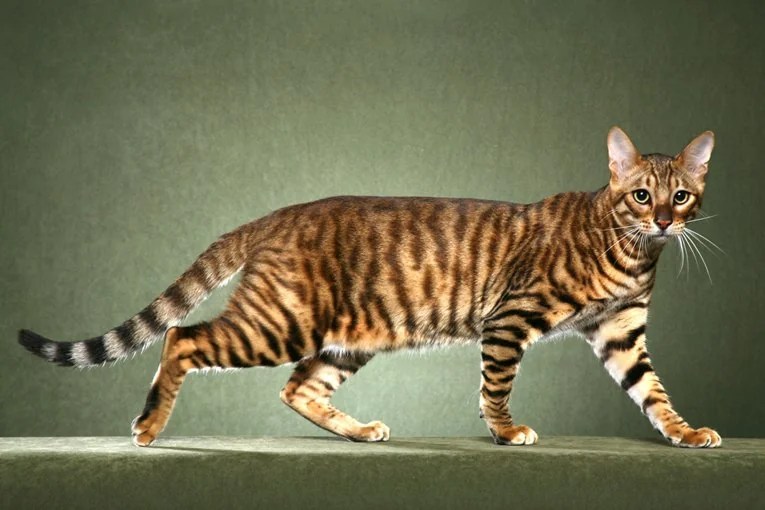
Pet site listicles name the Ashera cat as “luxurious,” one of the most expensive and rare breeds ever. Videos show surprisingly large, exotic-looking felines with leopard-like rosettes and a calm demeanor.

In media reports a man named Simon Brodie talks the breed up, presenting himself as the CEO of a biotechnology company that “developed” the Ashera through careful genetic manipulation, selecting only the most positive traits. For a few thousand dollars more, Brodie promises, they come in hypoallergenic versions too.

Brodie often sounded like he was describing the newest iteration of a tech product rather than a cat, calling the Ashera “a status symbol” and listing its optional features the way a car salesman talks about leather and heated seats.

“It’s exotic, but under the skin it’s a domestic house cat, very easy to take care of and extremely friendly,” he told Reuters. “Everybody has thought at one time, wouldn’t it be great to have a leopard at home, or a tiger? Obviously, you can’t and this is about the nearest thing to it.”

Brodie conjured images of engineers poring over genetic data and working with gene-editing equipment in a laboratory to create the perfect pet.

“Anybody can throw the ingredients in, but unless you know what ingredients are the best ingredients in the best percentages, you’re not going to produce the same final product,” Brodie told the U.K. wire service.

The problem? The Ashera doesn’t actually exist, and there’s no evidence Brodie has ever been in a lab, let alone spearheaded the creation of a new breed of feline.

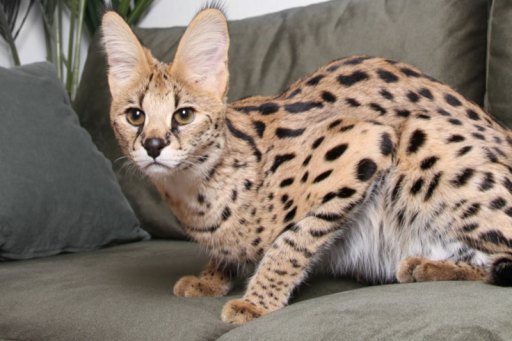
Not an Ashera cat
A Savannah cat with clear Serval lineage is shown as an example of an “Ashera cat” on several websites about the fictional breed.

Sadly, people might not realize that right away because of the publish-now, verify-never nature of web publications. Catster maintains a current page for the “breed,” citing its “outstanding lineage” and its supposed status as “one of the rarest and most expensive cats in the world,” potentially setting back its owners $100,000 or more per cat. You have to scroll down before the site warns about the “controversy and skepticism regarding the breed’s origins,” as if there’s still a debate whether the Ashera is a real breed.

Sites I’d rather not link to include the Ashera in their lists of “most exclusive” and “rare” breeds, and recent Reddit threads claim their price owes partly to their rarity because the company “only breeds about 100 cats a year.” When’s the last time you heard cats didn’t breed enough?

There are even “Ashera cat communities” designed to make it look like there are large online groups of happy owners, and Youtube channels featuring videos of Savannahs labeled as Asheras.

A sketchy operation

But dig a little deeper and you’ll find the truth. The Savannah Cat Association calls the Ashera a hoax, says the cats are Savannahs with fancy marketing, and details experiences people have allegedly had with Brodie. His company appeared to be a one-man operation with a voice mailbox, and people who purchased the pets said they were told to wire down payments to an account in the United Arab Emirates.

There are even claims Brodie was drop-shipping the cats, with customers saying they were delivered directly from an Oklahoma breeder of Savannahs.

And the people who saw an opportunity to have a pet cat despite severe allergies? They weren’t happy either, even those who negotiated deep “discounts” with Brodie.

“I don’t think any cat is worth $4,000,” a customer named Mike Sela told Columbia Journalism review, “but this seemed like a magical opportunity, especially with parents trying to get something for kids. You never thought you could get a cat and this is your chance.”

A group of angry customers who were promised hypoallergenic pets contacted ABC News, whose Lookout team enlisted the help of a biotechnology company to test cats purchased from Allerca, Brodie’s company. The tests showed the Ashera cats had the same amount of Fel d 1, the primary allergen in feline saliva, as the typical cat and could find no evidence of Brodie’s claims that he’d engineered an exotic cat sans allergens.

CJR took mainstream and legacy press outlets to task for reporting uncritically on Brodie’s claims despite the lack of any documentation, peer-review studies proving gene-edited hypoallergenic cats are possible, and for a complete lack of due diligence on the man himself. Per CJR:

“What Time, National Geographic, and other major outlets, including The New York Times, missed was that Brodie has no background in genetics—but he does have a well-recorded background in running scams. He was arrested in England, his native country, for selling shares in a non-existent hot-air balloon company. In the United States, he has left a wake of evictions, unpaid loans, and suits by unpaid employees. One judgment against him that stands out is by a company called Felix Pets, founded about a year before Allerca with the same goal of breeding hypoallergenic cats by eliminating the Fel-D-1 gene.”

Indeed, as the complaints piled up and Brodie’s deceptions began to catch up with him, the San Diego Union Tribune reported Allerca had been evicted from its “offices” — Brodie’s home address.

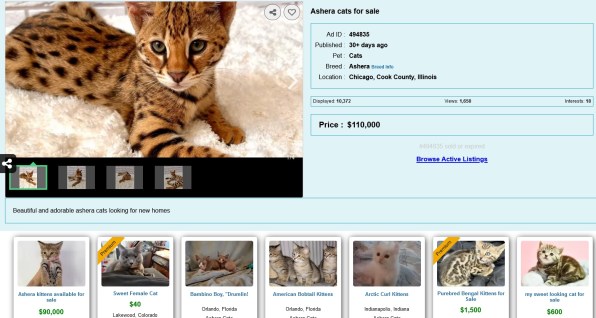
Ashera cats scam
A listing for an Ashera cat and a second listing for Ashera kittens, bottom left.

News stories say Brodie has changed his name numerous times and if he’s still out there, he’s almost certainly not Simon Brodie anymore. But the Ashera cat scam isn’t dead.

We found dozens of sites offering “Ashera kittens,” and online marketplaces for animals still have regularly-updated listings from people claiming they’re selling “genuine” Ashera cats in 2024. There’s also at least one group claiming they’re “officially licensed Ashera cat breeders,” touting a lofty “mission” not only of providing cats for people with allergies, but also “preserving exotic wildlife.”

The myth of hypoallergenic cats

Although there have been recent efforts to neutralize Fel d 1, they come from actual scientists who have published their work for peer review, or from public pet food companies that have paired with scientists to create kibble they claim reduces the Fel d 1 allergen in cats who eat it. They’re also focused on attacking the protein, not breeding or creating cats that lack it in the first place.

People with allergies should understand that despite what they may read online, hypoallergenic cats do not exist. No one has been able to “engineer” a feline without the Fel d 1 protein.

There’s serious debate among geneticists about whether trying it is ethical, as no one knows exactly what function Fel d 1 serves or what the potential consequences may be for editing it out of feline genetic code.

So if you’re looking for a “luxury cat” or you just want a cat that won’t trigger your allergies, beware before you’re separated from your hard-earned cash. As always, if something sounds too good to be true, it probably is.

Sunday Cats: Larry The Cat Celebrates 12 Years As De Facto UK Ruler, Cat Rescued From Rubble Won’t Leave Rescuer’s Side

Rescuers have saved hundreds of people and animals from the ruins of apartment buildings, houses, offices and shops after a massive earthquake hit Turkey and Syria.

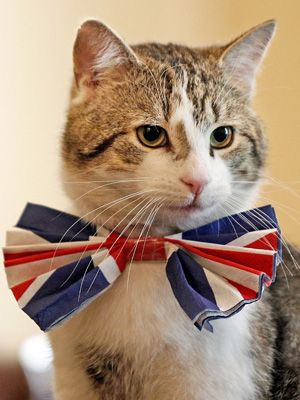
Prime ministers come and go, but Larry the Cat endures.

No. 10 Downing St. is the official office and residence of the prime minister. The building had a bit of a rodent problem in 2011, so former PM David Cameron’s staff adopted Larry from Battersea Dogs and Cats, a well-known rescue in the London area.

The shelter recommended Larry on the strength of his hunting skills, but at first it looked like his tenure as chief mouser at No. 10 might be as short as the prime ministers who serve him. Calls for his resignation grew louder as Larry was seen napping the days away while rodents still came and went with impunity.

Larry’s poor job performance reached the level of a scandal when the UK press reported the reason he was snoozing in daylight — he was sneaking off at night to visit his special lady friend, Maisie, who lives a few doors down at the residence of St. James Park’s keeper.

53d40c25d996d_-_larry-the-cat-151111-lrg
Ladies man, chief mouser and renaissance feline: Larry the Cat.

But Larry eased into his job, proved his worth as a hunter, and has even risen to the occasion by taking on tasks outside his job description. Most recently, he bravely defended No. 10 against a fox, chasing the canid intruder away.

With 12 years of service under his belt, Larry could easily retire. Battersea staff estimated the beloved mouser was at least two years old when he was adopted, putting him well into senior cat territory now. But like the late Queen Elizabeth II, Larry knows the British public needs some stability — and they’re not going to get it from their PMs, who shuffle through No. 10 as if it’s a hotel. Long live Larry!

A cat and his rescuer

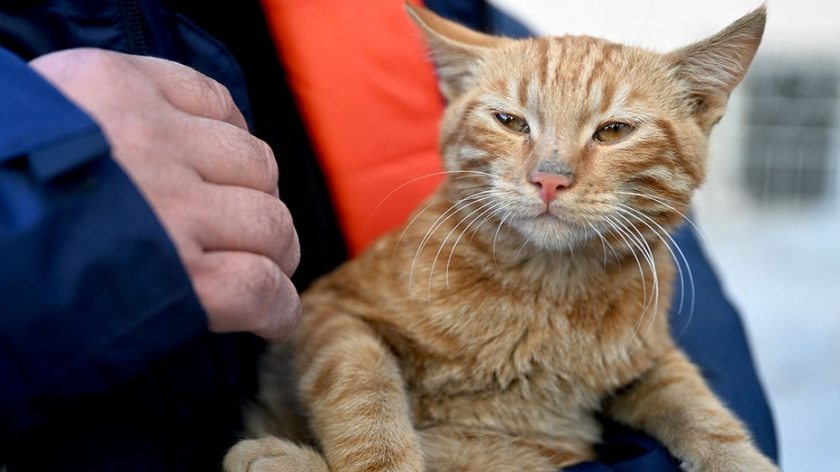
It’s been almost two weeks since a magnitude 7.8 earthquake slammed Turkey and Syria, and rescue efforts are now turning to recovery as hopes fade for anyone still trapped beneath the rubble.

A staggering 44,000 people are dead, and authorities say they expect that figure to rise as they add to the long list of people who are still unaccounted for.

Among the death and destruction, however, are signs of hope. There have been dramatic stories of people rescued after being trapped for as long as 280 hours, and social media is full of images of dusty cats and dogs being pulled out by rescue teams.

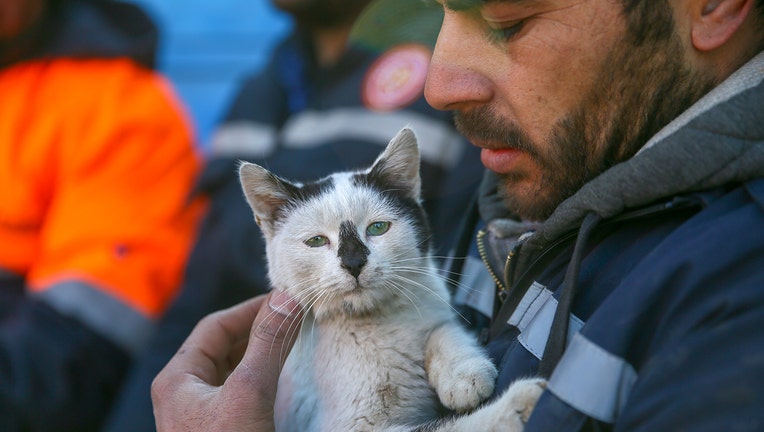
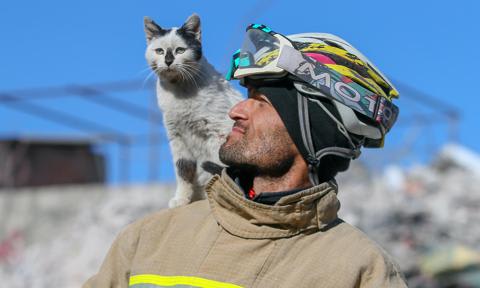
One of them is a handsome white cat with distinctive black markings on his face. The little guy was rescued by firefighter Ali Cakas after enduring nine days buried beneath the ruins of a building, and he’s refused to leave Cakas’s side ever since.

1156255-cat-turkey
Cakas and Enkas,Credit: Ali Cakas/Instagram

The firefighter from Mardin, Turkey, named the grateful cat Enkas, which translates to “wreckage” or “rubble.”

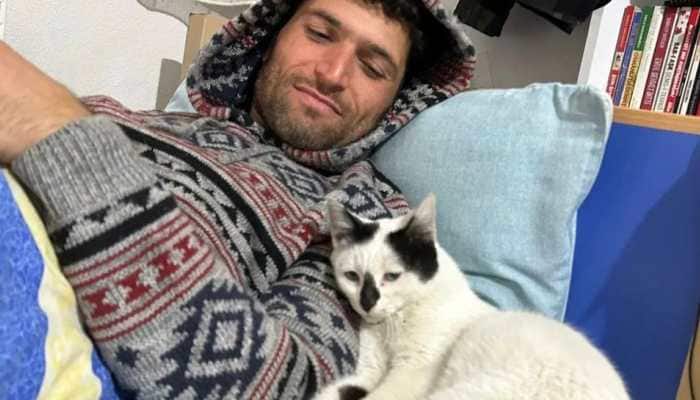
Enkas has become the unofficial mascot of the Mardin Fire Department, and photos of the ongoing rescue efforts this week showed Enkas perched on Cakas’ shoulder or snuggling up with him during breaks.

Cakas has adopted his new friend, and their friendship is testament to the fact that some good can come from even the worst circumstances.

rescue-cat
A cat rescued after days spent buried beneath the rubble.
quot-enkaz-quot-the-cat-won-39-t-leave-the-side-of-its-rescuers-in-quake-hit-gaziantep
Enkas and his human have become inseparable after the latter pulled the former from a collapsed building more than 200 hours after the quake.

Merry Christmas from Buddy!

Merry Christmas from the Buddies!

Buddy would like to wish all of PITB’s readers a Merry Christmas and happy holidays!

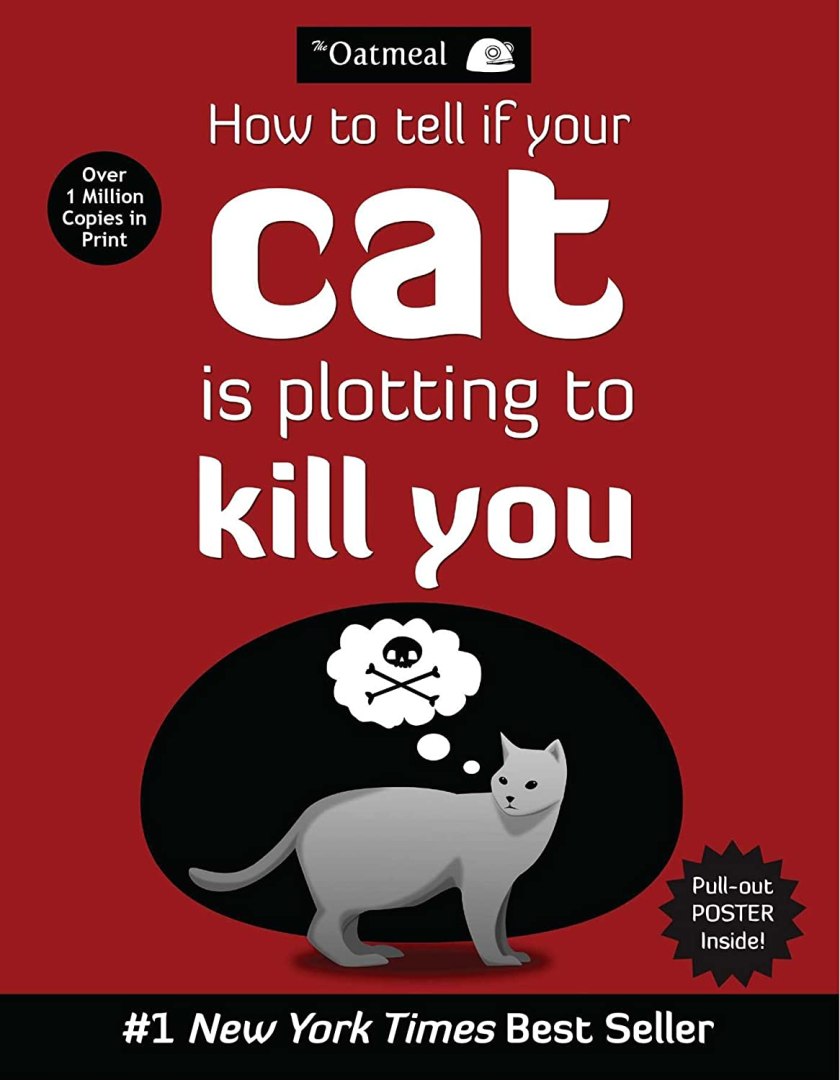
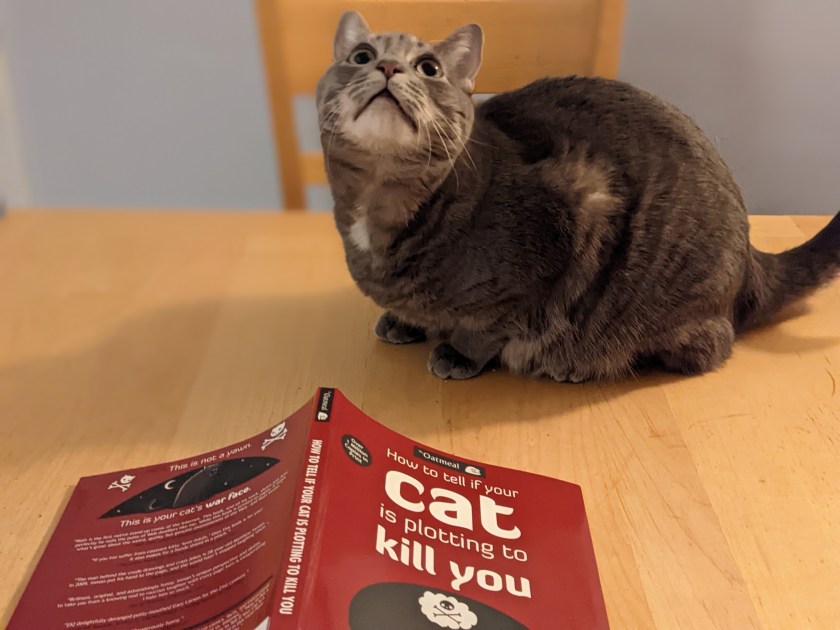
The Good Boy surprised me with a gift this year, which I unwrapped eagerly:

71-7V2e7VkL._AC_SL1500_

Buddy is such a good boy! And how thoughtful! He really is the best cat! Forget anything I ever said about him being annoying, picky or demanding.

He is a perfect little guy and any flaws I thought I saw in him were obviously my flaws projected onto him. I see that now. When he shrieks at me for breakfast while I’m asleep, the fault is mine for not anticipating his hunger and not getting up to feed him.

I mentioned how handsome and charming he is, right? Please don’t kill me!

I am very lucky to be Buddy’s human servant and vow to do a better job in all areas in 2022.

Merry Christmas, Big Bud!

Thank you!

Buddy and I would like to thank our readers, who indulge our absurd sense of humor and massage Buddy’s ego.

We’ve gotten lots of feedback, which we always appreciate, from our regular commenters as well as people who have reached out privately with kind words, requests, brutal criticisms and marriage proposals for Buddy.

We hope all of you have a wonderful Christmas and/or holiday celebration with your families, and that Santa brings you something awesome!

Love,

The Buddies

I Was A Good Boy On Halloween, Now Give Me Snacks!

Buddy agrees to dress up for Halloween in exchange for catnip and treats.

Bud won’t tolerate a costume and I wouldn’t make him wear one, but he’s cool with wearing a festive scarf courtesy of my mom, who insists she doesn’t like him but somehow ends up buying stuff for him.

The cool thing about having an unusually curious and friendly cat is that he dashes to the door like a dog whenever someone knocks. Halloween is no exception, and Bud has been helping me hand out candy since he was a kitten.

When trick or treaters come by, the little guy can’t wait to see who’s in the other side of the door. He sits on the threshold and just takes it all in — the new people, the funny costumes, the strange human ritual that involves helping children get an epic sugar high and upset stomach.

For Bud it’s a night of excitement without any anxiety since no one’s actually stepping into his territory. They all keep a respectful distance, like supplicants with an audience before a powerful but benevolent king, and in turn the king allows his servant to reward their fealty with gifts of candy.

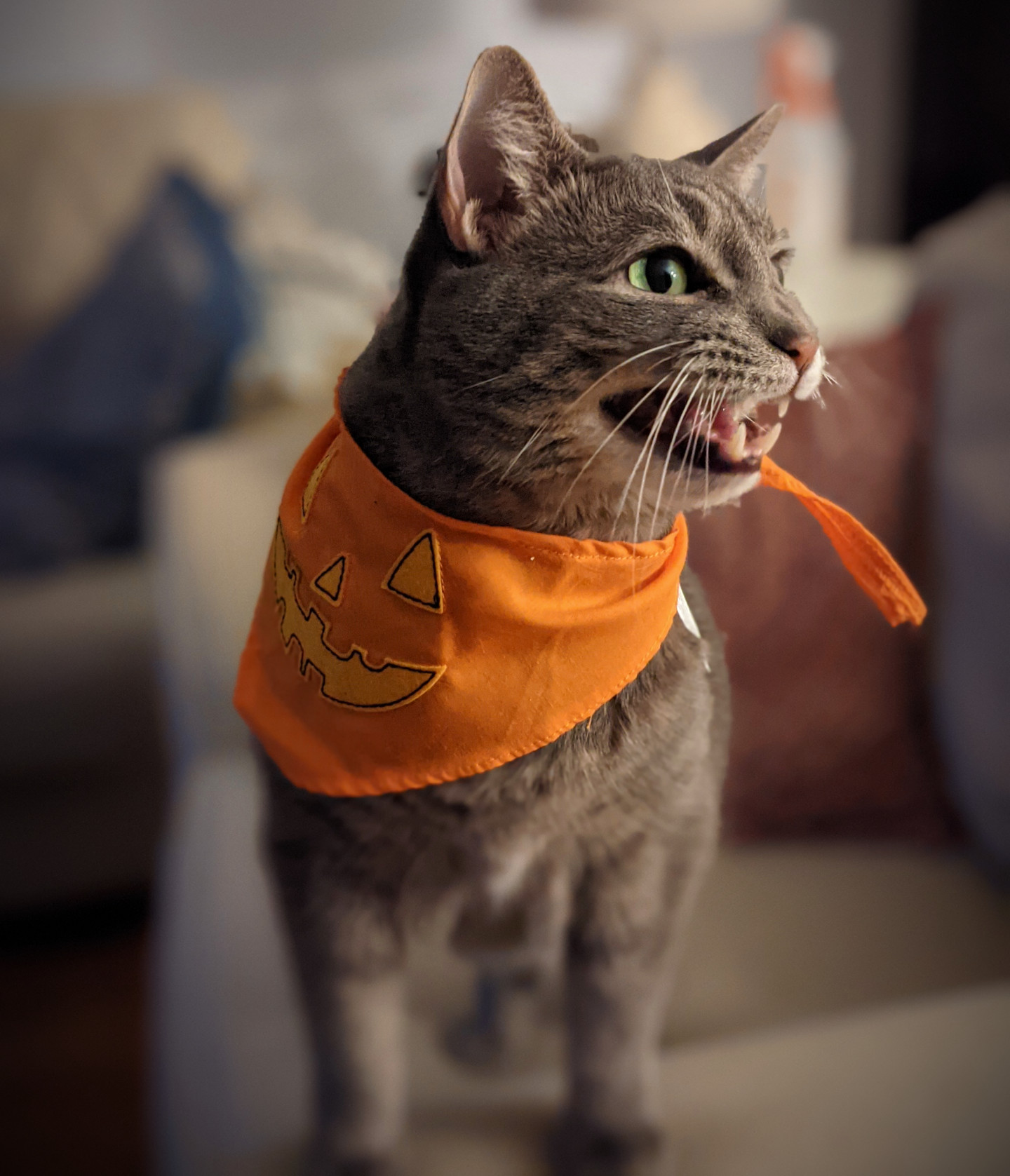
Bud on Halloween
“Let’s just get this over with, human. Remember, you said I could have catnip AND extra yums if I wear this infernal scarf!”

Sadly Halloween was a dud this year even more than last year, which was our first pandemic All Hallow’s Eve. Living in an apartment building, especially on the first floor, usually means a steady stream of kids, but this year I had maybe six or seven knocks on the door, and the kids were trick or treating in ones and twos. (All kids are chaperoned by parents these days too. It makes me wonder how my brother and I — and our friends — survived as kids, going out into the big bad world ourselves to trick or treat!)

unrecognizable men in glowing halloween masks driving car at night
You’d think Halloween was Purge Night by how parents hover over their kids. Credit: Erik Mclean/Pexels.com