I’ve never watched The Princess Diaries, but apparently the movie features a scene in which Sandra Oh picks up the phone and says:
“Gupta. Mmm-hmmm. Mmm-hmm. Mmm-hmm. The Queen is coming.”
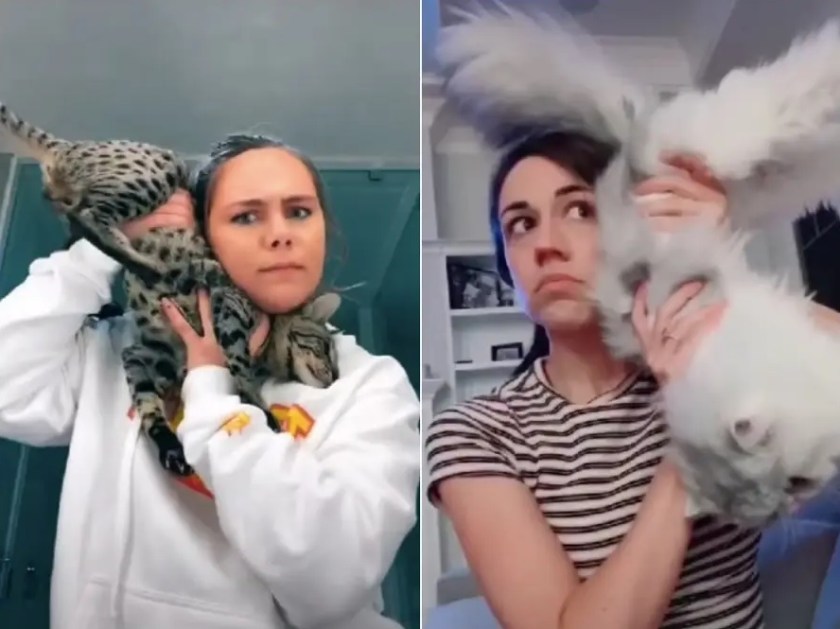
Why that’s worth replicating is beyond me, but apparently there’s a new trend among Tik Tokers to replicate the scene using cats in place of a phone, while holding the cats upside-down and promptly dumping them on the floor immediately afterward.
Why? Who the hell knows.
Above: Idiots reenacting a scene from The Princess Diaries using their cats as “phones.” The woman on the right is internet-famous Youtuber Colleen Ballinger.
You can see the bizarre cat-phoning Tik Toks here:
Say it with me now: “Cats are not toys. Cats are not toys. Cats are not toys…”
Veterinarian Dr. Jessica May told Business Insider the obvious, which is that cats aren’t enjoying their forced participation in this meme:
“Many are handled roughly and their body language shows a negative response to having been picked up,” she said. “It is especially concerning to see some cats being held upside down — something that is not only very frightening for the animal but that also puts the pet at risk of head injury if dropped.”
May said she’s also concerned by the way the Tik-Tokers are dropping their cats immediately afterward with no concern for their well-being.
People reenacting the same scene using dogs aren’t manhandling them or just dropping them like a phone, noted Paula Stewart of the Animal Talent Agency.
“I can’t imagine many people holding a dog upside down,” said Stewart. “But I think that we need to realize that animals, cats and dogs are sentient beings. They’ve got emotions like us and we shouldn’t treat them badly.”
It should go without saying, but using Tik-Tok is a bad idea anyway unless you fancy China’s communist government gaining access to your personal information, which is exactly what people are providing by using the service.
Finally, if I was the kind of fool who thought this was funny and tried to reenact it, Buddy would tear my face off.
And you know what? He’d be perfectly right to do so. He’s a sentient animal, not a toy.
“Gupta. Mmm-hmm. Mmm-hmmm. The King is coming, and he’s going to tear your face apart for being a jackass.”
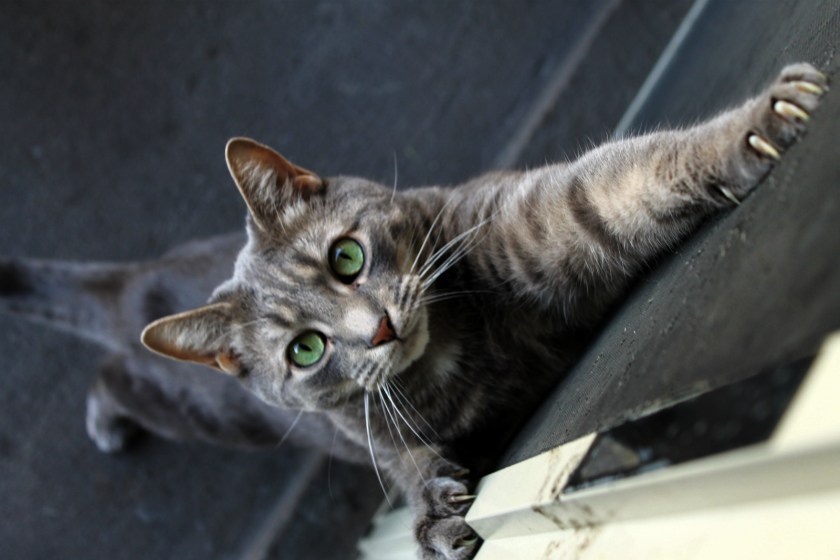
“You don’t want to tangle with these talons, bro.”
For anyone unfamiliar with Assassin’s Creed, it’s a series of games that imagine eras of history as digital theme parks filled with grand adventures, with the player as the hero in the middle of it all.
In Origins you’re an Egyptian warrior marauding through a landscape of pyramids, sphinxes, temples, crocodiles and lions. In Odyssey you’re a Spartan-born mercenary sailing the Aegean with Herodotus by your side and Aspasia as one of your BFFs.
These aren’t recreations of the ancient world so much as they’re simulacra of what people living in the 21st century think ancient Egypt and Greece looked, sounded and felt like.
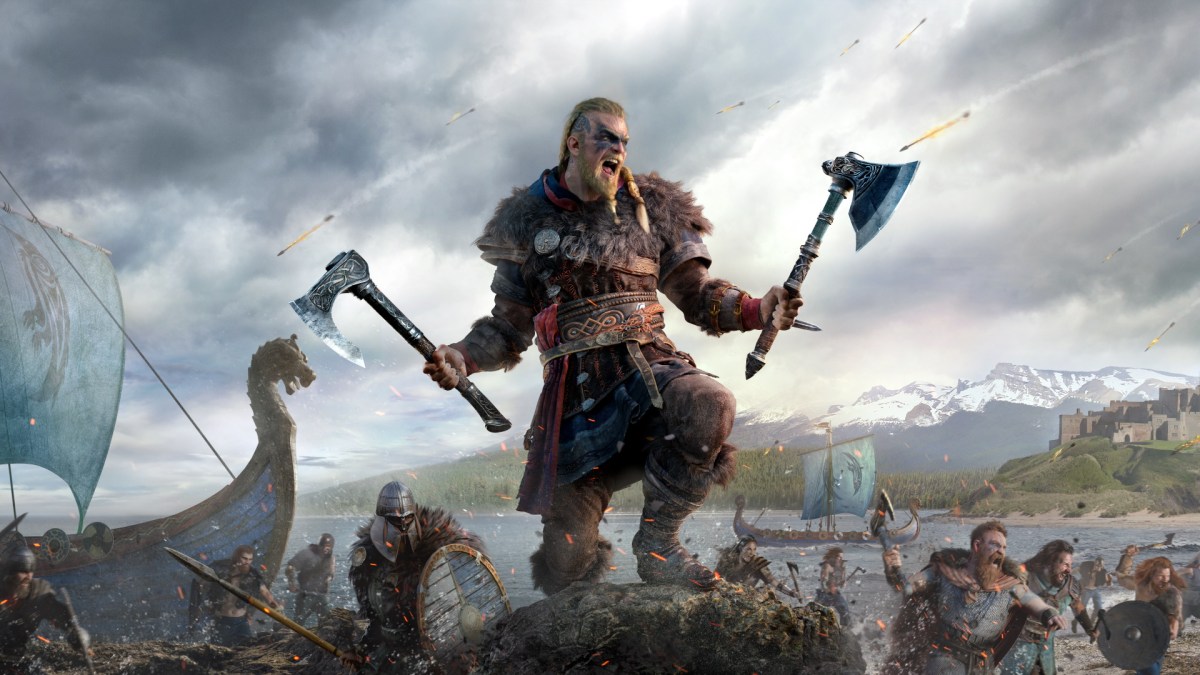
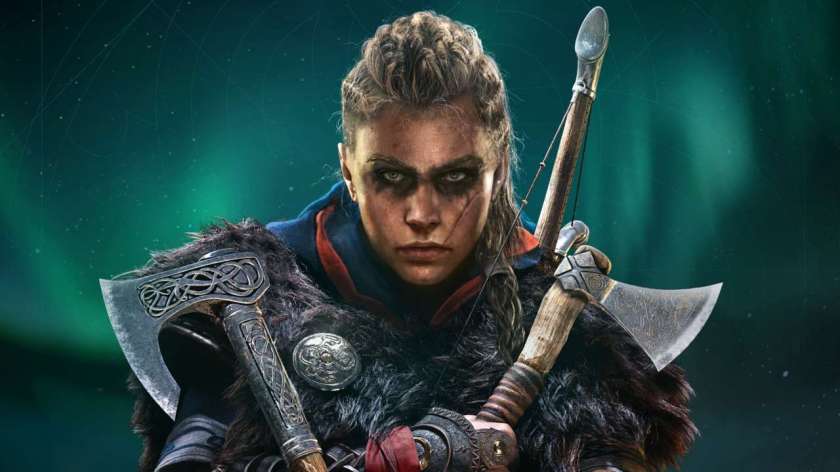
The latest installment, due to arrive in December, is Assassin’s Creed: Valhalla, which leans heavily on History Channel’s Vikings and Netflix’s The Last Kingdom for its visual style. The game covers the same territory as those shows as well, taking place during the Viking era when invaders from Norway, Denmark and Sweden relentlessly pillaged the Anglo-Saxon kingdoms of England.
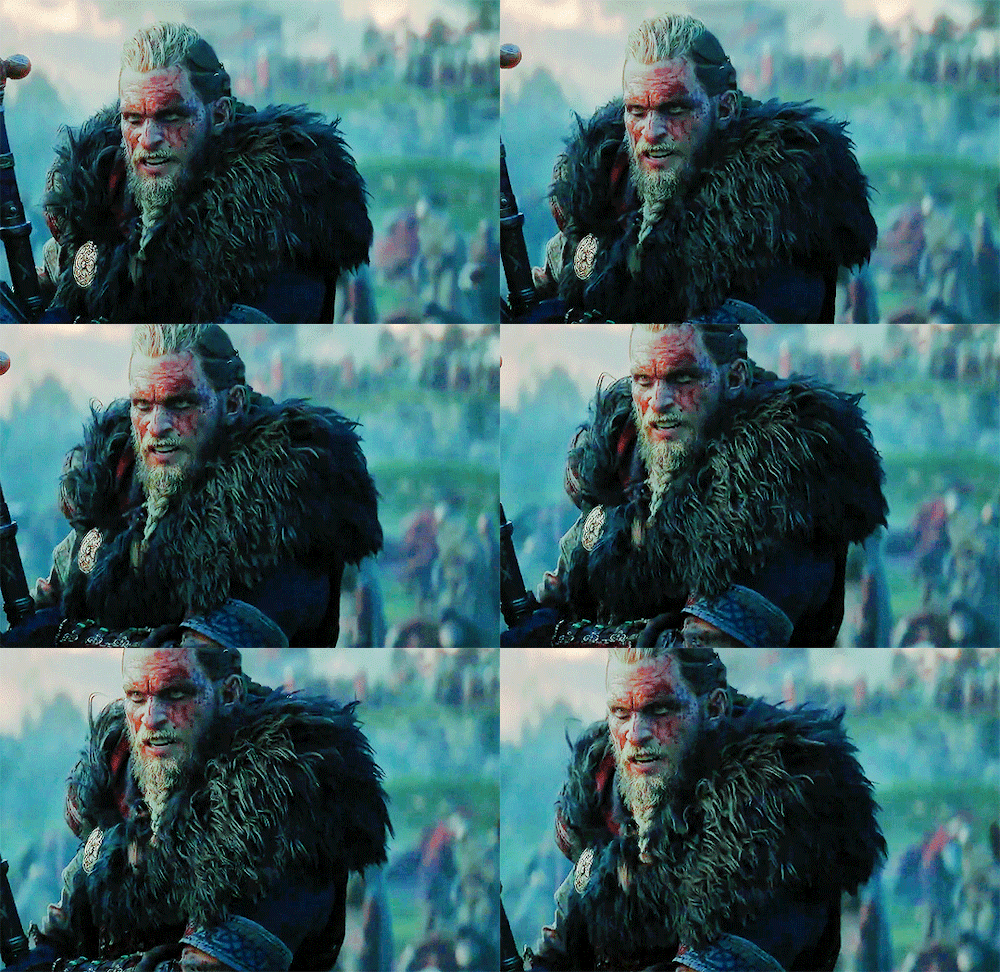
The male version of Evior, the player character.The female version of main character Evior.
The vikings were low-tech raiders — they didn’t have a real writing system, they left no enduring mark on architecture, their smithing techniques were inferior and their technological contributions to humanity were limited to shipbuilding and seafaring.
They raided the Anglo-Saxons, in short, because they wanted to loot shiny shit. Gold and silver chalices, precious gems, crucifixes, woodwork, iron weapons, anything of value worth hauling back to Scandinavia.
In Valhalla, players will assemble their own raiding parties, and apparently they can take cats. The video below shows the player character recruiting a “raider cat” for his longboat. There’s a short sidequest involved. From there, the cat accompanies the player and his vikings across the sea. Like a typical feline, the game’s cat likes to sleep and is usually found curled up in the front of the longboat, but don’t expect kitty to help out when the fighting starts:
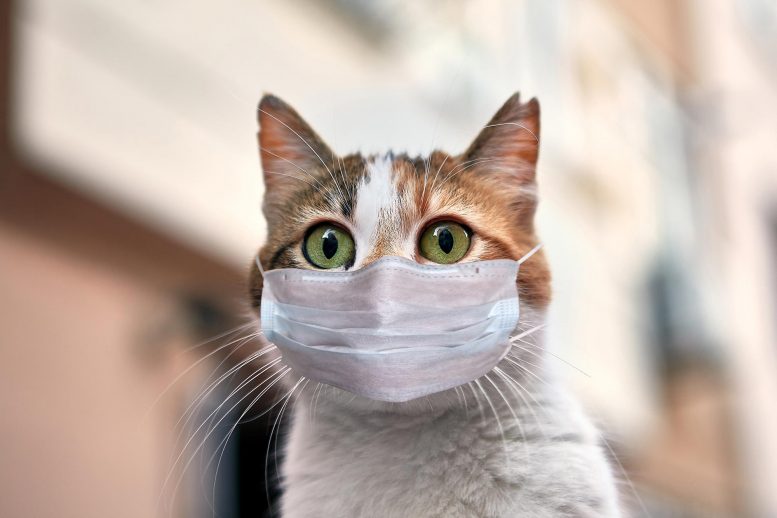
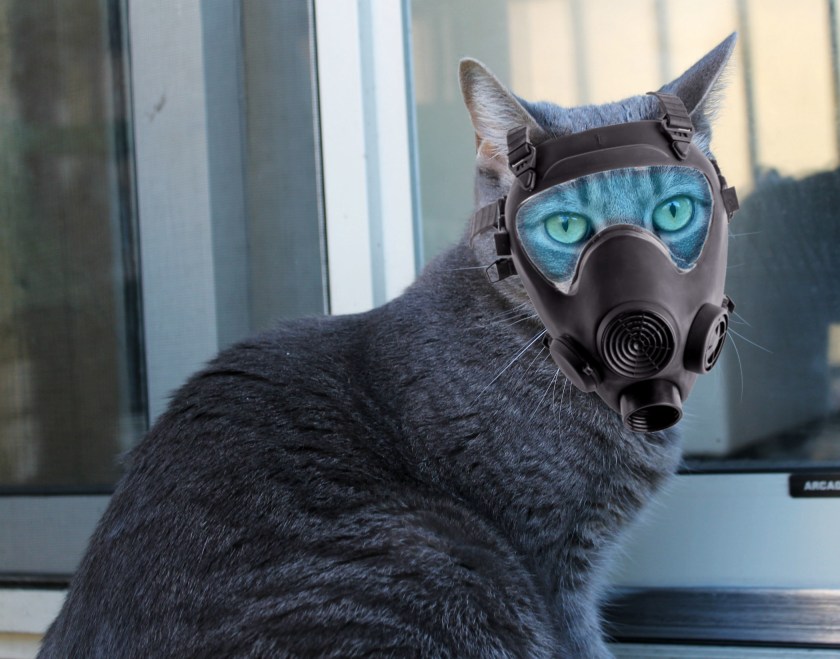
Because we never miss an opportunity to do spectacularly stupid things here in good old ‘Merica, we’ve politicized the act of wearing a mask, the simplest and most effective way to prevent the spread of the Coronavirus.
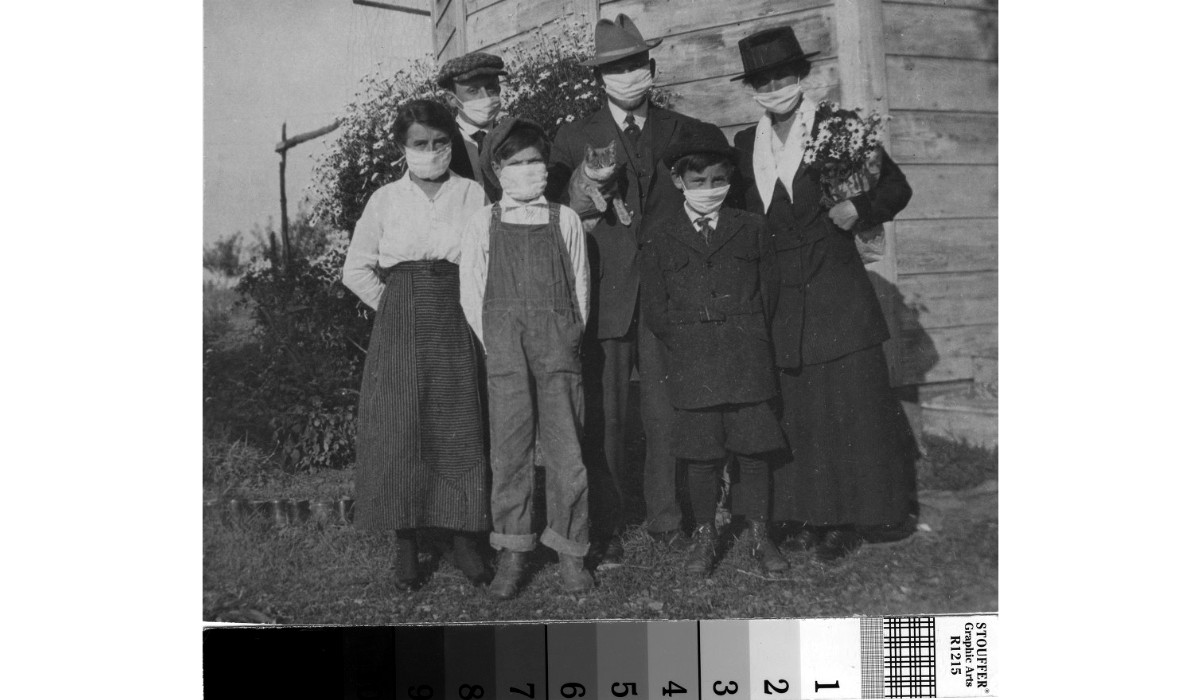
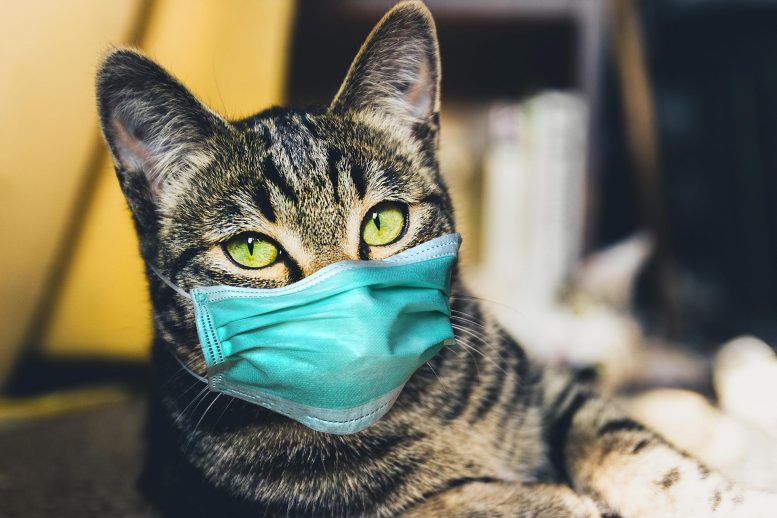
Since mask-wearing has become a meme as well, a historical photo that apparently shows a cat wearing a mask has been making the rounds. It shows a California family — mom, dad, two boys, two girls and a cat — standing together for a group photo, with each of them wearing a facial covering.
It’s become something of a go-to on social media, used in response to those who believe the virus is a hoax, a minor threat overblown by the US media, or an invention of evil Big Pharma who infected the world — while cackling evilly, presumably — in order to rake in enormous profits from selling the vaccine. (How “Big Pharma” is making billions off a vaccine that doesn’t exist is never explained by the conspiracy theorists.)
The photo was archived by the Dublin (CA) Heritage Park and Museum, and it’s dated from 1920, the third and last year the Spanish Flu spread to every corner of the globe. Between 50 and 100 million people lost their lives to that virus, historians estimate, and it wasn’t until several decades later that scientists understood what they were dealing with.
Snopes spoke to Tyler Phillips, who coordinates the archival material for the Dublin Heritage Park and Museum. Unfortunately, Phillips said, not much is known about the photograph other than that it was taken around 1920.
“The fun thing about this photo is that it does appear that even the cat is wearing a mask, but unfortunately we cannot prove that. The staff here at our museum go back and forth on that same question,” Phillips said. “My personal belief is that it is an optical illusion. I cant imagine any cat staying that calm with a tight fitting mask on their face. Also if you zoom in real close you can start to see the faint features of the cats face (nose and mouth). Since the original photo is pretty small and very old its not much easier to tell looking at it.”
So Snopes says the claim that the cat is wearing a mask is “unproven,” and Phillips thinks it’s an optical illusion.
We here at PITB think it’s a legit mask: We don’t see whiskers or even visual artifacts that would result from pixelated or blurred whiskers at the low resolution of the photo. In addition, it’s perfectly normal for a mask to follow the contours of a face, so that doesn’t rule out a mask. A coat pattern that happens to look exactly like a cloth mask, however, isn’t common.
Lastly, cats are individuals. Some will tolerate masks, some won’t. Buddy would probably try to claw me to death if I made him wear a mask, but your average Maine Coon would probably think, “Yeah whatever is cool, bro!”
One thing’s for sure, though: You won’t see any cats confusing the small inconvenience of wearing a mask with “tyranny” or “oppression,” and you won’t see Kitty Karens pulling the snowflake card in grocery stores, insisting the rules don’t apply to them. Those are uniquely human behaviors.
Bob the Street Cat represented hope, second chances and the unconditional love between humans and animals.
Back in 1 AB (that’s After Bud, for those of you who don’t use the Buddesian Calendar) my mom got me a copy of A Streetcat Named Bob, which told the story of a recovering heroin addict and the cat who literally walked into his life.
James Bowen was in a rehab program and was living for the first time in his own apartment when the injured but insistent orange tabby showed up at his door. Though dirt poor, Bowen scraped together enough money from busking — playing his guitar in public for tips — to bring Bob to the veterinarian and buy the basics he’d need to care for the cat.
After adjusting to life inside the apartment with James, Bob decided one day he’d accompany his human to work, which for James meant standing outside major metro hubs and hawking a magazine called The Big Issue. For our readers who aren’t familiar with the magazine, The Big Issue exclusively employs the homeless and the struggling as magazine vendors, offering them an opportunity for employment when they might not otherwise be able to secure it.
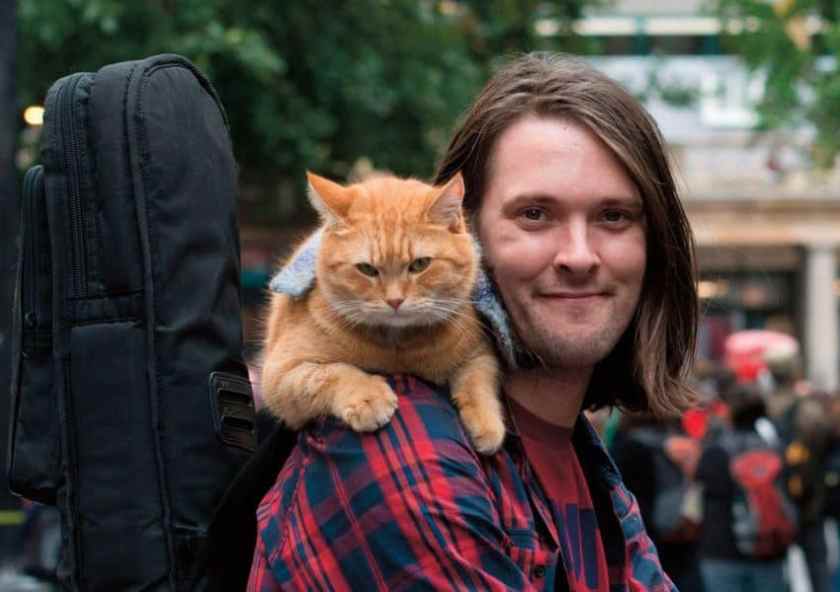
Bob turned out to be an unflappable cat, calmly riding on James’ shoulders as they took the bus to James’ assigned vendor location. Whether perched on James shoulder or standing next to him, Bob became a fixture by James’ side, handling the crowds and the interested passersby with a calm not usually associated with cats.
Bob riding the shoulder of his beloved human, James Bowen.
Soon word spread of the magazine salesman with “The Big Issue cat.” A local newspaper ran a story about James and Bob, then a few Youtubers visited the duo on the street, uploading videos of man and cat selling magazines and busking for extra money.
One of James and Bob’s biggest breaks came when Sir Paul McCartney heard their story and visited them in person as they were hawking magazines in London.
From there, as the Legend of Bob grew, a shrewd literary agent saw potential in the story of the recovering addict and the cat, and inked Bowen to a book deal. The rest is history: The book propelled James and his feline friend to stardom, leading to a handful of additional books, a cartoon and a 2016 movie about the duo.
“He taught me that I had to buckle up…because he was following me around and stuff like that, I had to take responsibility for him,” Bowen recalled in a 2016 interview. “I didn’t know it then, but the love that he was giving me was helping me to change my ways.”
For many people, the story of James and Bob represented not only the unconditional love between cat and human, but also hope and the promise of second chances in life.
Bud is no Bob — he’d run screaming at a book signing with hundreds lined up to greet him — and I’m no James, but my mom thought I’d enjoy the book because I was also going through a tough time when I adopted Buddy — though nothing as dramatic as James’ situation — and like James I found a measure of peace in taking care of my cat, which allowed me to look outward and gave me a responsibility that took my mind off my own problems.
Actor Luke Treadaway, left, who played James Bowen, right, in the movie based on Bowen’s book. Bob played himself!
After finishing the book I pulled up a few of the early videos of James and Bob on Youtube and, among the streetside interviews and other clips, I found a vid of James and Bob appearing on a British morning television show.
For the most part the interview went the way you’d expect those things to go: James and Bob were there to promote their book, James gave Bob a treat in exchange for a high-five, and the questions were rote.
All except one, when the male anchor turned to James and asked him if he’s thought about what he’ll do when Bob dies.
As his female co-anchor stared daggers at the man, James swallowed, hesitated, and said he doesn’t like to dwell on that thought, that he prefers to focus on the moment, being grateful for having Bob in his life and appreciating him.
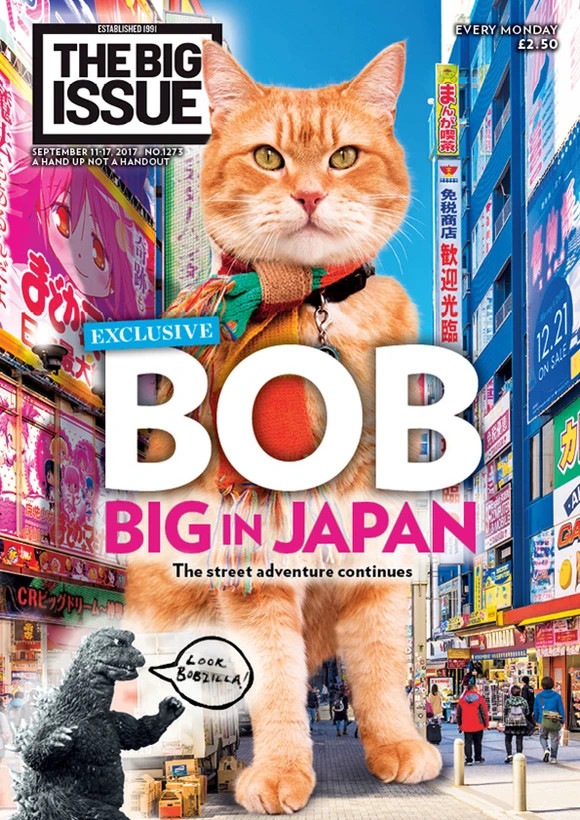
Bob became an international celebricat, with his book tour taking him and James to Japan and other countries.
At the time the eventuality of Bob’s death seemed remote. No one was sure how old Bob really was, but veterinarians estimated he was eight or nine years old.
Now, at age 14, Bob has passed away.
Bob’s fans are legion: They lined up in their hundreds and thousands for his book tours, they sent thousands of scarves as gifts to the orange tabby and they made him the most celebrated cat in the UK.
Now they’re flooding The Big Issue with condolences and letters about Bob, and we hope James takes comfort from the fact that his little buddy touched so many lives.
Bowen, understandably, is devastated.
“There’s never been a cat like him. And never will again,” he said. “I feel like the light has gone out in my life. I will never forget him.”
For the rest of us, it’s a reminder that our cats are only with us a short while, and that there will come a day when we wish they’re still around to annoy us by jumping on our keyboards or rousing us from sleep with urgent meows for breakfast.
Appreciate them. Love them. And pay attention to them, which is all they really want from us.
“I’m a damn cat!” Brimley said. “Beverly, can you believe I’m a cat?!”
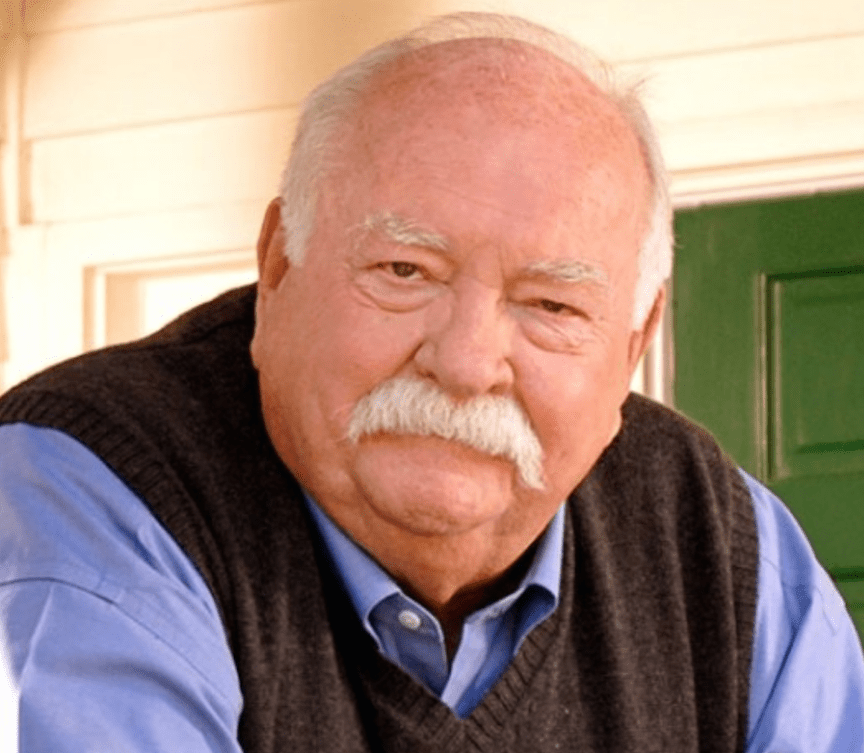
SALT LAKE CITY — American actor Wilford Brimley was reincarnated as a kitten this week, retaining his trademark mustache — and his beloved diabeetus — in his new feline form.
Brimley, who is known for appearing in films like 1982 classic The Thing, 80s sitcom Our House and decades of commercials raising awareness about diabeetus, said he went to bed Tuesday night feeling sick and fatigued.
“I thought I had that there Corona flu,” the 85-year-old American actor said. “I had me one of them dreams about heaven, where I met Jesus and we talked about diabeetus. Then when I woke up I went to reach for my glasses and realized, ‘Holy mackerel, I’ve got paws!‘”
(American actor Wilford Brimley in his human form, left, and as a kitten.)
Brimley, who is known to generations of Americans as a Quaker Oats spokesman, said he suddenly had an urge for raw meat.
“But that don’t sit well with my diabeetus,” he said. “So I went downstairs and I called to my wife Beverly, and I says ‘Beverly, I’m a kitten!’ And Beverly, she says ‘Wilford, is that you? Oh my stars, you still have your mustache!’”
Although it’s been years since Brimley’s days as a pitchman, the actor says he’ll return to TV — this time in commercials for Blue Buffalo canned food.
“Blue’s all natural ingredients will keep your cat healthy,” Brimley says in one of the new adverts, “whether she has diabeetus or not.”





 Pain In The Bud