Rita Vigovszky captures the essence of cats with her whimsical illustrations.
Rita Vigovszky knows cats.
The Budapest woman, who earns a living as an illustrator, often puts her own cat in her drawings to illustrate confounding and amusing feline behaviors, but she also draws various cats in silly and amusing situations.
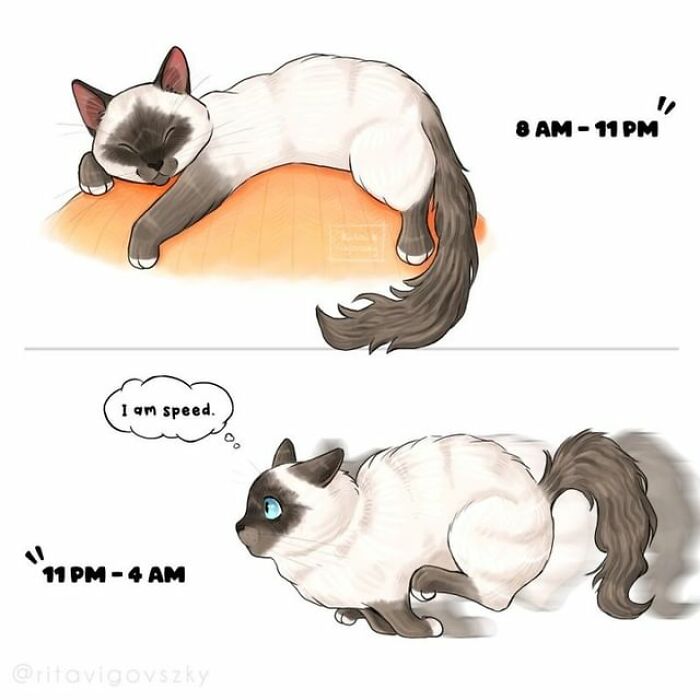
Who among us doesn’t sympathize with this? I can give Bud two vigorous play sessions with laser pointers and wand toys, and he’ll still reliably do this at night:
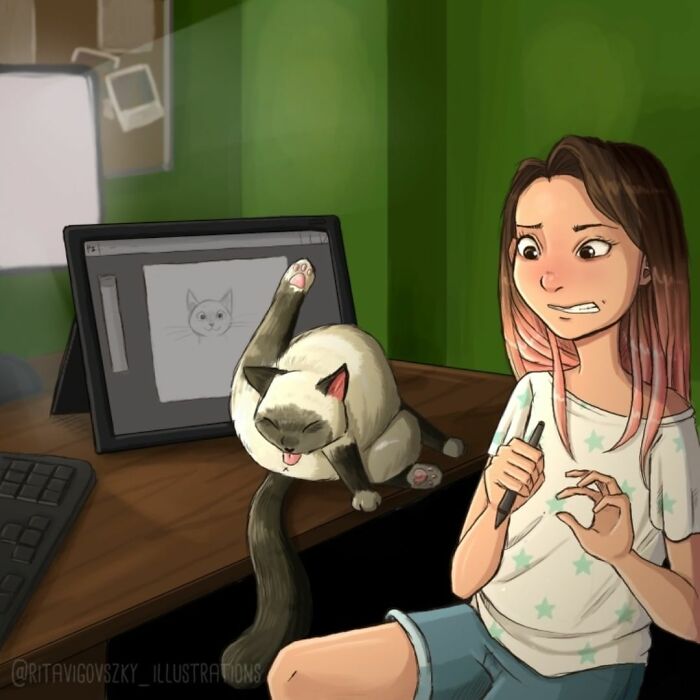
As George Carlin once said: “Cats don’t accept blame.” They also have no shame. At this point, probably every surface except the kitchen counters has been “groomed on.”
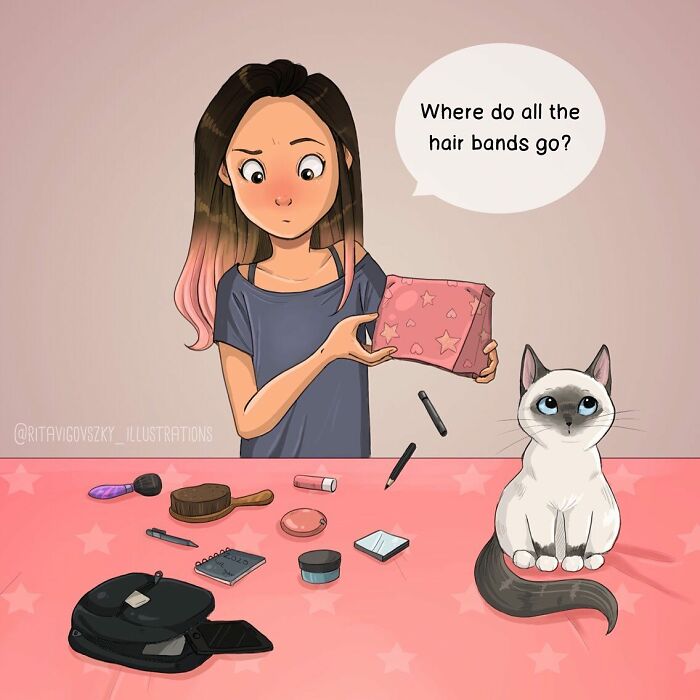
Prior to 2020, I would not have sympathized with this. Then the pandemic happened, barbershops in New York were closed for ages, I binged the entire run of Vikings during lockdown, and when I finally made it back to my barber, told him: “Give me that awesome Ragnar Lothbrok haircut!” So now I have a viking man bun (go ahead, laugh at me) with shaved sides and back, and Bud has many new hair band toys that tend to disappear under couches and in crevices:
Buddy finds success as a magician who makes all manner of delicious foods disappear.
NEW YORK — A thousand people are engaged in lively chatter inside the 42nd St. Illusionist Theatre when a tiny figure appears at the periphery of the stage and a hush falls over the crowd.
The lights dim and a drum roll echoes up from the orchestra pit.
“Is it him?” a man in the balcony asks.
“It’s him! It’s him!” a woman seated near the front answers, waving her handkerchief. “The Great Buddini!”
The crowd erupts into rapturous applause and the orchestra plays an excitingly mysterious tune as the Great Buddini pads across the stage, illuminated by a green spotlight.
“Thank you! Thank you!” the tuxedoed feline says, doffing his top hat. He touches a paw to his heart. “You’re too kind! Thank you!”
A whimsical melody drifts up from the pit and the Great Buddini produces a bag of Blue Buffalo Bursts from a pocket in his tuxedo. He presents it to the crowd, turns it over and tears it open theatrically.
“For my first trick, I’m going to make these Bursts disappear,” Buddini says, tossing the treats into the air and gobbling them all in quick succession.
The crowd loves it. Women clap, men stomp their feet and enthusiasts near the back whistle in appreciation.
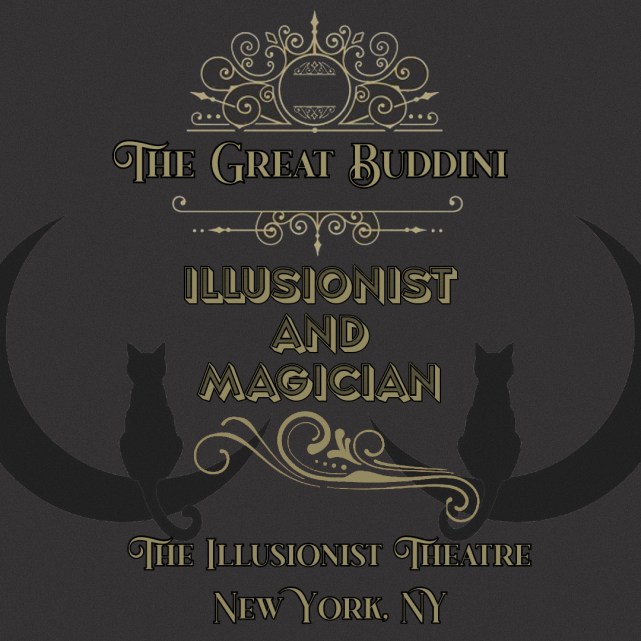
An advertisement for one of The Great Buddini’s shows.
“For my next trick,” Buddini says, “I’m going to make this entire turkey disappear!”
Two calicoes in bedazzled gowns emerge from behind the curtain, pushing a cart with a large turkey on top of it. They turn the cart 360 degrees, lift the black table cloth so the audience can see there are no hidden compartments, and stop just before the Great Buddini launches himself at the turkey and consumes it like an insane Pac Man, wolfing the entire bird down in less than eight seconds.
A drum roll begins anew, the Great Buddini turns, bows with a flourish and issues a massive belch that reverberates around the hall. Once again the theater shakes with the roaring approval of the crowd.
“He’s a genius!” a woman yells out later as Buddini, balanced on stilts, makes pieces of cheese vanish into his mouth. “He’s mad! He’s mad!”
The Great Buddini’s show, in which the famed magician makes 17 different kinds of food disappear, has been sold out for more than three weeks running since he arrived in New York.
A review in the New York Times called Buddini “an unrivaled master of sleight of paw” and noted kittens from as far away as Delaware were arriving in New York, hoping to apprentice for the master feline. The New York Evening News was equally flattering, writing that the Great Buddini “blurs the line between ho-hum magic and astonishing feats that border on the supernatural.”
Among the few negative reviews was a scathing piece in the New York Post, which chided enthusiasts for “falling for” Buddini’s “obviously mundane tricks.”
“He’s not ‘making the food disappear,’ he’s just eating it!” the Post’s critic seethed. “Am I going crazy? I can’t be the only one to notice this. People are paying to watch a chubby cat pig out on snacks on a stage. What has the world come to?”
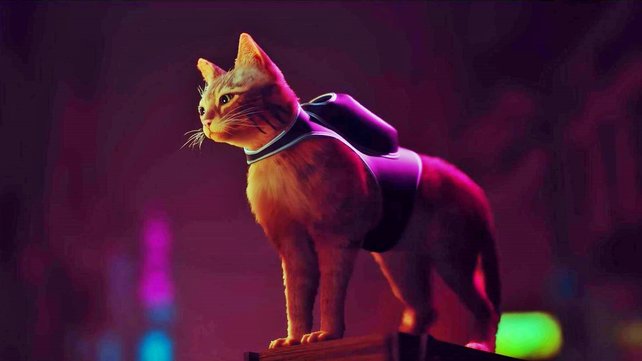
Stray puts players in the paws of a feline protagonist.
As a game that puts players in the paws of a feline protagonist, Stray is all about forgoing familiar video game tropes in favor of forcing players to think like a cat.
To do that, Stray’s developers spent a lot of time looking at vast amounts of reference material via the digital archive of feline images and videos known as the internet, and studying two of their co-workers — the office cats who play, lounge and provide inspiration for the development team.
“They are called Oscar and Jun,” producer Swann Martin-Raget wrote, “and even if they are not the most productive employees to be honest, they definitely add a lot of cheerful liveliness to the studio.”
Stray’s tight-knit team spent seven years bringing the heroic moggie and his world to life, and on July 19 players will finally get to explore the neon-drenched environs of a futuristic Hong Kong from a cat’s eye view.
Stray’s feline hero must navigate a future Hong Kong.
The developers worked hard to get the approval of Oscar and Jun, who could not be bribed with snacks.
“Seeing them interact with objects around the office (even sometimes shutting down our computers at the worst possible moment!) gave us quite a lot of inspiration for the various cat interactions that are possible throughout the game,” Martin-Raget wrote.
We’ve been following the development of Stray for a few years now at PITB and can’t wait to give it a spin. Check out the launch trailer here:
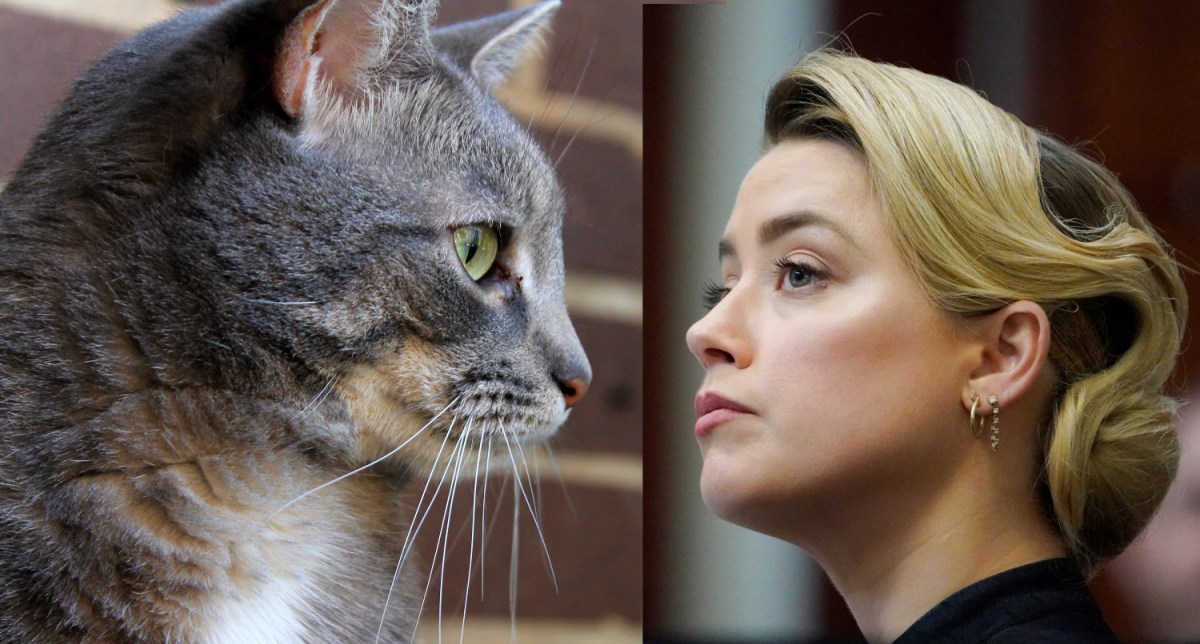
Denying the allegations against him, Buddy the Cat suggested a certain Aquaman actress was likely responsible.
NEW YORK — Buddy the Cat denied he had anything to do with an errant turd found approximately two feet from his litter box on Friday, instead blaming actress Amber Heard for the breach of poopiquette.
The stool in question, a roughly cylindrical piece consistent in color and texture with typical cat feces, was discovered at approximately 10:52 a.m.
“I am not the poopetrator,” a defiant Buddy said in a statement issued through his attorney. “It’s obvious that someone out there is hell bent on destroying my reputation as a good boy who always does his business in the box.”
The silver tabby’s lawyer, Johnny Clawchrane, told reporters he intends to prove his client could not have been responsible for the mystery stool. He said he would prove to the court that Buddy had an alibi, could not have produced the offending nugget, and has a long history establishing him as a consummate user of the litter box who never exits without meticulously burying his business.
“Buddy the Cat has a staunch record of being a very good boy and is personally offended at the suggestion that he could have been responsible,” Clawchrane said.
Instead, the high-powered attorney said, he intends to prove the offending party is none other than actress Amber Heard, who is currently embroiled in another lawsuit centered around the mysterious appearance of feces.
“Who was responsible? Let’s look at Occam’s Razor, folks,” Clawchrane said. “There is a very famous person whose modus pooperandi, such as it is, involves retaliatory defecation.”
Clawchrane pointed to testimony in the ongoing trial between actor Johnny Depp and Heard, his ex-wife. Depp and his house manager testified that Heard dropped anchor on the bed she shared with the Piratesof the Caribbean actor. Heard herself called it a “practical joke gone horribly wrong.”
“We will prove that Ms. Heard had the motivation and means to, uh, smear Buddy the Cat,” Clawchrane insisted. “Justice will be served!”
Heard’s attorney, Benjamin Rottenborn, said the accusation was “patently ridiculous.”
“My client doesn’t even know Buddy the Cat,” Rottenborn said. “Furthermore, just look at him. He looks like precisely the kind of scoundrel who would poop outside the litter box.”
Plus a Japanese artist’s stunningly real-looking bespoke cat backpacks.
A Reddit post with almost 30,000 upvotes claims a cat took it upon himself to learn sign language after realizing his human is deaf.
You don’t need me to tell you it’s nonsense, do you? It’s interesting how we’re willing to believe a cat can endeavor to learn sign language, but we — the supposedly more intelligent species — can’t be bothered to watch for emotions conveyed by the curl of a tail or a twitch of the whiskers.
Cats are incredibly smart little furballs, but just like the people who claim their cats are meaningfully communicating via talking boards with 100 buttons, this is just social media fodder for the credulous.
Unfortunately the credulous are numerous, although a few Redditors had a good time at their expense. One user complimented the addition of a VHS-like filter over the video clip, giving it a vintage quality.
“Not a filter. It’s been around for a while,” another Redditor responded. “The cat now knows ASL, English, French, Spanish, and is working on its doctoral thesis.”
A cat in a backpack? No, a cat backpack
In a reminder that the Japanese have an endless appetite for all things cat-related, the newest hot item among the Land of the Rising Sun’s neko-infatuated is a bespoke cat backpack hand-sewn by a housewife in Fukui prefecture.
The bags don’t come cheap. It takes Miho Katsumi between one and three months to make each one, and they’ll set you back about $1,000 each via Katsumi’s site. Check out her Instagram for more images.
How quickly do you think Bud would murder me if I came home with one of these in his image one day? 🙂