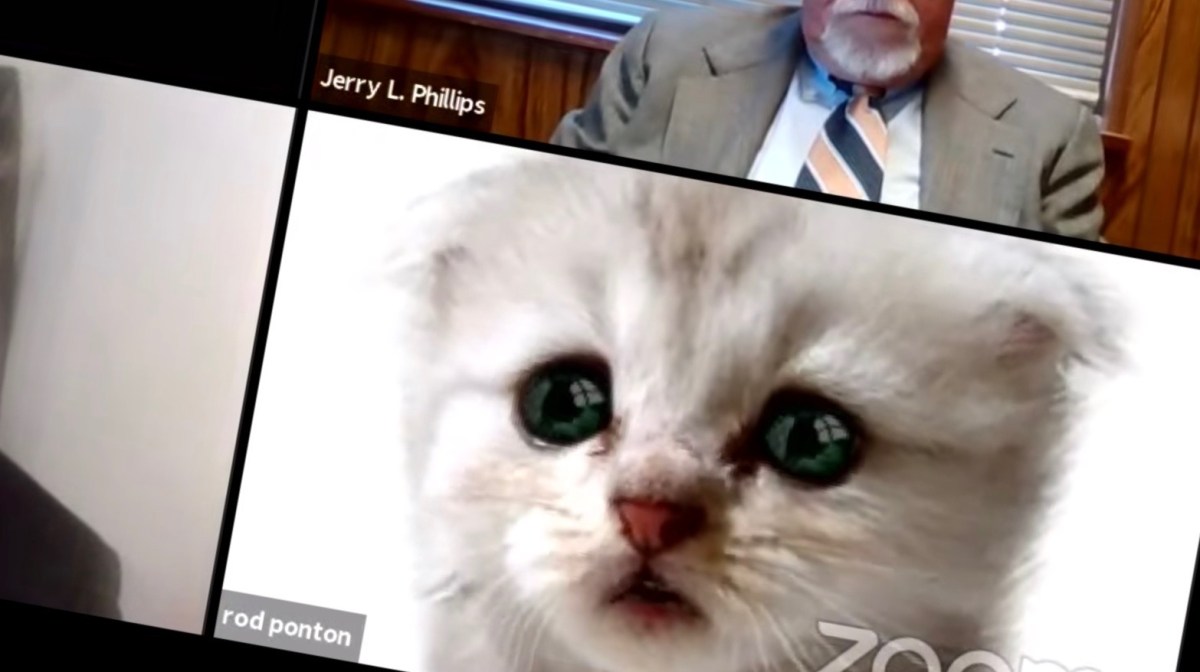
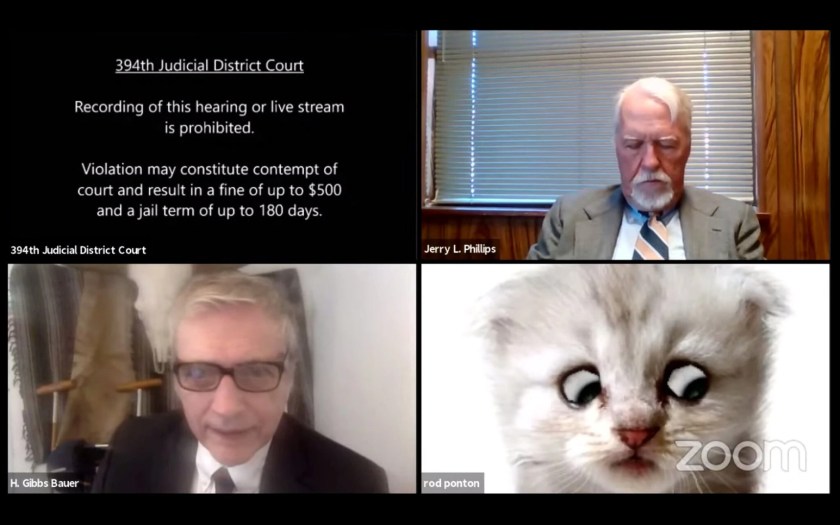
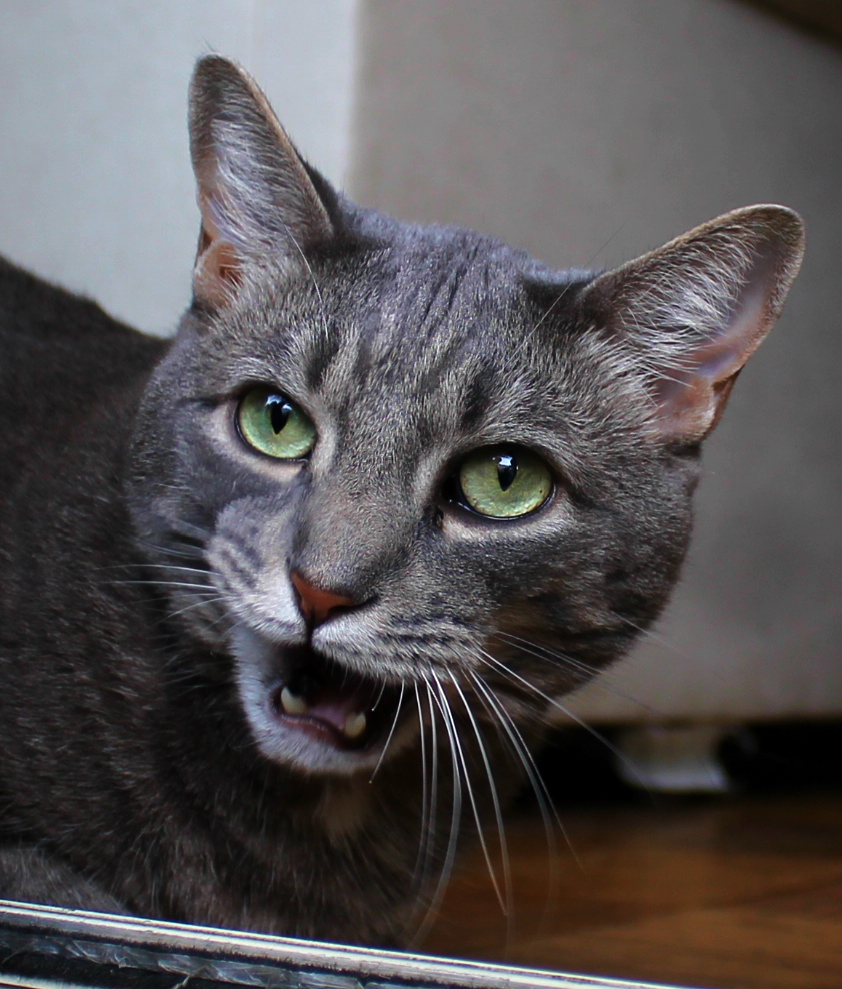
Americans have denied pretty much everything in courts of law over the years, but this one may be a first. After a Texas lawyer connected to a Zoom virtual civil forfeiture hearing and couldn’t figure out how to remove a filter that turned his on-screen image into that of an anthropomorphic kitten, the lawyer stated the obvious.
“I’m here live,” the attorney told the presiding judge. “I’m not a cat.”
Two other lawyers keep straight faces as attorney Rod Ponton struggled to remove a cat filter during a Zoom call.
The lawyer is Rod Ponton of Presidio, Texas, and he’s become a viral sensation.
“When I got on Zoom everything seemed fine – my picture popped up, I was in the waiting room with the judge. But when the judge called the case, I disappeared and a cat appeared instead of me to my great surprise of course,” Ponton told the BBC.
Ponton’s misadventure is relatable at a time when almost everything that doesn’t require physical presence has been moved online due to the Coronavirus, and it’s perhaps most relatable to adults who can’t figure out what their kids have done to their computers.
Ponton, it turns out, was using his secretary’s computer after her kid had been using it. Thus the kitten filter.
He told the BBC he’s trying to “roll with it” as the video racks up millions of views.
“In Texas we have a phrase that you can’t put toothpaste back in the tube,” Ponton said. “If this was going to become an internet sensation I just had to laugh at myself along with everybody else doing so.”
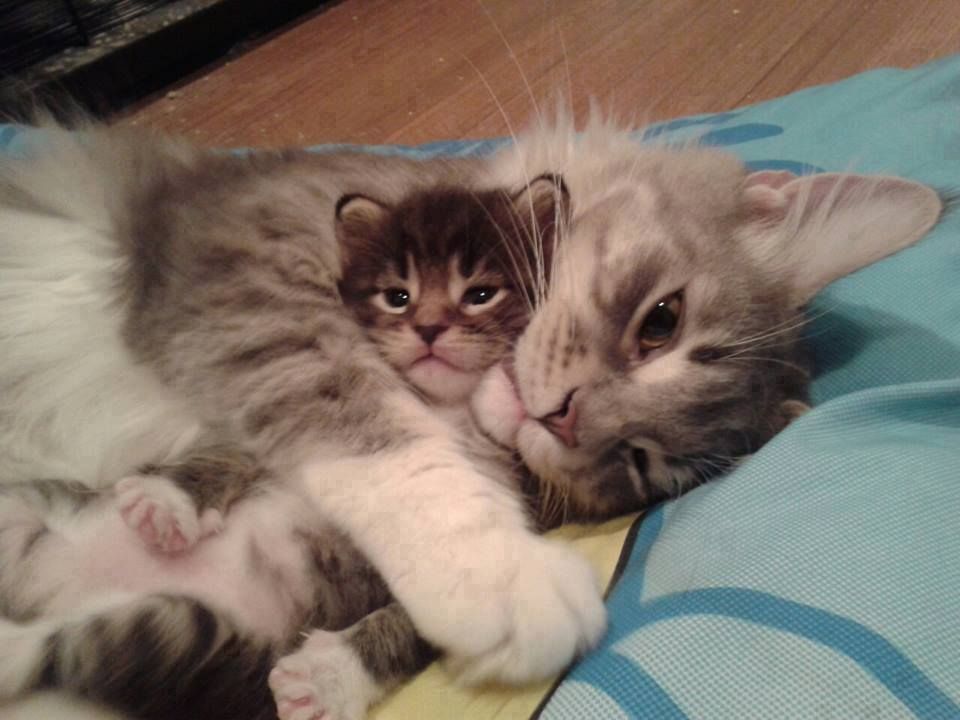
The sacrifices mom cats make for their kittens illustrate that cats are capable of great empathy and love.
One of the most compelling cat stories I’ve ever heard involved a reader of this blog, a woman who took in a white stray she named Snowy.
Snowy was a street cat who was always with a male cat, and the woman fed them both whenever they came by. Soon it became clear Snowy was pregnant, and her trusting tom — the father of her babies — nuzzled her goodbye as Snowy accepted the woman’s invitation to move inside at least temporarily so she’d have a safe place to give birth to her kittens.
In the three weeks that followed, Snowy raised her kittens in the woman’s home, and the tomcat would come by daily to see her and their little ones.
Snowy died when a pair of dogs climbed the porch steps, snapping at her kittens. Snowy fought the dogs off while her babies escaped, but she died from her injuries.
The poor tom who had been her constant companion came by the next night and meowed for her. He showed up again and again, meowing mournfully each night, distraught at her disappearance.
The story shows cats are capable of extraordinary empathy and love: The love between Snowy and her mate, who was protective of Snowy and loving with their babies, an unusual trait in toms. The love Snowy had for her babies, sacrificing her life for theirs. And the love the crestfallen woman had for those kittens when she returned home and found Snowy dead and the kittens hiding.
Another story of a mother who gave her life for her kittens reinforces the idea that cats are capable of great love and empathy.
When a mobile home in Pasco County, Florida, caught fire this week, the man who lived there was able to escape but his cats were trapped and firefighters couldn’t reach them.
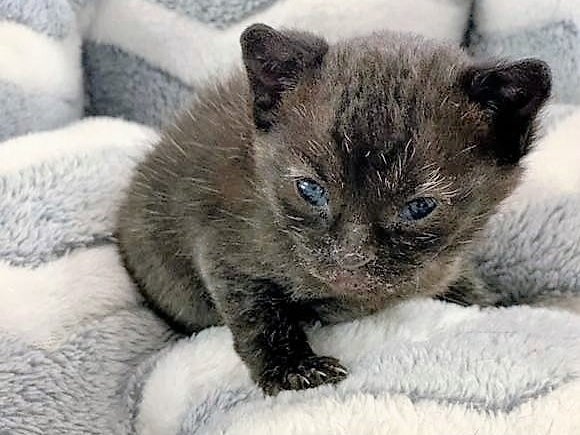
Molly’s mom sacrificed her life to save the 2 1/2-week-old kitten.
The mother cat covered her kittens with her body, laying on top of them and remaining there even as the fire scorched her.
When firefighters poked through the debris, they found the cat and her kittens. The mom and one of her babies died at the veterinary hospital, but one kitten survived.
“It seemed as if mom did everything possible to protect her kittens, even risking her own life in their defense, but the flames and the smoke were too much,” said Rick Chaboudy, executive director of the Suncoast Animal League. “But mom managed to protect one of her kittens from the blaze, enough to give that kitty a chance at life. Other than her whiskers being burned completely off and a slight odor of smoke, she is doing well with her bottle feeding and her cuddling.”
Staff at the shelter named the kitten Molly after Molly Williams, a former slave who became the first black female firefighter in the US. Molly the kitten is expected to make a full recovery.
What’s that? A tear, you say? Absurd! Buddy and I do not cry. Now if you’ll excuse us, we’re going to toss a football around, talk about trucks and fix some things around the house with power tools.
“In addition to being handsome, I am very meowscular and I know kung fu!”
A story from Turkey illustrates the deep bond animals share with their favorite people.
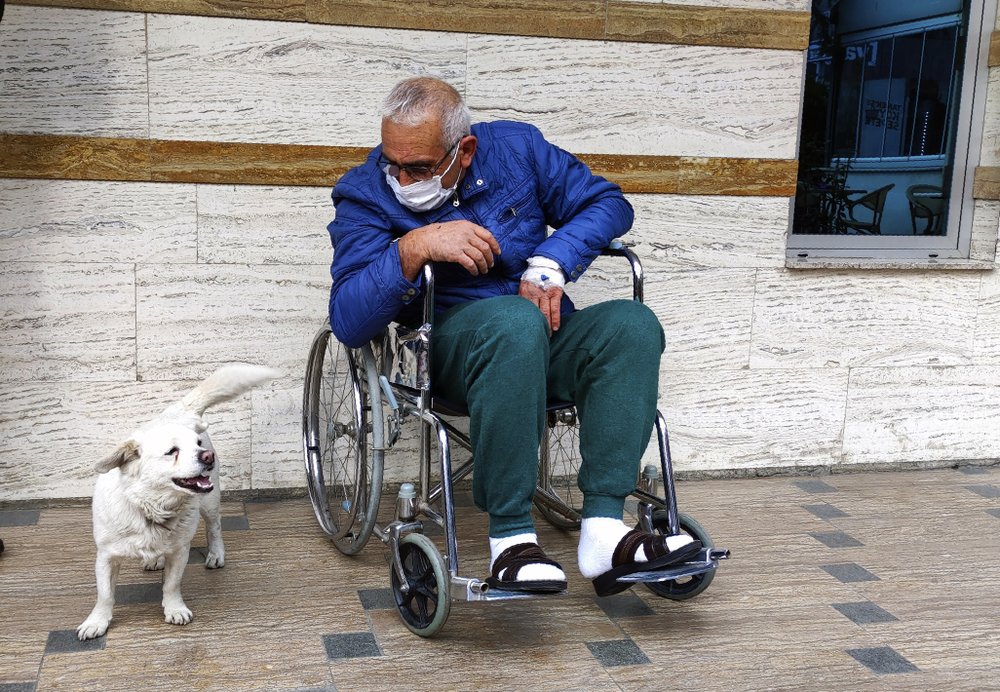
A story about an extraordinarily loyal dog has touched the hearts of animal lovers all over the world, and probably has many of us thinking: If I had a medical emergency, would my pet chase an ambulance to the hospital and wait there for days until I emerged?
That’s what Boncuk the loyal dog did after her owner, Cemal Senturk, suffered a brain embolism and was taken to a hospital in the northern Turkish city of Trabzon on Jan. 14.
Boncuk waited patiently for her best friend until Aynur Egeli, Senturk’s daughter, took the loving pup home the first night.
The next morning Boncuk was gone, and Egeli knew exactly where she was going.
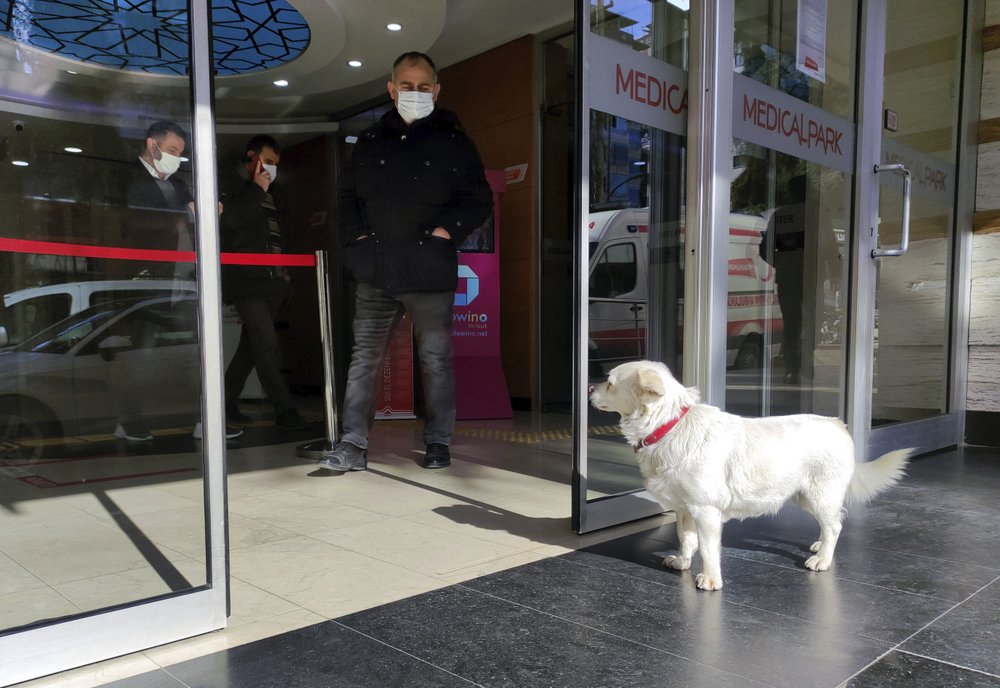
“She comes every day around 9 a.m. and waits until nightfall,” Muhammet Akdeniz, a security guard at the hospital, told local media. “When the door opens she pokes her head inside,” Akseniz said, but the polite pooch “doesn’t go in.”
Boncuk poked her head inside but knew she wasn’t allowed inside the hospital.
Boncuk was reunited with Senturk on Wednesday when an orderly wheeled the man out to the hospital entrance. Senturk was later discharged.
In photos and a short video of the reunion, Boncuk is the image of happiness and relief: Her tail wags uncontrollably and she can’t contain her enthusiasm as she literally jumps for joy.
“She’s very used to me,” Senturk said. “And I miss her, too, constantly.”
Boncuk’s story reminds us of Hachiko, the Japanese Akita dog who was so devoted to his owner, Hidesaburō Ueno, that he’d run to Shibuya station every day to greet Ueno as he stepped off the subway. Ueno was in mid-lecture in front of a class of students when he suffered a brain hemorrhage and died on the spot.
It’s a story of animal devotion that resonates so strongly with people that Hachiko was memorialized with a statue just feet from the spot where he stood every day, waiting for Ueno.
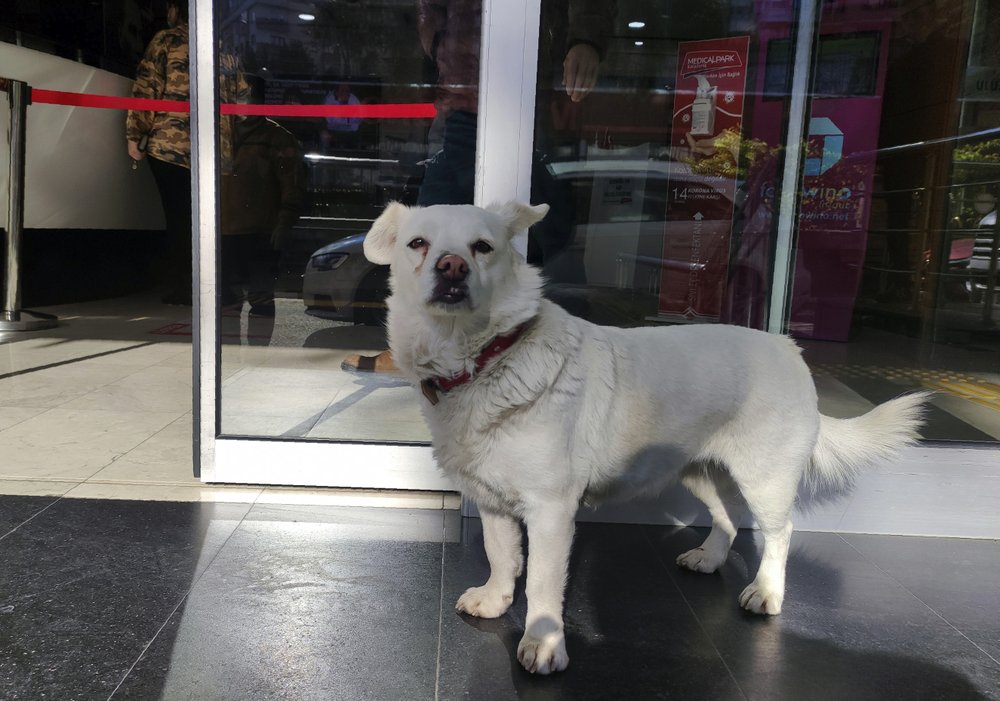
Boncuk waits for her owner in front of the hospital.
Yes, this wonderful story begs the question: Would my pet do the same for me?
Putting aside the problem of actually getting to the hospital — which would be almost impossible given the distance, traffic and the fact that he’s an indoor cat — if Bud were allowed to stay in a hospital room with me, I believe wholeheartedly that he would remain by my side.
Like other pets who have strong bonds with their people, he knows when I’m not feeling well, and when I was sidelined with Bell’s palsy and a debilitating headache a few years ago, he never left my side.
That is not to say he wouldn’t be his usual incorrigible self. You know that little button that calls the nurse? He would abuse the hell out of it if he knew its function, and he’d probably think the nurses were there to serve him, bring him snacks and fluff his pillow.
“Nurse! In here! My pillow needs fluffing! Also, could you be a doll and fetch me some Temptations?”
The truth is that pets are not allowed in the vast majority of hospitals. Writing in PetLife, Alicia Beyer notes pets “not only brighten patients’ spirits, but hospitals are reporting that the pet visits can have dramatic effects on patient’s health, recovery and emotional well-being.”
In Canada, there’s an organization called Zachary’s Paws, which was started by Donna Jenkins in honor of her 25-year-old nephew.
“While Zachary was in the hospital for many weeks and very sick after having a stem cell transplant, he begged to see his dog, Chase,” Jenkins told Bored Panda. “We sneaked Chase into ICU to see him and the effect it had on Zachary was remarkable. When Zachary realized he was not going to survive his cancer, he made me promise to start the organization.
But as PetMD notes, there are good reasons why most hospitals don’t allow pets, including problems pets can pose to patients with compromised immune systems and allergies. Hospitals that do allow pet visits have strict standards, and the animals must be thoroughly cleaned by staff before they’re allowed in.
Alas, even as more hospitals allow pet visitation or therapy animals, many exclude cats, and a 2015 report by the Society for Healthcare Epidemiology of America says cats “should be excluded.” The report claims cats can’t be trained as well as dogs, the risk of bites and scratches is higher, and more patients may be allergic to cats.
Jamie Lynn Spears says she’s run over “I don’t want to tell you how many cats” with her Tesla because it doesn’t make enough noise.
Coronavirus. Unprecedented income inequality. Instability. Millions of religious minorities wasting away in Chinese government concentration camps.
The world is a mess right now and sometimes it’s difficult to know where to start, but thankfully Jamie Lynn Spears — unintelligible mumbler, erstwhile country music singer and younger sister of Britney — is here to set our priorities straight.
“The Tesla is a secret cat killer, and it’s a problem that we really gotta fix,” a purple-haired Spears told her followers in a video she uploaded to Instagram a few days ago.
“We have now lost — I don’t want to tell you how many cats — because they don’t hear the Tesla crank and unfortunate things happen and it’s really devastating and tragic for everyone involved,” Spears said.
Perfectly understandable. I mean, who doesn’t run over a cat or six while backing out of the driveway? And who wants to be bothered with actually caring for cats and keeping them indoors when you can tell your 2.1 million Instagram followers that a corporation is at fault?
“Like, one of those noises”
Thankfully, Jamie Lynn has a solution, which she also shared with her followers.
“So since the Tesla is so quiet, maybe you could, like, make one of those noises that, like, bother cat or animal ears when it cranks up, so that, like, they know something’s happening and they aren’t caught off guard, and things don’t end in a very tragic way,” Spears continued, indicating she’s spent a lot of time ruminating on this issue. “So, Elon Musk, let’s figure this out, B, because you owe me a couple of cats.”
Like other celebrities, Spears was apparently expecting to air her thoughts and have the entire internet break into a slow clap and say “You’re so right! Hooray for you!” And like other celebrities, Spears deleted the video and furiously backpedaled when people started questioning her claims.
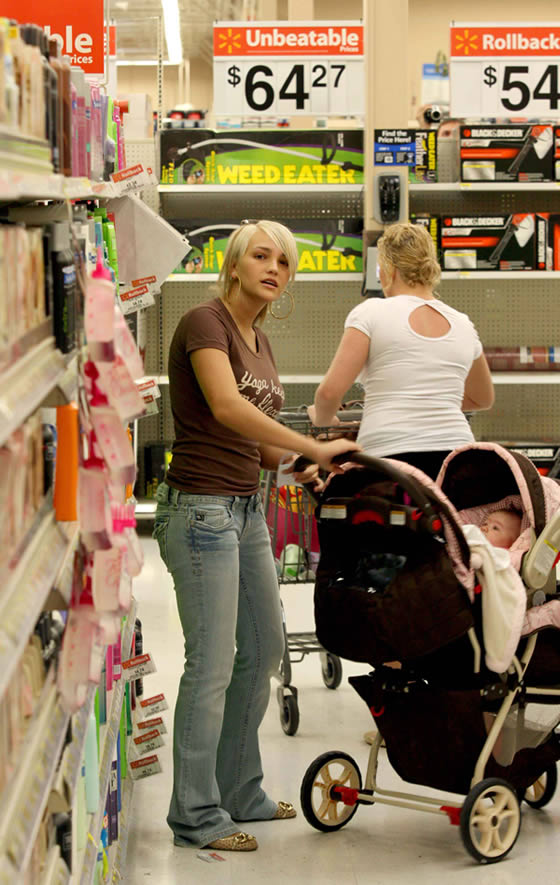
Jamie Lynn Spears, net worth $6 million, sister of Britney Spears (net worth $59 million), shopping at Walmart.
The first thing people wanted to know was: Just how many cats did Jamie Lynn lose to Evil Elon Musk and the Teslarizer?
Was it 1) “I don’t want to tell you how many cats” as Spears first indicated, 2) “A couple of cats” as Spears claimed in a follow-up video, or 3) Zero cats, as Spears claimed in a follow-up post to her follow-up video?
After looking into the camera and flatly declaring that Elon Musk owes her “a couple cats,” as if they’re replaceable products, Spears wrote that she “did not run over any cats” and Tesla is “not to be blamed.”
Let’s collab, yo. I got mad ideas!
“I was only making a suggestion about something I think would be extremely helpful, and the geniuses at @Teslamotors are the best to go to for said issue,” she concluded, suggesting Tesla should contact her to “collaborate” on a solution.
We’re sure the industry-disrupting engineers and other geniuses working for Tesla would have been thrilled to collaborate with a mind of Spears’ caliber, but alas they won’t get the opportunity.
That’s because Teslas and other electric cars are already required by law to make a persistent sound when traveling at low speeds, a tweak made at the behest of the American Council of the Blind.
Although Spears got a bit shy after she didn’t receive the ovation she was expecting and refused to clarify how many cats she’s killed with her Teslas, we know the number is at least one. In another recent video, Spears’ similarly purple-haired toddler is seen saying her cat, Turkey (*sniff*), was “in heaven.”
We are sorry Turkey had the misfortune of being adopted by a living indictment of the American education system, and we hope rescue and shelter organizations within 50 miles of Spears’ trailer decline to adopt cats out to her in the future, lest they end up on Musk’s tab.
And if you think we’re being too harsh on Spears, we’d ask you: What kind of world do we live in when someone is allowed to casually kill animals through her own negligence with complete impunity? We’re talking about life here, not broken toys or kitchen appliances.
A California parks district is under fire for killing cats that allegedly strayed too close to protected marshland where birds winter.
Employees of a parks agency in California’s Bay area killed almost four out of every 10 cats that may have strayed close to protected wildlife areas, newly released documents show.
The East Bay Regional Park District (EBRPD), an independent government district that manages parks in Contra Costa and Alameda counties, found itself at the center of a growing controversy earlier this month after admitting its employees were shooting cats they claimed could be a threat to local wildlife.
When more than a dozen cats went missing, several local volunteers who care for colony cats in the area contacted the EBRPD for an explanation. Staff at the EBRPD initially told the caretakers they’d trapped the cats and brought them to local shelters.
But when Cecilia Theis, one of the cat caretakers, contacted staff at nearby rescues and shelters, they said they hadn’t taken in any strays from the EBRPD.
“I immediately stopped what I was doing and searched for them,” Theis wrote in a letter to the EBRPD. “The cats I cared for were never taken to the shelter. [An EBRPD employee] even described the cats.”
It wasn’t until KGO, the local ABC news affiliate, began asking questions that the EBRPD admitted its “conservationists” had shot and killed the cats, claiming the stray felines ventured too close to a protected marshland where endangered bird species migrate for the winter. The marshland is located within the Martin Luther King Jr. Shoreline, a regional park managed by the EBRPD.
The Martin Luther King Jr. Shoreline / Credit: Bay Nature Institute
News of the district’s cat culling first broke on Dec. 8 when KGO aired a segment on the controversy. The EBRPD told the news agency that it had the right to cull animals that represent a threat to wildlife, per an old policy that local rescues, shelters and colony managers weren’t aware of.
District staff eventually admitted they killed 18 cats in 2020.
Despite press enquiries and public records requests, the district still has not provided details about the cat culling. It’s not clear how the district’s staff determines whether an individual cat represents a threat to local wildlife, whether there are protocols or standards governing the use of lethal force against stray domestic animals, or even what kind of firearms were used.
“I was heartbroken,” Ann Dunn of Oakland Animal Services told KGO. “Yeah, I was heartbroken, just knowing that that there’s no reason that that needed to happen.”
“We certainly didn’t realize they were doing what they were doing, otherwise we would have reached out sooner,” Dunn added.
The EBRPD has not responded to public records requests by KGO. Government agencies in California are required by law to respond to public records requests within 10 days. If they decline to release the requested records, they must provide a compelling reason why the information cannot be shared with the public, per open records laws and government transparency best practices.
Open records laws are arguably the most crucial tool used by media organizations, public interest groups and regular people who want to keep tabs on what their tax dollars are used for and how government offices are run.
Additionally, records provided by the EBRPD are incomplete. A document that is supposed to provide a full accounting of animals killed, trapped and caught by the EBRPD over the past three years is missing details on many of the incidents, and the numbers don’t add up with the district staff’s public statements.
The data was obtained through a public information request by Theis and shared with this blog. Additional public information requests are pending.
DOCUMENTS: PDF of the East Bay Regional Parks District records on cat culling: (Click to view full size)
Between 2018 and mid-December of 2020, the EBRPD dealt with 62 incidents involving cats. The district’s records say its “conservationists” shot and killed 24 of those cats. The remaining 38 were caught or trapped, meaning 39 percent — about four in 10 — of cats identified as potential threats to local wildlife were shot rather than trapped or caught by hand.
However, the documents list only 14 cat shootings in 2020, and only 13 during the time period when officials say they killed 18 strays. The documents list one cat shot in 2018 and eight cats shot in 2019.
Others have noticed the discrepancies as well. A Change.org petition started by Cassidy Schulman has almost 46,000 signatures and includes statements urging the EBRPD to come clean on the controversy.
“How can they claim that they communicate openly and honestly with the public they serve when they (separately and on more than one occasion) told Cecelia and another colony caretaker that they had not killed the cats, but had taken them to shelters in Oakland and Dublin?” Schulman wrote on the petition page. “Most of the colony cats were not only spayed, neutered and vaccinated – they were also microchipped by Fix Our Ferals. Had even a single one arrived alive at any shelter or veterinary hospital, they would have immediately been scanned for chips, and the organization would have been notified.”
In her letter to the EBRPD, Theis complained that a staffer there “even went so far as to pretend she was looking for paperwork” when pressed about what happened to the colony cats. Another employee told Theis the paperwork hadn’t been sent to the shelters because of COVID restrictions. That same employee told Theis four cats “had to be shot” because they were sick.
But those explanations were abandoned by the EBRPD when KGO’s reporters began asking about the fate of the cats. That’s when the staff admitted they’d killed 18 cats, including 13 at the Martin Luther King Jr. Shoreline.
While the EBRPD itself said it won’t rule out killing more cats, members of the board that oversees the EBRPD have pledged to end the practice.
“The Park District appreciates all animal life but is required by law to protect threatened and endangered wildlife living in District parklands,” EBRPD spokesman Dave Mason told SFGate. “It is imperative that the public understands that feral cats are not part of a healthy eco-system and feeding them only serves to put endangered wildlife at risk.”
The EBRPD’s cat-killing policy — and similar efforts by states and municipalities in the US and other countries — are influenced by a series of studies claiming cats are one of the biggest factors leading to the extinction of endangered species of birds and small mammals.
However, the claim that cats are a major contributor to bird extinction is controversial.
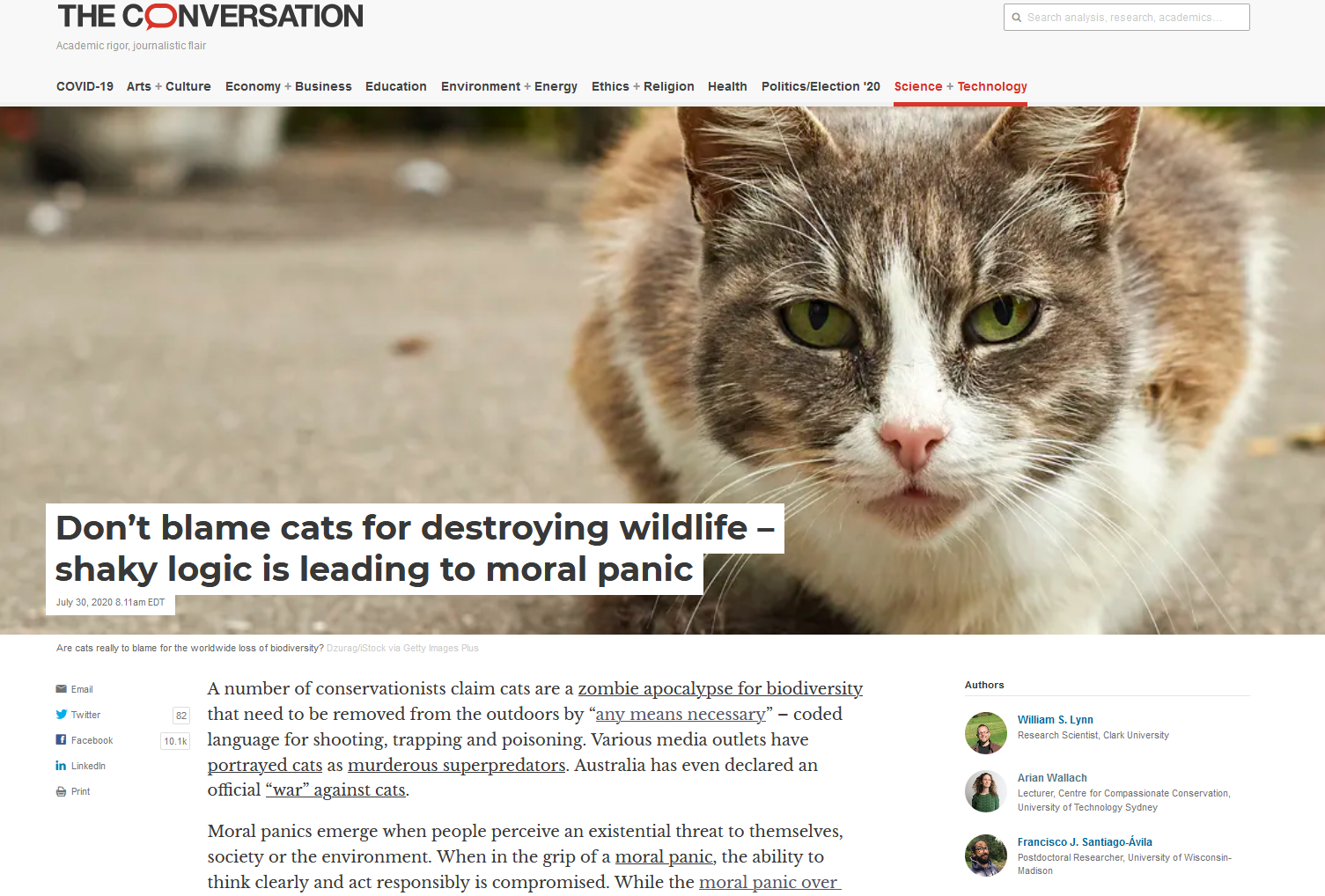
“Conservationists and the media often claim that cats are a main contributor to a mass extinction, a catastrophic loss of species due to human activities, like habitat degradation and the killing of wildlife,” a trio of academics wrote this summer. “As an interdisciplinary team of scientists and ethicists studying animals in conservation, we examined this claim and found it wanting.”
Other scientists challenge the claims that cats are the primary cause of species extinction among birds and small mammals.
There is no direct evidence that felis catus — domestic cats — are a major driver of extinction. A handful of studies that purport to show a connection are not based on observational or even secondary data. Instead, they rely on guesswork and numbers cobbled together from unrelated studies.
Most of the studies use aggregate data taken from earlier studies that did not measure the ecological impact of stray, feral and outdoor cats. For example, one paper used GPS data from an earlier study in which cats had devices affixed to their collars to track their movements.
But that earlier study did not include any information about the cats’ hunting activities, so the authors of the meta-analyses handed out questionnaires to cat owners asking them to rate their cats’ hunting skills on a five or 10-point scale.
The authors took the GPS data and the questionnaire results, calculated an estimated number of prey animals killed per cat annually, then extrapolated that data based on an estimate of more than 100 million stray/feral cats living in the US, even though that number could be off by as much as 80 million.
The result — a claim that cats kill up to 20 billion birds and small mammals in the US each year — is based on so much guesswork and arbitrarily plugged-in numbers that it’s worthless from a practical perspective. Yet that hasn’t stopped credulous press outlets from reporting the numbers as fact, or authorities from using such studies to justify extreme measures against stray and feral cats.
Because lives hang in the balance, and public policies are directly influenced by these studies, cats deserve better than guesswork.
CORRECTION: Earlier posts incorrectly labeled the East Bay Regional Park District as a California state agency. It is in fact a special district founded in 1934, and serves Alameda and Contra Costa counties.