Thankfully for our furry friends, smaller brains don’t necessarily correlate to lower intelligence. It’s more about the complexity of neural connections.
Cats have gotten a good deal out of domestication: They’re safer, warmer and protected from almost all threats. They know where their next meal is coming from, and won’t hesitate to meow our ears off if dinner is late.
But one tradeoff doesn’t immediately appear beneficial: Domestic cats have smaller brains than the species they’ve evolved from, African and Eurasian wildcats.
“[D]omestic cats indeed, have smaller cranial volumes (implying smaller brains) relative to both European wildcats (Felis silvestris) and the wild ancestors of domestic cats, the African wildcats (Felis lybica),” the research team wrote.
Wild cats have the largest brains on average, followed by wild-domestic hybrids and domestic cats with the smallest brains of the three.
That’s another strong indicator that domestication is the determining factor in feline brain size, although the researchers point out that they are comparing domestic cats to current wildcats, and not the ancient population of wildcats from which domestic cats evolved beginning some 10,000 years ago with the dawn of agriculture and permanent human settlements.
Wildcats with friendlier and bolder dispositions were the first to approach human settlements, drawn by the rodents who were themselves feasting on human grain supplies. Humans realized that the cats were taking care of their rodent problems but weren’t interested in eating the grain, and a beautiful partnership was born.
“I have a yuge, yuge brain, the best brain. It’s tremendous.”
Smaller brains do not necessarily correlate to lower intelligence, however, and cats aren’t the only species whose brains became smaller after they were domesticated. Dog brains are about 30 percent smaller than the brains of gray wolves, but dogs have adapted spectacularly to living with humans and reading human behavioral cues.
“The dog is successful not because of the size of its whole brain per se, but because domestication has led to subtle brain changes with a stunning result: the ability to live in the world of people,” a Smithsonian Magazine article points out, noting dogs are also adept at getting people to do all sorts of things for them.
If brain size alone resulted in higher levels of intelligence, whales and elephants would rule the Earth.
Instead “the complexity of cellular and molecular organization of neural connections, or synapses, is what truly determines a brain’s computational capacity,” neuroscientist Kendra Lechtenberg wrote.
The researchers weren’t interested in drawing any major conclusions about feline cognition with the study. They’re more interested in the phenomena of “domestication syndrome,” which causes changes both physical (floppy ears, coat color variation, shorter muzzles) and behavioral. (Less aggression, playfulness.)
The jury’s still out on why exactly those traits emerge, but some studies have attributed it to differences in embryonic development. Unlike many other domestic animals, cats don’t look much different than their wild felis lybica and felis sylvestris counterparts.
The cat study was published on Jan. 26 to Royal Science Open Science, a peer-reviewed open-access journal. The research team was comprised of biologists from the University of Vienna and data curators from the National Museum of Scotland.
Two viral stories claim schools are allowing students to “identify” as felines, while one district is accused of providing litter boxes in school bathrooms.
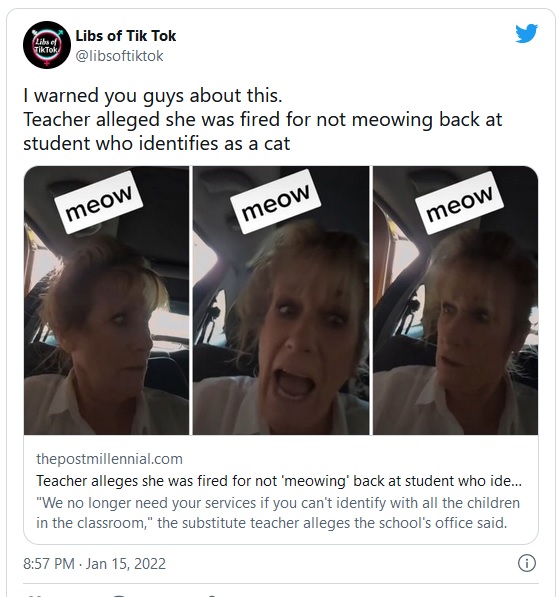
Two curious stories relating to cats have been circulating online this week: In the first story, a substitute teacher claims she was fired because she refused to meow back to a student who “identifies as a cat,” while parents in a Michigan school district were infuriated by a rumor that the district was providing litter boxes to cat-identified students in school bathrooms.
First, the obvious, or perhaps not-so-obvious considering the media attention and outrage surrounding bothstories: Neither one is true.
Why did people believe them? Because we’ve gone insane as a society, of course, and basic reality now means different things to different people depending on their political ideologies. If you’re on the left, you might think parents who aren’t sophisticated news consumers are so paranoid about school curricula, they’d believe just about anything. If you’re on the right, you’re might argue that some schools have gone so overboard with political correctness, it’s not a stretch to imagine privileges conferred on the allegedly cat-identified.
For those of us who subscribe to neither ideology, the whole thing is another sad example of the polarization that is destroying the US, the same divisive talk amplified by platforms like Twitter and Facebook.
But that’s beyond the scope of this blog, which is to celebrate cats, have a laugh and occasionally put the spotlight on animal welfare. I don’t want to lose readers by wading into a political landmine field, but most importantly I don’t want anyone to feel unwelcome on this site.
The Michigan incident started when a mom of kids at the Midland School District, about 130 miles northwest of Detroit, spoke at a school board meeting about a rumor — which she took as fact — alleging the school was accommodating “furries” by providing litter boxes in unisex bathrooms.
Lisa Hansen asked other parents to join her to “do some investigating” into the policy
“I’m all for creativity and imagination, but when someone lives in a fantasy world and expects other people to go along with it, I have a problem with that,” Hansen told the Midland school board. “This whole furry thing has just got me. I’m staying calm, but I’m not happy about it, and it’s happened on your watch, and I don’t understand it.”
Here’s the video: (It should start at the relevant section, but if it doesn’t, Hansen speaks at the 32:44 mark)
Hansen’s claims were picked up and reshared by a state GOP chairwoman, Meshawn Maddock, who warned “Parent heroes will TAKE BACK our schools” in a Facebook post.
The school’s superintendent, Michael Sharrow, was forced to do damage control with a public statement, telling parents it’s a “source of disappointment that I felt the necessity to communicate this message to you.”
“There is no truth whatsoever to this false statement/accusation,” Sharrow wrote. “There have never been litter boxes within MPS schools.”
The story about the fired substitute also had its roots in an online video, with a woman who says she’s a teacher relating the story via TikTok. The woman, who uses the handle @crazynamebridgetmichael, said she was taking attendance when a student responded to his name with feline vocalizations.
“I get to the third row and I hear this ‘meow!’ ‘Uhhh, excuse me? Excuse me?'” she said in the TikTok video. “I start looking on the ground, through the fourth row—everything’s good. Go to the fifth row—everybody’s there. Then I hear ‘meow!’ I’m like, ‘Okay, what’s up with that? Who’s doing it?’ And this little girl in the very front row says, ‘You have to meow back at him; he identifies as a cat.’ Are you kidding me?”
The student stormed out of the classroom when she laughed at him, she said, and the school’s administration fired her: “They said ‘We no longer need your services if you can’t identify with all the children in the classroom.'”
The story was picked up by several widely-read sites, included in Tucker Carlson’s daily newsletter, and reshared on prominent Twitter accounts in addition to going viral on Facebook.
The story was widely shared on social media and reported by a few dozen online media outlets.
The only problem is it isn’t true. In a follow-up video the teacher admitted she made up the story to “create awareness of what kids are going through at school.” She didn’t elaborate, so it’s not clear if she was criticizing school policies for allowing students to identify as different genders or arguing that kids’ needs aren’t accommodated. Occam’s Razor would indicate she was just chasing clicks.
The one thing that’s certain, however, is that cats don’t deserve to be in the middle of this mess.
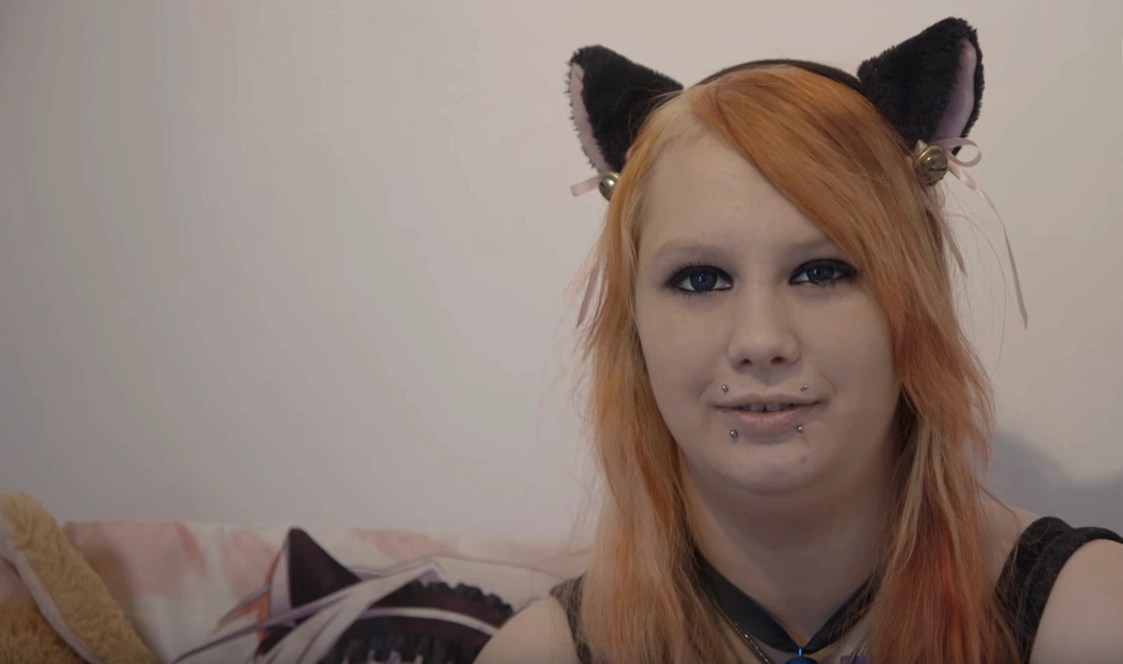
Top image: A 20-year-old Norwegian woman who identifies as a cat. The woman says she was “born the wrong species.” “My psychologist told me I can grow out of it, but I doubt it,” she told an interviewer. “I think I will be cat all my life.”
Criminal charges are still pending, and Logan faces a civil suit and a state veterinary board investigation for allegedly abusing a cat.
Ever since a leaked video showed him punching and choking a cat at his practice, Richard Timothy Logan has tried to hang on to his veterinary career.
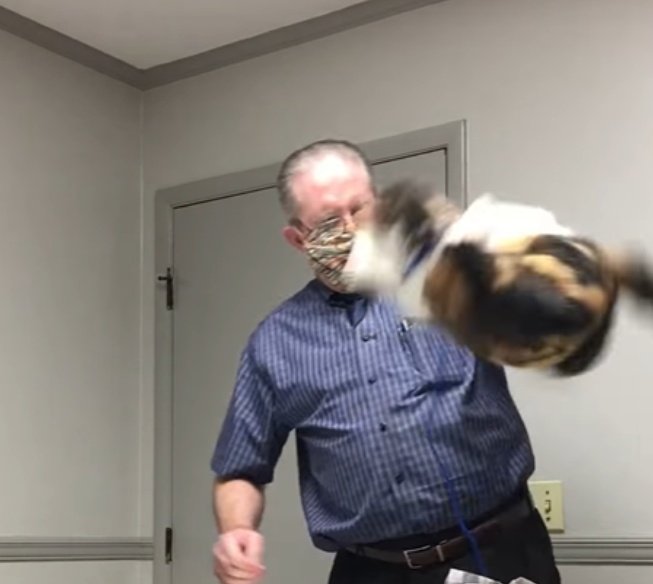
The Ozark, Alabama-based vet came to the attention of animal welfare advocates and cat lovers in early April 2021, when a former employee at Andrews Avenue Animal Hospital posted a video showing a man identified as Logan in a veterinary examination room, punching, choking and dangling a 21-year-old cat by her collar.
Logan was investigated by police and arrested on animal abuse charges. That case is still pending. In addition, he faces a civil suit related to the video and the state’s veterinary board is investigating his conduct after the video sparked a series of complaints and requests to revoke his license to practice veterinary medicine.
Now, more than eight months after the video’s leak and his arrest, Logan announced he will “no longer be associated with” Andrews Animal Hospital. A letter posted on the animal hospital’s doors says Logan left the on Jan. 10 and the practice is looking for a new veterinarian. If they can’t find one by Jan. 31, they’ll call it quits.
A man identified as Logan was examining a calico cat in November, in an exam room at the animal hospital when he grabbed the cat by the scruff of her neck and punched her on the top of her head with a closed fist, video of the exam shows. Still holding the cat by her scruff, he slammed her down onto the exam table, then did it again more forcefully.
Logan then swiped the cat off the exam table, causing her to fall to the floor.
Logan steps out of the frame for several seconds, then the video cuts forward, showing Logan again with his hands on the cat as a veterinary assistant holds the terrified, screaming feline down.
He punches the cat a second time, makes an annoyed gesture, then picks the cat up by her collar and dangles her as she struggles.
The cat was traumatized by the incident but survived and didn’t suffer any permanent physical damage.
Logan pleaded not guilty to two subsequent counts of animal abuse and hired an outspoken lawyer who has denied Logan did anything wrong, said his client has been the target of outlandish threats, and even tried to undermine the former employee who posted the video by claiming she brought her own dog to the veterinarian for treatment and “trusted him with her precious pet.”
David Harrison, Logan’s attorney, said his client was going to sue online commenters who condemned the accused veterinarian, and says Logan will be vindicated in court. He did not dispute that the video shows Logan mishandling the cat, but said it lacks context.
The video, Harrison claims, merely “shows Logan appearing to abuse a cat, though contributing circumstances, if any, are not known.”
In this still from the leaked video, Logan throws the 21-year-old cat onto the exam table in his veterinary practice.
It’s worth noting there are no circumstances in which it’s appropriate for anyone, much less a veterinarian, to abuse a cat. Even frustration’s not an excuse: Handling animals is part of the job in veterinary work, and vets are trained to calm cats they have to examine, as well as techniques to hold and restrain cats if they won’t tolerate routine things like having blood drawn for lab work.
Harrison even invoked America’s war dead in Logan’s defense when the abused cat’s owners filed a civil suit.
“We have the best defense there is—not guilty,” Harrison told WTVY, a local news station. “One point five million Americans have died on foreign soil for us to have the right to be innocent until proven guilty.”
The number Harrison cites is untrue: There have been 666,411 total combat deaths in all US wars, and some 451,000 combat deaths on foreign soil.
Logan or his staff has also been involved in a protracted war of words with his online critics and former clients, even going so far as to pull the charts of two former clients and describing them in detail in an attempt to refute complaints they’ve made on Google reviews. While Andrews Avenue Animal Hospital has 4+ stars on Google reviews thanks to an abundance of five-star reviews counteracting the negative reviews, its rating on Yelp is considerably worse.
“There’s no [NAME REDACTED] in the aaah computer system except a [NAME REDACTED] in collections from 2014 for a bad/unpaid debt ! Her dog has not been to aaah for any surgery and has not been on the appointment book for anything & is flat out lying !,” an account that defended Logan posted. (The retaliatory review included the name of the client. We redacted the name for this post.)
A non-profit helps terminally ill and elderly clients find future homes for their beloved cats so they don’t end up in shelters.
Buddy has a dirty little secret: He’s a biter and scratcher.
The little guy has improved dramatically over the past few years and it’s something we actively work on, but he occasionally has his moments when he gets freaked out and indiscriminately lashes out, or gets frustrated and redirects his flood of emotion on the nearest person, which is almost always me.
I love the little dude anyway, I can anticipate his moments of overstimulation or freak-outs, and I know how to calm him down.
But I also know that, if anything were to happen to me and Buddy ended up in the shelter system, he probably wouldn’t make it out. He’s even more likely to lash out in a scary, unfamiliar situation, and cats who bite and scratch are usually deemed unadoptable and put on the express route to the needle.
That’s why I made my relatives promise that, if I get hit by a bus or something, one of them has to adopt Bud, give him a loving home, and treat him as an extension of me.
Not everyone has that luxury, especially the elderly and the terminally ill. That’s why Angela Rafuse, a 27-year-old from Novia Scotia, founded My Grandfather’s Cat.
Rafuse’s grandfather had recently lost his wife of almost 60 years and had his own health problems that demanded urgent attention, but he resisted going to the hospital because he didn’t want to leave his wife’s cat, Mackenzie, alone.
“That cat was all he had left of my grandmother, and he didn’t want Mackenize to end up in a shelter,” Rafuse told People.
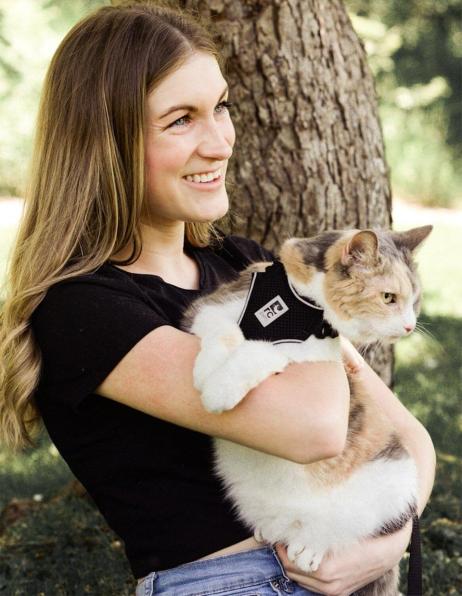
Rafuse with Mackenzie. Credit: My Grandfather’s Cat
When her grandfather passed away in 2019, Rafuse adopted Mackenzie. When she posted a video of the quirky cat to TikTok, the resulting discussion in the comments led to the realization that lots of people have been in similar situations, with relatives whose illnesses were compounded by worry about what will happen to their beloved pets when they’re gone.
“We heard stories from people who had to put their grandparents’ pets into shelters after they passed because there wasn’t a family member to adopt them,” Rafuse told blogTO, a local news site focused on Toronto.
My Grandfather’s Cat works “to keep the animal with their human up until the very last day and provide the comfort of knowing a loving family will adopt their pet when the time comes,” according to the non-profit’s site.
Refuse and volunteers work with people who are terminally ill, seniors who are forced to move into housing situations that don’t allow pets and other situations, and helps them find loving homes for their pets. Knowing their cats and dogs will be taken care of after they’re gone grants peace of mind to people who are already dealing with major life changes or their own mortality.
The group relies entirely on donations and doesn’t charge clients or adopters. My Grandfather’s Cat offers its services to all Canadian regions, and Rafuse said she hopes to expand to the US.
“It is the most rewarding thing in the entire world to be doing this,” she said, “and I know my grandfather would be proud.”
The pope’s comments were made in the larger context of an imminent “demographic winter” caused by an aging population and historically low birth rates.
Popes have a mixed record when it comes to cats.
Back in the 13th century Pope Gregory IX famously declared cats were at the heart of alleged Satanic rituals in Europe, relying on the account of one Konrad von Marburg, an author of massacres, church inquisitor and all-around idiot known for brutally torturing his victims to elicit “confessions” of heresy.
Von Marburg told the pope that Satanists had a ritual involving a black cat who would walk around backwards while the Satan-worshipers kissed its ass. The pope bought the risible story and believed von Marburg’s accounts of growing numbers of heretics, especially in Germany.
The resulting papal letter, Vox in Rama, did not declare cats were evil and didn’t ask Catholics to kill them, despite widespread claims to the contrary on the internet, but it did contribute to distrust of the animals a century ahead of the Black Plague, when people thought cats were carrying the disease.
The pope who loves cats
Then there’s the Pope Emeritus, Benedict XVI.
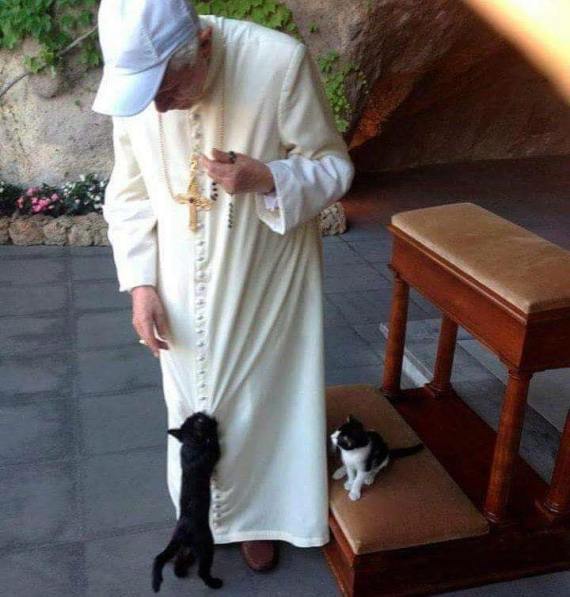
Pope Emeritus Benedict XVI with two kittens in 2017. Credit: The Joseph Ratzinger/Pope Benedict XVI Foundation.
Cat lovers around the world rejoiced when it was revealed Pope Benedict was a cat lover and had two pet felines of his own. Cardinal Roger Mahoney, the former archbishop of Los Angeles, said Benedict was wild about kitties.
“The street talk that the pope loves cats is incorrect,” Mahoney said in 2005. “The pope adores cats.”
Catholics petitioned Benedict to help with animal welfare causes and to lend his support to efforts to help the many stray cats of Rome.
Francis the Saint and Francis the Pope
That brings us to our current pope, Francis. The elevation of Francis was met with approval from animal lovers: His chosen papal name honors St. Francis of Assisi, a Radagast the Brown type figure who lived a life of luxury as a wealthy playboy and party-goer until he had a religious conversion, sold all his possessions and became a monk.
St. Francis believed true faith in God meant having a deep respect for animals. While it’s not clear what’s true and what’s apocryphal, there are stories of Francis preaching to birds, nursing various animals back to health and even convincing a wolf to stop attacking a village in Italy in exchange for the villagers feeding it. St. Francis was by all accounts gentle with animals and appreciative of nature.
St. Francis is revered in the Catholic church and beloved by groups like the Humane Society. He is the patron saint of animals, and on his feast day Catholics bring their pets to be blessed at church.
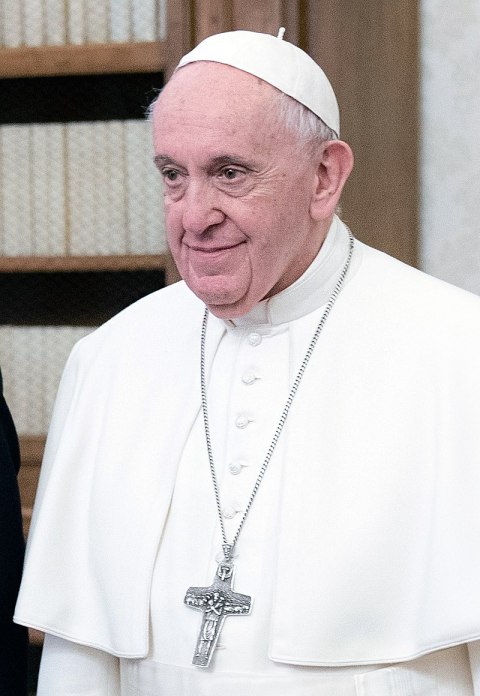
Pope Francis during a visit with former US Vice President Mike Pence. Credit: Wikimedia Commons
Pope Francis continued his namesake’s work with Laudato Si, a papal encyclical which endeared him to animal lovers all over the world.
The encyclical was notable for the church’s strongest language yet in advocating for protecting and respecting animals. PETA made Pope Francis its person of the year in 2015, and the pope was feted by many other animal welfare groups across the world.
In Laudato Si, Francis explicitly rejected the idea that animals are resources for humans to exploit, asserted the Catholic view that animal life has intrinsic value, and called on human beings to be stewards of animals and the Earth. Abusing and exploiting animals is “beneath human dignity,” he wrote, and the associated desensitization and heartlessness of practices like factory farming are a stain on the human race.
Animals, the pope wrote, not only have souls but will “take their place” in heaven, “resplendently transfigured” in the presence of God. He also pointed out the disastrous effects we’re having on wildlife by destroying habitats, carving up the remaining land, over-fishing the oceans, poaching and hunting.
What Francis said about pets
So why are people suddenly upset with the pope?
He made some off-the-cuff remarks about people choosing pets over children, said it was “selfish” to choose the former, and brought up the plight of the world’s orphans. He pointed out that people collectively spend hundreds of billions on pet food and products while humans in the third world lack basic things like clean water, food and medicine. He also said “denying” motherhood and fatherhood leaves us spiritually poorer, as the experience brings us closer to God.
As usual any time a pope speaks, his statements are taken out of context and rehashed in the media. That’s expected, especially in the age of clickbait, the 140-character tweet and the 15-second news segment. Pope Francis gets himself into trouble by sometimes speaking too candidly when he should know his message will be garbled by gatekeepers and information filters, leading to strong reactions to things he didn’t actually say.
The pope wasn’t condemning keeping pets across the board, and he wasn’t saying all pet owners are selfish. His comments were made in the context of a larger discussion on universally declining birth rates in developed countries, specifically Europe’s “demographic winter,” also called a “demographic time bomb.”
In simple terms, Europe’s population is rapidly aging and birth rates are historically low. Populations are dying off, there are fewer people to care for the elderly, and there aren’t enough babies to replace the dead. The average age in Europe is 43, which is 12 years older than the average in the rest of the world.
COVID has compounded the problem, partly due to social distancing and partly due to economic uncertainty as a ripple effect of the virus. Of course it isn’t all that simple, and the demographic winter’s wider effects are complex and well beyond the scope of this blog.
It also helps to remember the Catholic Church has a strong social justice streak. Not the kind that involves writing snarky tweets and first world problems, but real social justice through charity, schools, scholarships, food banks, shelters, soup kitchens, hospitals and innumerable other efforts.
The pope’s background as a native of Argentina, a former janitor and chemist who became the first Latin American pontiff, also colors his outlook. He doesn’t hesitate to call out the hypocrisy of first-world nations, and although we don’t like to hear it, most of the time we need to. After almost two thousand years of popes existing in or near the world’s seats of power, for the first time we have a pope who grew up from the outside looking in.
That’s not to say I agree with everything Pope Francis had to say on the matter, but I think it’s also important to recognize that he didn’t just take shots at people who care for pets out of the blue, and he didn’t condemn people for caring for animals.