Why Do Americans Love Shooting Cats?

Americans are exceptionally cruel to cats, especially strays and outdoor kitties. Why?

Seriously, what the hell is wrong with people in this country?

American cruelty to cats is even more upsetting within the context of human behavior elsewhere. In Turkey, where it’s practically a national pastime to care for felines, people build shelters for strays, welcome them into their shops with food and affection, and kitties are so trusting of humans that mother cats have on several instances brought their kittens into human hospitals and clinics for help.

Then we have ‘Merica, where apparently it’s a sport for people to sit on their front porches drinking beer and shooting stray cats with pellet guns.

Like, for instance, in Long Island this past weekend, where some stain on the human race shot a ginger tabby named Abraham and left him with a pellet lodged in his spine. Or in northern California, where a couple brought their cat to the vet because they thought he’d been attacked by a coyote, only for x-rays to show the little one had been shot several times by someone with a pellet gun. Or Augusta, South Carolina, where a cat was shot with what appears to be a bullet from a 9mm handgun. Or tiny Brookville, Pa., where a man shot his neighbor’s cat for the unthinkable crime of exploring his porch.

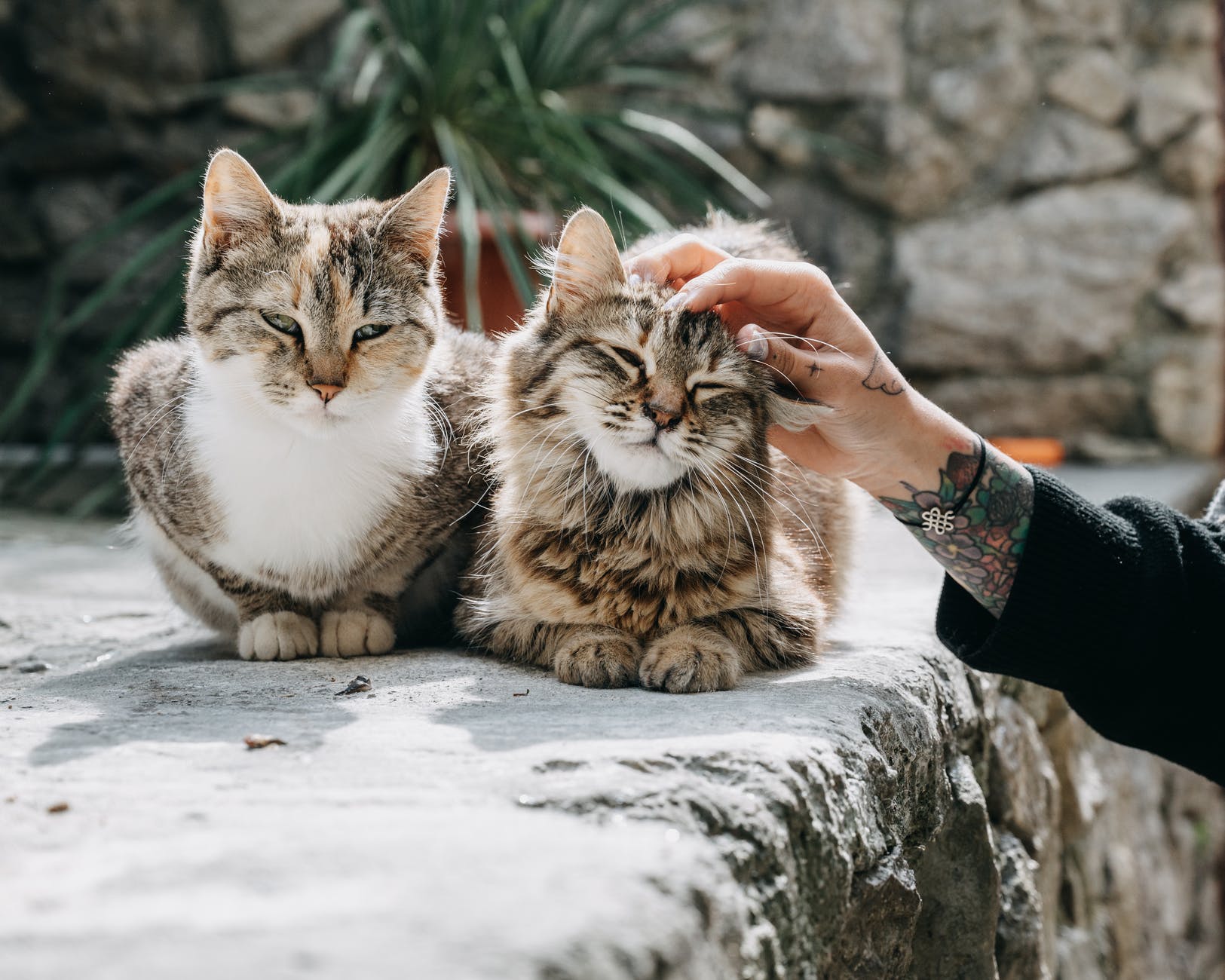
hipster with tattoos stroking cute cats on stony fence
Credit: Dmitriy Ganin/Pexels

I have Google News alerts set up for cat-related stuff to mention here on PITB, and a lot of it is great: Compassionate rescues, feline hi-jinx, heroic cats saving kids.

But those stories are always sandwiched in between articles about people shooting cats. Constantly, incessantly, apparently without a thought about the suffering they’re causing sentient animals who have feelings just like we do and experience pain, anxiety and fear the same as us. That’s not conjecture, contrary to what some people might believe, but objective scientific fact as proven experimentally many times over in recent years.

When Americans aren’t shooting cats they’re stealing them, mutilating them and killing them, like the recent nightmare case out of Tennessee: A woman left her cat in the care of a friend while she was traveling, and the friend allowed the cat to roam outside. Another woman saw the cat wandering, didn’t like what she saw and stole the kitty, eventually giving it away to 19-year-old Deamion Robert Davis via Craigslist. Davis now faces charges of animal cruelty for allegedly binding the cat’s paws and stabbing it to death with a screw driver, according to police. Detectives said they traced the killing to Davis by lifting fingerprints from the tape Davis allegedly used to bind the cat.

So because some busybody saw a pet cat on the street and decided a random, sketchy 19-year-old who responded to a Craigslist ad would provide a better home, a woman’s cat was brutally killed.

Meanwhile hatred for cats continues to be driven by bad science, like this meta-analysis of 202 toxoplasma gondii studies by researchers who need to be reminded that correlation does not imply causation. The research team looked at data on toxoplasma infections recorded in wild animals, then with no evidence whatsoever framed their study around the suggestion that cats “may” be and “probably” are transmitting the parasite to wild animals because the rates of infection are higher in urban areas.

Never mind that humans are much more likely to be infected by eating under-cooked food, certain meats, touching contaminated soil, or using utensils that were used to cut contaminated meat and shellfish. The study ignored that fact and posited — again without evidence — that cats are the primary vector for other animals and humans.

It would be nice if people in the scientific community took responsibility for the fact that their research influences the behavior of others, and blaming cats for everything from bird extinctions to parasite infections drives people to do cruel things like cull cats or poison their food. If they’re going to publish studies drawing a link between cats and extinctions or diseases, scientists have a responsibility to make sure there’s a connection more substantial than “we think, therefore we publish.”

That will conclude this rant on human cruelty to animals.

Temptations Releases ‘Tasty Human’ Flavor Treats For Halloween

From the makers of kitty crack: “Human” flavored kitty crack!

I’ve never been more grateful that I’ve weaned Buddy off of Temptations.

The treats, which are famously irresistible to cats thanks to some strange alchemy that definitely isn’t healthy for them, now come in Tasty Human flavor in a new promotion for Halloween. (They’re heavy on corn and other fillers, as usual, but the meat ingredients in Tasty Human flavor come from chicken, liver and beef. Apparently we taste like KFC and burgers.)

The commercial spots are clever and humorous.

“I read that if our cats were bigger, they’d try to eat us!” a man whispers as ominous music plays and his cute cat grooms himself in the background. “So this Halloween, I’m gonna keep him satisfied with these.”

The man tosses a nervous look over his shoulder at his cat as the music swells with a horror movie-style orchestral stab, then he shakes the bag.

I won’t be buying any.

The popular cat treats are made by Mars, the almost $40 billion pet food and candy multinational that has had its own significant controversies, particularly with the use of slave labor in sourcing particular ingredients. Many of its pet food brands, such as Whiskas, are loaded with cheap carbohydrates and use by-product meal as their primary protein sources.

But I stopped feeding the Budster Temptations before I knew any of that, and for an entirely different reason: The little guy turned into a full-fledged kitty crack addict when he ate them.

Like any cat, Bud loves his treats, but when I fed him Temptations he had a one-track mind: The first thing he’d do in the morning was follow me to the kitchen, sit in front of the treat cabinet and meow incessantly for his precious Temps. It got to the point where he was turning his nose up at wet food he’d always liked and pestering me for Temptations instead. He was going full-on Gollum from Lord of the Rings.

I weaned him off once, stupidly folded less than a year later when I bought a bag for him on impulse (we were out of treats and the grocery store did not have any other kind), and had to wean him off the kitty crack a second time when he returned to his cracktastic ways.

Nowadays the little dude gets natural treats with non by-product meat as the main ingredients, and he behaves like a normal cat: He still loves his snacks, but he doesn’t ignore his wet food and howl at me for kitty crack.

tl;dr: Serve the Temps at your own risk. 🙂

Dodgers Pitcher Shows Off His Love For Cats

The Dodgers’ Tony Gonsolin is a consummate cat man, entering Saturday’s playoff game against the Braves with a custom pair of cat-celebrating kicks.

The Dodgers’ Tony Gonsolin was rocking a unique look during his appearance Saturday against the Atlanta Braves.

The Los Angeles reliever, known for a repertoire that includes a mid-90s fastball, an extremely effective splitter and a nasty slider, was wearing a custom pair of cleats with fake cat fur to represent his kitties, Tigger and Blu. The custom kicks also featured a graphic of a cute ginger tabby on the sides.

catcleats
Tony Gonsolin’s custom cat cleats, which he wore in the National League Championship Game 2 against Atlanta on Oct. 17, 2021.

The 27-year-old hasn’t exactly been secretive about his love for cats, tweeting often about his furry friends and taking the opportunity to show them off every Caturday, but his Oct. 17 appearance was notable because he took it to a whole new level.

Alas, the Dodgers lost Saturday’s game on a ninth-inning walkoff single by the Braves’ talented Austin Riley. The 24-year-old has had a breakout season this year for Atlanta, hitting .303 with 33 home runs and 107 RBI, numbers that easily put him in the top echelon of offensive third basement.

But Gonsolin’s no slouch either. The righty boasts an impressive 2.85 ERA in three seasons in the MLB — all with the Dodgers — striking out 148 batters in 142.1 innings and posting a tidy 1.089 WHIP.

For our non-baseball-loving friends (me and Bud love us some baseball), that means Gonsolin is an extremely effective reliever, allowing few baserunners and keeping the ball out of play by frequently striking out batters.

Going To Asia? Leave Your Pets At Home, Plus: Aussie Former Soldier Pleads In Shelter Assault

Authorities in some countries are killing pets as a precaution against spreading COVID even though virologists say there’s no evidence humans can contract the virus from their pets.

The coronavirus pandemic hasn’t been kind to pets, but the virus itself has done little damage to animals compared to the actions of scared and misinformed people.

After finally admitting it had a human-to-human transmissible virus on its hands — months after it knew privately about the virus outbreak — the Chinese government waged a war on pets in the first few weeks of 2020 as the world watched in horror.

People abandoned pets en masse in empty homes and apartments, while government authorities shot dogs and cats on sight to prevent the spread of the virus even though there was no evidence they could be infected, much less pass the virus to people. As paranoia and misinformation spread, people even resorted to clubbing pets to death on the streets.

Now we know cats can get the virus, but there’s still no evidence they can transmit it to humans, which makes the practice of killing COVID-infected pets even more infuriating in addition to pointless.

The latest incident is from Vietnam, where authorities killed 15 dogs and a cat belonging to a local bricklayer who returned to his home province after work dried up. Authorities seized his pets and “destroyed them” last week in what a government official is now calling a mistake prompted by “COVID prevention pressure and local coercion.”

danchoonghung83871633869679-16-5401-4445-1633923236_680x408
Pham Minh Hung, 49, with his dogs as he returned home to Ca Mau, Vietnam. Credit: Pham Minh Hung

That story follows an incident in the Chinese city of Harbin, where three cats were euthanized in late September — over the owner’s objections — by authorities who said they were worried the pets would “re-infect” their owners.

Pet ownership and respect for animals among the public has increased in countries like China and Vietnam in recent years, prompted by an increase in disposable income and the influence of the internet. Both cases caused widespread backlash in their respective countries, with users defying laws prohibiting criticism of government to complain about the pet killings.

“It doesn’t seem very realistic that the cats would contaminate the environment so badly that they would be a risk for their owner to re-contract COVID,” Rachael Tarlinton, a virology professor at the UK’s University of Nottingham, told Reuters.

He REALLY Wanted His Cat Back

Meanwhile in Australia, a former soldier has pleaded guilty to reduced charges after he “stormed” a pet shelter in Melbourne’s suburbs to recover his cat in January.

Prosecutors say 45-year-old Tony Wittman was outfitted with a fake but real-looking rifle and full military gear when he went to the Lost Dog’s Home in Cranbourne West late on a January night, holding a female employee at gunpoint while demanding to know where the cats were kept.

Wittman had called the shelter 10 minutes before it closed earlier that night, Australian media reported at the time, and was told the shelter had recovered his cat, but that he’d have to wait until morning to claim her.

Wittman, who threatened to shoot the employee if she didn’t comply with his demands, told the court he suffers from PTSD and felt he needed to retrieve the lost feline immediately because he “loves his cat and relies on his cat for support.”

Wittman got spooked and left the shelter before taking his cat. He dumped his tactical vest and other gear in bushes not far from the shelter.

The incident was captured on the shelter’s security cameras, and Wittman was caught when he dropped by the following morning to pick up his cat as if nothing had happened.

“The victim and her work colleagues are absolutely traumatised by what’s happened,” a detective told the court in an earlier hearing. “He’s aware of their workplace. He lives close by. He has shown a complete disregard for the safety and wellbeing of the general public.”

Wittman’s lawyers were able to negotiate a deal with prosecutors in exchange for a guilty plea to lesser charges

Animals Teach Us Our Self Worth Isn’t Tied To What We Do

We could learn a lot from our feline friends, who live in a default state of contentment, according to a philosopher who muses on cats in his new book.

NPR has an interesting article about the very human tendency to peg our self worth to our careers and our egos to our accomplishments, something most of us are guilty of to one degree or another.

I know I’m guilty of it, and I’m often unhappy when I’m not meeting some arbitrary level of creative output.

But Devon Price, a social psychologist, told NPR a pet chinchilla named Dumptruck — “the opposite of productive, and frankly, rather destructive” — led to a revelation Price had about intrinsic worth.

“I would never look at him and think of his life in terms of, ‘Has he justified his right to exist?'” Price told NPR. “He’s not paying rent. He’s not performing any service. And it would be absurd to even think about his life in those terms.”

The article prompted me to think about Bud, of course. He’s just Bud. A gray-furred, mercurial, amusing little guy whose favorite activities are eating, sleeping and hanging out with his Big Buddy.

How Buddy pulls his weight

Does he do anything to “justify” his existence? Well, according to him, he does.

“What services do I provide?” Buddy repeated when asked. “Well, first of all, I’m delightful. I’m responsible for like 95% of the delightfulness around here, let’s be honest. Yes, delightfulness is a word. Because I say it is!”

He also claims he provides security — “no burglar in their right mind would break in knowing I’m here” — as well as daily wake-up services, and “annoyingness desensitization.”

orange cat on focus photography
Credit: Alexas Fotos/Pexels

Price’s observations are not far from those of John Gray, the British philosopher who published a new book, Feline Philosophy: Cats and the Meaning of Life, earlier this year.

Cats live in the moment, Gray points out, and don’t stress themselves obsessing over “an imagined future.” Some people, especially those who don’t appreciate the full scope of animal cognition, would say cats are so adept at enjoying the present because they’re simple creatures incapable of thinking in the abstract or planning for the future.

That, of course, isn’t true: Cats develop abstract thinking skills early in their development, they understand object permanence, and anyone who’s seen a mother cat care for her babies — fretting over hiding spots, frequently moving her kittens and checking in on them when she must hunt for food — knows our feline friends are most certainly capable of planning and worry. (Or you can just watch my cat when his dinner’s late.)

Human anxiety is compounded by existential concerns, which cats aren’t burdened by. They’re not worried about their place in the world, and it probably never occurs to them that trying to be happy acknowledges the possibility of failure.

Contentment is a cat’s natural state

Cats, Gray points out, just do what makes them happy, whether it’s playing with a favorite toy or shredding a roll of toilet paper. They’re not worried about whether they could have more fun doing something else, or whether they’re making the best use of their time. Cats are “among the wisest animals because they’re spontaneous and playful and content with whatever life presents them,” as one reviewer of Gray’s book put it.

photo of grey tabby kitten lying down
Credit: Anel Rossouw/Pexels

“I would say that a lot of torment in our lives comes from that pressure for finding meaning,” Gray told The Guardian earlier this year. “Unless you adopt a transcendental faith which imagines a wholly other world where meaning is secure from any accident, most of the things that happen to us are pure chance. We struggle with the idea that there is no hidden meaning to find. We can’t become cats in that sense – we probably will need to always have the disposition to tell ourselves stories about our lives – but I would suggest a library of short stories is better than a novel.”

In response to questions about what cats might say to us if they could truly talk, rather than simply communicate, Gray responds with a question of his own: “If they could talk, would they find us sufficiently interesting to talk with?”

Would they consider us buzz kills? Would they roll their eyes, say nothing and return to gleefully knocking beverages off tables?

“Unless cats are hungry or mating or directly threatened, they default to a condition of rest or contentment or tranquility — basically the opposite of humans,” Gray told Vox. “So if cats could philosophize, my guess is they’d do it for their own amusement, not because of some deep need for peace.”

tabby kittens on floral comforter
Credit: Pixabay/Pexels