Unfortunately, Lord Fluffybutt III did not make the list.
U.S. News and World Report compiled a list of the top cat names in America by looking at pet insurance registrations, and a bunch of familiar names topped the list.
Luna is the current most popular name for female cats, followed by Bella, while Milo edged out Oliver for the most popular male cat names. The data is current for the year 2024, the report said.
While other lists use different ways of calculating the top names, including registrations on pet-related sites and listings on PetFinder, the U.S. News list closely mirrors the others.
The name “Buddy” was named “most badass” for the 27th year in a row, since pet insurance companies began keeping statistics. (Okay, we made that up, but it’s probably true.)
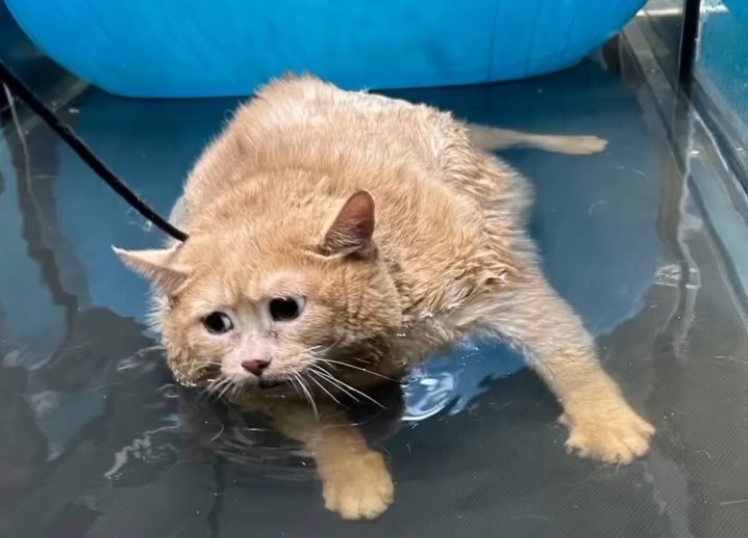
Crumbs was rescued from a bad situation where people fed him without regard for his health. Now he’s got a lot of work ahead of him as his new caretakers help him lose weight so he can walk on his own again.
Crumbs, the morbidly obese tabby who was rescued from the basement of a Russian hospital last week, is already putting in the work to melt pounds.
That means he’s enduring two things most cats hate — exercise and water. You’ll recall from our earlier post that Crumbs weighs 38 pounds and cannot walk under his own power, so his new caretakers at Matroskin animal rescue in Perm, Russia, have him on a special waterproof treadmill where he gets the benefit of buoyancy while he gets his steps in.
The big guy is not a happy camper in the video, but he’s doing his best.
I’ve heard horror stories about the hospitals in Russia and Ukraine, so if it sounds strange that the staff at a hospital would feed cookies, soup and other inappropriate food to a cat, well, let’s just say it’s not the kind of environment most of us picture when we think “hospital.” (Which is another reason to be grateful for living in the west, where we have it much better than most of us generally realize.)
Non-native English speaking staff at the Hindustan Times may have confused Whiskas the cat food brand with whiskey, the alcoholic beverage, or there may have been a translation error.
Interestingly, a Hindustan Times story about Crumbs claims the hospital employees served whiskey to the obese cat in addition to the junk food, a claim repeated in the headline and article.
That would add another wrinkle to an already ridiculous story, but thankfully it’s not true. Your intrepid friends here at PITB checked the original text and with the help of translation software, determined it used the Russian word for “Whiskas,” as in the cat food, not whiskey. (It probably goes without saying, but never give alcohol to your cat. As little as a teaspoon of whiskey could be fatal.)
So if there’s some small comfort here, it’s that the people who fed Crumbs for so long weren’t completely ignorant to his needs, and it appears he got at least some species-appropriate food.
Crumbs shortly after he was rescued. Credit: Matroskin animal shelter
Feeding strays is now punishable by a $150 fine in an Ohio town, the latest municipality whose elected leaders chose to ignore expert guidelines on managing feline populations.
Every time the stray cat issue comes up, local town boards and city councils act as if they need to reinvent the wheel.
Imagining that they are the first to deal with this extremely common problem, they make decisions from positions of ignorance, dismissing the concerns of people who actually work with cats. Or they “do the research” and come up with their own ineffective policies instead of simply looking at what other towns and cities have tried in the past.
At least that way, you know what works and what doesn’t, and how much your decision’s going to cost taxpayers.
But that would be the smart thing to do, which is why our local elected leaders don’t do it. Instead they pull stunts like the village board of Mogadore, Ohio, a town of 3,700 about 10 miles east of Akron.
The Mogadore board just passed a law that makes feeding strays and ferals punishable by a fine of up to $150, as if that will stop cats from finding food and breeding.
Tellingly, Mogadore’s elected leaders say their ordinance applies to “wild, stray, or un-owned” cats, which means they don’t understand they’re all the same species.
Apparently neither do the reporters at WOIO, a local news station in Cleveland. A story from the station is confidently incorrect in telling readers “[d]omestic cats that have become wild, meaning live outdoors, roam free, and rarely interact with humans, are also considered feral.”
Credit: Sami Aksu/Pexels
Felis catus is a domestic animal. By definition a domestic cat is not wild and cannot become wild. Evolution cannot happen to a single animal.
While evolution is a constant process, speciation — wolves becoming dogs, wildcats becoming house cats, wild boar becoming docile farm pigs — is a species-wide shift that takes at leasta few hundred years but often much longer, “from human-observable timescales to tens of millions of years” depending on the species.
The whole process results in changes at the genetic level. The transition from wildcats to domestic cats, for example, involved changing only 13 genes.
This is not rocket science, it’s basic stuff we all learned in high school science classes.
But that’s almost beside the point.
Fining people for feeding stray cats, including caretakers who voluntarily manage cat colonies, will not solve the problem. It doesn’t work. It has never worked in any town anywhere in the world.
It also creates a needlessly adversarial relationship with the passionate people doing the hard work of managing the feline population, often thanklessly and at their own expense. Why make enemies of them when they’re doing a public service?
Mogadore’s village board had a representative from Alley Cat Allies and people from local rescues on hand to inform them that fines don’t work, and to offer the humane and effective option of trap, neuter, return. TNR may not be perfect, but it’s better than anything else people have tried.
Mogadore’s board and mayor ignored the experts and went ahead with their plan to fine people instead.
They’re not alone. This happens thousands of times across the US, Europe, Australia and most other places where domestic cats live. Japan and Turkey take a more humane approach, and they’re better for it. But here in the US, we often deal with issues by ignoring precedent and engaging in wishful thinking.
If the residents of Mogadore are lucky, their elected officials will realize their mistake sooner rather than later.
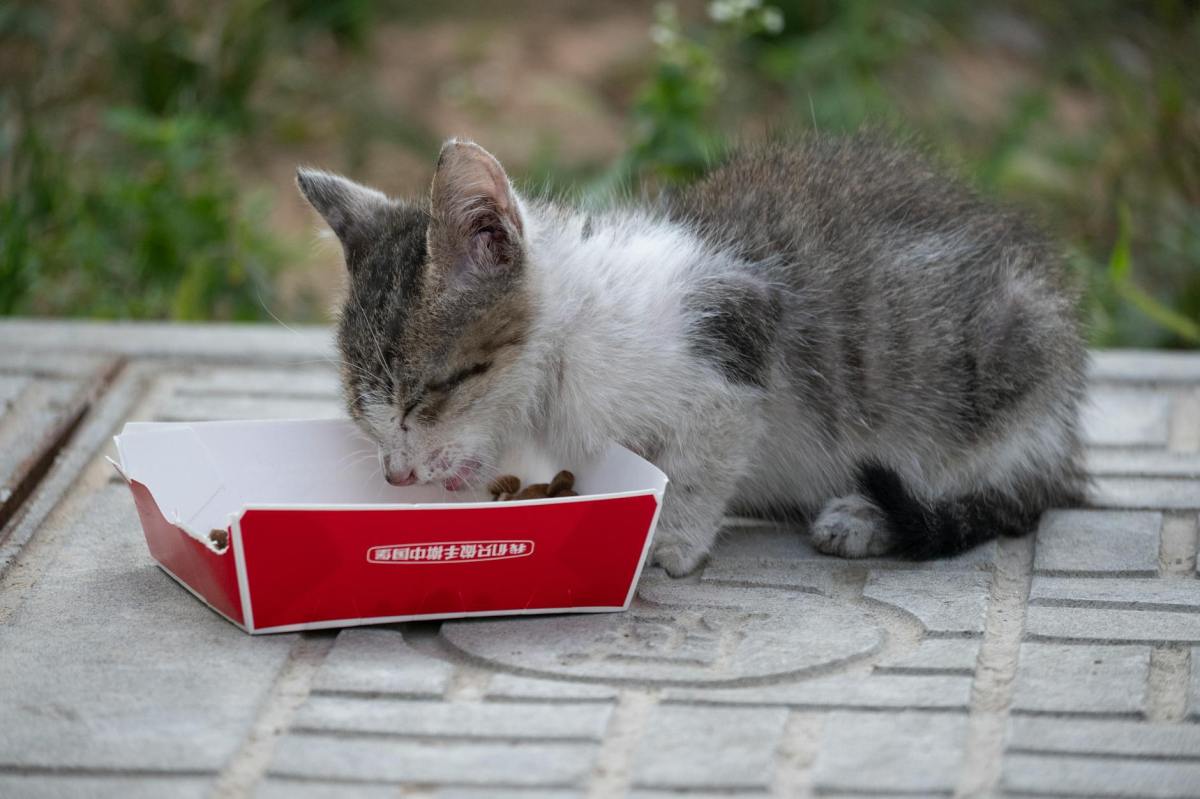
Stray and feral cats already have a difficult existence without ill-advised laws making it illegal to care for them. Credit: Mehmet Fatih Bayram/Pexels
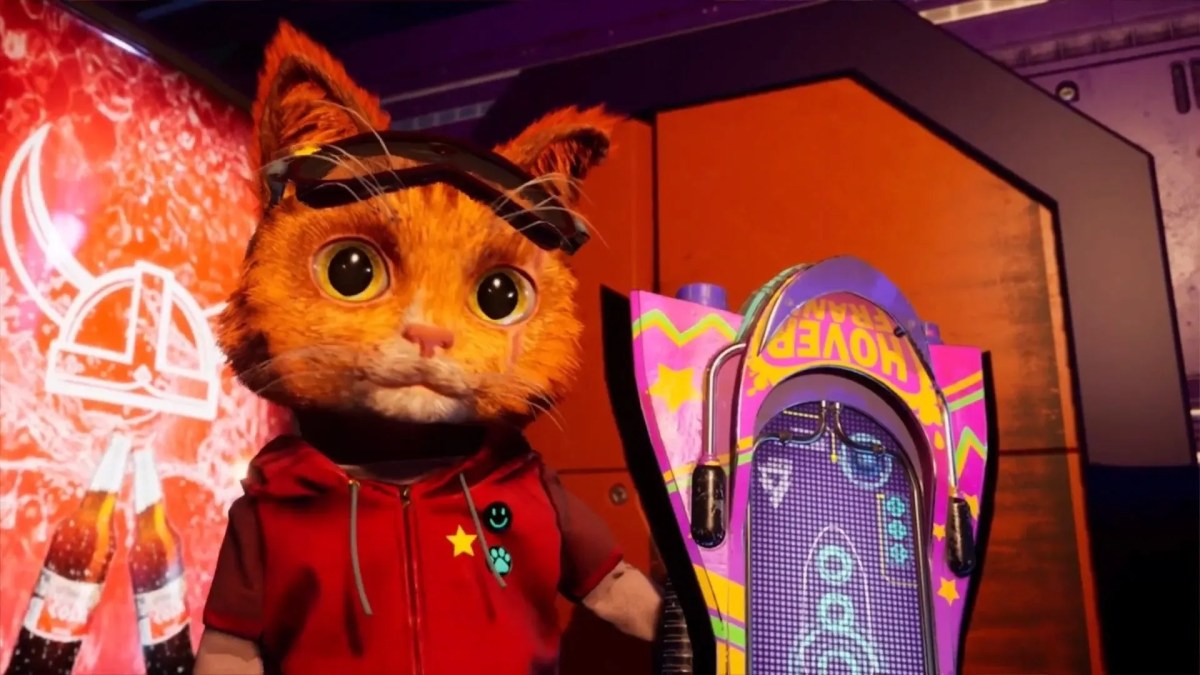
Gori is a cat game for people with a sense of humor and a love for high-octane, chaotic fun.
There’s a moment in the very first stage of Gori: Cuddly Carnage when you get your first weapon upgrade, and your talking hoverboard, Frank, chimes in: “Yeah! A new weapon! Let’s try it on those little shits!”
The “little shits” Frank is referring to are undead unicorns, cute little bad guys who squeak and hop but will murder feline protagonist Gori if he doesn’t kill them first.
And that’s what Gori: Cuddly Carnage is about: killing enemies, and doing it in the most stylish way possible, with satisfyingly-animated moves that involve spinning, smashing and slashing the bad guys with your hoverboard as you zoom through neon-lit levels at a frenetic pace. All of this is set to a grinding metal soundtrack, with high-sustain solos and singers extolling the awesomeness of Gori.
Gori himself is a cute orange tabby cat who happily meows as he executes rail slides and jumps, but this is not a game for children. Developers Wired Productions and CouchPlay have aimed this at cat lovers with a dark sense of humor and gamers who enjoy the nonstop war dance of games like Ghostrunner and the modern Doom franchise, which reward you for an improvisational and fast-paced approach to challenges.
The more quickly you complete levels, the more acrobatic your approach, the higher your score.
Cuddly Carnage’s gameplay feels more like Jet Grind Radio and Ghostrunner than Tony Hawk, despite our hero getting around on a board. Credit: Angry Demon Studio
The game gives you four difficulty choices, from Indoor Cat (“Easily slay enemies left and right in between naps!”) to Cuddly Carnage, the most difficult setting that promises aggressive enemies who hit hard. I’m terrible at games that involve heavy wall-running and constant speed, so I chose the second-easiest difficulty, although the difficulty level seems to have less to do with pace than it does the challenge posed by enemies. Next time I’ll kick it up a notch.
If there’s a story here, it’s almost incidental and serves only to introduce the comically absurd setting. Gori’s spaceship is destroyed, and he’s landed on the ruin of a planet abandoned by its human settlers to find a new ship. Why does he need a ship? To find yums and toys, of course.
The early game looks a bit like the third installment of Borderlands and plays like a faster version of Jet Grind Radio with the aforementioned elements of balletic violence. Hilariously, the first level is littered with what look like abandoned Tesla Cybertrucks, which you can slash in half with your hoverboard to collect resources.
Gori hovers and battles his way through bright, neon-lit streets filled with bizarre and hilarious enemies. Credit: Angry Demon Studio
Cuddly Carnage eases you in, showing you how to execute moves and how to navigate the levels by rail grinding. The idea is to stay airborne as long as possible, using your feline agility and Frank’s boost abilities, descending only to unleash whoopass on your enemies.
While Gori: Cuddly Carnage represents another welcome “play as a cat” game, it’s a completely different beast than 2022’s slow-paced, thoughtful Stray or this year’s playful Little Kitty, Big City.
We played the PC version via Steam, but the game is also available on current versions of XBox, Nintendo Switch, and PS4/5. Steam reviews are extremely positive so far, with 97 percent of reviewers recommending taking a spin with the manic meowster.
Gori is designed as a cute orange tabby, but he’s also a slob: his ship is littered with toys and empty cat food cans, and he loos like he could use a good grooming.
The petition says “an exceptional teacher” has been “unjustly accused.” The petition’s creator blamed “snowflakes” for sharing the video of the incident with police, who arrested the teacher on Aug. 25.
A new petition claims Texas high school teacher Emily Marie Benner has been “unfairly accused” of abusing a cat and demands Benner’s school district reinstate her as a teacher immediately, “no questions asked.”
The petition’s creator blames “soft, slow-minded” “snowflakes” for allegedly manufacturing outrage, claims Benner could sue police for arresting her, and demands authorities drop charges against her.
Benner was arrested on Aug. 25 after police and school administrators were provided with a video showing the 25-year-old teacher allegedly abusing a cat two days earlier. In the video, which was shot in a classroom at Westwood High School of Palestine, Texas, Benner tells her students to hold the screaming feline down as she staples shut an incision on the cat’s abdomen, according to police, who also said the cat was not given anesthesia.
Benner was teaching an animal science class but is not a veterinarian and isn’t licensed to practice veterinary surgery. It’s not clear how she obtained the cat, nor have authorities said who made the initial incision on the cat’s abdomen. Police said the feline is recovering in the care of a veterinarian.
According to the petition, Benner is “a dedicated agricultural teacher in Westwood” who “has been unjustly accused of animal cruelty.”
“Her charge not only questions her professional integrity but also jeopardizes her role as an influential educator in our community. As people who appreciate her significant contributions to education in Palestine, TX, USA, we understand how detrimental this baseless accusation is to our local education system. Considering she has been an exceptional teacher, we call for the immediate dismissal of these charges and the reinstatement of Emily Marie Benner in her role, no questions asked.”
A still image from Benner’s high school classroom on Aug. 23 shows students holding down the thrashing, screaming feline while Benner staples its abdomen.
While Westwood School District Superintendent Wade Stanford said the “procedure amounted to animal cruelty” and promised to take “immediate and decisive action to address this issue” in a letter to parents of Westwood High School students, he did not say Benner was suspended or comment on her current status.
Benner’s arrest and alleged suspension as an educator is a “grave actionable breach to a respected member of our community,” the petition claims, asking signatories to help “right this wrong.” It also claims Benner has not been afforded due process.
“It’s the Christian thing to do and the right thing to do!” one person who signed the petition commented.
The petition’s creator, Jim Hughes of Palestine, made a post in Benner’s defense on Facebook, arguing that people were “spreading hate” by criticizing Benner. The post sparked arguments among locals who said home surgical procedures on animals are common in rural communities, and others who disputed that assertion, insisting it’s cruel not to provide the professional care of a veterinarian.
“Do you think everyone has the money to take their pet to the vet?” Hughes wrote, blaming the criticism on “snowflakes” who live in a “soft, slow-minded world.”
Arguing that animal owners “would be broke” if they sought veterinary help “for every incident,” Hughes said home surgery is just the way it’s done: “Every farmer I know castrates with just a pocket knife and no pain medicine.”







 Pain In The Bud