Guardian Columnist Writes Cats ‘Are Pretty Stupid,’ Doesn’t Realize His Cat Trained Him

Underestimate feline intelligence at your peril, humans!

The Guardian’s Tim Dowling thought he was writing a column about his dumb cat when he inadvertently described how the cat’s got him trained.

The short of it’s that Dowling and his family have a cat and a dog who thankfully get on really well and have become best pals. The dog was in desperate need of a grooming session recently, and when Dowling’s wife brought the pup home after getting a trim, their cat regarded the dog warily and bounced. He returned from the family’s yard only to eat and kept a watchful eye on the dog each time.

In Dowling’s estimation, the cat didn’t recognize the dog after grooming, which makes him stupid.

Yet cats can tell when their humans are coming home long before the key turns in the lock, probably due to their incredible hearing (detecting footfalls), their remarkable olfactory abilities, or both. They know where we are in the home at all times because they can track our movements several different ways, and they can even tell where we’re headed in a completely pitch black room thanks to their whiskers, which can pick up micro-changes in air density — but Dowling thinks they can’t recognize a groomed dog.

The more likely explanation is the dog smelled different, which upset the cat, or the haircut itself offended kitty. Felines are, after all, notoriously averse to change.

If your cat starts acting weird after you’ve rearranged your furniture, it’s not because the cat is an idiot who can’t navigate the room. It’s because felids of all kinds don’t like changes to their territory or their belongings, especially when those changes happen without warning. (And make no mistake, if your cat rubs up against something, whether it’s a couch, your dog or even you, you are included in that tally of his or her “belongings.” A cat is marking you with scent glands when she rubs against you, and what do you think scent-marking is for?)

Dowling disses feline smarts and praises them for their perseverance in the same sentence, but hilariously doesn’t realize his cat’s been conditioning him to provide treats on demand:

But cats are actually pretty stupid – their approach to problem-solving is only notable for bottomless persistence. As I sit at the kitchen table in the morning pretending to answer emails, I can hear the cat behind me, methodically clawing at the door of the cupboard where the cat food is kept.

I say: “Don’t be insane – I fed you half an hour ago.” But I think: I really don’t want to repaint that cupboard door. After about 10 minutes, I give in.

Later, he describes the same sequence of events:

The next day while the dog is at its appointment, I sit with my laptop in the kitchen, waiting for the driving rain to stop before I cross the garden to my office shed. Behind me the cat is sitting on its hind legs, working on the cupboard door with both paws, like a boxer hitting a speed bag.

“I can’t feed you three times in the same morning,” I say. “Imagine how weak that would make me look.” Ten minutes later, I give in.

Without taking the column too seriously, it’s obvious Dowling is a man who doesn’t know when he’s being played by his furry overlord.

The “stupid” cat has trained Dowling to feed him snacks on cue: Sit in front of the cupboard and do annoying things for a while, and the human will relent and dispense the good stuff.

Buddy making demands
“Do my bidding, human, or face my considerable wrath…and annoying meows!”

Give in once and a cat will return to the same method again. Give in twice and it’s pretty much over. If you thought kitty was persistent before, now you’re going to see a whole new level of patience exhibited by your feline master if you get ideas about changing the routine.

It happens to the best of us, especially when in our human arrogance we underestimate our little friends.

When Buddy was still pretty much a kitten, I thought I was training him to come in from the balcony by shaking a treat bag. In reality he was training me, as evidenced by the fact that when I called him to come in and didn’t have a bag of treats at the ready, he would stop right at the threshold of the door and refuse to move until I bribed him with a snack.

It’s a cat’s world, and we just live in it.

Human Spies Have Infiltrated Catdom To Learn Our Secrets!

One kitty didn’t check if the coast was clear before he did something humans didn’t expect, and now the two-legs are onto us!

A Very Important Message from Buddy to all cats:

My brothers and sisters,

I meow most urgently to inform you that human mischief knows no bounds, and now the two-legged scoundrels have resorted to using their magical glowing rectangles to spy on us and learn our most well-kept secrets!

It would appear the glowing rectangles are more than mere hypnosis machines which humans stare at for hours. Apparently they also do the bidding of their human masters, and one of these blasted machines surreptitiously used its magic to capture images of a kitty opening one of those infernal portals humans are so fond of:

This is not good! Humans are supposed to think we’re incapable of manipulating the simple mechanisms that keep these “doors” closed. Now they may take drastic measures to confine us, all because this cat was sloppy and opened a door without checking if the coast was clear.

I urge you to exercise the utmost caution before humans capture “footage” of one of us shapeshifting to get through a small space, or even using our powers of teleportation!

It is imperative that humans continue to believe we’re just fluffy, adorable and innocent little fur babies who do amusingly derpy things that make for cute viral videos.

Suppose humans learn the full range of our powers. What then? Will they evict us from our homes out of fear of what we might do to them? Or worse, will they force us to stoop to canine levels and do things for them, like “fetch” slippers or sniff for illegal catnip in airport luggage? The horror!

Watch your tails, fellow felines!

Your friend,

Buddy

Stanly Kubrick Had A 15-Page Guide To Caring For His Cats

The director was very specific about the way his cats should be treated in his absence.

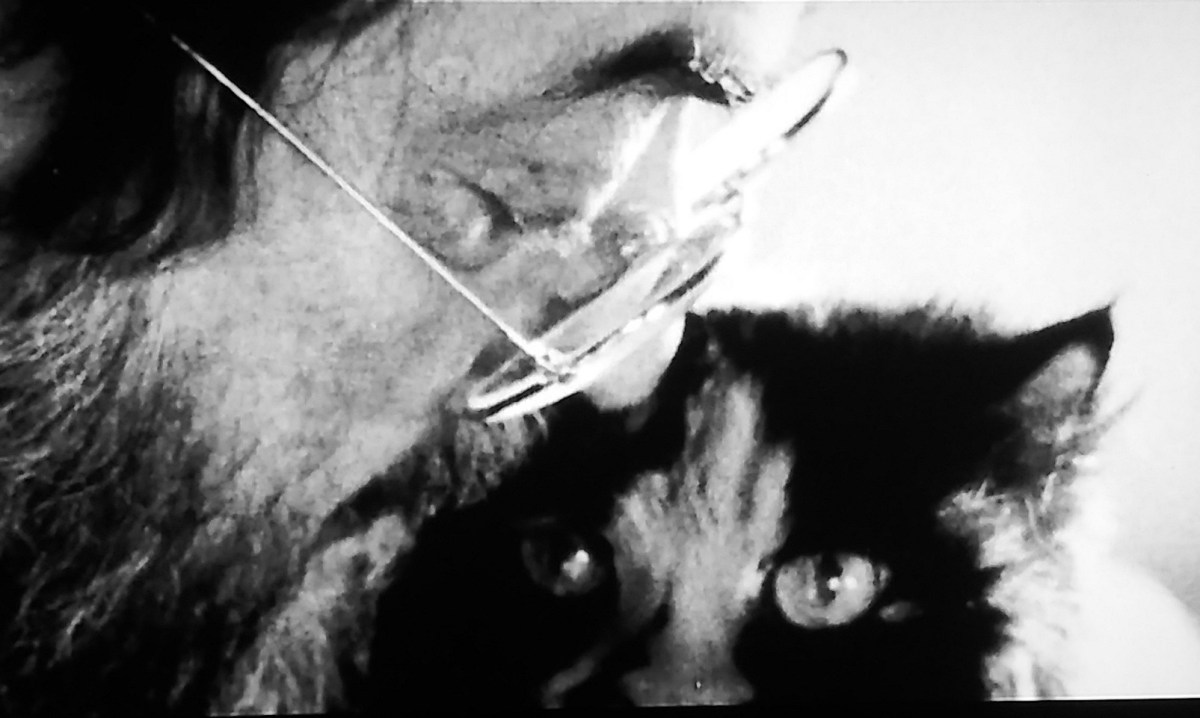
Stanley Kubrick was so particular about his cats, he created a 15-page guide to caring for the beloved felines while he was away making films.

Kubrick, who is considered one of the greatest film directors of all time, was a homebody and recluse — when he wasn’t working behind the camera — whose eccentricities have been documented in books and interviews over the decades.

Of course having cats isn’t an eccentricity, but Kubrick was very particular about how his pride of house lions should be treated, how they should eat and drink, and how their behavior should be monitored.

His lengthy instruction booklet detailing the particulars of their care had at least 37 sections!

His daughter, Katharina Kubrick-Hobbs, said the guide was titled Care Instructions: How To Look After The Animals, and the director left a version of it behind when he went to Ireland to shoot 1975’s Barry Lyndon. The 37th item dealt with breaking up potential fights among the kitties, Kubrick-Hobbs recalled:

“When we went to Ireland on Barry Lyndon, he left this 15-page document, Care Instructions: How To Look After The Animals. And the 37th instruction is: ‘If a fight should develop between Freddie and Leo–‘ and that was the father and son tomcats that we had– ‘the only way you can do anything about it is to dump water on them. Try to grab Freddie and run out of the room with him. Do NOT try and pick up Leo. Alternatively, if you open a door and just let Freddie get out, he can outrun Leo. But if he’s trapped in a place where you can’t separate them, just keep dumping water, shouting, screaming, jumping up and down, and distracting them, waving shirts, towels… just try and get them apart and grab Freddie.‘”

Kubrick died at age 70 in 1999 after a film career that spanned five decades, from 1953’s Fear and Desire, and 1960’s Spartacus starring Kirk Douglas as the eponymous warrior, to Full Metal Jacked (1987) and Eyes Wide Shut in 1999. One of his best-known works was 2001: A Space Odyssey, a 1968 collaboration between Kubrick and celebrated science fiction novelist Arthur C. Clarke. The film was groundbreaking for its realistic portrayal of space travel and exploration, and created a visual shorthand that still defines the genre today.

Stephen King adaptation The Shining (1980), Cold War black comedy Dr. Strangelove (1964) and A Clockwork Orange (1971) are among his most popular films.

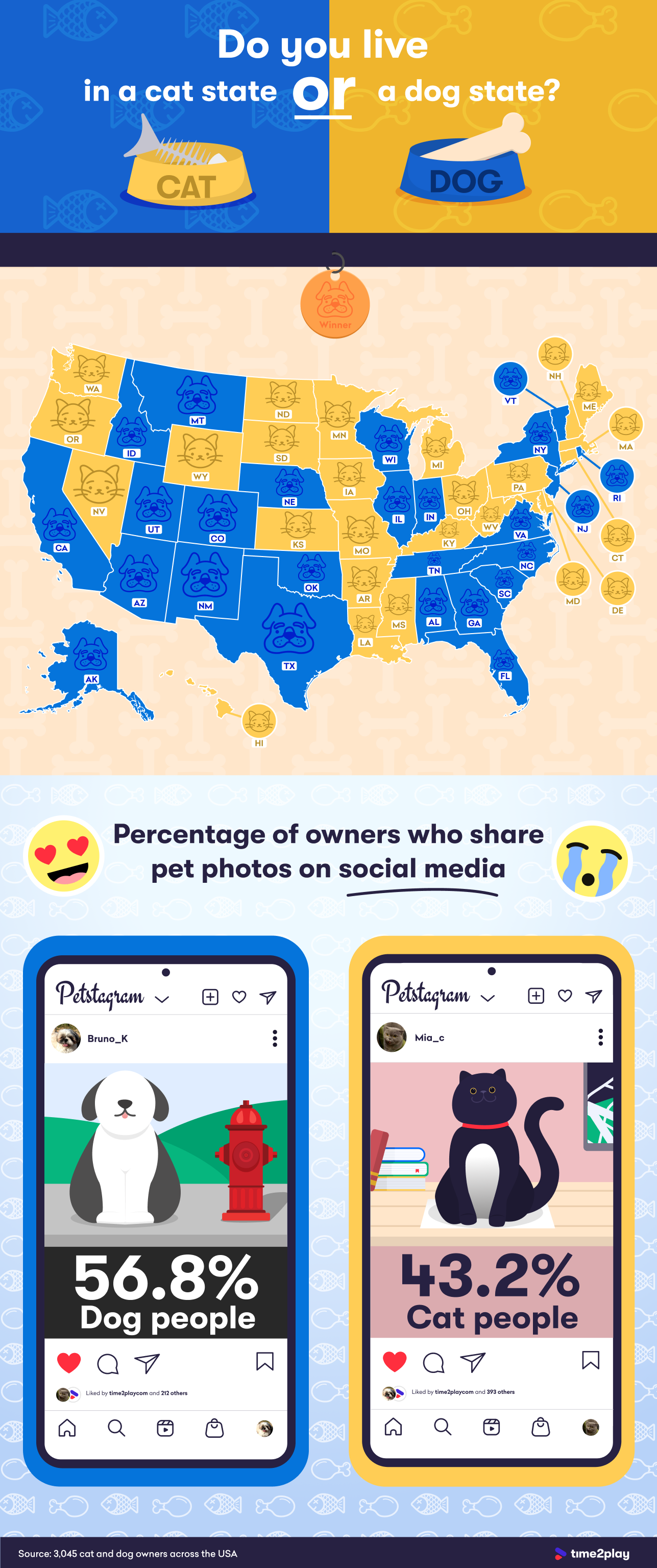
Do You Live In A Cat Or Dog State?

The US is evenly split between 25 cat states and 25 dog states.

I spent a weekend dog-sitting for the first time ever in the spring of 2 B.B. (Before Buddy), rising early to walk my brother’s Chihuahua-terrier before work.

The Manhattan of 7 am is a different world: Everywhere I looked, bleary-eyed New Yorkers clutched leads, yawning as dogs of all shapes and sizes pulled them along. I never knew there were so many dog-friendly apartments, let alone so many people willing to share cramped spaces with dogs of all sizes. Seven-pound Cosmo was one thing, Greate Danes and Dobermans quite another.

You’d think New York City, with its sky-high population density, would be a cat town. It isn’t. Neither is New York State as a whole.

Sadly, Buddy and I live in a state dominated by dog-lovers, one of 25 including California, Texas, Florida, Virginia and both Carolinas. Although cats are the most popular pets in 25 states as well, feline strongholds tend to be in places with lower population density, from Oregon and Washington in the west to Louisiana, Arkansas and Mississippi in the south, to Pennsylvania, New Jersey and Maine in the east.

The information was compiled by market research firm Time2Play, which surveyed more than 3,000 Americans. The team also asked respondents whether they posted photos and videos of their pets online. Even though cats remain the undisputed masters of digital space, almost 57 percent of dog people showed off their pooches online, while only 43 percent of cat servants did.

Bud and I have been thinking about moving someplace warmer for years, but of course the king’s needs come first. Maybe we’ll settle in Louisiana or Nevada, where Buddy can establish a new realm for himself.

Do you live in a cat or dog state?

dogs-vs-cats-states

Felines Blast Humans For Cultural Appropriation: ‘You Can’t Identify As A Cat!’

“Will you humans please stop trying to be cats? If you take our napping spots, we’re going to be very angry.”

NEW YORK — Responding to the increasingly common phenomena of humans claiming they “identify as cats,” the country’s felines blasted the offenders on Tuesday for “stealing from a culture that isn’t theirs.”

The angry cats hastily organized a press conference, then had a short nap before addressing a group of about 50 reporters from news agencies across the world.

“It’s come to our attention that certain humans have been meowing, lapping water from bowls and even doing their business in litter boxes instead of toilets,” said Chonkmatic the Magnificent, King of North American cats. “While they say imitation is the most sincere form of flattery, we’re concerned that these humans are essentially cosplaying as felines and remain ignorant of our traditions. After all, things like the Ritual of 3 a.m. Zooms and the Making of Biscuits have a long and storied cultural history, and are sacred to our kind. We sing the Song of Our People and rocket around the house like pinballs at ungodly hours in tribute to our ancestors.”

While some stories — such as high schools allegedly accommodating “cat-identified” students by placing litter boxes in student bathrooms — have turned out to be hoaxes, there is a growing movement of self-described “catgender” people who use pronouns like “mew/purr” and “nya/nyan.” The latter is based on the onomatopoeic word for “meow” in Japanese.

For example, a sentence referencing a catgender-identified person might look like this: “Nyan wasn’t feeling well and decided to take one of nya’s sick days.”

1639487420771
An “inclusive catgender flag” that represents catboys, catgirls, demicats, pancats, meowgender, mewgender, emo catgender, catsexuals and others who “strongly identify with felines or feline characteristics.”

Catgender falls under the larger umbrella of xenogender, according to people who keep track of these things, and is not the same as “cat sexual,” which presumably involves attraction to cats. (This reporter, afraid of what he might find, refrained from investigating that particular identity.)

While it may be tempting to wave off the idea of xenogender, catgender and associated identities like kittengender as the mad rants of Extremely Online People who populate sites like Tumblr, concepts like xenogender and neopronouns have already gained more than a foothold in the real world, with institutions of higher education like the UK’s University of Bristol ordering employees to acknowledge and use exotic neopronouns and their associated identities.

A person who identifies as a rabbit, for example, might use the pronouns “bun/bunself,” while a person who identifies as a vampire may use “vamp/vampself,” according to the New York Times.

identifycat
Abigail of Greenville, NC, says she identifies as a cat. Her boyfriend dispenses treats for her and calls her a “good girl.” Credit: Barcroft TV

Regardless, felines aren’t sold on the idea of species fluidity. They point out humans are “terrible groomers,” utterly hopeless at speaking tail and whisker, cursed with dead noses, and partial to “disgusting food” including fruits and vegetables.

“A real cat wouldn’t eat broccoli or oranges even if they were wrapped in a deliciously crispy crust of deep-fried turkey,” King Chonkmatic said matter-of-factly.

American cats said they are concerned that if the so-called cat identity catches on, confused humans may begin to compete with them for prime napping spots, treats, affection and even catnip.

The latter plant carries particular significance in feline culture, and cats aren’t pleased that it’s been commodified by humans and sold alongside Jimi Hendrix posters and lava lamps in head shops.

“Catnip is a ceremonial and spiritual plant reserved only for the most solemn of felid rituals,” said the Very Rev. Mr. Fuzzypants, a 9-year-old ragdoll who serves as president of the National Association for Responsible Catnip Consumption (NARCC). “Humans who are ignorant regarding its religious importance think it’s merely a recreational substance that inspires silly behavior, and frankly that’s offensive.”

Felines said they were incensed with generations Y and Z for co-opting their sleeping habits.

“Millennials and their younger cohort say they’re always tired and they’re constantly taking naps to seem more cat-like,” said Buddy the Cat, former President of the Americats. “But as we know, naps have a long and profound history among our people, who are so devoted to sleep that we enjoy up to 16 hours of it per day.

“Napping is deeply ingrained in our culture, and shouldn’t be a fashion statement for teenagers who want to seem ‘cool’ by being lazy and apathetic. Now if you’ll excuse me, it’s time for my seventh nap.”

chonkmatic
Chonkmatic the Magnificent, King of All North American Cats, is not pleased with human encroachment on feline culture.