Incidents like Sunday’s attempted cat robbery are happening more often in recent years, a forensic investigator specializing in animal-related crimes says.
Pet theft is a low-risk, high-reward way for the criminally-minded to make a quick buck, which is one reason why such crimes have become much more common since the pandemic, a forensics professor told the New Haven Register.
But first we’d like to draw your attention to an announcement we made back in February of 2021. At the time pet theft was in the headlines after robbers shot a man walking Lady Gaga’s breed dogs, while across the country in Portland a man stole a van full of daycare-bound pups.
Here’s what we wrote at the time:
“Buddy would like everyone to know he does not actually live in New York, and that his true location is a secret.
“I could be living in Rome,” the troublemaking tabby cat said. “I could be Luxembourgish. Maybe I live in Königreich Romkerhall or the Principality of Sealand. You just don’t know.”
“The one thing you can be certain of is I definitely don’t live in New York.”
We would like to make clear that we continue to blog from Not New York.
On a more serious note, financial woes brought on by the pandemic, painful inflation and a generally difficult economy have attracted the criminally inclined to the petnapping trade, and as Maxwell pointed out to the Register, few people are held accountable for animal-related crimes. That includes darker endeavors like dog fighting and puppy/kitten mills.
“Sadly, animal cruelty in general is under-prosecuted, and very, very few actually end up resulting in jail time,” Maxwell said.
A cat stays above the fray and surveys her surroundings from an elevated perch. Credit: cottonbro studio/Pexels
Sometimes pet thieves are opportunists who see a cat or dog who catches their fancy, or they believe might be worth money. Those cases often include people luring well-loved animals off porches and property with food.
Most, however, are people who intentionally target breeds that command high prices and are primarily responsible for what Maxwell says is a 40 percent spike in petnappings since early 2020. For felines that means Bengals, Savannahs, Ragdolls, Maine Coons, Norwegian Forest Cats and other breeds that can net the thief a solid payday for minimal effort.
“They’re going to steal your pedigree cat, your pedigree dog that’s worth thousands” and immediately flip the animal, Maxwell told the newspaper.
Social media, it turns out, is a double-edged sword.
While cops and animal welfare organizations warn people against showing off valuable pets online — and urge people to disable features like location tagging — the same platforms are often invaluable for retrieving stolen cats and dogs. Groups on sites like Reddit and Facebook help people find their well-loved four-legged family members and warn others when they identify resellers.
The would-be robbers knew the cat was worth money and specifically targeted the victims, according to police.
Two armed men broke into a Connecticut home on Sunday afternoon and demanded the victims turn over their “high dollar value cat,” according to the East Haven Police Department.
The would-be robbers initially tried to force their way into the East Haven house through a rear sliding glass door, but when the victims tried to prevent them from getting in, one of the men simply kicked through the glass, cops said.
That’s when the intruders brandished a handgun and demanded not cash, not jewelry or other valuables, but the cat!
The kitty in question must have been spooked by all the commotion because the frustrated robbers left empty-handed after a few minutes of fruitless searching. They hopped into a blue BMW and sped off, the victims told police.
Cops didn’t offer any description or breed information about the feline, describing it simply as a “high dollar value cat.”
It’s not uncommon for prized breed cats to command $5,000 from prospective buyers, and some breeds like the “exotic” Savannah cat can sell for as much as $20,000.
Bengal cats like the one above are favorite targets of thieves. Credit: jerry u6770/Pexels
While it’s unusual for someone to break into a home and demand a cat at gunpoint, in the middle of the day no less, cat theft is actually a thing.
Thieves most frequently go after Bengals, Savannahs, Maine Coons, Ragdolls and other breeds that can make them a quick buck by selling them to unsuspecting buyers. Surprisingly domestic shorthairs are on several lists of most commonly stolen cats, but a vet tech tells Reader’s Digest that moggies make the list simply because there are so many of them.
Part of the problem is that the penalties for stealing cats aren’t prohibitive. Most states either treat cats and dogs as property that can simply be replaced, or classify theft of pets in archaic agriculture and markets laws, which were designed to deal with disputes over livestock and farm animals, not pets.
In Sunday’s attempted robbery, police found the BMW abandoned in Hamden, a town about 10 miles north of East Hampton. They’re still looking into the unsuccessful caper, telling local media that the attempt was planned, not a crime of opportunity or a random event.
Still, if you have a “high dollar value cat,” it’s worth taking some precautions. Here at Casa de Buddy we’ve installed a feline version of a panic room: a panic box! Reinforced with heavy shipping tape, the thick corrugated cardboard is sure to keep bad guys out while also remaining roomy, yet paradoxically snug.
The kittens died “foaming at the mouth, throwing up bright green.” Acts of vigilantism against cats are happening more frequently as junk science about their hunting habits spreads via news reports.
Cat rescuer Erica Messina was trapping stray kittens to get them out of the cold and into homes before winter, hoping the young cats would have better lives.
Instead, they died horribly shortly after she successfully trapped them from a lakeside colony in October.
“All of the 13 kittens that I had all passed the same way,” Messina told KBTV, a Fox affiliate in Beaumont, Texas. “They were foaming at the mouth, they were throwing up bright green and peeing bright green.”
Two weeks later, per KBTV, a dozen adult cats from the same colony died the same way the kittens did, “some with chemical burns on their noses.”
“I was upset. I was at work when I found out and I came out here and started asking people, you know, what the problem was,” Messina told the station. “I got no answers.”
Like others who have cared for large colonies of strays who were killed by overzealous birders, Messina says she now has PTSD as she’s trying to save the lives of the remaining cats. She’s managed to catch all but four of them with the help of other local cat lovers and rescue organizations.
They’re getting no help from the authorities. Police referred Messina to Beaumont Animal Care, who told her they can’t help unless she can prove the cats were intentionally harmed. Not only are they putting the burden of proof on the victims in this case, but the victims can’t speak for themselves.
‘A bird-watcher’s paradise’
The colony lived in Collier’s Ferry Park, a lakeside park that also borders marshes where migratory birds spend time alongside native species. Indeed, Beaumont, a coastal Texas city of 115,000, markets itself, and Collier’s Ferry Park in particular, as a prime bird-watching spot.
Collier’s Ferry Park in Beaumont, Texas, where 25 cats were killed in an alleged poisoning. Credit: National Parks Service
A 2013 story in the local newspaper, the Beaumont Enterprise, detailed how local officials and business owners were promoting the park as a bird-watching paradise, noting that “[b]irders in particular are a lucrative market” driving tourism in the city. The story explains how the park is ideal for birds and those who like to watch them, details prized species found there — including herons, the least grebe and cinnamon teal — and includes input from a zoologist with a focus on birds, along with a local businessman who leads guided bird tours on the lake.
Collier’s Ferry Park is also listed on a site for “birding hotspots” while Texas Monthly calls it “one of the country’s best bird-watching spots.”
It is precisely the sort of place misguided bird watchers, driven to rage by widespread junk science blaming cats for declines in bird population, tend to dispense what they believe is vigilante justice. It stretches credulity to imagine anyone but a self-styled conservationist who blames cats for bird extinctions would risk a criminal conviction to poison a colony of cats, especially in a well-known hotspot for bird watchers.
Junk science blames cats for declining bird populations
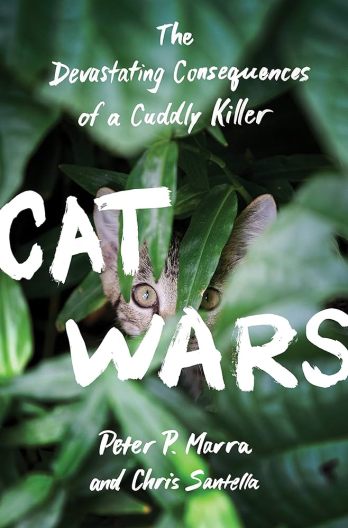
We’ve written our share about the disingenuous and agenda-driven activism that passes for research, most of it published by Peter Marra, a Georgetown avian ecologist who also authored the book Cat Wars: The Devastating Consequences Of A Cuddly Killer. The book advocates a “war” on cats and says they must be extirpated “by any means necessary” to protect birds and small mammals.
It does not, notably, put the blame on human activity, including but not limited to habitat destruction, the widespread use of harmful pesticides, wind farms, sky scrapers and all the other man-made structures, chemicals and machines that have contributed to a 70 percent decline in wildlife in the last 50 years.
But don’t take our word for it. Vox Felina calls Marra “a post-truth pioneer” who has claimed cats “kill more birds than actually exist,” while Alley Cat Allies echoes our own criticism by pointing out that Marra’s studies are composites of “a variety of unrelated, older studies” which his team uses to concoct “a highly speculative conclusion that suits the researchers’ seemingly desperate anti-cat agenda.”
“This speculative research is highly dangerous—it is being used by opponents of outdoor cats and Trap-Neuter-Return (including the authors) to further an agenda to kill more cats and roll back
decades of progress on TNR. And it is being spread unchecked by the media.”
In an NPR piece criticizing the studies blaming cats, Barbara J. King shares many of our own criticisms, chiefly that Marra and company have done no original research, relying instead on older studies, most of which have nothing to do with feline predatory habits, and none of which actually measure bird deaths from cats. King also notes, as we have, that it’s impossible to arrive at anything resembling a precise figure for feline ecological impact when Marra et al admit they don’t know how many free-ranging cats there are in the US, offering a uselessly wide estimated of between 20 and 120 million.
She also points out that the research team conducted “statistical perturbations” to massage the data into something fitting their agenda, which is activism, not science.
The researchers are guilty of “violating basic tenets of scientific reasoning when making their claims about outdoor cats,” bioethicist and research scientist William Lynn wrote.
“Advocates of a war against cats have carved out a predetermined conclusion,” Lynn noted, “then backfilled their assertions by cherry picking an accumulation of case studies.”
The war on cats
Across the world, people are using these studies and those of Marra’s acolytes to justify cruel cat-culling programs, like the recently-canceled cat hunt that would have rewarded children for shooting felines in New Zealand, and Australia’s widely-condemned mass culling that used poisoned sausages to kill millions of cats.
Stories of stray and feral cat poisonings in the US abound. Here at PITB we wrote a series of stories exposing how a government biologist in California took it upon himself to hunt cats under the cover of night, killing them with a shotgun and later celebrating in emails to colleagues, calling the dead cats’ bodies “party favors.”
Indeed, one of Marra’s own proteges, Nico Arcilla — formerly Nico Dauphine — went vigilante. Arcilla, who shares author credits with Marra on studies claiming free-ranging cats kill billions of birds, was a working for the Smithsonian National Zoo in Washington, D.C., when she was convicted in 2011 of attempted animal cruelty. The managers of a local colony, suspicious after strange substances began appearing in the feeders they’d set up for the strays, set up cameras which caught Arcilla placing poison on the food left out for the cats.
Back in Beaumont, Texas, a familiar story plays out: people who manage cat colonies out of love for the animals are working with local rescues, pooling together limited resources to save the remaining strays and hoping for justice.
“It’s terrible, you know? There are some people that just hate cats,” said Vyki Derrick, president of local rescue Friends of Ferals. “The rescuers have been trying to pull them out of the colony and it’s just sad that people want to interfere with that when the problem, ‘problem’ is being taken care of.”
Apparently a lot of people use the “pspsps” thing to get their cats’ attention, and Mental Floss has a new story proposing some theories about why people use it and why cats respond.
The first and most obvious is that felines hear higher frequencies than humans, and they’re especially tuned into those frequencies because their usual prey — including rodents and birds — not only make noises in the higher ranges, they make noise us humans can’t hear, but felid ears are primed to pick up.
Mental Floss’s Ellen Gutoskey also points out that it could be “a truncation of ‘Here, pussy, pussy, pussy’—popularized in part by ‘Pussy, Pussy, Pussy,’ a 1930s song by the Light Crust Doughboys. In fact, the tempo is fast enough that it almost sounds like they’re singing ‘Pspsps.”
I think she could be onto something there unless the “pspsps” sound is universal, but truthfully I have no clue whether people in other countries, or outside the English-speaking world, use it to call their cats. I don’t and never really needed to. Bud comes when called a good 85 percent of the time, and if he doesn’t I usually assume it’s for good reason, like he’s having a nice nap or he has no current use for his servant.
Miles the cat
The Guardian’s Hannah James Parkinson writes about adopting Miles, the shelter’s most skittish cat who had been passed over time and again until she came along.
Earning Miles’ trust wasn’t easy, but Parkinson did it with time, patience and love, and eventually Miles became her little buddy and even came out of his shell enough to make friends with another neighborhood cat.
Credit: Hannah Jane Parkinson
Unfortunately Miles got hurt, infected and died while he was outside overnight. Parkinson doesn’t say if the little guy got hit by a car, but the description of his initial injury is consistent with it.
The indoor vs outdoor thing is a thorny issue. I saw it as a more black-and-white problem until hearing from several readers who live in places like farmland or very quiet neighborhoods where the chance of a cat getting hit is small.
I don’t begrudge anyone making what they think is the best choice for their cat(s), except maybe for Australians and New Zealanders. Seriously, guys, bring those cats in before sadistic “hunters” get them in their crosshairs or they nibble on the poisoned meat that both governments like to use to “manage” the cat population. Neither country seems overly concerned with pet cats getting caught up in their zealous extirpation campaigns, and when birders are this riled up it’s best not to take chances anyway. If your cat isn’t spending time outdoors, it can’t be blamed for killing local wildlife.
I love dogs, but…
The Daily Mail has a horrific story about a pair of unleashed rottweilers that followed a woman into her home as she was carrying groceries and mauled her two pet cats to death in front of her traumatized children.
The attack happened around noon on Aug. 30 in a small town in the UK’s Western Midlands. The dogs came bounding in and snatched one of the cats off the kitchen counter, then mauled the other. The ginger tabby died immediately, either from shock or his severe injuries, while the other lived long enough to make it to the vet, who said the little tuxedo couldn’t be saved.
The woman told the newspaper her kids are having nightmares about the attack, while the police response was underwhelming to say the least, especially because the cats weren’t the only animals attacked by the roaming rottweilers.
“We were called to Raglan Way, Chelmsley Wood (on August 30) to reports of two dogs attacking another dog. The injured dog was taken to the vets to be treated,” a police spokesman told the paper. “The owners of the two dogs were spoken to and were taken back home to be secured by the owners. We have asked neighbourhood officers to speak to the dog’s owners regarding securing the animal, and will consider any further steps that need to be taken to ensure public safety.”
The owners of the dogs “were spoken to.” Wow. Let no one say the West Midlands Police don’t have a sense of scale. Perhaps if it happens again they’ll send a stern letter.
I hope the resulting media stories, and the beginning of the attack caught on a home security camera, lead to enough pressure that the police take the incident seriously and the owners of the dogs have to face consequences. There’s nothing prohibitive about talking to them. The only way irresponsible people are going to leash their dogs, especially dogs capable of this kind of thing, is if the consequences for not doing so are sufficiently prohibitive to make them think twice.
Finally, here’s a video of a cute baby kookaburra to balance out all that horribleness:
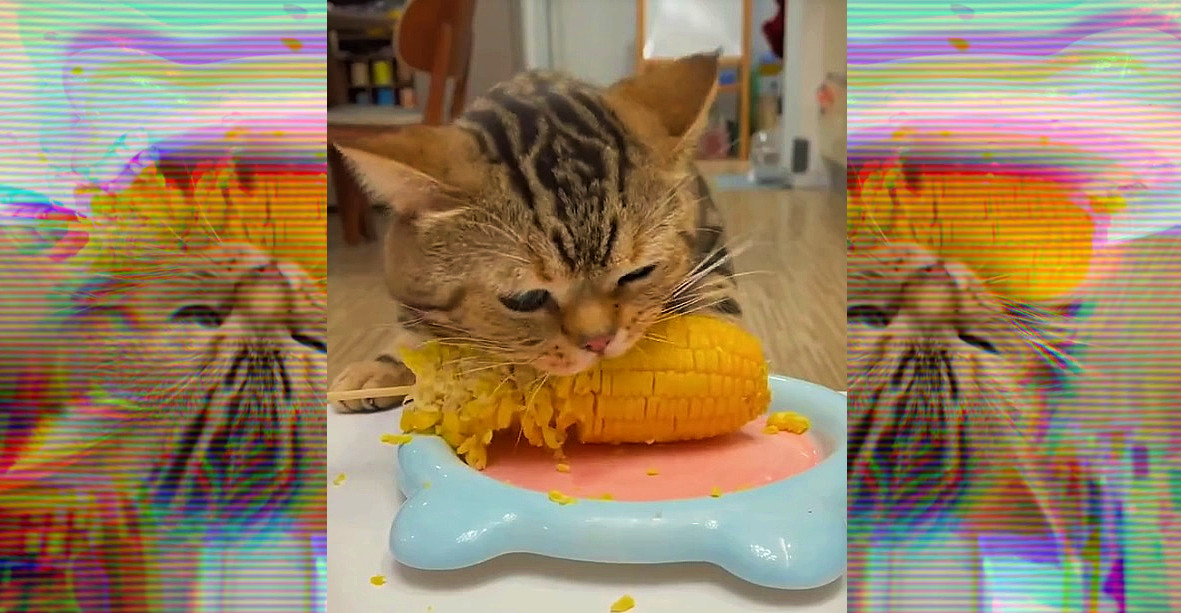
The English language does not provide the means to properly state how much this cat loves corn. To quote Dave Chappelle: “Look at him, he loves it!”
This isn’t just a video of a cute cat eating corn.
It’s a video of a cute cat who gives a cry of joy when he sees his human plop corn a cob of corn onto his plate, then tears into it with such gusto that he half-purrs, half-growls as he devours his yums. Seriously, make sure you turn the volume on, it has to be heard to be believed:
The Corn Kid, famous for declaring “When I tried it with butter, everything changed…I can’t imagine a more beautiful thing!” might be given a run for his money by this cat.
And if you haven’t heard about the Corn Kid, well, make your day brighter by checking out this songified version by the same guys who created a ridiculously catchy pop song out of the Bed Invader news segment back in 2010:
In case you’re wondering, corn won’t kill your cat. In fact, as veterinarians point out, your cat probably eats corn regularly because pet food companies use the stuff as filler in cat food despite the fact that, as obligate carnivores, cats don’t really get any nutritional value by eating it. However, it’s not meat, so if your cat likes corn, you should give it to kitty only in moderation as too much can cause an upset stomach and digestive problems.