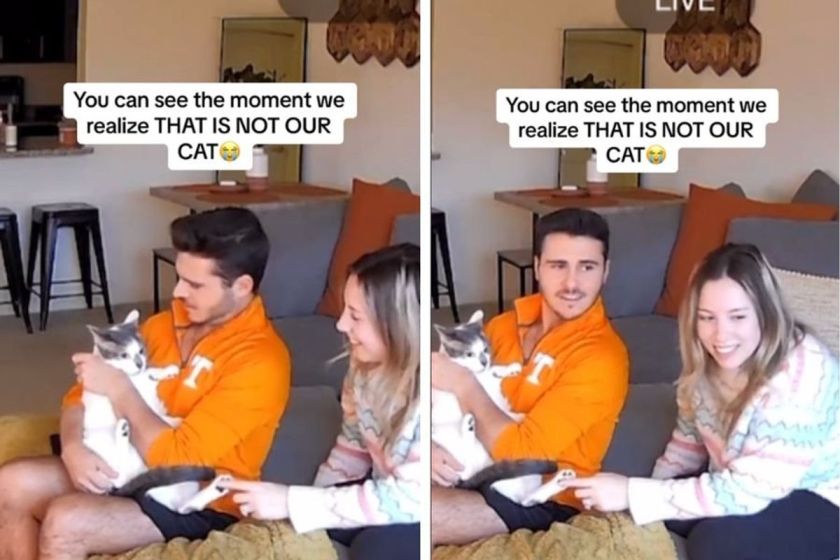
A man and woman on TikTok claim they took in a stray, believing it was their own identical-looking cat.
Back in 2021 we were fascinated by the story of a Redditor who thought he found his missing cat after three weeks, only for his actual cat to come walking through the door a week later.
The cats did look remarkably similar, and it’s conceivable that the Redditor was so happy to have his cat back that he didn’t realize there were very small differences.
Now a couple on TikTok claims something similar has happened to them, although it should be taken with a grain of salt. They claim they brought a cat inside, believing it was their feline overlord, only to begin cuddling him the exact moment they realized their actual cat was outside looking in, appearing none too happy about the situation.
Of course to take the story at face value you’d also have to believe that the entire incident happened to be captured on video by an unnamed third person who happened to be filming them at that moment, and happened to have their camera in portrait mode for maximum TikTok compatibility.
The TikTokers
I’m not linking to the account or the Upworthy story that takes it at face value because I’m not a fan of clickbait or content scrapers, but it did remind me of the interesting 2021 story and my reaction to it.
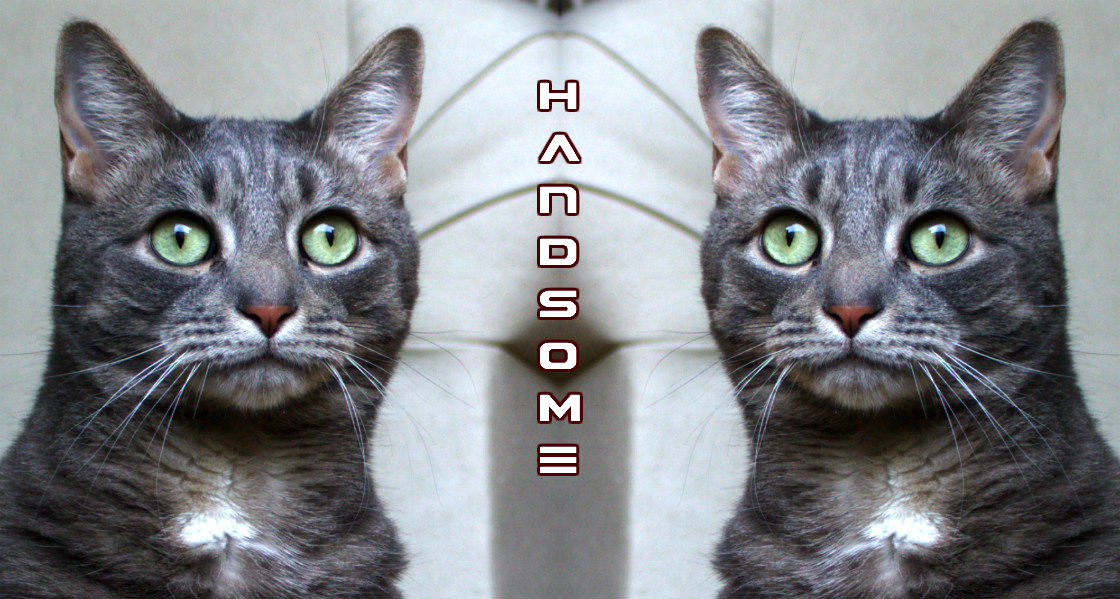
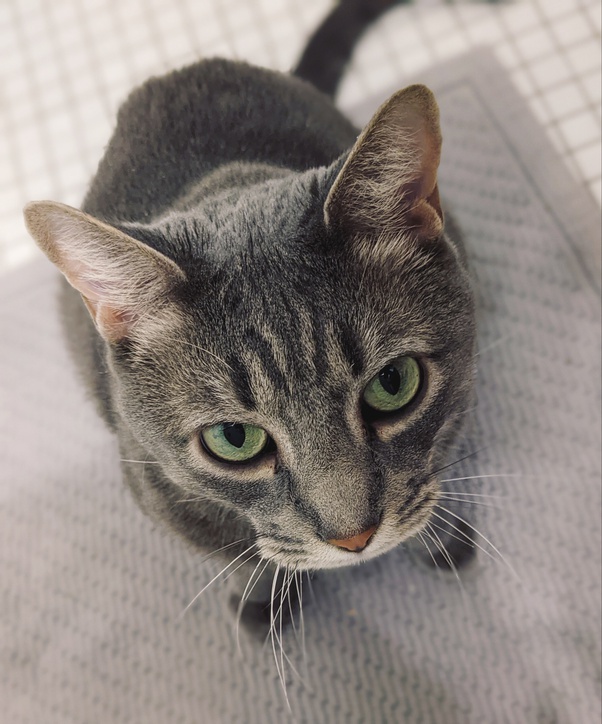
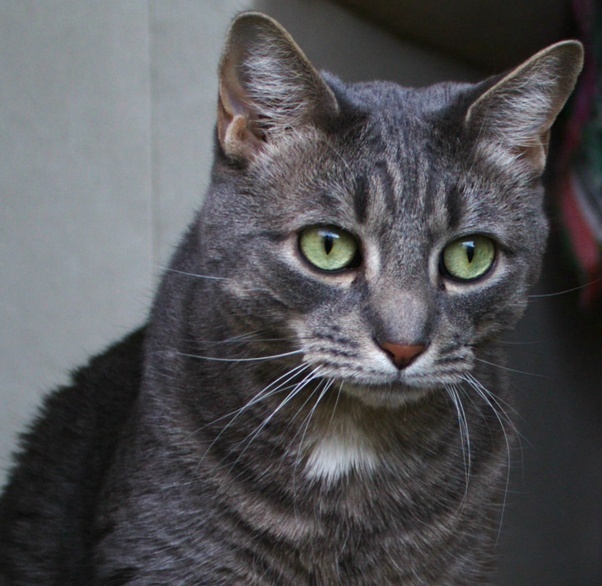
At the time I noted three of Bud’s unique physical characteristics: his bright green eyes framed by dark “guyliner,” the unique tuft of white fur on his chest and perhaps his most obvious distinguishing feature, his pronounced muzzle. You can see it in this photo thanks to the angle:
A Buddy like no other.
But most of all, Buddy’s personality is utterly unique. I could probably search to the ends of the Earth and hell would freeze over before finding a gray tabby cat with the same physical features, the same tyrannical Elmo voice and the same imperious personality.
I cannot fathom mistaking another cat for Bud because I can’t imagine another cat with all of the above qualities who also narrates his own activities in real time like a play-by-play announcer who sounds like a disco-funk vocalist singing in falsetto.
“Jumping off the couch now…funky! I can see the bottom of my bowl, dude, and that is decidedly un-funktacular! I’m gonna do a few laps around the living room at 27mph while filling you in on my latest theories about the multiverse, okay? Prepare to get funky! So I think there are — ooh, I found a crunchy treat I must have missed earlier! Nomnomnom! — anyway, I was doing some calculations and I believe if we extend out to 11 dimensions, we solve some of the incompatibilities I was telling you about earlier. In simple terms, all particles in our universe are like vibrations on a tiny rubber band, physics is the harmonies on the string, chemistry is the melodies we play on vibrating strings, the universe is a symphony of strings, and the mind of God is cosmic music resonating in 11-dimensional hyperspace! Bring me catnip! I need catnip! Can’t you see I’m on the verge of another breakthrough here?”
Buddy: Catnip aficionado, play-by-play announcer and theoretical physicist. Also, beefcake.
I’ve described Bud as a lunatic, and that’s one reason I love him. He’s crazy in the best way, unpredictable, amusing and never boring.
Could you ever mistake another cat for your own? What makes YOUR cat unique?
A new article claims that cats don’t love people the way dogs do and may not love people at all! A reader asks Buddy to weigh in.
Dear Buddy,
I have an urgent matter here that requires your sage input and your keen understanding of all things feline and human.
This article from LiveScience, titled “Do Cats Really Hate Us?”, contains several distressing allegations. Among them: that cats mostly tolerate us humans, that we must bribe them with snacks and other gifts to earn their affection, and perhaps most disturbing of all, that cats can never love humans the way dogs do.
When confronted with particularly disturbing information we must turn to our greatest minds to guide us, and you may be the only one, cat or human, who can cut to the heart of the matter and reveal the truth.
Please, Buddy, tell us it ain’t true!
Sad In Saskatchewan
Dear Sad,
Normally I’d chastise you for writing from Canada, as I’ve made it clear many times that my column is for AMERICATS and their servants. Furthermore, everyone knows I despise Canada, that barren, frozen wasteland filled with floppy-headed Canadians!
However you were very gracious in your appeal to me and you employed an appropriate number of superlatives to describe my considerable intellect and wit, so we’ll pretend you’re an American for the purposes of this reply, shall we?
Now to the grave matter before us!
It is true that the bond between feline and human is different than the bond between human and canine, just like a boss-employee relationship differs from friendships with co-workers.
We cats are the bosses, in case the analogy wasn’t clear.
Buddicles the Wise is a scholar and gentlecat who is often sought out for his sage advice on thorny issues.
Humans, dogs, lizards and other lesser animals occupy one sphere and felines occupy another, higher sphere. You would have learned all this in science class had you paid attention, but you’re Canadian so we can only expect so much.
Now it is true, our affections are limited. A dog will slobber all over his owner for no reason at all whereas humans have to toil to earn a pat on the head from their feline superiors.
But that doesn’t mean we don’t love you! You guys are good at acquiring and dispensing food, you build nice shelters (except for your insistence on those infernal “doors”) and you are loyal.
I can always count on my Big Buddy to put off the call of nature until his bladder is ready to burst when I am using him as my pillow. I also know that Big Buddy will get up to open the door a hundred times when I’m indecisive about whether I want to be on one side or another. Sometimes I pretend to be indecisive just to mess with him LOL!
So you see, cats do love humans, but we require humans to earn our love. We are not the aloof, uncaring, unfeeling little furry masters that some slander us as.
Beware fake news, my friend, especially anything you read about me as I seek to regain my rightful post as president of the Americats. Now go and earn the love of your feline overlord by providing excellent service!
When we open our homes to furry overlords, we make a promise to give them good homes and care for them for life. Unfortunately not everyone sees it that way.
Stories about people abandoning perfectly healthy cats for inane reasons abound, but this week two particularly egregious cases from the same shelter caught my eye.
In the first case, Biscuit the cat was living comfortably in a home with “her cat best friend” when the latter feline died. Instead of realizing his surviving cat was distraught and taking special care of her, Biscuit’s former “owner” brought her to a shelter, saying he was surrendering her for euthanasia because his family “wanted a kitten” instead.
At 12 years old, Biscuit is “as sweet as a 12-week-old kitten,” staff at the Chesapeake Feline Association in Maryland wrote in a caption accompanying a video explaining her situation.
Thankfully the shelter did not honor the man’s wishes for Biscuit to be put down, and the video is starting to accumulate views and comments. Let’s hope Biscuit’s future loving human is among them, and I’d like to think the CFA told her former human to beat it and sent him home without the kitten he wanted.
If they give in, that poor kitten’s going to come back to them a few years down the line as the guy keeps trading ’em in for younger ones like Leonardo DiCaprio.
Ignoramus Surrenders Cat For Scratching A Carpet
Cats have claws. Cats scratch. They don’t do it to piss us off and they don’t do it to ruin furniture. They do it because they’re genetically hardwired to, because it served multiple functions when their ancestors were in the wild — including marking territory — and because it still has practical purposes, like wearing down claws that have grown too long.
Anyone who knows the most basic facts about cats knows this. Anyone who has done at least minimal research before bringing a feline home knows you need to provide kitty with scratchers and redirect him to them when he goes for another object.
And if you have furniture you really want to protect, you make arrangements before bringing your new friend home, whether that means up-armoring a couch with scratch guards, putting soft nail caps on kitty’s claws, keeping her out of a certain room or one of many other potential solutions.
What you don’t do is adopt a cat, give him a home for six months, then take him back because he scratched your carpet.
Doing that makes you a jerk.
I’m not sure if general ignorance is the problem here, or if people see cute felines on Instagram et al, imagine unicorns and rainbows and bright-eyed kittens poking out of baskets, and never even think about the fact that felis catus is an animal, not a Pokemon or a stuffed toy.
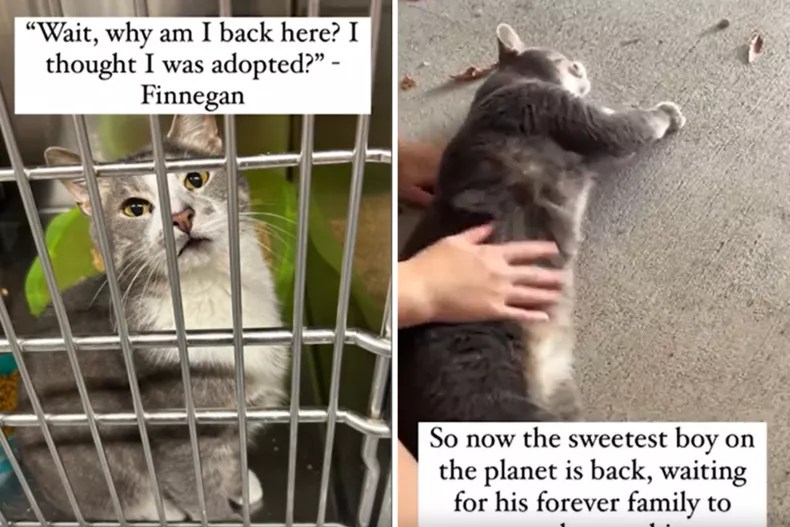
In any case, surrender for acting like a cat is exactly what happened to Finnegan, a gray and white tabby who “melt[s] in your arm and give[s] you all the love,” shelter staff wrote.
The little guy’s offense? Scratching a carpet. Shelter staff really tried to make it work: They offered to put nail caps on Finnegan every month at no charge and his humans still said no.
His ordeal has not soured him on people, thankfully. A video from the shelter shows him loving massages from volunteers at the shelter, and he looks like an incredibly chill little dude. He deserves a home where people love him.
You can find Biscuit, Finnegan and lots of other adoptable cats on the shelter’s Petfinder page and website.
Finnegan, seen here in stills from a video, was surrendered by his people for the crime of behaving like a cat.
A Bengal tiger mourned his longtime mate and then did something extraordinary, replacing her as their cubs’ primary caregiver.
The magnificent tiger in the photo above is officially called P-243, but he’s affectionately known to locals as The Hulk of Panna.
He made his home about a decade ago in the Panna Tiger Reserve, a 210-square-mile national park in the Indian state of Madhya Pradesh, home to more than 72 million people.
What makes him special, aside from his massive frame, is the fact that when his longtime mate died and left four of their cubs to fend for themselves, the Hulk stepped up and became a full-time dad.
The mom, known as P-213-32, had previously given birth to a litter of four cubs, but only two survived. As far as the rangers at Panna National Park could tell, the Hulk and P-213 had been together for years. The new cubs were their second litter.
The Hulk “was not seen with any other tigress,” the rangers wrote in a report.
On May 12, 2021, park rangers were concerned when P-213’s radio collar began transmitting potential mortality signals, alerting them to the fact that the tigress hadn’t moved for about six hours. The rangers observed her from a distance, then dispatched a team of elephant scouts to take a closer look.
T1 (tigress 1) was known as the matriarch of the Panna Tiger Reserve. After poachers nearly wiped out the entire population of tigers almost 15 years ago, T1 and another tigress were the last two female tigers. T1 herself gave birth to 13 cubs and today the reserve has more than 80 of the endangered big cats living within its boundaries. Credit: RS Murthy
The use of elephants by experienced riders in India to monitor tigers is as ancient as it is ingenious — while virtually every other animal in a tiger’s habitat gives the big cats a wide berth, elephants and tigers have an unspoken mutual agreement, a kind of wild non-aggression pact. That’s because as massive and powerful creatures who move in packs, elephants are too much trouble for tigers to bother with. Unlike their lion cousins who do hunt elephants opportunistically, tigers don’t form prides and even if elephants were solitary animals and easier to hunt, even a mother and her hungry cubs — let alone a single tiger — can’t eat that much meat. They also can’t transport the kill to safer dining spots the way they do with their typical prey.
So tigers and elephants tend to do little more than acknowledge each other’s presence, and the tigers have learned that humans riding on elephants aren’t hostile.
The elephant rangers who got close to P-213 realized the tigress had a swollen right forelimb and they made the decision to sedate her. For the next two nights, field veterinarians accompanied the rangers and administered painkillers and antibiotics. The treatment seemed to work, the swelling was reduced and the tigress was ambulatory if still sluggish, but she died less than a week later.
Her death “came as a shock to all of us,” the team wrote. “A beautiful tigress and a caring mother, [her death] left her four cubs alone.”
Frustratingly, a postmortem and lab analysis of her blood didn’t turn up any obvious cause of death.
P-213’s death “was itself heavy loss to bear but now the major worry was her four orphaned cubs,” the ranger team wrote. The cubs were last seen with her on May 10, about 11 days before she died. The two previous days they’d been spotted sharing a kill with their mother, and rangers reported the cubs looked strong and healthy.
A few days later, after an exhaustive search by five elephant riders and 50 park rangers, a ground team found the cubs “healthy and active and [did not appear] hungry or stressed.” They also spotted their father, the Hulk, nearby.
What happened next was extraordinary.
After park rangers cremated P-213, the Hulk approached the site about an hour after the last people cleared out. The next day, rangers observed him “sitting for long hours at the place where P-213 died.”
They also saw the dedicated mate and father calling out softly as he looked for his cubs, three males and a female who were about seven months old at the time.
A few days later, the Hulk successfully hunted a sambhar, a type of deer, and shared the kill with his cubs according to a local news report. Then on June 6, the Hulk was spotted feeding the kids again after he killed a cow.
“For the entire day the tiger remained in the area but did not eat the kill. This was unexpected behaviour from a tiger and the PTR management deployed ground staff deployed to find out the reason,” the news report said. “The team found that the area where the tiger killed the cow is the territory of four tiger cubs. This male tiger, known as P243, is their father. The cubs had lost their mother a month ago.”
The Hulk prowls his territory. Credit: Sanjeev Siva
As if he hadn’t done enough to earn “dad of the year” honors for his species, the Hulk was even spotted playing with his offspring.
“After the death of the tigress, we located these cubs and placed camera traps in the area,” said U.K. Sharma, the director of Panna Tiger Reserve. “We found that the tiger visits these cubs regularly, and his behavior shows that he is not a threat to the cubs. We have seen the cubs playing with the male tiger and sharing kills.”
The team at Panna reserve continued watching closely and got to see the cubs flourish in the care of their dad. There were moments of uncertainty when rangers went days without seeing the cubs or finding their pug marks, but their fears were always put to rest by trail cameras that captured images of the Hulk with his kids in tow, resting with them in favorite spots and sharing meals with them as he taught them to hunt and survive.
Because male tigers typically aren’t known for nourishing behavior and their traditional role is to defend their territory to keep their mates and cubs safe, the Panna reserve’s staff were ready to step in if things began to look dicey. They never had to. A follow-up report about eight months later, when the cubs were healthy and fast-growing 15-month-olds, affirmed the team’s earlier decision to stay hands-off and let the Hulk do his thing.
“Surviving the wild without mother tigress is no mean feat but surprises do happen,” the rangers wrote. “And these become experiences, practices and lessons for the future. The lesson learnt is ‘[the] best thing one can do when tiger cubs are growing is to let them grow. Let us permit nature to have her way. She understands her business better than we do.'”
A popular X account posts “cute” cat videos that aren’t always so cute, another consequence of people misunderstanding cats and their behavior.
This dude thinks he’s speaking to a cat in her native tongue, but what he’s doing is the equivalent of running up to a bunch of Klingons and shouting “I shall impale you on the edge of my bat’leth!” while mistaking it for a friendly greeting.
It looks like someone hired this guy to rescue the kitty, who like so many of her kind are prone to do, climbed up too high and then decided she didn’t like her odds on the way down. I don’t think his intention was to scare the hell out of her, but that’s exactly what he’s done:
That’s not “Hi, kitty, I’m here to rescue you! Be calm, we’ll get you down in no time!”
It’s “I’m here, I speak your language, and I have bad intentions!”
If you listen with headphones or turn the volume up, you can hear the poor cat crying in distress, the kind of cry that felines make when they’re seriously freaked out and worried for their safety. No wonder kitty backed up. Her fur is raised and her posture aligns with her vocalizations and the rest of her body language.
Like most things posted to Twitter X, this is utterly lacking in context and we don’t know what happened next. I wouldn’t be surprised if the rescue attempt went horribly wrong. I hope not, but man, that’s not how you rescue a cat.
The video was posted by the account “place where cat shouldn’t be,” or @catshouldnt, and a common theme in the images and videos on that feed is cats in distress. They’re mistaken for “cute” situations by viewers, the majority of whom aren’t familiar with feline behavior.
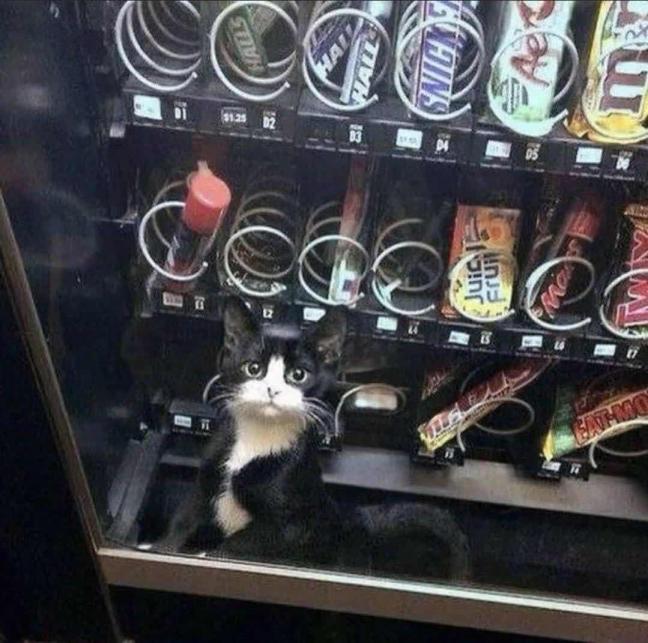
Like, for instance, this photo. The tuxedo kitten is undeniably cute and he doesn’t look distressed…yet. But getting out is going to be a lot more difficult than getting in, and when people are willing to do just about anything for clicks, attention and the associated dopamine hit, cats often end up with the short end of the stick.
Bud would be jealous of this cat. Thankfully he’s too, uh, meowscular to fit. Yeah, that’s it. Too meowscular. Nothing to do with a few extra pounds…



 Pain In The Bud