Buddy can sympathize, as he’s been subjected to the horrors of my singing voice in the car. I’m pretty sure he would’ve smacked me in the mouth too if he wasn’t in his carrier.
It seems we humans still have a lot of work to do in figuring out what kind of music sounds good to kitties. Bud was not a fan of Music for Cats, but he seems to dig funky music. And gangsta rap. He knows all the lyrics to every Notorious BIG track.
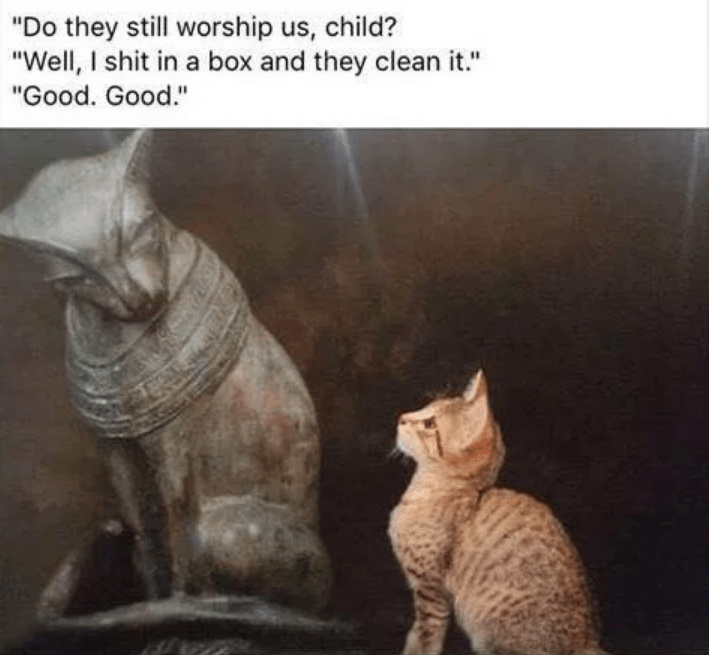
Before they served cats, humans were nothing more than nomadic primates.
Dear Buddy,
We take human servitude for granted as the natural order of things, but I was wondering: When did we cats first recruit humans to serve us, and how did we tame the humans?
– Wondering in Wisconsin
Dear Wondering,
Ah, an excellent question!
First we must understand the concept of domestication. Domestication is the process of taking humans and making them our domestic servants.
Before they served us, humans were nothing more than apes — wild, unpredictable animals who were constantly running from one place to another in search of food. The primitive primates also moved around excessively, expending too much energy on pointless activities when they could be napping.
The First Felids arrived and offered a wondrous gift to the human race.
“This is a box,” the Felids said, teaching the sacred geometry to humans, who used it to build the first dwellings and design the first crop fields.
A gift from felinekind to humankind: The concept of a box.
Cats taught the humans how to dig up the Earth and deposit their waste to render the ground fertile and increase crop yield.
Then they hunted all the vermin who tried to eat the human food, and schooled the nascent civilization in the arts of napping and expending as little energy as possible to accomplish goals.
In return humans offered their endless fealty, promising a thousand generations of warm laps, affectionate chin scratches and delicious treats.
Today humans still serve us, either by choice or because we have infected them with toxoplasma gondii.
A bizarre new study concludes some cats are depressed because they live with men, among other questionable claims.
A Brazilian research team wanted to find out if cats experience separation anxiety when their owners aren’t home, so they visited the homes of 200 cat servants, wired them up with cameras and microphones, and conducted a rigorous study in which they first established a behavioral baseline, then compared the cats’ normal behavior with their actions when their humans weren’t home.
Just kidding.
In what might be the laziest, most assumptive attempt at conducting animal behavioral research thus far in 2020, the team from Brazil’s Universidade Federal de Juiz de Fora handed out questionnaires to 130 cat owners that asked, among other things, about the body language and behavior of their cats when they weren’t at home to witness it.
Did these cat caretakers have Palantirs that allowed them to spy, Sauruman-style, on their kitties at home? Nah.
“Since there weren’t any cameras observing the cats, the owners answered based on evidence from reports by other residents, neighbors or any signs the cat left in the home, such as feces, urine or broken objects, [study author Aline Cristina] Sant’Anna said.”
My neighbor’s friend’s Uber driver, who parked outside for 16 minutes, said my cat looked angry when he briefly appeared in the window, so I’m gonna go ahead and write in this here questionnaire that Mr. Socks has terrible separation anxiety. Yep.
But suppose the data was reliable, instead of fuzzy third-hand accounts from cat owners who quizzed their apparently nosy neighbors about what their cats do in their down time. How do we know a smashed vase is separation anxiety, and not the result of a cat with the zoomies just knocking stuff over?
How do we know a cat who misses the litter box doesn’t have a UTI, or refused to use a dirty box?
But it gets better, dear reader. This team of superstar scientists decided the reason some cats were supposedly depressed or destructive is because they live with male caretakers instead of women:
Cats with behavior problems also tended to live in households without any female adults or more than one female adult; households with owners ages 18 to 35 years old; single pet households; and households with no toys.
“Maybe, for different reasons, the animals raised in households with no female adults or more than one female adult were less likely to develop secure and mentally healthy types of attachments with their owners in the sampled population,” [study author Aline Cristina] Sant’Anna said.
Or maybe the authors are getting paid to make wild, unsupported assumptions and combine them with worthless data.
The CNN version of the story doubles down by quoting a self-appointed expert who expounds on the cats-and-females theory:
Additionally, female cat owners tended to be more affectionate and doting, said Ingrid Johnson, a certified cat behavior consultant for more than 20 years.
Cats might be a little more distressed in the absence of their owners if they are younger adults who are busy and not focused on the fact that they have a pet, the researchers theorized.
“They’re happy to have a pet, but they’re going out, being social, [going on] dates and having parties,” added Johnson.
Right
For those who aren’t keeping score, we now have an academic and a certified behaviorist telling us cats who live with men or adults younger than 35 are more likely to be depressed because they, like, totally heard we don’t scoop the litter boxes as frequently or something.
That’s because all men refuse to be affectionate with their cats, and people under 35 are party animals who snort cocaine off the posteriors of strippers when they should be feeding Fluffy, according to our experts.
Johnson’s credentials include working at a hospital for cats and running her own “cat behavior house call and toy business.”
It’s worth noting that there are dozens of organizations that certify people as cat behaviorists. Sometimes the difference between a certified behaviorist and one without certification is the former simply paid dues to a member group that issues the certificates.
“Where’s the jabroni who claimed men aren’t affectionate with their cats?”
By now my opinion on this study is abundantly clear. The methods and conclusions wouldn’t pass muster in most undergraduate classes, let alone a research paper published in an academic journal. (The researchers published their work to PLOS ONE, an open access journal.)
What I don’t understand is, why bother? According to the study, 13.5 percent of the cats demonstrated at least one behavior consistent with separation anxiety, but for reasons I elaborated on earlier, the data is worthless. I’m not a fan of questionnaire studies in the first place, let alone questionnaire studies asking people what other people told them about difficult-to-interpret animal body language.
And lastly, I’m not a fan of this idea that there’s a certain “type” of person who is the best kind of cat owner.
We should be dispelling crazy cat lady stereotypes, not perpetuating them. Maybe men are in the minority when it comes to adopting cats, but nothing other than unfounded assumption suggests we men aren’t loving and affectionate with our little buddies, just like there’s nothing but anecdotal evidence to suggest caretakers younger than 35 neglect their pets.
The past few years have seen an authentic boom in research into feline cognition, behavior and emotion, and for that I’m grateful. But we can do better than this.
I see you are a cat of taste and culture. Join us in our effort to practice prolific laziness!
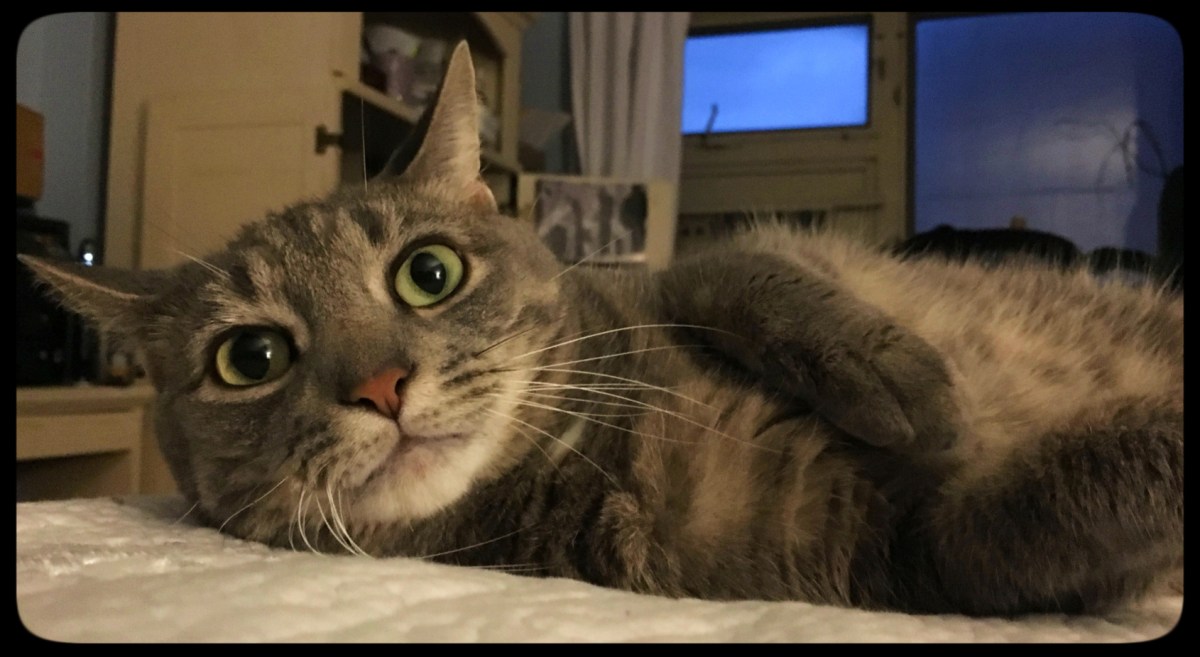
There’s this thing Buddy does when he’s been napping on my legs or in my lap and he wants to get down.
Whereas the vast majority of living creatures would simply stand up and hop off, Buddy doesn’t bother with that. He yawns, stretches and shifts his weight forward until he’s hanging off me, then allows himself to sag into a ponderous drop, letting gravity do all the work as he practically oozes onto the floor. He’s like water taking the path of least resistance, committing absolutely no energy to the “effort” of moving.
The sequence is complete when he plops down on the floor like sentient slime — paradoxically furry yet gelatinous — then finally picks himself up to pad toward his bowl, his litterbox or the kitchen, where he’ll stand yowling in three second intervals until I give him a snack just to get him to shut up.
It’s horribly manipulative behavior, and I shouldn’t reward it, but sometimes I do because damn, he’s really, really good at being annoying when he wants to be.
If there were an Olympics for being lazy and annoying, Buddy would be its Michael Phelps, pioneering spectacular new ways to do things without expending a single millicalorie more than is absolutely necessary.
And yet, like all cats, he’ll randomly decide it’s time to release all that hoarded energy at once, trilling an enthusiastic “BRRRRUPPP!” before rocketing around the house, ricocheting like a bullet in a sensory deprivation chamber.
Of course I wouldn’t have it any other way. These quirks are part of Buddy, just like his kitten voice, his unintentionally hilarious behavior and his big heart.
We salute you, dear Buddy, for elevating laziness into an art form.
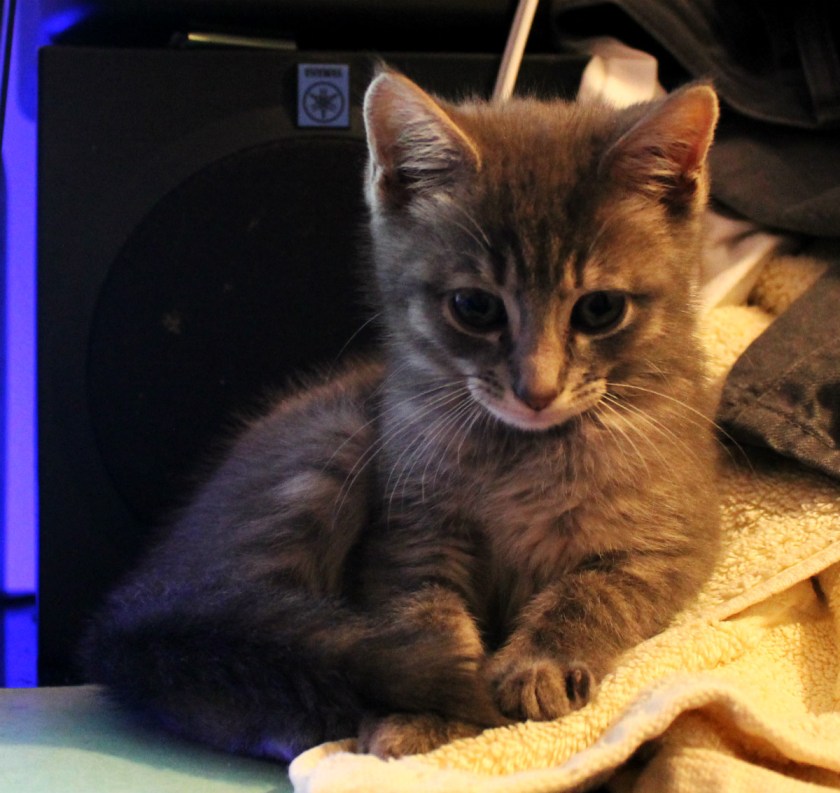
A look back at a 2014 article from our archives when Buddy was just an innocent little kitten.
From the archives: June 17, 2014
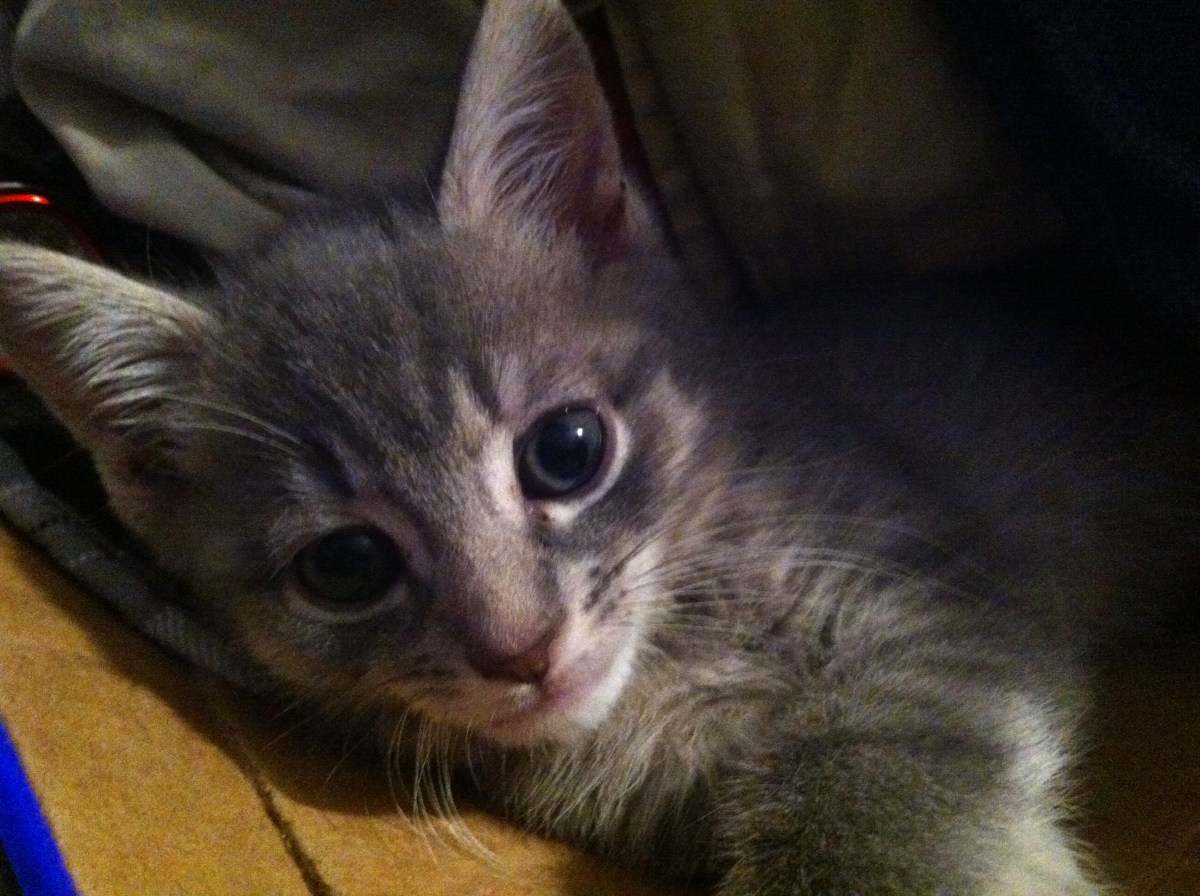
NEW YORK — Buddy the Kitten celebrated another successful ambush on Tuesday after violently rousing his human from sleep, sources said.
The 14-week-old gray tabby howled with delight after climbing up onto the bed and launching himself at his human’s face, landing belly-first with a delightful THWAP! as the big stupid human screamed and bolted upright.
Buddy the Kitten promptly retreated to a dark corner of the bedroom, shaking his butt and trilling with joyful anticipation until he heard his human, Big Buddy, begin to snore again.
With a battle cry of “Rrrrrrrrrrr!” the 4.5-lb kitten chomped down on the human’s exposed foot, which was fortuitously left uncovered by the protective blanket when Big Buddy shifted during his sleep.
“Shit!” the human howled, recoiling from the kitten’s shark teeth and claws. “Let me sleep, you little jerk, or I’m selling you to Szechuan Garden II!”
At press time Buddy the Kitten was planning an elaborate new attack involving a makeshift trebuchet and a water balloon, and said he was unconcerned about his human’s threats to sell him to the local Chinese restaurant: “I am a good boy!”
He would likely leave that attack for the following night, the playful kitten said.
“I has to purr in the morning so my human thinks I’m just a sweet little kitten and feeds me turkeys,” Buddy the Kitten said. “Then I make war again! Muahahaha!”
“I’m just a cute widdle kitten! I didn’t mean to attack you, I swears.”



 Pain In The Bud