Real Life Cats Are The Villains of Nintendo’s Newest Game

Gamers want to race. Cats have other ideas.

Nintendo’s newest game has been out for all of one day and already cats are like “Nuh-uh.”

The idea behind Mario Kart Live: Home Circuit is clever yet simple and seemingly tailored for the pandemic era: Using a Nintendo Switch, players control a tiny Mario Kart equipped with a camera and race it around courses they design in their homes. Because players are controlling the kart through a screen and seeing things from the kart’s point of view, the game augments the race course by generating obstacles to dodge, coins to collect and opponents to race against.

It’s called augmented reality, because it adds layers of computer-generated imagery over things we can see with our own eyes. It’s the same concept behind smart glasses and floating heads-up displays.

But there’s one wild card Nintendo’s designers may not have anticipated: Felis catus.

Nothing grabs a cat’s attention quicker than a small, fast-moving object, and the little karts have been triggering the predatory instincts of countless cats.

Some cats go all “You shall not pass!” Gandalf-style on the karts:

https://twitter.com/yamanoneko_23/status/1316999872961081344

Others aren’t sugar coating what they think of the invasive little cartoon racers:


Finally, some cats just don’t know what to make of it:

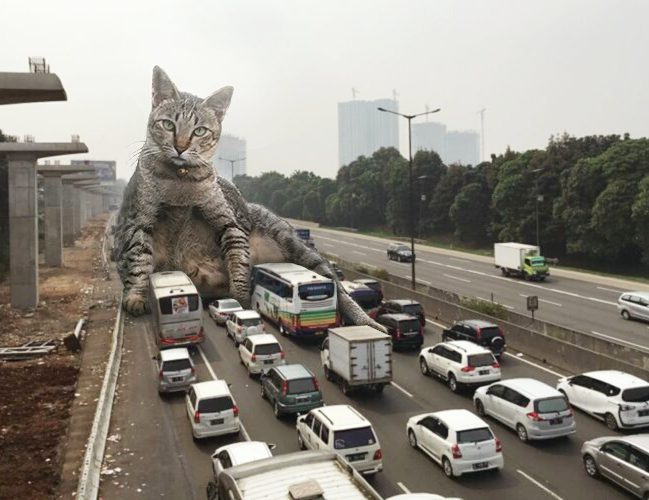
The best part about this is that, from the kart’s eye view, house cats look like furry kaiju — giant, lumbering beasts hell bent on sending the racers careening off course.

It also begs the question: Is there anything in existence that cannot be improved by adding cats?

Study Confirms Cats Are Set At Ease By ‘Slow Blinks’

For the first time, a study shows slow-blinking has a positive effect on human-feline communication.

I’d been in Japan for almost two weeks last year when I dialed back to the States on a Facetime call and my mom — who had been taking care of Buddy in my absence — held Bud up to her iPad.

“Someone wants to say hi to you,” she said.

Buddy looked at me, then tentatively blinked with one eye. When I returned the blink, he meowed excitedly, reaching a paw out to the screen.

Aside from making me feel bad about leaving my cat for so long, the exchange between Bud and I seemed to confirm the importance of the slow eye-blink in feline-human communication. It also confirmed that he missed me.

Now there’s a formal study that, for the first time, shows cats are more relaxed and more likely to approach humans — even strangers — if they’re greeted with a slow blink. Cats also like to reciprocate with a slow blink of their own when greeted that way, the study found.

blinkingcat
Credit: u/sol-aurum/Reddit

“This study is the first to experimentally investigate the role of slow blinking in cat-human communication,” said Karen McComb, a psychologist from the University of Sussex and co-author of the study. “And it is something you can try yourself with your own cat at home, or with cats you meet in the street. It’s a great way of enhancing the bond you have with cats. Try narrowing your eyes at them as you would in a relaxed smile, followed by closing your eyes for a couple of seconds. You’ll find they respond in the same way themselves and you can start a sort of conversation.”

Why does a slow blink put cats at ease?

Tasmin Humphrey, a Ph.D. student and study co-author, said it’s “possible that slow blinking in cats began as a way to interrupt an unbroken stare, which is potentially threatening in social interaction.”

The researchers say their results could help people communicate more clearly with their cats, and could be useful in shelters, where staff and volunteers are often tasked with trying to calm scared cats.

“Hello! Scratch Me Right Behind My Ears Please!”

Right there, just behind the ear. That’s it! Ah! Keep going, human…

Well hello there, human!

Let me just squeeze in here and…ah, that’s better! Now I’m sitting between you and the glowing rectangle, which means you must pay attention to me.

You know, human, you really are the best. Forget all that stuff I meowed before when it looked like dinner was gonna be late. I didn’t mean it. Can you just go ahead and scratch me behind the ears?

Ah, that feels good! Now my cheeks and under my chin! Don’t be afraid to give my fur a good scratch. That’s it. This is the life! I’m so relaxed…

Hey, could you scratch just right here on my belly? No, I’m serious, I’m not just showing you my belly for poops and giggles. I really could use a good scratch right there and…wow that feels great…hey, stop it, you jerk! You had a good thing going there and then you ruined it by going half a millisecond too long.

Now scratch my head again, it’s time for Seventh Nap…

Study: There Are 5 Types Of Cat Owners

Do you keep your cats inside, or do you let them roam free?

When it comes to attitudes about hunting and impact on local wildlife, there are five broad categories of cat owners, a new study says.

Four out of the five aren’t particularly worried about their cats killing birds and small mammals, the University of Exeter researchers wrote in the study, which was published in Frontiers In Ecology and the Environment, a research journal.

  1. Concerned Protector. These are people who keep their cats indoors to keep them safe from the world. Their main worries are cats being stolen, lost or killed. They don’t have strong feelings about hunting behaviour and wouldn’t keep their cats indoors solely to stop them hunting.
  2. Freedom Defenders believe cats should be able to roam where they please, like wild animals. Cats hunting is a good sign of normal behaviour and helps control the rodent population. They oppose any restrictions of cat access to the outdoors.
  3. Tolerant Guardians believe that the benefits of roaming outweigh the risks of the cat being injured or lost. They love wildlife and cat hunting is the least attractive part of cat ownership, but it is just what cats do. They’re not sure how cat owners can effectively reduce hunting behaviour.
  4. Conscientious Caretakers believe cats should have access to the outdoors but they don’t oppose some containment. Hunting by cats really bothers them, and they particularly worry about birds. They believe owners should have have some responsibility managing their cat’s hunting behaviour.
  5. Lasseiz-faire landlords believes it’s natural for cats to want to go out into the natural world and if they fall foul of it (dogs, bigger cats, SUVs) that’s natural too. They’ve never seriously thought about the effects of cats on wildlife populations. They’d be more likely to manage their cat’s hunting behaviours if it was killing things all the time.

You can take a short quiz (16 multiple choice questions) to find out what kind of cat caretaker you are. For what it’s worth, the quiz says I’m a “conscientious protector,” which sounds about right.

cat-predation

In his mind, of course, Buddy is a fierce, powerful feline and a mighty hunter. In reality he’s hilariously inept at the hunting games we play, and no matter how many times I’ve brought him outside on his harness, he goes into sensory overload every time, spending the first 20 minutes nervously huddled before he relaxes, his tail shoots up and he starts to enjoy the new sights and smells.

Fortunately I don’t have to deal with a cat who pines for the outdoors. Bud has no desire to go out there on his own, and he won’t even step onto the balcony if it’s too hot, too cold, raining, snowing or especially windy.

Most of all it’s too dangerous out there between traffic, potential predators like coyotes, train tracks, other cats and people who will abuse or kill cats just because they can. I don’t want to lose my little Bud.

Dear readers, if you take the test, please let us know which category it placed you in.

Does Your Cat Like To Teleport?

Cats are swift and sneaky.

I was working on a writing project late one night when I got up from my desk, intending to head to the kitchen for a beverage when I almost stumbled over Buddy, who was lounging care free and belly-up in my bedroom doorway.

“Not a good place to lounge, Bud,” I said, stepping over him as he stretched and yawned.

I took another step, looked up…and saw Bud sitting on the dinner table about 12 feet ahead of me, fixing me with his quizzical Buddy Stare. WTF? I thought.

teleportingcat

I did a double-take, looking down at the doorway where the little dude had been laying just a second ago, then turned back toward the table. Buddy regarded me, head cocked slightly to one side as his tail gently thumped the table.

For a long second I entertained the possibility that there were two cats, that somehow a gray tabby who looked a lot like Bud had gotten inside, and for some unfathomable reason Buddy was perfectly nonchalant about it.

“No teleporting in the house!” I told him. “It’s rude!”

“Mrrreppp,” Bud replied, hopping down from the table and stepping toward the kitchen.

teleportingcat2

The story comes to mind because we had another teleporting incident last night, with little man lounging on my bed, then appearing on my desk chair half a second later.

It’s easy to forget how quick and silent cats can be when it suits them, especially since the majority of their time is spent sleeping, eating and lounging. Their little legs can accelerate them to 30 miles per hour, which leaves average humans in the dust and even surpasses the fastest human runners.

Not bad for a species known for its unmatched laziness.

Please share feline teleportation stories if you’ve got ’em. We must further investigate this additional facet of feline weirdness!