I was working on a writing project late one night when I got up from my desk, intending to head to the kitchen for a beverage when I almost stumbled over Buddy, who was lounging care free and belly-up in my bedroom doorway.
“Not a good place to lounge, Bud,” I said, stepping over him as he stretched and yawned.
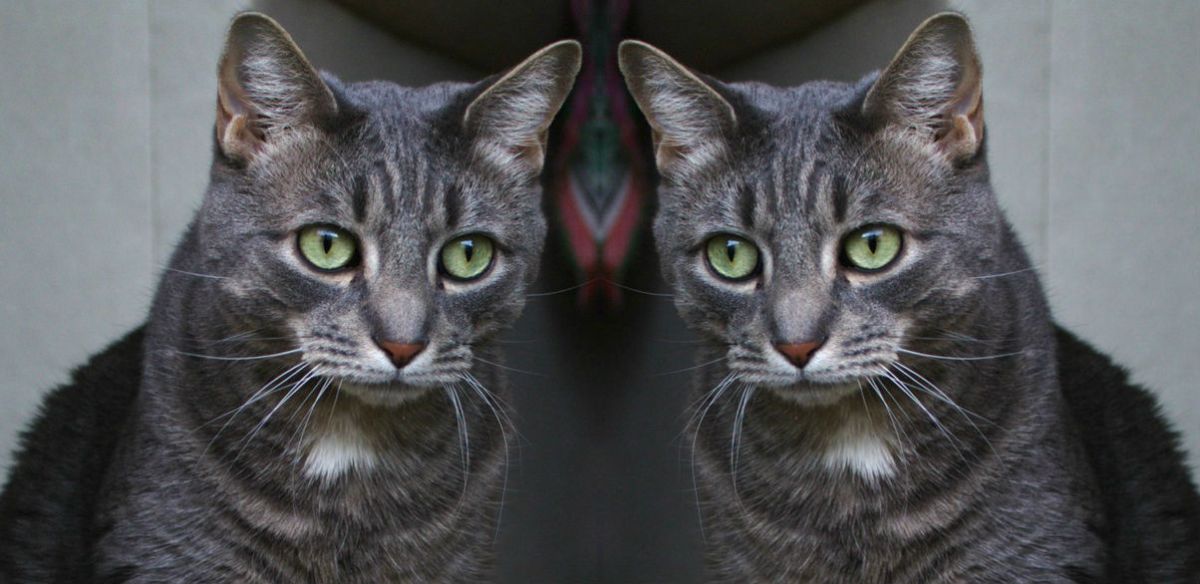
I took another step, looked up…and saw Bud sitting on the dinner table about 12 feet ahead of me, fixing me with his quizzical Buddy Stare. WTF? I thought.
I did a double-take, looking down at the doorway where the little dude had been laying just a second ago, then turned back toward the table. Buddy regarded me, head cocked slightly to one side as his tail gently thumped the table.
For a long second I entertained the possibility that there were two cats, that somehow a gray tabby who looked a lot like Bud had gotten inside, and for some unfathomable reason Buddy was perfectly nonchalant about it.
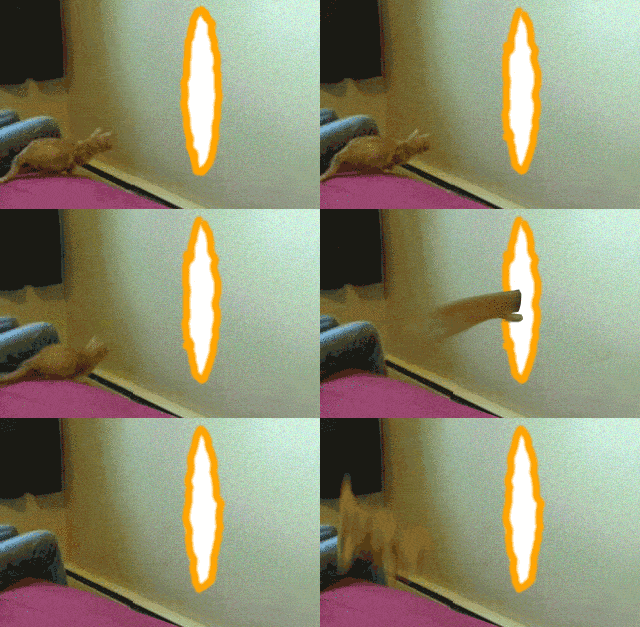
“No teleporting in the house!” I told him. “It’s rude!”
“Mrrreppp,” Bud replied, hopping down from the table and stepping toward the kitchen.
The story comes to mind because we had another teleporting incident last night, with little man lounging on my bed, then appearing on my desk chair half a second later.
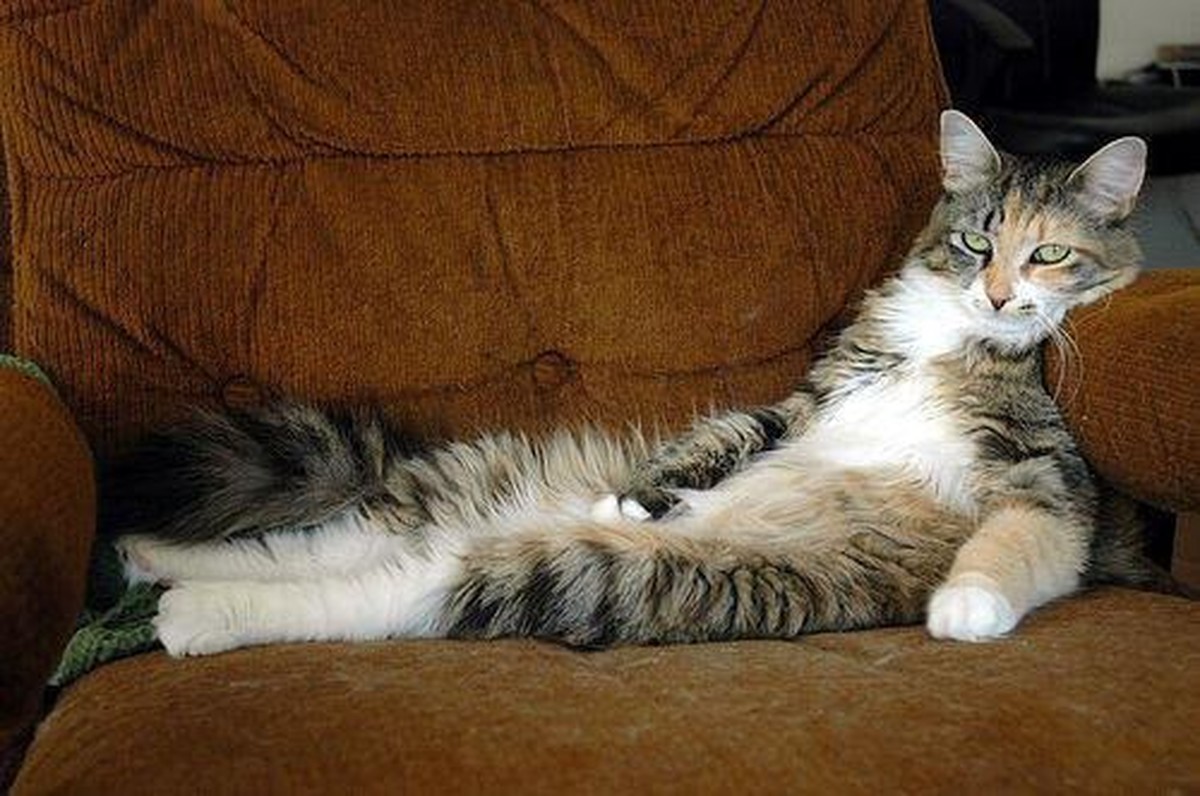
It’s easy to forget how quick and silent cats can be when it suits them, especially since the majority of their time is spent sleeping, eating and lounging. Their little legs can accelerate them to 30 miles per hour, which leaves average humans in the dust and even surpasses the fastest human runners.
Not bad for a species known for its unmatched laziness.
Please share feline teleportation stories if you’ve got ’em. We must further investigate this additional facet of feline weirdness!
Unlike other animals, cats aren’t big on food puzzles. They just want the food.
My cat has a morning ritual: He’ll meow in front of the treat cabinet, which now contains healthy snacks, then gobble down his first yums of the day before padding over to the carpet or the couch to lay down.
Ya know, because he worked so hard. After a long and tiring night of sleep and the grueling physical exertion of working his jaw muscles to eat, he needs a respite. A cat nap, if you will.
He’s not unique in this respect, and his morning siesta is just the first of many. Cats need their beauty rest after an exhausting day of lounging, sleeping and having their food literally placed before them.
A new study confirms what we already know — that cats are lazy little bastards — and even hints at new levels of laziness unbeknownst to us thus far.
Working hard or hardly working?
“Get a puzzle feeder,” they say. “Make ’em work a little for their food,” they say. “It’ll stimulate their instincts.”
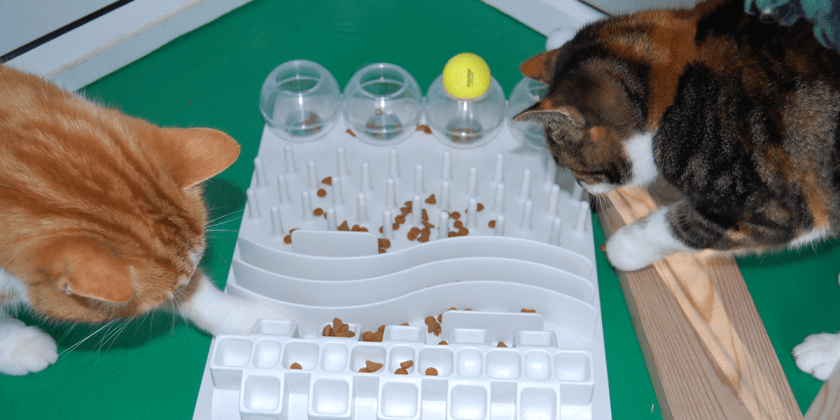
Animal behaviorists have recommended toys like puzzle feeders and treat balls for years, prompted by research that shows animals enjoy “contrafreeloading,” a fancy way of saying when given a choice between free food and food in a puzzle feeder, animals will opt for the latter.
The behavior is consistent across many species of domestic and wild animals, from dogs and rats to chimpanzees and birds. Maybe it stimulates their urge to forage. Maybe it gives them something fun to do. Or maybe food just tastes better to animals when they’ve earned it.
Cats, however, aren’t contrafreeloaders. They want the easy yums.
That’s according to a new study by a University of California at Davis research team. Cats didn’t ignore the food puzzles entirely, but they showed a clear preference for the low-hanging fruit, so to speak.
“It wasn’t that the cats never used the food puzzle, they just used it less, ate less food from it, and typically would eat from the freely available food first,” said UC Davis’ Mikel Delgado, a co-author of the study.
“I’m tellin’ ya, Horace, they do this just to piss us off. How are we supposed to gobble it all down if we have to fish every little kibble out one by one? I hate humans!”
As for why cats aren’t taken with puzzle feeders — besides their inherent laziness, of course — that question will take more studies to answer.
“There are different theories about why animals might contrafreeload, including boredom in captive environments, stimulating natural foraging behaviors, and creating a sense of control over the environment and outcomes,” Delgado said.
When it comes to cats, Delgado’s best guess is that puzzle feeders might just be the wrong game since it doesn’t stimulate their hunting instincts. Maybe the next study should involve small pieces of chicken and turkey tied to the ends of wand toys, so our mighty little hunters can catch their “prey” and dine like proper tigers.
How to do justice to your feline overlord with photographs.
As some of our readers know, I spent the first years of my professional career as a crime reporter, covering everything from murders to mall shooters, plane crashes and freak accidents.
One of the perks of the job — aside from seeing some truly crazy and bizarre things up close — was getting to work side-by-side with amazing photojournalists.
I watched how they handled themselves, what they were willing to do to get their shots and how they captured the essence of a story in just one or two frames.
It turns out photographing cats isn’t much different from capturing random moments of life. Our furry friends are unpredictable, they tend to shy away from the camera and they won’t wait for you to get the shot.
Some of this advice is general and some of it is cat-specific. I’m certainly no professional and I’m always learning, but I hope you can put some of the lessons I’ve learned to good use getting better shots of your own little buddies:
Let kitty forget about the camera
Cats are famously curious, and a shiny new thing must be investigated. As far as kitty is concerned, the best way to investigate is to pad right up to it, rub her cheeks against it, maybe bite the camera strap. You know, the standard stuff.
Let your cat do what she needs to do. If you don’t let her do her thing, the camera could become an item of intrigue, but let her sniff and bunt it a few times and she’ll quickly forget about it. A camera, after all, is clearly not as awesome as a cardboard box, a milk bottle cap or a treat.
When your cat decides to ignore your camera, you can start taking pictures. Which brings us to our next tip…
Distract the little ones with toys
Cats won’t pose for us, but that doesn’t mean we can’t nudge them toward particular actions or postures. Dangling a good wand toy or ball is a great way to get your cat to look at the camera or reach out. Want an action shot? Set a fast shutter speed and toss a ball or a bottle cap.
Catnip and treats, when used strategically, can also help you get the shot you want.
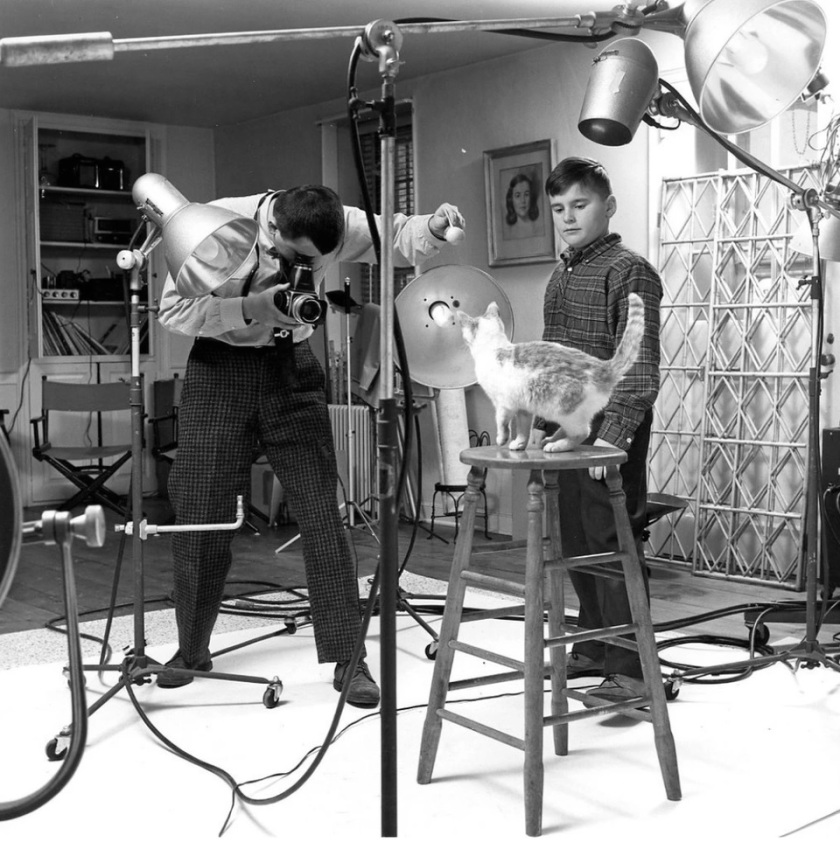
Walter Chandoha, who was known for his playful photos of felines, uses a ball to distract a cat while snapping shots.
Use your smartphone for shots of opportunity
We’ve all been there: You’re sitting on your couch reading a book or watching a movie when you look over and realize your kitten looks adorable sleeping on his back, or your adult cat is striking a majestic pose…but you don’t have your camera.
The second you get up your cat is going to shift or get up to follow you, and the shot is gone.
For those fleeting opportunities keep your smartphone to hand and configure it so you can pull up the camera with a single button push: No passwords, no navigating to the app. Both iOS and Android can be configured to reach the camera quickly. (In most versions of iOS, for example, simply swipe from right to left on the lock screen to get the camera. In Android, double tap the power or home button.)
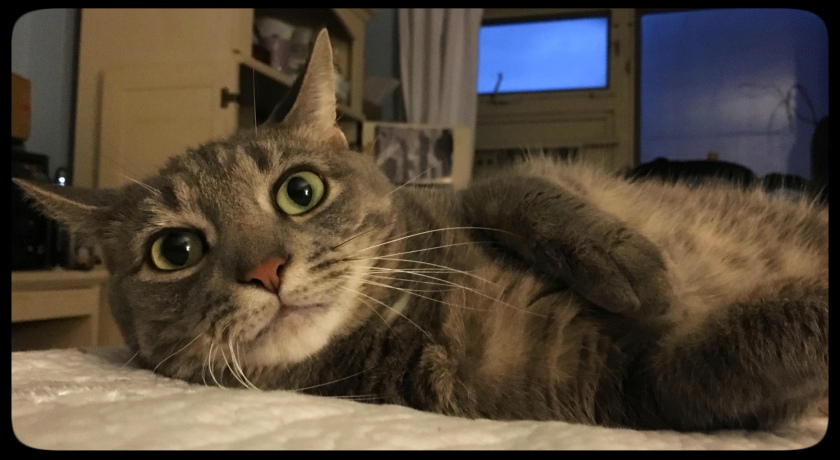
Below is one of my favorite photos of Buddy taken in a moment of opportunity with an iPhone. It may not be the kind of ultra-sharp image captured by a pro camera, but as one commenter put it, Buddy looks like he’s “radiating love.” I’d rather have a smartphone shot than no shot any day:
Choose the right setting
Unless they’re sprawled out in an ecstatic nip haze or curling up for a post-dinner nap, cats are usually moving. Unfortunately, your cat is not going to hold a pose for you while you fumble with the settings.
Whether you’re photographing a kitten with limitless energy or an adult who’s just doing his thing, you’re going to want a fast shutter speed — something in the neighborhood of 1/1,000 of a second to avoid blur and capture crisp images of motion.
If you’re not comfortable changing the settings manually, use the sports/motion preset on your camera.
Get up close, on the floor and use a proper zoom lens
Too many cat photos look like they could double as interior home photos that just happen to have a cat in them. If you’re shooting from eye height and your cat is a tiny smudge of fur in the center of the shot, you can do so much better.
Bring yourself down to your cat’s level and either shoot up close or use your zoom.
If you’re using a smartphone or a point-and-click, you’re going to want to get close because digital zoom is worthless: The camera doesn’t actually zoom, it simply displays the view at a larger size. You’re not capturing more detail. That’s why the quality decreases the more you “zoom” and the image becomes pixelated.
If you’re using a Canon, a Nikon or some other brand of dedicated camera, you have the advantage of a true optical zoom that does capture more detail. It can be useful for keeping your distance — and thus avoiding potentially distracting the cat — and for playing with perspective.
Get down to your cat’s level and don’t be afraid to move in close to get the best shot. (Credit)
Crop judiciously
Shooting in ultra-HD JPG or RAW means you’re capturing more detail with each shot, giving you the option of heavily cropping photographs so your subject dominates the scene without degrading the image quality.
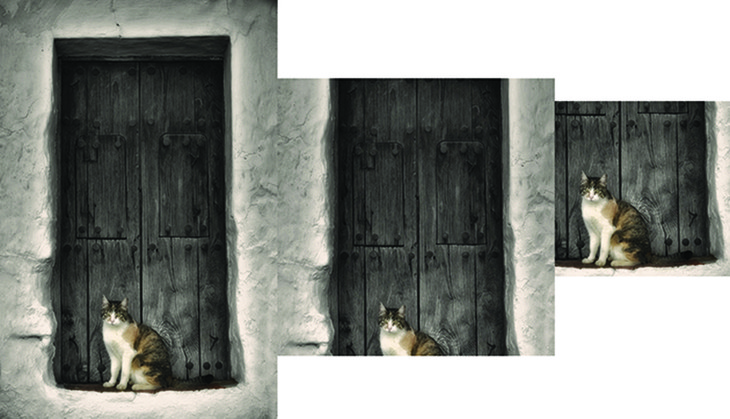
Here’s a raw photograph of Bud on my balcony with clutter in the background and uneaten treats on the ground that could be mistaken for turds or something, and the same image cropped close:
The cropped version puts the focus squarely on His Grace and cuts out most of the distracting junk. Along with a simple tweak to the color levels — giving definition to the shadows and creating better contrast — the photo is improved and its subject appear more vivid.
Cropping can make a dramatic difference in your photos. (Credit)
Don’t sweat imperfections
You may have noticed Buddy almost always has gunk in the corner of his eyes. (Just like humans, some cats produce more of it. It’s not a threat to his health.) He’s not fond of me trying to remove it. Early on I attempted to Photoshop the eye gunk out of his shots. Not only was it a lot of work, but it was very difficult to remove it without the photo looking wrong.
I decided to just let it go, thinking people would see it right away, but I’ve never even gotten a single question or comment about it. Nobody’s perfect, not even the Budster. (Shocking, I know.)
Avoid the temptation to go all Instagram-y with filters
There isn’t a camera app these days that doesn’t come loaded with Instagram-style filters to “improve” your photos. I strongly recommend resisting the urge to use them and instead take the time to learn how to filter your photos manually with Photoshop or a free alternative like the browser-based Photoshop clone, Pixlr.
The vast majority of Instagram-style filters are simply presets of the most extreme color, contrast and saturation sliders available. They degrade the image, stripping it of detail and making it look like every other photo on that platform, like autotune for images.
That’s all for now. Next time we’ll take a look at how to apply some basic filters to your photos to emphasize shadow and light, and make colors pop the way they should. Check back for part two in the weeks ahead, and thanks for reading!
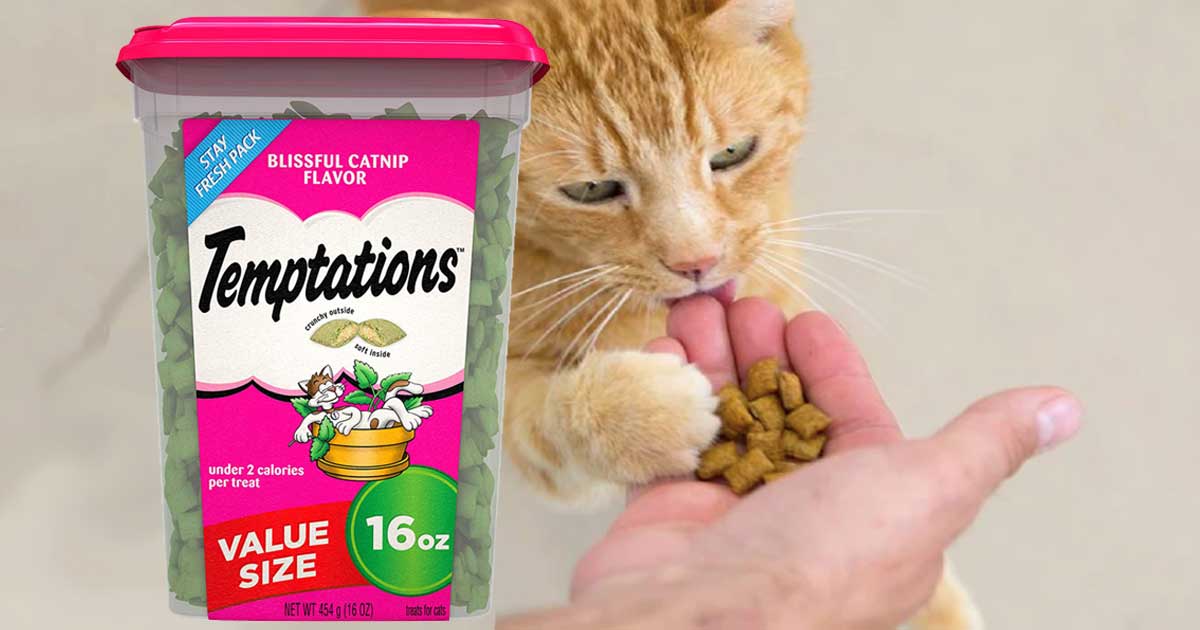
A video shows a cat breaking into a large tub of Temptations in less than a minute.
In my last post about Temptations, aka the kitty crack, I noted that Buddy had once gotten into one of those big tubs of the stuff and gorged himself before getting sick.
He’s not the only cat to do that, as I wrote at the time, but this cat takes cake: She’s able to pop the lid off and get at the cracktastic treats inside in less than 60 seconds:
And here’s a cat who has learned how to open his treat cabinet to get the Temptations inside:
These videos confirm I made the right call getting the little guy off the stuff.
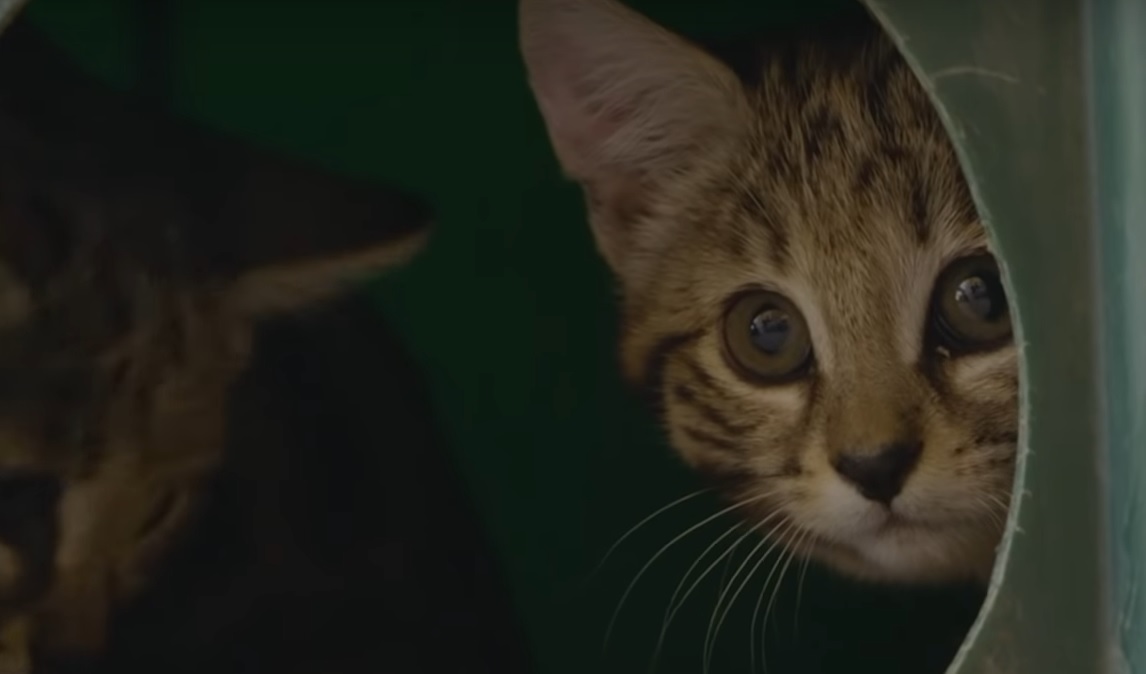
Tiny black-footed kittens were born at the San Diego Zoo during the Coronavirus lockdown.
Zoos around the US are closed because of the Coronavirus, but that doesn’t mean we have to miss out on the milestones of baby animals like the San Diego Zoo’s Ryder and Skyler, two black-footed kittens.
Black-footed cats are notable not only for their diminutive size — typically maxing out at two or three pounds — and their cuteness, but also for their astonishing hunting skills. The tiny terrors have voracious appetites and a 60 percent success rate when hunting. That eclipses the 25 percent success rate of lions, 32 percent success rate of domestic cats and the zero percent success rate of Buddy.
Ryder, a male, and Skyler, a female, were born in April. They haven’t started hunting yet, but they’ve now reached the stage where they’re eating meat instead of milk, as this video shows: