Blog Posts

The Ashera Cat Scam: How One Man Invented A ‘Luxurious’ Breed And Cashed In

Although the original perpetrator of the scam was exposed, there are still opportunists selling “Ashera cats” to unsuspecting buyers who have their hearts set on hypoallergenic pets.

Pet site listicles name the Ashera cat as “luxurious,” one of the most expensive and rare breeds ever. Videos show surprisingly large, exotic-looking felines with leopard-like rosettes and a calm demeanor.

In media reports a man named Simon Brodie talks the breed up, presenting himself as the CEO of a biotechnology company that “developed” the Ashera through careful genetic manipulation, selecting only the most positive traits. For a few thousand dollars more, Brodie promises, they come in hypoallergenic versions too.

Brodie often sounded like he was describing the newest iteration of a tech product rather than a cat, calling the Ashera “a status symbol” and listing its optional features the way a car salesman talks about leather and heated seats.

“It’s exotic, but under the skin it’s a domestic house cat, very easy to take care of and extremely friendly,” he told Reuters. “Everybody has thought at one time, wouldn’t it be great to have a leopard at home, or a tiger? Obviously, you can’t and this is about the nearest thing to it.”

Brodie conjured images of engineers poring over genetic data and working with gene-editing equipment in a laboratory to create the perfect pet.

“Anybody can throw the ingredients in, but unless you know what ingredients are the best ingredients in the best percentages, you’re not going to produce the same final product,” Brodie told the U.K. wire service.

The problem? The Ashera doesn’t actually exist, and there’s no evidence Brodie has ever been in a lab, let alone spearheaded the creation of a new breed of feline.
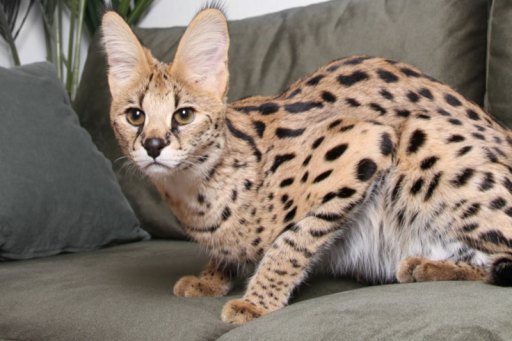
Not an Ashera cat
A Savannah cat with clear Serval lineage is shown as an example of an “Ashera cat” on several websites about the fictional breed.

Sadly, people might not realize that right away because of the publish-now, verify-never nature of web publications. Catster maintains a current page for the “breed,” citing its “outstanding lineage” and its supposed status as “one of the rarest and most expensive cats in the world,” potentially setting back its owners $100,000 or more per cat. You have to scroll down before the site warns about the “controversy and skepticism regarding the breed’s origins,” as if there’s still a debate whether the Ashera is a real breed.

Sites I’d rather not link to include the Ashera in their lists of “most exclusive” and “rare” breeds, and recent Reddit threads claim their price owes partly to their rarity because the company “only breeds about 100 cats a year.” When’s the last time you heard cats didn’t breed enough?

There are even “Ashera cat communities” designed to make it look like there are large online groups of happy owners, and Youtube channels featuring videos of Savannahs labeled as Asheras.

A sketchy operation

But dig a little deeper and you’ll find the truth. The Savannah Cat Association calls the Ashera a hoax, says the cats are Savannahs with fancy marketing, and details experiences people have allegedly had with Brodie. His company appeared to be a one-man operation with a voice mailbox, and people who purchased the pets said they were told to wire down payments to an account in the United Arab Emirates.

There are even claims Brodie was drop-shipping the cats, with customers saying they were delivered directly from an Oklahoma breeder of Savannahs.

And the people who saw an opportunity to have a pet cat despite severe allergies? They weren’t happy either, even those who negotiated deep “discounts” with Brodie.

“I don’t think any cat is worth $4,000,” a customer named Mike Sela told Columbia Journalism review, “but this seemed like a magical opportunity, especially with parents trying to get something for kids. You never thought you could get a cat and this is your chance.”

A group of angry customers who were promised hypoallergenic pets contacted ABC News, whose Lookout team enlisted the help of a biotechnology company to test cats purchased from Allerca, Brodie’s company. The tests showed the Ashera cats had the same amount of Fel d 1, the primary allergen in feline saliva, as the typical cat and could find no evidence of Brodie’s claims that he’d engineered an exotic cat sans allergens.

CJR took mainstream and legacy press outlets to task for reporting uncritically on Brodie’s claims despite the lack of any documentation, peer-review studies proving gene-edited hypoallergenic cats are possible, and for a complete lack of due diligence on the man himself. Per CJR:

“What Time, National Geographic, and other major outlets, including The New York Times, missed was that Brodie has no background in genetics—but he does have a well-recorded background in running scams. He was arrested in England, his native country, for selling shares in a non-existent hot-air balloon company. In the United States, he has left a wake of evictions, unpaid loans, and suits by unpaid employees. One judgment against him that stands out is by a company called Felix Pets, founded about a year before Allerca with the same goal of breeding hypoallergenic cats by eliminating the Fel-D-1 gene.”

Indeed, as the complaints piled up and Brodie’s deceptions began to catch up with him, the San Diego Union Tribune reported Allerca had been evicted from its “offices” — Brodie’s home address.
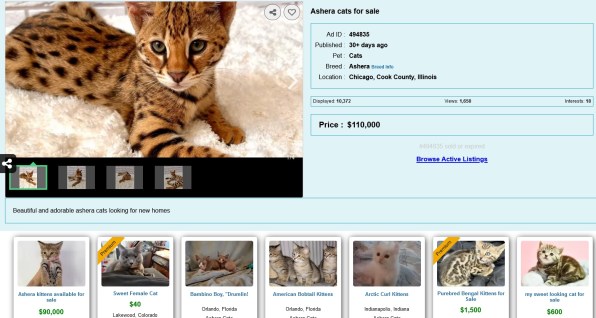
Ashera cats scam
A listing for an Ashera cat and a second listing for Ashera kittens, bottom left.

News stories say Brodie has changed his name numerous times and if he’s still out there, he’s almost certainly not Simon Brodie anymore. But the Ashera cat scam isn’t dead.

We found dozens of sites offering “Ashera kittens,” and online marketplaces for animals still have regularly-updated listings from people claiming they’re selling “genuine” Ashera cats in 2024. There’s also at least one group claiming they’re “officially licensed Ashera cat breeders,” touting a lofty “mission” not only of providing cats for people with allergies, but also “preserving exotic wildlife.”

The myth of hypoallergenic cats

Although there have been recent efforts to neutralize Fel d 1, they come from actual scientists who have published their work for peer review, or from public pet food companies that have paired with scientists to create kibble they claim reduces the Fel d 1 allergen in cats who eat it. They’re also focused on attacking the protein, not breeding or creating cats that lack it in the first place.

People with allergies should understand that despite what they may read online, hypoallergenic cats do not exist. No one has been able to “engineer” a feline without the Fel d 1 protein.

There’s serious debate among geneticists about whether trying it is ethical, as no one knows exactly what function Fel d 1 serves or what the potential consequences may be for editing it out of feline genetic code.

So if you’re looking for a “luxury cat” or you just want a cat that won’t trigger your allergies, beware before you’re separated from your hard-earned cash. As always, if something sounds too good to be true, it probably is.


Does Your Feline Overlord Have A Favorite Genre Of Music?

Cats have exceptional hearing abilities and can detect sounds in frequencies well beyond what the human ear is capable of hearing, but can they appreciate music?

The question of whether cats appreciate music is an interesting one, and we still don’t have definitive answers despite attempts to make music for our furry friends and study the way they respond to sound.

We’ve mentioned the ongoing efforts to make tunes for felines on this blog before, and previously experimented by playing composer David Teie‘s Music for Cats for our brave volunteer, Buddy.

Excited by the possibility of music specifically designed for cats, and a study in the Journal of Feline Medicine and Surgery that found it had a calming effect on the species, we queued up a track and watched the Budster’s reaction:

“Using Buddy as my test subject, I went to Youtube, selected the track Cozmo’s Air from “Music for Cats” and sat back, expecting Bud to start nodding his furry head at any moment.

Instead his ears pricked up, did their radar-dish swivel toward the speakers, and his eyes went wide. As the song gained volume and intensity, Bud’s ears and whiskers snapped back and he let out a clearly anxious “yerrrrrrrrrrppp!” I tried to calm him down, to no avail, and a second track didn’t improve things.

He wasn’t having it.”

Over at Catster, Christopher Bays writes about his cat, Olga, and her relationship with music.

Olga “has listened to classic rock, jazz, blues, classical, heavy metal, punk (or new wave?), and accordion tunes from Hungary, and it all sounds the same to her,” Bays concludes.

djfunkybud
“Spinning the megamix, bro.”/PITB

Noting that our tastes change as we age, Bays said he’s thankful Olga wasn’t around during his teenage punk and metal phase (ditto), and notes she’s not particularly interested in any sounds coming from electronic devices, with the exception of the roaring MGM lion. (Fun fact: The famous “lion’s roar” is actually a recording of a tiger played over footage of a lion yawning. The creators apparently felt lions don’t sound sufficiently badass enough.)

Bays points out our cats don’t exactly have control over what we play, and while that’s true, if you’re a genre-hopper like me, you’ve probably observed your furry friend’s reaction to various types of music.

Given the fact that the small amount of research done so far indicates cats do respond to tunes — and the existence of music-loving animals like Kiki and Snowball — I think felines probably are capable of enjoying the organized, rhythmic arrangements of sounds we call music.

I can’t say whether a favorite track can unleash a wave of emotion, nostalgia or energy the way it can for us humans, but I’ve played a lot of music around Bud and even played music for him on my guitar and keyboard.

He seems very comfortable with old jazz, soul and funk, he comfortably loafs when I’m in the mood for classic 90s hip hop, and he seems to tolerate the prog rock of Coheed and Cambria well enough. More recently he’s been on a 90s nostalgia trip with me: Blues Traveler, the Spin Doctors, Nirvana, Oasis, Better Than Ezra, Letters to Cleo, Ash, Weezer, Blur, The Roots.

And he seems especially chill in the sonic presence of synthwave, also called retrowave, an EDM-inflected genre that evokes nostalgia for an era that never really existed outside of 80s retrofuturism. It’s highly rhythmic, with steady 4/4 beats and vintage synthesizers cranking out arpeggios that rise and fall like waves, which may be a source of comfort to a species that likes things just the way they are without any big surprises.

Have you noticed your cats responding to music? What’s your kitty’s favorite genre or song? Is there anything they clearly don’t like?

Local Cat Enjoys 7 Meals A Day From 7 Houses

The resourceful cat has mastered the art of meowing adorably and appearing hungry, tugging at the heartstrings of seven neighbors who all think he doesn’t get enough to eat.

NEW PALTZ, NY — It’s not easy playing the part of a hungry stray to seven different families in a one block radius, but local cat Tangerine says he makes it work by sticking to a strict schedule.

“I’m always at the green house at 7:45 am sharp, ’cause that’s when the kids leave for the school bus. When they see me they call out to their mom, who’s usually got tuna or eggs for me,” the enterprising feline said.

From there it’s on to the three-story Dutch revivalist house on the corner, where a retired gentleman calls Tangerine “Rusty” and offers him a generous bowl of kibble.

“The key is to master the plaintive meow and to look just a bit unsure of yourself,” Tangerine explained, “like you haven’t had a meal in ages and aren’t sure where your next meal is coming from.”

But Tangerine isn’t nearly done after only two houses. The crafty cat has his stops all planned out and knows the routines of every one of his neighbors, a feat of efficiency and logistical planning that would make FedEx envious.

If the weather’s nice, the orange tabby will settle down for a rest in the neighbor’s yard, which has flowers that are particularly enjoyable to defecate on. If it’s chilly or raining, Tangerine heads back home for his morning snooze.

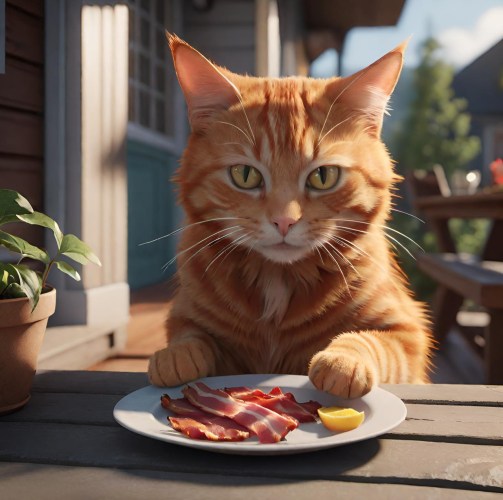
Immediately after First Nap is the highlight of the morning: a visit to the Bacon House where the inhabitant, a 47-year-old software engineer, has bestowed the name Simba on Tangerine and always offers deliciously crispy bacon, the feline said.

A visit to Bacon House
Visiting Bacon House is a highlight of the day, never to be missed. Image: PITB

Next it’s Second Nap followed by Fourth Meal at the wrap-around porch two houses down, which provides ample shade for subsequent snoozing. The people there call Tangerine “Creamy Delicious” and offer him a wide variety of palate-pleasing treats.

Tangerine prepares for the visit by rolling in the dirt for a minute or two, making himself look scruffy and unkempt.

“You poor thing!” the woman who lives there often says as Tangerine nuzzles against her hand and meows cutely. “You probably haven’t eaten since yesterday!”

The rest of the afternoon through early evening takes the orange tabby between three additional homes where he enjoys diced chicken, crumbled sausage and occasional steak.

By the time he’s finished his rounds, Tangerine is drained and returns home to rest.

“It’s not easy doing that much eating and sleeping,” Tangerine said with a wide yawn. “If it were easy, every cat would be out there like I am with the side hustle.”

As of press time Tangerine said it was too early for a formal announcement, but said he’s been working on “considerations of sleep and logistics” that would allow him to expand to an ambitious route of nine houses and nine meals daily.

Pet Theft Up 40 Percent Since Pandemic, Criminologist Says

Incidents like Sunday’s attempted cat robbery are happening more often in recent years, a forensic investigator specializing in animal-related crimes says.

Pet theft is a low-risk, high-reward way for the criminally-minded to make a quick buck, which is one reason why such crimes have become much more common since the pandemic, a forensics professor told the New Haven Register.

Virginia Maxwell, who specializes in forensic investigation of animal cruelty, spoke to the newspaper in the wake of Sunday’s failed gunpoint robbery when two men broke into an East Haven, Conn., home and demanded the victims’ “high dollar value cat.”

But first we’d like to draw your attention to an announcement we made back in February of 2021. At the time pet theft was in the headlines after robbers shot a man walking Lady Gaga’s breed dogs, while across the country in Portland a man stole a van full of daycare-bound pups.

Here’s what we wrote at the time:

“Buddy would like everyone to know he does not actually live in New York, and that his true location is a secret.

“I could be living in Rome,” the troublemaking tabby cat said. “I could be Luxembourgish. Maybe I live in Königreich Romkerhall or the Principality of Sealand. You just don’t know.”

“The one thing you can be certain of is I definitely don’t live in New York.”

We would like to make clear that we continue to blog from Not New York.

On a more serious note, financial woes brought on by the pandemic, painful inflation and a generally difficult economy have attracted the criminally inclined to the petnapping trade, and as Maxwell pointed out to the Register, few people are held accountable for animal-related crimes. That includes darker endeavors like dog fighting and puppy/kitten mills.

“Sadly, animal cruelty in general is under-prosecuted, and very, very few actually end up resulting in jail time,” Maxwell said.

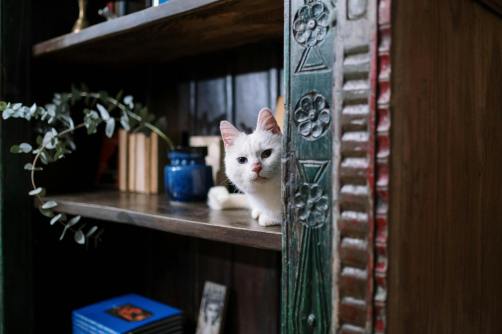
white cat on brown wooden shelf
A cat stays above the fray and surveys her surroundings from an elevated perch. Credit: cottonbro studio/Pexels

Sometimes pet thieves are opportunists who see a cat or dog who catches their fancy, or they believe might be worth money. Those cases often include people luring well-loved animals off porches and property with food.

Most, however, are people who intentionally target breeds that command high prices and are primarily responsible for what Maxwell says is a 40 percent spike in petnappings since early 2020. For felines that means Bengals, Savannahs, Ragdolls, Maine Coons, Norwegian Forest Cats and other breeds that can net the thief a solid payday for minimal effort.

“They’re going to steal your pedigree cat, your pedigree dog that’s worth thousands” and immediately flip the animal, Maxwell told the newspaper.

Social media, it turns out, is a double-edged sword.

While cops and animal welfare organizations warn people against showing off valuable pets online — and urge people to disable features like location tagging — the same platforms are often invaluable for retrieving stolen cats and dogs. Groups on sites like Reddit and Facebook help people find their well-loved four-legged family members and warn others when they identify resellers.

You can help keep your furry friends safe by making sure they’re microchipped, only allowing them outdoors when you’re there to accompany them, and keeping gates, doors and garages closed and locked.

2 Men Break Into House, Demand Cat At Gunpoint, Cops Say

The would-be robbers knew the cat was worth money and specifically targeted the victims, according to police.

Two armed men broke into a Connecticut home on Sunday afternoon and demanded the victims turn over their “high dollar value cat,” according to the East Haven Police Department.

The would-be robbers initially tried to force their way into the East Haven house through a rear sliding glass door, but when the victims tried to prevent them from getting in, one of the men simply kicked through the glass, cops said.

That’s when the intruders brandished a handgun and demanded not cash, not jewelry or other valuables, but the cat!

The kitty in question must have been spooked by all the commotion because the frustrated robbers left empty-handed after a few minutes of fruitless searching. They hopped into a blue BMW and sped off, the victims told police.

Cops didn’t offer any description or breed information about the feline, describing it simply as a “high dollar value cat.”

It’s not uncommon for prized breed cats to command $5,000 from prospective buyers, and some breeds like the “exotic” Savannah cat can sell for as much as $20,000.

bengal cat on white background
Bengal cats like the one above are favorite targets of thieves. Credit: jerry u6770/Pexels

While it’s unusual for someone to break into a home and demand a cat at gunpoint, in the middle of the day no less, cat theft is actually a thing.

Thieves most frequently go after Bengals, Savannahs, Maine Coons, Ragdolls and other breeds that can make them a quick buck by selling them to unsuspecting buyers. Surprisingly domestic shorthairs are on several lists of most commonly stolen cats, but a vet tech tells Reader’s Digest that moggies make the list simply because there are so many of them.

Part of the problem is that the penalties for stealing cats aren’t prohibitive. Most states either treat cats and dogs as property that can simply be replaced, or classify theft of pets in archaic agriculture and markets laws, which were designed to deal with disputes over livestock and farm animals, not pets.

Advocates in some countries, like the UK, are pushing legislation that would make stealing a pet a criminal offense with much harsher penalties.

In Sunday’s attempted robbery, police found the BMW abandoned in Hamden, a town about 10 miles north of East Hampton. They’re still looking into the unsuccessful caper, telling local media that the attempt was planned, not a crime of opportunity or a random event.

Still, if you have a “high dollar value cat,” it’s worth taking some precautions. Here at Casa de Buddy we’ve installed a feline version of a panic room: a panic box! Reinforced with heavy shipping tape, the thick corrugated cardboard is sure to keep bad guys out while also remaining roomy, yet paradoxically snug.

buddybox2
“Yes, this will do nicely, human.”