Scarlett The Cat Walked Through Flames Five Times To Save Her Kittens

When the abandoned garage she was sheltering in caught fire on a cold day in 1996, Scarlett the cat was determined to get all five of her babies to safety.

The night of March 30, 1996, was unseasonably cold, and as temperatures dipped below freezing, a young cat and her litter of five found shelter in an abandoned garage in Brooklyn.

Unfortunately for them a few humans had the same idea, huddling for warmth in the garage as they smoked crack.

Prodigy’s “Firestarter” was at the top of the charts at the time, an apt soundtrack for what would happen next — the crack-addled humans started a fire that spread quickly and took the young feline mother by surprise.

That momma, who would later be named Scarlett, scooped up one of her kittens and brought it to safety before immediately heading for the flames again.
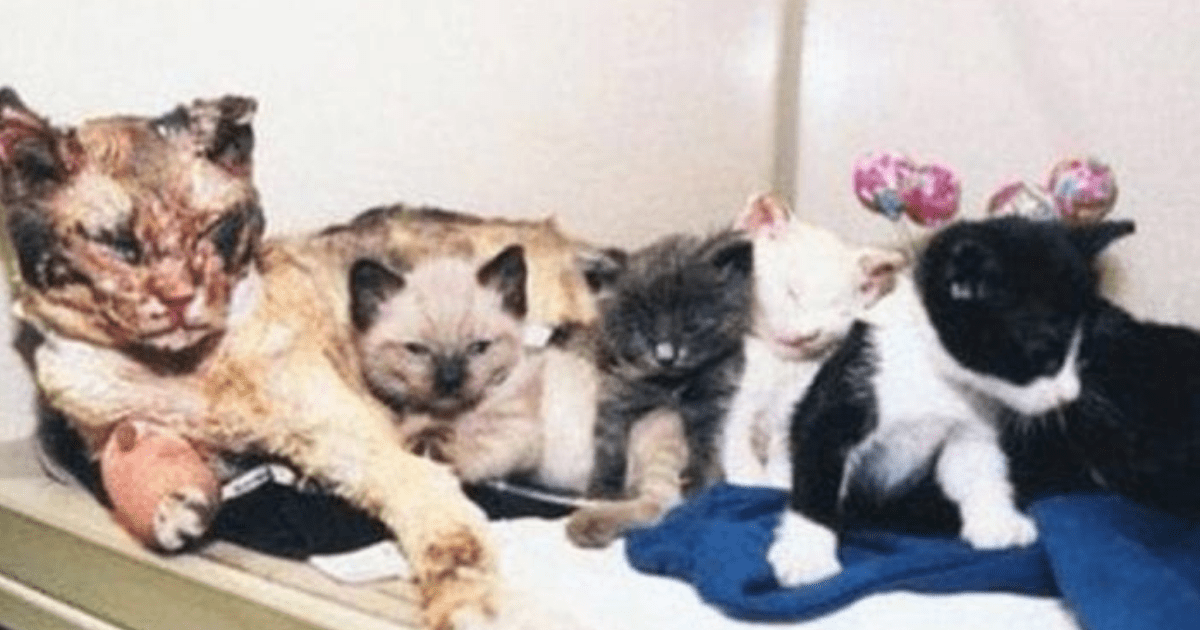
Scarlett and her babies
Scarlett, badly burned and bandaged, with her kittens at the North Shore Animal League. Credit: North Shore Animal League

FDNY firefighter David Giannelli was among the first responders at the engulfed garage and realized the small calico was rescuing her babies, running back into the flames to carry them out one by one.

When Scarlett had retrieved the last kitten, Giannelli watched her as she nuzzled all five of them to count them because she could no longer see — her eyes were sealed with burns and blisters.

Satisfied that her kittens were out of harm’s way, Scarlett collapsed.

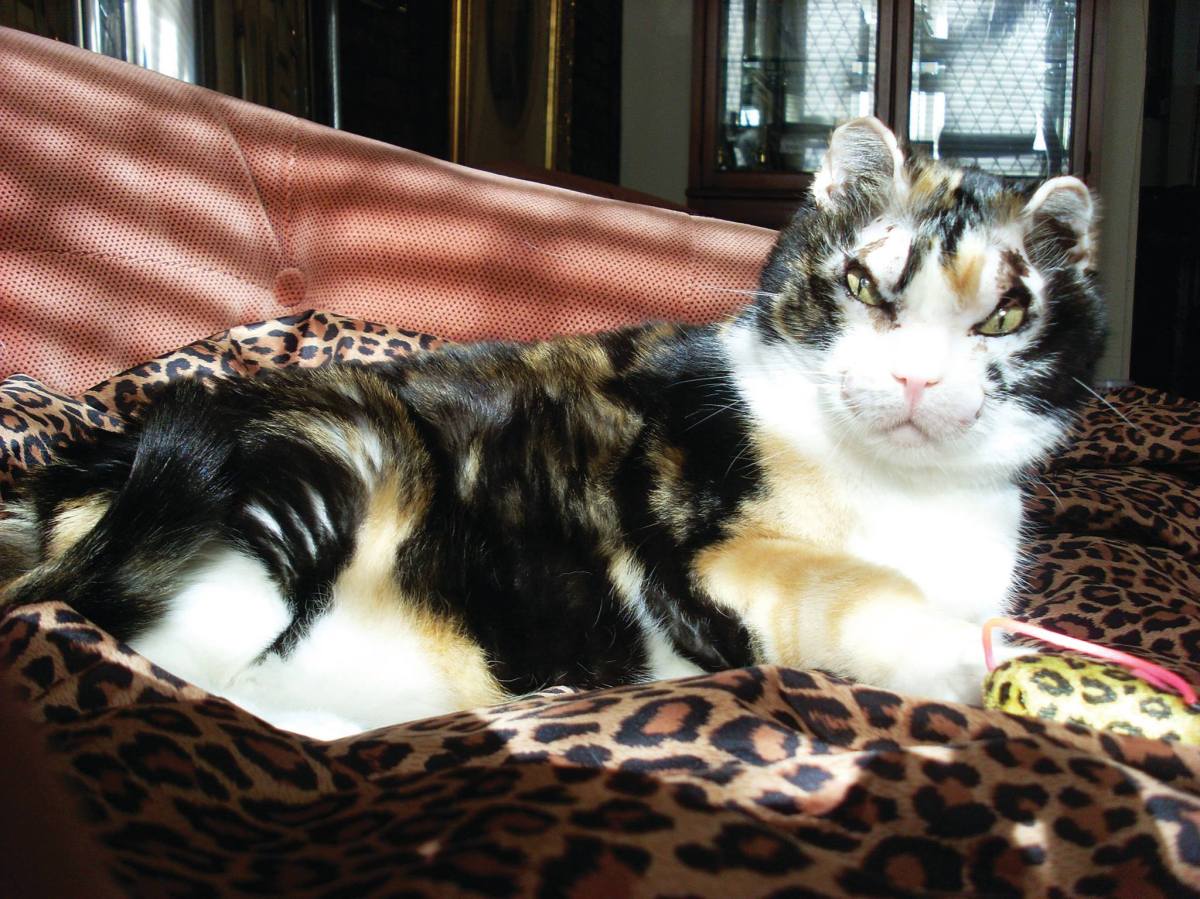
She paid a heavy toll for her actions. Her whiskers and the fur on her face was singed off, her ears were disfigured and she nearly died from smoke inhalation.

Giannelli brought the unconscious cat and her babies to New York’s North Shore Animal League, where veterinarians saved her life and put her on a path to recovery while also housing her with her beloved kittens.

Four of Scarlett’s kittens survived and were adopted out in pairs. Scarlett herself was adopted by New Yorker Karen Wellen, who was chosen out of thousands of applicants who wrote to the shelter. Wellen, who had suffered a medical emergency of her own, was specifically looking to adopt a special needs cat.

Scarlett’s kittens went to nearby families, who kept in touch with Wellen and scheduled reunions between her and the kittens she risked her life for.

“This cat is definitely the queen of the house,” Wellen told a TV news crew during a segment about Scarlett in the late 90s. “Whatever she wants is hers.”

Scarlett was a house cat for the rest of her life, living comfortably until she passed away on Oct. 11, 2008, at 13 years old.
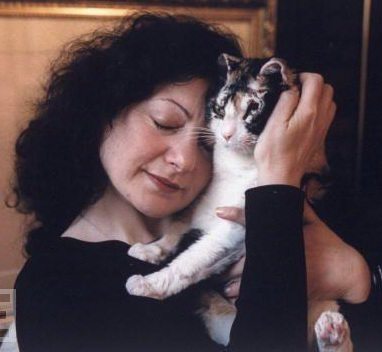
Wellen and Scarlett
Wellen with Scarlett.

Little Scarlett’s story is not only an example of extraordinary bravery, it’s testament to how much mother cats love their kittens and should give us pause before we separate mothers from their babies too early. The absolute minimum is eight weeks, but many shelters will only allow kittens to go home with adopters at 12 weeks old or older, which they say gives them enough time with their mothers and siblings to learn crucial social skills, like sharing, not playing too rough, and proper self-grooming.

In recent years, many shelters and rescues have enacted policies of requiring that kittens are adopted in pairs. Even when they’ve got loving homes with humans who dote on them and provide them with plenty of attention, having another kitten around to grow with and learn from has a huge positive effect on a young cat’s development.

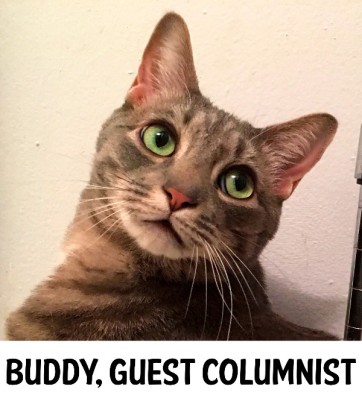
Buddy’s my first cat, as regular readers of PITB know, and if I could do it all over again, I’d have adopted one of his litter mates too. And who knows? Maybe in the future we’ll learn that keeping feline families together is optimal. Scarlett is testament to the fact that mother cats will sacrifice their own lives to save their babies. If that’s not love, what is?
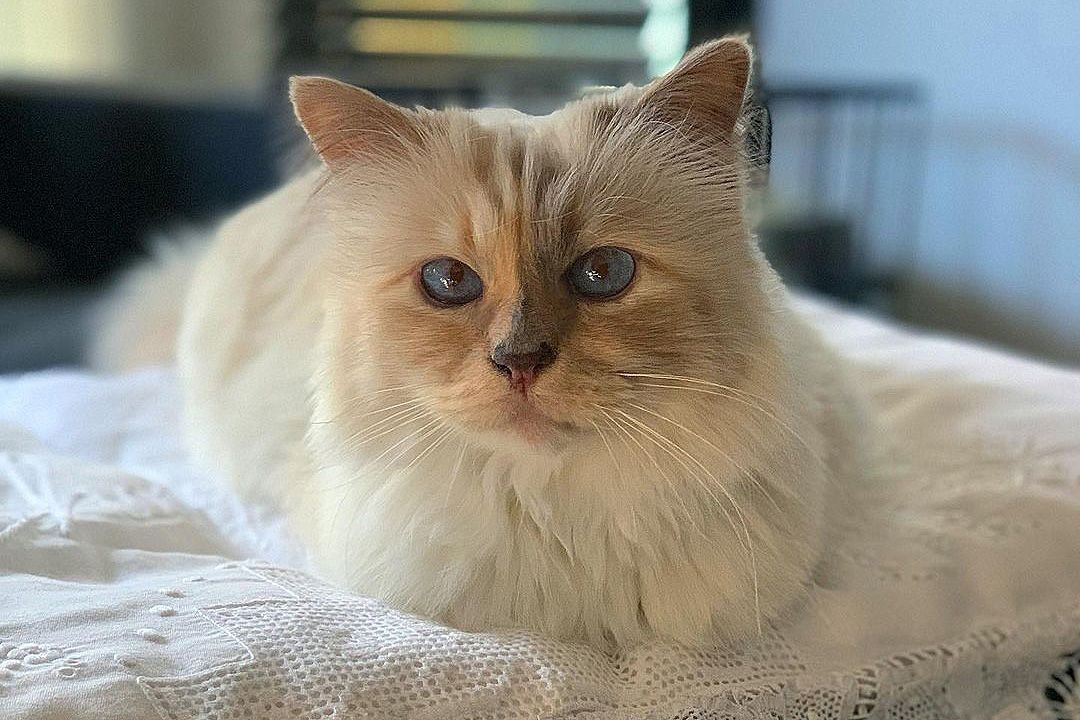
Other Toms Throw Shade At Buddy In Latest Episode of The Bachelorette: Choupette

Suitors are lined up for the cream-coated Burmese feline, who inherited an estimated $13 million fortune when her fashion designer human died.

Simba may have stolen a kiss with Choupette at the end of a moonlight walk, and Oreo may have scored by bringing her to a candle-lit hot tub, but most of the toms on The Bachelorette: Choupette remained focused on shading Buddy.

Perhaps because he’s widely viewed as a frontrunner for the affections of the cream-furred Birman, other toms hoping for her paw in marriage claimed they were not impressed by Buddy’s antics.

The silver tabby’s date with Choupette consisted of a simple meal of turkey pate, some after-dinner grooming and couch-scratching, and finally a bird-watching session, with both felines chirping away at a flock that had chosen an epic oak nearby.

“It’s almost like he’s saying ‘I don’t care about your fortune, Choupette, I’m here for you,’ which is frankly revolting,” said Loki, a four-year-old British shorthair. “Everyone knows I’m the only one who really cares about Choupette.”

Choupette
Choupette has appeared on the covers of almost every major fashion magazine in the world, usually in the arms of supermodels.

Choupette, the famous companion and muse to late German fashion designer Karl Lagerfeld, is worth an estimated $13 million thanks to her inheritance.

The young season got off to a rough start last week with confusion during the rose ceremony.

“What’s this for?” contestant Tux said after Choupette gave him a rose.

“She’s sending you home, dude,” said Jasper, a handsome Maine Coon.

“Wait, I thought that was the immunity idol,” Buddy interjected.

“It’s not an immunity idol, dummy!” Jasper said. “Wrong reality show. Sheesh, don’t you watch Real Housewives?”

The cats argued about it for several minutes until an angry Choupette told them to stop their meowing, and in the end it was Oliver, a seven-year-old Chartreux, who was sent home.

“Oh yeah, well I didn’t want a stupid rose anyway!” Oliver said, belching loudly as he left the mansion.

Choupette’s next decision may have been made for her when Garfield, a ginger tabby, said the quiet part out loud in a poem he wrote about the feline heiress. 

“Oh Choupette, your fur is so creamy,” Garfield recited, “your eyes are so blue, and your fortune is so dreamy. Our mansion will have scratchers on every…”

“Stop!” Choupette said, turning to the producers. “Send him home!”

“Choupette, my love! Don’t do this!” Garfield called over his shoulder as two burly tigers hauled him away. “Was it something I said?”

Coyote Repeatedly Slams Into Screen Door To Get At Cat, Plus: What If Air Conditioning Isn’t Enough?

With much of the US already sweltering under a summer heat dome, architectural engineers warn most American buildings aren’t designed for extreme temperatures, while energy experts warn of more rolling blackouts.

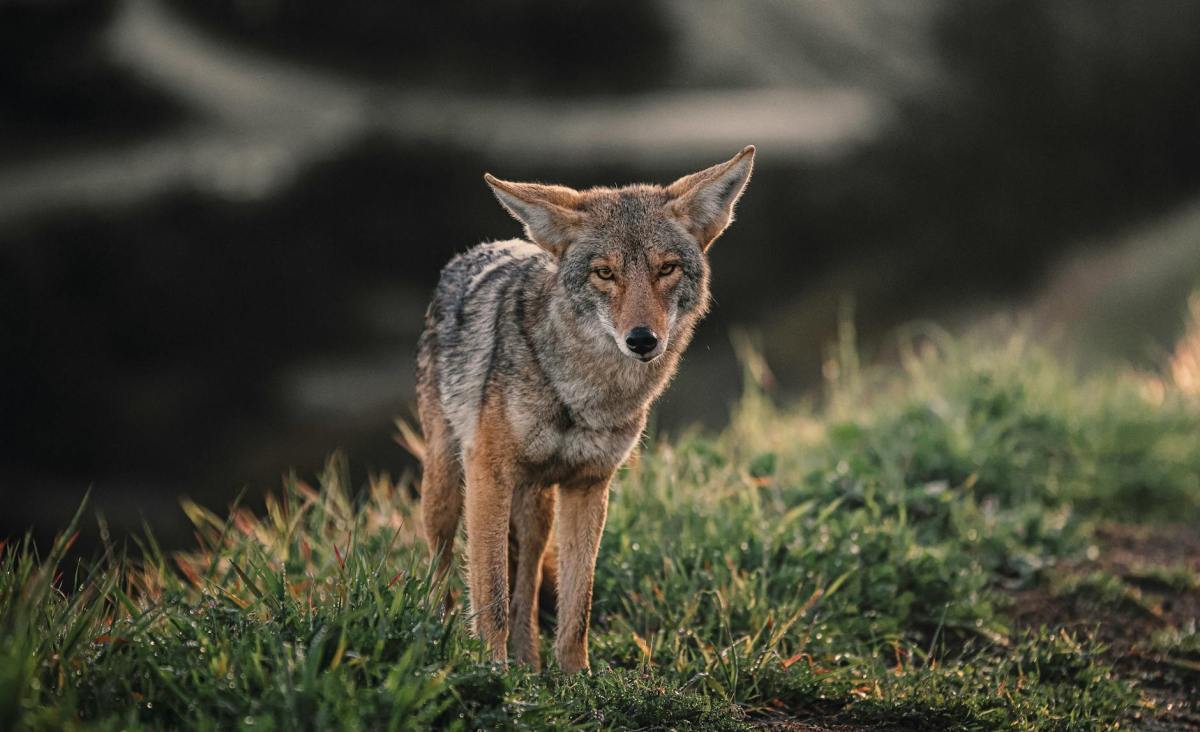
A family in Mission Viejo, Calif., heard a series of loud crashes at their back door, then reviewed their doorbell camera footage to find a determined coyote had been trying to attack their cat.

The footage shows the coyote repeatedly throwing itself at the screen door, which might have buckled if there hadn’t been a baby gate reinforcing it.

“We ended up putting a baby gate up to keep the cats inside,” homeowner Cindy Stalnaker told KABC. “That ended up being what prevented the coyote from getting inside the house because that’s what he was banging into repeatedly.”

Coyotes weigh about 30 to 35 pounds and will attack potential prey smaller than they are, which includes pets as well as young children.

The canids aren’t usually keen on approaching human homes, but in many places they’ve run out of room to roam as towns and cities clear more wild land for new developments. Less habitat means less prey, which can also lead the animals to scavenge and hunt on the fringes of residential and urban neighborhoods.

Stalnaker said she was grateful the baby gate held, but she’s looking into a more stable and permanent solution to keep her cats safe from coyotes.

What if air conditioning isn’t enough?

Human activity isn’t just driving wild animals to extinction, it’s killing them off with temperature extremes, and a Tuesday story from The Guardian provides a bleak look at how our present situation threatens human life as well: Buildings in most US cities aren’t built to mitigate excess heat, air conditioners weren’t designed to keep on chugging indefinitely with temperatures around 100 degrees, and power grids can’t keep up with the demand when millions of AC units are drawing power simultaneously.

At the same time, summers keep getting hotter and there’s no reprieve in sight.

Kids playing in water from a fire hydrant
Legal or not, New Yorkers turn to fire hydrants to get relief during heat waves. Credit: NYC Office of Emergency Management

While the heat has major ramifications for animals and sea life, it’s also directly endangering human life now:

“Some experts have begun to warn of the looming threat of a “Heat Katrina” – a mass-casualty heat event. A study published last year that modeled heatwave-related blackouts in different cities showed that a two-day blackout in Phoenix could lead to the deaths of more than 12,000 people.”

An architectural engineer tells the newspaper that temperatures have spiked so much in recent summers that cooling “systems that we sold 10 years ago are not able to keep up with the weather we have.”

The result for people in America’s hottest cities is that even AC doesn’t provide relief.

In the meantime we’re likely to see more headlines about rolling blackouts, punishing energy bills and people dying in their homes, scientists say. Fusion power and significant leaps in battery technology can’t come soon enough.

Elephants Call Each Other By Name, Study Says

Elephants encode names and other information in low-frequency rumbles that can be heard miles away. For social animals who live in large herds, it’s crucial to be able to address individuals.

Elephants are famously social animals, moving in matriarchal herds that can consist of as many as 70 of their kind.

They also communicate over long distances, emitting rumbles that can be heard miles away.

Because of their social and nomadic existence, it makes sense that elephants would need a way to single out individuals and address each other, and for the first time researchers say they’ve found evidence of Earth’s largest land animals calling each other by name.

“If you’re looking after a large family, you’ve got to be able to say, ‘Hey, Virginia, get over here!’” Duke University ecologist Stuart Pimm told the Associated Press.

The research involved field work and analysis using artificial intelligence. To record samples of elephants communicating, teams followed herds with recording equipment. Notably, elephant rumbles include sounds in frequencies lower than the human ear can detect.

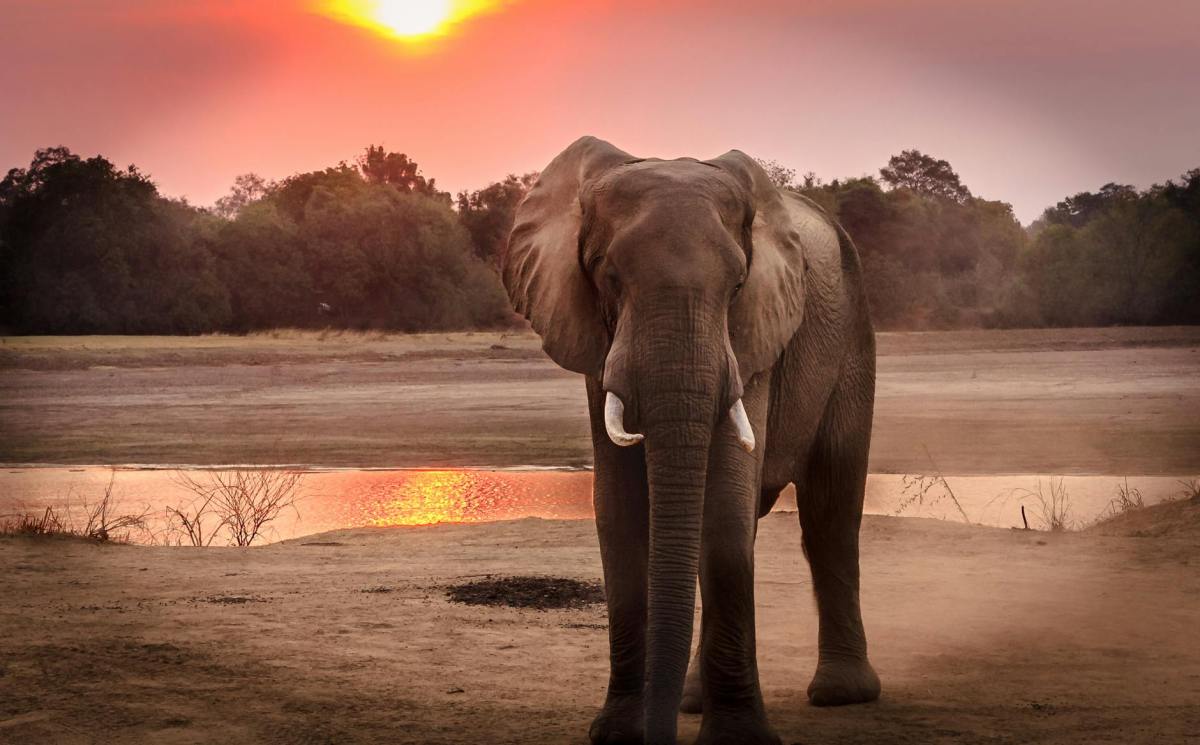
large elephants near lake
Credit: Pixabay/Pexels

The team paid close attention when one elephant vocalized and another responded, and recorded who initiated each rumble and who it was meant for.

Although elephants are best known for making loud “trumpeting” sounds, experts say those are more like exclamations while rumbles contain encoded information that African savanna elephants would need to communicate to each other.

“The rumbles themselves are highly structurally variable,” said Mickey Pardo, a biologist from Cornell University and co-author of the study. “There’s quite a lot of variation in their acoustic structure.”

A machine learning algorithm was then used to sort and categorize the large number of audio samples, looking for patterns that are difficult for human minds to detect.

“Elephants are incredibly social, always talking and touching each other — this naming is probably one of the things that underpins their ability to communicate to individuals,” said George Wittemyer, an ecologist at Colorado State University and co-author of the study. “We just cracked open the door a bit to the elephant mind.”

elephant-cub-tsavo-kenya-66898.jpeg
A female elephant with her young offspring in Kenya. Credit: Pixabay/Pexels

Notably, the elephant “names” are identifiers that they created for themselves, and are not the kind of human-bestowed names that cats and dogs respond to. The list of animals who have names for themselves is short, although likely to expand with further study. Dolphins, for instance, identify themselves with unique whistling patterns, and parrots have a similar method, but both species address individuals by imitating their calls. Elephants use their name analogs the way humans do, to directly address each other.

The research has the potential to raise public awareness of elephant intelligence and their plight as they face threats to their continued existence. Like almost all of the Earth’s iconic megafauna, elephants will become extinct if we don’t do a better job protecting them and ending the ivory trade. Every year about 20,000 elephants are slaughtered for their tusks to feed the demand for ivory, especially in China where it’s considered a status symbol, according to the World Wildlife Fund.

Yang Feng Glan, known as the”Queen of Ivory,” was sentenced to 15 years in prison by a Tanzanian court in 2019. Yang smuggled some 860 elephant tusks worth $6.5 million from Tanzania to China as the leader of one of the world’s most extensive poaching and ivory smuggling organizations.

During her years operating the smuggling ring, Yang presented herself as a successful businesswoman and ran in elite circles within China, authorities said. Two of her accomplices were also given 15-year sentences for their roles, but since then others have filled the vacuum left by Fang’s conviction, and elephant preserves are constantly under threat from heavily armed poachers.

Point/Counterpoint: ‘There Are So Many Wonderful Places To Lounge!’ vs ‘Dude, You’re In My Spot!’

Buddy the Cat praises the many comfortable lounging spots at Casa de Buddy, while Buddy the Cat blasts his human for sitting in his favorite spot! Who’s right?

There Are So Many Wonderful Places to Lounge!

buddycolumnYou know what I like about our my home, human? It affords me seemingly endless comfortable places to lounge and nap.

There’s the rug underneath the dinner table, which is soft and makes me feel well-protected with a roof over my head and chairs blocking access to anyone larger than me.

There’s your padded fake leather office chair, which not only retains your butt heat, but is also a fabulous item to scratch.

There’s my bed, which used to be your bed, which I graciously still allow you to use 22.3 percent of. Oh, and the wonderful raised platform above my scratcher, where I can watch birds safely and make weird noises when they fly. In the winter, the radiator provides a toasty alternative to draftier spots.

When I was but a kitten, I never dreamed of having such a vast realm to call my own, with so many comfortable places to be lazy.

Indeed, there’s no place like home, and no places like my spots.

Dude, You’re In My Spot!

buddycolumnCome on! Get up!

This is not funny. You know that’s my favorite spot! The left side of the couch is comfortable, warm, gives me a good view of everything, and smells like you.

Get up! Get up! If you don’t vacate the premises immediately I will be forced to disappear, wait until you’re distracted, then nearly give you a heart attack with a well-timed ambush.

Or perhaps I will take my spot anyway by sitting on your head. How foolish would you look then, eh human?

Yes, there are plenty of other places for me to rest but I like this one because you’re sitting in it.

Grrrr, fine! But I’m sleeping on top of you, so if you need to heed nature’s call, do it now, human. I don’t like to be disturbed by your bathroom trips. Also, could you try to breathe a little less? It’s just that when I’m laying on your chest, I can feel your exhales on my fur and it’s really annoying. If you could keep breathing to a minimum, that’d be great.