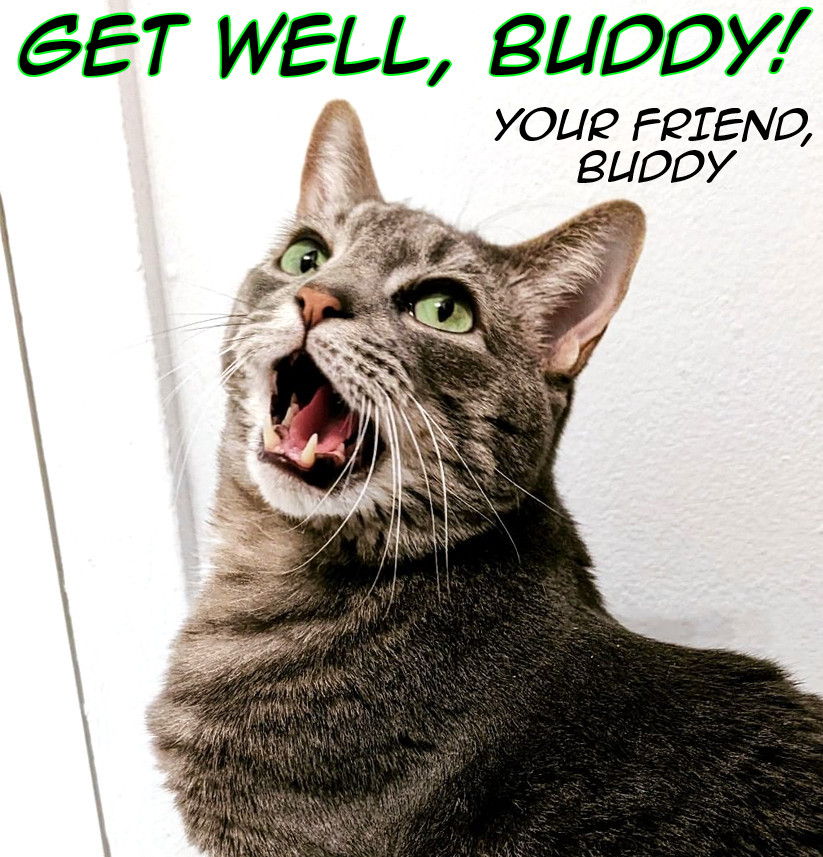
Did you know Buddy is an accomplished poet and cat of letters?
Haiku:
The food of the gods
Turkey, it’s so delicious
More turkey, servant!
Time for seventh nap
Beauty rest is required
Sleep on you, human!
Mystical flower
Transforms boring to blissful
Give me catnip now!
Buddymandias:
I met a traveler from an antique cat cafe
Who said: “Two vast and polished turds
Stand in the litter…near them, in the disarray
Half sunk a shattered clump lies, resembling Los Gatos
With wrinkled lip and cold sneer of jealousy
Tell that its sculptor well read those passions and pathos
Which yet survive, stamped on these lifeless turds of heresy
The paw that mocked them, and the heart that fed
And taped to the box, these words appear:
‘Our name is Los Gatos, Gang of Gangs we led
Look upon my catnip empire, ye mighty, and despair!’
Nothing beside remains round the decay
Of that colossal poop, boundless and bare
The lone and level litter stretches far away.”
The Raven
Once upon a midnight dreary I woke with something in my head
I couldn’t escape the memory of the poultry in my head
Like a game show contestant with a parting gift, I could not believe my eyes
When I heard through the voice of a trusted Big Buddy
Who used to humor me and feed me fries, yeah humor me and feed me fries
Quothe the raven: “Nevermore!”
“Shut up, raven!” I said. “Or I’ll make you into a late night snack
You may not be turkey, but every kind of bird I shall attack
So shut those loose lips, or I’ll use your bones as toothpicks
And then enjoy Temptations as a digestif.”
Buddy is available for readings at all distinguished parlors of poetry and bookstores. His chapbook, “Turkey In My Bowl,” is available in June from Handsome Boy Press.
Felines play a major role in Ghostwire: Tokyo, a horror adventure from Japanese studio Tango.
The premise of Ghostwire: Tokyo is simple: The entire human population of the city has vanished in some mysterious, cataclysmic supernatural event, leaving the heart of Tokyo silent, vacant and draped in an ethereal fog.
Instead of the bustle of humanity, the city is now populated by demons and yōkai, which are roughly equivalent to ghosts in Japanese folklore.
Only one human survives: Akito, our protagonist. He remains alive due to pure luck after a spirit named KK inhabits his body, intending to use it to fight the supernatural forces that have emptied Tokyo of its human inhabitants.
Akito and KK come to an uneasy truce sharing one body due to their aligned goals. KK’s presence not only allows Akito to survive the malevolent forces at work, but also imbues him with fantastic elemental powers to wield against the yōkai prowling the otherwise empty streets: He can summon wind, fire and water, and cleanse spirits and locations with Shinto prayer rituals.
A torii gate.
Akito performs a ritual to cleanse a torii gate.
Akito is set on rescuing his sister from sharing the same fate as hundreds of thousands of others, while KK spent his human life — and now his afterlife — trying to stop the mysterious figure behind the spirit invasion from harvesting human souls. For Akito to do the former, he and KK must do the latter.
Oh, and there are animals — lots of scared, confused cats and dogs who don’t know what to make of the city’s supernatural new inhabitants and don’t understand why the humans have gone missing. KK’s powers allow Akito to read animals’ thoughts.
“I can’t smell my buddy anywhere,” a confused dog tells me early in the game, whimpering as he wanders near the Shibuya scramble crossing.
It’s worth paying attention to Ghostwire’s lost pets. Feed a dog and the good boy could lead you to a cache of cash or a Jizo statue where you can say a prayer and augment your powers. Stop to pet and talk to a cat, and she might tell you a yokai is hiding nearby, disguising itself as an every day object.
True to a country obsessed with felines going back centuries, a cat isn’t always just a cat in the world of Ghostwire: Tokyo.
There are your regular domestic pets and strays, which are simply called neko, the Japanese word for cat. Akito encounters them often, comforts them and can read their thoughts with KK’s powers. Like the dogs, they’re confused, scared and hungry.
A cute cat warns me about nearby malevolent spirits.
A good boy leads me to a statue of Jizō Bosatsu, a deity who watches over children and travelers, and eases the suffering of lost souls.
“You’ve gotta spend money to make money, so why not spend it here with meow?”
This nekomata was meowing a hilariously out-of-tune song when I passed his shop stall.
Akito with a cat.
Then there are nekomata, which are the spirits of domestic cats who have become yōkai. Nekomata have made themselves at home in the absence of humans, showing their entrepreneurial spirit. The ghost cats have taken over every convenience store and kiosk in the city, urging Akito and KK to buy their snacks and supernatural wares to “be purrpared” for what awaits them.
“You’ve gotta spend money to make money,” one nekomata tells me, “so why not spend it here with meow?”
Nekomata are not to be confused with bakeneko, who are also yōkai but differ from their spirit cat cousins in subtle ways. Bakeneko can be friendly, mischievous or ambivalent, they can move without making a sound, and like nekomata they can speak and understand human language. Unlike nekomata, which have two tails, bakeneko only have one.
Finally, there are maneki neko. You’ve seen maneki neko even if you don’t realize it, probably on the counter of your local Japanese grocery, sushi house or Chinese restaurant. They’re the smiling, beckoning cats who are said to bring good fortune, health and other benefits. They’re based on the legend of a friendly cat who led a road-weary Japanese feudal lord and his men to a sanctuary just before a violent thunderstorm centuries ago, and have become ubiquitous in Japan and wider Asian culture.
For a game with a grim premise set in an empty but lived-in city, there’s plenty of bizarre humor as well. One mission has you delivering toilet paper to a human spirit who really, really needs to wipe after an epic bowel movement before he can move on and rest easy in the afterlife.
On another occasion I stopped to admire the detail and near-photorealistic beauty of a street bordering a shrine when I heard a nekomata hilariously meowing a cheerful song out of tune. When I turned toward the little cat, I saw him floating in the air and bouncing to his happy song.
As Akito, the player is tasked with lifting the fog from neighborhoods of central Tokyo, rescuing the spirits of deceased humans before they can be harvested by the demons and yōkai, and investigating the what, why and how of Tokyo’s takeover by malevolent spirits.
Akito and KK accomplish the former by “cleansing” Tokyo’s many shrines using a ritual performed at the shrine torii gates. Once a torii gate is cleansed, the fog around it subsides and more of Tokyo opens up for exploration and investigation. Meanwhile, Akito and KK must fight off yōkai to reach the floating spirits of Tokyo’s citizens, using a talisman to secure them. The duo can then “wire” the spirits to an ally outside the city, who helps return them to their bodies. The game keeps track of how many souls are saved, with the count rising to the hundreds of thousands for adept players.
One of the nastier yokai, toting an umbrella.
A yokai who takes the form of a headless, ethereal Japanese schoolgirl. If you let them get too close, they can seriously hurt and even kill you.
Akito performs a ritual to cleanse a torii gate.
The game remains true to Japanese folklore in the way it presents enemies, who are usually corruptions of human souls who have deep regrets about their lives. The spirits represent anxieties unique to, or prevalent in, Japanese society.
There are Rain Walkers, unnaturally thin salarymen toting umbrellas who advance on you inexorably, representing the angry spirits of men who spent their entire lives in service to a corporation, hardly spending time with their families or raising their kids because they work so much.
There are the Students of Pain and Misery, headless schoolgirls and schoolboys representing the spirits of teenagers whose grades couldn’t carry them into good universities, damning them to a life of tedious, low-paying jobs. Those are real concerns in a country where students spend in excess of 10 hours a day, six days a week in school. Teenagers are under enormous pressure to get top grades, and teen suicide is a major contributor to the country’s unusually high suicide rates.
Spirits of Lamentation are dangerous and move in sickeningly unnatural ways as spirits of people who were estranged from loved ones, while the small, raincoat-clad Forsaken are the spirits of abused children.
These malevolent spirits and others wander the streets, linger in alleys and leap across rooftops, but they also form groups called Hyakki Yagyo, which are parades of oni and yōkai who march through the streets of Japanese cities on summer nights, according to folklore.
You’ll hear the Hyakki Yagyo before you see it, tipped off by the booming taiko drums that accompany the ghostly parade.
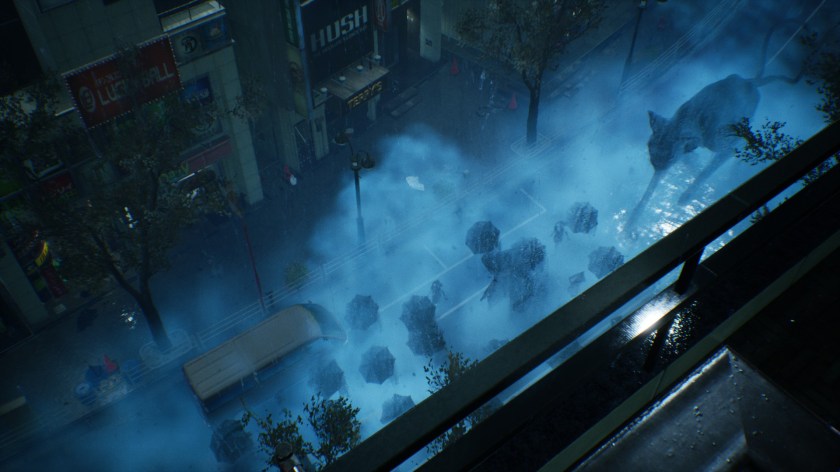
The arrival of Hyakki Yagyo in Ghostwire is impressively atmospheric: Lights and neon signs flicker and die out, while taiko drums boom from the mists. Then you see the spirits — yōkai with their umbrellas, massive demons, bizarre apparitions.
The first time I encountered a Hyakki Yagyo, I was so engrossed in watching the procession that I didn’t realize I was in its path until it was too late. I learned that if you get too close, the spirits yank you into an ethereal plane and surround you in numbers, determined to end your physical existence and make you one of them. Those encounters are among the most difficult in the game, but they’re also a fun test of skill.
Ghostwire gives us the most complete recreation of Tokyo in any game to date, and it’s magnificent. The metropolis extends seemingly forever in every direction, with 36 million people living a metro area that sprawls for almost 1,000 square miles. (That’s three times the size of New York with all its boroughs.)
Because of that, no game studio can handle the challenge of recreating the entire city on a 1:1 scale, and Ghostwire doesn’t attempt it. Instead the game world encompasses the famous Shibuya district and part of Minato City, two of the most bustling and famous districts in the heart of Tokyo. It’s a massive playground stretching from west of the scramble crossing, through Roppongi and all the way to Tokyo Tower.
Ghostwire is beautiful, polished and a hell of a lot of fun to play. You’re not going to find the gloriously intuitive combat of a game like Control, or even an experience like the fluid melee action of Shadow Warrior 2. Ghostwire’s combat is pedestrian compared to those games, but it becomes more fun and interesting as the game progresses and you’re given different powers and options to deal with a growing variety of ghastly enemies.
The lure of a game like this is its moody atmosphere, magnificent visuals, tense sound design and a plot that weaves hundreds of years of Japanese folklore into the mix, creating a world unlike anything else in gaming.
The writing deftly transitions between serious and funny, tense and lighthearded, and the partnership between Akito and KK allows for a running dialogue throughout the game, with the two of them asking each other questions, arguing over tasks and reacting to the craziness around them. What starts out as an uneasy alliance held together by necessity becomes grudging mutual respect and eventually friendship.
Rounding out the cast of characters are Mari, Rinko, KK’s friend Ed, and the masked protagonist. Rinko is the spirit of a woman who worked with KK in their human lives. Rinko and KK were killed for their determination, and in death they continue the fight against the malevolent spirits. Ed is a weirdo: He’s KK’s man on the outside, helping to reunite the severed souls of Tokyo with their human bodies when Akito and KK rescue them, but the only way to talk to Ed is by payphone — and even then, he only answers in recordings.
Mari is Akito’s sister, who was unconscious and helpless in a hospital when everyone vanished. More than anything, Akito wants to protect her.
Finally, there’s the man in a oni mask, the mysterious mastermind behind the supernatural takeover of Tokyo. Who is he? What does he want? Can he be defeated?
To answer those questions requires an adventure very much worth having.
Title: Ghostwire: Tokyo Release date: March 25, 2022 Platforms: PC, Playstation 5 Audience: Mature Cats: Many
Akito pulls the “cores” from two yokai during a battle sequence in Ghostwire: Tokyo.
A cat stares out from a living portrait in a
A maneki neko during a warped reality sequence.
A trio of stray cats who tell Akito they’re worried about the vanishing humans.
A new study reveals some surprises, while The Other Buddy continues to make progress after surviving an attack by two dogs.
I know you’re going to read this and think, “Okay, what have these two wiseasses come up with this time?” but I swear we didn’t make this one up!
It even appears to be a legitimate research paper, despite first attracting media attention on April Fool’s Day. (The paper itself was accepted in late 2021 and published in the journal PeerJ on March 25.)
To put it simply, adopting a cat will make all your wildest dreams come true. Buddy was right!
Cat servants are rated more attractive than people who don’t share their homes with cats, rate higher on traditional measurements of attractiveness like facial symmetry, and even weigh less (women) or, if they’re men, have higher levels of testosterone.
That’s according to a multinational research team led by Javier Borráz-León of Finland’s University of Turku.
How is this possible?
The team — which also consists of scientists from Latvia, Estonia and Mexico — believes it’s because of the infamous toxoplasma gondii, a parasite that infects cat droppings and can pass to humans and other animals.
T gondii nudges its hosts toward behavior that propagates the parasite itself.
“First, we found that infected men had lower facialfluctuating asymmetry whereas infected women had lower body mass, lower body mass index, a tendency for lower facialfluctuating asymmetry, higher self-perceived attractiveness, and a higher number of sexual partners than non-infected ones,” the study authors wrote. “Then, we found that infected men and women were rated as more attractive and healthier than non-infected ones.”
There’s precedent for this. Earlier studies have found that while most parasites make their hosts less likely to reproduce because they cause detectable negative health defects, toxoplasma gondii does the opposite. Male rats who are infected by t. gondii are more attractive to potential sexual partners in an example of a parasite that “can indeed manipulate host sexual signaling to their own advantage.”
That’s not to say you’d want to go and get yourself infected. Toxoplasma gondii can cause negative health effects, most famously in pregnant women, and may be responsible for agitating certain mental health issues. Some scientists have said fears about the parasite are overblown, and cats aren’t actually the primary culprits: People are more likely to become infected by drinking water from unsanitary sources, eating undercooked meat or shellfish, or eating unwashed vegetables and fruits from contaminated soil.
Still, it’s possible to get the parasite from being careless around cat litter, especially if your cat spends time outdoors. It’s another good reason to keep your kitties inside.
Your feel-good story of the morning. The @PSPCA says Buddy has left the building. He’s heading to his foster home this morning. One of his foster parents is a veterinarian who treated Buddy. ♥️ https://t.co/EEaIYBaO1l
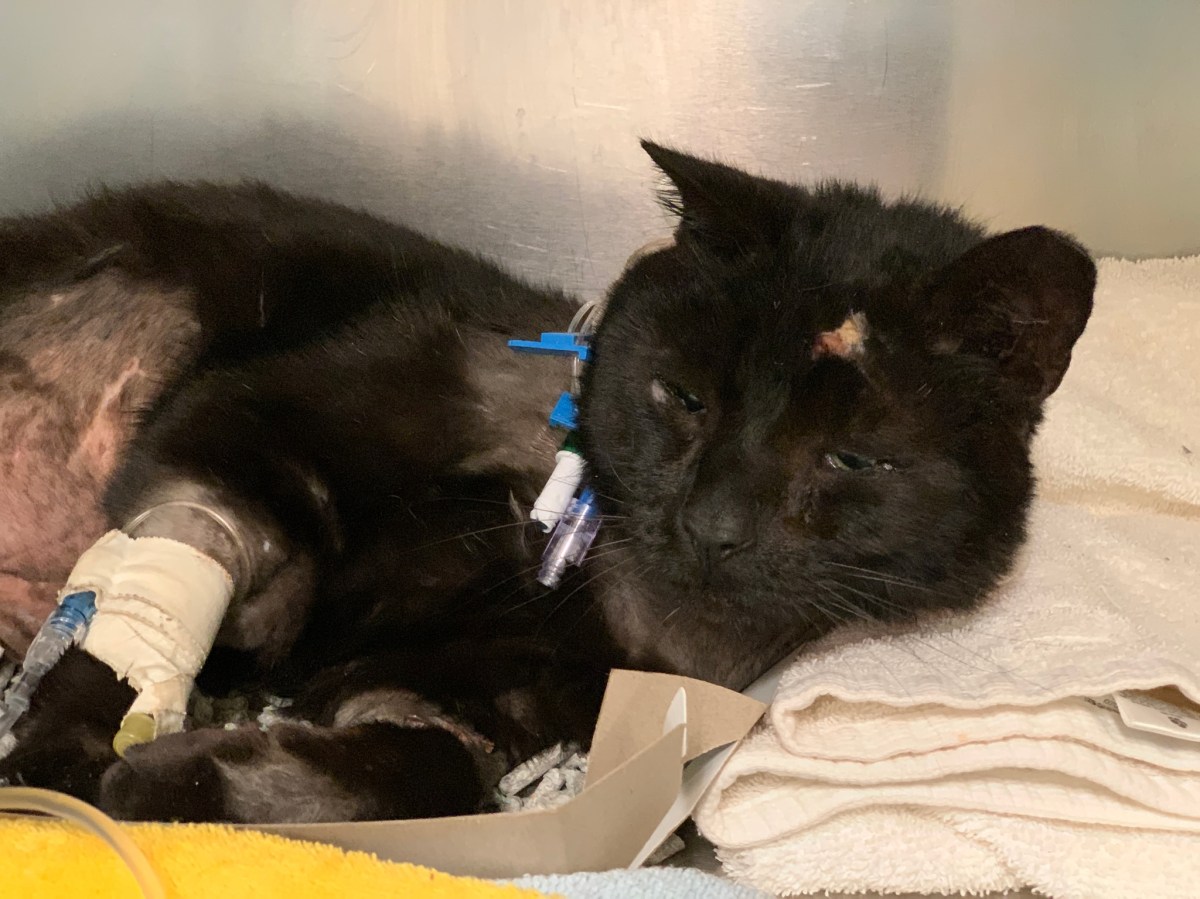
The little guy made headlines and captured hearts around the world with his ordeal, his bravery and the strength he showed as he clung to life in those first few days, when veterinarians feared he could succumb to his many wounds.
But late this week, Buddy was able to stand up for the first time since the attack, and he had a big appetite after so many days spent incapacitated and on pain medication.
The little fighter still needs time to recover before the Pennsylvania SPCA finds a good home for him. From what we hear, there are no shortage of applications from people who would love to give him the best life possible. For the time being, he’s staying with one of the veterinarians who cared for him during those fraught early days, so it’s good to know the good boy will have a familiar face around.
Looking to break into the profitable hypoallergenic cat market, scientists have turned their efforts to editing cat DNA.
On paper, the promise of “hypoallergenic cats” sounds great.
For the first time, people who love cats but are allergic to the furry little guys would be able to open up their homes to them. More cat lovers and more homes for cats is always a good thing, right?
Maybe not in this case.
The quest to create cats who do not trigger allergies depends on CRISPR gene editing, a method that allows scientists to edit, delete and replace sections of the genome. In this case, Virginia-based biotech company InBio wants to edit the genome of domestic felines to block Fel d 1 (Felis domesticus allergen I), a protein produced in cat saliva and in tiny subdermal exocrine glands, which secrete the protein via the same ducts that allow a cat’s fur to grow out from its skin.
Since cats are fastidious neat freaks and groom themselves constantly, the Fel d 1-carrying saliva is applied to their coats several times a day. When it dries, it contaminates a cat’s living space by flaking off the fur as dander or by shedding.
That’s why people who are allergic to cats can suffer symptoms like sneezing, itching and watery eyes not only from petting them, but also from spending time in homes where cats live.
What does Fel d 1 do, and why do cats need it?
The problem is that no one knows why cats produce Fel d 1 and what purpose it serves. Other proteins, like Fel d 4 found in pheromones and Fel d 2, help cats communicate by scent and prevent certain fluids from leaving the bloodstream, respectively.
Take a look at this quote from Nicole Brackett, a geneticist at InBio: (The emphasis on certain words is ours)
“The gene sequences don’t appear to be that well conserved over the course of evolution, which suggest things about whether or not the gene is essential,” Brackett told BioSpace, a life sciences publication. “An essential gene, one that would be required for survival or viability, generally doesn’t change much over evolution, and we’re seeing change between the exotic and domestic cat that suggests that maybe those sequences are not conserved, and maybe the protein is not essential.”
While we understand scientists have to be circumspect, especially regarding research that breaks new ground, that’s a lot of hedging and a lot of uncertainty. (It’s also not clear if Brackett is comparing domestic feline Fel d 1 levels to wild cats — felis sylvestris and lybica — wild felids in general, or hybrids like Bengals and Savannah cats, which are more commonly called exotics.)
Credit: cottonbro/Pexels
The team members developing the allergen gene edit assume Fel d 1 doesn’t have a critical function because individual domestic cats and other species of felids may produce different quantities of the protein.
But that’s a huge assumption, and it’s also presumptuous to assume we humans would know whether the gene edits have a major impact on felines. After all, we still don’t always know when cats are in pain or the reasons for many of their behaviors, and we don’t know what sort of cascade effect can be triggered by shutting down the production of a protein.
The race to make cats hypoallergenic
Companies see a huge opportunity for profit in the cat allergy alleviation market. Last year, Purina announced to much fanfare the availability of a new kind of cat food the company claimed would drastically reduce allergens after about three weeks of putting kitties on the new grub.
The claims haven’t been independently verified, and most press coverage is either credulous or consists of marketing masquerading as news coverage, like this advertisement from Purina that is presented like a news story in USA Today.
Back when a company called HypoCat announced it had conducted successful trials of a “vaccine” that would “neutralize’ Fel d 1, we spoke with immunologist Kamal Tirumalai, who pointed out that humans making such profound changes to companion animals for the sake of human convenience “passes neither the scientific nor the moral smell test.”
Like others, Tirumalai said she worried about unintended consequences.
“A vaccine given to cats to reduce their allergenicity for humans burdens them unnecessarily when human allergy to cats is primarily a human problem and should have a human solution in the form of reducing people’s cat allergies,” Tirumalai told PITB at the time. “Cats are perfect as they are. Why should they be the ones forced to change in order to be accommodated by a human whose immune system happens to have a problem with one of their proteins? This solution just doesn’t pass the moral smell test.”
HypoCat uses an injection to “induce anti-Fel d 1 antibodies in the cat,” while the CRISPR technique would snip the relevant DNA out entirely.
“Come now, let us not be absurd. Do you really think a designer kitten could be as handsome as I am?” Credit: Big Buddy
So far, Brackett and her colleagues have deleted one of two cat cells that produce Fel d 1 in samples in a petri dish, and have not made any changes to live animals. The experiments yielded a “55 percent knockout rate” for the Fel d 1 allergen, Brackett said, “which we were really happy with.”
Designer kittens: Gattaca for cats
If subsequent attempts are successful and the company sees commercial promise in editing feline genes, the process could be used to create “designer kittens” or to alter the genomes of existing cats. Brackett told Smithsonian magazine that the goal is to accomplish the latter.
But if it turns out the edits don’t work for existing cats, or the designer kitten trend becomes a thing, there’s another major moral concern similar to the objections to cat cloning. If people buy designer kittens, they’re not opening their homes to the millions of cats who need them.
Manipulating feline DNA isn’t a novel idea. A decade ago, a research team spliced genes from jellyfish using a different method to create cats who glow in UV light as part of a study into feline immunodeficiency virus (FIV).
Ultimately it comes down to what we’re willing to do for the sake of our own convenience. At a time when declawing has finally been outlawed in two states and dozens of cities, and people are more conscientious than ever with regard to their pets, do we want to risk their health so we don’t have to pop a few Benadryl?
Buddy, the cat who was brutally assaulted when two teenagers sicced their pitbulls on him in Philadelphia last week, is making progress every day.
The little guy began opening his eyes again a few days ago, the Pennsylvania SPCA said, and now they’ve shared a short video of Buddy the Black Cat sitting up, licking his lips and tucking into some yums:
Little Buddy the Cat has been pulling for his fellow Buddy. In the meantime, a lot of people have been asking the SPCA how they can help. Here’s a way to do that and get something in return: A spiffy t-shirt that says “Save Every Buddy” with an original design: