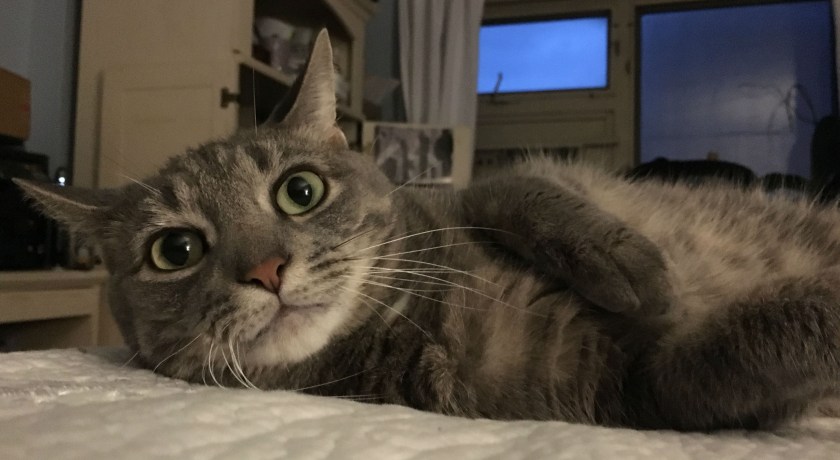
The newest trend on TikTok is terrorizing cats with Christmas trees so they’ll leave the trees alone during the holidays. Not cool.
Proving once again that social media has little or no redeeming value, TikTokers have latched onto a trend that has them using Christmas trees to terrify their cats.
The trend was started by a user who shared a “hack” she’d invented: Chase your chat around your home while wielding your new Christmas tree like a weapon, she said, and the cat won’t mess with the tree or its ornaments the rest of the holiday season.
“If you chase your cat around with the Christmas tree, it’ll be too scared to f**k with it,” said the “hack” originator, @alexisjj_.
User “@becs.richards” racked up more than 25 million views with a video that shows her holding her Christmas tree and thrusting it like a lance toward her confused and scared cat. She wore a big smile as she did so, and set the video to upbeat Christmas music.
Terrorizing your cat is a bad idea, author Anita Kelsey told Newsweek.
“A cat will not have any idea why you are causing them stress or fear and, more than likely, frightening a cat with a Christmas tree can lead to the cat being fearful of the room the tree is in, fearful of the tree, urinating around the home or on the tree and urinating on anything around the tree—like presents,” said Kelsey, author of Let’s Talk About Cats. “It also can cause a breakdown of trust between the cat and the person trying to frighten them.”
Daniel Cummings of the UK’s Cat Protection nonprofit said the method may seem successful, but it “doesn’t take into account how cats learn” and could cause long term problems.
“No cat owner would want to intentionally stress out their cat,” he said, “and part of cat ownership is accepting their natural behaviors.”
Unfortunately this newest trend isn’t surprising, especially coming from a user base of people who happily hand over their user data to the Chinese government, which controls TikTok and makes use of its data just as it does with any other ostensibly “private” company operating in China. There have been more than enough investigative stories illustrating how the Chinese government weaponizes data for any reasonable person to avoid platforms like TikTok.
I’m fortunate that Buddy is a good boy and mostly doesn’t mess with Christmas trees. He’s swiped a handful of ornaments off branches in the past, but so what? He’s a living being with feelings, and ornaments are just things.
Besides, as Cummings notes, curiosity and playfulness are part of the deal when we adopt cats. If people aren’t up for that, they shouldn’t adopt.
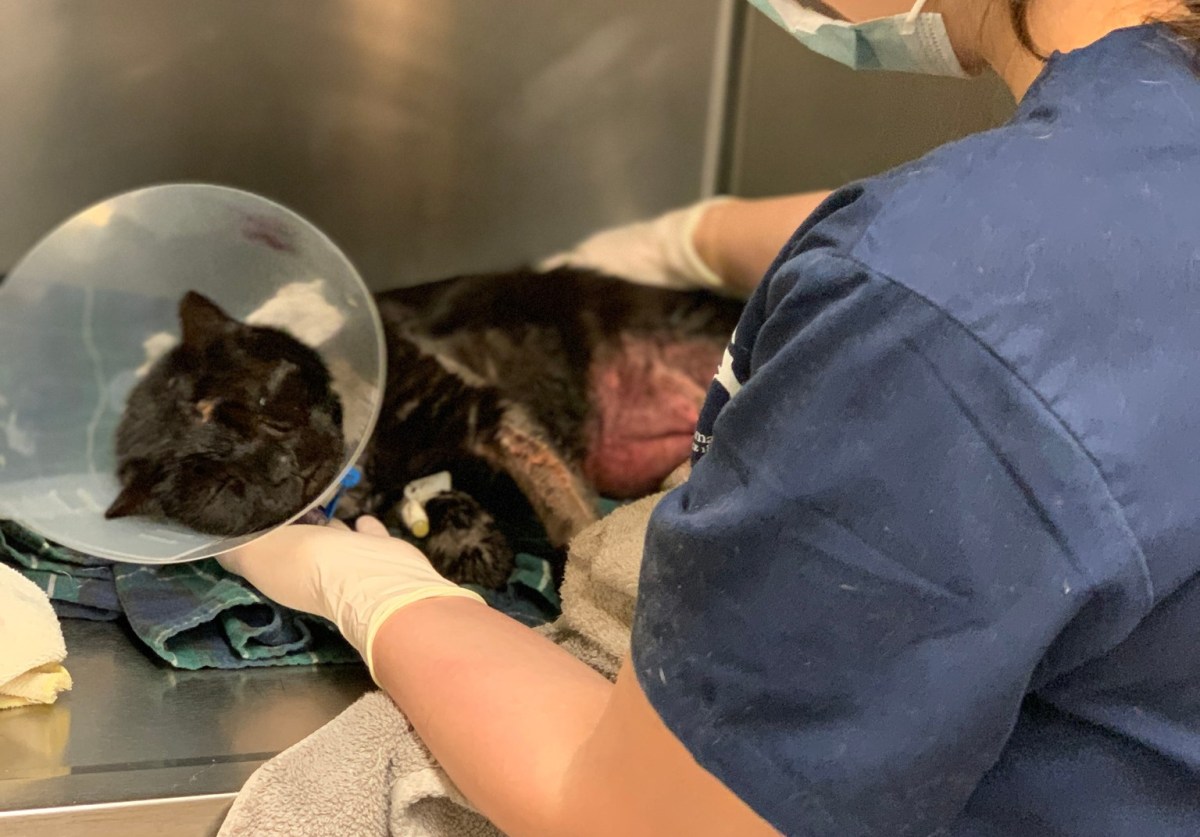
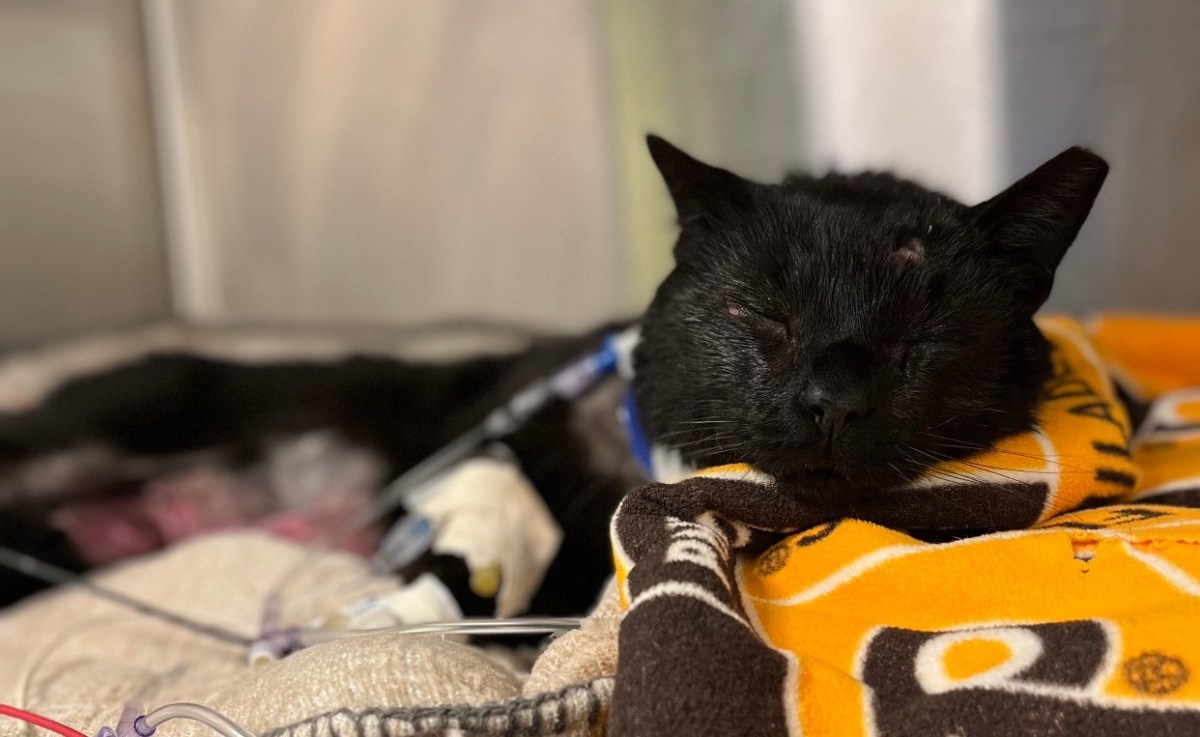
Kaya the kitten is recovering at her foster home after surgery.
UPDATE, 12/1: To Rescue says Kaya the kitten is “healing nicely” after surgery on her eyes, but will remain with her foster family for another week before she’s cleared for adoption. Kaya was examined by a veterinarian on Nov. 30 and was given the all-clear. She’ll stay in foster care until she’s finished with her medication.
Original post:
Several readers asked for a follow-up about Kaya the kitten after our earlier post about her.
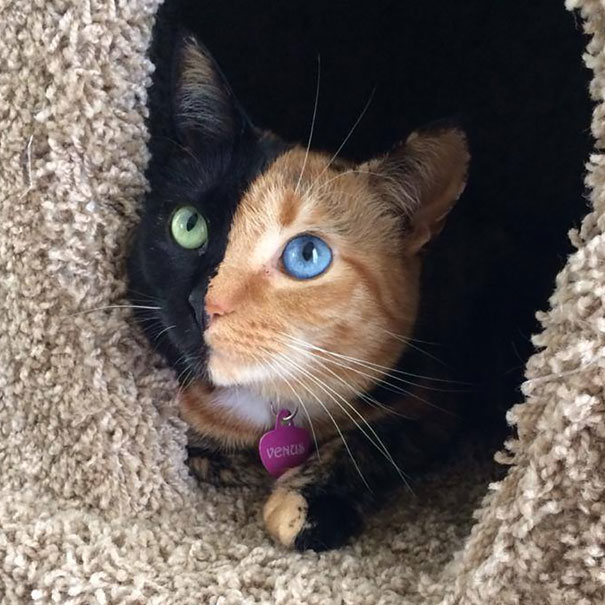
The shelter To Rescue turned to the internet for help after not a single potential adopter showed interest in Kaya, who has a congenital facial malformation but is otherwise healthy.
Kaya had successful surgery on her eyes on Nov. 16 and has been recovering in her foster home, where she continues to be her natural, playful self, shelter staff say.
She was scheduled for a follow-up vet visit today, Nov. 30. We’ll update as soon as we hear anything else.
If you’re interested in adopting sweet Kaya, you can visit the shelter’s site and fill out an adoption application.
The horror-drama from Netflix is more interested in untangling uncomfortable questions from the abstract than it is in providing answers. And that’s just fine.
Movie: The Platform (2020) Director: Galder Gaztelu-Urrutia Genre: Horror, social commentary Medium: Netflix
The premise of The Platform is simple: A man wakes up in a concrete prison cell. The center of the cell is dominated by rectangular gaps in the floor and ceiling, and when our protagonist warily steps closer he can see levels of identical cells above and below him. The cells extend as far as the eye can see in both directions, each populated by two prisoners.
Every day, a platform is lowered level-by-level, laden with a massive feast: Meats, wine, cheese, bread, cake, soup, pie, fish, escargot, paella, salads, grapes, apples and other fresh fruit, vegetables, juice. Every kind of food you can imagine, cooked and prepared to perfection by professional chefs.
Goreng, our protagonist, is greeted by his cell mate, a kindly old man named Trimagasi who sits down next to the edge of the hole in the floor in anticipation of the platform’s arrival. When it descends to their level he pigs out, shoveling as much food as he can into his mouth before a buzzer sounds and the platform descends another level.
Goreng looks on, digusted: The food is scattered all over the platform, much of it half-eaten. Clearly, these are someone’s disgusting leftovers.
Trimagasi, top, pigs out while Goreng picks at food scraps.
Trimagasi urges Goreng to eat, and explains that they are very fortunate indeed: At level 48 there’s still enough food leftover from the prisoners on the 47 levels above that they won’t starve this month. At the end of every month, he says, each pair of cellmates are put to sleep with gas and wake up on a new level that is chosen at random by the people operating the cruel social experiment.
Trimagasi tells Goreng he once spent a month on level 132, where not a scrap of food is left by the time the platform descends. Goreng asks the old man how he survived, and Trimagasi demures.
We also learn that Goreng voluntarily entered in exchange for a real-world opportunity promised to him after he spends six months inside. Trimagasi was sent there as punishment: Infuriated by a TV commercial for a self-sharpening knife called the Samurai Plus after he’d just purchased a knife sharpening kit, Trimagasi threw his TV out of his window and unintentionally killed an illegal immigrant who was riding a bicycle below. He’s approaching the end of his two-year sentence in what the authorities call the VSC, short for Vertical Self-management Center.
Each prisoner is allowed to take one item with them inside: Goreng takes a copy of The Ingenious Gentleman Don Quixote of La Mancha, harboring romantic notions of finally reading the book with his time in the prison. Trimagasi, who loves to use the word “obviously,” told Goreng his choice of item was obvious: His prized Samurai Plus, which he cradles lovingly as he boasts about how it can cut concrete without dulling.
Goreng puts two and two together, realizing how Trimagasi survived on level 132.
Going down: Just a portion of the feast as it exists on the platform before it’s consumed, defiled and excreted, level by level.
The Platform is a blunt allegory for human civilization, specifically the enormous wealth disparities of modern societies. The occupants of level 1 are the Jeff Bezoses and Walton families of the world, people with unimaginable, multigenerational wealth pigging out on life’s resources without thinking of the starving street children of India, the homeless of cities like New York and San Francisco, the families in North Korea eating tree bark.
Some reviewers think it’s a critique of capitalism, but I think it’s more universal than that: The kleptocrats of countries like Mexico, Russia and Brazil, the monarchies and emirates of the Middle East, and the party bigwigs of communist countries like China pig out on their own respective first levels while the people 130 “levels” down starve just the same.
The rest of us? We’re in the 30s, 40s and 50s, happily scarfing down the scraps from above, the ad revenue the Zuckerbergs and Pichais allow us by their forbearance, the slightly comfortable salaries allowed by corporate shareholders, the house and garage we might enjoy if we’re fortunate enough to run a successful small business in an industry that hasn’t been pillaged by the multinationals yet.
Looking down at the levels below in The Platform.
A plan to preserve food for the lower levels by force.
Trimigasi with his beloved Samurai Plus.
A poster for the Japanese release of The Platform. Credit: Netflix
Some people might find the movie heavy-handed, but I don’t see it that way. As uncomfortable as it is to watch at times, reality is much, much worse. The fact that some of the movie’s scenes are difficult to watch is testament to how lucky we are to be born in circumstances where that kind of suffering isn’t part of our experience, let alone our daily lives. Show The Platform to one of the handful of people to ever escape a North Korean hard labor camp, for instance, and they probably won’t even blink.
It also shows how our betters divide and conquer to keep the rest of us distracted and themselves secure. The idea that most people who receive social services are lazy bums is a popular one in some quarters, encouraging people not to have empathy for the less well off, but to loathe them. Likewise, the people occupying the higher floors of The Platform’s prison don’t feel sorry for those beneath them. In one scene, two cellmates tell a man they’ll help him ascend to their floor, then literally shit on him as he’s just within reach, cackling with delight as he falls.
I didn’t take it as a call for socialism either. The movie makes it pretty clear that neither asking people to moderate their consumption, nor trying to enforce sharing works out for the people who try those methods. Indeed when socialism has worked in real world circumstances, it’s been part of a hybrid model that still uses capitalism as its economic engine.
Mostly, The Platform exists to make people think. While Jeff Bezos goes to sleep tonight in his $50 million compound estate, dreaming of his next vanity flight to low Earth orbit or the next hypercar he’s going to buy, there’s someone shivering on a park bench with 15 cents in their pocket, stomach grumbling, knowing the people who pass them by every day don’t even see them as human.
Anyone familiar with evolutionary biology has heard the oft-repeated idea that we’re hardwired to propagate our DNA, and every decision we make — from who we date, when we get married, whether we put career goals on the line to take care of children — is ultimately dictated by that goal.
If that’s true, then “parenting” pets doesn’t make sense. They aren’t our biological children. They won’t carry on our family names and history after we’re gone, they won’t go to college and have careers and take care of us when we’re old. In stark terms, we’re “wasting” resources on raising — and often pampering — the offspring of other species.
Yet we do it, so the question is: Why?
Shelly Volsche, an anthropologist at Boise State University, thinks the explanation can be traced back to our roots in pre-agricultural hunter-gatherer societies, when alloparenting — cooperative parenting — was key to raising children.
“If people evolved to alloparent, and our environment is now making caring for children more difficult or less appealing to some, it makes sense for people to alloparent other species entering their homes,” Volsche wrote. “Alloparenting companion animals can offer a way to fulfill the evolved need to nurture while reducing the investment of time, money and emotional energy compared to raising children.”
As readers of this blog know, I don’t refer to my cat as my “child” and I don’t see him as some sort of child replacement. He’s Buddy, my buddy. We’re best buds. Other people choose to “parent” their children, and that’s cool. Whatever works for you.
A female macaque takes care of two babies. Alloparenting is common in macaque troops.
I think Volsche’s ideas are interesting, especially in the context of our primate cousins and the way they raise their young. Orangutans are quasi-solitary, and children stick with their moms for about eight years because it takes that long for them to mature and learn how to survive in the jungle on their own.
But more social primates, like chimpanzees, Capuchin monkeys, macaques and vervet monkeys, live in groups and cooperative parenting is a major part of how they handle raising “kids” when there’s no daycare or schools.
A mother who goes out to forage, for example, might leave her baby with an aunt or a trusted female of the troop, and it’s common to see female monkeys caring for babies that aren’t theirs.
Human and proto-human hunter-gatherer societies were essentially upjumped primate troops, so it’s that ingrained behavior we’re talking about here.
Ultimately, Volsche says we’re driven by a “need to nurture.”
“Although the details may look quite different — attending training classes instead of school functions, or providing smell walks for dogs instead of coloring books for children — both practices fulfill the same evolved function,” she wrote. “Whether child or pet, people are meeting the same evolved need to care for, teach and love a sentient other.”
“Emotional support snakes,” passengers breastfeeding cats, people being violent jerks to flight attendants: This is why airlines take away privileges.
As more airlines scoff at the idea of emotional support animals and banish pets to cargo compartments, selfish air travelers remind us why.
Like a woman on a Delta flight en route to Atlanta last week, who grossed out fellow passengers by breastfeeding her cat. Flight attendants asked the woman to stop and place her cat back inside its carrier, as per FAA rules, but she refused.
That prompted the pilot to send a message ahead to the destination airport via ACARS, short for Aircraft Communications Addressing and Reporting System:
An ACARS message sent from Delta Air flight DL1360 to ATL, Hartsfield-Jackson Atlanta International Airport.
The pilot asked for a ground team to meet the passenger aircraft upon landing. It’s not clear if the woman was prohibited from traveling on the airline in the future.
Regardless, as press reports note, Delta has been dealing with an 84 percent uptick in emotional support animal-related incidents, which comes amid a dramatic spike in general incidents aboard passenger jets. As of September, there were already three times as many incidents compared to the whole of 2019, and the FAA had handed out more than $1 million in fines, a CNN report noted. (Data for 2020 isn’t particularly useful as a point of comparison because air travel remained restricted for months due to the pandemic.)
It’s gotten so bad that flight attendants are quitting and airlines are worried about being unable to staff flights, as most don’t have enough attendants to provide a full crew complement as it is. And who can blame these flight attendants, who are already overworked and perform an often thankless job that should not include acting as law enforcement at 40,000 feet?
One flight attendant told the New York Times she feels like her and her colleagues are “like punching bags for the public,” while others say the job has become dehumanizing.
“What really hurts are the people who won’t even look at you in the eye,” she said. “I don’t even feel like a human anymore.”
Emotional support animals are supposed to be fairly rare and reserved for people with extreme anxiety. Instead, we’ve had a parade of assholes in the past few years demanding they be allowed to travel with “emotional support snakes” among other ridiculous companion animals. A Delta spokesperson said the airline had fielded demands from people with “comfort turkeys, gliding possums known as sugar gliders, snakes, spiders, and more.”
Then there’s “Flirty the Emotional Service Horse,” whose owner also maintains an Instagram page for the animal which informs visitors that Flirty prefers the gendered pronouns “she/her.”
What. An. Asshole.
Above: A selfish person.
Speaking not only as a cat caretaker, but one who is very attached to my little dude, did I like the idea of leaving him back in New York for almost a month when I went to Japan before the pandemic? No. Of course not. I missed him terribly.
Did I enjoy the 14-plus hours it took to fly to Haneda Airport? Of course not. On top of existing anxiety issues I can’t vape on a plane and I don’t like confined spaces.
But boo fucking hoo.
The rest of us just get on with it. We’re already pampered and accommodated beyond what we deserve in most circumstances. We should all have empathy, and we should all have respect for people who suffer from anxiety, but your right to comfort yourself ends at the point where I have to smell a horse’s ass for the six hours it takes to cross from New York to LA. Are passengers just supposed to endure it when the horse defecates? Is a single person’s comfort more important than the discomfort of entire rows of passengers surrounding her?
There are animal welfare issues here as well. No one should be allowed to take a wild animal on a passenger flight, and there’s a strong argument to be made that bringing a damn horse — or even a duck, for that matter — onto a flight is tantamount to animal abuse. Given the choice, those animals would not be there.
We live in an era of living indictments of the American education system who think the Constitution grants them the right to shit all over everyone else as long as it makes them feel good. There is no such right.
And the more that people abuse the privilege of taking an emotional support animal on a flight, the greater the chance that the people who genuinely need them will no longer be allowed the option.