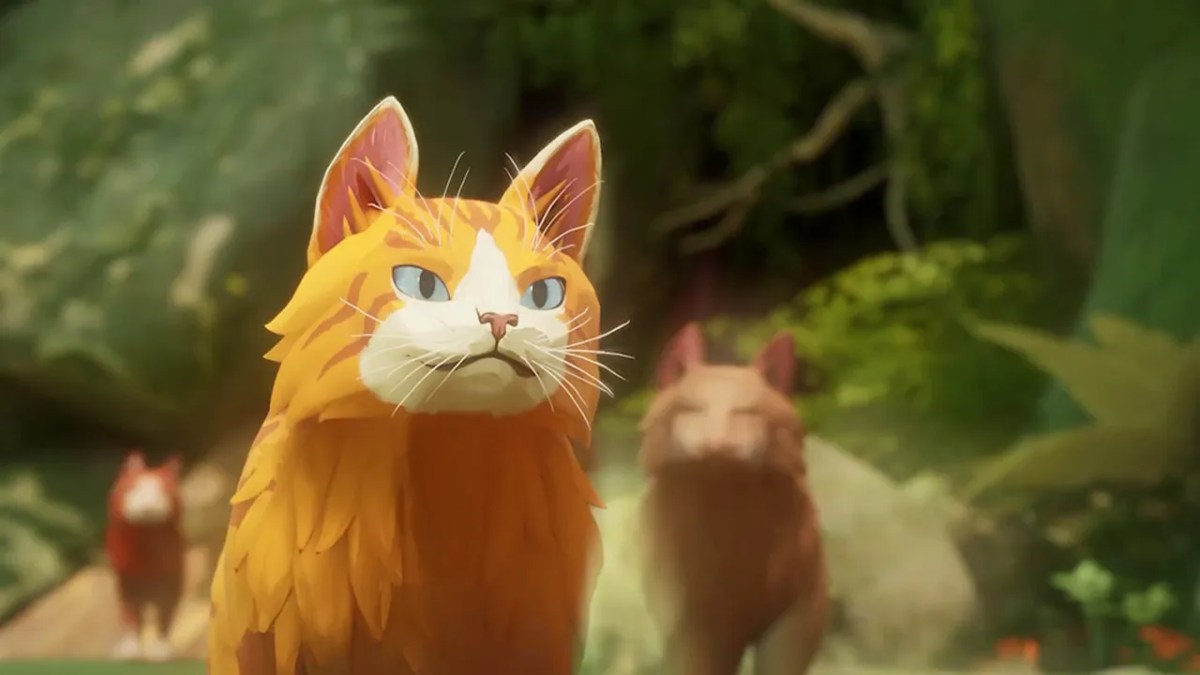
Based on the mega-popular book franchise, expectations were high for Warrior Cats: Clans of the Forest.
When reviewers accuse you of ruining childhood memories and start invoking all-time pop culture lows like Indiana Jones and the Crystal Skull, you know you’re in trouble.
I winced when I opened Steam on Friday and saw the newly-released Warrior Cats: Clans of the Forest had an abysmal “Mostly Negative” aggregate score on Steam. Since then the reviews have marginally improved, if you can call it improvement, with only 47 percent of players recommending the game for a “Mixed” rating, but most of the muted enthusiasm comes from the game’s intellectual property, not its production values, game loop or mechanics.
One reviewer called the narrative “diabolically bad,” saying the game’s story writers apparently paid little attention to the bestselling books it’s based on. Almost every review mentioned disappointment with the game’s cat-creation system, with Warrior Cats limiting users to a series of pre-determined names and strange coat colors that supposedly correspond to your character’s capabilities.
That means if players want to make their own cats in the game, they’re out of luck, and they have to choose between a cat who they favor aesthetically and one who has the attributes they want.
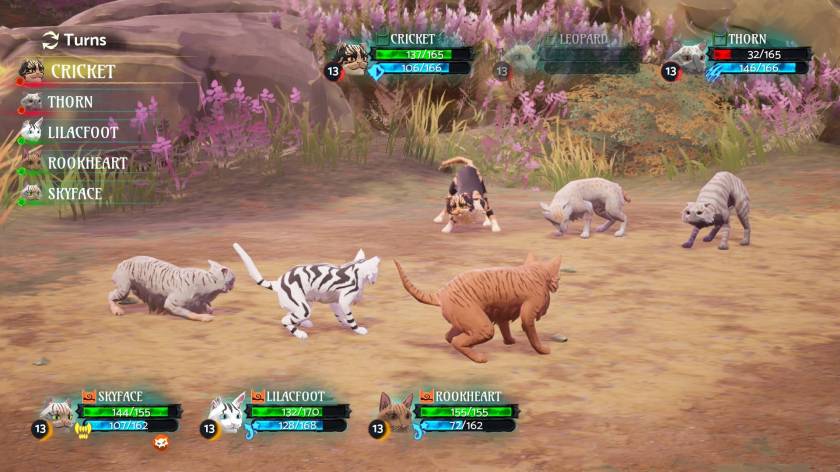
A screenshot showing the game’s turn-based combat system, which superficially resembles the systems used in games like Clair Obscure and old-school JRPGs.
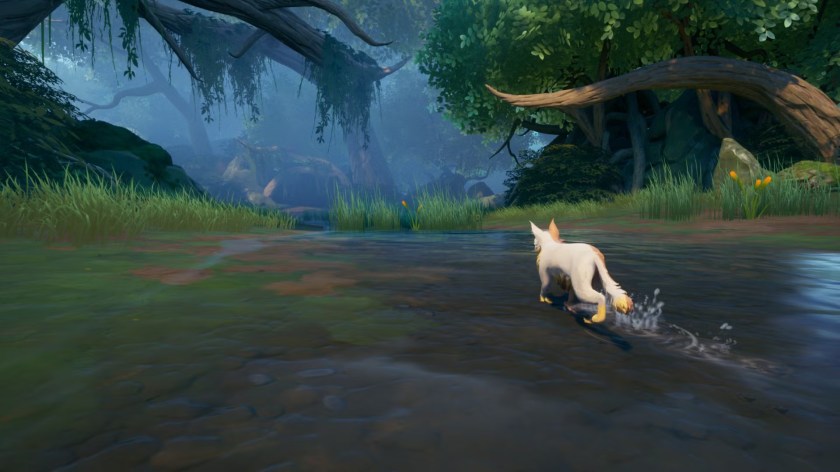
“I would’ve hated this as a kid as much as I do now. Playing Warriors on the playground by myself was more fun than this,” one reviewer wrote. “At least I had my imagination. Here, you have a buggy game with completely unintuitive mechanics, randomly generated clan cats that don’t matter to the story or to your story, tiny field mice that attack you, a lack of swimming ability in Riverclan, repetitive fight mechanics, invisible walls abound in an open world, and a storyline that is beyond paper thin. I wrote Warriors dialogue on Proboards when I was 8 that [were] better than anything in this game.”
“[S]uch a slog to get through; awful camera controls, repetitive quests, and a nonsensical story,” another wrote. The ending for the player’s chosen clan was “so absurd and out of nowhere I was dying from laughter from how bad it was.”
It’s worth noting that most of the negative reviews were from players who spent significant time in the game, enough to provide a fair assessment of what the game has to offer. The reviews PITB sampled were from players who had mostly between seven and 14 hours in-game.
Not everyone was down on the game. Most, including those who didn’t like the story or mechanics, praised the visuals, and a sizable minority of players wrote about how much they enjoyed playing a game set in a universe that was important in their childhood. Nostalgia did a lot of the heavy lifting in positive reviews.
Reviews from game critics were also mixed, although it’s worth noting there aren’t enough reviews for a consensus on Metacritic yet.
The visuals got a lot of love from reviewers, who praised the heavily stylized art direction and the environments, which include familiar locations from the books.
Steam shows the amount of in-game time under reviews so other players can get a sense of how much the individual reviewers stuck with games. The reviews show time played as of the moment of the review and total time played, so you can also see if a positive review preceded repeated plays. In a narrative game like Warrior Cats, 10 to 15 hours’ worth of content is about expected for a playthrough, while players in some games – open world exploration, survival, strategy, multiplayer – can amass hundreds of hours or more over years, attesting to a game’s replay value and the amount of content included.
Steam review aggregates are broken down into Overwhelmingly Positive for games praised by 95 percent of players or more, Very Positive for games reviewed favorably by at least 80 percent of players, Positive for games that have the same ratio of favorable reviews but fewer total reviews, Mostly Positive for games favored by 70 to 79 percent of players, and Mixed for games that meet the approval of between 40 and 69 percent.
The worst are Negative, Very Negative and Overwhelmingly Negative, reserved for games that are total disasters without redeeming qualities. Those games are often unfinished, abandoned by their developers, or are blatant cash-grabs.
Felines play a major role in Ghostwire: Tokyo, a horror adventure from Japanese studio Tango.
The premise of Ghostwire: Tokyo is simple: The entire human population of the city has vanished in some mysterious, cataclysmic supernatural event, leaving the heart of Tokyo silent, vacant and draped in an ethereal fog.
Instead of the bustle of humanity, the city is now populated by demons and yōkai, which are roughly equivalent to ghosts in Japanese folklore.
Only one human survives: Akito, our protagonist. He remains alive due to pure luck after a spirit named KK inhabits his body, intending to use it to fight the supernatural forces that have emptied Tokyo of its human inhabitants.
Akito and KK come to an uneasy truce sharing one body due to their aligned goals. KK’s presence not only allows Akito to survive the malevolent forces at work, but also imbues him with fantastic elemental powers to wield against the yōkai prowling the otherwise empty streets: He can summon wind, fire and water, and cleanse spirits and locations with Shinto prayer rituals.
A torii gate.
Akito performs a ritual to cleanse a torii gate.
Akito is set on rescuing his sister from sharing the same fate as hundreds of thousands of others, while KK spent his human life — and now his afterlife — trying to stop the mysterious figure behind the spirit invasion from harvesting human souls. For Akito to do the former, he and KK must do the latter.
Oh, and there are animals — lots of scared, confused cats and dogs who don’t know what to make of the city’s supernatural new inhabitants and don’t understand why the humans have gone missing. KK’s powers allow Akito to read animals’ thoughts.
“I can’t smell my buddy anywhere,” a confused dog tells me early in the game, whimpering as he wanders near the Shibuya scramble crossing.
It’s worth paying attention to Ghostwire’s lost pets. Feed a dog and the good boy could lead you to a cache of cash or a Jizo statue where you can say a prayer and augment your powers. Stop to pet and talk to a cat, and she might tell you a yokai is hiding nearby, disguising itself as an every day object.
True to a country obsessed with felines going back centuries, a cat isn’t always just a cat in the world of Ghostwire: Tokyo.
There are your regular domestic pets and strays, which are simply called neko, the Japanese word for cat. Akito encounters them often, comforts them and can read their thoughts with KK’s powers. Like the dogs, they’re confused, scared and hungry.
A cute cat warns me about nearby malevolent spirits.
A good boy leads me to a statue of Jizō Bosatsu, a deity who watches over children and travelers, and eases the suffering of lost souls.
“You’ve gotta spend money to make money, so why not spend it here with meow?”
This nekomata was meowing a hilariously out-of-tune song when I passed his shop stall.
Akito with a cat.
Then there are nekomata, which are the spirits of domestic cats who have become yōkai. Nekomata have made themselves at home in the absence of humans, showing their entrepreneurial spirit. The ghost cats have taken over every convenience store and kiosk in the city, urging Akito and KK to buy their snacks and supernatural wares to “be purrpared” for what awaits them.
“You’ve gotta spend money to make money,” one nekomata tells me, “so why not spend it here with meow?”
Nekomata are not to be confused with bakeneko, who are also yōkai but differ from their spirit cat cousins in subtle ways. Bakeneko can be friendly, mischievous or ambivalent, they can move without making a sound, and like nekomata they can speak and understand human language. Unlike nekomata, which have two tails, bakeneko only have one.
Finally, there are maneki neko. You’ve seen maneki neko even if you don’t realize it, probably on the counter of your local Japanese grocery, sushi house or Chinese restaurant. They’re the smiling, beckoning cats who are said to bring good fortune, health and other benefits. They’re based on the legend of a friendly cat who led a road-weary Japanese feudal lord and his men to a sanctuary just before a violent thunderstorm centuries ago, and have become ubiquitous in Japan and wider Asian culture.
For a game with a grim premise set in an empty but lived-in city, there’s plenty of bizarre humor as well. One mission has you delivering toilet paper to a human spirit who really, really needs to wipe after an epic bowel movement before he can move on and rest easy in the afterlife.
On another occasion I stopped to admire the detail and near-photorealistic beauty of a street bordering a shrine when I heard a nekomata hilariously meowing a cheerful song out of tune. When I turned toward the little cat, I saw him floating in the air and bouncing to his happy song.
As Akito, the player is tasked with lifting the fog from neighborhoods of central Tokyo, rescuing the spirits of deceased humans before they can be harvested by the demons and yōkai, and investigating the what, why and how of Tokyo’s takeover by malevolent spirits.
Akito and KK accomplish the former by “cleansing” Tokyo’s many shrines using a ritual performed at the shrine torii gates. Once a torii gate is cleansed, the fog around it subsides and more of Tokyo opens up for exploration and investigation. Meanwhile, Akito and KK must fight off yōkai to reach the floating spirits of Tokyo’s citizens, using a talisman to secure them. The duo can then “wire” the spirits to an ally outside the city, who helps return them to their bodies. The game keeps track of how many souls are saved, with the count rising to the hundreds of thousands for adept players.
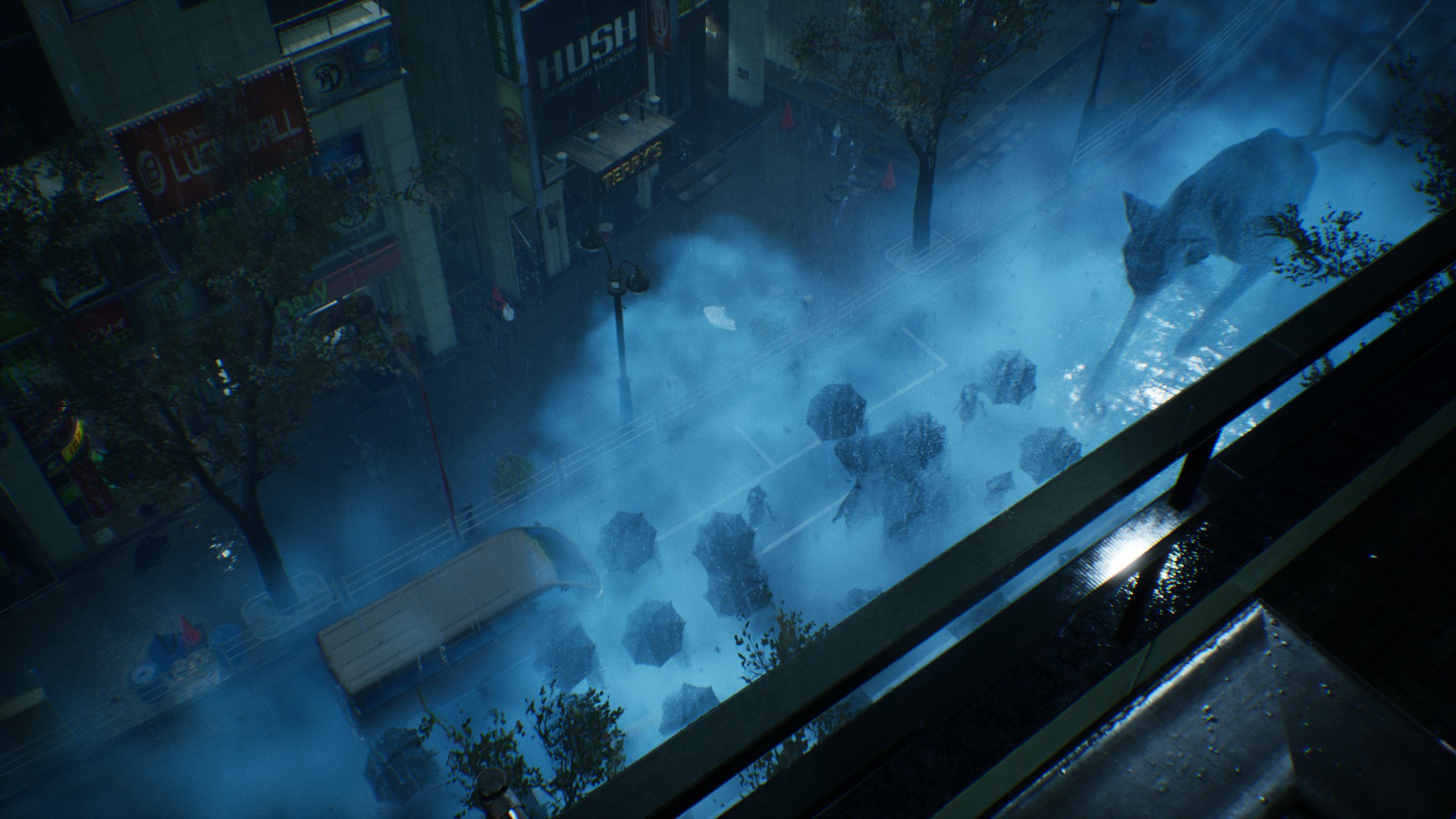
One of the nastier yokai, toting an umbrella.
A yokai who takes the form of a headless, ethereal Japanese schoolgirl. If you let them get too close, they can seriously hurt and even kill you.
Akito performs a ritual to cleanse a torii gate.
The game remains true to Japanese folklore in the way it presents enemies, who are usually corruptions of human souls who have deep regrets about their lives. The spirits represent anxieties unique to, or prevalent in, Japanese society.
There are Rain Walkers, unnaturally thin salarymen toting umbrellas who advance on you inexorably, representing the angry spirits of men who spent their entire lives in service to a corporation, hardly spending time with their families or raising their kids because they work so much.
There are the Students of Pain and Misery, headless schoolgirls and schoolboys representing the spirits of teenagers whose grades couldn’t carry them into good universities, damning them to a life of tedious, low-paying jobs. Those are real concerns in a country where students spend in excess of 10 hours a day, six days a week in school. Teenagers are under enormous pressure to get top grades, and teen suicide is a major contributor to the country’s unusually high suicide rates.
Spirits of Lamentation are dangerous and move in sickeningly unnatural ways as spirits of people who were estranged from loved ones, while the small, raincoat-clad Forsaken are the spirits of abused children.
These malevolent spirits and others wander the streets, linger in alleys and leap across rooftops, but they also form groups called Hyakki Yagyo, which are parades of oni and yōkai who march through the streets of Japanese cities on summer nights, according to folklore.
You’ll hear the Hyakki Yagyo before you see it, tipped off by the booming taiko drums that accompany the ghostly parade.
The arrival of Hyakki Yagyo in Ghostwire is impressively atmospheric: Lights and neon signs flicker and die out, while taiko drums boom from the mists. Then you see the spirits — yōkai with their umbrellas, massive demons, bizarre apparitions.
The first time I encountered a Hyakki Yagyo, I was so engrossed in watching the procession that I didn’t realize I was in its path until it was too late. I learned that if you get too close, the spirits yank you into an ethereal plane and surround you in numbers, determined to end your physical existence and make you one of them. Those encounters are among the most difficult in the game, but they’re also a fun test of skill.
Ghostwire gives us the most complete recreation of Tokyo in any game to date, and it’s magnificent. The metropolis extends seemingly forever in every direction, with 36 million people living a metro area that sprawls for almost 1,000 square miles. (That’s three times the size of New York with all its boroughs.)
Because of that, no game studio can handle the challenge of recreating the entire city on a 1:1 scale, and Ghostwire doesn’t attempt it. Instead the game world encompasses the famous Shibuya district and part of Minato City, two of the most bustling and famous districts in the heart of Tokyo. It’s a massive playground stretching from west of the scramble crossing, through Roppongi and all the way to Tokyo Tower.
Ghostwire is beautiful, polished and a hell of a lot of fun to play. You’re not going to find the gloriously intuitive combat of a game like Control, or even an experience like the fluid melee action of Shadow Warrior 2. Ghostwire’s combat is pedestrian compared to those games, but it becomes more fun and interesting as the game progresses and you’re given different powers and options to deal with a growing variety of ghastly enemies.
The lure of a game like this is its moody atmosphere, magnificent visuals, tense sound design and a plot that weaves hundreds of years of Japanese folklore into the mix, creating a world unlike anything else in gaming.
The writing deftly transitions between serious and funny, tense and lighthearded, and the partnership between Akito and KK allows for a running dialogue throughout the game, with the two of them asking each other questions, arguing over tasks and reacting to the craziness around them. What starts out as an uneasy alliance held together by necessity becomes grudging mutual respect and eventually friendship.
Rounding out the cast of characters are Mari, Rinko, KK’s friend Ed, and the masked protagonist. Rinko is the spirit of a woman who worked with KK in their human lives. Rinko and KK were killed for their determination, and in death they continue the fight against the malevolent spirits. Ed is a weirdo: He’s KK’s man on the outside, helping to reunite the severed souls of Tokyo with their human bodies when Akito and KK rescue them, but the only way to talk to Ed is by payphone — and even then, he only answers in recordings.
Mari is Akito’s sister, who was unconscious and helpless in a hospital when everyone vanished. More than anything, Akito wants to protect her.
Finally, there’s the man in a oni mask, the mysterious mastermind behind the supernatural takeover of Tokyo. Who is he? What does he want? Can he be defeated?
To answer those questions requires an adventure very much worth having.
Title: Ghostwire: Tokyo Release date: March 25, 2022 Platforms: PC, Playstation 5 Audience: Mature Cats: Many
Akito pulls the “cores” from two yokai during a battle sequence in Ghostwire: Tokyo.
A cat stares out from a living portrait in a
A maneki neko during a warped reality sequence.
A trio of stray cats who tell Akito they’re worried about the vanishing humans.