The quest for clicks and attention is a race to the bottom, and “petfluencers” are willing to dive deep to differentiate themselves from the thousands of others trying to build an audience.
Clothes, sneakers and hats. Vitamin supplements, energy drinks and probiotics. Backpacks and costumes.
What do all those things have in common? People are buying them for their pets, not themselves, and they’re part of the reason people in the UK spent more on pets in 2024 than childcare, hobbies or dating, according to Nationwide UK.
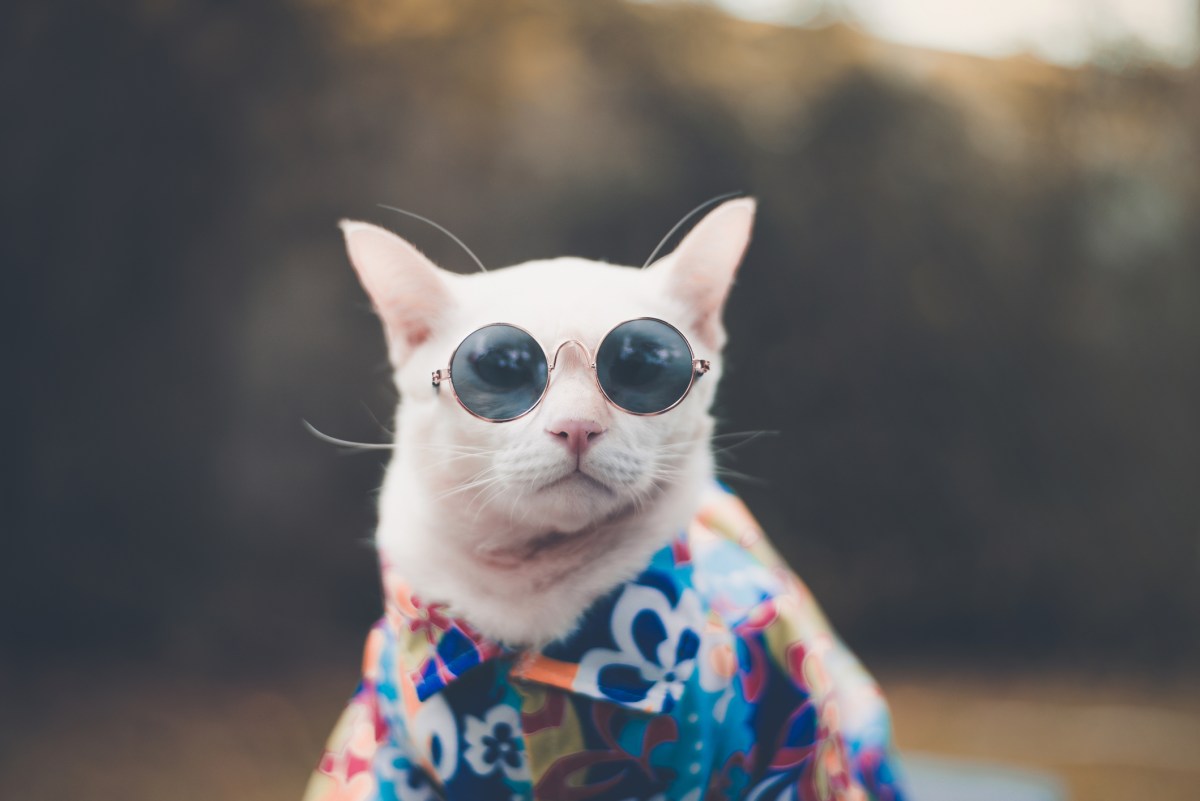
The problem is, they’re not doing it for their pets. Experts, including veterinarians and animal behaviorists, tell The Guardian that most cats, aside from hairless varieties like Sphynx cats, don’t like wearing clothing, nor do they like wearing costumes, or taking baths with heavy perfumes and essential oils.
Portrait of Hipster White Cat wearing sunglasses and shirt
Influencers — or petfluencers — stage elaborate “pampering” scenes, and make their pets wear different clothes to show off their shopping “hauls.” Some pose their animals like dolls and find ways to coerce them to remain still. Audiences think it’s cute. It’s not.
As for me, I’ve got a handy chart when I’m unsure if Bud will be cool with something:
Make him wear clothes. Result: Get clawed to death
Give him baths with essential oils. Result: Get clawed to death
Make him wear sneakers. Result: Death by bite to the jugular
Force him to eat supplements or guzzle energy drinks. Result: Shredded skin and lots of blood, perhaps some light homicide.
While the animals themselves aren’t thrilled with these new trends, they probably won’t go away any time soon. There’s just too much money involved.
The average pet owner in the UK spent the equivalent of $163 per month on their companions, and only half of UK households have pets compared to 66 percent in the US. Although there’s not an apples to apples comparison of total expenses on pets per month by household in the US, Americans spend $68 a month on cats on average, according to research by ValuePenguin. For dogs, it’s about $110 a month.
‘Salty liquorice’ cats owe their unique coats to a missing snip of DNA
It’s always an interesting occasion when nature gives us something new, and the salmiak cat is definitely unprecedented in the world of feline aesthetics.
The unique cats, named after a popular liquorice candy from Finland, have a coat pattern that results from a gradient on individual strands of fur, starting out black and getting lighter toward the tip. It gives their coats a singular peppered look, and in photographs the unusual felines almost look as if they’re rendered in monochrome stippling.
Credit: Ari KankainenThe Finnish candy the cats are named for.
The salmiak cat wasn’t the product of any breeding program, and reports in Finnish media say strays with the new coat pattern/color first emerged in 2007.
To find out how the salmiak emerged, a team of Finnish, British and American scientists sequenced the genomes of two salmiak cats. They found a mutation in genes that express coat color that resulted in a missing sequence of DNA, and they confirmed the mutation is recessive. That means to get salmiak kittens, both parents have to have the mutation.
“I had to leave work because I was a wreck, fully believing my cat was on the verge of life and death. It’s cruel that people do this,” one victim said.
Two weeks after his beloved cat vanished, Justin Hills received a phone call that simultaneously gave him hope and filled him with dread.
The man on the line spoke with practiced professionalism and told him that his cat, Little Wayne Shorter, had been found badly injured after he was hit by a car.
Little Wayne urgently needed surgery, said the man who identified himself as a staffer with Seattle Animal Shelter. Veterinarians were ready to begin surgery if Hills gave them the go-ahead and sent $2,800 via Venmo.
“The back of my head is screaming, ‘This is a scam. This is a scam.’ But at the same time, because it’s such an emotional pull, I’m thinking, even if there’s only a 10% chance that this is real, you know, I want to go ahead with it,” Hills told Seattle’s WKIRO.
Little Wayne Shorter
“The guy was rehearsed, was smooth. He sounded like, you know, an experienced person,” Hills said. “They had done some research on me before they called. You know, they knew my name. They knew my cat’s name, you know, the address and all this.”
When Hills called his bank, they warned him it was a scam. Hills said he’s glad he didn’t send the money but also devastated his cat is still missing — and that he was given false hope by someone trying to manipulate him in his desperation to be reunited with Little Wayne.
He’s not alone. In a post to Facebook group for missing pets in King County this week, Seattleite Harris Alex described a call from a person who claimed to work for Seattle Animal Shelter.
“They said someone found my cat, Binx, and that he had been hit by a car. They told me if I didn’t pay for surgery, he would die or be paralyzed within the next hour,” Alex wrote.
A caller said Binx, above, was seriously injured and needed urgent — and expensive — veterinary care.
Alex grew suspicious when the caller asked for a payment via Venmo, Paypal or Chime.
“I called the shelter to confirm they do not have him,” Alex wrote. “I had to leave work because I was a wreck, fully believing my cat was on the verge of life and death. It’s cruel that people do this. Be careful out there.”
Staff at Seattle Animal Shelter, which is run by the city, are aware of the scam and have gotten several calls from people asking if the shelter has their cats after being in contact with the impersonators.
“We would never ask somebody over the phone to make a payment,” said Don Baxter, manager of field services at the hospital. “We’re going to get that pet to a veterinarian and get it care and treatment, and then we’ll work out how to get the pet back to the owner after that.”
The lost/injured pet scam isn’t limited to Seattle, and the perpetrators will often switch to targets in another city if too many people become aware of their efforts, only to pop back up again later. The scam’s combination of social engineering and emotional urgency encourages victims to act quickly without giving the situation too much thought.
Experts advise people to keep their cool despite their hopes or fears, and demand proof that the person has the animal:
“This is one of the more difficult scams to deal with emotionally. If someone really has your pet, they should be able to at the very least send photos. Most people should be able to do a video call.
In general, scammers will pressure you to send money in advance. They will often make lots of excuses for not being able to provide proof they have your pet or meet in person.”
This general category of scam isn’t new, but social media has enabled scammers to believably pose as shelter staff using information pulled from the victim’s own lost pet posts and profiles, the FBI notes. The bureau also warns of several variations on the scheme.
Binx
The people running the con find their victims by scanning local missing pet groups on sites like Facebook and Reddit. They gather names and descriptive details, spin a narrative that shocks their intended victims, and create a sense of urgency by saying the cat will die if there’s any delay in performing surgery.
That’s what happened to Susan Burgess, who’d posted about her 15-year-old tabby cat, Linus, going missing. The caller said Linus was hurt and he needed to confirm her name, but Burgess realized he would have known it if he’d scanned Linus’ microchip.
She gave the scammer a piece of her mind before hanging up on him.
“On the off chance that you do have my cat, I hope that you are able to show some compassion and do the right thing,” she told the caller. “But I’m pretty sure that you don’t, and what you’re doing is very cruel.”
PSA:Speaking of scammy behavior, I can’t control the ads that are shown on PITB, but if you’re seeing ads for an amazing-looking, ultra-realistic toy rabbit presented as a great Easter gift, don’t fall for it. Here’s a video revealing what you’ll actually get from the deceptive seller:
Cheetahs are on the precipice of extinction because of relentless poaching on behalf of the children of oligarchs, and showing off collections of rare big cats has become de rigueur on social media.
Imagine you’re an obscenely wealthy Emirati heir, a Saudi prince, or the scion of a global business empire in Dubai.
You started an Instagram account, but sadly photos of your Lamborghinis and McLarens aren’t really moving the needle. In the circles you run in, everyone has those. Likewise, your $20 million digs are pedestrian by the standards of Gulf opulence, and showing off private jets is so 2023.
You need something to stand out, to show the peasants that you’re not just a fabulously affluent heir, you’re also really cool and everyone should envy you.
You need a big cat.
Maybe even cats, plural, if you can’t swing an ultra rare white lion or an 850lb liger on the illegal wildlife market.
“I’m not trying too hard in this photo, am I?”
Just imagine your follower count blowing up, and how jealous the peasantry will be when you post images of your apex predator pet chillin’ in the passenger seat of your Sesto Elemento, with a pair of $20,000 sunglasses on his head for the lulz.
That’s what’s currently happening in the Gulf among the incredibly well-off children of royalty, aristocrats, oil oligarchs, shipping magnates and other bigwigs, a report in Semafor notes.
“Of course you can’t put them in the Lamborghini, beratna! You don’t want those claws near your leather seats. Besides, my liger shall have his own custom made Koenigsegg with a gear shift he can operate by paw!”
In addition to providing compelling ‘tent to their social feeds in the form of photos and videos, it’s clear the owners believe big cats offer a kind of osmotic badassery: if you have your very own lion, you must be a powerful and interesting person!
This kind of thing is not new. Years ago there was a brief outcry when wildlife groups begged authorities to protect cheetahs, who are already critically endangered and risk extinction if global elites are allowed to continue to poach them and their cubs from the wild.
“While many of these states – including the United Arab Emirates and Saudi Arabia – ban the private ownership and sale of wild animals, enforcement is lax.
The overwhelming majority of these cheetahs end up in Gulf Arab mansions, where Africa’s most endangered big cats are flaunted as status symbols of the ultra-rich and paraded around in social media posts, according to CCF and trafficking specialists.”…
The trend is of “epidemic proportions,” according to CCF, an organization devoted to saving cheetahs in the wild. At the current rates of trafficking, the cheetah population in the region could soon be wiped out.
“If you do the math, the math kind of shows that it’s only going to be a matter of a couple of years [before] we are not going to have any cheetahs,” said Laurie Marker, an American conservation biologist biologist and founder of CCF.
Youtube has its share of dauphins showing off cats and cars, and Instagram has an entire sub-genre of pages featuring men in pristine white robes posing in million-dollar hyper cars next to cheetah cubs or tigers who have been sedated to their eyeballs.
As the Semafor report explains, technically keeping big cats is illegal in most Gulf states, except for the super rich. They can skirt existing wildlife laws by getting permits as private “zoo” and “sanctuary” operators, and who’s to say a good zookeeper can’t keep his jaguars in an enclosure with Maseratis and Aston Martins?
One guy even runs a place called Fame Park, a private zoo. The only way to get in is if he deems you famous enough, and thus worthy, to gaze upon his wondrous menagerie of endangered beasts.
The park’s motto is “Where luxury meets wildlife wonder,” and its operator styles himself as a conservationist who just happens to enjoy rubbing elbows with esteemed figures like Andrew Tate and Steven Seagal.
“What pet? I am a licensed zookeeper! In my zoo, enrichment is provided by Ferrari.”
Things really haven’t changed much in the last few hundred years, have they? One way royals and aristocrats amused themselves was by sending explorers to far off lands and instructing them to bring back strange animals.
That’s how elephants ended up in the courts of European kings, and how Hanno the Navigator found himself in mortal danger when he tried to capture gorillas, then decided they were “too violent” to drag back home and had them executed.
A court elephant photographed in 1851 by Eugene Clutterbuck Impey, an English administrator in the British Raj. This elephant is pictured in regalia used for royal processions and other ceremonies. Credit: National Gallery of Scotland
These days, the centers of power have shifted, but human behavior has not. Part of me still has hope, but the cynic in me fears people with the means to exploit rare and endangered animals will continue to do so until there are no more animals left to exploit.
Another critically endangered pet cheetah in a hyper car. Credit: Some clown’s InstagramEveryone knows that in the wild, big cat cubs nurse from Ferraris and Lamborghinis, and cheetahs learn to run fast by participating in drag races against the hyper cars. Credit: Another clown’s Instagram
A rare prequel that matches or exceeds the original, Day One explores relationships feline and human in a harrowing, life-or-death situation. With its Manhattan setting and post-apocalyptic vibe, the film also invites comparisons to the chaos and insanity of 9/11, when shocked survivors were just beginning to grapple with what they’d experienced.
If there’s one thing director Michael Sarnoski knows about cat people, it’s that putting a feline in danger is a reliably manipulative way to ratchet up tension.
Frodo the cat, therapy pet to Lupita Nyong’o’s Sam in A Quiet Place: Day One, is every bit the handsome co-star.
In a story about a woman and her cat trying to survive an apocalyptic event in New York City, the cat gets plenty of screen time. There are entire sequences following the little guy as he dashes away from danger (and sometimes toward it) and as he follows his feline instincts, which might not be the right instincts in a world that suddenly has its rules rewritten.
Nyong’o’s Sam, right, introduces Frodo to a young admirer in a Manhattan theater during the early minutes of A Quiet Place: Day One. Credit: Paramount
A Quiet Place: Day One is the third installment of the Quiet Place films. The first one thrilled audiences with a tight script, tense acting and a quiet/loud dynamic that made the absence of sound more sinister than sound itself.
A Quiet Place (2018) and its sequel (2020) take place about 16 months after the arrival of monstrous creatures of indeterminate origin. The aliens are blind, but that doesn’t impede their ability to rampage through human cities. They have an unearthly sensitivity to sound and can echolocate. Even a whisper can be enough to draw their attention if they’re in relatively close proximity.
We meet the Abbott family (John Krasinski, Emily Blunt and their children) some 16 months after the initial invasion, when they’re living silently on their isolated farm in upstate New York.
The audience is told nothing about where the creatures came from or what they are, and except for a short sequence in the very beginning of the sequel, we don’t see their arrival. The first two films deal exclusively with the aftermath, with scattered survivors trying to eke out an existence.
A curious Frodo watches Quinn’s character, Eric, emerge gasping from a flooded subway station. Credit: Paramount
Day One is a different beast entirely, both from a plot perspective and through the lens of Sarnoski, who leaves his fingerprints all over the franchise and imbues the prequel with a surprisingly poignant relationship between Nyong’o’s Sam and Joseph Quinn’s Eric, a young British student who moved to New York for law school. (If you’re a fan of Stranger Things, you’ll know Quinn as Eddie Munson, the D&D-playing metalhead and stand-out character from the show’s fourth season. He also had a brief appearance in the seventh season of Game of Thrones, and will appear in the upcoming sequel to Ridley Scott’s Gladiator.)
Sam and Eric are strangers thrown together by circumstance and quickly grow close. Eric, overwhelmed by the world being turned upside down in a country he’s not yet accustomed to, needs someone to latch onto. Sam, who has isolated herself as she wastes away from cancer, finds the companionship she didn’t know she needed.
While tens of thousands of New Yorkers heed the US military’s call to head to South Street Seaport for evacuation via boats, as the Death Angels apparently cannot swim, Sam is determined to reach Patsy’s pizzeria in Harlem, where she believes the world’s last slice of their beloved thin-crust pizza awaits. Unlike the other survivors, she doesn’t have the possibility of a future if she makes it to safety.
Walking from Chinatown in lower Manhattan to Patsy’s in Harlem is a hike, about nine miles as the crow flies. It would take most people the better part of three hours to walk under normal circumstances. In an invasion, when the slightest sound can mean death, it’s an extraordinarily dangerous and long journey.
Still, being determined to get the very last slice of pizza in an apocalypse is precisely the sort of ridiculous thing I’d do, so I sympathize with Sam.
In an amusing scene early in the film, a man in a bodega tells Nyong’o’s Sam she can’t have a cat in the store — while his own shop cat lounges on the counter next to him. Bonus point for the Knicks hat. Credit: Paramount
As for Frodo, he’s one cute little dude! I appreciate the fact that Michael Sarnoski elected to have an adult cat rather than a kitten, not because I have anything against kittens, but because Frodo is a reminder that felines of all ages are beautiful, and there are plenty of Frodos in shelters.
Nico and Schnitzel, the cats who play Frodo, are great animal actors. In one scene Frodo sees Quinn emerge from a flooded subway and stops, curiosity playing across his little face. He looks at the stranger and his mouth opens ever so slightly, as if in shock. How many takes did Sarnoski need to get that?
Nico and Schnitzel split duties as Frodo. Credit: Paramount
Frodo is also a survivor. His hunting instincts kick in when he sees a rat, drawing him closer to danger, and at one point curiosity beckons him toward the ruined shell of a building where the Death Angels are apparently nesting.
Incredibly, he never meows. There are times when he freaks out and runs, as cats are known to do, but he reliably finds his way back to Sam, and he has a knack for remaining absolutely still and silent when he needs to be.
There were so many moments when I imagined myself in Sam’s shoes and Buddy in Frodo’s paws, and we’d have been dead in all of them. As I noted in my post about the “Quiet Place Challenge” trend on social media, the Budster and I would have a life expectancy of approximately 60 seconds in the film’s world. Death by Buddy would be my fate, as inescapable as his mealtime screeching.
There is also a visceral 9-11 feel to the opening sequences of the invasion, and any New Yorker old enough to remember that day will be reminded of it. It’s impossible not to with the scenes of ash-covered survivors huddled inside buildings, crowds of dead-eyed people walking away from disaster and the eerie sight of a sooty Manhattan bereft of its usual bustle and life.
There are of course plot holes in Day One, or at least unanswered questions to things that don’t seem to make sense. When the military’s helicopters sweep over Manhattan, announcing via loudspeakers that survivors should head to the ports because “the enemy cannot swim,” I wondered: did these aliens just land in Manhattan? If so, why? Surely they don’t recognize the arbitrary municipal boundaries of humanity, and the whole area is one seemingly endless metropolis.
Quinn, left, and Nyong’o, right, panic as a Death Angel crashes down from above, listening for its prey. Credit: Paramount
The Death Angels are obviously sentient, but whether they’re sapient is another matter. They don’t seem to have much in the way of a sense of self-preservation, and there is no method to their madness. During the aforementioned helicopter scene, the characters watch as hundreds of Death Angels race toward lower Manhattan, drawn by the sound of the choppers and the loudspeaker. It’s impossible not to think it would be trivial to draw the lot of them with the loudest possible sound, then drop a few daisy cutters on them and call it a day.
Of course if any of that happened there would be no movie and no drama, so as with most stories like this, it’s best to let the film pull you along without stopping to over-analyze what you’re seeing.
If you’ve watched the first two films, you also know the reasons for the invasion are nebulous. The Death Angels don’t eat their kills, as Krasinski’s Lee Abbott learned, and if they’re the vanguard of a more intelligent species, doing all the dirty work before the masters arrive, well, we’ve yet to see who’s pulling the strings.
Overall, like horror master Mike Flanagan taking on a sequel to the tepid Ouiji earlier in his career, Sarnoski doesn’t view the fact that Day One is a prequel as an excuse to phone in a performance. He approaches the film with enthusiasm and energy as if it’s one of his own creations, and that’s evident in every frame. It’s a Sarnoski movie that happens to be a genre film, not the other way round.
There’s a surprising poignancy to Day One that makes it more than the sum of its parts. We’re not here to spoil anything, but if you’re a cat lover, we will say that Day One doesn’t pull an I Am Legend. You can watch the film with reassurance that Sarnoski has better tricks up his sleeve for stirring your emotions than gratuitous animal-involved violence.
It’s rare when a sequel or a prequel reaches the same heights as the original. How many of us wish franchises like Alien and The Matrix stopped at one film? Thankfully that’s not the case here. There’s life in A Quiet Place yet, and like the best science fiction, it’s a film that uses extraordinary circumstances to tell a very human story.
Perhaps the best part is the experience has made a cat lover of Nyong’o. In a short promo (below), she explains that she’s always been afraid of cats, viewing them as miniature lions.
“Now,” she says with a laugh, “somehow, I love them!”
She’s not just saying that either. After filming Day One, she adopted her own cat, Yoyo, and it takes just a glance at her Instagram page, which is festooned with photos of the orange tabby, to know that she really does love the little guy.
A group of people in North Carolina plucked two bear cubs off of a tree, dancing and laughing as they took selfies with the traumatized baby animals.
The World Wildlife Federation’s last Living Planet Report warned in 2022 that 69 percent of all wildlife has disappeared since 1970. A terrifying report from conservationists this year brought news that the natural world has fallen silent, with billions of animals erased from existence.
Why?
Because humans reproduce and rampage across the planet, no longer subject to survival of the fittest, with absolutely no regard for the species we share our world with.
That was proven again this week when a group of five people spotted bear cubs clinging to a tree not far from an apartment complex in Fairview, North Carolina, and decided the best course of action was to tear the terrified cubs off the branches so they could take selfies with them.
“So she can say, ‘Here, take my picture, post it all over. I’m holding a black bear,'” a horrified witness, 21-year-old Rachel Staudt, said as she filmed the group on Tuesday. “That’s insane. That’s 100% what she’s doing. She’s taking pictures of him.”
A still from Staudt’s video shows members of the group holding the bear cubs.
The woman called the authorities, who responded with a biologist from the North Carolina Wildlife Resources Commission, but not before the damage was done.
“Did she just drop it?” the woman filming the group said as one of the group members did a “celebratory dance move,” dropped one of the cubs, then chased it to get it back and take more photos.
The group told police and the biologist that both bears had “escaped,” but the biologist found one of the traumatized cubs near a retention pond on the property.
“The cub appeared to be lethargic and frightened. It looked to be favoring one of its front paws and was wet and shivering,” Game Mammals and Surveys Supervisor Colleen Olfenbuttel told CBS News. “The cub’s condition is likely a result of the unnecessary and irresponsible actions of the people involved.”
That cub has now been orphaned, as authorities said it’s not in any condition to be returned to the wild and will have to be raised and rehabilitated for the next four to six years. The other cub couldn’t be found. Hopefully it escaped.
The orphaned and traumatized bear cub that was recovered Tuesday after a group of people plucked the cub and its sibling out of a tree to take selfies with them.
Authorities noted it’s not uncommon for mother bears to leave their cubs briefly to go foraging, much like mother cats do with kittens and cubs when they need to hunt to feed themselves.
Common sense and a basic respect for wildlife is usually enough to keep people from snatching the animals, but much like people who pay money to take selfish with tigers who have been sedated to their eyeballs, any concern for the welfare of animals — if it existed in the first place — is quickly shelved as people can’t resist the opportunity to grab a selfie in the age of narcissism-fueled social media.
Authorities say they’re conducting an investigation, although it’s not clear what needs to be investigated. The people involved documented their behavior with selfies, and Staudt’s video clearly shows them handling the confused and scared baby animals.
The kind of ignorance demonstrated by the group doesn’t remedy itself. Authorities should make an example of them by prosecuting them to the fullest extent of the law while redoubling efforts to educate people about keeping their distance from wild animals. And if that’s not enough motivation, or if people can’t be bothered to respect wildlife, they should consider that this would be a very different story if the cubs’ mother had been nearby.