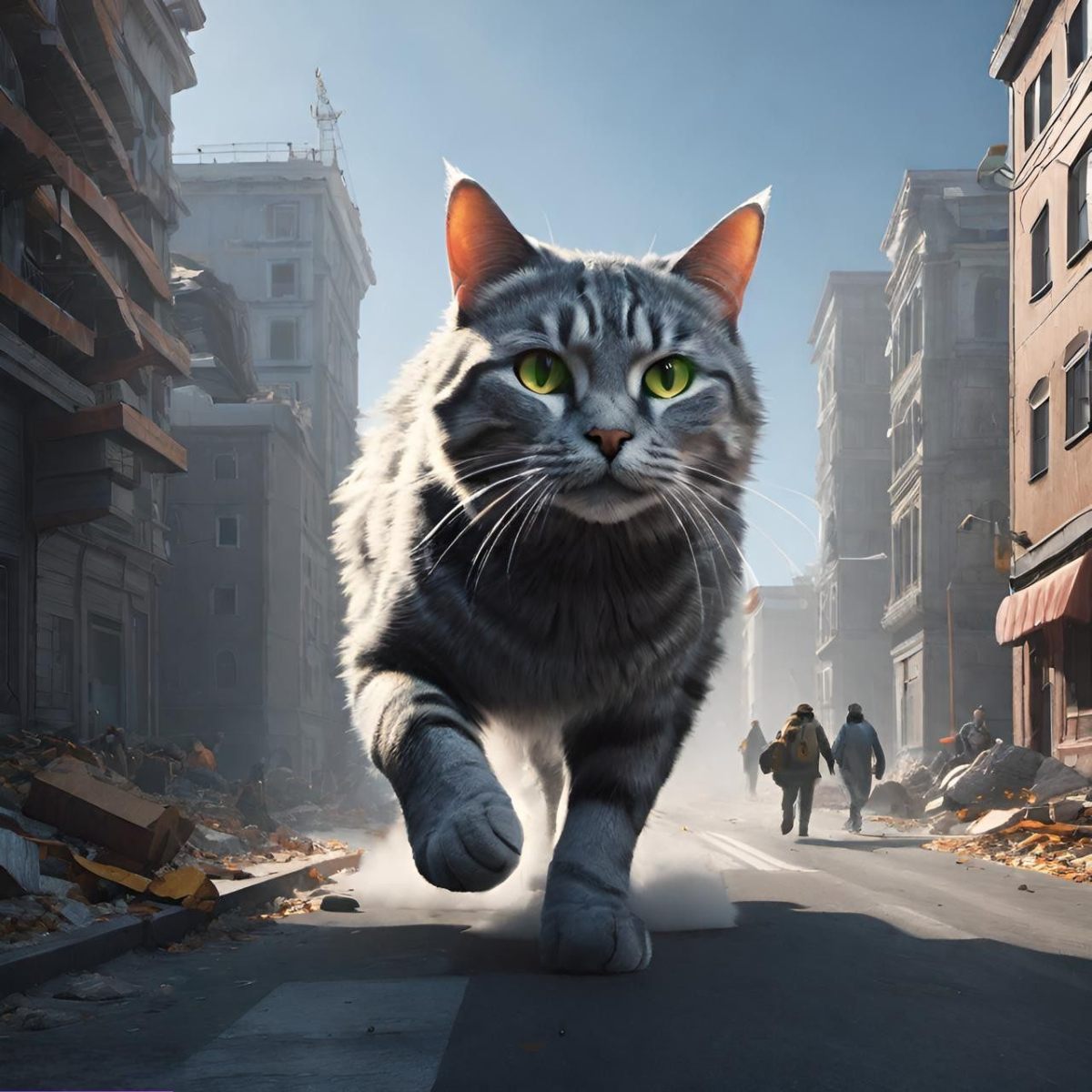
The feline laid waste to entire restaurants and food stalls during his rampage through the city, sending residents running for cover.
NEW YORK — The island of Manhattan was brought to a standstill this week after a massive and menacing wildcat was seen stalking the streets.
The first reports came in Wednesday afternoon after panicked callers told 911 dispatchers a “yuge gray tiger” had barreled into Gray’s Papaya on Broadway and 72nd, gorging itself on the eatery’s famous hot dogs.
Social media posts timestamped an hour later showed clips of the terrifying felid running full speed toward an Atomic Wings, where it tore through the entire inventory of chicken and hamburgers.
“Holy [bleep], that’s not a tiger, that’s a kaiju!” one TikTok user said in a video uploaded to the popular social media site.
The TikToker’s footage showed the gargantuan cat emerge from the Atomic Wings, hot sauce dribbling down the fur on its chin, and belch with such force that car alarms began shrieking in a three-block radius.
“We’re receiving reports that the colossal cat’s name is Buddy, and he escaped earlier Wednesday from an apartment where some lunatic was illegally keeping him as a pet,” Fox News’ Brett Baier told viewers. “A law enforcement source says the man has been taken into custody as a person of interest, and will likely face charges of harboring a dangerous wild animal.”
Detectives were seen escorting the cuffed man, who screamed incoherently that Buddy is allegedly “just a house cat.”
“He invented a laser that increased his size 70 fold!” the deranged man shouted as news cameras followed the detectives from the squad car. “He’s a wimp! Rustle a paper bag! Bring out a vacuum! You’ll see!”
New York Mayor Eric Adams dismissed the man’s claims as “the rantings of a clearly insane person,” and assured residents that the so-called Buddinese tiger would be “swiftly caught and dealt with by the brave men and women of the NYPD.”
“You’ll be able to make your dinner reservations, folks,” Adams said as an interpreter translated his words into American sign language behind him. “In the meantime, keep your doors and windows locked, and don’t cook anything pungent. This is a hungry beast who has eaten his way through dozens of restaurants.”
Police had set up a trap in midtown, with more than 900 pounds of roast turkey and baseball-size Temptations to lure the rampaging tiger.
The ill-fated turkey trap.
But the plan went horribly wrong on Thursday evening when the tiger approached.
“This beast is truly gargantuan!” ABC reporter Stephan Kim whispered during a live broadcast. “Each footfall seems to shake the earth. Look! The concrete is cracking and spidering beneath his paws as if it were brittle ice!”
The Buddinese Tiger stopped, sniffed, then launched himself at the pile of turkey, not even registering the tranquilizer darts fired by NYPD snipers stationed on top of nearby buildings until one hit him in the buttock.
The vicious cat roared and looked as if he would take down the building where the offending officer stood until he was distracted by the smell of Peruvian food wafting from a nearby Pio Pio.
“Arroz chaufa!” the tiger yelled, turning his enormous frame and stomping off into the distance.
City leaders admitted they’d underestimated the threat and had officially requested the National Guard, which was being mobilized late Thursday evening.
But an NYPD detective, speaking on condition of anonymity, said authorities were beginning to reconsider the claim that the rampaging animal could be a house cat.
“One of our officers called him a ‘good boy’ in a last, desperate attempt to save his own life when he was cornered by the beast,” the detective said. “To his surprise, the tiger pounced on him, licked his face, then went on his way, repeating ‘I’m a good boy!’ Maybe there’s some truth to this claim about the size-increasing laser.”
Rep. Marjorie Taylor-Greene of Georgia siezed on the story, posting a message on X claiming credit for “warnin’ ya’ll about these space lasers.”
“One of these lasers has turned a cuddly little house cat into a terrifying tiger,” Greene wrote. “So who’s a conspiracy theorist now?”
SAN DIEGO – The Siestas were down to their last cat still slumbering, and it looked like their rivals from Detroit, with three felines snoring away, would wake up with the victory.
But San Diego’s sole snoozer wasn’t any ordinary cat. He was 21-year-old Oscar the Couch, one of the most accomplished nappers in the world.
Long after Detroit’s younger, less experienced kitties had gotten up, stretched, enjoyed a meal and used their litter boxes, Oscar was finally beginning to stir from the dregs of his dreams.
Oscar yawned as his teammates cheered, and the referees declared the San Diego Siestas the winners.
“Competitive napping is unlike any other sport out there,” said Sammy the Sloth, a rotund tuxedo cat and snore-by-snore announcer for the Competitive Napping League’s broadcast team. “It rewards the slow and the sedentary, moving somewhere between the speed of a snail and the growing of grass. The only other sport that comes close is golf.”
The Competitive Napping League (CNL) was just a dream of its founders until Saudi Royal Feline Smudge bin Salman stepped in, signing the laziest felines to seven figure contracts and infusing the new sport with millions in marketing money.
San Diego Siestas!
Now competitive napping matches routinely air on ESPN7, and this year the CNL inked a deal for six nationally televised naps per season. The most accomplished nappers can also participate in the postseason nap-offs, and ambassadors for the sport are lobbying the International Olympic Committee to include competitive napping in the winter and summer games.
“This isn’t a genteel game like baseball or jai alai,” said Somnambulist Smokey, a silver shorthair. “This is hardcore, no-snores-barred snoozing, and it’s not for the faint of heart.”
As a sleepwalker, Smokey is one of the league’s most accomplished competitors. He’s known for getting up mid-snore and slapping his opponents in the face before laying down again. Initially suspected of cheating, Smokey was vindicated when brain activity monitors showed he remained in REM sleep, making him an authentic sleepwalker.
However, he’s not the only cat with tricks up his paw.
Filthy Frank the Flatulist is captain of the Fort Worth Forty Winks, and his emissions are of such olfactory potency that they can wake opponents out of the deepest slumbers.
“The [New York] Nappers strolled in here like they owned the place,” said teammate Charlie the Chonk. “Frank had them up and yowling in about 30 seconds with a squeaker that wafted over to the enemy and refused to dissipate.”
Credit: Matheus Bertelli/Pexels
Competitive napping is growing in popularity, with amateur clubs springing up in Japan, Taiwan, Scandinavia and the Principality of Sealand.
The Copenhagen Cozies and Helsingør Hygge recently slept through exhibition matches against the Louisiana Liesures and the Miami Sleepmasters.
“There’s nothing like the rush of a good nap followed by mews that you’ve outslept your opponents,” said Liesures captain Zoe Zzzz, “then going back down for another nap to celebrate!”
In a tragedy for the baseball world, the hated Dodgers defeated the beloved Yankees in the World Series. Buddy the Cat is NOT happy about the outcome.
Freddie Freeman, Dodgers first baseman, infuriating hit-celebrator, and Yankee killer, has adopted a kitten.
The evil Freeman has named his new kitten Champ, in a not very subtle nod to his team winning the World Series with a game five victory over the Bronx Bombers on Oct. 30.
“Freddie Freeman thinks he can buy his way into my good graces by adopting a cat, and a gray tabby, no less,” Buddy the Cat, president-elect of the Americats, told reporters. “Well, I have news for you, Tom Brokaw — you’re still on my poop list!”
Freeman with Champ. Credit: Freddie Freeman/Instagram
Buddy cited the considerable distress Freeman’s five home runs and 12 RBI caused Buddy’s human, including the “despicable” game one walk-off grand slam that shocked the Yankees. He also blasted Freeman for “doing a stupid little dance” every time the Dodger reached base.
But most of all, Buddy said, he blamed Freeman for cutting short the celebratory treats he enjoyed at every previous stage of the playoffs, when the Yankees were on a roll en route to the World Series.
“In the American League Division series against the Kansas City Royals, snacks rained down from the heavens as the Yankees took the series 3-1,” he said. “In the American League Championship Series, I feasted like a viking in Valhalla as the Yankees crushed the Cleveland Indians.”
But tragically, the silver tabby said, there was only one game in the World Series that merited celebration at Casa de Buddy.
“One measly game!” Buddy raged. “So no, you’re not on my good side, Freeman!”
Freeman should be kicked out of the league just for doing this dance on the bases, Buddy said.
Asked about Freeman’s teammate, Shohei Ohtani, and his dog, Decoy, Buddy claimed the canine “lives by my forbearance alone, and it would be a shame if he found his home raided by Feline Bureau of Investigation (FBI) agents.”
New to kids and nostalgic to adults, Playland means summer for New Yorkers. PITB visits the National Historic Landmark.
“You know,” I said to my niece, rapping my knuckles against a wooden support beam of Playland’s Dragon Coaster, “they built this thing 100 years ago.”
Her eyes widened. At 10 years old and already wise beyond her years, she smelled a joke at her expense by her constantly wise-cracking uncle. (I once told her and her sister that my cat had a vast collection of Pokémon cards, and that he almost certainly had the ultra-rare cards they coveted. At the time, their young minds didn’t question it and wanted to propose trades with Buddy, but now it comes up every time I tell them something absurd.)
“No it wasn’t!” my niece said as we stood in line to ride the venerable and historic wooden coaster.
My brother chimed in.
“It says it right there,” he said, pointing to a sign above the queue. “This roller coaster was built in 1929, the year the park opened.”
Playland’s ferris wheel and the manicured midway that runs the length of the park, with a giant fountain on one end and a stage for outdoor performances on the other. Credit: PITB
The Dragon Coaster is indeed almost a 100 years old, and to a 10-year-old a century is an incomprehensible amount of time. Mentioning the ride’s age almost backfired on us and we had to assure the kids the ride was safe.
Truth be told, the Dragon Coaster doesn’t look safe. It’s all aging wooden beams, rusting rivets and peeling paint, and the coaster rattles as it allows gravity to do the bulk of the work, with an initial 80-foot drop propelling the cars over 3,400 feet of shuddering track. But it passes inspection every year and it’s a relic of a time when things were built to different standards.
The iconic coaster’s history also extends to pop culture: Tom Hanks rode the Dragon Coaster in the 1988 film, Big, as did Mariah Carey in the video for her 1995 hit Fantasy. In 1987, it was featured prominently in the psychological thriller Fatal Attraction with Glenn Close and Michael Douglas.
A young Tom Hanks on Playland’s boardwalk in Big (1988). The “Zoltar” machine that grants Hanks’ wish in the movie is still in the park and has been moved to the midway.
Mariah Carey riding the Dragon Coaster in the 1995 video for her hit, Fantasy. Carey returned to Playland last summer with her family over the July 4 weekend.
The Dragon Coaster’s front entrance in September of 2024. Credit: PITB
My brother and I rode the Dragon Coaster when we were kids, as did my mom and her friends in their youth. If you grew up in Westchester County, the Bronx or Manhattan, chances are that Playland was a big part of your summers.
I have vague memories of the park from early childhood, fond memories of screaming on rides like the Mind Scrambler in my teenage years, fresher memories of taking my little charges there when I was a summer camp counselor, and new memories formed annually as I bring my brother’s kids.
Taking the kids to the amusement park was one of the things I most looked forward to when I became an uncle, and they’re at the age now where they really love it. Visiting the park brought on waves of nostalgia (“Good Vibrations” by Marky Marky and the Funky Bunch blasted from the PA when we first arrived), the happiness of seeing the kids’ eyes light up with joy, and the realization that even though I get dizzy and my stomach doesn’t appreciate rapid changes in gravity and direction anymore, some rides are still a hell of a lot of fun as an adult.
The medium-size version of three carousels at Playland in Rye, NY, September 2024. Credit: PITB.
We returned this year to find new rides, refurbished shops and lots of construction. Playland is in the middle of yet another refresh, this time to the tune of $150 million, leaving some rides and areas of the park dark to visitors.
Playland was built on 280 acres of prime waterfront real estate on the Long Island Sound and it’s very much a product of its time. Although it has seen its share of retrofits and refurbishment over almost century of existence, there’s no hiding the fact that it was constructed in the 1920s.
The structures — which include an entrance plaza, an ice casino and arcade, a pool, a beachfront boardwalk and a central tower — were built in an Art Deco style, with a consistent limestone, orange and emerald green color scheme.
As a kid my favorite ride was the Mind Scrambler, a blackout ride variation on the classic Scrambler housed within a dome. I remember waiting on line with my friends, hoping we’d get a good song for the ride, which was adorned with lots of neon and blacklights for maximum funkiness and disorientation.
Alas, messing around on a ride like that doesn’t bring good results. In a sequence of events that’s still difficult to believe, a seven-year-old girl was killed when she was thrown from the Mind Scrambler in 2004.
The exterior Mind Scrambler shortly before the darkride was dismantled following a series of deaths.
Three summers later, park management promoted a 21-year-old Playland employee who was working the night the girl was killed, making her the ride’s manager. She died that summer on the same ride. An investigation found she was kneeling backwards in her seat when she was thrown from the Scrambler just 20 seconds in.
The woman’s death prompted the park’s management to shut the ride down, a decision that was later made permanent despite the fact that “user error” was to blame.
Riders on the Dragon Coaster during the Great Depression. Credit: Rye Historical Society
A poster from the 1930s showing a bird’s eye view of Playland in Rye, NY. Note the beaches and the boardwalk below the park and the adjacent suburban neighborhood. Very little about the park’s layout or the neighborhood has changed over the years. Credit: Rye Historical Society
A close second favorite was the Music Express, a straightforward moderate speed ride that was also known for pumping out loud pop hits. I have fond memories of riding the Music Express to everything from the Spin Doctors’ Two Princes and Technotronics’ Move This, to Blues Traveler’s Run Around and Snow’s ludicrous summer hit, Informer.
The Music Express was out of commission last summer, but this time it was back in action.
“We’ve gotta ride this!” I told my nieces. Just when I was thinking it was getting a little intense, it slowed down. That wasn’t so bad, I thought. Then it spun up again, faster than before, this time spinning backwards. I felt like I’d downed a six pack of beer in a half hour when I stumbled off the damn thing.
The Music Express at Rye Playland.
I wisely limited myself to less strenuous rides for the rest of the night, including the bumper cars, Ferris wheel and the Zombie Castle. At seven years old, my younger niece isn’t big enough yet to ride some of the attractions by herself, and that’s when the Funcle steps in. Thankfully she’d had her fill of stomach-churners too.
Above: A classic swing ride at rest, left, and mid-sequence as it twirls riders through the air. Credit: PITB
Playland became a National Historic Landmark in 1987, and is unique among amusement parks in the US — and possibly the world — in that it’s government-owned. That’s because the people who live in the area, a wealthy waterfront enclave, were worried about growing crowds, traffic and “unsavory” people. In the 1920s at the urging of the community, Westchester County purchased the land, folded several smaller waterfront operations into a single park, and began drafting plans for a larger destination in the Art Deco style popular at the time.
While Art Deco is typically associated with structures like the Empire State Building and the Chrysler Building in Manhattan, as well as the Chicago Board of Trade skyscraper, the jazz-age aesthetic is another feature that makes Playland so unique.
The Zombie Castle was built in the 1930s with a different theme, then was refurbished in the late 1960s, perhaps in response to the success of George Romero’s Night of the Living Dead, which was released in 1968. This image shows the Zombie Castle on September 22, 2024. Credit: PITB
Remarkably, many of the attractions are as old as the park itself, including the aforementioned Dragon Coaster, The Whip, and the original carousel. Several of the older rides were designed and manufactured by engineer W.F. Mengels, the “Wizard of Coney Island” who was famous for designing many of that iconic park’s rides.
Taking the kids to Legoland in New York earlier this summer felt like a soulless experience, like paying to sit through a four-hour commercial for eponymous toys. Every ride was tied to a Lego intellectual property, every note of the piped-in music a corporate composition, every ride forcing you to exit via attached gift shops where $300 play sets beckoned to the children.
Even the “waterpark” had a corporate regimen to it: you’re required to book “appointments” ahead of time and get precisely 20 minutes to cool off under sprinklers on a Lego pirate-themed water playground, complete with Lego palm trees and Lego ships while the next group queues in the afternoon sun and watches, willing time to go faster.
Playland may not be as polished, but the experience feels more honest, and there’s no doubt the kids had more fun here. If I were a betting man, I’d wager Playland will still be there when they have kids of their own, while Legoland will be consigned to the dustbin of themed parks that don’t give you a reason to come back.
Coney Island’s version of The Whip designed by W.F. Mengels. Undated but likely in the 1910s.
A sign with original architectural drawings of The Whip from 1928, explaining “free-pivoting joints, combined with centrigual force, generates twists and turns which change with every rotation.”
Kiddyland is a section of the park for the little ones. It has a miniature roller coaster, a tiny carousel, and at least a half dozen other rides for young kids.
A view from the Ferris wheel at Rye Playland (PITB)
The Whip is one of the park’s original rides, built in 1928.
A Virginia man created National Black Cat Appreciation Day, a celebration of melanistic house panthers, in honor of his late sister, who loved her 20-year-old black cat named Sinbad.
Happy National Black Cat Appreciation Day!
A few years after the death of his 33-year-old sister, June, Wayne Morris wanted to do something in her honor. June adored her black cat, Sinbad, who died at 20 years old, just two months after she passed.
So the Virginia man teamed up with Rikki’s Refuge, a sanctuary where he volunteered, and created National Black Cat Appreciation Day in 2011. Morris chose the day of June’s passing, August 17, in her memory, and that first year marked it by holding a fundraiser for Rikki’s Refuge.
Morris was delighted by black cats as well. He often posted about Norman and Batman, his own melanistic miniature panthers, advocated for the adoption of black felines, and painted whimsical scenes of cats, which were auctioned to raise money for Rikki’s.
Morris often posted about his cats, including Batman, seen here. Credit: Wayne Morris
Wayne Morris founded National Black Cat Day.
Morris also liked to show off his other black cat, Norman. Credit: Wayne Morris
Morris painted scenes involving black cats, which were auctioned off to raise money for feline rescues. Credit: Wayne Morris
Batman. Credit: Wayne Morris
(Above, clockwise from top left: Batman, Wayne Morris, Norman, Batman again, and one of Morris’s paintings.)
Wayne Morris died in 2022, but the day he founded has continued to grow in popularity. In the 14 years since its inaugural celebration, National Black Cat Appreciation Day has spread via fundraisers for shelters across the country, as well as sites within the online catosphere, like this one.
Morris was motivated beyond honoring his sister and raising money for his favorite rescue. Black cats — also affectionately known as voids — have suffered unfortunate reputational damage over the centuries.
Melanistic felines are actually considered good luck in Japan, China and most of Asia, where they can be found in temples and their likenesses are used as maneki neko, the ubiquitous “lucky cats” in homes and businesses. (Black maneki neko are said to ward off evil spirits, diseases and people with bad intentions, while the golden cat statues are associated with wealth and the white neko are thought to bring good health.)
But in much of the western world they’re associated with bad luck, “evil” forces in folklore, and they’ve been invoked in outbursts of moral panic over things like witchcraft.
Big cats can be voids too, like this stunning black jaguar in Scotland’s Edinburgh Zoo. Credit: Wikimedia Commons
A black cat — or a statue of one — was said to be involved in Satanic rituals in Spain by Konrad van Marburg, an inquisitor known for his brutal zealotry. While the effect of that accusation has been exaggerated for years in internet discussions and posts (Pope Gregory IX’s papal bull dealt with a small area of Germany and did not declare that black cats were Satanic), it naturally comes up in superstitions about the animals.
A 2020 study of 8,000 adoptions found black cats were less likely to be adopted and more likely to be euthanized. That study and others found there was “scant evidence” for the dramatic margins suggested by anecdotal accounts circulating online and in some publications, but confirmed the problem is real. Research also suggests that negative perceptions of black cats isn’t correlated to religious preferences, but is tied to general belief in the supernatural.
Interestingly, additional research has hinted at a decidedly more modern and petty reason people may hesitate to adopt black cats: they think voids are more difficult to photograph, which is an issue for people who want to show their pets off online. (We’ve written about that particular hang-up before, and noted it’s possible to take beautiful photographs of voids by being mindful of factors like lighting and contrast between fur color and the background.)
Regardless, the combined effect of the superstitions and negative associations has harmed black-coated felines, and National Black Cat Appreciation Day is also an attempt to push back and show people that black cats are just, well, cats.