Cats were built by mother nature to stalk by starlight.
From the African savannas to the Andean mountains, the jungles of the Amazon to the Hollywood hills, and everywhere in suburban America, cats of all types and sizes prowl the night. With eyes that are up to eight times more sensitive in the dark, incredibly sensitive hearing, and whiskers that can pick up the slightest change in air density, felids were built by mother nature to stalk by starlight.
Some cat species are crepuscular, some are nocturnal, but as ambush predators, they’re all at their best when hunting under the cover of darkness.
Image credits, top to bottom: Per Karlson/PVKFoto, Reddit r/natureisf***inglit, Cockscomb Basin Wildlife Preserve, Wikimedia Commons, Steve Winter/National Geographic, National Park Service, Colorado Parks and Wildlife
The new puma will have big paw prints to fill if it decides to make its famous predecessor’s range its own. People in Los Angeles are thrilled to have another mountain lion prowling the Hollywood Hills.
When the mountain lion known as P-22 died in late 2022, people in Los Angeles were so distraught they painted murals of him on building facades, buried him after a indigenous tribal funeral and even held a festival in his honor.
The famous feline had already been the subject of books, documentaries and an iconic photograph by National Geographic’s Steve Winter. The image showed P-22 in mid-stride, perfectly centered in a small pool of light beneath the Hollywood sign in the hills of Los Angeles at night. It was a natural symbol of wildlife adapting and surviving.
The love for P-22 wasn’t only based on the incredible fact that a mountain lion had established his “range” in Griffith Park, an oasis of wilderness surrounded by urban landscapes. The puma had to cross Interstate 405 and Route 101, heavy-traffic highways that are famously lethal to his species, to get there. For the next decade he skillfully avoided cars and trucks as he went about his business, popping up on trail cameras or in the backyards of Los Angelinos.
Now there’s a potential successor to the vacant throne.
The new puma isn’t collared and wildlife experts don’t know where it came from, but like P-22 it had to cross several dangerous highways to reach the city.
It’s not clear yet if the mountain lion is male or female. Jeff Sikitch, a biologist with the National Parks Service who is part of an ongoing, decades-long study of pumas, told the Los Angeles Times that he thinks the cat is likely a young male, but there’s not much to go on so far except for witness sightings and a low-resolution video taken by a man who lives in an apartment building near the edge of Griffith Park.
“Will this cat be as skilled as P-22 was at avoiding cars for a decade?” the National Wildlife Federation’s Beth Pratt told the BBC. “We don’t know what’s going to happen here.”
The only images of the newcomer so far are grainy video stills, but Griffith Park itself has trail cameras that are used to monitor wildlife. Credit: Vladimir Polumiskov
For now, wildlife officials are waiting and watching to see if the potential puma successor puts down roots in P-22’s old hunting grounds or tries to make the dangerous trek out of the city.
If the new puma decides to stay, it will enjoy plentiful deer and a benefit most members of its species do not have — a local population that understands mountain lion attacks are extraordinarily rare, and will support them by giving them a wide berth.
On the other hand, despite the 4,000 acres of Griffith Park and the residential neighborhoods below, the cat’s inherited range would be much smaller than what’s typical for the species. Like humans cramming belongings into apartments, pumas sacrifice space when they live in or around cities.
Suzanne Pye, a local who admired P-22 from afar, said she welcomes the newcomer and isn’t worried about attacks on people. The presence of a mountain lion after almost 18 months without one prowling the hills, she said, will add “a frisson of excitement to the morning hikes.”
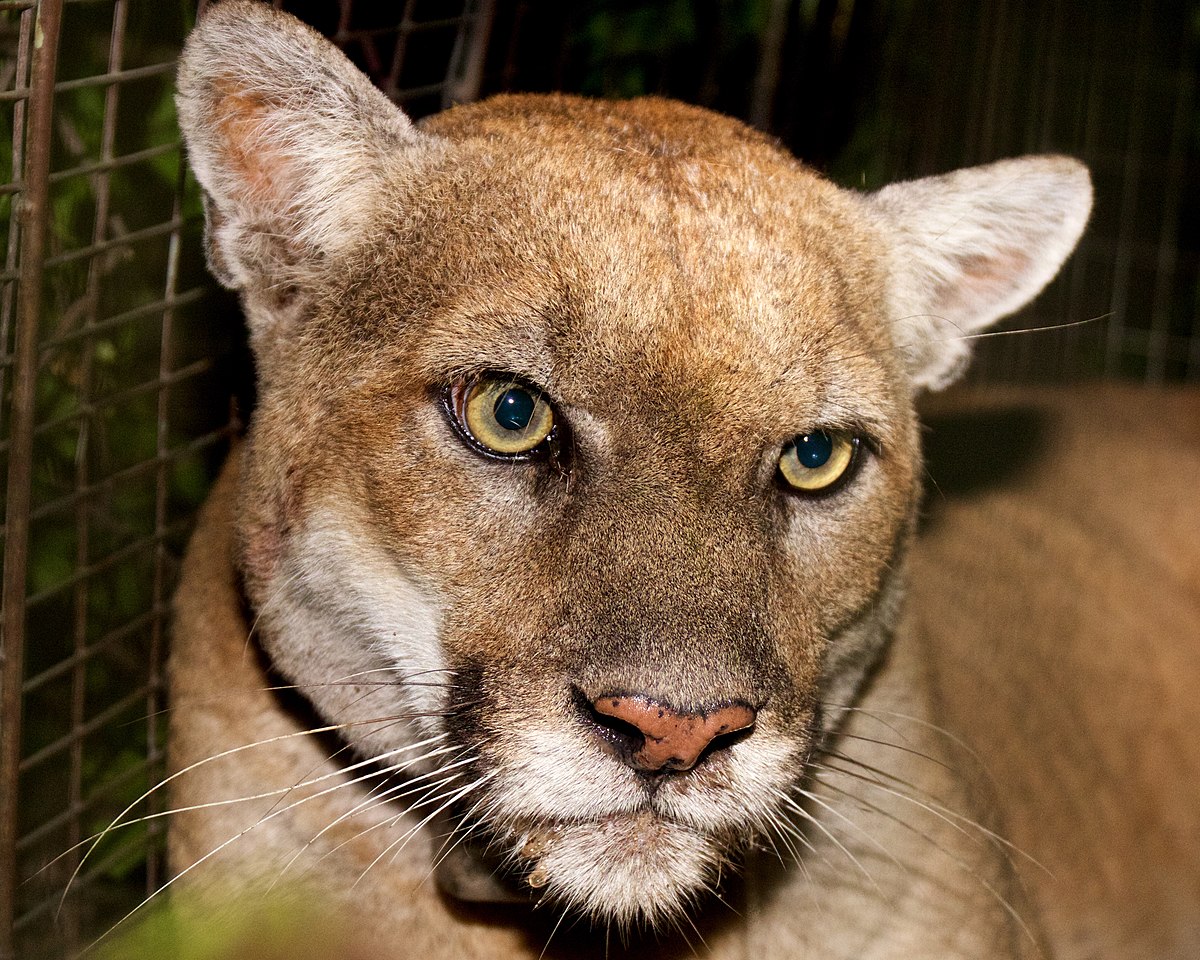
A close-up of P-22 in 2019, when he was briefly captured for a health check-up. Credit: Wikimedia Commons
Although the original perpetrator of the scam was exposed, there are still opportunists selling “Ashera cats” to unsuspecting buyers who have their hearts set on hypoallergenic pets.
Pet site listicles name the Ashera cat as “luxurious,” one of the most expensive and rare breeds ever. Videos show surprisingly large, exotic-looking felines with leopard-like rosettes and a calm demeanor.
In media reports a man named Simon Brodie talks the breed up, presenting himself as the CEO of a biotechnology company that “developed” the Ashera through careful genetic manipulation, selecting only the most positive traits. For a few thousand dollars more, Brodie promises, they come in hypoallergenic versions too.
Brodie often sounded like he was describing the newest iteration of a tech product rather than a cat, calling the Ashera “a status symbol” and listing its optional features the way a car salesman talks about leather and heated seats.
“It’s exotic, but under the skin it’s a domestic house cat, very easy to take care of and extremely friendly,” he told Reuters. “Everybody has thought at one time, wouldn’t it be great to have a leopard at home, or a tiger? Obviously, you can’t and this is about the nearest thing to it.”
Brodie conjured images of engineers poring over genetic data and working with gene-editing equipment in a laboratory to create the perfect pet.
“Anybody can throw the ingredients in, but unless you know what ingredients are the best ingredients in the best percentages, you’re not going to produce the same final product,” Brodie told the U.K. wire service.
The problem? The Ashera doesn’t actually exist, and there’s no evidence Brodie has ever been in a lab, let alone spearheaded the creation of a new breed of feline.
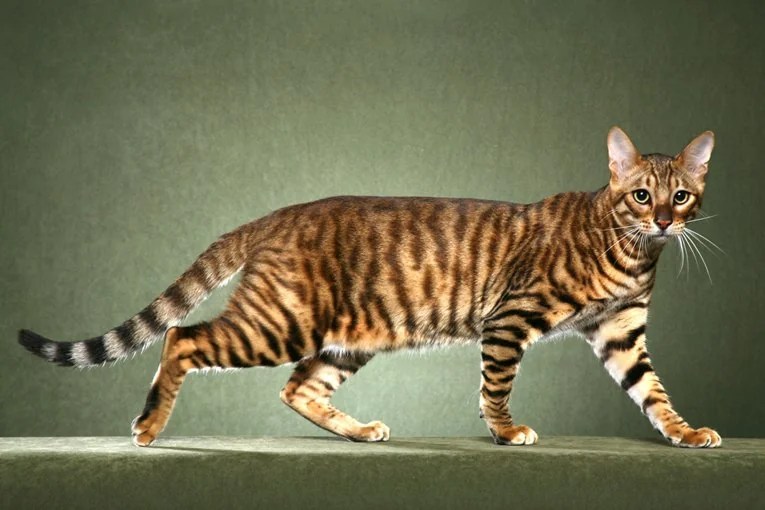
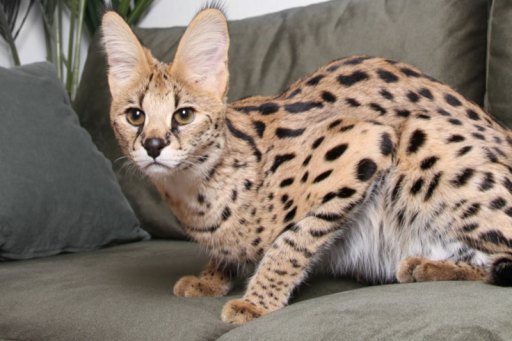
A Savannah cat with clear Serval lineage is shown as an example of an “Ashera cat” on several websites about the fictional breed.
Sadly, people might not realize that right away because of the publish-now, verify-never nature of web publications. Catster maintains a current page for the “breed,” citing its “outstanding lineage” and its supposed status as “one of the rarest and most expensive cats in the world,” potentially setting back its owners $100,000 or more per cat. You have to scroll down before the site warns about the “controversy and skepticism regarding the breed’s origins,” as if there’s still a debate whether the Ashera is a real breed.
Sites I’d rather not link to include the Ashera in their lists of “most exclusive” and “rare” breeds, and recent Reddit threads claim their price owes partly to their rarity because the company “only breeds about 100 cats a year.” When’s the last time you heard cats didn’t breed enough?
There are even “Ashera cat communities” designed to make it look like there are large online groups of happy owners, and Youtube channels featuring videos of Savannahs labeled as Asheras.
A sketchy operation
But dig a little deeper and you’ll find the truth. The Savannah Cat Association calls the Ashera a hoax, says the cats are Savannahs with fancy marketing, and details experiences people have allegedly had with Brodie. His company appeared to be a one-man operation with a voice mailbox, and people who purchased the pets said they were told to wire down payments to an account in the United Arab Emirates.
There are even claims Brodie was drop-shipping the cats, with customers saying they were delivered directly from an Oklahoma breeder of Savannahs.
And the people who saw an opportunity to have a pet cat despite severe allergies? They weren’t happy either, even those who negotiated deep “discounts” with Brodie.
“I don’t think any cat is worth $4,000,” a customer named Mike Sela told Columbia Journalism review, “but this seemed like a magical opportunity, especially with parents trying to get something for kids. You never thought you could get a cat and this is your chance.”
A group of angry customers who were promised hypoallergenic pets contacted ABC News, whose Lookout team enlisted the help of a biotechnology company to test cats purchased from Allerca, Brodie’s company. The tests showed the Ashera cats had the same amount of Fel d 1, the primary allergen in feline saliva, as the typical cat and could find no evidence of Brodie’s claims that he’d engineered an exotic cat sans allergens.
CJR took mainstream and legacy press outlets to task for reporting uncritically on Brodie’s claims despite the lack of any documentation, peer-review studies proving gene-edited hypoallergenic cats are possible, and for a complete lack of due diligence on the man himself. Per CJR:
“What Time, National Geographic, and other major outlets, including The New York Times, missed was that Brodie has no background in genetics—but he does have a well-recorded background in running scams. He was arrested in England, his native country, for selling shares in a non-existent hot-air balloon company. In the United States, he has left a wake of evictions, unpaid loans, and suits by unpaid employees. One judgment against him that stands out is by a company called Felix Pets, founded about a year before Allerca with the same goal of breeding hypoallergenic cats by eliminating the Fel-D-1 gene.”
Indeed, as the complaints piled up and Brodie’s deceptions began to catch up with him, the San Diego Union Tribune reported Allerca had been evicted from its “offices” — Brodie’s home address.
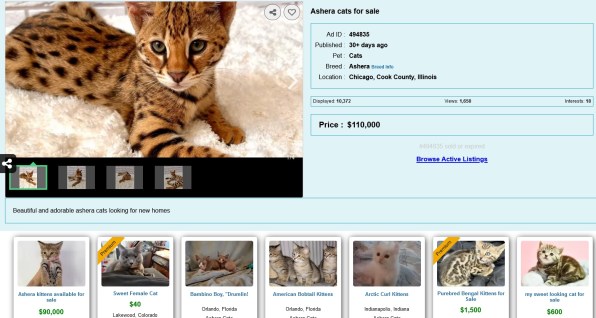
A listing for an Ashera cat and a second listing for Ashera kittens, bottom left.
News stories say Brodie has changed his name numerous times and if he’s still out there, he’s almost certainly not Simon Brodie anymore. But the Ashera cat scam isn’t dead.
We found dozens of sites offering “Ashera kittens,” and online marketplaces for animals still have regularly-updated listings from people claiming they’re selling “genuine” Ashera cats in 2024. There’s also at least one group claiming they’re “officially licensed Ashera cat breeders,” touting a lofty “mission” not only of providing cats for people with allergies, but also “preserving exotic wildlife.”
The myth of hypoallergenic cats
Although there have been recent efforts to neutralize Fel d 1, they come from actual scientists who have published their work for peer review, or from public pet food companies that have paired with scientists to create kibble they claim reduces the Fel d 1 allergen in cats who eat it. They’re also focused on attacking the protein, not breeding or creating cats that lack it in the first place.
People with allergies should understand that despite what they may read online, hypoallergenic cats do not exist. No one has been able to “engineer” a feline without the Fel d 1 protein.
There’s serious debate among geneticists about whether trying it is ethical, as no one knows exactly what function Fel d 1 serves or what the potential consequences may be for editing it out of feline genetic code.
So if you’re looking for a “luxury cat” or you just want a cat that won’t trigger your allergies, beware before you’re separated from your hard-earned cash. As always, if something sounds too good to be true, it probably is.
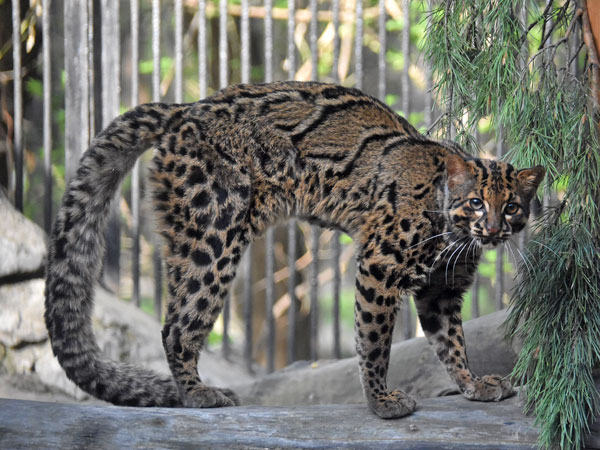
The semi-arboreal marbled cat is arguably the most elusive feline on the planet.
Dear readers, before you think this is a joke entry about Bud, let me emphasize we’re talking about the marbled cat, not the well-marbled cat.
“I am NOT chubby, I am meowscular!”
“I’ve never heard of a marbled cat,” you might be thinking, and there’s a good reason for that.
These little guys are incredibly elusive, live far from most humans and are found only in Asia. They’re extremely difficult to track and locate in the wild and haven’t been the subject of any comprehensive field study, granting them an air of mystery in an era when you can find almost anything you want to know about almost any animal with a few clicks.
There’s a whole lot we don’t know about marbled cats, including their behavior in the wild, how long they gestate, what they eat and how they’ve successfully adapted to so many varied habitats.
Credit: Wildcats Magazine
The singular species is semi-arboreal. Almost all cats can climb trees. The problem is getting down afterward, which is why so many domestic cats get stuck in trees. They can’t descend head-first and they’re wary of descending tail-first, which makes them vulnerable. Marbled cats have unusually flexible claws that enable them to descend head-first with ease, so they don’t balk at climbing. Their large paws keep them sure-footed on tree limbs and they’re confident off the ground.
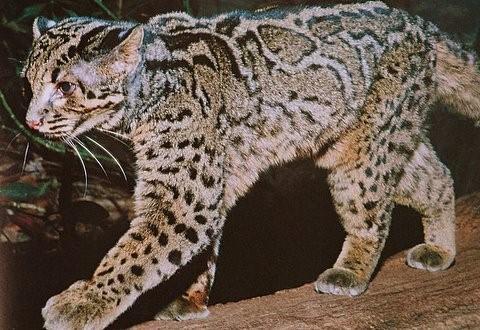
In 2011, a trail camera in Indonesia was tripped by a marbled cat, finally giving us a close-up view:
The striking felines are sometimes called “miniature clouded leopards,” and you can clearly see why.
The species is native to the eastern Himalayas, mostly in Nepal, Bhutan, Myanmar and tiny corners of China and India, as well as countries like Thailand, Cambodia and Indonesia. They’re extremely adaptable and live in a variety of habitats, from the forests of high-elevation mountain slopes to the humid jungles of Indonesia’s Borneo and Sumatra.
Marbled cats are about the same size as domestic cats, but they’ve got incredibly big, fluffy tails that are longer than their own bodies, which serve as formidable counter-weights for their tree-hopping. Their ears are a bit more round than the ears of their domestic cousins. They tend to have larger paws, and they have unique clouded coat patterns that are unlike any breed of domestic feline or close wildcat relatives.
Despite their relatively large natural habitat and the difficulty in pinning down population numbers, conservationists estimate there are fewer than 10,000 marbled cats. They’re threatened by the same deforestation by the palm oil industry that has devastated orangutan and clouded leopard habitats, although their strongholds in steep, high-elevation forests are safe for now. Marbled cats are listed as endangered by some authorities and as near-threatened by others, though like all wildlife their numbers are in decline.

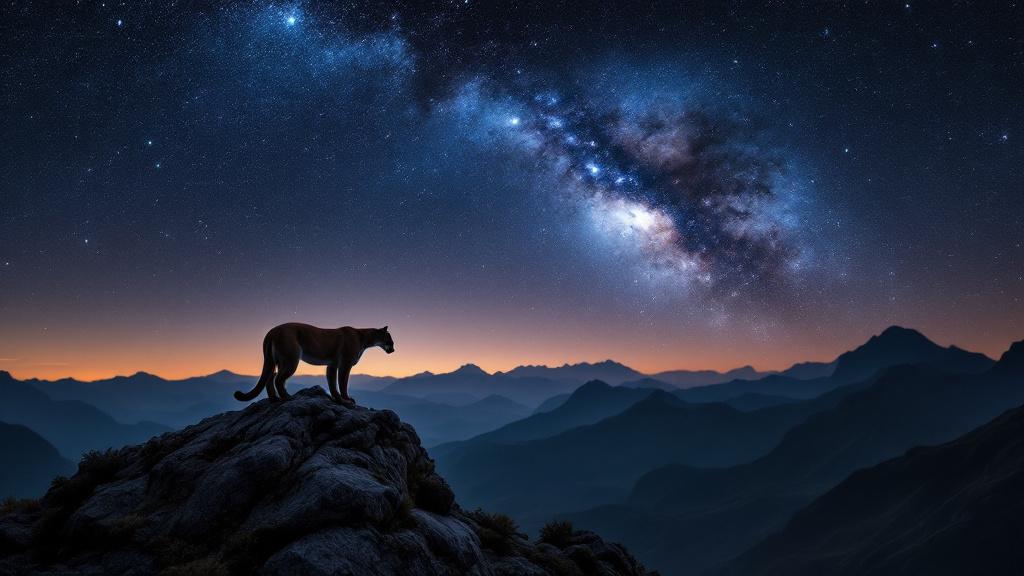


 Image credits, top to bottom: Per Karlson/PVKFoto, Reddit r/natureisf***inglit, Cockscomb Basin Wildlife Preserve, Wikimedia Commons, Steve Winter/National Geographic, National Park Service, Colorado Parks and Wildlife

 Pain In The Bud