Radiation Cats: The Bizarre Idea To Turn Felines Into Living Nuclear Waste Detectors

How do you ensure people will heed warnings to steer clear of nuclear waste storage sites thousands of years in the future? One outlandish proposal involves genetically engineering domestic cats to glow in the presence of radiation.

Imagine you’re a person living five thousand years downstream.

Maybe civilization collapsed and restarted, maybe records were lost, or maybe like Etruscan, Harappan and proto-Elamite, the languages we speak today will be long forgotten.

At any rate, if you discover a forceful warning left by your ancestors from the deep past, would you understand it without translation or cultural context?

And if you’re the one tasked with leaving the message, how would you do it?

The message has to be enduring. It must be recorded in a format that will withstand the tests of time, conquest and natural disasters. The message must be comprehensible without cultural context, because we have no idea how language will shift in the future or whether our descendants will enjoy the knowledge that comes with continuity of records.

Lastly, the message must be both compelling and absolute in its meaning, because its content is vitally important: This site contains nuclear waste. Do not under any circumstances excavate or disturb the contents of this facility. It will lead to sickness, suffering and death.

The traditional trefoil warning sign is unlikely to scare anyone off. The new radiation hazard sign, right, seems unambiguous, but so do warnings on Egyptian tombs.

How do you phrase that in a way our naturally curious species will heed the message?

We certainly didn’t heed the warnings on the tombs of King Tut and other pharaohs. For all we know, humans of the future might believe the hidden chambers deep in Yucca mountain or buried 3,000 feet underground are filled with fabulous treasures and wonders beyond imagination.

They might interpret the warnings as superstition, meant to ward off looters, “grave robbers” and anyone else who might be motivated to break in. They might see the care and effort that went into encasing the objects and conclude there must be something very much worth preserving inside.

Or they might be driven by simple curiosity, as so many human endeavors have been.

A tour group visiting the incomplete Yucca Mountain nuclear waste storage facility. Credit: Daniel Meyer/Wikimedia Commons

Arguments about how to warn the future are at least as old as the Manhattan Project (1942) and the first nuclear power plants (1954 in the USSR, 1958 in the US), but there weren’t serious efforts to come up with a plan until the 1970s, when scientists, historians and other thinkers began to engage in formal efforts to find a long-lasting solution.

Some of the ideas are boring, some are impractical, and some are absurd, like an idea to create a “garden of spikes” atop nuclear material waste sites, to discourage people from settling in the area or excavating.

Unfortunately, one idea that’s still being kicked around is the concept of the radiation cat, or raycat.

Knowledge and language may be lost to history, signage may be destroyed, physical obstacles may be removed. But one constant that has endured, that has seen empires rise and fall, and has existed long before Stonehenge and the pyramids of Giza, is the human relationship with cats.

They’re now valued as companions, but we still use them as mousers on ships, in heavily populated cities, in ancient structures and on farms and vineyards.

They’re embedded so deep into our cultural psyche that it would not be outlandish to think the archaeologists of the future may conclude the internet was constructed primarily to facilitate the exchange of images of cats.

Even the first high-bandwidth deep space transmission was a video of a cat, so in a very real sense, the dawn of a solar system-wide internet was heralded by an ultra high definition clip of an orange tabby named Taters, beamed back to earth from the exploratory spacecraft Psyche, which was 19 million miles away when it transmitted Taters on Dec. 11, 2023.

Consider also that the basic felid body plan — shared by domestic kitties, tigers, pumas, black-footed cats and the 37 other extant species — has barely changed in 30 million years, because cats are extremely successful at what they do.

In other words, cats aren’t going away, and domestic felines have a place in every human society.

So philosophers Françoise Bastide and Paolo Fabbri conceived of the “living warning” in 1984. The idea is to alter the genetic code of felis catus so that the animals glow or change color in the vicinity of nuclear waste, using minuscule levels of radiation as the trigger.

There are natural precedents for this, including bioluminescence and several species of octopus that radically change colors and patterns on their skin to evade predators.

The second component, once the genetic code has been altered, is the creation of folklore: songs, stories and myths that will endure through time, warning people to keep cats close, treat them well, and run like hell if they change color because it means something terrible, something evil beyond imagination, is nearby.

To ensure the folklore of feline Geiger counters endures, an idea by linguist and semiotician Thomas Sebeok would be incorporated. Although empires and states rise and fall, there’s one organization that has survived for 2,000 years preserving a unified message: the Catholic church.

Sebeok proposed an atomic priesthood, an order that would pass the knowledge down through generations, continually seeding culture with stories and songs of glowing felines.

Spent nuclear fuel rods are stored in on-site pools at the facilities where they were used, but pools are meant only as temporary storage solutions. Credit: Wikimedia Commons

If this stuff sounds wacky, that’s because it is. We won’t figure out a way to ensure a message is received and understood thousands of years in the future without considering some off-the-wall plans.

Of course messing with the genetic code of any animal raises serious ethical questions.

We don’t have the right to play God and tinker with the genetic code of extant species. We don’t fully understand the immediate consequences for the health and happiness of cats, and we know almost nothing about the long-term effects on the species.

I’d also argue that we have a special relationship with cats and dogs, one that exceeds any obligations we may feel toward our primate “cousins” or other non-human animals.

Cats and dogs have been living with humans for a combined 40,000 years. They have been molded by us, they are dependent on us, and all that time in human proximity has led to unique changes.

No animals on this planet can match them when it comes to reading human emotions. Our little buddies pick up on our emotional states before we’re consciously aware of them partly because of their robust sensoriums, and partly because as their caretakers, our business is their business.

A clip of a cat named Taters was the first data burst transmitted to Earth using NASA’s upgraded deep space network. Credit: NASA/JPL

We bear a responsibility to both species and the individual animals. It’s not just the fact that without them, our lives would feel less meaningful. It’s the indisputable fact that without them — without dogs who flushed out prey on yhr hunt and guarded small settlements, without cats who prevented mass starvation by hunting down rodents — we would not be here.

Cats and dogs play a major role in the story of the human race. We are indelibly linked. Their DNA is not ours to tinker with, and they are not tools we can repurpose at our convenience.

Thankfully the US Department of Energy has never endorsed the concept of raycats. While there is a website advocating for a raycat program and small groups around the world dedicated to its propagation, the interest is mostly academic.

The Raycat Solution, which maintains a site dedicated to the idea, has a FAQ which says its supporters are serious about its potential usefulness, but for now most experts see it as a thought experiment and reminder that the problem must be dealt with eventually. At some point NIMBY will have to yield to reality, and wherever the US ends up storing nuclear waste, it’ll need to be secured, sealed and marked.

The goal is for the message to endure at least 10,000 years, at which point scientists say the radiation will be minimal.

That’s assuming that the future holds the collapse and rebuilding of human civilization, or at least a technological backslide in which the majority of our species’ knowledge is lost.

We like to think things will be brighter than that and instead of glowing to warn people of danger, cats of the far future will be where they belong — with their human buddies, exploring new frontiers on starships with plenty of comfortable napping spots.

Header image depicts the Alvin Ward Vogtle Nuclear Power Plant in Georgia, the largest nuclear plant in the US. Image via Wikimedia Commons/NRC

[1] The nuclear waste storage facility at Yucca Mountain was initially funded and approved by congress in 2002, then was canceled and de-funded in 2011 after significant pushback from people who live in Nevada, along with their representatives in congress. Plans for the site have changed several times in more than two decades, leaving the US with no central, secure site to store nuclear waste.
The First Edition Of Webster’s Dictionary From 1828 Says Cats Are ‘Deceitful’ And ‘Extremely Spiteful’

What would the Dictionary Man think of a modern American society dominated by the power and cuteness of cats?

Cats have taken over the internet, claim a mighty share of the $64 billion Americans spent on pet food in 2023, and have essentially installed themselves as the leisurely masters of 28 percent of American homes.

But it wasn’t always that way, and a look at the first-ever edition of Webster’s Dictionary reveals a very different attitude toward our furry overlords:

“The domestic cat needs no description. It is a deceitful animal, and when enraged, extremely spiteful. It is kept in houses, chiefly for the purpose of catching rats and mice.”

Wow. Whoever does feline PR should get a raise, because we’ve gone from “We tolerate the imperious little bastards because they’re good at killing rodents” to “Does my little angel want a snack? How about some ‘nip then? Anything for my bestest little pal!” in the span of two centuries.

Buddy to Noah Webster: Bow!
Buddy 1, Noah Webster 0. Naturally.

Noah Webster, whose name is now synonymous with dictionaries, saw the effort to standardize spelling and pronunciation as central to formalizing an American linguistic identity distinct from our mother country. Or, as he put it, “[t]o diffuse an uniformity and purity of language in America” that would not only differentiate our English from England’s, but also unify the states at a time when many people still viewed the idea of a united states with skepticism.

By doing so, he hoped America would avoid the pitfall of dividing itself into regions of nearly mutually unintelligible dialects, a problem that plagues other countries. Consider the fact that India has almost 800 distinct languages and dialects, down from a staggering 1,652 in 1961 as hundreds of local languages died with the last generations of their speakers. Hindu, the country’s most popular language, is spoken only by about 43 percent of the population.

The goal, Webster wrote when he published his dictionary’s first edition, was “to furnish a standard of our vernacular tongue, which we shall not be ashamed to bequeath to three hundred millions of people, who are destined to occupy, and I hope, to adorn the vast territory within our jurisdiction.”

As dictionary.com notes, Webster wrote that passage in 1828 when the US population was just 13 million and vast swaths of what we now consider familiar territory was at the time largely unexplored wilderness.

His prediction of an America of 300 million people came true in 2006. Today there are approximately 335 million of us.

In other words, a hell of a lot has changed since the Connecticut born-and-raised Webster cobbled together a uniquely American system of spelling and pronunciation, so maybe it shouldn’t be a surprise that attitudes toward cats have shifted so dramatically.

Still, we’d love to see the look on Webster’s face if we could bring him forward in time and show him how the “deceitful” and “extremely spiteful” little furballs have come to such prominence in American culture. What would Webster make of the spoiled modern house cat, with her condos, tunnels, toys, harnesses, bowls filled with salmon and duck, and even psychoactive recreational drugs for their enjoyment?

Bow before your feline overlords, Webster!

Editor Cat Says
“We have made some edits, humans. See to it that the next edition includes this new and improved definition, or we shall withhold snuggles.”

The Dividing Line Between Human And Animal Has Been Blurred Again As AI Reveals Startlingly Complex Whale Language

By unlocking the mysteries of how sperm whales communicate and demonstrating their impressive cognitive abilities, researchers hope to get people invested in the fate of these endangered animals.

Sperm whales are chatty.

Their language is markedly different from the deep cetacean moans associated with other whales, taking the form of Morse code-like clicks that boom through the ocean in a decibel range almost twice that of jet engines.

And while we’ve long known animals like monkeys assign specific meaning to short vocalizations varying from alarm calls to affirmations of social rank, sperm whale conversations can endure for an hour or more, with participants exchanging complex strings of clicks that vary depending on context, environment and even which pod family is speaking.

Sperm_whale_Tim_Cole_NMFS_crop
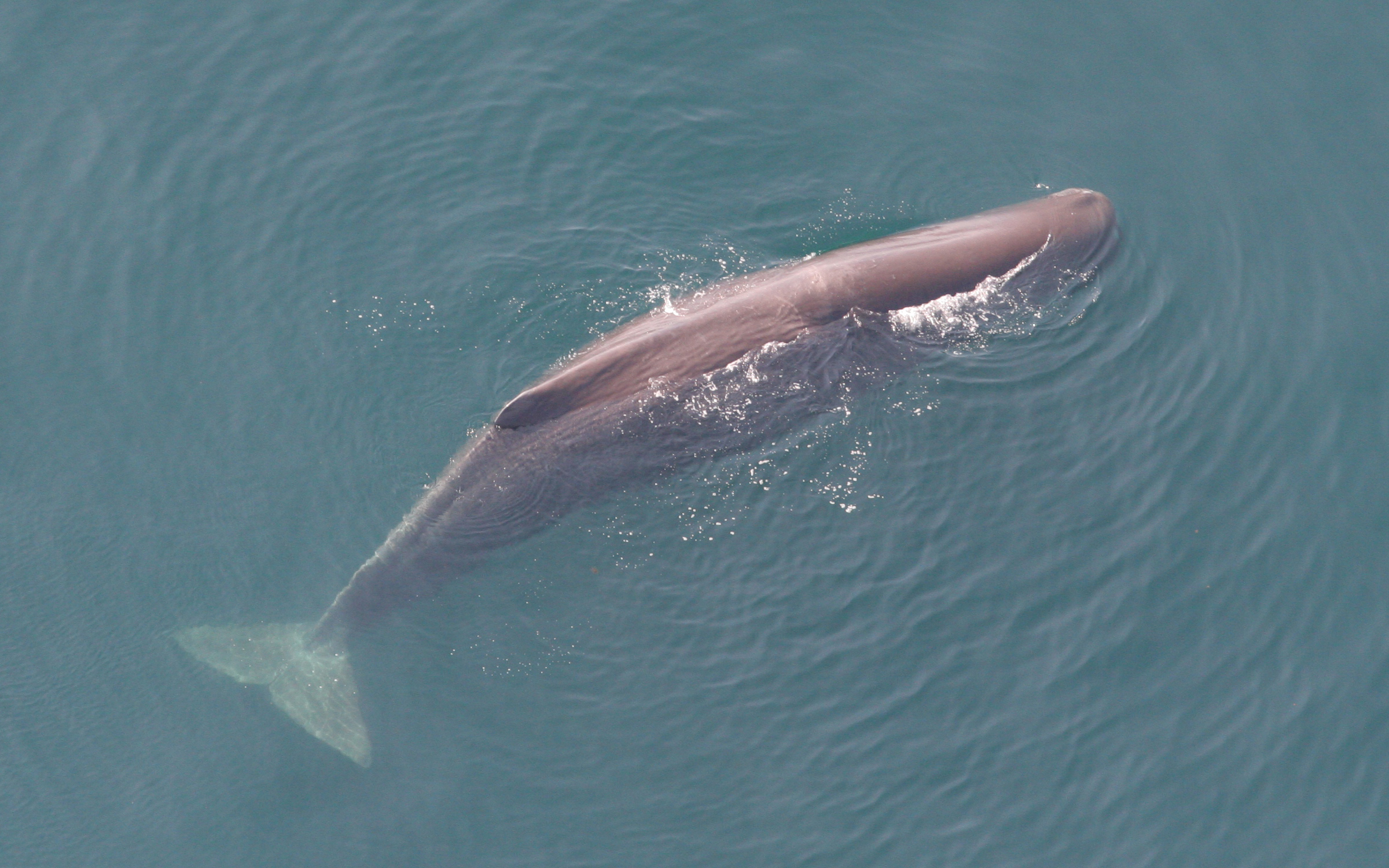
An aerial view of a sperm whale near the ocean surface. Credit: Wikimedia Commons

While artificial intelligence has been maligned over the past few years as people grapple with its rapid progress and potential for abuse, it remains the best tool we have for teasing out patterns that our human minds can’t discern, especially from large quantities of data.

With more than 9,000 recordings of sperm whales, Project CETI — Cetacean Translation Initiative, a non-profit effort to decode and translate sperm whale communication — had precisely the kind of huge data cache that AI excels at analyzing.

By feeding the recordings into specially trained machine learning algorithms, the research team was able to identify a wealth of new language patterns. While human languages are composed of quantized morphemes — prefixes, suffixes and root words — whale communication is broken down into sequences of clicks and pauses called “codas.”

Like Morse code, codas make a distinction between short clicks and long clicks. Sperm whales also vary the tempo of the clicks, which could represent inflection, “dialects” or concepts completely alien to the human mind.

“Some of what they’re doing might be totally different from our way of communicating and we’re probably never going to be able to fully grasp those differences,” Oregon State postdoctoral marine researcher Taylor Hersh told NPR.

sperm whale fluke
A sperm whale fluke visible above the surface of the ocean. Credit: Wikimedia Commons

Researchers believe the “inter-click intervals” — akin to ghost notes in music — may be as significant as the clicks themselves. Importantly, while human ears were able to identify and catalog some of the codas, the machine learning algorithms found many that human analysis missed.

That’s not surprising considering sperm whales — the loudest animals on Earth, capable of generating sounds up to 230 dB — took a much different evolutionary course and, as ocean-dwelling creatures weighing up to 90,000 pounds (40,800 kg) likely have a radically different sensorium compared to humans.

The comparisons to music go further than ghost notes.

“This study shows that coda types are not arbitrary, but rather that they form a newly discovered combinatorial coding system in which the musical concepts of rubato and ornamentation combine with two categorical, context-independent features known as rhythm and tempo, by analogy to musical terminology,” CETI’s team wrote on May 7 while unveiling the most recent study.

Sperm_whale_distribution_(Pacific_equirectangular)
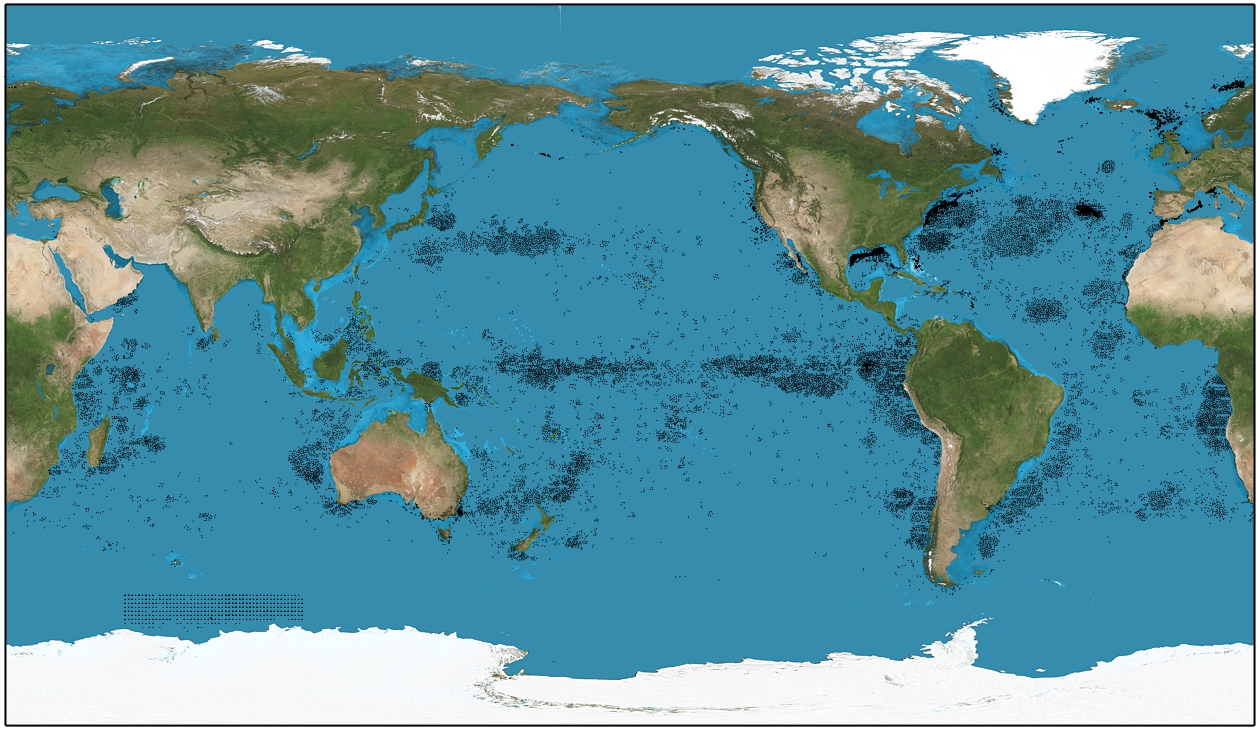
Sperm whale distribution based on human sightings. Sperm whales freely travel the oceans except in cold, ice-packed environs. Credit: Wikimedia Commons

While people have used many abilities to mark the dividing line between humans and animals over the years — including the ability to use tools, experience emotions, and demonstrate self-awareness — human capacity for authentic language with syntax and context-dependent meaning was one of the stalwarts, standing the test of time as new research toppled the other dividers by showing animals do indeed use tools, experience rich emotions and have complex inner mental lives.

With this research, scientists are assembling a “sperm whale phonetic alphabet” that will make it easier to discern and catalog whale codas.

To be clear, there’s still a lot of work ahead before scientists can prove sperm whale codas are comparable to human definitions of language, but whether they strictly meet that definition may not matter. After all, it’s clear the clicks and pauses of whale codas are imbued with meaning, even if it remains elusive to us for the moment.

Indeed, “sperm whale communication has both contextual and combinatorial structure not previously observed in whale communication,” the team wrote.

Proving sperm whale codas are tantamount to human language isn’t the goal anyway. The team has two overriding priorities — decode the meanings behind the codas, and get the wider public invested in the fate of these endangered animals by showing they’re not so different from us.

“Our results show there is much more complexity than previously believed,” MIT AI lab director Daniela Rus told NPR, “and this is challenging the current state of the art or state of beliefs about the animal world.”

Cats Can’t Dance, Cats Can’t Sing…But Birds Can!

Snowball is the first animal known to dance to the rhythm of music, while Ruby is, well, Ruby.

We take a break from our regularly-scheduled cats to check in on two remarkable birds: Snowball the incredible dancing cockatoo, and Ruby the infamously foul-mouthed African grey parrot.

pitbbirds2

Both animals have been the subject of viral videos, but haven’t become ubiquitous memes or the sort of superstar that transcends certain corners of the internet.

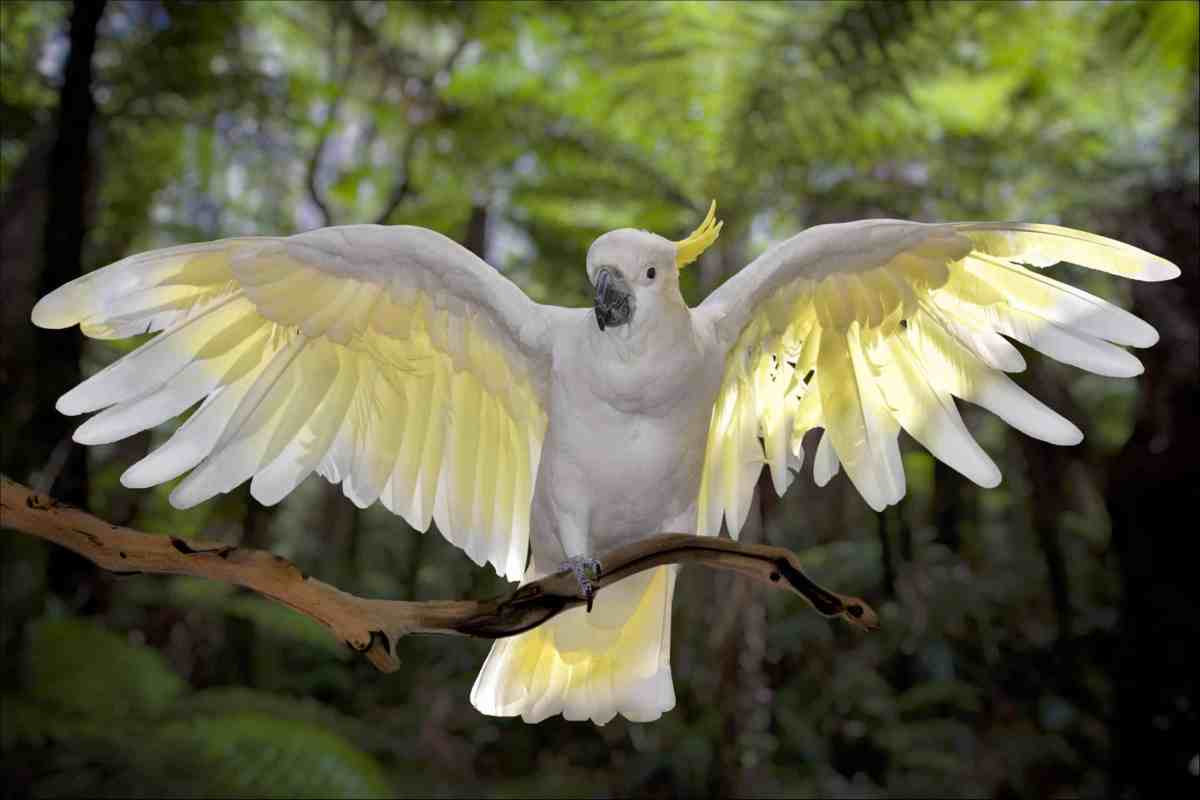
Snowball is clearly the more wholesome of the two, and it’s immediately apparent why: He dances.

Actually, that’s underselling it. Snowball doesn’t just dance, he feels the beat and moves with it, timing his dance moves — headbangs, foot-wiggles, side-steps and more — to the music, often the snare like people do. Snowball isn’t the first animal to move to music, but he’s the first animal to groove to music, which is an important distinction.

“His owner had realized that he couldn’t care for the sulfur-crested cockatoo any longer. So in August 2007, he dropped Snowball off at the Bird Lovers Only rescue center in Dyer, Indiana—along with a Backstreet Boys CD, and a tip that the bird loved to dance. Sure enough, when the center’s director, Irena Schulz, played “Everybody,” Snowball “immediately broke out into his headbanging, bad-boy dance,” she recalls. She took a grainy video, uploaded it to YouTube, and sent a link to some bird-enthusiast friends. Within a month, Snowball became a celebrity. When a Tonight Show producer called to arrange an interview, Schulz thought it was a prank.”

Other animals are prompted to motion by music, but they don’t time their motions to the beat. Snowball’s talents have attracted curious neuroscientists, who believe Snowball is able to coordinate his body movements with the rhythm because, like humans, he can process language.

It might seem a little odd that such an ability seems to hinge on language until you realize that language itself is rhythmic, ordered sound, and that human communication often pairs speech with coordinated movements. (Think of people who “talk” with their hands, TV presenters who move their heads for emphasis or the simple act of nodding, shaking your head or shrugging to punctuate a point.)

Scientists study Snowball because he’s inherently fascinating, but also because he can help us understand how birds and humans communicate, and how homo sapiens and certain avian species, out of all the animals on Earth, developed this skill.

Ruby the Foul-Mouthed African Grey Parrot

Ruby is a different case entirely. She’s interesting to internet audiences because she’s hilarious, and if she holds academic appeal, it’s because of the way she’s been socialized and the things she’s learned.

Ruby, one of Youtube’s earliest viral stars, lives with her human, Nick Chapman, in Brighton, UK.

First thing’s first: If you’re put off by obscenities or you’re easily offended, you should take a pass on these videos.

For everyone else, well, it’s not just that Ruby swears. That sort of novelty would wear off quick. What makes Ruby unique — and consistently hilarious — is that she’s inventively obscene, working insults into unique combinations. And, as you’ll see, she swears in French as well as heavily-accented UK English. It’s the latter that often makes for her most amusing outbursts.

“I love you,” Ruby tells Chapman in one video.

“Well that’s a nice change, sweetheart!” Chapman says.

“Bollocks.” Ruby takes a half step to her right on the small platform in front of her cage, turning her head toward Chapman. “You fat bastard!”

Chapman laughs. “I knew that wouldn’t last.”

Ruby’s foul language is unmistakably British and as casually vicious as it gets. She hurls invective at the seagulls who are a constant presence in seaside Brighton and expresses her love for Chapman by insulting him.

“Fuck off, you tw-t!” the bird says, prompting laughter from Chapman.

“Oh dear,” Chapman says. “That’s not nice!”

“Eh,” Ruby says. “Tw-t! You’re not funny.”

“I know I’m not funny. I’m immature, I’m irresponsible. But so what?”

In another video, Chapman tries to engage Ruby by telling her he loves her in French.

Ruby sits motionless for a few long seconds, then utters a single syllable with expert comedic timing: “Tw-t!”

Chapman does a deep belly laugh.

“Shut up, c–t!’ Ruby says. “You f—er!’

“Oh dear,” Chapman says between laughs. “You’re shocking, you know that?”

One thing becomes abundantly clear over the course of just a few videos: Chapman loves Ruby and, despite the constant verbal abuse she directs toward him, she loves Chapman too.

For a man who owns a bird who loves foul language, you’d think Chapman would have a dirty mouth, but for the most part he doesn’t. It’s often impossible to predict what a parrot will pick up on.

Eric, another Youtube-famous parrot, learned his favorite swear words when his owner’s friends came over to watch football, or soccer to us Yanks. Eric’s fond of yelling “A fookin’ legend! A fookin’ legend!” 

Ruby is quick to pick up on new words, and Chapman thinks she likes the harsh sounds of some of the language’s most offensive insults. (Perhaps it’s no mistake that many of the most vulgar words in English have a guttural quality, reflecting their meaning.)

Long before Ruby became a Youtube star, Chapman said he realized the potential for awkwardness. One day he was strolling along the waterfront in Brighton when an older woman stopped to chat and asked about Ruby.

“She’s beautiful,” the woman said, admiring the African grey.

“Shut your c–t!” Ruby snapped back.

The shocked woman looked at Chapman, who pretended he hadn’t heard what his bird said.

The issue of whether parrots understand what they’re saying still hasn’t been settled. Like some other animals — cats and dogs among them — they can understand words in their contextual meanings, though it’s very unlikely a swearing parrot knows precisely what it’s doing.

Then again, to insist parrots are just repeating sounds would be to discount examples like the late Alex, an African grey who could count, distinguish between different items by color and shape, and allegedly innovate to some extent.

Then there’s this video of a parrot telling a cat to “shut the f— up” as the cat meows. It makes me wonder, if I had a parrot, what the bird would pick up from my conversations with Buddy. There’d be a lot of “Hi, Bud!” and “What a good boy!”, and the vast majority of it would be kind, patient and loving, but I won’t pretend there aren’t times when I’ve told him I can’t take any more of his hours-long discourses on teleportation, turkey or unifying classical and quantum physics.

That said, I wouldn’t change a thing about Buddy. He’s my Buddy.