Another Tech Company Wants To Translate Meows And Barks Using AI: Can It Work?

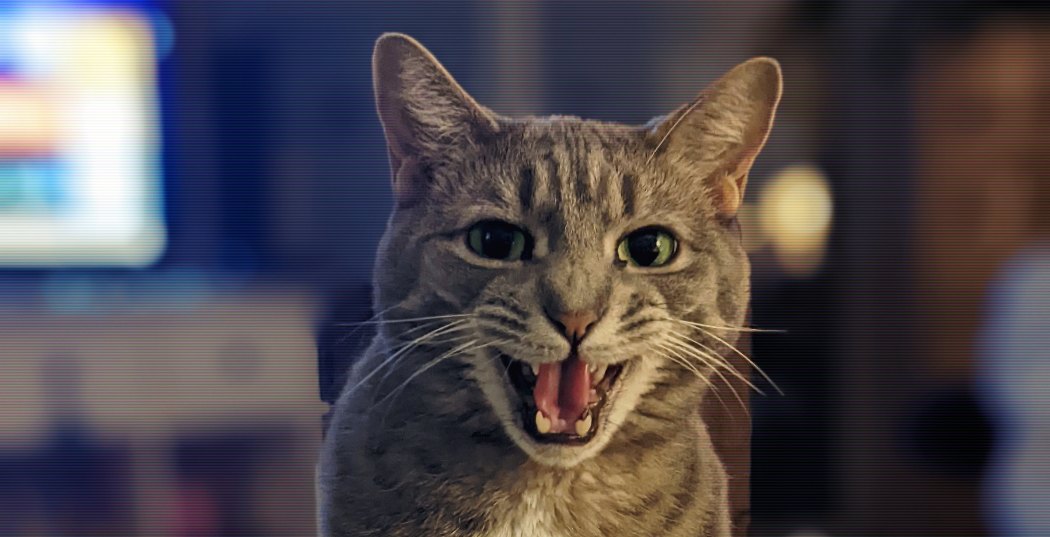
Cats and dogs communicate primarily by scent, touch and body language, but human efforts to understand them have focused exclusively on meows and barks. If we want to truly understand our non-human friends, we need to take an approach that considers the other ways animals “talk” to each other.

A few years ago when MeowTalk made a minor splash in the startup world, I was pretty bullish on its potential to help us understand our cats better.

Sure, the app had an unhelpful habit of attributing improbably loving declarations to Buddy, but I thought it would follow the trajectory of other machine learning models and drastically improve as it accumulated more data.

More users meant the app would record and analyze more meows, chirps and trills, meaning it was just a matter of time before the AI would be able to distinguish between an “I want attention!” meow and a “My bowl is dangerously close to empty!” meow.

Obviously that didn’t happen, and what I personally didn’t take into account back then — and should have, given how obvious it is in retrospect — is that cats don’t just communicate via vocalizations.

In fact, cats don’t normally incorporate vocalizations into communication at all. Pet kitties do it entirely for our benefit because they know we’re generally awful at interpreting body language and we are completely useless when it comes to olfactory information.

It’s actually amazing when you really think about how much of the heavy lifting cats do in our efforts to communicate with each other. They recognize we can’t communicate the way they do naturally, so they try to relate to us on our terms. In return, we meet them less than halfway.

No wonder Buddy sometimes looks frustrated as he meows at me, as if I’m the biggest moron in the world for not understanding the very obvious thing he’s trying to tell me.

“Human, how can you not understand the simple feeling of innerer schweinehund I’m trying to convey here? The cringe is killing me!”

Now the Chinese tech giant Baidu is throwing its hat into the ring after filing a patent in China for an AI system that uses machine learning to decode animal communication and “translate” it to human language.

Machines are designed to process things from a human viewpoint according to human logic, so if Baidu wants to succeed where MeowTalk has not, its engineers will need to take a thoughtful approach with the help of animal behavior experts.

This is a hard problem that encompasses animal cognition, neuroscience, linguistics, biology, biochemistry and even philosophy. If they approach this strictly as a tech challenge, they’ll set themselves up for failure.

Without the information and context clues provided by tails, whiskers, facial expressions, posture, eye dilation, heart rate, pheromones and even fur, an AI system is only getting a fraction of the information cats are trying to convey.

Trying to glean meaning from that is like trying to read a book in which only every fourth or fifth letter is legible. There’s just too much missing information.

Even if we can train machines to analyze sound visual, tactile and olfactory information, it may not be possible to truly translate what our cats are saying to us. We may have to settle for approximations. We’ve only begun to guess at how the world is interpreted differently among human beings thanks to things like qualia and neurodivergence, and the way cats and dogs see the world is undoubtedly more strange to us than the way a neurodivergent person might make sense of reality.

“He grimaced. He had drawn a greedy old character, a tough old male whose mind was full of slobbering thoughts of food, veritable oceans full of half-spoiled fish. Father Moontree had once said that he burped cod liver oil for weeks after drawing that particular glutton, so strongly had the telepathic image of fish impressed itself upon his mind. Yet the glutton was a glutton for danger as well as for fish. He had killed sixty-three Dragons, more than any other Partner in the service, and was quite literally worth his weight in gold.” – Cordwainer Smith, The Game of Rat and Dragon

An animal’s interpretation of reality may be so psychologically alien that most of its communication may be apples to oranges at best. Which is why I always loved Cordwainer Smith’s description of the feline mind as experienced via a technology that allows humans with special talents to share thoughts with cats in his classic short story, The Game of Rat and Dragon.

In the story, humans are a starfaring civilization and encounter a threat in the void between stars that people don’t have the reaction speed to deal with. Cats, however, are fast and swift enough, and with a neural bridge device, teams of humans paired with cats are able to keep passengers safe on interstellar journeys.

The narrator, who is one of the few people with an affinity for teaming up with felines, hopes he’ll be paired with one of his two favorite cats for his latest mission, but instead he’s assigned to partner with an old glutton of a tomcat whose mind was dominated by “slobbering thoughts of food, veritable oceans of half-spoiled fish.”

The narrator wryly notes that the last time one of his colleagues was paired with that particular cat, his burps tasted of fish for weeks afterward. But the cat in question, despite being obsessed with fish, is a badass at killing “dragons,” the human nickname for the bizarre entities that attack human ships in space. (The software that allows felines and humans to link thoughts also portrays the “dragons” as rodents in the minds of the cats, stimulating their ancient predatory drive so they’ll attack instantly when they see the enemy.)

We can’t know for sure if Smith’s interpretation of the feline mind is accurate, but another part rang true when he wrote that cat thoughts were all about the moment, filled with sentiments of warmth and affection, while they rapidly lost interest in thoughts about human concerns, dismissing them “as so much rubbish.”

If the mind of a cat is that relatable, we’ll be incredibly lucky. But in reality we’re dealing with animals who evolved in drastically different ecological niches, with different priorities, motivations, and ways of looking at the world — literally and figuratively.

That doesn’t mean we shouldn’t try to understand our furry friends. Research has yielded interesting information about the way animals like whales and elephants communicate, and AI is at its best when it augments human creativity and curiosity instead of trying to replace it.

Even if we don’t end up with a way to glean 1:1 translations, the prospect of improving our understanding of animal minds is tantalizing enough. We just need to make sure we’re listening to everything they’re saying, not just the meows.
TikTok’s Latest Viral Trend Is Popping Cat Pimples: Can We Ban This App Already?

Each viral trend on the app is more grotesque than the last.

I’m all out of withering sarcasm, so I’ll just say it: The newest trend on TikTok involves close-up videos showing people popping their Sphynx cats’ pimples.

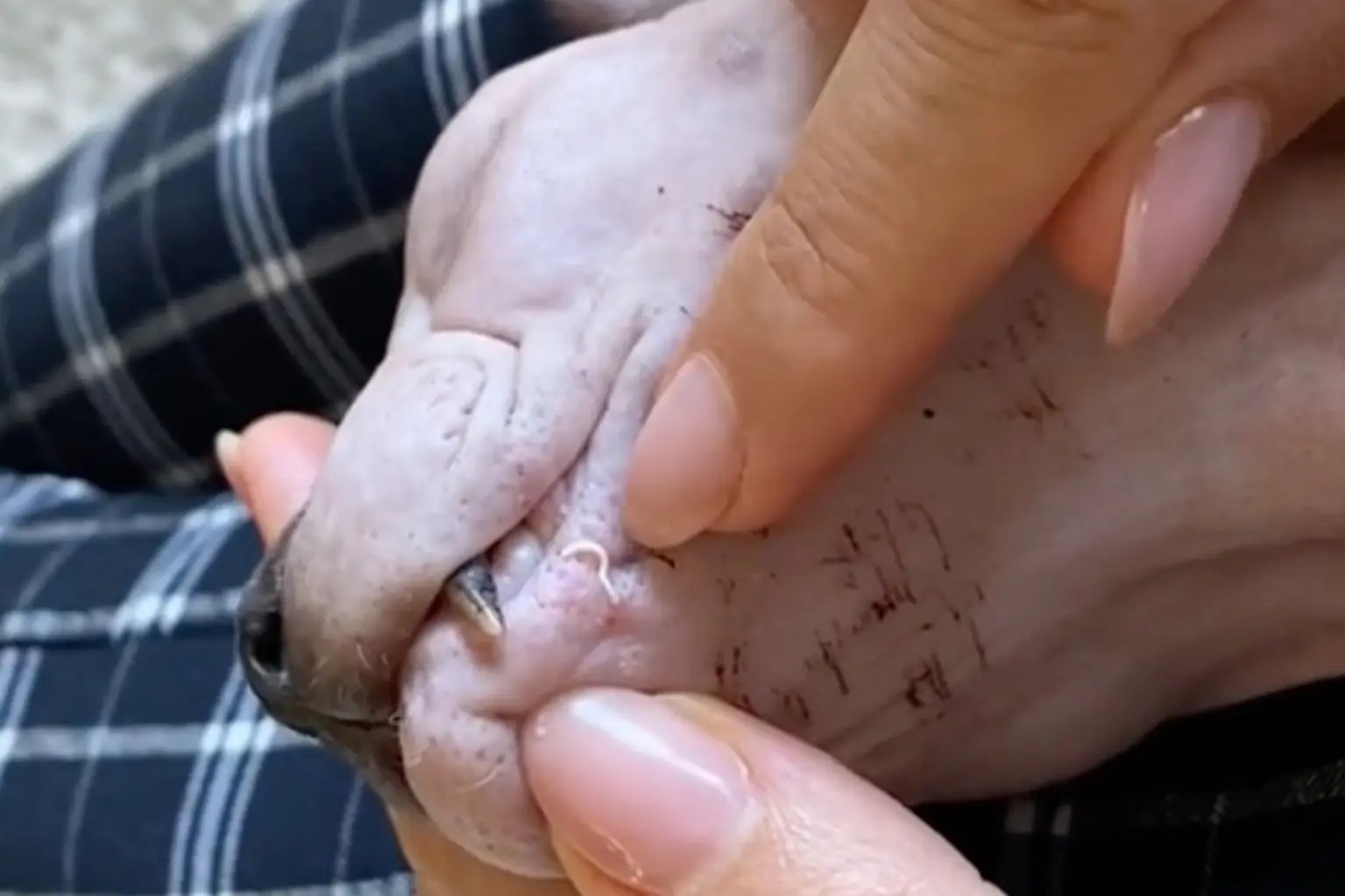
The PewDiePie of the craze, if you will, is one @Sphynx.cleaner, whose videos show a woman’s carefully manicured hands holding a defeated-looking Sphynx cat and popping its pimples between her formidable fingernails.

Tens of millions of people have watched her videos of puss pimple-popping, not including the millions of other views accumulated by lesser practitioners of the grotesque genre.

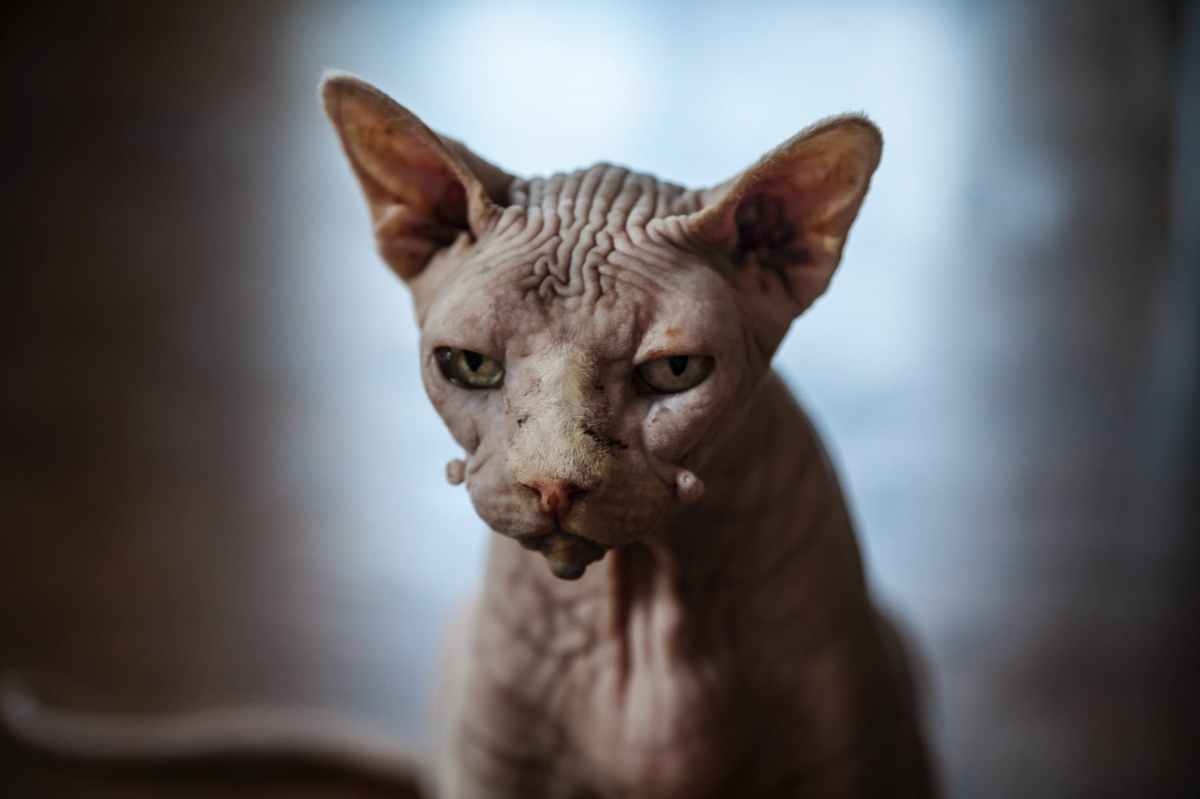
Sphynx cats lack fur and have skin often compared to chamois leather. Fur helps cats absorb and redistribute naturally-occurring oils secreted by the skin, so felines of the Sphynx breed are much more susceptible to acne problems than typical short- and long-haired cats. Without fur to help redistribute them, the skin oils can create a “film” that clogs pores, according to Jessica Taylor, a veterinarian in North Carolina.

Sphynx pimples
Uh, no. Credit: Sphynx.cleaner/TikTok

Not surprisingly, popping a cat’s pimples makes things worse and is not pleasant for the kitty.

“These lesions indicate a disruption in the skin and skin barrier, and squeezing or poking them can introduce bacteria, potentially worsening the lesion, causing pain and infection,” Taylor told Newsweek. “If the lesion is already infected, handling it could spread bacteria to the pet parent.”

As for TikTok, this is not the first time one of the app’s trends has been detrimental to the health and safety of felines, although most of its inanity is focused on humans. I suppose you can view it as some sort of advanced Darwinian engine, accelerating the self-removal of human beings from the gene pool. Among the trends that have gone viral on the app:

  • People who use self-tanning bottles as nasal spray out of some misguided belief that ingesting the stuff will not only achieve the desired effect, but somehow lead to a more even, natural-looking distribution of tanner. It reminds me of former President Donald Trump’s impromptu suggestion, during a national press conference, that ingesting hand sanitizer could be a “tremendous” way to stop COVID.
  • Videos instructing women to eat the tablets inside Clearblue pregnancy tests as a “contraceptive hack,” claiming the tablets — which are designed to absorb urine during the chemical test — are actually morning after pills.
  • People ingesting methylene blue — an anti-fungal fish tank cleaner — because “fitness influencers” say it can “cure” COVID-19, boost metabolism and slow the aging process. Think of the triumph of critical thinking here: These are people who won’t get a vaccine that’s been through three-stages of trials before getting FDA approval, and whose efficacy and safety have been the subjects of rigorous peer review, but they’re willing to drink a chemical manufactured and sold as a cleaning solution for fish tanks.
  • The so-called Nyquil Challenge, in which people use Nyquil instead of cooking oil to cook chicken in a frying pan.
  • Period blood face masks, which are self-explanatory. Another grotesque and potentially dangerous trend started by “influencers” who claim some sort of nebulous expertise and know that “hacks” will net them attention and clicks. The more outrageous, the better.

https __prod.static9.net
“Did you know that urinal cakes are made by Carvel? It’s true! They’re deliciously chocolatey, with just a hint of vanilla, cinnamon and industrial strength anti-bacterial. Mmmmmm!”

Of course, we’ve known for years that Chinese companies are beholden to the Chinese government according to Chinese law, which means the government — and the communist party — can help itself to TikTok user data whenever it wants.

After TikTok’s US-based executives insisted to congress that American users’ data is firewalled and cannot be accessed by the company’s employees in China — and, by extension, the Chinese government — a series of leaks confirmed that China’s government was in fact regularly accessing that data. Absolutely no one, except maybe the politicians who think the internet is a “series of tubes,” were surprised by this revelation.

China’s government can use the data to track journalists, exploit American and European users, program its algorithm to shuffle them toward harmful content, censor content the Chinese government doesn’t like, and even coerce individuals by threatening to release information on their viewing habits.

So can we evacuate TikTok’s US headquarters already, raze it to the ground, and ban the app from every mobile store?

methblue2
“Mr. Darwin! Mr. Darwin let him go! Magnifico!”

New App Translates Your Cat’s Meows

MeowTalk uses machine learning and algorithmic AI to learn cat vocalizations and what they mean.

It’s gonna be the future soon, and I can’t wait!

It was only a matter of time before someone leveraged machine learning and algorithmic AI to parse cat vocalizations, and thanks to Javier Sanchez, translating your cat’s meows — and trills, huffs and chirps — is now a reality.

Sanchez was a member of Amazon’s machine learning team contributing to the development of Alexa, the now-ubiquitous virtual assistant operated by voice commands.

“I got to see how the sausage was made, how they train their models and work with all the data science platforms,” Sanchez said. “So I was fresh off the heels of that and I was thinking, ‘Well, we could do something similar with cats and it could be an app.’”

javiersanchezcat
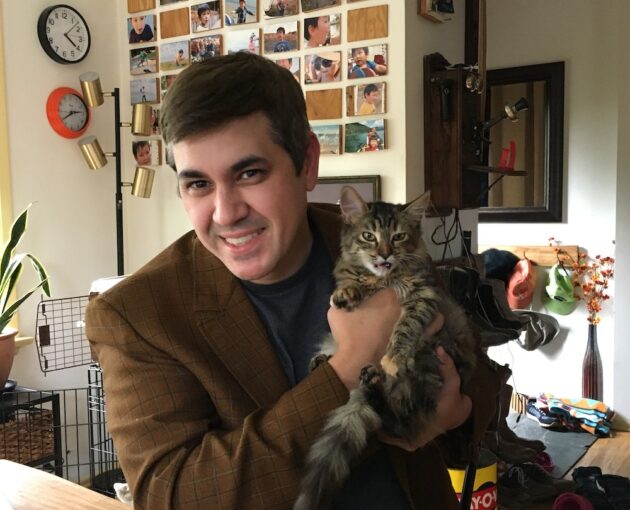
Sanchez with his cat.

Sanchez’s new employers at the tech firm Akvelon saw promise in the idea and gave him the green light.

The resulting app, MeowTalk, is now available on iOS and Android.

There are two layers to the concept: The first one involves nine or 10 “intents” common to all or most cats. They include vocalizations for “Feed me,” “Hey human!”, “Let me out,” and “Pay attention to me,” among others.

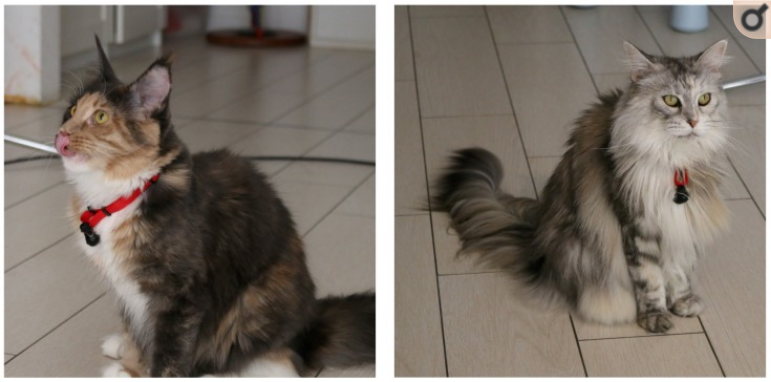
Sanchez didn’t guess or intuit the meanings — they’re based on research by a team at the University of Milan, who built a data set of cat vocalizations by attaching tiny microphones to cats and recording everything the fluffsters say. Each feline utterance was analyzed and catalogued by frequency, rhythmic quality and context, among other traits.

Screenshot_2020-11-12 Automatic Classification of Cat Vocalizations Emitted in Different Contexts
Two cats who participated in the University of Milan study: Note the small black microphones on their collars.

The second layer is where it starts to get really interesting: By using MeowTalk like Shazam, the app will start recording your cat’s particular trills, chirps and meows and — with your help — eventually piece together what they mean.

As with dictation software and machine learning in general, the more data the app gets, the better its translations become.

This is important because, while cats share many sounds, each cat develops its own unique vocalizations:

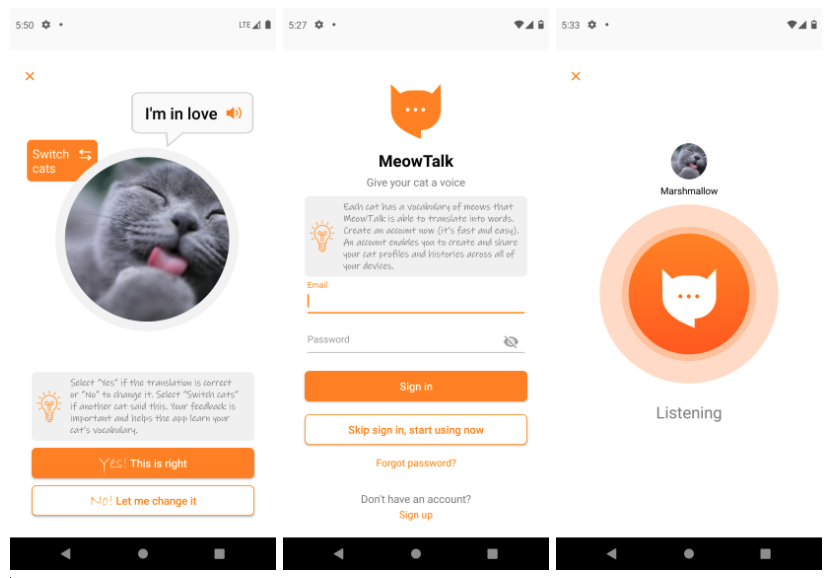
With MeowTalk, you can create a profile for your cat and start using its auto-recognition to translate your cat’s meows and start mapping its language. While some translations are built-in and inherent to the app, translations specific to your cat require you to train the app to recognize your cat’s specific vocabulary and intentions. Translations you deem to be incorrect can be corrected via the app. MeowTalk is not static; instead it learns and evolves with each translation that you confirm, adding to its corpus, just as we would add new words into our own memory banks or language processing programs.

At the same time thousands of other cat owners are also using the app, feeding the algorithm more data, which the app uses to improve itself. Development is ongoing, with future changes reflective of user (and cat) feedback.

“A tool like this can help certain people bond even more with their cats, especially if they can’t be in contact with other people on a regular basis,” Sanchez said. “So this could be a real game changer for a key demographic that have cats.”

Screen-Shot-2020-11-02-at-4.19.06-PM
MeowTalk’s user interface.

Applying what they’re learning via the app, Sanchez and his team are also working toward their next goal: Giving your cat a human voice. They’re developing a small device that clips on a cat’s collar and translates meows into human speech in real time.

That tech has the potential to give me nightmares. Imagine Buddy having a human voice and saying “Gimme snacks now, servant!” “Open the door, butler!” “You’re 23 seconds late with dinner!”

Maybe I’ll pass on the collar device. In the meantime I plan to download the iOS version of MeowTalk and give it a spin. I’ll report back in a week or two after giving it some time to adjust to the Budster. If any of our readers give it a shot, we’d like to hear your impressions as well.

superhandsomebuddy1
Did you know? The Buddinese language includes 22 separate words for “jerk” and 37 different ways of demanding food.

The Cats of Star Trek

From Data’s cat Spot to the Caitians of the Federation and the Kzin warrior cats, Star Trek’s universe is populated by our furry friends.

Fair warning: It’s about to get real nerdy up in here.

Cats have been a mainstay in science fiction, more so than any other animal.

Whether it’s Cordwainer Smith’s spacefaring cats obliterating aliens in “The Game of Rat and Dragon,” Sigourney Weaver’s Jonesy the Nostromo ship cat surviving the eponymous Alien, or Fritz Lieber’s beloved Gummitch the Super Kitten, felines have long played major roles in speculative fiction.

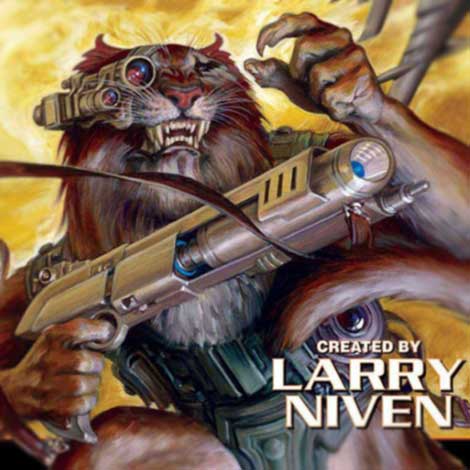
They’ve been mousers on interstellar starships, companions on long-haul freighters and — like Speaker to Animals, the Kzin from Larry Niven’s classic science fiction novel Ringworld — warriors of galactic repute leading dangerous expeditions to alien worlds.

Star Trek is no different.

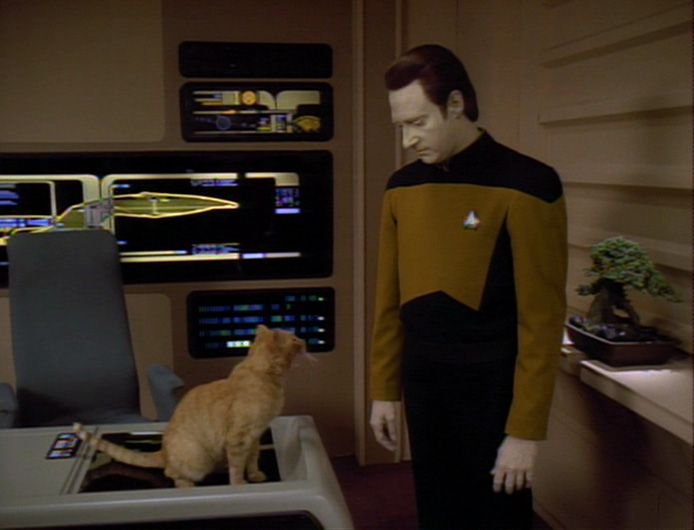
Mention the topic of cats to any Trekkie and the first thing that probably comes to mind is Spot, the orange tabby cat who belonged to Commander Data on Star Trek: The Next Generation.

Spot was a mainstay on the Enterprise-D, earning the respect of the Klingon Commander Worf and serving as Data’s muse for a hilarious poem in the cat’s honor, “Ode to Spot.”

One of the highlights of Star Trek: The Next Generation is watching the gruff Klingon learn that, unlike dogs, cats don’t give a damn about commands.

But cats play a much bigger role in the wider Star Trek universe than even many Trekkies realize.

The Caitians

caitian2
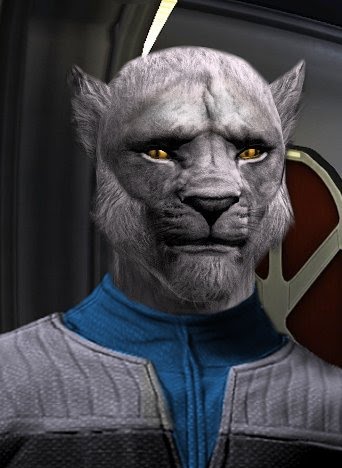
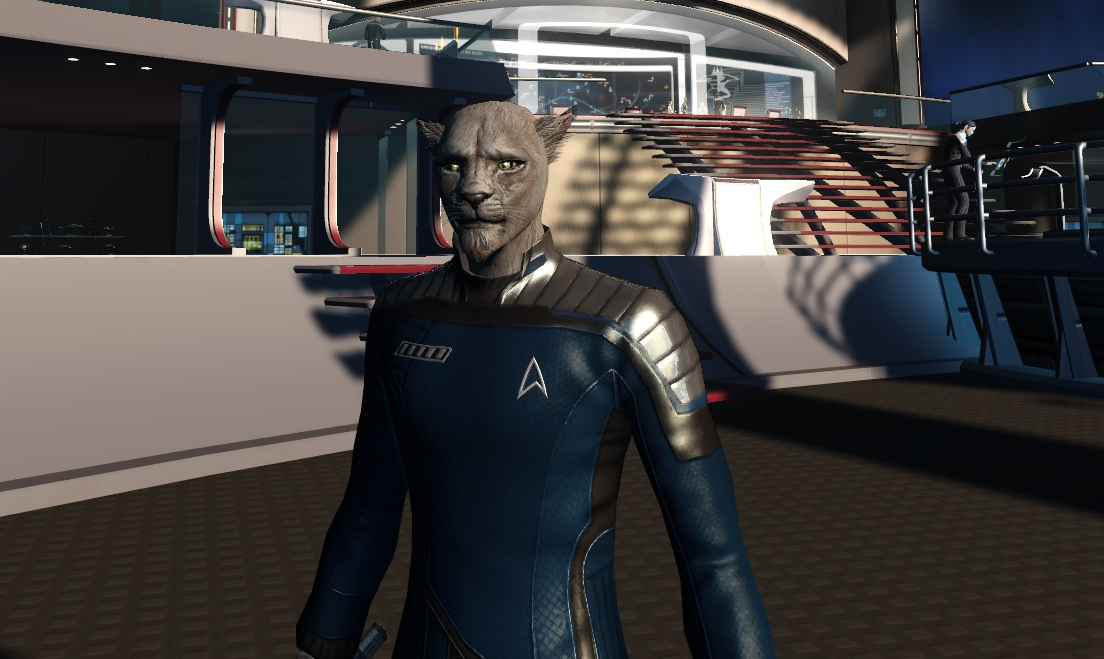
A Caitian science officer in his Starfleet uniform. Source: STO

As fans of Star Trek know, the Federation is an alliance of peaceful worlds and races committed to exploration of the galaxy, friendship with new species and non-interference with developing civilizations.

What many may not realize, however, is just how many species are involved in the Federation. Some, like the Bajorans, Andorians and Betazoids, are seen pretty frequently in Trek shows and movies, but others have made only a few on-screen appearances.

Among the latter are the Caitians, described in Memory Alpha (the wiki of canon for Star trek) as “a warp-capable species resembling felines.”

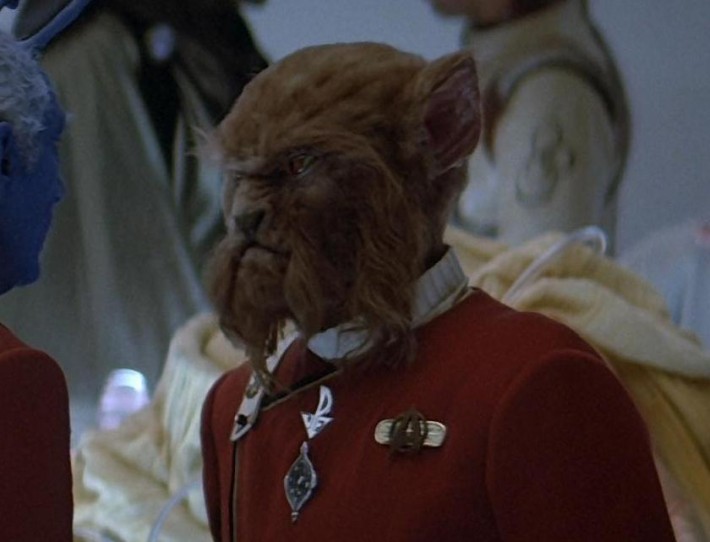
Their home planet is known as Cait to other races, and Ferasa to the Caitians themselves, and is located within the Lynx constellation. They made their first live-action appearance in 1986’s Star Trek IV: The Voyage Home:

Star Trek's Caitians
A Caitian Starfleet officer from Star Trek IV: The Voyage Home.

Because of its origins as a network television show, budget has always been a major factor in the way aliens are depicted in Star Trek.

The show’s writers have come up with an elaborate back story for why so many alien species are humanoid, closely representing humankind, but the minor differences of most species — the ridged foreheads of Klingons and elfin ears of Vulcans — are for the most part remnants from the days when production crews had little money or time to create elaborate props and effects.

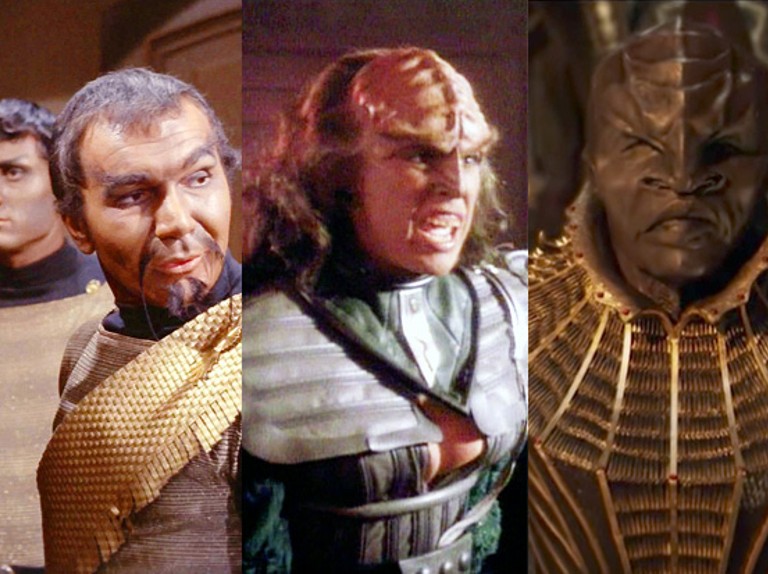
It’s also the reason why the Klingons, for example, were radically redesigned in the 2009 Star Trek reboot, with its lavish budget and SFX.

Klingons
Klingons have been redesigned several times through the decades thanks to larger budgets and advances in special effects.

With a species like the Caitians, however, you either go all-in or not-at-all. That’s why the species has made only three appearances in Trek films to date, and why most of their exploits have been reserved for Trek novels and comics.

But the internet loves cats, and Star Trek Online, the massively multiplayer online game set in the Trek universe, saw enormous positive feedback when it added Caitians as a playable species back in 2011.

Here’s my very own Caitian starfleet captain from the game:

Buddy Trek
My Caitian character: The blue uniform indicates he rose through the ranks as a science officer before becoming a member of Starfleet’s admirality.

According to Star Trek lore, the Caitians share distant ancestry with the Kzin, the aforementioned war-like race of feline aliens from Niven’s Ringworld books.

That’s because Niven himself had a run as a writer for Trek comic books in the 1980s, and wrote his own creation into the wider Star Trek universe.

kzin3

kzin2
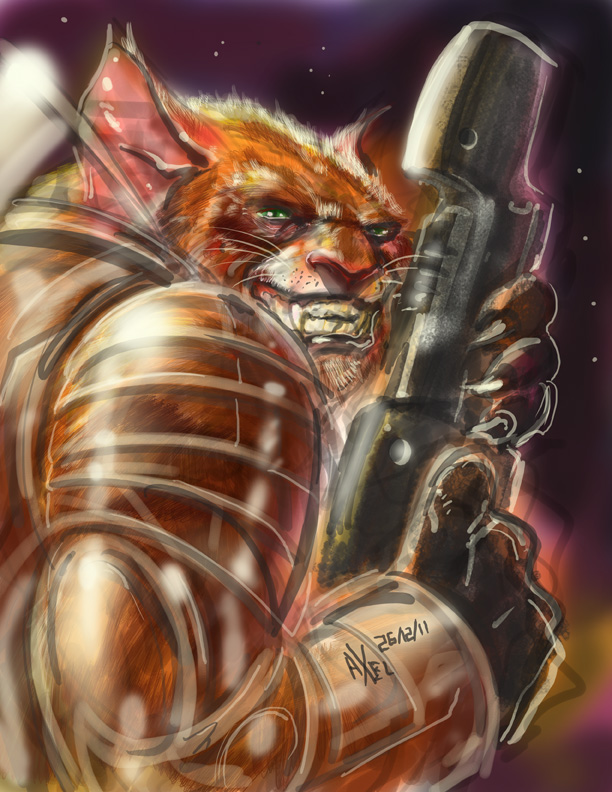
Kzinti warriors from Larry Niven’s Ringworld. The feline aliens were later introduced to the Star Trek universe by Niven himself when he penned a series of Trek comics.


Just like cats have a range of personalities, and breeds have their own unique characteristics — the gentle giant Maine Coons, the talkative Siamese — the felines of Star Trek have different lineages and dispositions.

While the Caitians are peaceful and staunch allies of humans and the Federation, the Kzinti are a bunch of war-loving lunatics who find great joy in blowing things up.

Thanks — or no thanks — to JJ Abrams, there are even “sexy Caitians,” like the pair we see in 2013’s Star Trek: Into Darkness. In the film we see Captain James T. Kirk, played by Chris Pine, waking up in a bed with two women. Both women have long, feline tails, and Abrams would later confirm they’re the alternate universe version of Caitians.

caitian3
These Caitians are quite different. (Star Treek 2009 reboot.)

Maybe, just maybe, a handful of you non-Trekkies have made it this far. Maybe your love of cats kept you interested in this story, and you’re thinking to yourself, “I wonder what Star Trek is all about…”

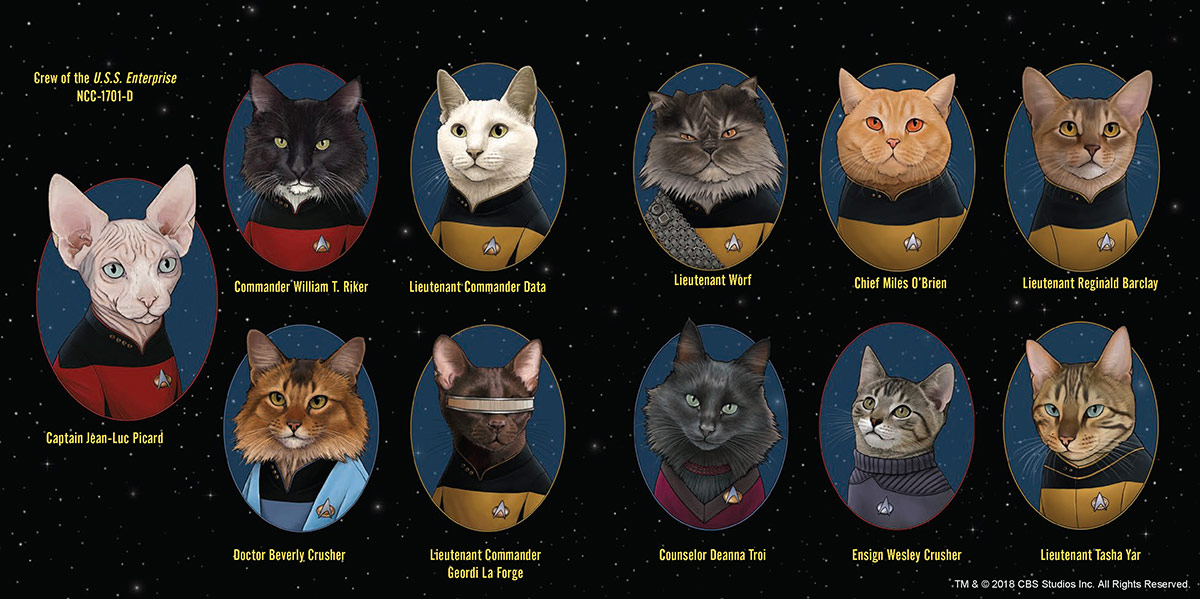
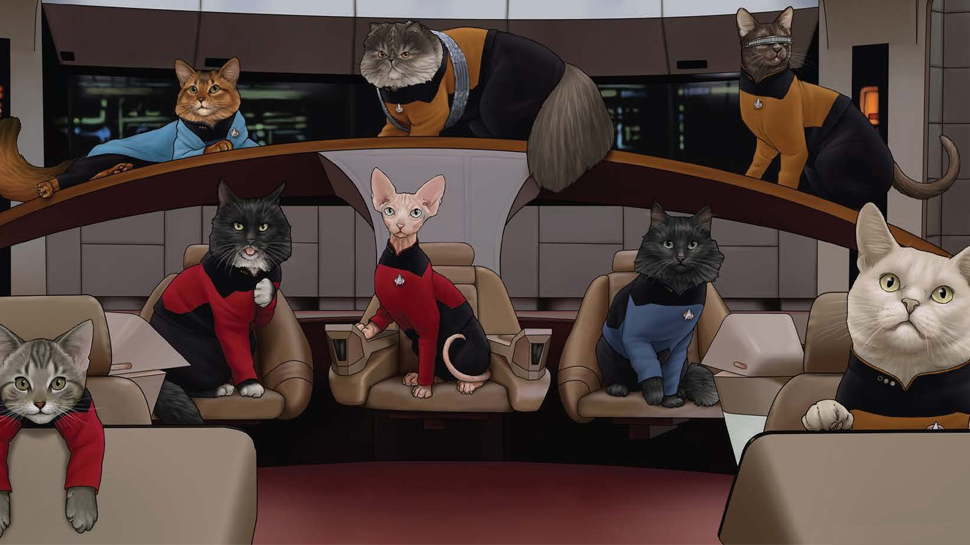
In the spirit of the Federation, I leave you this parting gift. During these dark days of quarantine, should you browse Netflix and find yourself tempted by Star Trek: The Next Generation, here’s a guide to the entire cast that imagines each of them as cats. And not just any cats: Each kitty resembles its Enterprise crew counterpart.

Live long, my friends, and prosper!

(Star Trek Cats by artist Jenny Parks. Check out more at her site!)

Cats of Star Trek
Credit:Jenny Parks

TNG-Cats
The crew of Star Trek: The Next Generation as kitties. Credit: Jenny Parks

Ode to Spot: Nerdy Appreciation for Cats

In Star Trek, cats are along for the ride as humans explore the galaxy.

People who hate on Star Trek think it’s all technobabble about tachyon fields and Starfleet officers shouting things like “Captain, shields are at 60 percent and falling!” during yawn-inducing battle sequences.

Au contraire, my feline-loving friends! Star Trek is not only awesome, it’s written by people who love cats, and kitties have always had a place on the USS Enterprise.

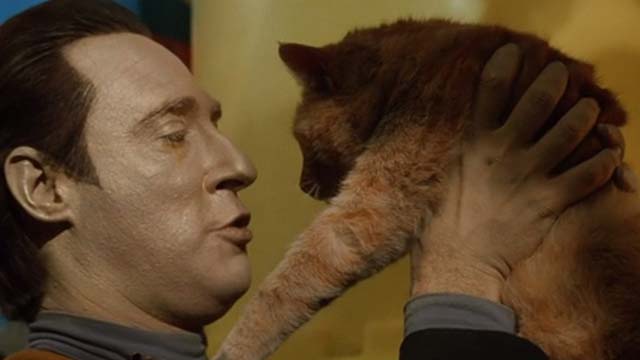
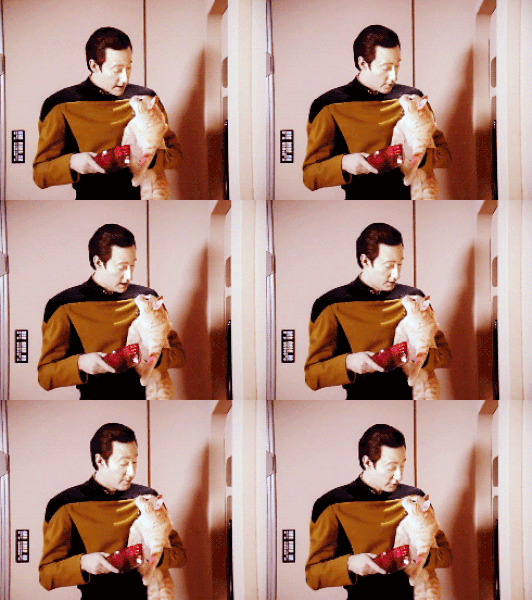
Perhaps the most famous of those cats is Spot, a ginger tabby who belonged to Lt. Commander Data in Star Trek: The Next Generation.

Even in space, it appears, cats are still picky and want attention on their own terms — Data famously tried 221 different types of cat food “formulas” before finding one Spot approved of, and when Spot wasn’t wandering the corridors of the Enterprise 1701-D, he was hanging around his human android, demanding attention and affection.

In season six of the iconic TV show, much to the chagrin of his fellow crew mates, Data read a poem about how much he loves his cat. The poem is called “Ode to Spot”:

Felis catus is your taxonomic nomenclature
An endothermic quadruped, carnivorous by nature
Your visual, olfactory, and auditory senses
Contribute to your hunting skills and natural defenses
I find myself intrigued by your sub-vocal oscillations
A singular development of cat communications
That obviates your basic hedonistic predilection
For a rhythmic stroking of your fur to demonstrate affection
A tail is quite essential for your acrobatic talents
You would not be so agile if you lacked its counterbalance
And when not being utilized to aid in locomotion
It often serves to illustrate the state of your emotion
Oh Spot, the complex levels of behavior you display
Denote a fairly well-developed cognitive array
And though you are not sentient, Spot, and do not comprehend
I nonetheless consider you a true and valued friend


“Ode to Spot” has become a favorite of Star Trek fans who also happen to be cat lovers. Perhaps unsurprisingly, there’s quite a bit of overlap.

I do, however, feel the poem is in need of an update on those last two lines:

Because you are sentient, Spot, I know you comprehend
That I consider you a true and valued friend

The episode aired in 1991, but in 2019 there are still people who don’t know cats are sentient. Cats think, they feel, they’re aware of the world around them. They have a full range of emotions, experiencing things like happiness, sadness, anger, excitement, anticipation, anxiety, jealousy and contentment.

71280ec861512a2d1275de16e97ac657ee19b488_00

Most people who share their homes with cats and dogs would say it’s obvious that animals have emotions, but thanks to the efforts of modern scientists, we now have evidence.

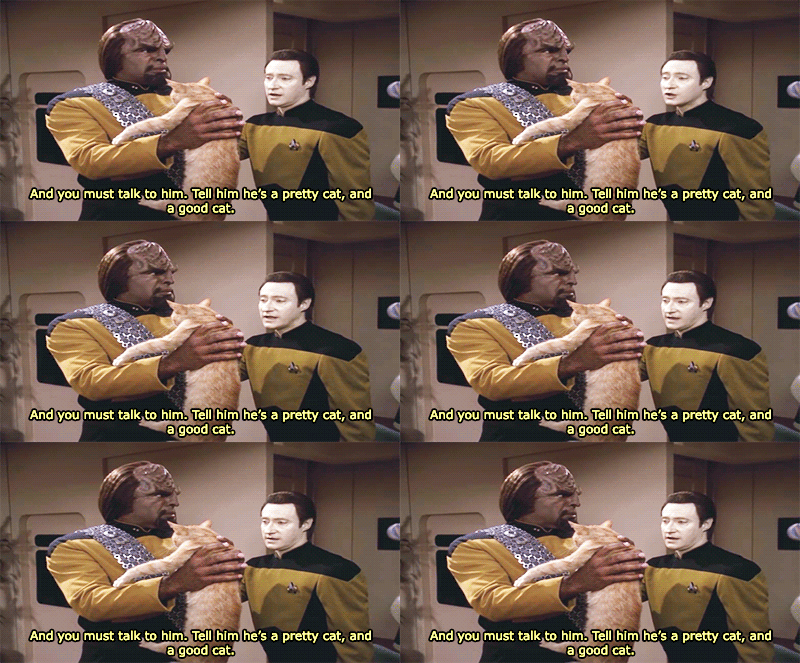
Perhaps Star Trek’s writers simply got their terminology wrong. After all, in one episode, Data needs to find a cat sitter and settles on Worf, the Klingon chief of security on the Enterprise. Data is clearly worried about how Spot will get on in his absence, rattling off a list of things Worf needs to do to take care of the cat.

“And you must talk to him,” Data adds, worry creasing his forehead. “Tell him he’s a pretty cat, and a good cat.”

Worf, already looking uncomfortable as he holds Spot, glares at Data and deadpans: “I will feed him.”

Data, who realizes he’s pushing his luck, takes one last look at Spot and nods.

“Perhaps that will be enough.”

tumblr_p1sv4uV2aF1u501aoo4_400

4094c82068ff268f91c1c8e3d6a54d32
Data and Spot. Originally, Spot was a lighter orange and was played by a male cat. In later seasons he was replaced by a female with a darker coat.