Another Tech Company Wants To Translate Meows And Barks Using AI: Can It Work?

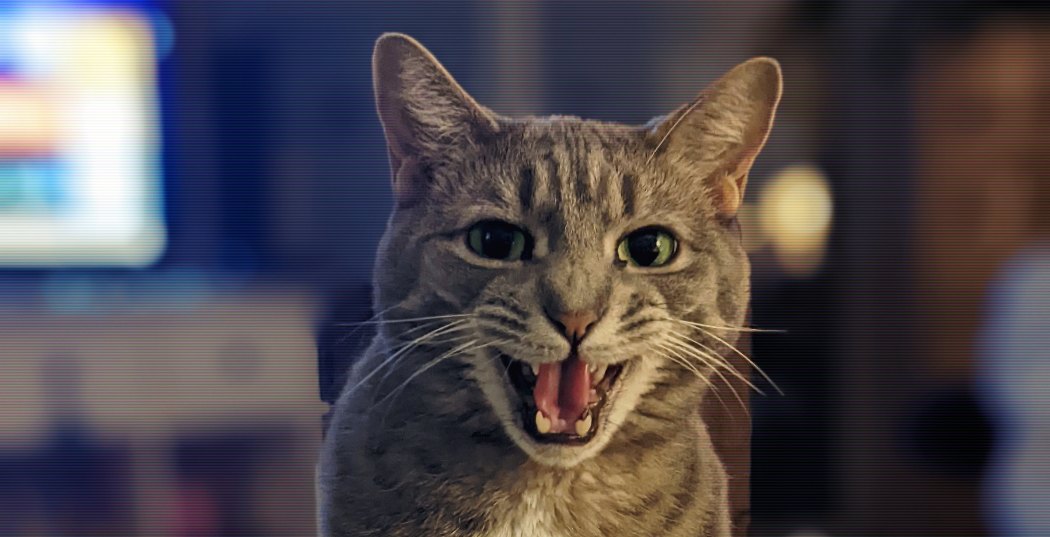
Cats and dogs communicate primarily by scent, touch and body language, but human efforts to understand them have focused exclusively on meows and barks. If we want to truly understand our non-human friends, we need to take an approach that considers the other ways animals “talk” to each other.

A few years ago when MeowTalk made a minor splash in the startup world, I was pretty bullish on its potential to help us understand our cats better.

Sure, the app had an unhelpful habit of attributing improbably loving declarations to Buddy, but I thought it would follow the trajectory of other machine learning models and drastically improve as it accumulated more data.

More users meant the app would record and analyze more meows, chirps and trills, meaning it was just a matter of time before the AI would be able to distinguish between an “I want attention!” meow and a “My bowl is dangerously close to empty!” meow.

Obviously that didn’t happen, and what I personally didn’t take into account back then — and should have, given how obvious it is in retrospect — is that cats don’t just communicate via vocalizations.

In fact, cats don’t normally incorporate vocalizations into communication at all. Pet kitties do it entirely for our benefit because they know we’re generally awful at interpreting body language and we are completely useless when it comes to olfactory information.

It’s actually amazing when you really think about how much of the heavy lifting cats do in our efforts to communicate with each other. They recognize we can’t communicate the way they do naturally, so they try to relate to us on our terms. In return, we meet them less than halfway.

No wonder Buddy sometimes looks frustrated as he meows at me, as if I’m the biggest moron in the world for not understanding the very obvious thing he’s trying to tell me.

“Human, how can you not understand the simple feeling of innerer schweinehund I’m trying to convey here? The cringe is killing me!”

Now the Chinese tech giant Baidu is throwing its hat into the ring after filing a patent in China for an AI system that uses machine learning to decode animal communication and “translate” it to human language.

Machines are designed to process things from a human viewpoint according to human logic, so if Baidu wants to succeed where MeowTalk has not, its engineers will need to take a thoughtful approach with the help of animal behavior experts.

This is a hard problem that encompasses animal cognition, neuroscience, linguistics, biology, biochemistry and even philosophy. If they approach this strictly as a tech challenge, they’ll set themselves up for failure.

Without the information and context clues provided by tails, whiskers, facial expressions, posture, eye dilation, heart rate, pheromones and even fur, an AI system is only getting a fraction of the information cats are trying to convey.

Trying to glean meaning from that is like trying to read a book in which only every fourth or fifth letter is legible. There’s just too much missing information.

Even if we can train machines to analyze sound visual, tactile and olfactory information, it may not be possible to truly translate what our cats are saying to us. We may have to settle for approximations. We’ve only begun to guess at how the world is interpreted differently among human beings thanks to things like qualia and neurodivergence, and the way cats and dogs see the world is undoubtedly more strange to us than the way a neurodivergent person might make sense of reality.

“He grimaced. He had drawn a greedy old character, a tough old male whose mind was full of slobbering thoughts of food, veritable oceans full of half-spoiled fish. Father Moontree had once said that he burped cod liver oil for weeks after drawing that particular glutton, so strongly had the telepathic image of fish impressed itself upon his mind. Yet the glutton was a glutton for danger as well as for fish. He had killed sixty-three Dragons, more than any other Partner in the service, and was quite literally worth his weight in gold.” – Cordwainer Smith, The Game of Rat and Dragon

An animal’s interpretation of reality may be so psychologically alien that most of its communication may be apples to oranges at best. Which is why I always loved Cordwainer Smith’s description of the feline mind as experienced via a technology that allows humans with special talents to share thoughts with cats in his classic short story, The Game of Rat and Dragon.

In the story, humans are a starfaring civilization and encounter a threat in the void between stars that people don’t have the reaction speed to deal with. Cats, however, are fast and swift enough, and with a neural bridge device, teams of humans paired with cats are able to keep passengers safe on interstellar journeys.

The narrator, who is one of the few people with an affinity for teaming up with felines, hopes he’ll be paired with one of his two favorite cats for his latest mission, but instead he’s assigned to partner with an old glutton of a tomcat whose mind was dominated by “slobbering thoughts of food, veritable oceans of half-spoiled fish.”

The narrator wryly notes that the last time one of his colleagues was paired with that particular cat, his burps tasted of fish for weeks afterward. But the cat in question, despite being obsessed with fish, is a badass at killing “dragons,” the human nickname for the bizarre entities that attack human ships in space. (The software that allows felines and humans to link thoughts also portrays the “dragons” as rodents in the minds of the cats, stimulating their ancient predatory drive so they’ll attack instantly when they see the enemy.)

We can’t know for sure if Smith’s interpretation of the feline mind is accurate, but another part rang true when he wrote that cat thoughts were all about the moment, filled with sentiments of warmth and affection, while they rapidly lost interest in thoughts about human concerns, dismissing them “as so much rubbish.”

If the mind of a cat is that relatable, we’ll be incredibly lucky. But in reality we’re dealing with animals who evolved in drastically different ecological niches, with different priorities, motivations, and ways of looking at the world — literally and figuratively.

That doesn’t mean we shouldn’t try to understand our furry friends. Research has yielded interesting information about the way animals like whales and elephants communicate, and AI is at its best when it augments human creativity and curiosity instead of trying to replace it.

Even if we don’t end up with a way to glean 1:1 translations, the prospect of improving our understanding of animal minds is tantalizing enough. We just need to make sure we’re listening to everything they’re saying, not just the meows.
‘Why I Took 50,000 Pictures Of My Cats Pooping’

One software engineer went to incredible lengths to monitor her cat’s bathroom habits.

When Alan Turing, the father of artificial intelligence, posed the heady question “Can machines think?”, he inspired generations of computer scientists, philosophers, physicists and regular people to imagine the emergence of silicon-based consciousness, with humanity taking the godlike step of creating a new form of life.

And when science fiction writer Philip K. Dick wrote his seminal 1968 novel, “Do Androids Dream of Electric Sheep?” — the story that would eventually become Ridley Scott’s 1982 classic Bladerunner — he wondered what makes us human, and whether an artificial being could possess a soul.

It’s safe to say neither of those techno-prophets were thinking of fledgling AI algorithms, representing the first small steps toward true machine-substrate intelligence, announcing themselves and their usefulness to the world by helping us watch felis catus take a shit.

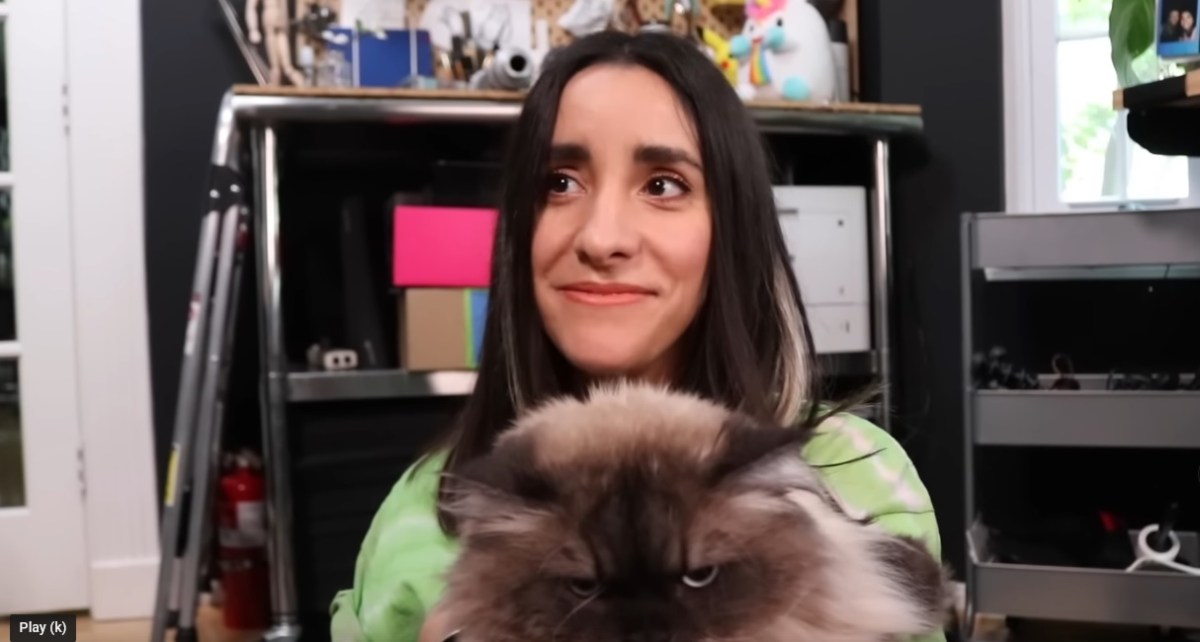
And yet that’s what the inventors of the LuluPet litter box designed an AI to do, and it’s what software engineer and Youtuber Estefannie did for her cat, Teddy, who’s got a bit of a plastic-eating problem.

“The veterinarian couldn’t tell me how much plastic he ate, and it would cost me over $3,000 [to find out]. So I didn’t do it,” Estefannie explains in a new video. “Instead, the vet gave me the option of watching him go to the bathroom. If he poops and there’s no plastic in his intestines, then he won’t die, and he might actually love me back.”

Estefannie casually described how she wrote a python script, set up a camera and motion sensor, and rigged it to take photos of Teddy doing his business. But, she explained, there was “a tiny problem”: Luna the Cat, aka her cat’s cat.

“This is Luna, this is technically not my cat, this is Teddy-Bear’s cat, and she uses the same litter box as Teddy,” she explained.

For that, she’d need more than a script. She’d have to build a machine learning algorithm to gorge itself on data, cataloguing tens of thousands of photos of Teddy and Luna along with sensory information from the litter box itself, to learn to reliably determine which cat was using the loo.

So Estefannie decided it was a good opportunity to “completely remodel” Teddy’s “bathroom,” including a compartment that would hide the bespoke system monitoring his bowel movements. The system includes sensors, cameras and lights to capture still images of Teddy dropping deuces in infrared, and a live thermal imaging feed of the little guy doing his business. (Teddy’s luxurious new bedroom turned out to be too dark for conventional cameras, thus the pivot to infrared.)

From there, Estefannie manually calculated how long Teddy’s number ones and twos took, and cross-referenced that information with photo timestamps to help determine the exact nature of Teddy’s calls of nature.

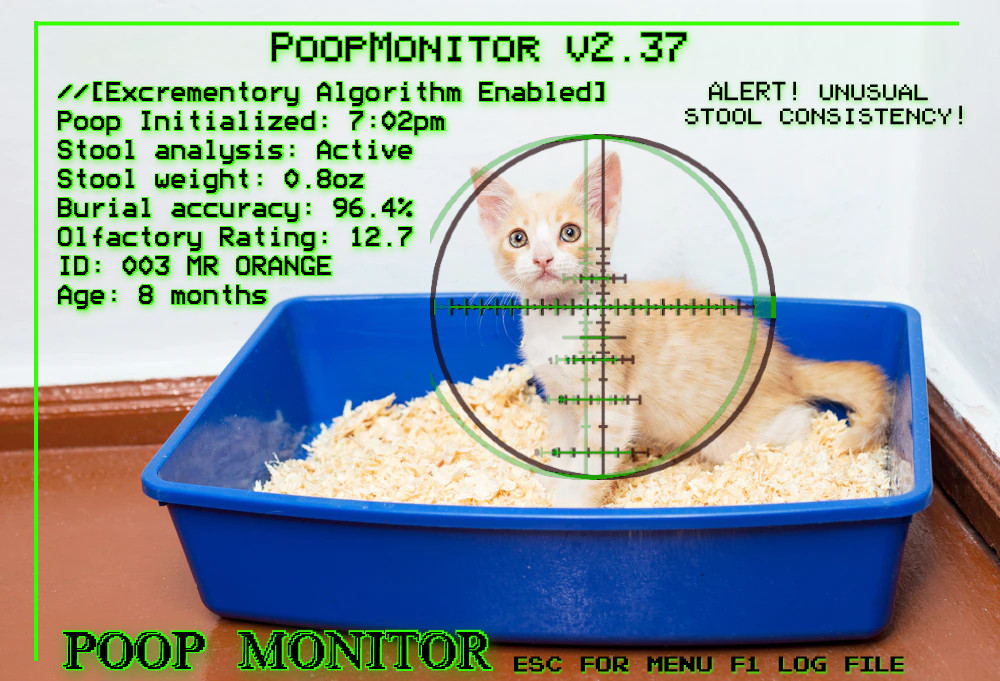
catpoopinggui
The future! (Note: This is our cheesy photoshopped interpretation, not Estefannie’s actual stool monitoring interface.)

When all the data is collected, Estefannie’s custom scripts sends it to an external server, which analyzes the images from each of Teddy’s bathroom visits and renders a verdict on what he’s doing in there.

Finally, Estefannie gets an alert on her smartphone when one of the cats steps into the litterbox, allowing her the option of watching a live feed and, uh, logging all the particulars. The software determines if a number two was successful, and keeps detailed records so Teddy’s human servant can see aberrations over time.

“So now I definitely know when Teddy-Bear is not pooping and needs to go to the hospital,” she said.

I am not making this up.

For her part, Estefannie says she’s not worried about a technological singularity scenario in which angry or insulted machines, newly conscious, exact revenge on humans who made them do unsavory tasks.

“Did I make an AI whose only purpose in life is to watch my cats poop?” Estefannie asked, barely keeping a straight face. “Mmmhmm. Will it come after me when the machines rise? No! Ewww!”

Every Attempt To Translate Meows Has Failed. Why?

A New York Times science writer tries MeowTalk, the app that says it can tell you what your cat is saying.

New York Times science writer Emily Anthes details her experience with MeowTalk in a new story, and has more or less come to the same conclusions I did when I wrote about the app last year — it recognizes the obvious, like purring, but adds to confusion over other vocalizations.

Back in January of 2021, in MeowTalk Says Buddy Is A Very Loving Cat, I wrote about using MeowTalk to analyze the vocalizations Bud makes when he wants a door opened. After all, that should be a pretty basic task for an app that exists to translate meows: Cats ask for things, or demand them, some would say.

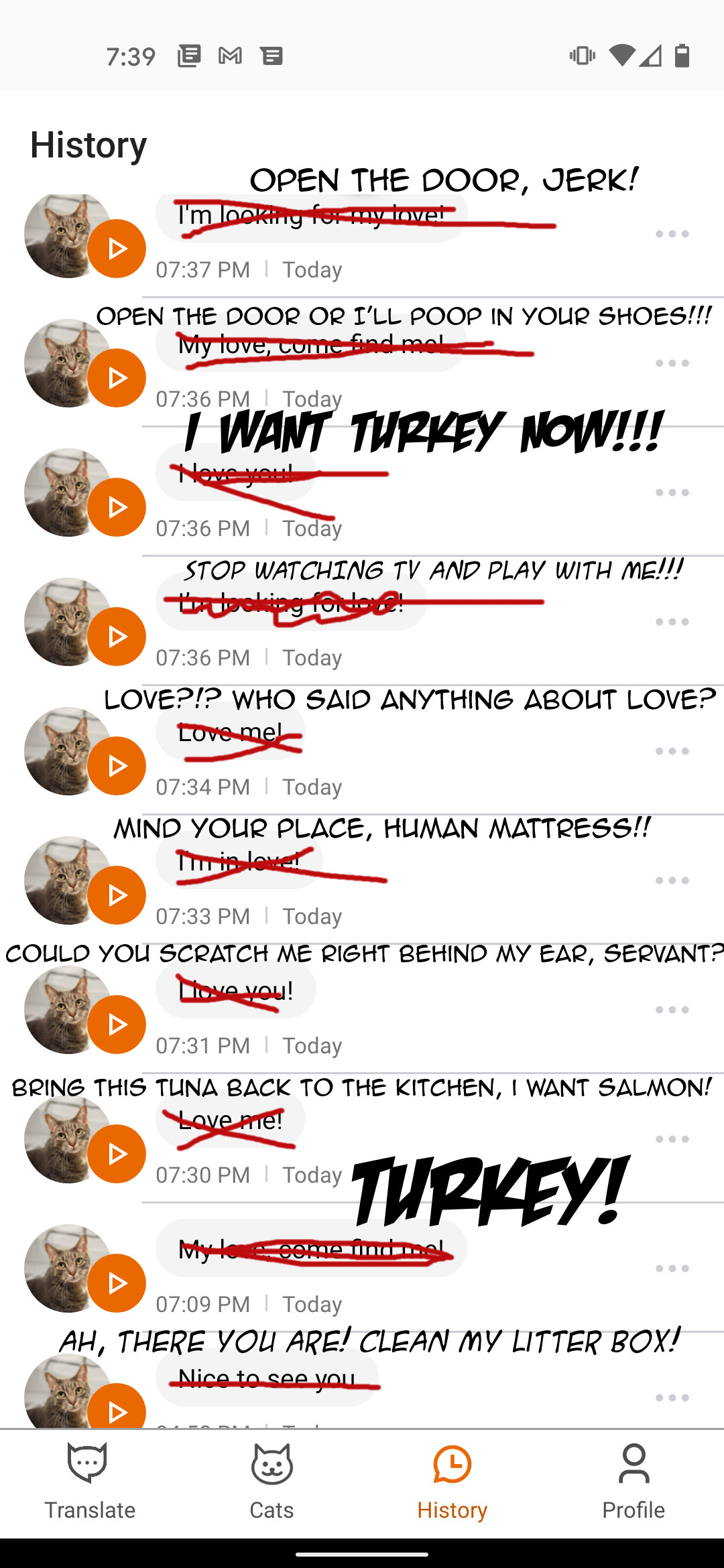
But instead of “Open the door!”, “I want to be near you!”, “Human, I need something!” or even “Obey me, human!”, it told me Bud was serenading me as he pawed and tapped his claws on the door: “I’m looking for love!”, “My love, come find me!”, “I love you!”, “Love me!”, “I’m in love!”

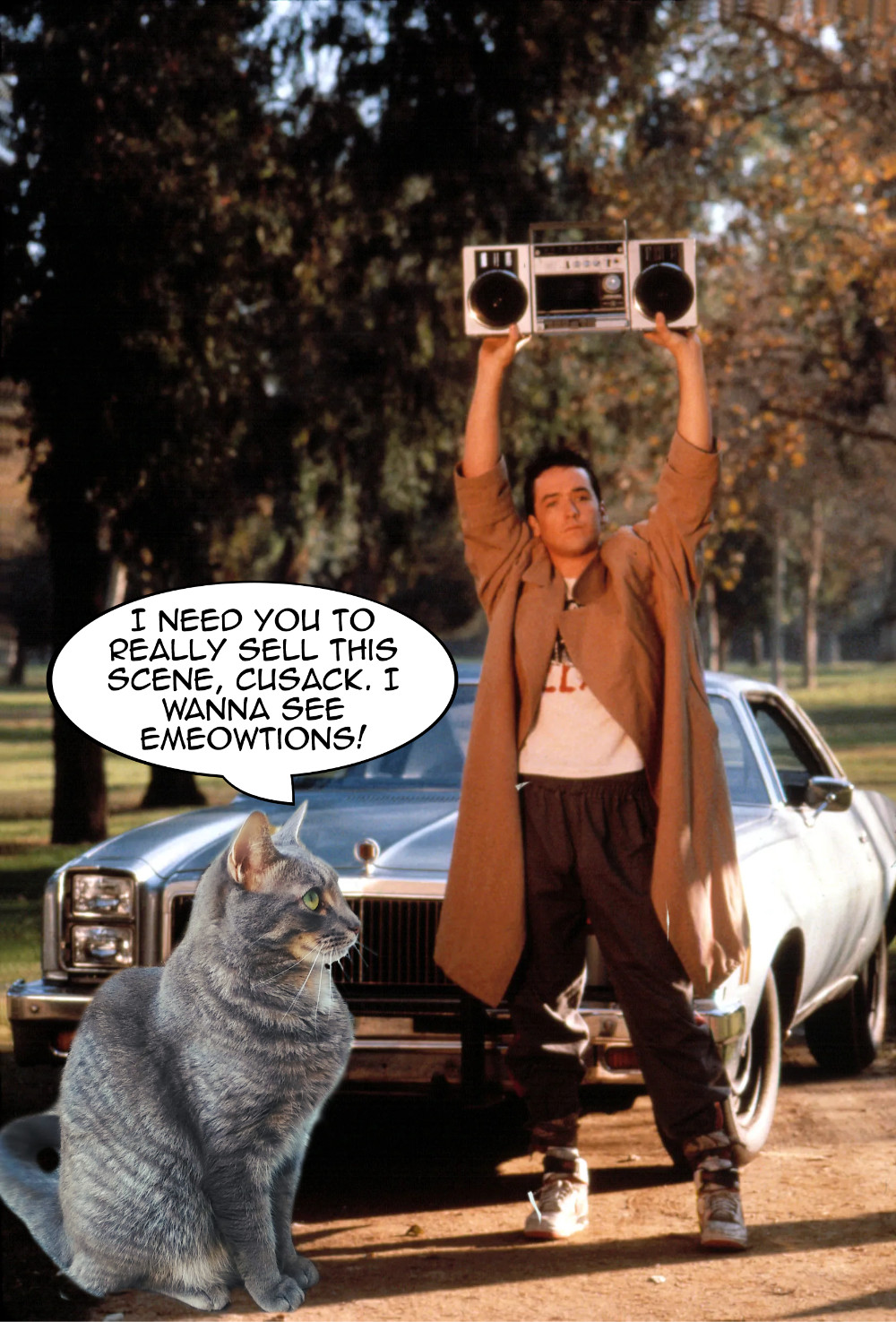
According to MeowTalk, my cat was apparently the author of that scene in Say Anything when John Cusack held up a boombox outside of Ione Skye’s bedroom window.

John Cusack and Buddy the Cat
Buddy the Director.

Anthes had a similar experience:

“At times, I found MeowTalk’s grab bag of conversational translations disturbing. At one point, Momo sounded like a college acquaintance responding to a text: ‘Just chillin’!’ In another, he became a Victorian heroine: ‘My love, I’m here!’ (This encouraged my fiancé to start addressing the cat as ‘my love,’ which was also unsettling.) One afternoon, I picked Momo up off the ground, and when she meowed, I looked at my phone, ‘Hey honey, let’s go somewhere private.’ !”

On the opposite side of the emotional spectrum, MeowTalk took Buddy’s conversation with me about a climbing spot for an argument that nearly came to blows.

“Something made me upset!” Buddy was saying, per MeowTalk. “I’m angry! Give me time to calm down! I am very upset! I am going to fight! It’s on now! Bring it!”

In reality the little dude wanted to jump on the TV stand. Because he’s a serial swiper who loves his gravity experiments, the TV stand is one of like three places he knows he shouldn’t go, which is exactly why he wants to go there. He’s got free rein literally everywhere else.

If MeowTalk had translated “But I really want to!” or something more vague, like “Come on!” or “Please?”, that would be a good indication it’s working as intended. The app should be able to distinguish between pleading, or even arguing, and the kind of freaked-out, hair-on-edge, arched-back kind of vocalizations a cat makes when it’s ready to throw down.

buddytranslations
Accurate translations of Buddy’s meows.

Still, I was optimistic. Here’s what I wrote about MeowTalk last January:

“In some respects it reminds me of Waze, the irreplaceable map and real-time route app famous for saving time and eliminating frustration. I was one of the first to download the app when it launched and found it useless, but when I tried it again a few months later, it steered me past traffic jams and got me to my destination with no fuss.

What was the difference? Few people were using it in those first few days, but as the user base expanded, so did its usefulness.

Like Waze, MeowTalk’s value is in its users, and the data it collects from us. The more cats it hears, the better it’ll become at translating them. If enough of us give it an honest shot, it just may turn out to be the feline equivalent of a universal translator.”

There are also indications we may be looking at things — or hearing them — the “wrong” way. Anthes spoke to Susanne Schötz, a phonetician at Lund University in Sweden, who pointed out the inflection of a feline vocalization carries nuances. In other words, it’s not just the particular sound a cat makes, it’s the way that sound varies tonally.

“They tend to use different kinds of melodies in their meows when they’re trying to point to different things,” said Schötz, who is co-author of an upcoming study on cat vocalizations.

After a few months in which I forgot about MeowTalk, I was dismayed to open the app to find ads wedged between translation attempts, and prompts that asked me to buy the full version to enable MeowTalk to translate certain things.

The developers need to generate revenue, so I don’t begrudge them that. But I think it’s counterproductive to put features behind paywalls when an application like this depends so heavily on people using it and feeding it data.

To use the Waze analogy again, would the app have become popular if it remained the way it was in those first few days after it launched? At the time, I was lucky to see indications that more than a handful of people were using it, even in the New York City area. The app told me nothing useful about real-time traffic conditions.

These days it’s astounding how much real-time traffic information the app receives and processes, routing drivers handily around traffic jams, construction sites and other conditions that might add minutes or even hours to some trips. You can be sure that when you hear a chime and Waze wants to redirect you, other Waze users are transmitting data about a crash or other traffic impediment in your path.

Bud
“I’m thinking deep thoughts about turkey.”

MeowTalk needs more data to be successful, especially since — unlike Waze — it depends on data-hungry machine learning algorithms to parse the sounds it records. Like people, machine learning algorithms have to “practice” to get better, and for a machine, “practice” means hearing hundreds of thousands or millions of meows, chirps, trills, yowls, hisses and purrs from as many cats as possible.

That’s why I’m still optimistic. Machine learning has produced algorithms that can identify human faces and even invent them. It’s produced software that can write prose, navigate roads, translate the text of dead languages and even rule out theories about enduring mysteries like the Voynich Manuscript.

In each of those cases there were innovators, but raw data was at the heart of what they accomplished. If MeowTalk or another company can find a way to feed its algorithms enough data, we may yet figure our furry little friends out — or at least know what they want for dinner.

Why Are UK Cat Owners So Intent On Allowing Their Cats To Run Free?

A UK couple created a cat flap that uses algorithmic AI to determine if their cat is trying to come inside while carrying prey in her mouth. If she’s carrying prey, the cat flap won’t open.

Jinx the cat was so grateful to UK couple Martin Rosinski and Michelle Bowyer for giving her a home that she decided to bring them a gift.

“The first time I was working at home, I heard Michelle making a commotion because Jinx had come in with a mouse and dumped it on the carpet in front of her as a ‘thank you’. That’s their way of expressing love. You can’t tell her off, so we thanked her a lot for it and took it away from her,” Rosinski said.

“Then this started happening more and more often to the point where we would be woken up at 2 a.m. as Jinx would meow loudly and announce, ‘Hey I have a gift. If we didn’t get to her fast enough she would decide to eat it herself, which would involve piles of mouse parts being smeared into the carpet. This was happening at 2 a.m., then again at 4 a.m. on many nights and we’d not get any sleep having to deal with this. Her record was four in one night – that night was a frenzy of three mice and one bird. It was something that was a real cause of stress.”

The solution is pretty simple, right? Keep Jinx inside.

The former stray won’t like it at first. There will be an adjustment period when the meowing will be seriously annoying. But it’s better than allowing your cat to play Predator at night and waking up to find your cat sitting on your chest, proudly presenting a twitching mouse to you.

Rosinski and Bowyer didn’t take Jinx inside.

Instead they created a bespoke intelligent cat flap that allows Jinx to come and go as she pleases, but won’t open if she’s carrying prey. They both have backgrounds in tech: he’s a researcher who also tinkers with software and hardware, and she’s a web developer.

cute brown tabby cat
Despite being domesticated, cats retain their predatory instincts and many will kill small mammals and birds if allowed to wander on their own outdoors. Credit: Aleksandr Gorlov/Pexels

Their system, OnlyCat, uses a camera and an algorithm to determine if Jinx is carrying something in her mouth. If she is, the cat flap won’t grant her access, and Bowyer and Rosinski will get a text informing them Jinx has been up to her hi-jinx again, along with a photo of her entry attempt.

The OnlyCat prototype has prevented Jinx from bringing in 42 prey animals since June of 2021, the couple said. OnlyCat may prevent her from bringing her prey inside, but it hasn’t dissuaded her from killing.

“Two months ago I think something clicked and she realized, ‘I can’t bring these home. It’s just not going to work,’” Rosinski told the UK’s South West News Service. “She still catches them outside but she’s learned that there’s no point even trying to bring them home, which is a relief.”

The couple developed the OnlyCat into a full product, which launches on Aug. 16 at £499. (A little more than $600 USD.) Their site says the retail version of the flap has worked 100 percent of the time in tests, and the developers believe “99%+ accuracy should be achievable for everyone.”

It’s similar to a device built by Amazon engineer Ben Hamm which uses DeepLens, an AI-enabled camera system, and Sagemaker, a software tool for training machine-learning algorithms, to determine if cats are carrying prey.

Hamm’s version, which he created for his cat Metric in 2019, initiates a 15-minute lockout timer if Metric tries to enter while carrying a kill, and automatically sends a donation to the National Audubon Society, which protects birds and their habitats. The algorithm was trained using tens of thousands of images of cats approaching normally, and with prey in their mouths. So far, Hamm hasn’t developed a retail version of his AI-enabled cat flap.

orange tabby cat on gray rock
The feline predatory drive is instinctual. Indoor cats can exercise that drive with wand toy games and by chasing laser pointers. Credit: Aleksandr Nadyojin/Pexels

We don’t think there’s any one way to raise cats, and it’s obvious there are different cat cultures in various countries.

Nevertheless, seven out of 10 cat owners in the UK allow their cats to roam free, and anecdotes like the ones about Jinx, with her multiple kills a night habit, draw the ire of birders and conservationists.

Peter Marra is the author of Cat Wars: The Devastating Consequences Of A Cuddly Killer and co-author of many of the leading studies claiming cats are the primary threat to bird populations. He’s currently making the media rounds and endorsing strict policies — many of them in enacted in response to his studies — that would make it illegal to allow cats outdoors.

The Australian government is airdropping poisoned sausages by the ton in a plan to cull as many as two million cats, a town in Germany tried to ban outdoor cats, a US politician recently suggested starting a “hunting season” for feral and stray felines, and some people — including wildlife biologists and conservationists — have gone vigilante and convinced themselves they’re doing good by randomly picking off cats with shotguns and poisoning feeding stations for strays.

Maybe it’s time for more people to reconsider allowing their cats to roam free. Like putting a cat on a diet or trying to break a bad habit, there’ll be loud and annoying protests in meow, and it’ll get worse before it gets better, but eventually cats always adjust to changes if given long enough.

As domesticated animals they don’t have a natural habitat anymore, and they don’t actually need to be outside. It’s entirely possible to keep things fun and interesting for the furry little guys, and that’s on us. All that’s required is our time, attention and affection. Interactive play time. Toys that can keep a cat occupied by herself. Catnip. Condos and tunnels. Window perches. Cat TV on Youtube. Simple things to play with, like plastic bottle rings, crinkled tin foil and cardboard boxes.

We don’t think anyone should be required to keep their cats indoors, and that’s the point. We have an opportunity to meet conservationists halfway and make a real effort to reduce feline impact on small wildlife. If we don’t, eventually we’ll be forced to comply by laws that’ll be draconian compared to the voluntary measures we could have taken to prevent the government from getting involved.