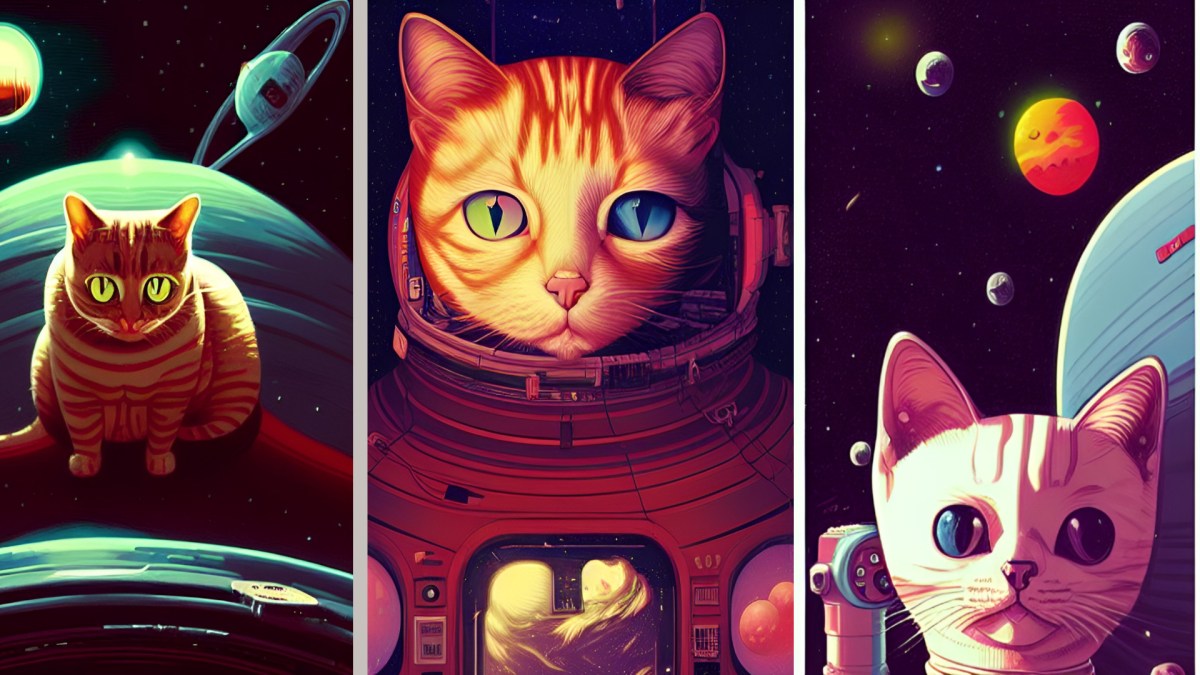
Buddy reminded us that cats can in fact dance, and they’ve got serious moves.
After I committed the unspeakable crime of posting a story about amazing birds here on Pain In the Bud, Buddy himself took time out of his busy napping and eating schedule to educate me on feline abilities.
Cats can in fact dance, the little guy told me. As evidence, he presented the glorious Youtube rendition of Ievan Polkka, featuring blind Turkish singer Bilal Göregen passionately performing a Finnish folk song while a cat vibes to it in the foreground.
The cat comes in at around the 55 second mark, but you’ll want to watch the whole magnificent video. Thanks, Buddy, for correcting me, and I humbly apologize for ever doubting the many talents of your people.
The director was very specific about the way his cats should be treated in his absence.
Stanley Kubrick was so particular about his cats, he created a 15-page guide to caring for the beloved felines while he was away making films.
Kubrick, who is considered one of the greatest film directors of all time, was a homebody and recluse — when he wasn’t working behind the camera — whose eccentricities have been documented in books and interviews over the decades.
Of course having cats isn’t an eccentricity, but Kubrick was very particular about how his pride of house lions should be treated, how they should eat and drink, and how their behavior should be monitored.
His lengthy instruction booklet detailing the particulars of their care had at least 37 sections!
His daughter, Katharina Kubrick-Hobbs, said the guide was titled Care Instructions: How To Look After The Animals, and the director left a version of it behind when he went to Ireland to shoot 1975’s Barry Lyndon. The 37th item dealt with breaking up potential fights among the kitties, Kubrick-Hobbs recalled:
“When we went to Ireland on Barry Lyndon, he left this 15-page document, Care Instructions: How To Look After The Animals. And the 37th instruction is: ‘If a fight should develop between Freddie and Leo–‘ and that was the father and son tomcats that we had– ‘the only way you can do anything about it is to dump water on them. Try to grab Freddie and run out of the room with him. Do NOT try and pick up Leo. Alternatively, if you open a door and just let Freddie get out, he can outrun Leo. But if he’s trapped in a place where you can’t separate them, just keep dumping water, shouting, screaming, jumping up and down, and distracting them, waving shirts, towels… just try and get them apart and grab Freddie.‘”
Kubrick died at age 70 in 1999 after a film career that spanned five decades, from 1953’s Fear and Desire, and 1960’s Spartacus starring Kirk Douglas as the eponymous warrior, to Full Metal Jacked (1987) and Eyes Wide Shut in 1999. One of his best-known works was 2001: A Space Odyssey, a 1968 collaboration between Kubrick and celebrated science fiction novelist Arthur C. Clarke. The film was groundbreaking for its realistic portrayal of space travel and exploration, and created a visual shorthand that still defines the genre today.
Stephen King adaptation The Shining (1980), Cold War black comedy Dr. Strangelove (1964) and A Clockwork Orange (1971) are among his most popular films.
“Will you humans please stop trying to be cats? If you take our napping spots, we’re going to be very angry.”
NEW YORK — Responding to the increasingly common phenomena of humans claiming they “identify as cats,” the country’s felines blasted the offenders on Tuesday for “stealing from a culture that isn’t theirs.”
The angry cats hastily organized a press conference, then had a short nap before addressing a group of about 50 reporters from news agencies across the world.
“It’s come to our attention that certain humans have been meowing, lapping water from bowls and even doing their business in litter boxes instead of toilets,” said Chonkmatic the Magnificent, King of North American cats. “While they say imitation is the most sincere form of flattery, we’re concerned that these humans are essentially cosplaying as felines and remain ignorant of our traditions. After all, things like the Ritual of 3 a.m. Zooms and the Making of Biscuits have a long and storied cultural history, and are sacred to our kind. We sing the Song of Our People and rocket around the house like pinballs at ungodly hours in tribute to our ancestors.”
While some stories — such as high schools allegedly accommodating “cat-identified” students by placing litter boxes in student bathrooms — have turned out to be hoaxes, there is a growing movement of self-described “catgender” people who use pronouns like “mew/purr” and “nya/nyan.” The latter is based on the onomatopoeic word for “meow” in Japanese.
For example, a sentence referencing a catgender-identified person might look like this: “Nyan wasn’t feeling well and decided to take one of nya’s sick days.”
An “inclusive catgender flag” that represents catboys, catgirls, demicats, pancats, meowgender, mewgender, emo catgender, catsexuals and others who “strongly identify with felines or feline characteristics.”
Catgender falls under the larger umbrella of xenogender, according to people who keep track of these things, and is not the same as “cat sexual,” which presumably involves attraction to cats. (This reporter, afraid of what he might find, refrained from investigating that particular identity.)
While it may be tempting to wave off the idea of xenogender, catgender and associated identities like kittengender as the mad rants of Extremely Online People who populate sites like Tumblr, concepts like xenogender and neopronouns have already gained more than a foothold in the real world, with institutions of higher education like the UK’s University of Bristol ordering employees to acknowledge and use exotic neopronouns and their associated identities.
A person who identifies as a rabbit, for example, might use the pronouns “bun/bunself,” while a person who identifies as a vampire may use “vamp/vampself,” according to the New York Times.
Abigail of Greenville, NC, says she identifies as a cat. Her boyfriend dispenses treats for her and calls her a “good girl.” Credit: Barcroft TV
Regardless, felines aren’t sold on the idea of species fluidity. They point out humans are “terrible groomers,” utterly hopeless at speaking tail and whisker, cursed with dead noses, and partial to “disgusting food” including fruits and vegetables.
“A real cat wouldn’t eat broccoli or oranges even if they were wrapped in a deliciously crispy crust of deep-fried turkey,” King Chonkmatic said matter-of-factly.
American cats said they are concerned that if the so-called cat identity catches on, confused humans may begin to compete with them for prime napping spots, treats, affection and even catnip.
The latter plant carries particular significance in feline culture, and cats aren’t pleased that it’s been commodified by humans and sold alongside Jimi Hendrix posters and lava lamps in head shops.
“Catnip is a ceremonial and spiritual plant reserved only for the most solemn of felid rituals,” said the Very Rev. Mr. Fuzzypants, a 9-year-old ragdoll who serves as president of the National Association for Responsible Catnip Consumption (NARCC). “Humans who are ignorant regarding its religious importance think it’s merely a recreational substance that inspires silly behavior, and frankly that’s offensive.”
Felines said they were incensed with generations Y and Z for co-opting their sleeping habits.
“Millennials and their younger cohort say they’re always tired and they’re constantly taking naps to seem more cat-like,” said Buddy the Cat, former President of the Americats. “But as we know, naps have a long and profound history among our people, who are so devoted to sleep that we enjoy up to 16 hours of it per day.
“Napping is deeply ingrained in our culture, and shouldn’t be a fashion statement for teenagers who want to seem ‘cool’ by being lazy and apathetic. Now if you’ll excuse me, it’s time for my seventh nap.”
Chonkmatic the Magnificent, King of All North American Cats, is not pleased with human encroachment on feline culture.
Dodgers pitcher Tony Gonsolin is a big-time cat guy who celebrates all things feline as he dominates from the pitcher’s mound.
Tony Gonsolin hasn’t been shy about his love for cats.
The Los Angeles Dodgers pitcher rocked cat shirts and spoke often about cats during his time in the minors, continued the habit when he was promoted to the majors, then last year kicked it up a notch when he wore cat-themed cleats as a starting pitcher.
Now the 28-year-old Gonsolin has the highest profile of his young career as he leads all of major league baseball with an astounding 1.58 ERA, 0.84 WHIP and a 9-0 record, and he’s continued using his platform to spread love for all things feline.
For our readers outside the US, as well as those unfamiliar with the sport, the numbers above mean Gonsolin has been exceptional and virtually unhittable this year. Pitching is often compared to chess, and for good reason. Being a pitcher is paradoxical — a pitcher’s job is to throw the ball across the plate while at the same time making it as difficult as possible for the batter to actually hit the ball. As a result, pitchers use deception, psychological tricks and a wide variety of tiny physical adjustments to make the ball behave in different ways.
People with a passing knowledge of baseball think these guys just throw as hard as they can to blow the ball past the batter at 100 mph. While some pitchers are capable of that, it’s not a viable strategy. Throw the same pitch again and again, and hitters will know what’s coming. That’s not what you want to do, unless you enjoy getting clobbered by home runs.
Instead, a great pitcher will follow that 100 mph fastball with an 82 mph breaking ball, throwing the hitter’s timing off and baiting him into swinging early. Or he’ll throw a 12-6 curveball, which drops off by several feet as it crosses the plate.
One of Gonsolin’s go-to pitches is a split-finger fastball, also known as a splitter because of the grip pitchers use to throw the pitch. It combines the speed of a fastball with the drop of a curveball and is very difficult to hit when executed by a skilled pitcher.
In addition to wearing cat-themed cleats, getting his teammates and manager to wear cat shirts and using social media to talk about his love for all things feline, Gonsolin celebrates every “Caturday” with posts about cats.
As he climbed the ladder from minor leaguer to pro, Gonsolin was a cat man without a cat because the uncertainty and travel schedule of a minor leaguer doesn’t leave much time or stability for a pet. In addition to the constant possibility of being dealt to another team, minor leaguers can be shuffled between different levels of play (AAA, AA, single-A, fall leagues, etc) and sent up to their MLB team for short stints if big leaguers get hurt and the team needs a temporary replacement.
Now that Gonsolin is an established major leaguer, and the Dodgers value him so much that it’s very unlikely they’ll trade him to another team, Gonsolin adopted an orange tabby named Tigger. It’s safe to say little Tigger is a well-loved cat who is doted on by his adoring human.
Credit: Tony Gonsolin/Instagram
Note: As longtime readers of PITB know, Little Buddy and I are Yankee fans. I was born and raised here in New York, started watching the Yankees as a child when they were lousy in the early 90s, lived through the glorious Joe Torre Era when Derek Jeter, Bernie Williams, Paul O’Neil, Mariano Rivera (my favorite Yankee), Andy Pettite et al won four (!) World Series in five years from 1996 to 2000, and have been waiting patiently for the Yanks to win it all again for the first time since 2009. This is our year! The Yankees are historically great in 2022. Buddy himself might not fully understand baseball, but he has a mean mid-20s swipe ball and he likes it when the Yankees win and I’m happy. We wish Gonsolin well, but if the Dodgers and Yankees end up in the World Series this year, well, I’ll be rooting against him, cat cad of not. Sorry, Tony!
Jorge Posada, Derek Jeter, Mariano Rivera and Andy Pettite, four of the greatest Yankees in the 1996-2000 dynasty.
Rita Vigovszky captures the essence of cats with her whimsical illustrations.
Rita Vigovszky knows cats.
The Budapest woman, who earns a living as an illustrator, often puts her own cat in her drawings to illustrate confounding and amusing feline behaviors, but she also draws various cats in silly and amusing situations.
Who among us doesn’t sympathize with this? I can give Bud two vigorous play sessions with laser pointers and wand toys, and he’ll still reliably do this at night:
As George Carlin once said: “Cats don’t accept blame.” They also have no shame. At this point, probably every surface except the kitchen counters has been “groomed on.”
Prior to 2020, I would not have sympathized with this. Then the pandemic happened, barbershops in New York were closed for ages, I binged the entire run of Vikings during lockdown, and when I finally made it back to my barber, told him: “Give me that awesome Ragnar Lothbrok haircut!” So now I have a viking man bun (go ahead, laugh at me) with shaved sides and back, and Bud has many new hair band toys that tend to disappear under couches and in crevices: