Sunday Cats: Adopt A Cat And All Your Wildest Dreams Will Come True! PLUS: Buddy Has Left The Building!

A new study reveals some surprises, while The Other Buddy continues to make progress after surviving an attack by two dogs.

I know you’re going to read this and think, “Okay, what have these two wiseasses come up with this time?” but I swear we didn’t make this one up!

It even appears to be a legitimate research paper, despite first attracting media attention on April Fool’s Day. (The paper itself was accepted in late 2021 and published in the journal PeerJ on March 25.)

To put it simply, adopting a cat will make all your wildest dreams come true. Buddy was right!

Cat servants are rated more attractive than people who don’t share their homes with cats, rate higher on traditional measurements of attractiveness like facial symmetry, and even weigh less (women) or, if they’re men, have higher levels of testosterone.

That’s according to a multinational research team led by Javier Borráz-León of Finland’s University of Turku.

How is this possible?

The team — which also consists of scientists from Latvia, Estonia and Mexico — believes it’s because of the infamous toxoplasma gondii, a parasite that infects cat droppings and can pass to humans and other animals.

T gondii nudges its hosts toward behavior that propagates the parasite itself.

“First, we found that infected men had lower facial fluctuating asymmetry whereas infected women had lower body mass, lower body mass index, a tendency for lower facial fluctuating asymmetry, higher self-perceived attractiveness, and a higher number of sexual partners than non-infected ones,” the study authors wrote. “Then, we found that infected men and women were rated as more attractive and healthier than non-infected ones.”

There’s precedent for this. Earlier studies have found that while most parasites make their hosts less likely to reproduce because they cause detectable negative health defects, toxoplasma gondii does the opposite. Male rats who are infected by t. gondii are more attractive to potential sexual partners in an example of a parasite that “can indeed manipulate host sexual signaling to their own advantage.”

That’s not to say you’d want to go and get yourself infected. Toxoplasma gondii can cause negative health effects, most famously in pregnant women, and may be responsible for agitating certain mental health issues. Some scientists have said fears about the parasite are overblown, and cats aren’t actually the primary culprits: People are more likely to become infected by drinking water from unsanitary sources, eating undercooked meat or shellfish, or eating unwashed vegetables and fruits from contaminated soil.

Still, it’s possible to get the parasite from being careless around cat litter, especially if your cat spends time outdoors. It’s another good reason to keep your kitties inside.

Buddy has left the building

After surviving a brutal and intentional attack when two teenagers sicced their pitbulls on him, Buddy the Philadelphia Cat has been upgraded to stable condition and he’s off to a foster home!

The little guy made headlines and captured hearts around the world with his ordeal, his bravery and the strength he showed as he clung to life in those first few days, when veterinarians feared he could succumb to his many wounds.

But late this week, Buddy was able to stand up for the first time since the attack, and he had a big appetite after so many days spent incapacitated and on pain medication.

The little fighter still needs time to recover before the Pennsylvania SPCA finds a good home for him. From what we hear, there are no shortage of applications from people who would love to give him the best life possible. For the time being, he’s staying with one of the veterinarians who cared for him during those fraught early days, so it’s good to know the good boy will have a familiar face around.
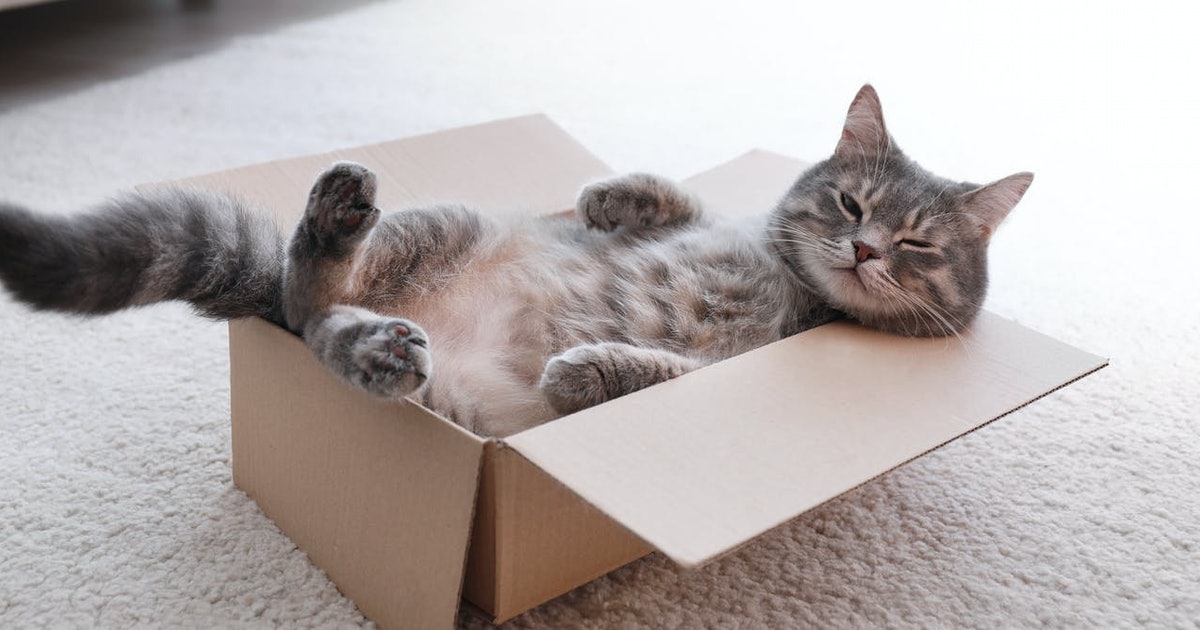
What’s The Real Reason Cats Love Boxes?

It’s about more than just having a cozy place to sit.

Buddy is not overly obsessed with boxes.

I think that’s because he feels safe here, he’s got plenty of places to hide if he wants, and he’s got a big cat tunnel with four ways in or out. He doesn’t need another little space to crawl into.

Still, like any cat, the little dude likes a good box. When he gets to play with a new box he likes to sniff it, rub against it once or twice, then jump inside and determine if it’s comfortable. Then he gets serious, looks around, and slowly sinks down below the top of the box…

…and remains there for a few seconds before cautiously raising his head and looking around. Usually this is accompanied by a delighted trill, and I get the strong sense that he thinks he’s invisible to anyone outside the box while he has the advantage of seeing them.

“You cannot see Buddy, but Buddy sees you!”

Does he ambush me from the box? Does a bear crap in the woods?

There isn’t an abundance of research into why cats love boxes so much, but the existing data combined with what we know about the feline mind strongly suggests that, first and foremost, boxes have a strong psychological effect. They make cats feel secure and well-protected.

Anyone familiar with cats knows the little furballs like to wedge themselves into hideaways, scurry under tables and hide in laundry baskets. The behavior starts in kittenhood when they’re tiny enough to crawl into shoes and sneakers.

In 2021, animal cognition grad student Gabriella Smith conducted a study in which she found cats will happily sit in Kanizsa contours with the same enthusiasm they have for boxes.

Kanizsa contours are two-dimensional. The participants created them by using tape and paper to make the shapes on the floor. They’re not even proper boxes, just the illusory suggestion of boxes or general square shapes. That doesn’t seem to matter to cats:

Of course pieces of tape or paper on the floor do not afford any real protection, so the feline affinity for boxes seems to be more about feeling protected.

Since cats are territorial, it could be that they also like clear boundaries around their personal space.

The key here seems to be having the boundary without blocking access, as cats are notoriously not cool with closed doors or being confined. If they want to spend an hour in a tiny space and it’s their idea, they’re fine with it, but they don’t like to be restricted by when they can come and go.

Notably, this isn’t behavior limited to felis catus. So far there doesn’t seem to be any exception to the box-loving rule among felines and felids of any species. Tigers, lions, jaguars, leopards, snow leopards and pumas seem just as fond of them as their smaller cousins, as you can see in this video from Big Cat Rescue:

Boxes are comforting, cozy, fun to explore and make the perfect hiding spots for ambushes. If you’re a cat big or small, what’s not to like?

Sunday Cats: FitBit For Felines, Plus CFA’s Top Breeds For 2021

Now you can track how much time your cat spends exercising, grooming herself and sleeping.

A Japanese company that sells FitBit-like devices for cats released its first data-driven report this week and promises new revelations to come as more people buy the devices for their cats, leading to more data.

The company and its device are both called Catlog. To mark “Cat Day” in Japan, which falls on Feb. 22, researchers at the Shibuya, Tokyo-based firm issued a report saying data shows cats sleep progressively longer as they age, and cats in general sleep longer in winter.

Yeah. Not exactly a whopper.

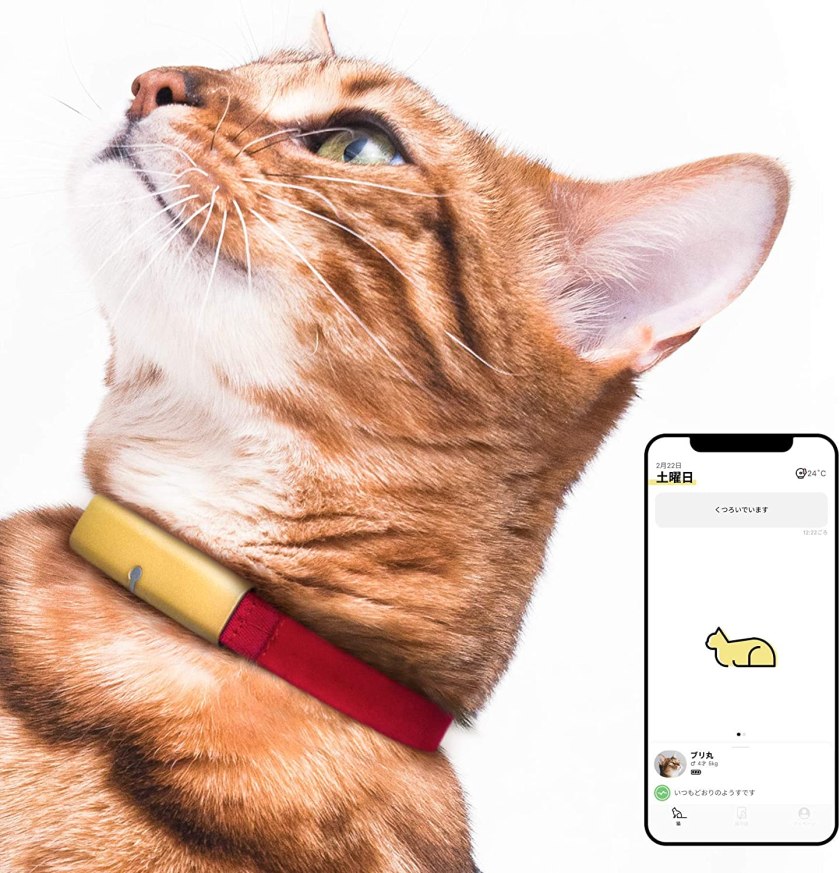
Still, it’s one thing to know something anecdotally and another to prove it, and there are tantalizing possibilities as more kitties are equipped with Catlog. The collar-like device uses “biologging” technology to record and sort data on things like eating, drinking, sleeping, grooming and exercise. The data is relayed to caretakers via a mobile app and added to the information coming from every other Catlog, giving the research team behind the app hard data for cats across all ages and breeds.

The Catlog has received Japan’s Good Design Award, a sought-after mark of excellence among Japanese products.

Catlog
Catlog looks like a regular collar with an unobtrusive device attached.

Unfortunately Buddy won’t be contributing to that data even if Catlog pushes into the US market. Little dude won’t tolerate a collar at all and is not shy about loudly, repeatedly, incessantly communicating when he doesn’t like something. 🙁

Most Popular Cat Breeds of 2021, According to CFA

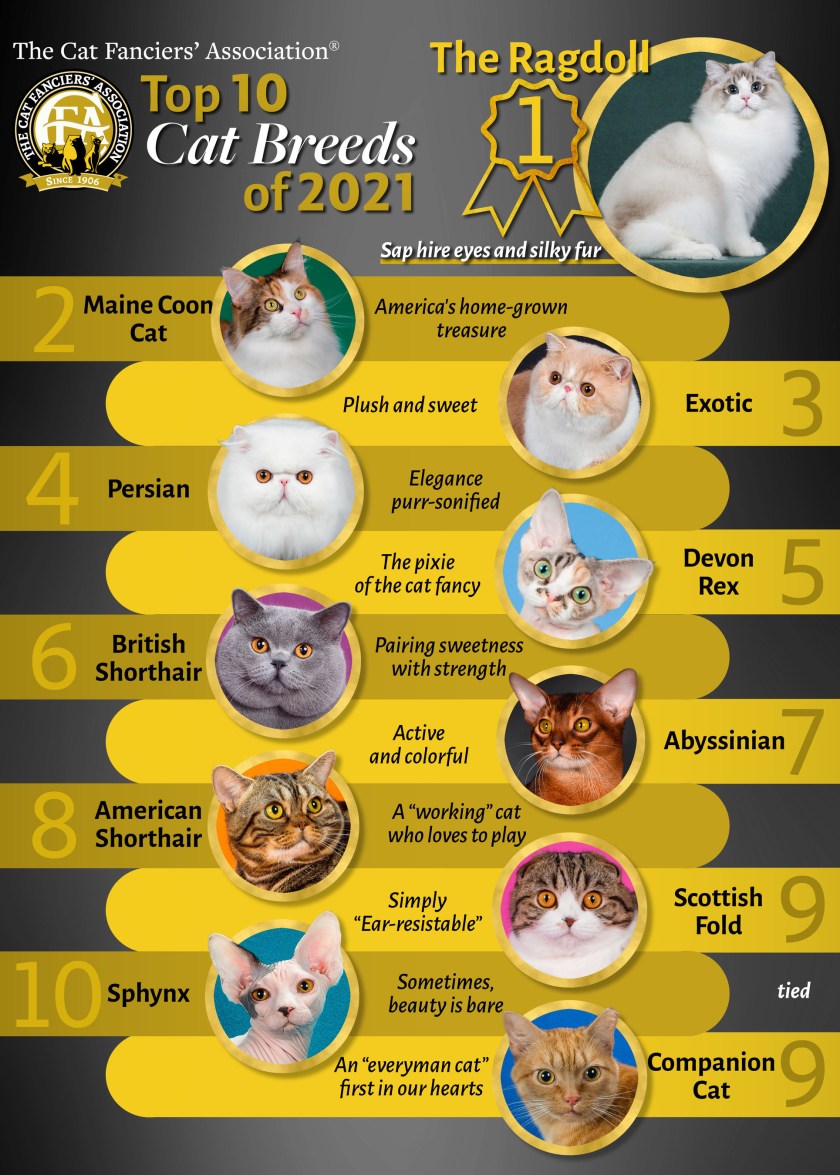
The Cat Fanciers’ Association has released its annual list of the most popular cat breeds. While the CFA recognizes 45 breeds and registers “non-pedigreed” cats as well, the list is based only on CFA registered cats. That means it provides a good snapshot of which breeds are trendy, but it’s not a definitive most popular breeds list.

Cats without a particular breed still account for the vast majority of all pet felines, but among people who registered their cats with CFA, Ragdolls were the most popular in 2021, followed by gentle giant Maine Coones and exotic shorthairs. (Note that this list does not include the fearsome and elusive Buddinese Tiger.)

2021-breeds-with-CC
The world’s largest registry of pedigreed cats has again determined the world’s most popular cat breeds, based on registrations. This year’s Top 10 list reflects the increasing popularity of certain breeds. However, registrations of ALL cats have increased substantially, reflecting the growing popularity of pet cats since the beginning of the pandemic.

Can Cats Feel Jealousy?

While the answer is obvious to cat servants, proving feline jealousy in a study is a different ballgame entirely.

Bud isn’t fond of my smartphone.

Like many other humans I spend too much time looking at the damn thing, and that’s not good even though I have the excuse that I use my phone as a reader and my presence on social media ranges from extremely limited to nonexistent.

When His Grace has decided I’ve looked at the screen long enough and it’s Buddy Time, he’ll pad up and slap the phone out of my hands, or if I’m laying down he’ll climb on top of me, nudge the phone out of the way and sit on my chest so he has my full attention.

“No glowing rectangle!” he’s saying. “It’s Buddy Time! Now scratch my chin and rub the top of my head as I purr!”

Naturally I comply, and before long Buddy is leaning in, pressing the top of his head against my forehead, which is his way of saying: “I love you, slow dumb human! You have many flaws and you don’t give me enough snacks, but you’re my Big Buddy!”

Of course, intuitively knowing Buddy is jealous of — or annoyed by — my phone is different than proving it in a well-designed, repeatable experiment.

Psychology Today’s Jessica Wu writes about just such an effort by a team of researchers out of Japan.

Before I offer my criticism of the study, let me first say I have respect for the team at Kyoto University. They’re one of a handful of research teams around the world that routinely produce studies into cat behavior and cognition, and it’s clear that they view it as an important and crucial area of research. That’s significant, because even though we’ve seen something of a renaissance in cat-related studies over the past half-decade or so, many scientists still think cats are nearly impossible to work with.

The team at Kyoto also understands the territorial nature of cats makes it difficult to study them in a lab environment, so they go the extra mile and enlist people who are willing to let them into their homes to study their little tigers.

That’s what the Kyoto team did for their 2020 study on jealousy, splitting their research between typical homes and cat cafes. (Fifty two cats in total participated.) All the cats observed in the study had been living in their homes or cafes for at least six months.

Researchers took a method that’s been used to study human babies and dogs, and adapted it for felines. They brought in a plush cat and a pillow with a corresponding color and texture.

https://youtu.be/VSSt-YtZo58

Then they asked the participants to spend time petting the plush cat and the pillow in front of their furry overlords while team members carefully watched the kitties for their reaction. Each experiment was then repeated with a stranger petting the plush and the pillow to gauge whether cats behaved differently when observing someone they aren’t emotionally attached to.

The team found the cats “reacted more intensely” to the plush cats than the pillows, but there wasn’t any marked difference in how they reacted when they watched their humans versus strangers.

Crucially, the cats didn’t show signs that they were upset, like human babies have in such experiments, and they didn’t try to physically separate their humans from the plushies, as many dogs did in their version of the experiment.

jealous-cat
“How dare you hand out yums and not include me!” Credit: icanhazcheezburger

The results indicate cats didn’t express jealousy in the experiment, but the Kyoto team are pros, noting that it’s just one study with one approach.

“We consider the existence of some cognitive bases for jealousy to emerge in cats, and the potential effect of cats’ living environment on the nature of their attachment to their owner,” they wrote. “More ecologically valid procedures are required for further study of these issues.”

It’s my non-expert, non-scientific opinion that researchers would get better results using actual cats instead of proxies. That introduces a new set of problems and an experiment involving rival cats won’t be easy, but science isn’t supposed to be easy, and if we really want to understand how cats think, we have to get as close as possible to mimicking real circumstances.

Plush Cat in Kyoto study
The plush cat used in the Kyoto study. Perhaps the cats involved in the research felt the humans were insulting their intelligence. Credit: Kyoto University

It would also help to expand the scope of the experiment. How much can researchers really glean from a fleeting interaction? Jealousy isn’t something that just bubbles up and disappears. It happens within an emotional context. It’s a secondary emotion that sprouts from elements of primary emotions like fear, anger and confusion.

Scientists are very careful about anthropomorphizing animals, for obvious reasons, but sometimes they’re guilty of over-correcting as well and denying the obvious, which is why the prevailing scientific opinion for almost half a century, until 1959, was that animals don’t have emotions or cognition.

In the meantime, Buddy will continue to make sure Buddy Time is equal to, or greater than, glowing rectangle time.

Study: Cat Brains Have Gotten Smaller

Thankfully for our furry friends, smaller brains don’t necessarily correlate to lower intelligence. It’s more about the complexity of neural connections.

Cats have gotten a good deal out of domestication: They’re safer, warmer and protected from almost all threats. They know where their next meal is coming from, and won’t hesitate to meow our ears off if dinner is late.

But one tradeoff doesn’t immediately appear beneficial: Domestic cats have smaller brains than the species they’ve evolved from, African and Eurasian wildcats.

“[D]omestic cats indeed, have smaller cranial volumes (implying smaller brains) relative to both European wildcats (Felis silvestris) and the wild ancestors of domestic cats, the African wildcats (Felis lybica),” the research team wrote.

Wild cats have the largest brains on average, followed by wild-domestic hybrids and domestic cats with the smallest brains of the three.

That’s another strong indicator that domestication is the determining factor in feline brain size, although the researchers point out that they are comparing domestic cats to current wildcats, and not the ancient population of wildcats from which domestic cats evolved beginning some 10,000 years ago with the dawn of agriculture and permanent human settlements.

Wildcats with friendlier and bolder dispositions were the first to approach human settlements, drawn by the rodents who were themselves feasting on human grain supplies. Humans realized that the cats were taking care of their rodent problems but weren’t interested in eating the grain, and a beautiful partnership was born.

superhandsomebuddy1
“I have a yuge, yuge brain, the best brain. It’s tremendous.”

Smaller brains do not necessarily correlate to lower intelligence, however, and cats aren’t the only species whose brains became smaller after they were domesticated. Dog brains are about 30 percent smaller than the brains of gray wolves, but dogs have adapted spectacularly to living with humans and reading human behavioral cues.

“The dog is successful not because of the size of its whole brain per se, but because domestication has led to subtle brain changes with a stunning result: the ability to live in the world of people,” a Smithsonian Magazine article points out, noting dogs are also adept at getting people to do all sorts of things for them.

If brain size alone resulted in higher levels of intelligence, whales and elephants would rule the Earth.

Instead “the complexity of cellular and molecular organization of neural connections, or synapses, is what truly determines a brain’s computational capacity,” neuroscientist Kendra Lechtenberg wrote.

The researchers weren’t interested in drawing any major conclusions about feline cognition with the study. They’re more interested in the phenomena of “domestication syndrome,” which causes changes both physical (floppy ears, coat color variation, shorter muzzles) and behavioral. (Less aggression, playfulness.)

The jury’s still out on why exactly those traits emerge, but some studies have attributed it to differences in embryonic development. Unlike many other domestic animals, cats don’t look much different than their wild felis lybica and felis sylvestris counterparts.

The cat study was published on Jan. 26 to Royal Science Open Science, a peer-reviewed open-access journal. The research team was comprised of biologists from the University of Vienna and data curators from the National Museum of Scotland.