Can Cats Feel Jealousy?

While the answer is obvious to cat servants, proving feline jealousy in a study is a different ballgame entirely.

Bud isn’t fond of my smartphone.

Like many other humans I spend too much time looking at the damn thing, and that’s not good even though I have the excuse that I use my phone as a reader and my presence on social media ranges from extremely limited to nonexistent.

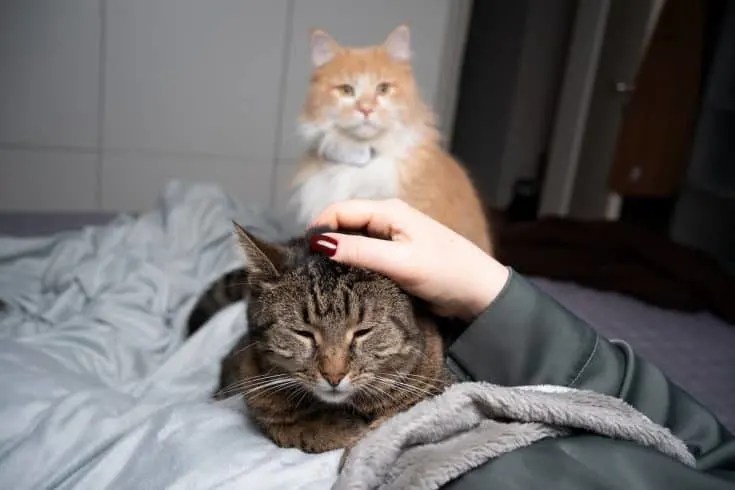
When His Grace has decided I’ve looked at the screen long enough and it’s Buddy Time, he’ll pad up and slap the phone out of my hands, or if I’m laying down he’ll climb on top of me, nudge the phone out of the way and sit on my chest so he has my full attention.

“No glowing rectangle!” he’s saying. “It’s Buddy Time! Now scratch my chin and rub the top of my head as I purr!”

Naturally I comply, and before long Buddy is leaning in, pressing the top of his head against my forehead, which is his way of saying: “I love you, slow dumb human! You have many flaws and you don’t give me enough snacks, but you’re my Big Buddy!”

Of course, intuitively knowing Buddy is jealous of — or annoyed by — my phone is different than proving it in a well-designed, repeatable experiment.

Psychology Today’s Jessica Wu writes about just such an effort by a team of researchers out of Japan.

Before I offer my criticism of the study, let me first say I have respect for the team at Kyoto University. They’re one of a handful of research teams around the world that routinely produce studies into cat behavior and cognition, and it’s clear that they view it as an important and crucial area of research. That’s significant, because even though we’ve seen something of a renaissance in cat-related studies over the past half-decade or so, many scientists still think cats are nearly impossible to work with.

The team at Kyoto also understands the territorial nature of cats makes it difficult to study them in a lab environment, so they go the extra mile and enlist people who are willing to let them into their homes to study their little tigers.

That’s what the Kyoto team did for their 2020 study on jealousy, splitting their research between typical homes and cat cafes. (Fifty two cats in total participated.) All the cats observed in the study had been living in their homes or cafes for at least six months.

Researchers took a method that’s been used to study human babies and dogs, and adapted it for felines. They brought in a plush cat and a pillow with a corresponding color and texture.

Then they asked the participants to spend time petting the plush cat and the pillow in front of their furry overlords while team members carefully watched the kitties for their reaction. Each experiment was then repeated with a stranger petting the plush and the pillow to gauge whether cats behaved differently when observing someone they aren’t emotionally attached to.

The team found the cats “reacted more intensely” to the plush cats than the pillows, but there wasn’t any marked difference in how they reacted when they watched their humans versus strangers.

Crucially, the cats didn’t show signs that they were upset, like human babies have in such experiments, and they didn’t try to physically separate their humans from the plushies, as many dogs did in their version of the experiment.

jealous-cat
“How dare you hand out yums and not include me!” Credit: icanhazcheezburger

The results indicate cats didn’t express jealousy in the experiment, but the Kyoto team are pros, noting that it’s just one study with one approach.

“We consider the existence of some cognitive bases for jealousy to emerge in cats, and the potential effect of cats’ living environment on the nature of their attachment to their owner,” they wrote. “More ecologically valid procedures are required for further study of these issues.”

It’s my non-expert, non-scientific opinion that researchers would get better results using actual cats instead of proxies. That introduces a new set of problems and an experiment involving rival cats won’t be easy, but science isn’t supposed to be easy, and if we really want to understand how cats think, we have to get as close as possible to mimicking real circumstances.

Plush Cat in Kyoto study
The plush cat used in the Kyoto study. Perhaps the cats involved in the research felt the humans were insulting their intelligence. Credit: Kyoto University

It would also help to expand the scope of the experiment. How much can researchers really glean from a fleeting interaction? Jealousy isn’t something that just bubbles up and disappears. It happens within an emotional context. It’s a secondary emotion that sprouts from elements of primary emotions like fear, anger and confusion.

Scientists are very careful about anthropomorphizing animals, for obvious reasons, but sometimes they’re guilty of over-correcting as well and denying the obvious, which is why the prevailing scientific opinion for almost half a century, until 1959, was that animals don’t have emotions or cognition.

In the meantime, Buddy will continue to make sure Buddy Time is equal to, or greater than, glowing rectangle time.

Study: Cat Brains Have Gotten Smaller

Thankfully for our furry friends, smaller brains don’t necessarily correlate to lower intelligence. It’s more about the complexity of neural connections.

Cats have gotten a good deal out of domestication: They’re safer, warmer and protected from almost all threats. They know where their next meal is coming from, and won’t hesitate to meow our ears off if dinner is late.

But one tradeoff doesn’t immediately appear beneficial: Domestic cats have smaller brains than the species they’ve evolved from, African and Eurasian wildcats.

“[D]omestic cats indeed, have smaller cranial volumes (implying smaller brains) relative to both European wildcats (Felis silvestris) and the wild ancestors of domestic cats, the African wildcats (Felis lybica),” the research team wrote.

Wild cats have the largest brains on average, followed by wild-domestic hybrids and domestic cats with the smallest brains of the three.

That’s another strong indicator that domestication is the determining factor in feline brain size, although the researchers point out that they are comparing domestic cats to current wildcats, and not the ancient population of wildcats from which domestic cats evolved beginning some 10,000 years ago with the dawn of agriculture and permanent human settlements.

Wildcats with friendlier and bolder dispositions were the first to approach human settlements, drawn by the rodents who were themselves feasting on human grain supplies. Humans realized that the cats were taking care of their rodent problems but weren’t interested in eating the grain, and a beautiful partnership was born.

superhandsomebuddy1
“I have a yuge, yuge brain, the best brain. It’s tremendous.”

Smaller brains do not necessarily correlate to lower intelligence, however, and cats aren’t the only species whose brains became smaller after they were domesticated. Dog brains are about 30 percent smaller than the brains of gray wolves, but dogs have adapted spectacularly to living with humans and reading human behavioral cues.

“The dog is successful not because of the size of its whole brain per se, but because domestication has led to subtle brain changes with a stunning result: the ability to live in the world of people,” a Smithsonian Magazine article points out, noting dogs are also adept at getting people to do all sorts of things for them.

If brain size alone resulted in higher levels of intelligence, whales and elephants would rule the Earth.

Instead “the complexity of cellular and molecular organization of neural connections, or synapses, is what truly determines a brain’s computational capacity,” neuroscientist Kendra Lechtenberg wrote.

The researchers weren’t interested in drawing any major conclusions about feline cognition with the study. They’re more interested in the phenomena of “domestication syndrome,” which causes changes both physical (floppy ears, coat color variation, shorter muzzles) and behavioral. (Less aggression, playfulness.)

The jury’s still out on why exactly those traits emerge, but some studies have attributed it to differences in embryonic development. Unlike many other domestic animals, cats don’t look much different than their wild felis lybica and felis sylvestris counterparts.

The cat study was published on Jan. 26 to Royal Science Open Science, a peer-reviewed open-access journal. The research team was comprised of biologists from the University of Vienna and data curators from the National Museum of Scotland.

Reason #488 To Keep Your Cats Indoors: They Hunt Whether They’re Hungry Or Not

Cats who have regular outdoor access and hunt wildlife still get 96 percent of their nutrition from pet food, a new study found, suggesting their predatory behavior is driven by instinct, not hunger.

A new study from the UK debunks the claim that cats need access to the outdoors to supplement their diets with wild kills.

Cats who spend a significant amount of time outdoors and regularly kill local wildlife still get 96 percent of their nutrition from meals provided by their humans, according to research by a team at the University of Exeter.

The scientists connected with cat owners through ads on social media, TV and in print publications, specifically seeking out “cat owners living throughout southwest England whose cats regularly captured wild animals and brought them back to the house,” the study’s authors said.

They gave the owners a questionnaire to collect some basic information on the kitties — age, sex, breed, whether they had unrestricted access to the outdoors, and how much time they spend outside — then split the 90 participating cats into six groups.

Cat hunting
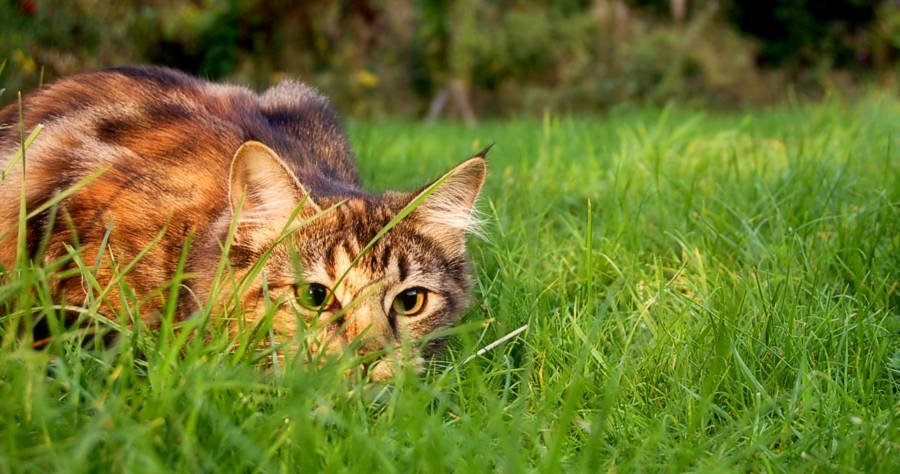
A domestic tabby cat stalking in the grass. Credit: Wikimedia Commons

To set a baseline, the scientists trimmed small sections of whisker from each of the cats, then trimmed a second sample at the end of the study.

By comparing stable isotope ratios in the whisker samples, they were able to determine what the cats were eating. Despite regular access to the outdoors and successful hunts, pet food accounted for the vast majority of their diets.

As a result, the researchers concluded, outdoor cats hunt because they’re driven by predatory instinct, not hunger.

“When food from owners is available, our study shows that cats rely almost entirely on this for nutrition,” said Martina Cecchetti, the study’s lead author.

“Some owners may worry about restricting hunting because cats need nutrition from wild prey, but in fact, it seems even prolific hunters don’t actually eat much of the prey they catch,” Cecchetti said. “As predators, some cats may hunt instinctively even if they are not hungry – so-called ‘surplus killing’ – to capture and store prey to eat later.”

A second component of the study was designed to find the best mitigation strategy to change the behavior of outdoor cats.

Each group was given a different strategy: In one group, cats were outfitted with bells on their collars, while another group wore reflective break-away collars and cats from a third group were fitted with BirdBeSafe collars. The other groups were told to make habit changes inside the home. For example, one set of cats was fed a higher-protein diet without grain filler, another group was fed with puzzle feeders, and the last group was given extra interactive play time.

While high-protein diets and play time helped cut down on hunting, the BirdBeSafe collars had the biggest impact on hunting success. The collars come in bright colors designed to stand out to avian eyes, taking away stealth and the element of surprise from cats.

The study was sponsored by Songbird Survival, a British non-profit that funds bird conservation research and looks for ways to mitigate the dwindling numbers of many avian species.

Susan Morgan, Songbird Survival’s executive director, said her group hopes cat owners will do their part to help: “Pet owners can help us reverse the shocking decline in songbirds via three simple, ‘win-win’ steps: fit collars with a Birdsbesafe cover; feed cats a premium meaty diet; play with cats for five to ten minutes a day to ‘scratch that itch’ to hunt.”

Of course there’s an obvious solution the study didn’t include: Keeping cats indoors. While keeping cats indoors is common in the US, cat ownership culture in the UK is different — another subject for another post.

Read the full text of the study here. Header image credit Pexels. Body images credit BeSafeCollar.

Previously:

1024px-Florida_panther_kittens
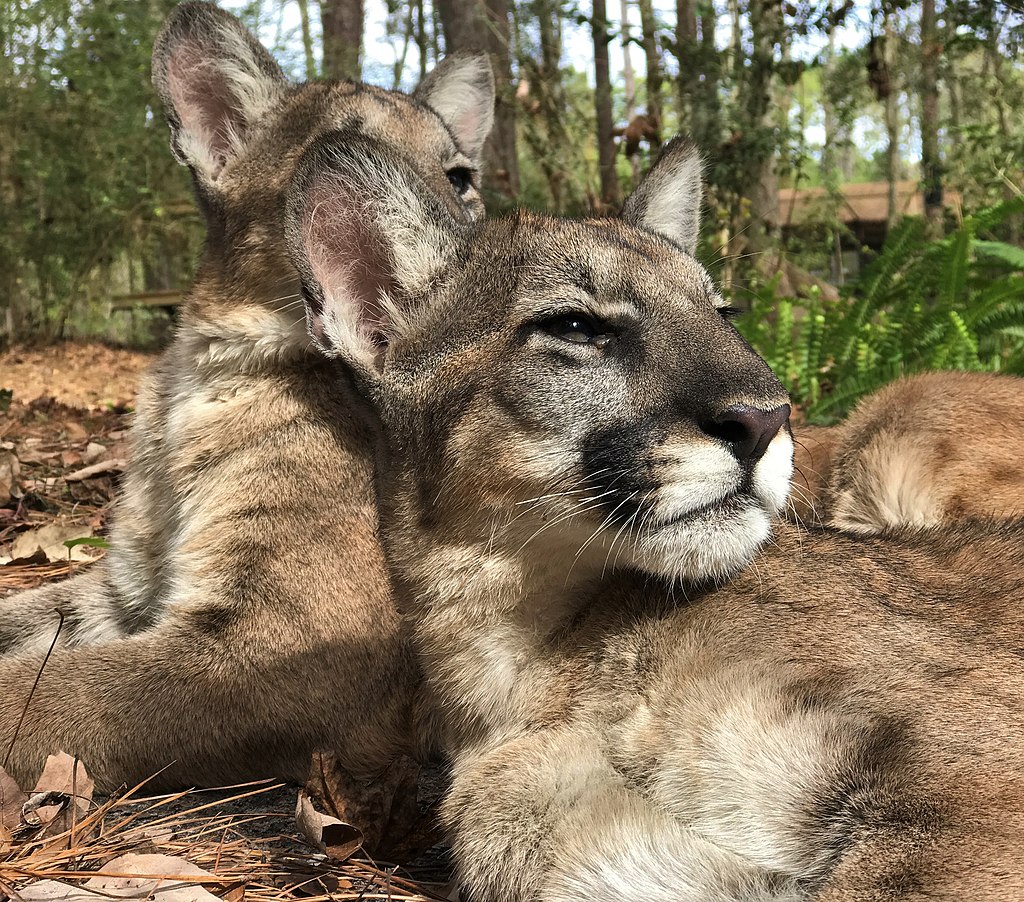
A pair of young mountain lions in Florida. Credit: Wikimedia Commons/WOConservation

The Most Important Cat Study Ever Has Been Completed, And The Results Are In

For the first time ever, a US city has conducted a true cat census using scientifically proven methods, including doing it the hard way — by counting. The project’s authors hope other cities follow their lead.

The last decade has seen something of a renaissance in cat-related research, with insightful studies about feline behavior coming from researchers in the US and Japan.

On the other hand there’s been a glut of research into feline predatory impact and public policy, and the majority of those studies have been deeply flawed. They’re based on suspect data and tainted by the interests of people who are more interested in blaming cats for killing birds than they are in learning about the real impact of domestic felines on local wildlife.

Those studies have all taken extreme shortcuts — using data that was collected for entirely different studies, for example, or handing out questionnaires that at best lead to highly subjective and speculative “data” on how cats affect the environment.

Several widely-cited studies that put the blame on cats for the extirpation of bird species have relied on wild guesses about the cat population in the US, estimating there are between 20 million and 120 million free-roaming domestic cats in the country. If you’re wondering how scientists can offer meaningful conclusions about the impact of cats when even they admit they could be off by 100 million, you’re not alone.

No one had ever actually counted the number of cats in a location, much less come close to a real figure — until now.

When leaders in Washington, D.C., set out to tackle the feral cat problem in their city, they knew they couldn’t effectively deal with the problem unless they knew its scope. They turned to the University of Maryland for help, which led to the D.C. Cat Count, a three-year undertaking to get an accurate census with the help of interested groups like the Humane Society and the Smithsonian.

DC Cat Count
An image from one of 1,530 motion-activated cameras deployed for the D.C. Cat Count. Credit: D.C. Cat Count

The researchers approached each of their local shelters and rescues for data, then assembled a meticulous household survey to get a handle on how many pet cats live in the city, and how many have access to the outdoors.

Finally — and most critically — they used 1,530 motion-activated cameras, which took a combined 6 million photos in parks, alleys, public spaces, streets and outdoor areas of private residences. They also developed methods for filtering out multiple images of individual cats, as well as other wildlife. And to supplement the data, team members patrolled 337 miles of paths and roads in a “transect count” to verify camera-derived data and collect additional information, like changes in the way local cats move through neighborhoods.

DC Cat Count
A cat who looks a lot like the Budster was captured in this 2019 photo from a motion-activated camera with night vision. Credit: DC Cat Count

Now that all the data’s been collected and analyzed, the D.C. Cat Count finally has a figure: There are about 200,000 cats in the city, according to the study.

Of those, 98.5 percent — or some 197,000 kitties — are either pets or are under some form of human care and protection, whether they’re just fed by people or they’re given food, outdoor shelter and TNR.

“Some people may look at our estimate and say, oh, well, you know, you’re not 100% certain that it’s exactly 200,000 cats,” Tyler Flockhart, a population ecologist who worked on the count, told DCist. “But what we can say is that we are very confident that the number of cats is about 200,000 in Washington, D.C.”

The study represents the most complete and accurate census of the local cat population in any US city to date, and the team behind it is sharing its methods so other cities can conduct their own accurate counts. (They’ll also need money: While the D.C. Cat Count relied on help from volunteers and local non-profits it was still a huge project involving a large team of pros, and it cost the city $1.5 million.)

By doing things the hard way — and the right way — D.C. is also the first American city to make truly informed choices on how to manage its feline population. No matter what happens from here, one thing’s certain — the city’s leaders will be guided by accurate data and not creating policy based on ignorance and hysteria painting cats as furry little boogeymen.

DC Cat Count
Not all the photos captured images of cats, and not all the felines were little: In this 2019 night image, a bobcat wanders in front of a trail camera. Credit: DC Cat Count

How Much Can AI Teach You About Your Cat?

A new AI algorithm promises to help you gauge your cat’s mood — and determine if she’s in pain — by analyzing facial expressions.

In the photograph, Buddy is sitting on the coffee table in the classic feline upright pose, tail resting to one side with a looping tip, looking directly at me.

The corners of his mouth curve up in what looks like a smile, his eyes are wide and attentive, and his whiskers are relaxed.

He looks to me like a happy cat.

Tably agrees: “Current mood of your cat: Happy. We’re 96% sure.”

Screenshot_20210730-092555

Tably is a new app, currently in beta. Like MeowTalk, Tably uses machine learning and an algorithmic AI to determine a cat’s mood.

Unlike MeowTalk, which deals exclusively with feline vocalizations, Tably relies on technology similar to facial recognition software to map your cat’s face. It doesn’t try to reinvent the wheel when it comes to interpreting what facial expressions mean — it compares the cats it analyzes to the Feline Grimace Scale, a veterinary tool developed following years of research and first published as part of a peer-reviewed paper in 2019.

The Feline Grimace Scale analyzes a cat’s eyes, ears, whiskers, muzzle and overall facial expression to determine if the cat is happy, neutral, bothered by something minor, or in genuine pain.

It’s designed as an objective tool to evaluate cats, who are notoriously adept at hiding pain for evolutionary reasons. (A sick or injured cat is a much easier target for predators.)

But the Feline Grimace Scale is for veterinarians, not caretakers. It’s difficult to make any sense of it without training and experience.

That’s where Tably comes in: It makes the Feline Grimace Scale accessible to caretakers, giving us another tool to gauge our cats’ happiness and physical condition. With Tably we don’t have to go through years of veterinary training to glean information from our cats’ expressions, because the software is doing it for us.

Meanwhile, I used MeowTalk early in the morning a few days ago when Buddy kept meowing insistently at me. When Bud wants something he tends to sound whiny, almost unhappy. Most of the time I can tell what he wants, but sometimes he seems frustrated that his slow human isn’t understanding him.

I had put down a fresh bowl of wet food and fresh water minutes earlier. His litter box was clean. He had time to relax on the balcony the previous night in addition to play time with his laser toy.

So what did Buddy want? Just some attention and affection, apparently:

Screenshot_20210801-181618

I’m still not sure why Buddy apparently speaks in dialogue lifted from a cheesy romance novel, but I suppose the important thing is getting an accurate sense of his mood. 🙂

So with these tools now at our disposal, how much can artificial intelligence really tell us about our cats?

As always, there should be a disclaimer here: AI is a misnomer when it comes to machine learning algorithms, which are not actually intelligent.

It’s more accurate to think of these tools as software that learns to analyze a very specific kind of data and output it in a way that’s useful and makes sense to the end users. (In this case the end users are us cat servants.)

Like all machine learning algorithms, they must be “trained.” If you want your algorithm to read feline faces, you’ve got to feed it images of cats by the tens of thousands, hundreds of thousands or even by the millions. The more cat faces the software sees, the better it gets at recognizing when something looks off.

At this point, it’s difficult to say how much insight these tools provide. Personally I feel they’ve helped me understand my cat better, but I also realize it’s early days and this kind of software improves when more people use it, providing data and feedback. (Think of it like Waze, which works well because 140 million drivers have it enabled when they’re behind the wheel and feeding real-time data to the server.)

I was surprised when, in response to my earlier posts about MeowTalk and similar efforts, most of PITB’s readers didn’t seem to share the same enthusiasm.

And that, I think, is the key here: Managing expectations. When I downloaded Waze for the first time it had just launched and was pretty much useless. Months later, with a healthy user base, it became the best thing to happen to vehicle navigation since the first GPS units replaced those bulky maps we all relied on. Waze doesn’t just give you information — it analyzes real-time traffic data and finds alternate routes, taking you around construction zones, car accident scenes, clogged highways and congested shopping districts. Waze will even route you around unplowed or poorly plowed streets in a snowstorm.

If Tably and MeowTalk seem underwhelming to you, give them time. If enough of us embrace the technology, it will mature and we’ll have powerful new tools that not only help us find problems before they become serious, but also help us better understand our feline overlords — and strengthen the bonds we share with them.

Buddy is bored
Buddy’s bored of all this AI talk and wants a snack.