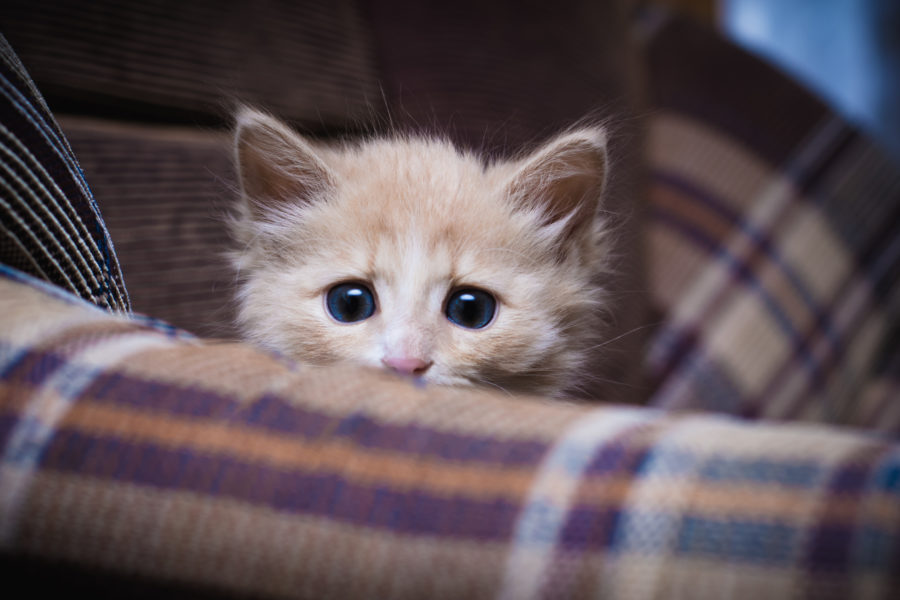
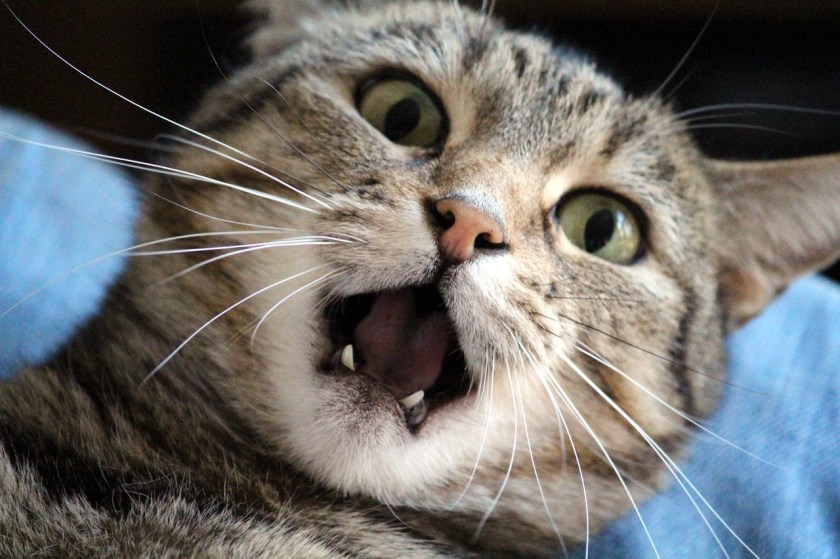
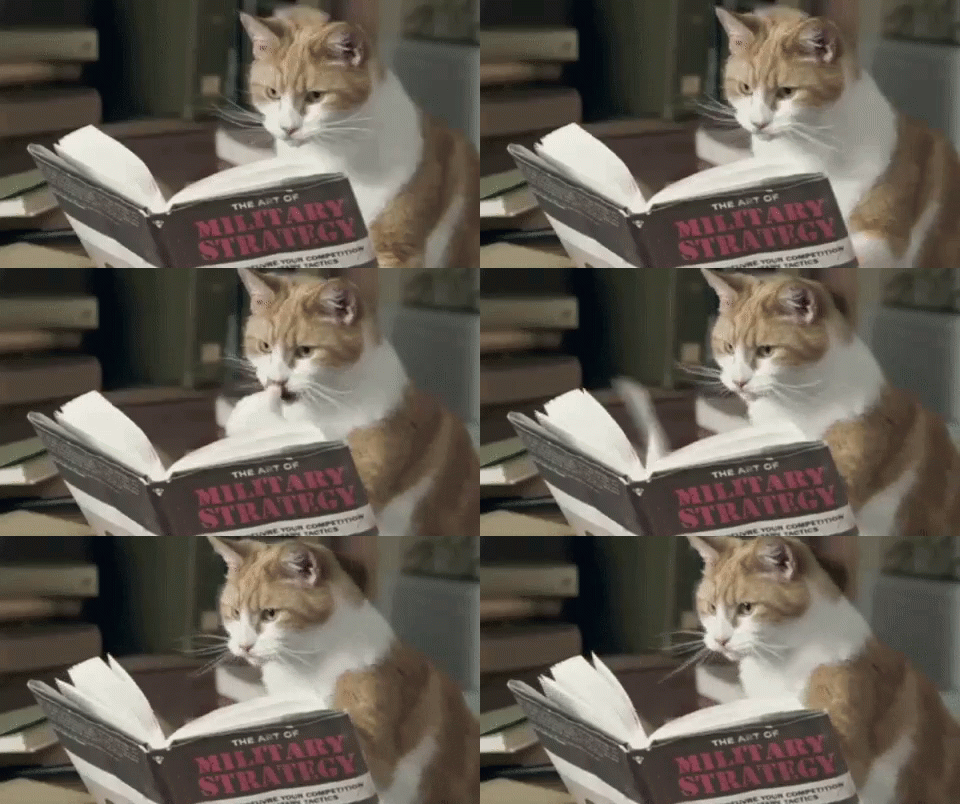
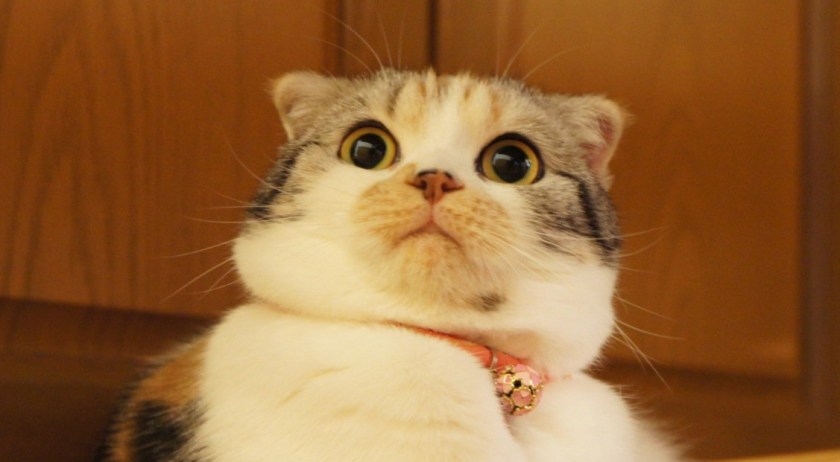
Our usually-brave (lol) hero didn’t take well to feline-centric tunes.
In case you didn’t know, music written specifically for cats is a thing.
I’d heard about it a while back, and the project seemed impressive: “Music for Cats” composer David Teie is a soloist with the National Symphony Orchestra, and he worked with animal behaviorists and veterinarians to come up with kitty-soothing sound textures and test the music’s efficacy on cats visiting the veterinarian.
A 2019 study in the Journal of Feline Medicine and Surgery concluded “Music for Cats” could help our furry friends relax and ease their stress. Keeping in mind an earlier study that suggested cats prefer “feline-centric sounds,” Teie incorporated audio of events cats associate with happy times, like kittens suckling milk from their mothers.
Using Buddy as my test subject, I went to Youtube, selected the track Cozmo’s Air from “Music for Cats” and sat back, expecting Bud to start nodding his furry head at any moment.
Instead his ears pricked up, did their radar-dish swivel toward the speakers, and his eyes went wide. As the song gained volume and intensity, Bud’s ears and whiskers snapped back and he let out a clearly anxious “yerrrrrrrrrrppp!” I tried to calm him down, to no avail, and a second track didn’t improve things.
He wasn’t having it.
This pretty much sums up Buddy’s reaction to cat music. Credit: Creative Commons
Teie’s cat music is back in the news with the release of the Kickstarter-backed Music for Cats 2, and there are quite a few imitators on Youtube hawking their own supposedly cat-soothing musical efforts. (Though your cat might think she’s in Guantanamo Bay if you subject her to six-hour videos of “cat lullabies.”)
Should I test some of the new music on Buddy to see if he responds more favorably? And for our fellow readers and cat servants, have you played any of this stuff for your cats? If you have, how’d it work out?
Common misconceptions can impact the way owners bond with their kitties.
We’ve all heart the familiar knocks on our feline friends: They’re aloof, selfish animals who are indifferent to their humans as long as their bowls are filled with food and they’ve got a warm place to sleep for 16 hours a day.
NPR hosts took a look at those stereotypes in their new segment, Animal Slander, in which they take “common phrases and stereotypes about animals — blind as a bat, memory of a goldfish — and figure out how much truth there is to them, or if they’re really just slanderous to these animals.”
Emily Kwong and Maddie Sofia of Shortwave — NPR’s daily science podcast — host the series, taking a look at a different animal in each segment.
“We can at least set the record straight on some potential slander that cats endure,” Sofia said, “such as cat are aloof, especially compared to dogs, that they love food more than they love us, and the idea that cats love people who don’t love cats.”
The feline mind has been a mystery to scientists for a long time. Credit: Shutterstock
Kwong and Sofia spoke to Kristyn Vitale, an animal behaviorist from Oregon State University. If Vitale’s name looks familiar to you it’s because we’ve talked about her work before on Pain In The Bud. Along with researchers at Sophia University in Tokyo, Vitale’s team at OSU has been putting out most of the headline-making cat research in recent years.
They were responsible for the much-talked-about study showing cats relate to their owners the same way human children relate to their parents in uncertain situations. They were also the authors of a study that found cats prefer affection from humans more than food.
The former validated the feelings of many cat servants by confirming the similarities between the parent-child and caretaker-animal dynamics. In other words, we’re surrogate parents to our cats.
“It was very interesting to find just how closely those numbers match what we’ve seen in dogs and humans,” Vitale said. “The majority of both dogs and human children are securely attached, and that’s anywhere from about 60 to 65 percent of the population, which is exactly what we found with cats.”
It wasn’t so long ago that scientists had apparently given up on cats, concluding they’re too uncooperative to serve as research subjects.
“I can assure you it’s easier to work with fish than cats,” comparative psychologist Christian Agrillo told Slate in 2014. “It’s incredible.”
Cats “freaked out” when taken from their homes to a lab for studies, Agrillo said, and most weren’t interested in the test.
“Very often, they didn’t participate in the experiment or they walked in the wrong direction,” Agrillo said at the time. “It was really difficult to have a good trial each day.”
“Be cooperative? What’s in it for me?” Credit: Shutterstock
The teams at Oregon State and Tokyo’s Sophia University have worked around those issues by designing studies that focus on feline reactions rather than scenarios that required them to take certain actions. That method may not yield results in the sort of comparative psychology studies scientists like Agrillo design, but it’s given researchers a window into the feline mind.
Stereotypes about cats can dissuade scientists from studying them, Vitale said, which is why it’s important to debunk them.
The stereotypes “do bother me because some of these ideas are why the field of cat cognition has been stagnant for a long time,” she said. “A lot of these expectations shape the work that people want to do, and if we say cats are aloof and untrainable, well, then they can’t learn to how engage in cognitive testing. But in our lab we’re showing cats can be trained just as readily as dogs.”
Likewise, stereotypes can negatively impact the way owners treat their feline friends. That’s something we’ve talked about before: While dogs warm quickly to people, earning the love and trust of a cat takes effort. The better you treat a cat, the tighter your bond becomes.
“If people don’t think they can bond with their cat, or engage in a lot of these interactions, why even try?” Vitale asked. “And if we don’t try with our cats, that’s going to produce a very different individual than we see with dogs.”
As for the NPR hosts, they concluded cats have indeed been unfairly maligned.
“The next time someone says ‘I love this cat so much because it acts like a dog,'” Kwong said, “lovingly tell them ‘No, this cat acts like a cat.'”
A handful of people on Twitter found the study “problematic” and called for its removal.
Last Monday, the academic journal Biological Conservation published a “controversial” study about cats.
It didn’t last a week.
The journal quietly took the paper offline after it was buried in a heap of scorn and hysteria from that fount of good vibes, Twitter.
People whose profiles are appended with tags like “she/her” and “he/him” outlined why the paper is “problematic,” providing an afternoon’s worth of fresh outrage for the grievance enthusiasts.
The study, by a research team from China’s Nanjing University, has two main conclusions: The more women living on a college campus, the more stray and feral cats live there too. Additionally, the team surveyed men and women about their interactions with strays — with responses indicating women are more likely to care for them — and followed a handful of men and women to watch their interactions with cats.
“Study? Yes, I like to study…how to bend humans to my will so they feed me more delicious yums!”
Is it ground-breaking science? No. Do the results prove women are better caretakers of cats than men? Nope. Did the authors perhaps overextend themselves by mixing up correlation and causation? Probably.
But it’s still research, and studies should not be buried or banished from peer-reviewed journals because a handful of malcontents on Twitter cry sexism. Some aspects of the paper, like the small sample of observed interactions, are thin. But the authors did look at 30 universities, a healthy sample size as far as institutions go.
If follow-up studies indicate that women are indeed more likely to care for cats, so what?
Is reality sexist? Do we need to protect people from even the most mildly controversial things?
As a man who loves cats, I don’t doubt that most caretakers are women. I see the anecdotal proof among the ranks of rescue volunteers. I see it in my readership here — aside from the Extraordinary League of Cat Dads, some 85 percent of this blog’s readers are female.
And that’s perfectly fine!
I would like to see more men warm to the idea of adopting and caring for cats, but the fact that women in general seem to have more empathy for them isn’t sexist. It doesn’t mean every woman loves cats any more than it means all men don’t.
Pain In The Bud’s readership is overwhelmingly female, but most of our traffic isn’t from women — it’s from female cats who find Buddy devilishly handsome!
Some readers know I have a background in journalism and spent almost 15 years of my career as a reporter and editor. One thing that appalls me as a journalist is the routine practice of quoting tweets in lieu of speaking to people face to face or picking up the phone and asking questions.
Platforms like Twitter thrive on negativity. Whether 140 or 280 characters, Twitter’s bite-size messages may be good for people who have the attention span of gnats, but they don’t exactly foster productive or nuanced discussion. Perhaps most important of all, people are more likely to say negative things online than they are in a human-to-human conversation, and too often handfuls of loudly-complaining people are mistaken for a majority.
Studies show negative tweets are far more likely to spread than positive or neutral messages, which skews public perception. They also show Twitter opinions are not representative of the general public, in part because most of Twitter’s power users come from similar backgrounds and share world views.
To put it bluntly, Twitter is full of roving bands of grievance artists constantly on the lookout for new things to shit on, and we should stop assigning so much importance to what we think are the prevailing sentiments on social media platforms.
Academic journals are peer-reviewed. Taking the vetting responsibility away from experts and giving it to a few unhappy people on social media is not a smart way to present research.
The study authors’ peers will poke holes in their work if the holes indeed exist, and that’s part of what peer review is for. Not to bury research, but to encourage scientists to rethink it, refine it and try again.
A new video purports to show a cat speaking fully formed sentence in English. People are buying it.
A new, internet-breaking viral video appears to capture a cat speaking English, prompting a wave of speculation about whether cats are basically furry parrots when it comes to talent for mimicry.
The TikTok clip features a voice saying “Hello” and “Are you coming?” followed by an amused narrator turning the camera on his cat and incredulously asking “What did you just say?”
The video’s viral success has led to a net-wide conversation about animal cognition, and whether cats in particular understand far more than they let on.
“And this is a proof that animals can talk,” one TikTok user commented, summing up much of the online reaction to the clip.
It should be noted the handful of times cats have been recorded producing vaguely human-sounding speech, the sounds were stress vocalizations from terrified or anxious cats.
That’s what’s happening in the famous “Oh long Johnson, oh don piano!” video, in which a stressed out tuxedo vocalizes a few phrases before proceeding with more gibberish. To people who aren’t familiar with cats the video may seem funny, but those of us who care for the little tigers can recognize the signs of extreme agitation.
Here’s the “Oh long Johnson” video:
And here’s the new “Hello!”/“Are you coming?” video:
The viral TikTok video is a whole different ballgame: The words are well-formed, the sound is clear, and the phrase makes sense.
Unfortunately, it’s not real.
First I’ll point out the obvious: The cat is off-camera when it “speaks” because painstakingly editing video to make its mouth move in sync is a much more difficult task than dubbing in a vocal file.
Secondly, a careful listening with headphones makes it clear the “Hello” and “Are you coming?” are not from the same source as the meow, and the directional mix isn’t right. The sound should be distorted and should be directional if it’s coming from a cat in the next room, to the right of the person recording the scene on a smartphone.
This was an audio cut and paste job without much attention paid to detail. The video’s creator didn’t bother panning the clip.
But perhaps most damning of all, the sound looks wrong. I isolated clips of the cat “speaking” in a wave editor — an old copy of the ultra-reliable Cool Edit Pro — and compared them to various samples of cat meows pulled from the Internet and sampled from Buddy himself.
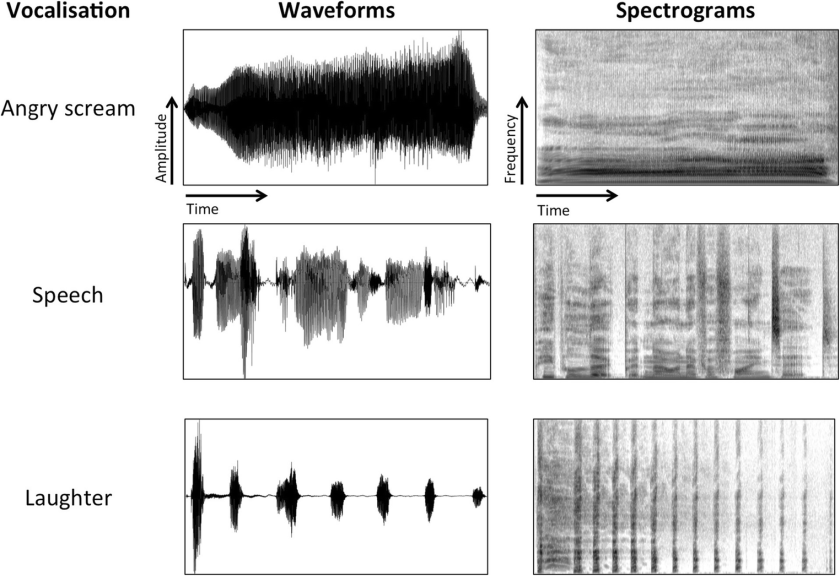
When visualized in an audio editor, “the waveform of speech is complex and variable, reflecting the variety of vowels and consonants that are used and the dynamic nature of speech articulation.”
In other words, you can see the stops and starts of human speech and the articulations of different sounds reflected in how the audio appears visually. This is because we have fine motor control over our vocal apparatus, something animals lack. (A 2016 Princeton study determined macaques, for example, have the necessary vocal anatomy to mimic human speech, but they don’t have the “brain circuitry” to form the precise articulations.)
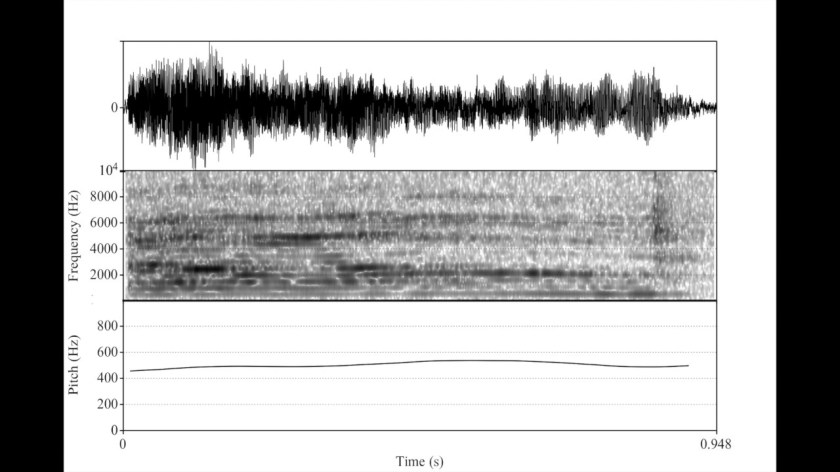
Cat vocalizations, on the other hand, lack those markers. Additionally, at higher resolutions you can see patterns indicative of rhythmic sounds in samples of cat vocalizations, not unlike isolated drum tracks in a studio recording.
This is because feline meows often have embedded purrs, and trills are naturally quantized. They’re rhythmic sounds. If you’ve ever had a purring cat laying on your chest, this will be familiar to you: You can hear the percussive sound, which persists while the cat is exhaling and inhaling.
A domestic cat’s meow in waveform. Notice the lack of transients, pauses and variation, which would be indicative of human speech patterns.
Solicitation purrs and even basic meows have similar qualities. It’s a well-known fact that cats communicate with each other via body language — tail, eyes, ears, posture — and scent. Adult cats rarely vocalize to each other, so when they meow to us it’s because they recognize that we don’t “speak” tail or whisker, and they’re trying to communicate with us in a form we understand.
But cats are like macaques — they do not possess the brain circuitry to form the precise articulations necessary for human speech.
As primates, macaques have similarly-formed mouths, tongues, teeth and lips. Cats do not, which presents another set of problems when imagining them mimicking human speech. Think of “t” sounds, both the hard t and the soft “th” — they require us to rest our tongues against our upper front teeth or the roof of our mouths.
Cats don’t have substantial front teeth. They’re more like little shredders.
Likewise, to speak the phrase “Are you coming?” requires fine motor control to form the hard “c” sound. It involves precise control of air flow from the throat to the mouth and subtle placement of the tongue
Although the idea of talking pets may be appealing to generations that grew up on Disney movies and other media featuring anthropomorphized animals, the truth is they do talk to us in their own ways. The least we can do, as the supposedly more intelligent species, is to meet them halfway.
It turns out cat owners are no better than random people when it comes to this task.
Most of us completely suck at deciphering our cats’ facial expressions, according to a new study.
That might come as a surprise to some because it’s often claimed cats don’t have facial expressions, or they can’t be read. They do, and they can.
The researchers from Ontario’s University of Guelph used a series of short clips selected from YouTube cat videos. They stripped all the context and blacked out everything but each cat’s face so participants wouldn’t be able to read body language or identify what the cats were doing.
The people who participated in the study — more than 6,000 in all — had only the faces to go on, and they were asked to assess whether each cat’s facial expression was positive or negative.
It turns out reading feline facial expressions is especially difficult: On average, participants got only 11.85 out of 20 questions right. That’s less than 60 percent.
Here’s the crazy part: Researchers found cat owners were no better at interpreting cat expressions than random people. Veterinarians scored the highest, a result that makes perfect sense.
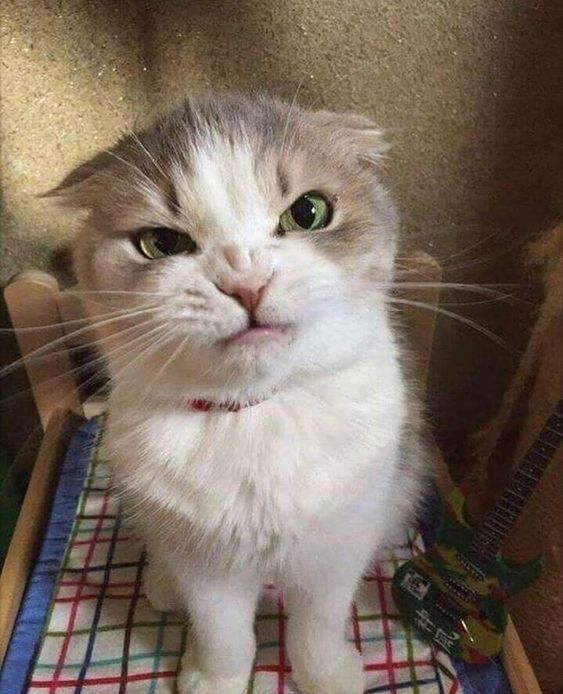
“No, I did NOT drink from the toilet! How dare you impugn my character with such vulgar accusations, good sir!”
Less than 15 percent of people are “cat whisperers,” study author Georgia Mason said, and can correctly interpret a cat’s mood based on the face alone.
“Anyone who writes cats off as sort of moody or distant is probably underestimating them,” Mason said. “The point is they are signaling, it’s just subtle and you need expertise and maybe intuition to see it.”
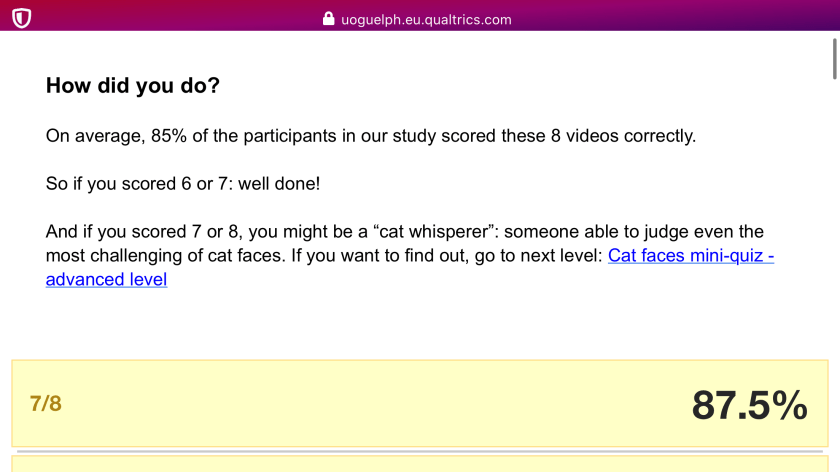
If you’re wondering what the test looks like, you can take an abbreviated version of it online. Here’s my score:
I’m a cat whisperer! Okay, not really. I scored a lousy four out of eight in the advanced version of the test.
I’m accustomed to reading feline body language — whiskers, ears, tails and fur provide a wealth of information about a cat’s mood — and absent most of that information, I found it difficult to gauge based on their faces alone.
On the positive side, scientists say the lessons from these studies can be applied to our companion cats eventually.
“We’re hoping [to conduct] more research to develop tools to help people read their cat better,” Mason said. “That would make living with a cat more rewarding.”